Nahum 3:15

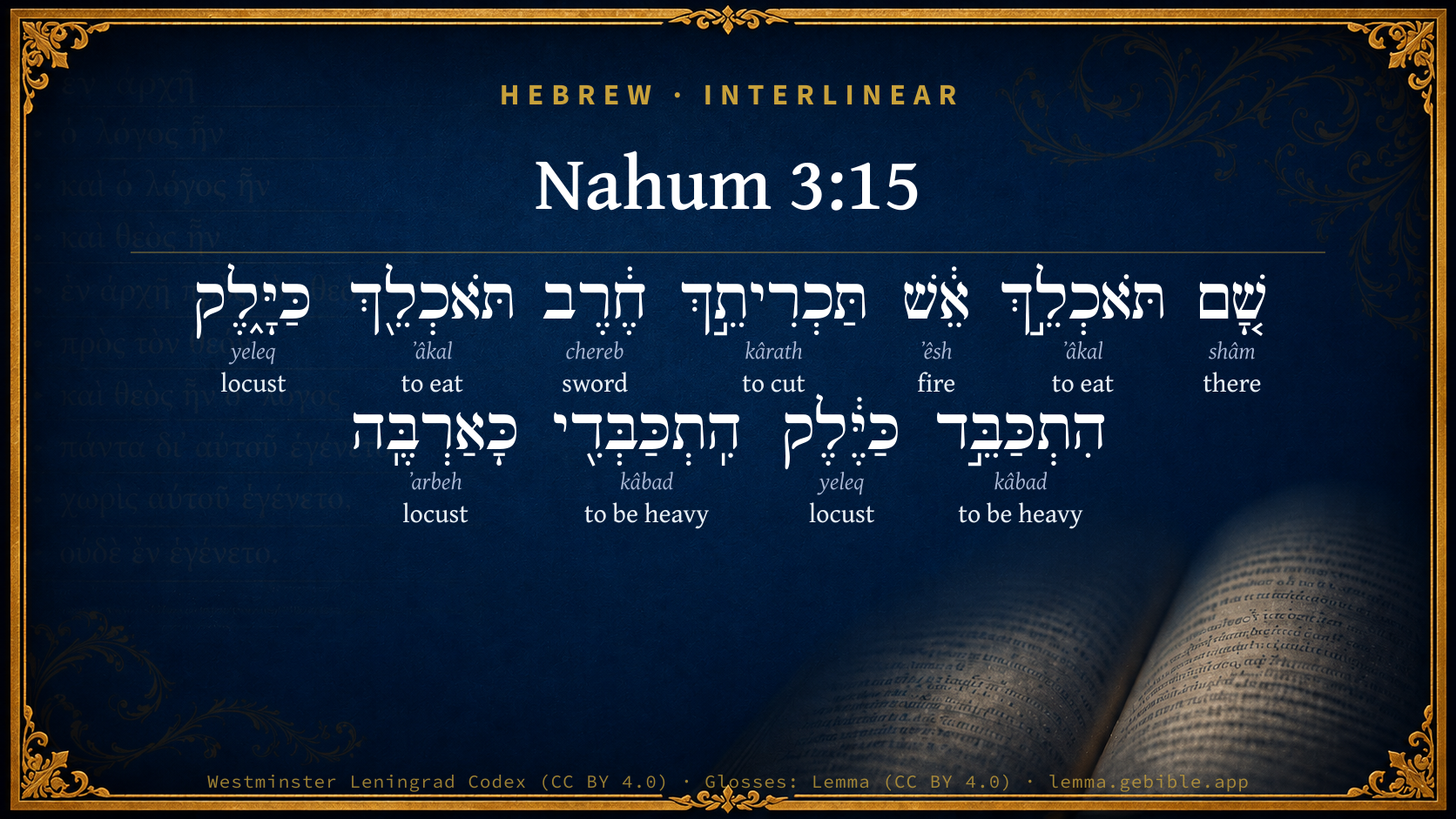
Hebrew (Westminster Leningrad Codex) Nahum 3:15 appears in the Hebrew Old Testament. The text above is from the Westminster Leningrad Codex. Each word links to its Strong’s number, a concise gloss, and parsing drawn from the Open Scriptures Hebrew Bible morphology. Click any word for its full Brown-Driver-Briggs (BDB) entry.
Download image
Cite this verse

Nahum 3:15 (World English Bible). Public Domain. Lemma interlinear Bible study tool, https://lemma.gebible.app/v/nahum/3/15.

Show BibTeX & RIS
BibTeX
RIS
English Translation
There the fire will devour you. The sword will cut you off. It will devour you like the grasshopper. Multiply like grasshoppers. Multiply like the locust.
World English Bible · Public Domain
Download a study sheet

One document with this verse’s original text, its word-by-word gloss line, the meaning frame, cross-references with their text, attributed commentary, and full source and license credits — printable, and it pastes into notes with its structure intact.

This verse Autodidact and up

Study sheet (.html) Plain text (.txt)

A passage Seminary Student

Up to 50 verses in one chapter. A passage sheet keeps up to 6 commentary sources and 12 cross-references per verse, in the order this page ranks them, and says so on the sheet whenever that leaves anything out. Ask for a single verse and you get the Autodidact verse sheet above.

Everything on this page stays free to read, with no account — the sheet is a download of what is already on screen, not access to it.

Want to remove ads? Support Godless Engineer
Compare translations 3

The same verse in 3 English versions, stacked beneath the original-language interlinear above. Click any original word for its lexicon entry.

Each is an independent rendering of the whole verse — the interlinear is not word-aligned to these translations.

Highlighted words mark where these versions differ — a whole-verse word diff, not a word-by-word alignment.

  • World English Bible Public Domain
    There the fire will devour you. The sword will cut you off. It will devour you like the grasshopper. Multiply like grasshoppers. Multiply like the locust.
  • King James Version Public Domain
    There shall the fire devour thee; the sword shall cut thee off, it shall eat thee up like the cankerworm: make thyself many as the cankerworm, make thyself many as the locusts.
  • unfoldingWord Literal Text CC BY-SA 4.0
    Fire will devour you there, and the sword will cut you off. It will devour you as the creeping locust. Multiply yourself as the creeping locust; multiply yourself as the swarming locust!

unfoldingWord Literal Text — © unfoldingWord, licensed CC BY-SA 4.0. Word-aligned USFM3 via Door43 (git.door43.org/unfoldingWord/en_ult).

Versions to compare (up to 4)

3 of 4 selected

Show all 18 translations

Every available English version of this verse, each an independent rendering of the whole verse.

  • World English Bible Public Domain
    There the fire will devour you. The sword will cut you off. It will devour you like the grasshopper. Multiply like grasshoppers. Multiply like the locust.
  • Berean Standard Bible Public Domain
    There the fire will devour you; the sword will cut you down and consume you like a young locust. Make yourself many like the young locust; make yourself many like the swarming locust!
  • Majority Standard Bible Public Domain
    There the fire will devour you; the sword will cut you down and consume you like a young locust. Make yourself many like the young locust; make yourself many like the swarming locust!
  • King James Version Public Domain
    There shall the fire devour thee; the sword shall cut thee off, it shall eat thee up like the cankerworm: make thyself many as the cankerworm, make thyself many as the locusts.
  • American Standard Version (1901) Public Domain
    There shall the fire devour thee; the sword shall cut thee off; it shall devour thee like the canker-worm: make thyself many as the canker-worm; make thyself many as the locust.
  • Revised Version (1885) Public Domain
    There shall the fire devour thee; the sword shall cut thee off, it shall devour thee like the cankerworm: make thyself many as the cankerworm, make thyself many as the locust.
  • Geneva Bible (1599) Public Domain
    There shall ye fire deuoure thee: the sword shall cut thee off: it shall eate thee vp like the locustes, though thou bee multiplied like the locustes, and multiplyed like the grashopper.
  • Douay-Rheims (1899) Public Domain
    There shall the fire devour thee: thou shalt perish by the sword, it shall devour thee like the bruchus: assemble together like the bruchus, make thyself many like the locust.
  • Young's Literal Translation Public Domain
    There consume thee doth a fire, Cut thee off doth a sword, It doth consume thee as a cankerworm! Make thyself heavy as the cankerworm, Make thyself heavy as the locust.
  • Literal Standard Version CC BY-SA 4.0
    There a fire consumes you, || A sword cuts you off, || It consumes you as a cankerworm! Make yourself heavy as the cankerworm, || Make yourself heavy as the locust.
  • Unlocked Literal Bible CC BY-SA 4.0
    Fire will devour you there, and the sword will destroy you. It will devour you as young locusts devour everything. Make yourselves as many as the young locusts, as many as the full-grown locusts.
  • unfoldingWord Literal Text CC BY-SA 4.0
    Fire will devour you there, and the sword will cut you off. It will devour you as the creeping locust. Multiply yourself as the creeping locust; multiply yourself as the swarming locust!
  • Darby Bible Public Domain
    There shall the fire devour thee; the sword shall cut thee off; it shall devour thee like the cankerworm. Make thyself many as the cankerworm, make thyself many as the locust.
  • World Messianic Bible Public Domain
    There the fire will devour you. The sword will cut you off. It will devour you like the grasshopper. Multiply like grasshoppers. Multiply like the locust.
  • Webster's Bible Public Domain
    There shall the fire devour thee; the sword shall cut thee off, it shall eat thee up like the canker-worm: make thyself many as the canker-worm, make thyself many as the locusts.
  • Free Bible Version CC BY-SA 4.0
    But even so, there the fire will consume you, you will be cut down by the sword. You will be destroyed as if you were devoured by a swarm of locusts. So multiply yourselves like locusts, like a swarm of locusts.
  • Bible in Basic English Public Domain
    There the fire will make you waste; you will be cut off by the sword: make yourself as great in number as the worms, as great in number as the locusts.
  • JPS Tanakh (1917) Public Domain
    There shall the fire devour thee; the sword shall cut thee off, it shall devour thee like the canker-worm; make thyself many as the canker-worm, make thyself many as the locusts.

Literal Standard Version (2020), Covenant Press — licensed CC BY-SA 4.0. Text via the HelloAO Bible API (eBible.org). Unlocked Literal Bible (unfoldingWord) — licensed CC BY-SA 4.0. Text via the HelloAO Bible API (eBible.org). unfoldingWord Literal Text — © unfoldingWord, licensed CC BY-SA 4.0. Word-aligned USFM3 via Door43 (git.door43.org/unfoldingWord/en_ult). Free Bible Version, Dr. Jonathan Gallagher — licensed CC BY-SA 4.0. Text via the HelloAO Bible API (eBible.org).

Word by word

More ways to search: Search by grammar → Find every occurrence → Compare this word →

Practice this passage: Drill this verse → Learn its vocabulary →

כַּיָּ֑לֶק
yeleq
H3218
“like/as the · locust”
Preposition, Determined + Noun, Common, Masculine, Singular, Absolute
Part of Speech
Preposition + Noun
Type
Common
Gender
Masculine
Number
Singular
State
Absolute
Full BDB Definition

Origin: from an unused root meaning to lick up

TWOT: 870a

young locust (early stage of development) - caterpillar (as devouring)
  1. שָׁ֚ם shâm H8033 “there” Adverb
  2. תֹּאכְלֵ֣ךְ ʼâkal H398 “to eat · you” Verb, Qal, Imperfect, 3rd Person, Feminine, Singular + Suffix, Personal, 2nd Person, Feminine, Singular
  3. אֵ֔שׁ ʼêsh H784 “fire” Noun, Common, Both, Singular, Absolute
  4. תַּכְרִיתֵ֣ךְ kârath H3772 “to cut · you” Verb, Hiphil, Imperfect, 3rd Person, Feminine, Singular + Suffix, Personal, 2nd Person, Feminine, Singular
  5. חֶ֔רֶב chereb H2719 “sword” Noun, Common, Feminine, Singular, Absolute
  6. תֹּאכְלֵ֖ךְ ʼâkal H398 “to eat · you” Verb, Qal, Imperfect, 3rd Person, Feminine, Singular + Suffix, Personal, 2nd Person, Feminine, Singular
  7. הִתְכַּבֵּ֣ד kâbad H3513 “be heavy” Verb, Hithpael, Imperative, 2nd Person, Masculine, Singular
  8. כַּיֶּ֔לֶק yeleq H3218 “like/as the · locust” Preposition, Determined + Noun, Common, Masculine, Singular, Absolute
  9. הִֽתְכַּבְּדִ֖י kâbad H3513 “be heavy” Verb, Hithpael, Imperative, 2nd Person, Feminine, Singular
  10. כָּאַרְבֶּֽה ʼarbeh H697 “like/as the · locust” Preposition, Determined + Noun, Common, Masculine, Singular, Absolute

About this verse

These counts appear in no published source. They are computed here, from the morphology-tagged text and Lemma’s own curated glosses. What Lemma adds →

11
words
8
distinct lemmas
Prophets
section

Notable vocabulary

The rarest word here is כַּיָּ֑לֶק locust H3218 — appearing just 9 times in the whole Hebrew Bible.

Shared distinctive vocabulary

כַּיָּ֑לֶק locust H3218 occurs in 7 verses of the Hebrew Bible. Also found in:

Grammatical profile

  • 5 verbs
  • 5 nouns
  • 1 adverb

Verb forms

  • תֹּאכְלֵ֣ךְ Qal · Imperfect
  • תַּכְרִיתֵ֣ךְ Hiphil · Imperfect
  • תֹּאכְלֵ֖ךְ Qal · Imperfect
  • הִתְכַּבֵּ֣ד Hithpael · Imperative
  • הִֽתְכַּבְּדִ֖י Hithpael · Imperative

Repetition

Words recur within this verse — often emphatic in Hebrew:

  • תֹּאכְלֵ֣ךְ to eat H398 ×2
  • כַּיָּ֑לֶק locust H3218 ×2
  • הִתְכַּבֵּ֣ד to be heavy H3513 ×2

Hebrew & Septuagint length

In English translation the verse runs 26 words from the Hebrew and 28 from the Septuagint (LXX English) — closely comparable.

A rough comparison of the two English renderings, which tokenize alike — not a word-level alignment.

Word counts can differ between the Hebrew and the Greek without any difference in meaning — e.g. the Hebrew direct-object marker אֵת has no separate Greek word, and Greek often adds the article ὁ.

In the original languages it is 11 Hebrew tokens and 15 Greek tokens — but the two are counted differently (Hebrew bundles its prefixes and suffixes into one token; the Greek is in lemma form), so that isn’t a like-for-like length.

Cross-references

6

Topical passages linked to Nahum 3:15 in the Treasury of Scripture Knowledge — connected by theme and wording, ordered by reader-vote popularity; previews shown in the World English Bible.

  • Joel 1:4 What the swarming locust has left, the great locust has eaten. What the great locust has left, the grasshopper has eaten. What the grasshopper has left, the caterpillar has eaten.
  • Nahum 2:13 "Behold, I am against you," says Yahweh of Hosts, "and I will burn her chariots in the smoke, and the sword will devour your young lions; and I will cut off your prey from the earth, and the voice of your messengers will no longer be heard."
  • Nahum 3:13 Behold, your troops in your midst are women. The gates of your land are set wide open to your enemies. The fire has devoured your bars.
  • Exodus 10:13–15 Moses stretched forth his rod over the land of Egypt, and Yahweh brought an east wind on the land all that day, and all the night; and when it was morning, the east wind brought the locusts.
  • Joel 2:25 I will restore to you the years that the swarming locust has eaten, The great locust, the grasshopper, and the caterpillar, My great army, which I sent among you.
  • Zephaniah 2:13 He will stretch out his hand against the north, destroy Assyria, and will make Nineveh a desolation, and dry like the wilderness.

Cross-references courtesy of OpenBible.info (CC BY 4.0).

Hebrew and Greek witnesses Masoretic Hebrew ↔ Greek Septuagint

The same verse in the two great witnesses to the Old Testament, shown verse-for-verse.

These are two independent witnesses, not word-aligned to each other, and the Septuagint is shown in lemma (dictionary) form.

Hebrew Nahum 3:15 Masoretic · Westminster Leningrad Codex

שָׁ֚ם תֹּאכְלֵ֣ךְ אֵ֔שׁ תַּכְרִיתֵ֣ךְ חֶ֔רֶב תֹּאכְלֵ֖ךְ כַּיָּ֑לֶק הִתְכַּבֵּ֣ד כַּיֶּ֔לֶק הִֽתְכַּבְּדִ֖י כָּאַרְבֶּֽה

There the fire will devour you. The sword will cut you off. It will devour you like the grasshopper. Multiply like grasshoppers. Multiply like the locust.

World English Bible · Public Domain

Greek LXX Nahum 3:15 Septuagint · lemma form

ἐκεῖ καταἐσθίω σύ πῦρ ἐκὀλεθρεύω σύ ῥομφαία καταἐσθίω σύ ὡς ἀκρίς καί βαρύνω ὡς βροῦχος

There the fire shall devour you; the sword shall utterly destroy you, it shall devour you as the locust, and you shall be pressed down as a palmerworm.

LXX2012 (modern English Septuagint) · Public Domain

On this verse, Whedon's Commentary on the Bible discusses the Septuagint’s reading. Read the note in Commentary ↓

Hebrew: Westminster Leningrad Codex (CC BY 4.0). Greek: Septuagint (public domain); English from LXX2012 (modern English Septuagint) (Public Domain). How the Septuagint differs from the Hebrew →

Targum (Aramaic paraphrase)

1

The Targum is the ancient Jewish Aramaic paraphrase of the Hebrew Scriptures — an interpretive translation, not the Hebrew text itself. Onkelos (literal) and Pseudo-Jonathan (expansive) render the Torah, and Jonathan the Prophets. Coverage is partial: where no permissively-licensed English translation exists for a verse, only the Aramaic is shown. This is verse-level text, not a word-by-word alignment to the Hebrew.

  1. Targum Jonathan Prophets (Joshua–Malachi)
    לְתַמָן וֵיֵתוּן עֲלָךְ עַמְמַיָא דְתַקִיפִין כְּאֶשְׁתָּא יְשֵׁיצוּנִיךְ קָטוֹלֵי חַרְבָּא יִתְכַּנְשׁוּן עֲלָךְ מַשִׁרְיַת עַמְמִין דְסַגִיאִין כְּזָחֲלָא יַחֲפוּנַיִךְ כְּגוֹבָא:

    (no public-domain English translation for this verse)

    Targum Jonathan — Aramaic: “Mikraot Gedolot” (public domain). English: “Sefaria Community Translation” (CC0 1.0 (public-domain dedication)); “London "Chaldee Paraphrase," 1871” (public domain). Text via Sefaria.

Commentary

Notes on Nahum 3:15 from classic Christian and Jewish commentators (each source and its license shown beneath its notes). The classic Christian expositions comment on the surrounding passage and are grouped to its opening verse, so a note may address several verses; the Jewish commentaries on the Tanakh (Rashi and others) are per-verse, so they appear only where the commentator wrote on this verse.

Lemma curates 59 commentaries, every one of them public domain or Creative Commons licensed, each selected and text-cleaned for this edition rather than reprinted as found. About our sources →

Trapp's Complete Commentary

John Trapp

Nah 3:15 There shall the fire devour thee; the sword shall cut thee off, it shall eat thee up like the cankerworm: make thyself many as the cankerworm, make thyself many as the locusts.

Ver. 15. There shall the fire devour thee] There, that is, in thy strongholds, where thou thinkest thyself most safe. These shall be to thee pro carcere et pistrino, for a prison, or little ease; when the fire of God’s wrath shall kindle upon thee the fire of war shall consume thee. See Amo 1:4 Joe 1:19; Joe 2:3; Joe 2:30 Amo 7:4. {See Trapp on "Amo 1:4"} {See Trapp on "Joe 1:19"} {See Trapp on "Joe 2:3"} {See Trapp on "Joe 2:30"} {See Trapp on "Amo 7:4"} Evil shall hunt the violent man to destroy him, Psa 140:11, neither must he think to be safe anywhere from Divine vengeance, Amo 9:2-3 Psa 139:7-10 Oba 1:4; which will not suffer them to live, as those Barbarians could tell, Act 28:4. The heathens called Nemesis, or Vengeance, Aδραστεια, to show that no guilty person could shun it. Shuffle he may for a season from side to side, as Balaam’s ass did, to avoid the angel’s sword, Num 22:27, but at length lay down under it, and so condemned her master’s madness, 2Pe 2:16. Running into God is the only best way to escape him; as to close and get in with him that would strike you doth avoid the blow.

The sword shall cut thee off] Est haec vehemens plane comminatio, saith Gualther. This is truly a very vehement threat. See how thick it falls, like hail shot upon them, that they can hardly take breath; and all too little to work upon their hard hearts, which could not repent. These uncounselable Ninevites were like the smith’s dog; whom neither the hammers above him nor the sparks of fire falling round about him can awake. Like leviathan, they esteemed iron as straw, and brass as rotten wood. Darts were counted by them as stubble, they laughed at the shaking of the spear, Job 41:27; Job 41:29. It is proper to God’s people to tremble at his word, to stand in awe of his judgments, while they yet hang in the threatenings. Wicked men laugh when they should fear; and say in their hearts when God threateneth them, as Frederick II, Emperor of Germany, was wont to say openly, in the greatest threatening of his enemies, Minarum strepitus, Asinorum crepitus. The noise of theatenings, the rustlings of asses.

It shall eat thee up as the cankerworm] Which useth to make quick despatch and clean work, see Joe 1:1-20; Joe 2:1-32, to shear all before it.

Make thyself many] Heb. weighty with multitude; so that the axletree of the earth may seem to groan under thy grandeur and massiness. Do this thou, O King of Nineveh (for the Hebrew verb here is masculine). Do the like thou, O city of Nineveh.

Make thyself many as the locusts] Which hath its name in Hebrew from multitude; because, as that legion in the Gospel, they are many: and here the Hebrew verb is feminine. Ministers must lay about them on all hands; and be ready to turn themselves, as it were, into all shapes and fashions, both of speech and spirit, to bring people to the knowledge of God and his will, of themselves and their duties.

John Trapp, A Commentary or Exposition upon All the Books of the Old and New Testament (1647–1656) — public domain. Text from a community e-Sword module.

Whedon's Commentary on the Bible

Daniel D. Whedon

15. Nothing can save the city.

There — Is understood best, as commonly, in a local sense; in that very place, fortified with extraordinary care, and even while attempting to add to its strength destruction will come. Fire shall devour the city (compare Rogers, History of Babylonia and Assyria, 2:292), while the inhabitants are cut down in a terrible slaughter.

Like the cankerworm — Utterly and completely (see on Joe_1:4; Joe_1:7; Joe_1:11).

With Nah_3:15 b begins a new thought, continued in Nah_3:16; but down to the end of Nah_3:17 the details of interpretation are more or less uncertain. LXX. omits one of the imperative clauses in 15b; if both are retained the second must be considered a repetition for the sake of emphasis. Since both exhortations are addressed to Nineveh, both imperatives should be read as feminines, though in the present text one is masculine. The exact force of the verses and the exact relation of the separate clauses to one another are uncertain, but it seems best, on the assumption that the present Hebrew text is substantially correct, to understand 15b as a new ironical exhortation to strengthen the defenses, by summoning a greater number of defenders.

Make thyself many as the cankerworm,… locusts — For the names see on Joe_1:4. The soldiers are to be increased in number until they resemble a swarm of locusts. According to the present Hebrew text the prophet continues in Nah_3:16, again in a spirit of sarcasm: There is no need for advice; thou hast already multiplied thy numbers until they are more than the stars of heaven, but — the multitudes are not soldiers prepared to fight and to beat back the attack.

Merchants — The very location of Nineveh made her a prominent commercial center from a very early period; this helped to increase her wealth and splendor, but merchants, unaccustomed to hardships and often reared in luxury, do not make the best soldiers.

A more satisfactory sense would be had if the perfect of Nah_3:16 a were changed into an imperative, and if the three imperatives, “make thyself many… , make thyself many… , (Nah_3:15 b) multiply” (Nah_3:16 a), were taken in a concessive sense, “though thou shouldst make thyself many… , though thou shouldst make thyself many… , though thou shouldst multiply” (G.-K., 110a). To these clauses, forming the protasis, Nah_3:16-17 would be the apodosis; even the great numbers shall vanish away.

Nah_3:16-17, which belong closely together, picture the sudden disappearance of the defenders of Nineveh; they point, therefore, to the sequel of the siege — the time when the enemy has entered the city. Again the prophet employs the figure of the swiftly moving swarms of locusts.

Nah_3:16 b is the introduction to Nah_3:17, calling attention to the point which the speaker desires to emphasize, the rapidity with which the locusts move; in Nah_3:17 the application is made.

The cankerworm spoileth, and fleeth away — If this is the right translation, the cankerworm represents the enemy who plunders the city and then withdraws quickly. In the sense of spoiling the verb is not uncommon; but since in Nah_3:15; Nah_3:17 the Ninevites are likened to locusts, it seems better to understand here also the cankerworms as representing the Ninevites. If so, another meaning of the verb must be sought. It is used quite frequently in the sense of stripping off a garment; applied to the locusts it may refer to the stripping off of the skin that confines the wings, which enable them to fly. Margin R.V., “spreadeth himself.” The transformation progresses very rapidly; hardly has the locust freed his wings when away he flies. In this connection A.B. Davidson calls attention to Tennyson’s lines: —

To-day I saw the dragon-fly

Come from the wells where he did lie;

An inner impulse rent the veil

Of his old husk;

from head to tail

Come out clear plates of sapphire mail.

He dried his wings;

like gauze they grew,

Through crofts and pastures wet with dew,

A living flash of light he flew.

17. With the same swiftness the Ninevites will disappear. This interpretation of Nah_3:17 is preferable to that which, omitting 16b entirely, co-ordinates 17 with the concessive clauses of 15b and 16a, and sees the apodosis in Nah_3:18. Crowned [“princes”] — A word of uncertain meaning, which occurs only here in the Old Testament; it is thought to be an Assyrian loan word denoting some prominent official. Wellhausen compares it with one found in Zec_9:6, and Deu_23:2, “bastard” or “bastard race,” that is, a man of uncertain, impure origin; but this sense is not suitable here. Captains [“marshals”] — Hebrews tiphsar, found again in Jer_51:27, where it denotes a high official. It also is probably an Assyrian loan word; it resembles the Assyrian dupsharru, “the tablet writer,” who occupied a prominent place during the reign of the literary Ashurbanapal. Here it cannot be used in this narrow sense, but in the more general sense of high official (compare Jdg_5:14).

Locusts — See on Joe_1:4.

Great grasshoppers — R.V., “swarms of grasshoppers”; literally, grasshopper of grasshopper. A peculiar construction which may be due to the accidental repetition of the one word “grasshopper” or “swarm of grasshoppers” (compare Amo_7:1); the sense is “like grasshoppers.” The point of comparison is the suddenness with which they disappear.

In the cold day — The cold stiffens the wings of the locusts, therefore on a cold day they settle down in a sheltered spot.

When the sun ariseth they flee away — Under the warm rays of the sun they revive, and immediately they disappear, without leaving a trace behind. So the inhabitants of Nineveh will vanish without leaving behind them a trace.

Daniel D. Whedon (gen. ed.), Commentary on the Old and New Testaments (1874–1909) — public domain. Text from a community e-Sword module.

Tyndale Open Study Notes

Tyndale Open Resources

3:15 The Old Testament often uses locusts as a metaphor for armies (see Joel 2:1-11).

Tyndale Open Study Notes — © Tyndale Open Resources, licensed CC BY-SA 4.0. Text via the HelloAO Bible API.

Geneva Bible (1599)

Geneva Bible translators

Signifying, that God’s judgments should suddenly destroy the Assyrians, as these vermin are with rain or change of weather.

Geneva Bible (1599) marginal notes — public domain. Text via Bolls.life.

Jamieson, Fausset & Brown

Robert Jamieson, A. R. Fausset & David Brown

There--in the very scene of thy great preparations for defense; and where thou now art so secure.

fire--even as at the former destruction; Sardanapalus (Pul?) perished with all his household in the conflagration of his palace, having in despair set it on fire, the traces of which are still remaining.

cankerworm--"the licking locust" [HENDERSON].

make thyself many as the locusts--"the swarming locusts" [HENDERSON]; that is, however "many" be thy forces, like those of "the swarming locusts," or the "licking locusts," yet the foe shall consume thee as the "licking locust" licks up all before it.

Jamieson, Fausset & Brown — Commentary Critical and Explanatory on the Whole Bible (1871) — public domain (CC PDM 1.0). Text via the HelloAO Bible API.

Adam Clarke's Commentary

Verse 15. Make thyself many as the cankerworm] On the locusts, and their operations in their various states, see the notes on Joe 2:2. The multitudes, successive swarms, and devastation occasioned by locusts, is one of the most expressive similes that could be used to point out the successive armies and all-destroying influences of the enemies of Nineveh. The account of these destroyers from Dr. Shaw, inserted Joe 2:2-11; Joe 2:20, will fully illustrate the verses where allusion is made to locusts.

Adam Clarke's Commentary on the Bible (1810–1826) — public domain. Text from a community e-Sword/MySword module.

John Calvin's Commentaries

But he adds, There shall the fire consume thee There is much importance in the adverb of place, there, which he uses: there also, he says, shall the fire eat thee up: for he expresses more than before, when he said, that the Assyrians would weary themselves in vain in fortifying their city and their empire; for he says now, that the Lord would turn to their destruction those things in which they trusted as their defenses; There then shall the fire consume thee We now then see what the Prophet means.

We must at the same time observe, that he mentions water; as though he said, However sparingly and frugally thy soldiers may live, being content with water as their drink, (for it is necessary, when we would firmly resist enemies, to undergo all indulgences, and if needs be to endure want, at least the want of delicate meat and drink,) — though thy soldiers be content with water, and seek not water fresh from the spring or the river, but drink it from cisterns, and though thy fortresses be repaired, and thy walls carefully joined together in a solid structure, by bricks well fitted and fastened, yet there shall the fire consume thee; that is, thy frugality, exertion, and care, not only will avail thee nothing, but will also turn out to thy ruin; for the Lord pronounces accursed the arrogance of men, when they trust in their own resources.

He afterwards adds, Exterminate thee shall the sword; that is, the Lord will find out various means by which he will consume thee. By the fire, then, and by the sword, will he waste and destroy thee. He then says, He will consume thee as the chafer we may read the last word in the nominative as well as in the objective case — He as a chafer will consume thee. If we approve of this rendering, then the meaning would be, — “As chafers in a short time devour a meadow or standing corn, so thy enemies shall soon devour thee as with one mouthful.” We indeed know, that these little animals are so hurtful, that they will very soon eat up and consume all the fruit; and there is in these insects an astonishing voracity. But as the Prophet afterwards compares the Assyrians to chafers and locusts, another sense would be more suitable, and that is, — that God’s judgment would consume the Assyrians, as when rain, or a storm, or a change of season, consumes the chafers; for as these insects are very hurtful, so the Lord also exterminates them whenever he pleases. He afterwards adds, to be multiplied; which is, as I have said, a verb in the infinitive mood. But the sentence of the Prophet is this, by multiplying as the chafer, to multiply as the locusts: but why he speaks thus, may be better understood from the context; the two following verses must be therefore added —

John Calvin's Commentaries (1540-1563) — public domain. Text from the Calvin Translation Society English edition (1840s-50s) via the Christian Classics Ethereal Library (ccel.org). Calvin's coverage is partial (roughly two-thirds of the Bible); uncommented books and verses are honest gaps, never fabricated. The 19th-century editor's footnotes and remarks are omitted so the notes are faithfully Calvin's own voice.

Ellicott's Commentary for English Readers

(15, 16) The diversion of metaphor here is somewhat repugnant to modern taste. The sword, like the locust, shall devour Nineveh. Yet Nineveh is immediately afterwards compared in its numbers, destructive influence, and sudden disappearance to the locust. It is a transition like St. Paul’s “going off at a word.” The comparison of the locust suggests the thought that Nineveh herself has been a locust-pest to the world, and the direction of the metaphor is thereupon suddenly changed. A paraphrase will best bring out the meaning. (15) “Hostile swords devour thee, as a locust swarm devours. Vainly clusters together thy dense population, itself another locust-swarm. (16) Yea, as the stars of heaven for number have been thy merchants, as a pest of locusts which plunders one day and is gone the next.”

A Bible Commentary for English Readers, edited by Charles John Ellicott (1878–1897) — public domain. Text from a community e-Sword module.

The Cambridge Bible for Schools and Colleges

gen. ed. J. J. S. Perowne

15. There] amidst her brick moulds, shall the fire devour her, the sword cut her off. The “fire” is said of the city, the sword of the inhabitants. The remains of Nineveh shew that the city was destroyed by fire.

like the cankerworm] Perhaps: young locust, before it attains ability to fly (Nah_3:16), as distinguished from “locust” in the end of the verse. In any case the word is a name for locust, whatever “cankerworm” may mean, Joe_1:4; Psa_105:34. The phrase: the sword shall consume thee as the young locust, can only mean, in numbers as great as young locusts (Jer_51:14)—many as the young locust though thou art. The comparison is peculiar, though the idea is amplified in the next clause. The text is possibly in disorder.

Make thyself many] The imperatives can only be concessive—many as the young locusts shouldst thou make thyself. The first “make thyself many” is masc. and the second fem., which is scarcely possible in grammar. Sept. read the last part of the verse in a shorter form, though the last clause of Nah_3:16 seems to require it in some shape. The words are connected with Nah_3:16.

The Cambridge Bible for Schools and Colleges (gen. ed. J. J. S. Perowne; Cambridge University Press, 1878–1918) — public domain. Text from a community e-Sword module.

John Gill's Exposition

There shall the fire devour thee,.... In the strong holds, made ever so firm and secure; either the fire of divine wrath; or the fire of the enemy they should put into them; or the enemy himself, as Kimchi; and so the Targum,

"thither shall come upon thee people who are as strong as fire:''

the sword shall cut thee off; it shall eat thee up as the cankerworm: that is, the sword of the Medes and Chaldeans shall utterly destroy thee, as the cankerworm is destroyed by rain or fire; or rather, as that creature destroys all herbs, plants, and trees it falls upon, and makes clear riddance of them, so should it be with Nineveh:

make thyself many as the cankerworm; make thyself many as the locust; which go in swarms, innumerable, and make the air "heavy" in which they fly, and the earth on which they fall, as the word (y) signifies. The locust has one of its names, "arbah", in Hebrew, from the large numbers of them; so a multitude of men, and large armies, are often signified in Scripture to be like grasshoppers or locusts, for their numbers; see Jdg 6:5. So Sithalces king of Thrace is represented (z) as swearing, while he was sacrificing, that he would assist the Athenians, having an army that would come like locusts, that is, in such numbers; for so the Greek scholiast on the place says the word used signifies a sort of locusts: the sense is, gather together as many soldiers, and as large an army, as can be obtained to meet the enemy, or cause him to break up the siege: and so we find (a) the king of Assyria did; for, perceiving his kingdom in great danger, he sent into all his provinces to raise soldiers, and prepare everything for the siege; but all to no purpose, which is here ironically suggested. The word in the Misnic language, as Kimchi observes, has the signification of sweeping; and some render it, "sweep as the locust" (b); which sweeps away and consumes the fruits of the earth; so sweep with the besom of destruction, as Jarchi, either their enemies, sarcastically spoken, or be thou swept by them.

(y) "aggravate", Montanus; "onerate", Tigurine version; "gravem effice te", Burkius. (z) Aristophan. in Acharnens. Act. 1. Scen. 1. (a) Diodor. Sicul. l. 2. p. 113. (b) So R. Sol. Urbin. Ohel Moed, fol. 39. 1.

John Gill's Exposition of the Whole Bible (1746–1763) — public domain (CC PDM 1.0). Text via the HelloAO Bible API.

Albert Barnes' Notes on the Bible

There - where thou didst fence thyself, and madest such manifold and toilsome preparation,

Shall the fire devour thee. - All is toil within. The fire of God’s wrath falls and consumes at once. Mankind still, with mire and clay, build themselves Babels. “They go into clay,” and become themselves earthly like the mire they steep themselves in. They make themselves strong, as though they thought “that their houses shall continue forever” Psa 49:11, and say, “So, take thine ease eat, drink and be merry” Luk 12:19-20. God’s wrath descends. “Thou fool, this night thy soul shall be required of thee. It shall eat thee up like the canker-worm.” What in thee is strongest, shall be devoured with as much ease as the locust devours the tender grass. The judgments of God, not only overwhelm as a whole, but find cut each tender part, as the locust devours each single blade.

Make thyself many as the cankerworm - As though thou wouldest equal thyself in oppressive number to those instruments of the vengeance of God, gathering from all quarters armies to help thee; yea, though thou make thy whole self one oppressive multitude, yet it shall not avail thee. Nay, He saith, thou hast essayed to do it.

Albert Barnes' Notes on the Bible (1834–1885) — public domain. Text from a community e-Sword/MySword module.

Haydock's Catholic Bible Commentary

Locust. Yet all will be in vain. Thy numbers will be cut off as easily as locusts.

George Leo Haydock (1774–1849), Haydock's Catholic Family Bible and Commentary, 1859 edition — public domain. Excludes Psalms (Douay-Rheims chapter numbering differs from Protestant) and Deuterocanonical books (Catholic canon only).

Matthew Poole's English Annotations

There; in the very fortresses.

The fire; either literally, or figuratively, the wrath of the enemy hot as fire, or the pestilence, or all together.

The sword of the Chaldeans, their wars, (after all that the Scythians have done against thee,) these shall utterly destroy thee.

It shall eat thee up: this tells us the manner how the Ninevites shall be destroyed, they shall be eaten up.

Like the canker-worm; either the enemy shall as easily eat thee up as the cankerworm eats the green herb, or thou shalt as soon be devoured as canker-worms are destroyed by storms, rain, fire, or change of weather.

Make thyself many as the cankerworm; they are innumerable, be thou so if thou canst be, all will be to no purpose.

Make thyself many as the locusts: the same irony repeated: when Ninevites have done all they can, they shall as fully and suddenly be destroyed as these vermin are.

Matthew Poole's English Annotations on the Holy Bible (1683–1685) — public domain. Text from a community e-Sword/MySword module.

The Pulpit Commentary

There. In the very place where thou hast taken all these precautions. Shall the fire devour thee. That fire played a great part in the destruction of Nineveh is asserted by historians and proved by the remains of the city discovered in modern times (see note on ver. 13: also Herod., 1:106; Diod. Sic., 2:25-28; Athen., 12:529). The fate of the last king, who burnt himself and his palace, is a well known story (see Justin, "Hist.," 1:3; Eusebius, "Chronicles," 1:9; 14:3; 15:7; Syncell., "Chronicles," 1:396, edit. Dind.) (Kuabenbauer). The sword shall cut thee off. While fire destroys the buildings, the sword shall devour the inhabitants of the city. The cankerworm; literally, the licker . (Joe_1:4) The locust in its earlier stage is thus described (see ver. 16). The figure implies that the destruction of Nineveh should be sudden and complete, as that wrought on vegetation by an inroad of locusts. Make thyself many. Collect thine armies, gather hosts as innumerable as the locusts, it will be all in vain. The "cankerworm" represented the enemy; the "locusts" represent the Assyrians themselves.

The Pulpit Commentary (1880–1919), ed. H.D.M. Spence-Jones & Joseph S. Exell — public domain. Text from a community e-Sword module.

John Wesley's Explanatory Notes

There - In the very fortresses. Eat thee - As easily as the canker-worm eats the green herb. Many - They are innumerable; be thou so if thou canst; all will be to no purpose.

John Wesley, Explanatory Notes Upon the Whole Bible (1754–1765) — public domain. Text via the GEBible commentary corpus.

Rashi

Rabbi Shlomo Yitzchaki (Rashi)

You shall be swept away Heb. הִתְכַּבֵּד, with a broom of destruction.

like the nibbling locust—which finishes and destroys completely all the vegetation of the field. Some interpret: -Heb. הִתְכַּבֵּד כַּיָּלֶק. You shall be covered heavily with troops like the nibbling locust, wherein הִתְכַּבֵּד is an expression of a heavy people (עַם כֶּבֶד).

Rashi on the Tanakh — English translations: “The Judaica Press complete Tanach with Rashi, translated by A. J. Rosenberg” (CC BY 4.0); “Pentateuch with Rashi's commentary by M. Rosenbaum and A.M. Silbermann, 1929-1934” (public domain); “The Metsudah Tanach series, Lakewood, N.J” (CC BY 4.0); and “The Book of Joshua, Metsudah Publications, 1997” (CC BY 4.0). Text via Sefaria.

Lesson kit

Teaching starters — assembled from the data on this page, not authored interpretation. Every prompt links to the verse data it draws on. Edit before teaching.

Nahum, in the Prophets, opens this verse with 11 words (8 distinct Hebrew lemmas). Its most distinctive word is yeleq (“locust”). A historical commentator’s framing appears above. Read the whole chapter for the surrounding context.

Discussion questions

  1. What does “locust” (yeleq) contribute to the verse as a whole?
  2. Psalms 105:34 shares the word «locust» with this verse. How do the two illuminate each other?
  3. “to eat” occurs 2× in this one verse. What is the effect of the repetition?
  4. These translations render this verse differently; the difference is in the English rendering, not the original. What questions does that raise?
  5. The verb «תֹּאכְלֵ֣ךְ» is Qal Imperfect. How does its form color the action?
  6. Reading how Trapp's Complete Commentary and Whedon's Commentary on the Bible read this verse, where do the two commentators agree and where do they part?

Things to notice

Reading settings

Reading text

Shown beneath each verse's original-language words.

Old Testament
Old Testament edition

Read the OT as the Masoretic Hebrew (MT) or the Greek Septuagint (LXX).

English shown for the Greek Septuagint (in the Hebrew ↔ Greek comparison).

Comparing translations? Open the Compare panel on any verse page to stack up to four side by side.