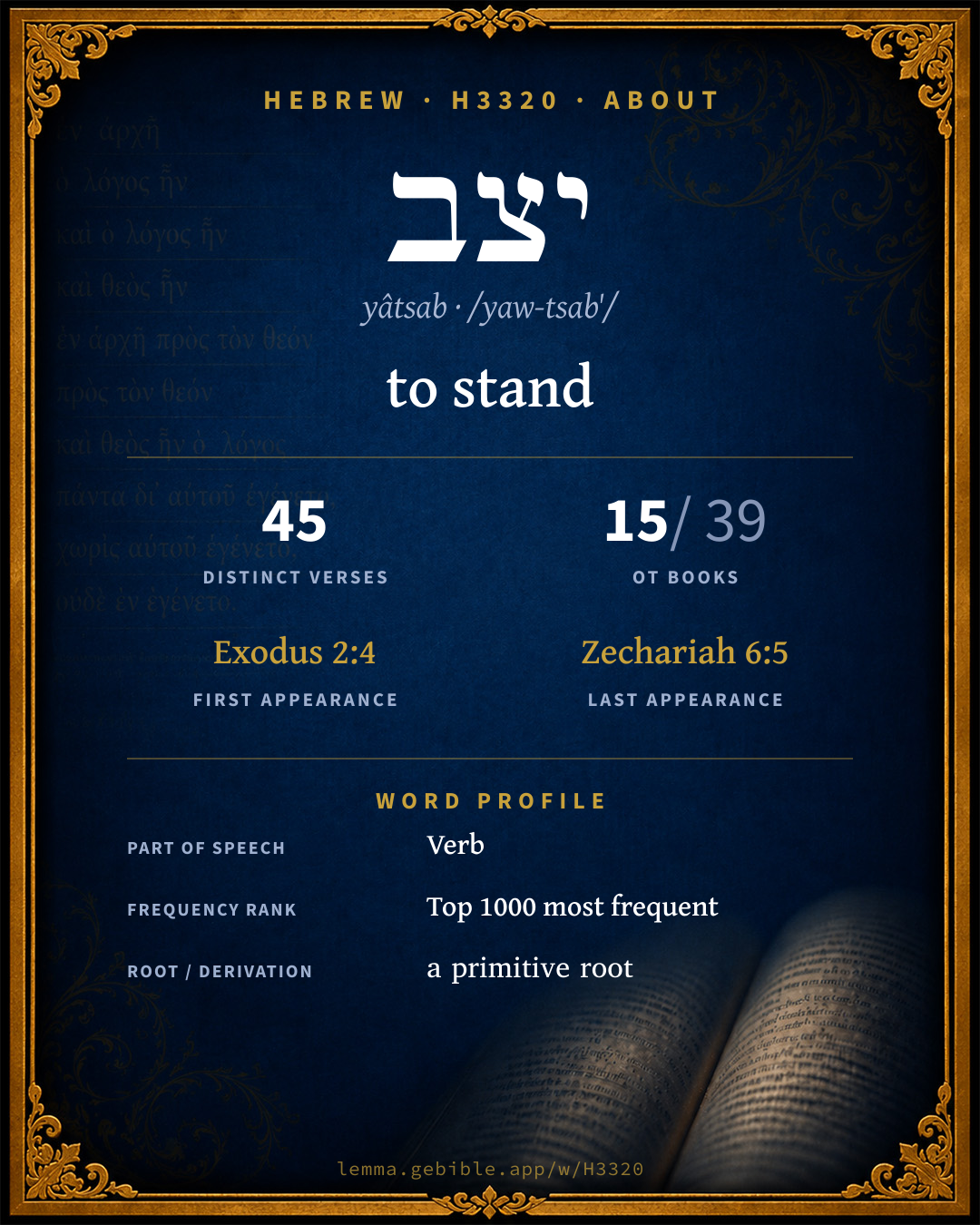
יָצַב
to stand
‘to stand’ is one of 2 main senses fuller range ↓
Full lexicon entry — Brown-Driver-Briggs (BDB)
From Brown-Driver-Briggs (BDB)
Where this word appears
Grammar key — what these labels mean
Part of speech
- Verb
- An action or state-of-being word.
Stem
- Hithpael
- The reflexive or reciprocal stem (the subject acts on itself).
Form
- Imperfect
- An incomplete, ongoing, or future action (“he will / would write”).
- Sequential Imperfect
- An imperfect with prefixed waw — the standard past-narrative form (waw-consecutive imperfect).
- Infinitive Construct
- A bound verbal noun, frequently with prepositions (“to write / in writing”).
- Imperative
- A direct command (“write!”).
- Cohortative
- A first-person volitional form expressing wish or resolve (“let me / let us write”).
- Sequential Perfect
- A perfect with prefixed waw continuing a preceding imperfect or command (waw-consecutive perfect).
- Perfect
- A completed action or state — Hebrew marks aspect (completeness) more than strict tense (“he wrote”).
Person
- 3rd Person
- The one spoken about (“he / she / it / they”).
- 2nd Person
- The one addressed (“you”).
- 1st Person
- The speaker (“I / we”).
Gender
- Masculine
- Grammatically masculine.
- Common
- Either gender — not distinguished for this form.
- Feminine
- Grammatically feminine.
Number
- Singular
- One.
- Plural
- More than one (in Hebrew, generally three or more).
Grammatical forms 12 distinct
- Verb, Hithpael, Imperfect, 3rd Person, Masculine, Singular 9 times (19%)
- Verb, Hithpael, Imperative, 2nd Person, Masculine, Plural 7 times (15%)
- Verb, Hithpael, Imperative, 2nd Person, Masculine, Singular 7 times (15%)
- Verb, Hithpael, Sequential Imperfect, 3rd Person, Masculine, Singular 6 times (13%)
- Verb, Hithpael, Infinitive Construct 6 times (13%)
- Verb, Hithpael, Sequential Imperfect, 3rd Person, Masculine, Plural 5 times (10%)
- Verb, Hithpael, Imperfect, 3rd Person, Masculine, Plural 3 times (6%)
- Verb, Hithpael, Cohortative, 1st Person, Common, Singular 1 time (2%)
+4 more forms (4 occurrences)
Parsed forms decoded from the imported morphology (morphhb / Westminster Leningrad Codex — WLC text public domain, morphhb tagging CC BY 4.0), counted across 48 parsed occurrences — not distinct verses.
Every verse where H3320 appears — 45 distinct verses across 15 books. Click any verse to open its interlinear word-by-word view. Verse text shown in the World English Bible for context — . Each verse’s Hebrew form is shown with its reference; the English is not keyword-highlighted, since the data carries no word-level English alignment. Use “Compare translations” on any verse to read it across multiple English versions. This concordance covers the Hebrew Bible; Septuagint (Greek Old Testament) occurrences are not indexed here.
Exodus 6 verses
- Exodus 2:4 וַ/תֵּתַצַּ֥ב conj + Hithpael wimpf 3fs His sister stood far off, to see what would be done to him.
- Exodus 8:20 וְ/הִתְיַצֵּב֙ conj + Hithpael impv 2ms Yahweh said to Moses, "Rise up early in the morning, and stand before Pharaoh; behold, he comes forth to the water; and tell him, 'This is what Yahweh says, "Let my people go, that they may serve me.
- Exodus 9:13 וְ/הִתְיַצֵּ֖ב conj + Hithpael impv 2ms Yahweh said to Moses, "Rise up early in the morning, and stand before Pharaoh, and tell him, 'This is what Yahweh, the God of the Hebrews, says: "Let my people go, that they may serve me.
- Exodus 14:13 הִֽתְיַצְב֗וּ Hithpael impv 2mp Moses said to the people, "Don't be afraid. Stand still, and see the salvation of Yahweh, which he will work for you today: for the Egyptians whom you have seen today, you shall never see them again.
- Exodus 19:17 וַ/יִּֽתְיַצְּב֖וּ conj + Hithpael wimpf 3mp Moses led the people out of the camp to meet God; and they stood at the lower part of the mountain.
- Exodus 34:5 וַ/יִּתְיַצֵּ֥ב conj + Hithpael wimpf 3ms Yahweh descended in the cloud, and stood with him there, and proclaimed the name of Yahweh.
Numbers 4 verses
- Numbers 11:16 וְ/הִֽתְיַצְּב֥וּ conj + Hithpael wpf 3cp Yahweh said to Moses, Gather to me seventy men of the elders of Israel, whom you know to be the elders of the people, and officers over them; and bring them to the tent of meeting, that they may stand there with you.
- Numbers 22:22 וַ/יִּתְיַצֵּ֞ב conj + Hithpael wimpf 3ms God's anger was kindled because he went; and the angel of Yahweh placed himself in the way for an adversary against him. Now he was riding on his donkey, and his two servants were with him.
- Numbers 23:3 הִתְיַצֵּב֮ Hithpael impv 2ms Balaam said to Balak, Stand by your burnt offering, and I will go: perhaps Yahweh will come to meet me; and whatever he shows me I will tell you. He went to a bare height.
- Numbers 23:15 הִתְיַצֵּ֥ב Hithpael impv 2ms He said to Balak, Stand here by your burnt offering, while I meet [Yahweh] yonder.
Deuteronomy 4 verses
- Deuteronomy 7:24 יִתְיַצֵּ֥ב Hithpael impf 3ms He will deliver their kings into your hand, and you shall make their name to perish from under the sky: there shall no man be able to stand before you, until you have destroyed them.
- Deuteronomy 9:2 יִתְיַצֵּ֔ב Hithpael impf 3ms a people great and tall, the sons of the Anakim, whom you know, and of whom you have heard say, Who can stand before the sons of Anak?
- Deuteronomy 11:25 יִתְיַצֵּ֥ב Hithpael impf 3ms There shall no man be able to stand before you: Yahweh your God shall lay the fear of you and the dread of you on all the land that you shall tread on, as he has spoken to you.
- Deuteronomy 31:14 וְ/הִֽתְיַצְּב֛וּ וַ/יִּֽתְיַצְּב֖וּ conj + Hithpael impv 2mp conj + Hithpael wimpf 3mp Yahweh said to Moses, Behold, your days approach that you must die: call Joshua, and present yourselves in the tent of meeting, that I may give him a charge. Moses and Joshua went, and presented themselves in the tent of meeting.
Joshua 2 verses
- Joshua 1:5 יִתְיַצֵּ֥ב Hithpael impf 3ms There shall not any man be able to stand before you all the days of your life. As I was with Moses, so I will be with you; I will not fail you, nor forsake you.
- Joshua 24:1 וַ/יִּֽתְיַצְּב֖וּ conj + Hithpael wimpf 3mp Joshua gathered all the tribes of Israel to Shechem, and called for the elders of Israel, and for their heads, and for their judges, and for their officers; and they presented themselves before God.
Judges 1 verse
1 Samuel 6 verses
- 1 Samuel 3:10 וַ/יִּתְיַצַּ֔ב conj + Hithpael wimpf 3ms Yahweh came, and stood, and called as at other times, Samuel, Samuel. Then Samuel said, Speak; for your servant hears.
- 1 Samuel 10:19 הִֽתְיַצְּבוּ֙ Hithpael impv 2mp but you have this day rejected your God, who himself saves you out of all your calamities and your distresses; and you have said to him, [No], but set a king over us. Now therefore present yourselves before Yahweh by your tribes, and by your thousands.
- 1 Samuel 10:23 וַ/יִּתְיַצֵּ֖ב conj + Hithpael wimpf 3ms They ran and fetched him there; and when he stood among the people, he was higher than any of the people from his shoulders and upward.
- 1 Samuel 12:7 הִֽתְיַצְּב֛וּ Hithpael impv 2mp Now therefore stand still, that I may plead with you before Yahweh concerning all the righteous acts of Yahweh, which he did to you and to your fathers.
- 1 Samuel 12:16 הִתְיַצְּב֣וּ Hithpael impv 2mp Now therefore stand still and see this great thing, which Yahweh will do before your eyes.
- 1 Samuel 17:16 וַ/יִּתְיַצֵּ֖ב conj + Hithpael wimpf 3ms The Philistine drew near morning and evening, and presented himself forty days.
2 Samuel 4 verses
- 2 Samuel 18:13 תִּתְיַצֵּ֥ב Hithpael impf 2ms Otherwise if I had dealt falsely against his life (and there is no matter hid from the king), then you yourself would have set yourself against [me].
- 2 Samuel 18:30 הִתְיַצֵּ֣ב Hithpael impv 2ms The king said, Turn aside, and stand here. He turned aside, and stood still.
- 2 Samuel 21:5 מֵֽ/הִתְיַצֵּ֖ב prep + Hithpael inf.cs They said to the king, The man who consumed us, and who devised against us, [that] we should be destroyed from remaining in any of the borders of Israel,
- 2 Samuel 23:12 וַ/יִּתְיַצֵּ֤ב conj + Hithpael wimpf 3ms But he stood in the midst of the plot, and defended it, and killed the Philistines; and Yahweh worked a great victory.
1 Chronicles 1 verse
2 Chronicles 3 verses
- 2 Chronicles 11:13 הִֽתְיַצְּב֥וּ Hithpael pf 3cp The priests and the Levites who were in all Israel resorted to him out of all their border.
- 2 Chronicles 20:6 לְ/הִתְיַצֵּֽב prep + Hithpael inf.cs and he said, Yahweh, the God of our fathers, aren't you God in heaven? and aren't you ruler over all the kingdoms of the nations? and in your hand is power and might, so that none is able to withstand you.
- 2 Chronicles 20:17 הִתְיַצְּב֣וּ Hithpael impv 2mp You shall not need to fight in this [battle]: set yourselves, stand you still, and see the salvation of Yahweh with you, O Judah and Jerusalem; don't be afraid, nor be dismayed: tomorrow go out against them: for Yahweh is with you.
Job 5 verses
- Job 1:6 לְ/הִתְיַצֵּ֖ב prep + Hithpael inf.cs Now it happened on the day when the sons of God came to present themselves before Yahweh, that Satan also came among them.
- Job 2:1 לְ/הִתְיַצֵּ֖ב לְ/הִתְיַצֵּ֖ב prep + Hithpael inf.cs prep + Hithpael inf.cs Again it happened on the day when the sons of God came to present themselves before Yahweh, that Satan came also among them to present himself before Yahweh.
- Job 33:5 הִתְיַצָּֽבָ/ה Hithpael impv 2ms + sfx h If you can, answer me; Set your words in order before me, and stand forth.
- Job 38:14 וְ֝/יִֽתְיַצְּב֗וּ conj + Hithpael impf 3mp It is changed as clay under the seal, And stands forth as a garment.
- Job 41:10 יִתְיַצָּֽב Hithpael impf 3ms None is so fierce that he dare stir him up. Who then is he who can stand before me?
Psalms 4 verses
- Psalms 2:2 יִ֥תְיַצְּב֨וּ Hithpael impf 3mp The kings of the earth take a stand, And the rulers take counsel together, Against Yahweh, and against his anointed, saying,
- Psalms 5:5 יִתְיַצְּב֣וּ Hithpael impf 3mp The arrogant shall not stand in your sight. You hate all workers of iniquity.
- Psalms 36:4 יִ֭תְיַצֵּב Hithpael impf 3ms He plots iniquity on his bed. He sets himself in a way that is not good; He doesn't abhor evil.
- Psalms 94:16 יִתְיַצֵּ֥ב Hithpael impf 3ms Who will rise up for me against the wicked? Who will stand up for me against the evil-doers?
Proverbs 1 verse
Jeremiah 2 verses
- Jeremiah 46:4 וְ/הִֽתְיַצְּב֖וּ conj + Hithpael impv 2mp Harness the horses, and get up, you horsemen, and stand forth with your helmets; furbish the spears, put on the coats of mail.
- Jeremiah 46:14 הִתְיַצֵּב֙ Hithpael impv 2ms Declare you in Egypt, and publish in Migdol, and publish in Memphis and in Tahpanhes: say you, Stand forth, and prepare you; for the sword has devoured round about you.
Habakkuk 1 verse
Zechariah 1 verse
About this entry
At a glance — auto-summarized from this page’s data, not written by a person. Every figure links to its source below. This summary describes the numbers; it doesn’t interpret them.
יצב — transliterated yâtsab — is a Hebrew verb carrying the sense “to stand.” Its English rendering has broadened — “stand” classically, “station yourself” (unfoldingWord Literal Text) in modern versions; see the renderings breakdown. Spanning 45 verses in 15 books, it ranks among the moderately common words of the Hebrew Bible. Its earliest occurrence is Exodus 2:4. BDB distinguishes 2 senses for it. Each statement above links to its evidence; the full detail follows below.
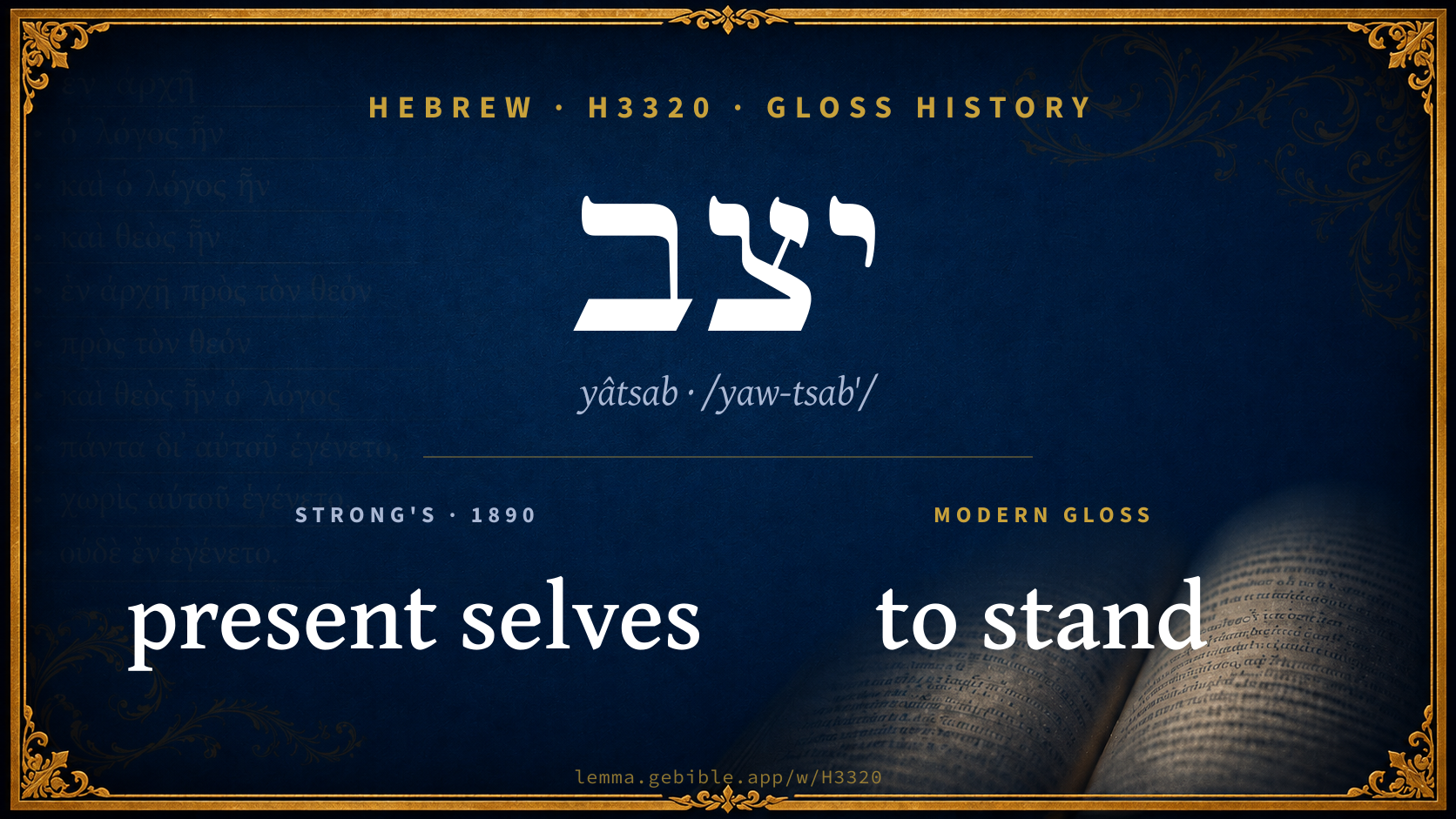
Gloss history
Strong's 1890 vs modern scholarship
About this word
Strong's H3320 catalogs a Hebrew word from the Hebrew Old Testament.
These counts are not copied from any lexicon or concordance. They are computed here, from the morphology-tagged Hebrew Old Testament. What Lemma adds →
- 45
- distinct verses
- The word appears in 45 distinct verses.
- 15 / 39
- OT books
- The word appears in 15 of 39 Old Testament books.
- #767
- by frequency
- Top 1000 most frequent Hebrew words (rank 767 of 8,640 Hebrew words by occurrence).
View all 45 occurrences in the concordance →
By section of the Old Testament
By traditional corpus
Conventional, traditional groupings — biblical authorship is debated, so this is a traditional corpus grouping, not an authorship claim. Each share is this word’s portion of its verses in that division of the Hebrew canon. Each figure is a share of the word’s 45 distinct verses.
- Prophets (Nevi'im) 17 verses · 38%
- Torah (Pentateuch) 14 verses · 31%
- Writings (Ketuvim) 14 verses · 31%
How translations render this word
Counts come from each version’s own published word-to-Strong’s tagging or interlinear alignment — an approximate guide to how each version renders this word, not a word-level alignment the data otherwise carries. Because each total is that version’s own tagged count, the per-version totals vary from one another and need not match the appearance or distinct-verse counts above. These counts may also differ from a printed concordance because Lemma counts each distinctly tagged rendering and does not collapse phrase taggings into a single head-word total. This is a fixed set of word-tagged versions (KJV, ASV, BSB, ULT) and does not change with the reading translation you choose elsewhere. Each version’s license is shown beside its name below (and on Sources).
- King James Version: Stand 6×, Present 4×, Stood 4×
- American Standard Version: Stand 6×, Present 4×, Be able to stand 3×
- Berean Standard Bible: Stand 5×, Present yourselves 4×, Stood 4×
- unfoldingWord Literal Text: Station yourself 5×, Station yourselves 4×, And 3×
King James Version Public Domain
Renders H3320 across 48 tagged occurrences — most commonly:
Plus 26 renderings that appear only once — usually multi-word phrases or single function words the recovered tagging swept in, not distinct renderings.
American Standard Version Public Domain
Renders H3320 across 48 tagged occurrences — most commonly:
Plus 25 renderings that appear only once — usually multi-word phrases or single function words the recovered tagging swept in, not distinct renderings.
Berean Standard Bible Public Domain
Renders H3320 across 47 tagged occurrences — most commonly:
Plus 24 renderings that appear only once — usually multi-word phrases or single function words the recovered tagging swept in, not distinct renderings. Not rendered by a distinct English word in 1 further occurrence.
unfoldingWord Literal Text CC BY-SA 4.0
Renders H3320 across 52 tagged occurrences — most commonly:
Plus 23 renderings that appear only once — usually multi-word phrases or single function words the recovered tagging swept in, not distinct renderings.
Senses in BDB
The 2 senses BDB distinguishes for this word, in lexicon order (not ranked by frequency or importance). The full entry — with sub-senses — is in the Lexicon Entry tab.
- to place, set, stand, set or station oneself, present oneself
- (Hithpael) to station oneself, take one's stand, stand, present oneself, stand with someone
Word origin
[ יָצַב ] vb. only Hithp. set or station oneself, take one's stand
— Brown-Driver-Briggs (Oxford 1906, public domain), digitized via Sefaria, supplemented by the OpenScriptures HebrewLexicon (CC BY 4.0). See Sources.
Origin: a primitive root
Jastrow Dictionary
A second Hebrew/Aramaic lexicon for comparison, covering Aramaic and post-biblical (Talmudic, Targumic, Midrashic) usage that the biblical-Hebrew BDB does not. Matched by lemma rather than by Strong’s number, so a lemma may carry more than one Jastrow headword (shown separately below), and the entries cover usage well beyond the Bible.
יָצַב
- (b. h.) to stand, be erect.—Denom. יְצִיבָה.—V. נָצַב.
- to place one’s self; to be firm. Cant. R. to I, 1 (ref. to Prov. XXII, 29) מִתְיַצְּבִים בתורה they are firm in the Law. Pesik. R. s. 6 (ref. to Prov. l. c.) בל יִתְיַיצָּב לפני פרעה וכ׳ he will not place himself (praying) before Pharaoh, the benighted (v. חָשׁוּךְ); Cant. R. l. c. לפני מלכי תורה יתיצב he will be placed before (ranked as the foremost of) the kings of the Law; Koh. R. to I, 1 לפני מלאכים יתי׳ he will be ranked before angels; a. e. e.g. Proverbs 22:29
יְצַב
- ; Pa. יַצֵּב to establish. [Dan. VII, 19 to ascertain.] Targ. I Chr. IV, 23.—V. נְצַב. e.g. Daniel 7:19
A Dictionary of the Targumim, the Talmud Babli and Yerushalmi, and the Midrashic Literature (Marcus Jastrow; London, Luzac, 1903) — Public Domain. Digitized via Sefaria. Digitized via Sefaria. Full attribution on Sources.
Forms in the corpus
The 38 distinct written forms H3320 takes in the Hebrew Bible, most frequent first — each parse links to that stem’s occurrences in the concordance. Hebrew forms include their vowel points and cantillation, so a single lemma takes many written forms.
| Form | Parsing | Example | Uses |
|---|---|---|---|
| יִתְיַצֵּ֥ב | Verb, Hithpael, Imperfect, 3rd Person, Masculine, Singular | Deuteronomy 7:24 | 4 |
| וַ/יִּֽתְיַצְּב֖וּ | Verb, Hithpael, Sequential Imperfect, 3rd Person, Masculine, Plural | Deuteronomy 31:14 | 3 |
| לְ/הִתְיַצֵּ֖ב | Verb, Hithpael, Infinitive Construct | Job 1:6 | 3 |
| הִתְיַצְּב֣וּ | Verb, Hithpael, Imperative, 2nd Person, Masculine, Plural | 1 Samuel 12:16 | 2 |
| וַ/יִּתְיַצֵּ֖ב | Verb, Hithpael, Sequential Imperfect, 3rd Person, Masculine, Singular | 1 Samuel 10:23 | 2 |
| מֵֽ/הִתְיַצֵּ֖ב | Verb, Hithpael, Infinitive Construct | 2 Samuel 21:5 | 2 |
| הִֽתְיַצְב֗וּ | Verb, Hithpael, Imperative, 2nd Person, Masculine, Plural | Exodus 14:13 | 1 |
| הִֽתְיַצְּב֛וּ | Verb, Hithpael, Imperative, 2nd Person, Masculine, Plural | 1 Samuel 12:7 | 1 |
| הִֽתְיַצְּב֥וּ | Verb, Hithpael, Perfect, 3rd Person, Common, Plural | 2 Chronicles 11:13 | 1 |
| הִֽתְיַצְּבוּ֙ | Verb, Hithpael, Imperative, 2nd Person, Masculine, Plural | 1 Samuel 10:19 | 1 |
| הִתְיַצֵּ֣ב | Verb, Hithpael, Imperative, 2nd Person, Masculine, Singular | 2 Samuel 18:30 | 1 |
| הִתְיַצֵּ֥ב | Verb, Hithpael, Imperative, 2nd Person, Masculine, Singular | Numbers 23:15 | 1 |
| הִתְיַצֵּב֙ | Verb, Hithpael, Imperative, 2nd Person, Masculine, Singular | Jeremiah 46:14 | 1 |
| הִתְיַצֵּב֮ | Verb, Hithpael, Imperative, 2nd Person, Masculine, Singular | Numbers 23:3 | 1 |
| הִתְיַצָּֽבָ/ה | Verb, Hithpael, Imperative, 2nd Person, Masculine, Singular | Job 33:5 | 1 |
| וְ/אֶֽתְיַצְּבָ֖ה | Verb, Hithpael, Cohortative, 1st Person, Common, Singular | Habakkuk 2:1 | 1 |
| וְ/הִֽתְיַצְּב֖וּ | Verb, Hithpael, Imperative, 2nd Person, Masculine, Plural | Jeremiah 46:4 | 1 |
| וְ/הִֽתְיַצְּב֛וּ | Verb, Hithpael, Imperative, 2nd Person, Masculine, Plural | Deuteronomy 31:14 | 1 |
| וְ/הִֽתְיַצְּב֥וּ | Verb, Hithpael, Sequential Perfect, 3rd Person, Common, Plural | Numbers 11:16 | 1 |
| וְ/הִתְיַצֵּ֖ב | Verb, Hithpael, Imperative, 2nd Person, Masculine, Singular | Exodus 9:13 | 1 |
| וְ/הִתְיַצֵּב֙ | Verb, Hithpael, Imperative, 2nd Person, Masculine, Singular | Exodus 8:20 | 1 |
| וְ֝/יִֽתְיַצְּב֗וּ | Verb, Hithpael, Imperfect, 3rd Person, Masculine, Plural | Job 38:14 | 1 |
| וַ/יִּֽתְיַצְּב֞וּ | Verb, Hithpael, Sequential Imperfect, 3rd Person, Masculine, Plural | Judges 20:2 | 1 |
| וַ/יִּֽתְיַצְּב֤וּ | Verb, Hithpael, Sequential Imperfect, 3rd Person, Masculine, Plural | 1 Chronicles 11:14 | 1 |
| וַ/יִּתְיַצֵּ֞ב | Verb, Hithpael, Sequential Imperfect, 3rd Person, Masculine, Singular | Numbers 22:22 | 1 |
| וַ/יִּתְיַצֵּ֤ב | Verb, Hithpael, Sequential Imperfect, 3rd Person, Masculine, Singular | 2 Samuel 23:12 | 1 |
| וַ/יִּתְיַצֵּ֥ב | Verb, Hithpael, Sequential Imperfect, 3rd Person, Masculine, Singular | Exodus 34:5 | 1 |
| וַ/יִּתְיַצַּ֔ב | Verb, Hithpael, Sequential Imperfect, 3rd Person, Masculine, Singular | 1 Samuel 3:10 | 1 |
| וַ/תֵּתַצַּ֥ב | Verb, Hithpael, Sequential Imperfect, 3rd Person, Feminine, Singular | Exodus 2:4 | 1 |
| יִ֝תְיַצֵּב | Verb, Hithpael, Imperfect, 3rd Person, Masculine, Singular | Proverbs 22:29 | 1 |
| יִ֥תְיַצְּב֨וּ | Verb, Hithpael, Imperfect, 3rd Person, Masculine, Plural | Psalms 2:2 | 1 |
| יִ֭תְיַצֵּב | Verb, Hithpael, Imperfect, 3rd Person, Masculine, Singular | Psalms 36:4 | 1 |
| יִתְיַצְּב֣וּ | Verb, Hithpael, Imperfect, 3rd Person, Masculine, Plural | Psalms 5:5 | 1 |
| יִתְיַצֵּ֔ב | Verb, Hithpael, Imperfect, 3rd Person, Masculine, Singular | Deuteronomy 9:2 | 1 |
| יִתְיַצָּ֑ב | Verb, Hithpael, Imperfect, 3rd Person, Masculine, Singular | Proverbs 22:29 | 1 |
| יִתְיַצָּֽב | Verb, Hithpael, Imperfect, 3rd Person, Masculine, Singular | Job 41:10 | 1 |
| לְ/הִתְיַצֵּֽב | Verb, Hithpael, Infinitive Construct | 2 Chronicles 20:6 | 1 |
| תִּתְיַצֵּ֥ב | Verb, Hithpael, Imperfect, 2nd Person, Masculine, Singular | 2 Samuel 18:13 | 1 |
Same root — word family
Other BDB entries built from the same root as H3320, grouped by Strong’s listed origin. These share a root / origin per the lexicon — not necessarily a shared meaning. Each links to that word’s own entry.
Derived from this word
Compare all same-root words → They share a root, not necessarily a meaning.
Septuagint verse parallels
This word appears in 43 verses that also exist in the Greek Old Testament (Septuagint), out of the 45 Hebrew verses it occurs in. You can read those verses in Greek by switching the Old Testament edition to the Septuagint.
Read these verses in the Septuagint
- Exodus 2:4
- Numbers 11:16
- Deuteronomy 7:24
- Joshua 1:5
- Judges 20:2
- 1 Samuel 3:10
- 2 Samuel 18:13
- 1 Chronicles 11:14
- 2 Chronicles 11:13
- Job 1:6
- Psalms 2:2
- Proverbs 22:29
This is a verse-level parallel only — the same verses exist in both the Hebrew and Greek Old Testaments. No word-level Hebrew↔Greek correspondence is claimed: the data carries no such alignment, so no Greek word is shown as this Hebrew word’s translation. Coverage is not total — the Septuagint omits the deuterocanon and renumbers the Psalms, so some Hebrew verses have no direct Greek parallel.