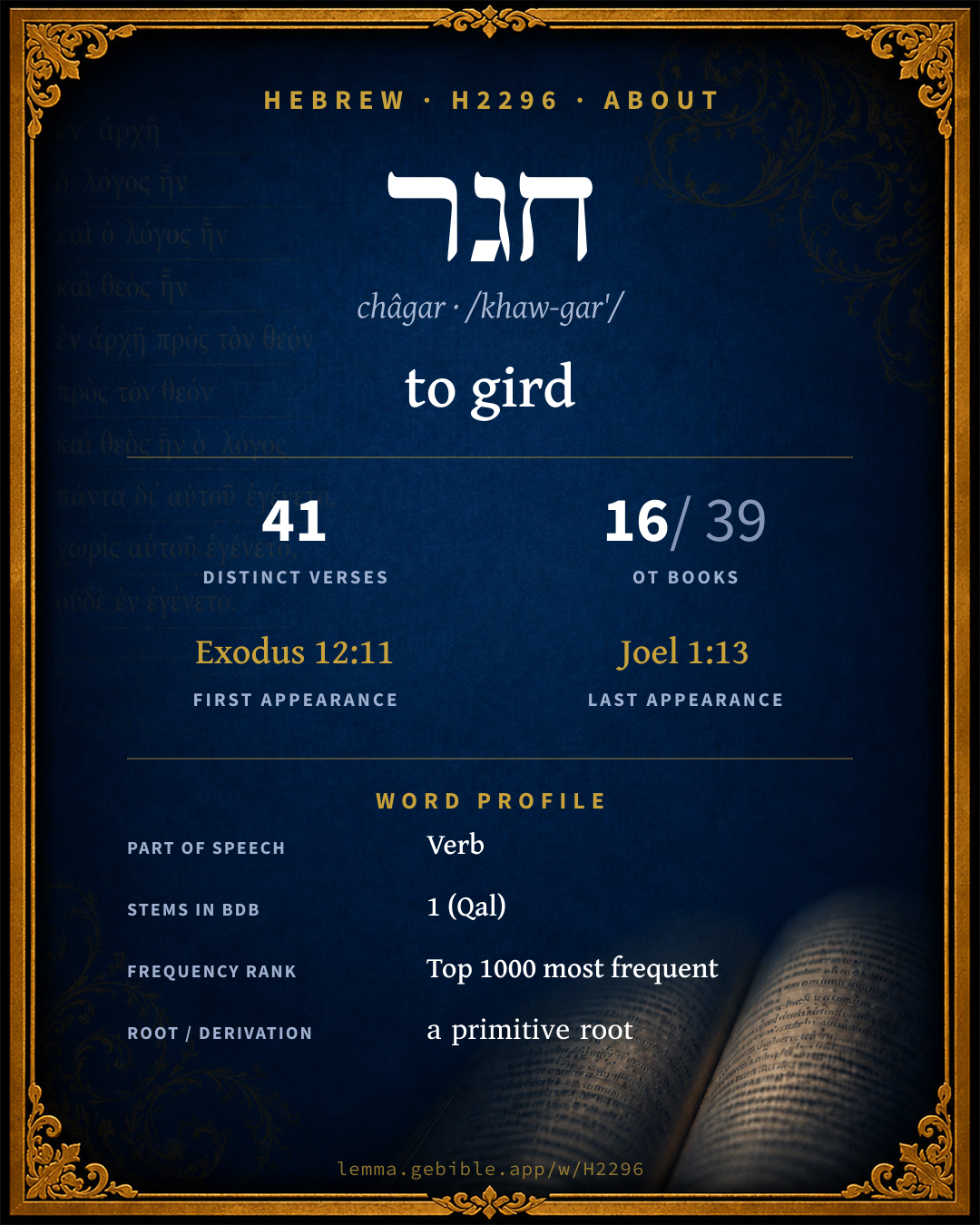
חָגַר
to gird
also: gird on, gird oneself fuller range ↓
Full lexicon entry — Brown-Driver-Briggs (BDB)
From Brown-Driver-Briggs (BDB)
Where this word appears
Grammar key — what these labels mean
Part of speech
- Verb
- An action or state-of-being word.
Stem
- Qal
- The basic, simple active stem — the plain form of the verb (“he wrote”). Here: ‘trans.’
Form
- Sequential Imperfect
- An imperfect with prefixed waw — the standard past-narrative form (waw-consecutive imperfect).
- Participle Passive
- A verbal adjective expressing action received (“written”).
- Imperative
- A direct command (“write!”).
- Sequential Perfect
- A perfect with prefixed waw continuing a preceding imperfect or command (waw-consecutive perfect).
- Perfect
- A completed action or state — Hebrew marks aspect (completeness) more than strict tense (“he wrote”).
- Infinitive Construct
- A bound verbal noun, frequently with prepositions (“to write / in writing”).
- Imperfect
- An incomplete, ongoing, or future action (“he will / would write”).
- Participle Active
- A verbal adjective expressing ongoing or characteristic action (“writing / one who writes”).
State
- Absolute
- The independent form of a noun, not bound to a following word.
- Construct
- A noun bound to a following noun in a possessive / “of” relationship (the construct chain).
Person
- 3rd Person
- The one spoken about (“he / she / it / they”).
- 2nd Person
- The one addressed (“you”).
Gender
- Masculine
- Grammatically masculine.
- Common
- Either gender — not distinguished for this form.
- Feminine
- Grammatically feminine.
Number
- Singular
- One.
- Plural
- More than one (in Hebrew, generally three or more).
Every verse where H2296 appears in the Book of Ezekiel — 3 distinct verses. Click any verse to open its interlinear word-by-word view. Verse text shown in the World English Bible for context — . Each verse’s Hebrew form is shown with its reference; the English is not keyword-highlighted, since the data carries no word-level English alignment. Use “Compare translations” on any verse to read it across multiple English versions. This concordance covers the Hebrew Bible; Septuagint (Greek Old Testament) occurrences are not indexed here.
Ezekiel
- Ezekiel 7:18 וְ/חָגְר֣וּ conj + Qal wpf 3cp They shall also gird themselves with sackcloth, and horror shall cover them; and shame shall be on all faces, and baldness on all their heads.
- Ezekiel 27:31 וְ/חָגְר֖וּ conj + Qal wpf 3cp and they shall make themselves bald for you, and gird them with sackcloth, and they shall weep for you in bitterness of soul with bitter mourning.
- Ezekiel 44:18 יַחְגְּר֖וּ Qal impf 3mp They shall have linen tires on their heads, and shall have linen breeches on their loins; they shall not gird themselves with [anything that causes] sweat.
About this entry
At a glance — auto-summarized from this page’s data, not written by a person. Every figure links to its source below. This summary describes the numbers; it doesn’t interpret them.
חגר (châgar) is a Hebrew verb most often rendered “to gird.” Older and newer Bibles part ways — “gird” in the King James Version, “put on” (Berean Standard Bible) in modern versions. See the renderings breakdown. It turns up in 41 verses across 16 books, a moderately common footprint. Scripture first uses it in Exodus 12:11. Beyond its headline sense, its full sense range takes in “gird on” and “gird oneself”. For the data behind this summary, explore the sense tree and the renderings breakdown below.
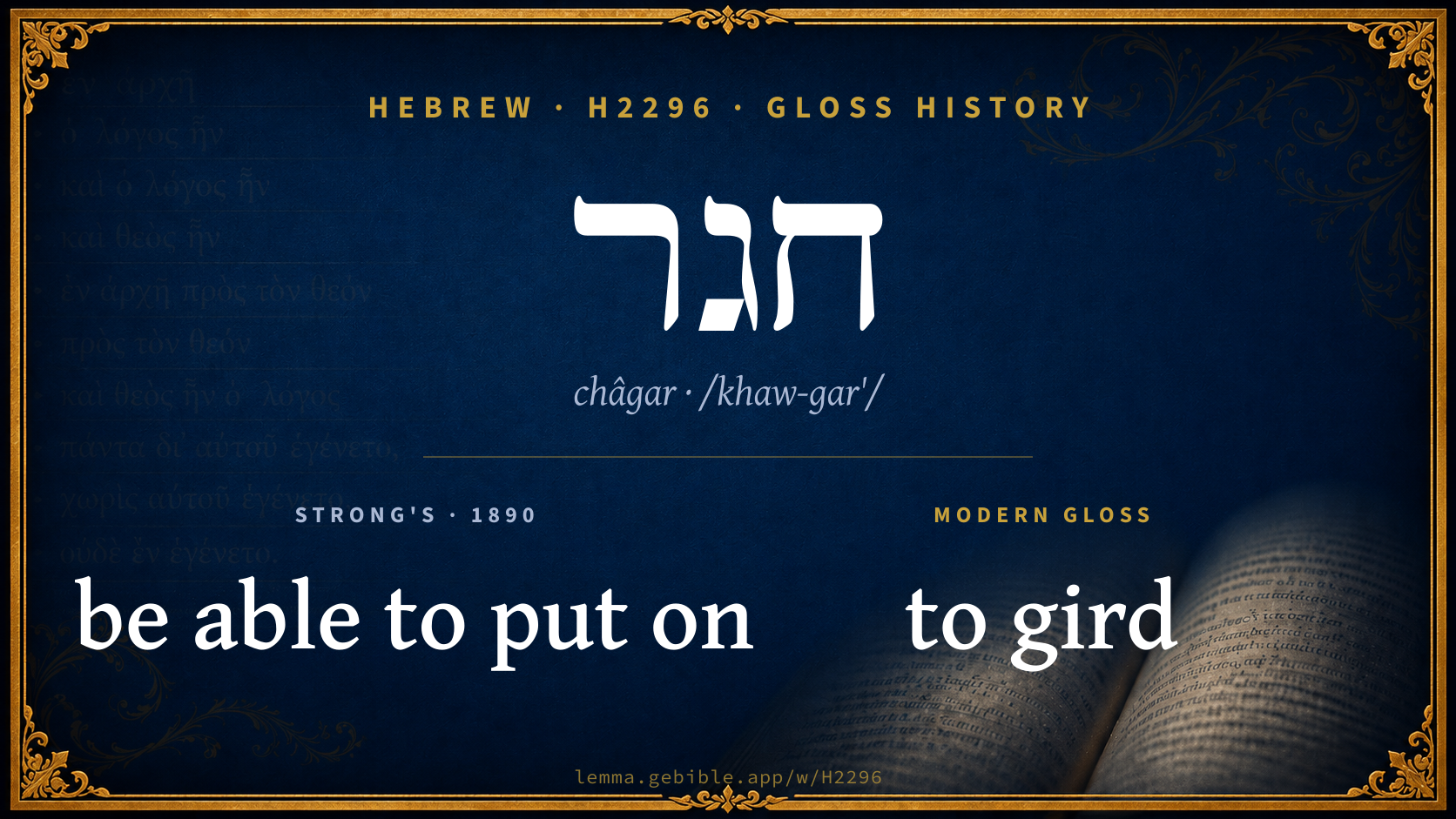
Gloss history
Strong's 1890 vs modern scholarship
About this word
Strong's H2296 catalogs a Hebrew word from the Hebrew Old Testament.
These counts are not copied from any lexicon or concordance. They are computed here, from the morphology-tagged Hebrew Old Testament. What Lemma adds →
- 41
- distinct verses
- The word appears in 41 distinct verses.
- 16 / 39
- OT books
- The word appears in 16 of 39 Old Testament books.
- #819
- by frequency
- Top 1000 most frequent Hebrew words (rank 819 of 8,640 Hebrew words by occurrence).
View all 41 occurrences in the concordance →
By section of the Old Testament
By traditional corpus
Conventional, traditional groupings — biblical authorship is debated, so this is a traditional corpus grouping, not an authorship claim. Each share is this word’s portion of its verses in that division of the Hebrew canon. Each figure is a share of the word’s 41 distinct verses.
- Prophets (Nevi'im) 28 verses · 68%
- Writings (Ketuvim) 7 verses · 17%
- Torah (Pentateuch) 6 verses · 15%
How translations render this word
Counts come from each version’s own published word-to-Strong’s tagging or interlinear alignment — an approximate guide to how each version renders this word, not a word-level alignment the data otherwise carries. Because each total is that version’s own tagged count, the per-version totals vary from one another and need not match the appearance or distinct-verse counts above. These counts may also differ from a printed concordance because Lemma counts each distinctly tagged rendering and does not collapse phrase taggings into a single head-word total. This is a fixed set of word-tagged versions (KJV, ASV, BSB, ULT) and does not change with the reading translation you choose elsewhere. Each version’s license is shown beside its name below (and on Sources).
- King James Version: Gird 6×, Girded 6×, Appointed 2×
- American Standard Version: Gird 6×, Girded 5×, Girt 3×
- Berean Standard Bible: Put on 5×, Armed 3×, Wearing 3×
- unfoldingWord Literal Text: Gird 4×, Girded 4×, Was girded 4×
King James Version Public Domain
Renders H2296 across 43 tagged occurrences — most commonly:
Plus 25 renderings that appear only once — usually multi-word phrases or single function words the recovered tagging swept in, not distinct renderings.
American Standard Version Public Domain
Renders H2296 across 43 tagged occurrences — most commonly:
Plus 26 renderings that appear only once — usually multi-word phrases or single function words the recovered tagging swept in, not distinct renderings.
Berean Standard Bible Public Domain
Renders H2296 across 42 tagged occurrences — most commonly:
Plus 31 renderings that appear only once — usually multi-word phrases or single function words the recovered tagging swept in, not distinct renderings. Not rendered by a distinct English word in 2 further occurrences.
unfoldingWord Literal Text CC BY-SA 4.0
Renders H2296 across 47 tagged occurrences — most commonly:
Plus 27 renderings that appear only once — usually multi-word phrases or single function words the recovered tagging swept in, not distinct renderings.
Senses in the full BDB
What do BDB’s symbols mean?
BDB uses these scholarly abbreviations:
| Symbol | Meaning |
|---|---|
| 𝔊 | the Septuagint (the ancient Greek translation, LXX) |
| 𝔙 | the Vulgate (the Latin translation) |
| 𝔖 | the Syriac version (the Peshitta) |
| 𝔗 | the Targum (the Aramaic translation) |
| ψ | the Psalms |
| √ | root (the underlying root or stem) |
| ‖ | parallel passage (a synonymous or contrasted parallel) |
| † | the dagger: every passage where the word occurs is cited |
The 4 senses and sub-senses the full Brown-Driver-Briggs lexicon distinguishes for this word, in lexicon order (not ranked by frequency), with BDB’s own verbatim wording and sub-sense lettering. Shown in Hebrew script with BDB’s own scholarly abbreviations. The condensed entry is in the Lexicon Entry tab. See also the Forms in the corpus table below.
Qal
- Pf. 3 fs. חָֽגְרָה Pr 31:17; 2 ms. וְהָגַרְתָּ֫ Ex 29:9; 3 pl. חָֽגְרוּ Is 15:3 La 2:10; וְח׳ consec. Ez 7:18; 27:31; Impf. 3 ms. יַחְגֹּר Lv 16:4, וַיַּחְגֹּר Lv 8:7(×2) + 4 times; sf. יַחְגְּרֶ֑הָ ψ 109:19; 2 ms. תַּחְגֹּר ψ 76:11 (but on text v. infr.); 3 mpl. יַחְגְּרוּ Ez 44:18 2 S 22:46 (but on text of both v. infr.), וַיַּחְגְּרוּ 1 S 25:13 1 K 20:32; 3 fpl. תַּחְגֹּרְנָה ψ 65:13; 2 mpl. וַתַּחְגְּרוּ De 1:41; Imv. ms. חֲגֹר 2 K 4:29; 9:1, חֲגוֹר ψ 45:4; fs. חִגְרִי־ Je 6:26; mpl. חִגְרוּ 1 S 25:13 + 3 times; fpl. חֲגֹרְנָה Je 49:3, cf. חֲג֖וֹרָה Is 32:11 (v. infr.); Inf. cstr. לַחֲגֹר Is 22:12; Pt. act. חֹגֵר 1 K 20:11 2 K 3:21; pass. m. חָגוּר Ju 18:11 + 5 times; f. cstr. חֲגֻרַת־ Jo 1:8; pl. חֲגוּרִים Ex 12:11 Ju 18:16; חֲגֻרִים Dn 10:5;— e.g. Proverbs 31:17
- 1. trans., gird some one, with girdle; c. 2 acc. Ex 29:9 Lv 8:13 (both P); pass., girded with ephod (acc.) 1 S 2:18 2 S 6:14; sq. בְּ Dn 10:5, c. acc. and בְּ, fig. Pr 31:17, חגרה בְּעוז מתניה Lv 8:7(×2) (P), c. acc. מתנים gird up thy loins, i.e. make ready to go 2 K 4:29; 9:1, pass. Ex 12:11 (P); cf. prob. also חֲג֖וֹרָה עַל־חֲלָצָ֑יִם Is 32:11 gird upon the loins (2nd acc. om.); on verb. form as Imv. fpl. v. AE Ki Ew§ 226 a Di Du; > as ms. Ol§ 234 a Ges§ 48. 5 Sta§ 591 d Kö§ 20. 12. e.g. Exodus 29:9
- 2. gird on, bind on (= gird oneself with), a girdle ψ 109:19 (in sim.); so especially c. acc. שׂק, שׂקים of mourning Is 15:3; 22:12 La 2:10 Ez 7:18; 27:31 2 S 3:31 Je 4:8; 6:26; 49:3; also 1 K 20:32 (c. acc. שׂק + ב bef. מתנים); pass., sq. על bef. obj. of mourning Jo 1:8 (sim.); abs. (שׂק om.) Jo 1:13 (‖ ספדו); sq. חֶרֶב 1 S 25:13(×3) Dt 1:41; ψ 45:4 ח׳ חרב על יָרֵךְ, so Ju 3:16, 1 S 17:39 (sq. acc. + מֵעַל); c. acc. cogn. ח׳ חגורה 2 K 3:21; abs. 1 K 20:11; pass. Ju 18:11, 16, 17 2 S 20:8 b (where read חֶרֶב Klo Dr—not We), 21:16; read perhaps also חָגוּר for חֲגוֹר 20:8 c, so Klo Dr. e.g. Psalms 109:19
- 3. intr. gird oneself, sq. בְּ rei Lv 16:4 (P), so לֹא יַח׳ בַיָּ֑זַע they shall not gird themselves with sweat(?) Ez 44:18 (del. 𝔖 Co Sgfr); c. acc. rei (fig.) גִּיל גְּבָעוֹת תַּח׳ ψ 65:13 with rejoicing the hills gird themselves; cf. שְׁאֵרִית חֵמֹת תַּחְ׳ ψ 76:11 with a remnant (residue) of wraths thou girdest thyself, so Hi Hup De VB; but very doubtful; 𝔊 Bö; Ew read תְּחָגֶּ֑ךָ for תַּחגר; Bae Ka omit line as corrupt; cf. further Che and crit. n.—וְיַחְגְּרוּ 2 S 22:46 is textual error for וְיַחְרְגוּ, cf. ‖ ψ 18:46; so Now Hup Kit al. e.g. Leviticus 16:4
Senses from the full Brown-Driver-Briggs lexicon (Brown, Driver, Briggs; Oxford 1906 — public domain), digitized via Sefaria, supplemented by the OpenScriptures HebrewLexicon (CC BY 4.0). Full attribution on Sources.
Word origin
vb. gird, gird on, gird oneself (NH id., Aramaic חֲגַר; Arabic حَجَرَ hinder, restrain, so Syriac ܚܓܰܪ; Assyrian agâru, surround, in deriv., DlW 105 ff.; Sab. מחגרת (cf. Arabic مَحْجِرٌ, مَحَاجِر, enclosed space, district, etc.), DHM in MV; also n.pr. dei and loc. חגר, Sab. Denkm3.81.93 CISiv. 1, No. 49 etc.)—
— Brown-Driver-Briggs (Oxford 1906, public domain), digitized via Sefaria, supplemented by the OpenScriptures HebrewLexicon (CC BY 4.0). See Sources.
Origin: a primitive root
Jastrow Dictionary
A second Hebrew/Aramaic lexicon for comparison, covering Aramaic and post-biblical (Talmudic, Targumic, Midrashic) usage that the biblical-Hebrew BDB does not. Matched by lemma rather than by Strong’s number, so a lemma may carry more than one Jastrow headword (shown separately below), and the entries cover usage well beyond the Bible.
חָגַר I
- (b. h.) to encircle; to gird. Sabb. 63ᵃ אם ת"ח חָגְרֵיהוּ על מתנך … if a scholar be even revengeful … like a serpent, bind him around thy loins (be not afraid of him). Midd. III, 1 וחוט … חוֹגְרוֹ וכ׳ and a red line went around it.—Gen. R. s. 71 לא ח׳ מתניו כנגדה did he not gird his loins (in bold prayer) in her presence (Gen. XXV, 21)? Ex. R. s. 43, beg. התחיל חוֹגֵר בתפלה (sub. מתניו) he began to pray boldly. Taan. 14ᵇ לַחֲגוֹר שק to put on sackcloth (for prayer); a. fr. e.g. Genesis 25:21
חֲגַר
- Y. Ned. III, beg. 37ᵈ ח׳ עליה מותנא. tied a rope around it, i.e. made the law more stringent. Bab. Ned. 49ᵇ וחוֹגְרַנִי צדעי (Rashi: וחוגר אני, Ar. וה׳) and I had my forehead tied up.
חָגַר II
- (v. חִגֵּר) to halt, to limp; to hesitate. Ḥull. 18ᵃ כדי שתַּחְגּוֹר וכ׳ a notch deep enough for the nail to halt on passing over the edge; Bekh. 37ᵇ; Tosef. ib. IV, 1 והיא חוֹגֶרֶת and it (the finger nail) is caught.
- same. Y. Pes. VII, 35ᵇ top כדי שתהא היד מַחְגֶּרֶת enough for the finger to be caught. Zab. III, 1 מַחְגִּירִין they halt (do not stand firm).
- to become lame. Tosef. Eduy. I, 14.
חֲגַר ²
- , to be lame. Targ. II Sam. IV, 4.
- same. Targ. II Esth. I, 2. Targ. II Sam. XIX, 27 מַחְגִּיר ed. Ven. (ed. Lag. מחוגר, oth. ed. חַגִּיר). [חֲגַר constr. of חִגְּרָא q. v.]
חִגֵּר
- (חָגַר I; cmp. אִלֵּם) [tied,] limping, lame. Ḥag. I, 1. Snh. 91ᵇ; a. fr.—Pl. חִגְּרִים, חִגְּרִין, חִי׳. Ib. VIII, 4. Mekh. Yithro, Baḥod., s. 9; a. e.—Fem. חִגֶּרֶת, חִי׳. B. Kam. 78ᵇ; Tosef. ib. VII, 15 החי׳ a lame animal. [Y. Shebi. VII, 37ᶜ top החגר, read: התַּגָּר.]
חָגָר
- Ḥagar (Petra), a district, cmp. next w. Gitt. I, 1 ומן הח׳ and from the district of Ḥ., v. next w.
A Dictionary of the Targumim, the Talmud Babli and Yerushalmi, and the Midrashic Literature (Marcus Jastrow; London, Luzac, 1903) — Public Domain. Digitized via Sefaria. Digitized via Sefaria. Full attribution on Sources.
Forms in the corpus
The 37 distinct written forms H2296 takes in the Hebrew Bible, most frequent first — each parse links to that stem’s occurrences in the concordance. Hebrew forms include their vowel points and cantillation, so a single lemma takes many written forms.
| Form | Parsing | Example | Uses |
|---|---|---|---|
| וַ/יַּחְגֹּ֤ר | Verb, Qal, Sequential Imperfect, 3rd Person, Masculine, Singular | Judges 3:16 | 3 |
| חָג֖וּר | Verb, Qal, Participle Passive, Masculine, Singular, Absolute | 1 Samuel 2:18 | 3 |
| וַ/יַּחְגֹּ֣ר | Verb, Qal, Sequential Imperfect, 3rd Person, Masculine, Singular | 1 Samuel 17:39 | 2 |
| חֲגֹ֣ר | Verb, Qal, Imperative, 2nd Person, Masculine, Singular | 2 Kings 4:29 | 2 |
| חָג֣וּר | Verb, Qal, Participle Passive, Masculine, Singular, Absolute | 2 Samuel 20:8 | 2 |
| הֶ/חָג֖וּר | Verb, Qal, Participle Passive, Masculine, Singular, Absolute | Judges 18:17 | 1 |
| וְ/חִגְר֣וּ | Verb, Qal, Imperative, 2nd Person, Masculine, Plural | 2 Samuel 3:31 | 1 |
| וְ/חָגְר֖וּ | Verb, Qal, Sequential Perfect, 3rd Person, Common, Plural | Ezekiel 27:31 | 1 |
| וְ/חָגְר֣וּ | Verb, Qal, Sequential Perfect, 3rd Person, Common, Plural | Ezekiel 7:18 | 1 |
| וְ/חָגַרְתָּ֩ | Verb, Qal, Sequential Perfect, 2nd Person, Masculine, Singular | Exodus 29:9 | 1 |
| וְ/יַחְגְּר֖וּ | Verb, Qal, Imperfect, 3rd Person, Masculine, Plural | 2 Samuel 22:46 | 1 |
| וְ/לַ/חֲגֹ֥ר | Verb, Qal, Infinitive Construct | Isaiah 22:12 | 1 |
| וַ/חֲג֖וֹרָה | Verb, Qal, Imperative, 2nd Person, Feminine, Plural | Isaiah 32:11 | 1 |
| וַ/יַּחְגְּרוּ֩ | Verb, Qal, Sequential Imperfect, 3rd Person, Masculine, Plural | 1 Kings 20:32 | 1 |
| וַ/יַּחְגֹּ֥ר | Verb, Qal, Sequential Imperfect, 3rd Person, Masculine, Singular | 1 Samuel 25:13 | 1 |
| וַֽ/יַּחְגְּרוּ֙ | Verb, Qal, Sequential Imperfect, 3rd Person, Masculine, Plural | 1 Samuel 25:13 | 1 |
| וַֽ/תַּחְגְּר֗וּ | Verb, Qal, Sequential Imperfect, 2nd Person, Masculine, Plural | Deuteronomy 1:41 | 1 |
| חֲגֹ֣רְנָה | Verb, Qal, Imperative, 2nd Person, Feminine, Plural | Jeremiah 49:3 | 1 |
| חֲגֻֽרַת | Verb, Qal, Participle Passive, Feminine, Singular, Construct | Joel 1:8 | 1 |
| חֲגֻרִ֔ים | Verb, Qal, Participle Active, Masculine, Plural, Absolute | Exodus 12:11 | 1 |
| חֲגֻרִ֖ים | Verb, Qal, Participle Passive, Masculine, Plural, Absolute | Daniel 10:5 | 1 |
| חֲגֽוֹר | Verb, Qal, Imperative, 2nd Person, Masculine, Singular | Psalms 45:3 | 1 |
| חֲגוּרִים֙ | Verb, Qal, Participle Passive, Masculine, Plural, Absolute | Judges 18:16 | 1 |
| חִגְר֣וּ | Verb, Qal, Imperative, 2nd Person, Masculine, Plural | 1 Samuel 25:13 | 1 |
| חִגְר֥וּ | Verb, Qal, Imperative, 2nd Person, Masculine, Plural | Jeremiah 4:8 | 1 |
| חִגְר֨וּ | Verb, Qal, Imperative, 2nd Person, Masculine, Plural | Joel 1:13 | 1 |
| חִגְרִי | Verb, Qal, Imperative, 2nd Person, Feminine, Singular | Jeremiah 6:26 | 1 |
| חָ֣גְרוּ | Verb, Qal, Perfect, 3rd Person, Common, Plural | Isaiah 15:3 | 1 |
| חָֽגְרָ֣ה | Verb, Qal, Perfect, 3rd Person, Feminine, Singular | Proverbs 31:17 | 1 |
| חָגְר֖וּ | Verb, Qal, Perfect, 3rd Person, Common, Plural | Lamentations 2:10 | 1 |
| חֹגֵ֖ר | Verb, Qal, Participle Active, Masculine, Singular, Absolute | 1 Kings 20:11 | 1 |
| חֹגֵ֤ר | Verb, Qal, Participle Active, Masculine, Singular, Construct | 2 Kings 3:21 | 1 |
| יַחְגְּר֖וּ | Verb, Qal, Imperfect, 3rd Person, Masculine, Plural | Ezekiel 44:18 | 1 |
| יַחְגְּרֶֽ/הָ | Verb, Qal, Imperfect, 3rd Person, Masculine, Singular | Psalms 109:19 | 1 |
| יַחְגֹּ֔ר | Verb, Qal, Imperfect, 3rd Person, Masculine, Singular | Leviticus 16:4 | 1 |
| תַּחְגֹּֽר | Verb, Qal, Imperfect, 2nd Person, Masculine, Singular | Psalms 76:10 | 1 |
| תַּחְגֹּֽרְנָה | Verb, Qal, Imperfect, 3rd Person, Feminine, Plural | Psalms 65:12 | 1 |
Same root — word family
Other BDB entries built from the same root as H2296, grouped by Strong’s listed origin. These share a root / origin per the lexicon — not necessarily a shared meaning. Each links to that word’s own entry.
Derived from this word
Proper names from this root
People and places named from this root — a name, not an additional meaning of the word.
Compare all same-root words → 1 of the same-root words is a proper name (a person or place). They share a root, not necessarily a meaning.
Septuagint verse parallels
This word appears in 37 verses that also exist in the Greek Old Testament (Septuagint), out of the 41 Hebrew verses it occurs in. You can read those verses in Greek by switching the Old Testament edition to the Septuagint.
Read these verses in the Septuagint
- Exodus 12:11
- Leviticus 8:7
- Deuteronomy 1:41
- Judges 3:16
- 1 Samuel 2:18
- 2 Samuel 3:31
- 1 Kings 20:11
- 2 Kings 3:21
- Psalms 45:3
- Proverbs 31:17
- Isaiah 15:3
- Jeremiah 4:8
This is a verse-level parallel only — the same verses exist in both the Hebrew and Greek Old Testaments. No word-level Hebrew↔Greek correspondence is claimed: the data carries no such alignment, so no Greek word is shown as this Hebrew word’s translation. Coverage is not total — the Septuagint omits the deuterocanon and renumbers the Psalms, so some Hebrew verses have no direct Greek parallel.