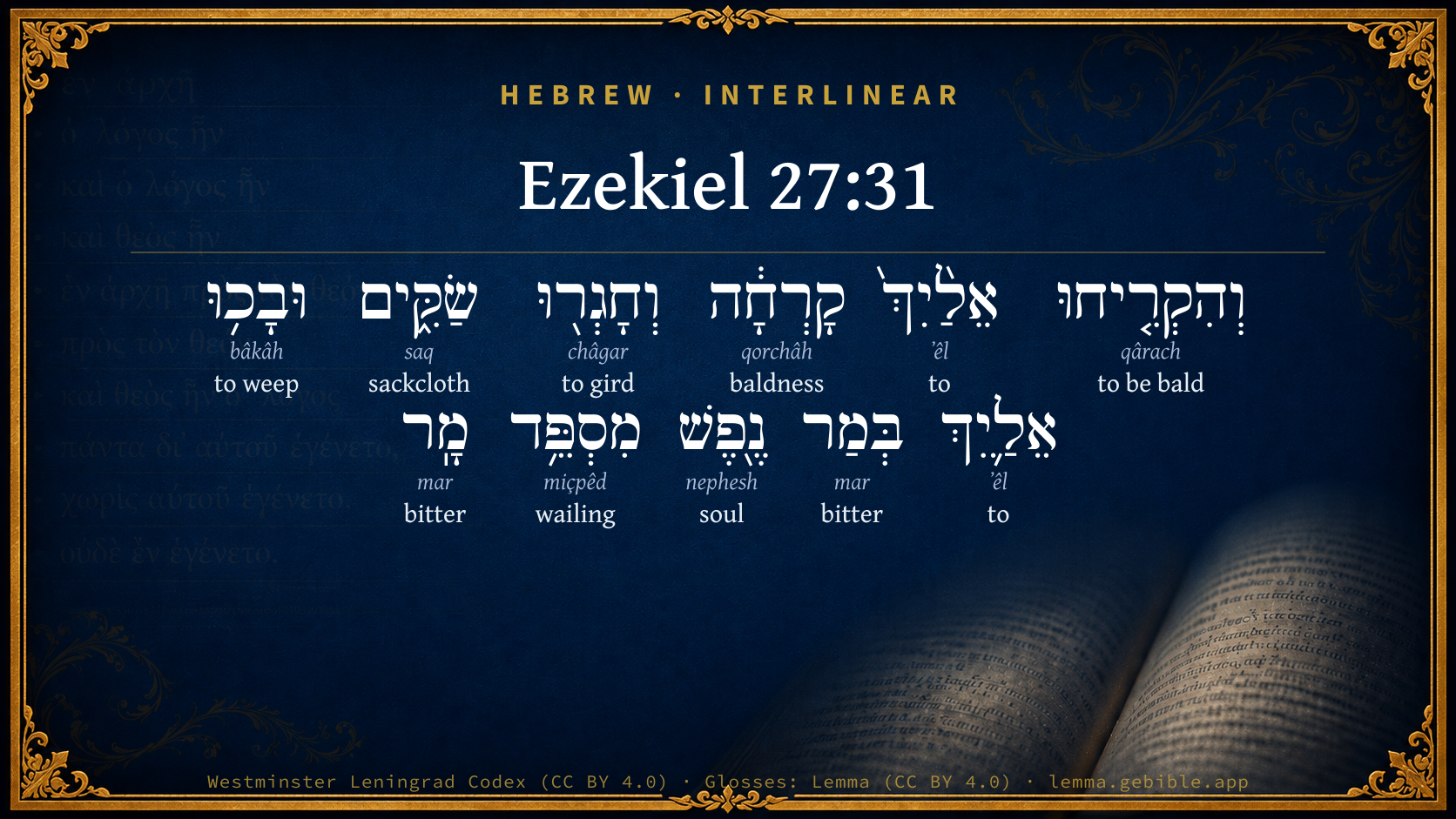
Ezekiel 27:31

Hebrew (Westminster Leningrad Codex) Ezekiel 27:31 appears in the Hebrew Old Testament. The text above is from the Westminster Leningrad Codex. Each word links to its Strong’s number, a concise gloss, and parsing drawn from the Open Scriptures Hebrew Bible morphology. Click any word for its full Brown-Driver-Briggs (BDB) entry.
Download image
Cite this verse

Ezekiel 27:31 (World English Bible). Public Domain. Lemma interlinear Bible study tool, https://lemma.gebible.app/v/ezekiel/27/31.

Show BibTeX & RIS
BibTeX
RIS
English Translation
and they shall make themselves bald for you, and gird them with sackcloth, and they shall weep for you in bitterness of soul with bitter mourning.
World English Bible · Public Domain
Download a study sheet

One document with this verse’s original text, its word-by-word gloss line, the meaning frame, cross-references with their text, attributed commentary, and full source and license credits — printable, and it pastes into notes with its structure intact.

This verse Autodidact and up

Study sheet (.html) Plain text (.txt)

A passage Seminary Student

Up to 50 verses in one chapter. A passage sheet keeps up to 6 commentary sources and 12 cross-references per verse, in the order this page ranks them, and says so on the sheet whenever that leaves anything out. Ask for a single verse and you get the Autodidact verse sheet above.

Everything on this page stays free to read, with no account — the sheet is a download of what is already on screen, not access to it.

Want to remove ads? Support Godless Engineer
Compare translations 3

The same verse in 3 English versions, stacked beneath the original-language interlinear above. Click any original word for its lexicon entry.

Each is an independent rendering of the whole verse — the interlinear is not word-aligned to these translations.

Highlighted words mark where these versions differ — a whole-verse word diff, not a word-by-word alignment.

  • World English Bible Public Domain
    and they shall make themselves bald for you, and gird them with sackcloth, and they shall weep for you in bitterness of soul with bitter mourning.
  • King James Version Public Domain
    And they shall make themselves utterly bald for thee, and gird them with sackcloth, and they shall weep for thee with bitterness of heart and bitter wailing.
  • unfoldingWord Literal Text CC BY-SA 4.0
    They will shave their heads bald for you and bind themselves with sackcloth, and they will weep bitterly over you and they will cry out.

unfoldingWord Literal Text — © unfoldingWord, licensed CC BY-SA 4.0. Word-aligned USFM3 via Door43 (git.door43.org/unfoldingWord/en_ult).

Versions to compare (up to 4)

3 of 4 selected

Show all 18 translations

Every available English version of this verse, each an independent rendering of the whole verse.

  • World English Bible Public Domain
    and they shall make themselves bald for you, and gird them with sackcloth, and they shall weep for you in bitterness of soul with bitter mourning.
  • Berean Standard Bible Public Domain
    They will shave their heads for you and wrap themselves in sackcloth. They will weep over you with anguish of soul and bitter mourning.
  • Majority Standard Bible Public Domain
    They will shave their heads for you and wrap themselves in sackcloth. They will weep over you with anguish of soul and bitter mourning.
  • King James Version Public Domain
    And they shall make themselves utterly bald for thee, and gird them with sackcloth, and they shall weep for thee with bitterness of heart and bitter wailing.
  • American Standard Version (1901) Public Domain
    and they shall make themselves bald for thee, and gird them with sackcloth, and they shall weep for thee in bitterness of soul with bitter mourning.
  • Revised Version (1885) Public Domain
    and they shall make themselves bald for thee, and gird them with sackcloth, and they shall weep for thee in bitterness of soul with bitter mourning.
  • Geneva Bible (1599) Public Domain
    They shall plucke off their heare for thee and gird them with a sackecloth, and they shall weepe for thee with sorow of heart and bitter mourning.
  • Douay-Rheims (1899) Public Domain
    And they shall shave themselves bald for thee, and shall be girded with haircloth: and they shall weep for thee with bitterness of soul, with most bitter weeping.
  • Young's Literal Translation Public Domain
    And they have made for thee baldness, And they have girded on sackcloth, And they have wept for thee, In bitterness of soul -- a bitter mourning.
  • Literal Standard Version CC BY-SA 4.0
    And they have made themselves bald for you, || And they have girded on sackcloth, || And they have wept for you, || In bitterness of soul—a bitter mourning.
  • Unlocked Literal Bible CC BY-SA 4.0
    They will shave their heads bald for you and bind themselves with sackcloth, and they will weep bitterly over you and they will cry out.
  • unfoldingWord Literal Text CC BY-SA 4.0
    They will shave their heads bald for you and bind themselves with sackcloth, and they will weep bitterly over you and they will cry out.
  • Darby Bible Public Domain
    And they shall make themselves utterly bald for thee, and gird themselves with sackcloth; and they shall weep for thee in bitterness of soul with bitter mourning.
  • World Messianic Bible Public Domain
    They will make themselves bald for you, and clothe themselves with sackcloth. They will weep for you in bitterness of soul, with bitter mourning.
  • Webster's Bible Public Domain
    And they shall make themselves utterly bald for thee, and gird themselves with sackcloth, and they shall weep for thee with bitterness of heart and bitter wailing.
  • Free Bible Version CC BY-SA 4.0
    They shave their heads for you and clothe themselves in sackcloth. They weep for you, crying out in agony and heartfelt mourning
  • Bible in Basic English Public Domain
    And they will have the hair of their heads cut off because of you, and will put haircloth on their bodies, weeping for you with bitter grief in their souls, even with bitter sorrow.
  • JPS Tanakh (1917) Public Domain
    And they shall make themselves utterly bald for thee, and gird them with sackcloth, and they shall weep for thee in bitterness of soul with bitter lamentation.

Literal Standard Version (2020), Covenant Press — licensed CC BY-SA 4.0. Text via the HelloAO Bible API (eBible.org). Unlocked Literal Bible (unfoldingWord) — licensed CC BY-SA 4.0. Text via the HelloAO Bible API (eBible.org). unfoldingWord Literal Text — © unfoldingWord, licensed CC BY-SA 4.0. Word-aligned USFM3 via Door43 (git.door43.org/unfoldingWord/en_ult). Free Bible Version, Dr. Jonathan Gallagher — licensed CC BY-SA 4.0. Text via the HelloAO Bible API (eBible.org).

Word by word

More ways to search: Search by grammar → Find every occurrence → Compare this word →

Practice this passage: Drill this verse → Learn its vocabulary →

וְהִקְרִ֤יחוּ
qârach
H7139
“and · to be bald”
Conjunction + Verb, Hiphil, Sequential Perfect, 3rd Person, Common, Plural
Part of Speech
Conjunction + Verb
Stem
Hiphil
Form
Sequential Perfect
Person
3rd Person
Gender
Common
Number
Plural
Full BDB Definition

Origin: a primitive root

TWOT: 2069

to be bald, make bald - (Qal) to make bald, make a baldness - (Niphal) to make oneself bald - (Hiphil) to make oneself bald - (Hophal) to make bald
  1. אֵלַ֨יִךְ֙ ʼêl H413 “to · you” Preposition + Suffix, Personal, 2nd Person, Feminine, Singular
  2. קָרְחָ֔ה qorchâh H7144 “baldness” Noun, Common, Feminine, Singular, Absolute
  3. וְחָגְר֖וּ châgar H2296 “and · to gird” Conjunction + Verb, Qal, Sequential Perfect, 3rd Person, Common, Plural
  4. שַׂקִּ֑ים saq H8242 “sacks” Noun, Common, Masculine, Plural, Absolute
  5. וּבָכ֥וּ bâkâh H1058 “and · to weep” Conjunction + Verb, Qal, Sequential Perfect, 3rd Person, Common, Plural
  6. אֵלַ֛יִךְ ʼêl H413 “to · you” Preposition + Suffix, Personal, 2nd Person, Feminine, Singular
  7. בְּמַר mar H4751 “in/at · bitter of” Preposition + Adjective, Adjective, Masculine, Singular, Construct
  8. נֶ֖פֶשׁ nephesh H5315 “soul” Noun, Common, Both, Singular, Absolute
  9. מִסְפֵּ֥ד miçpêd H4553 “wailing” Noun, Common, Masculine, Singular, Absolute
  10. מָֽר mar H4751 “bitter” Adjective, Adjective, Masculine, Singular, Absolute

About this verse

These counts appear in no published source. They are computed here, from the morphology-tagged text and Lemma’s own curated glosses. What Lemma adds →

11
words
9
distinct lemmas
Prophets
section

Notable vocabulary

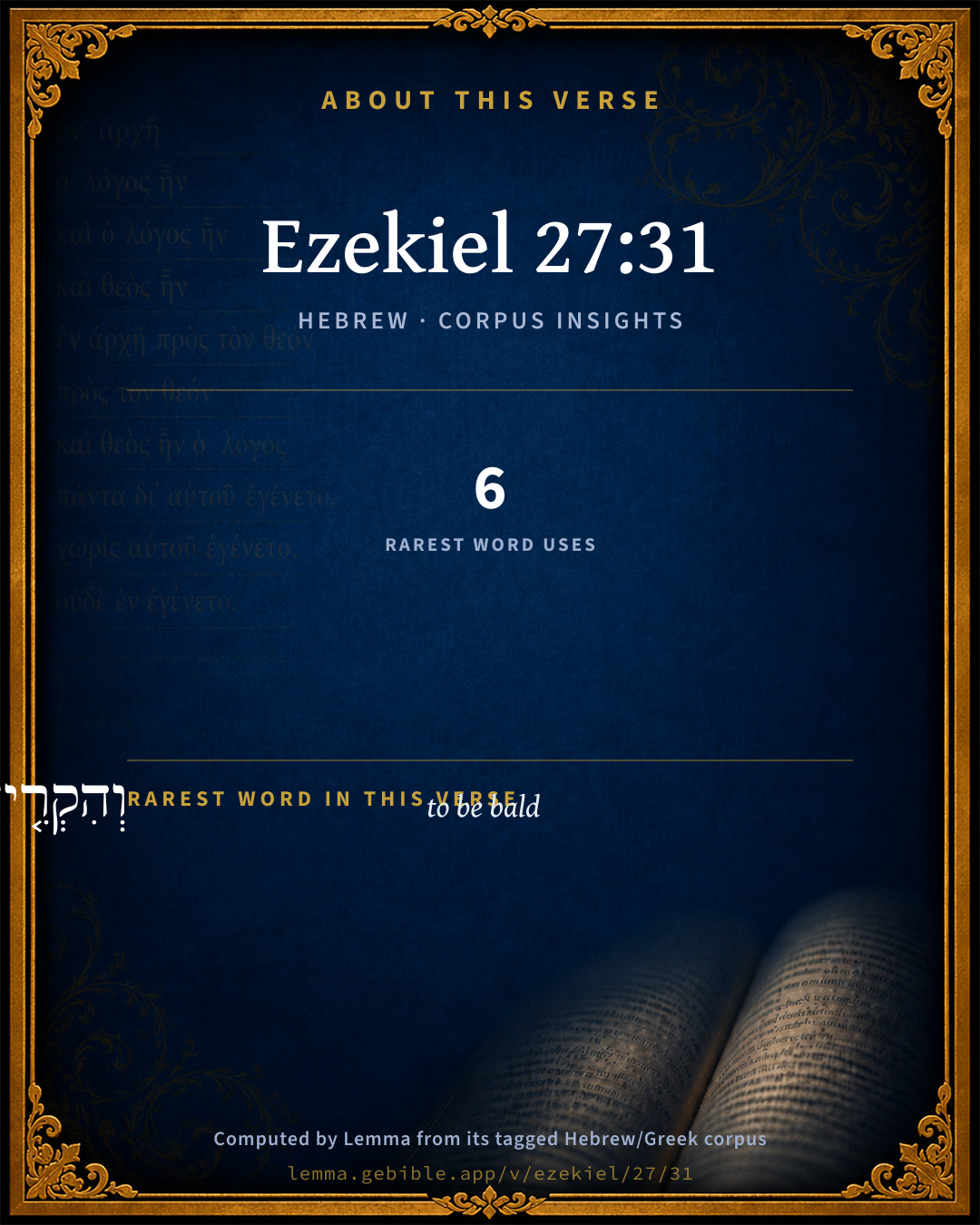
The rarest word here is וְהִקְרִ֤יחוּ to be bald H7139 — appearing just 6 times in the whole Hebrew Bible.

Shared distinctive vocabulary

וְהִקְרִ֤יחוּ to be bald H7139 occurs in 5 verses of the Hebrew Bible. Also found in:

Grammatical profile

  • 3 verbs
  • 4 nouns
  • 2 adjectives
  • 2 prepositions

Verb forms

  • וְהִקְרִ֤יחוּ Hiphil · Sequential Perfect
  • וְחָגְר֖וּ Qal · Sequential Perfect
  • וּבָכ֥וּ Qal · Sequential Perfect

Repetition

Words recur within this verse — often emphatic in Hebrew:

  • בְּמַר bitter H4751 ×2
  • אֵלַ֨יִךְ֙ to H413 ×2

Cross-references

13

Topical passages linked to Ezekiel 27:31 in the Treasury of Scripture Knowledge — connected by theme and wording, ordered by reader-vote popularity; previews shown in the World English Bible.

  • Isaiah 22:12 In that day did the Lord, Yahweh of Hosts, call to weeping, and to mourning, and to baldness, and to girding with sackcloth:
  • Ezekiel 7:18 They shall also gird themselves with sackcloth, and horror shall cover them; and shame shall be on all faces, and baldness on all their heads.
  • Isaiah 15:2 They are gone up to Bayith, and to Dibon, to the high places, to weep: Moab wails over Nebo, and over Medeba; on all their heads is baldness, every beard is cut off.
  • Isaiah 16:9 Therefore I will weep with the weeping of Jazer for the vine of Sibmah; I will water you with my tears, Heshbon, and Elealeh: for on your summer fruits and on your harvest the [battle] shout is fallen.
  • Isaiah 22:4 Therefore said I, Look away from me, I will weep bitterly; don't labor to comfort me for the destruction of the daughter of my people.
  • Leviticus 21:5 "'They shall not shave their heads, neither shall they shave off the corners of their beards, nor make any cuttings in their flesh.
  • Deuteronomy 14:1 You are the children of Yahweh your God: you shall not cut yourselves, nor make any baldness between your eyes for the dead.
  • Jeremiah 16:6 Both great and small shall die in this land; they shall not be buried, neither shall men lament for them, nor cut themselves, nor make themselves bald for them;
  • Jeremiah 47:5 Baldness is come on Gaza; Ashkelon is brought to nothing, the remnant of their valley: how long will you cut yourself?
  • Jeremiah 48:37 For every head is bald, and every beard clipped: on all the hands are cuttings, and on the loins sackcloth.
  • Amos 8:10 I will turn your feasts into mourning, And all your songs into lamentation; And I will make you wear sackcloth on all your bodies, And baldness on every head. I will make it like the mourning for an only son, And the end of it like a bitter day.
  • Micah 1:8 For this I will lament and wail; I will go stripped and naked; I will howl like the jackals, And moan like the daughters of owls.
  • Micah 1:16 Shave your heads, And cut off your hair for the children of your delight. Enlarge your baldness like the vulture; For they have gone into captivity from you!

Cross-references courtesy of OpenBible.info (CC BY 4.0).

Hebrew and Greek witnesses Masoretic Hebrew ↔ Greek Septuagint

The same verse in the two great witnesses to the Old Testament, shown verse-for-verse.

These are two independent witnesses, not word-aligned to each other, and the Septuagint is shown in lemma (dictionary) form.

Hebrew Ezekiel 27:31 Masoretic · Westminster Leningrad Codex

וְהִקְרִ֤יחוּ אֵלַ֨יִךְ֙ קָרְחָ֔ה וְחָגְר֖וּ שַׂקִּ֑ים וּבָכ֥וּ אֵלַ֛יִךְ בְּמַר נֶ֖פֶשׁ מִסְפֵּ֥ד מָֽר

and they shall make themselves bald for you, and gird them with sackcloth, and they shall weep for you in bitterness of soul with bitter mourning.

World English Bible · Public Domain

Hebrew: Westminster Leningrad Codex (CC BY 4.0). Greek: Septuagint (public domain); English from a public-domain English Septuagint. How the Septuagint differs from the Hebrew →

Targum (Aramaic paraphrase)

1

The Targum is the ancient Jewish Aramaic paraphrase of the Hebrew Scriptures — an interpretive translation, not the Hebrew text itself. Onkelos (literal) and Pseudo-Jonathan (expansive) render the Torah, and Jonathan the Prophets. Coverage is partial: where no permissively-licensed English translation exists for a verse, only the Aramaic is shown. This is verse-level text, not a word-by-word alignment to the Hebrew.

  1. Targum Jonathan Prophets (Joshua–Malachi)
    וְיִמְרְטוּן עֲלָךְ מְרַט וְיֵיסְרוּן סַקִין וְיִבְכּוּן עֲלָךְ בִּמְרִיר נְפַשׁ וְיַעְבְּדוּן מִסְפַּד מְרִיר:

    (no public-domain English translation for this verse)

    Targum Jonathan — Aramaic: “Mikraot Gedolot” (public domain). English: “Sefaria Community Translation” (CC0 1.0 (public-domain dedication)); “London "Chaldee Paraphrase," 1871” (public domain). Text via Sefaria.

Commentary

Notes on Ezekiel 27:31 from classic Christian and Jewish commentators (each source and its license shown beneath its notes). The classic Christian expositions comment on the surrounding passage and are grouped to its opening verse, so a note may address several verses; the Jewish commentaries on the Tanakh (Rashi and others) are per-verse, so they appear only where the commentator wrote on this verse.

Lemma curates 59 commentaries, every one of them public domain or Creative Commons licensed, each selected and text-cleaned for this edition rather than reprinted as found. About our sources →

Trapp's Complete Commentary

John Trapp

Eze 27:31 And they shall make themselves utterly bald for thee, and gird them with sackcloth, and they shall weep for thee with bitterness of heart [and] bitter wailing.

Ver. 31. And they shall make.] Moerebunt induti saccis, inducto calvitio. If this had been for sin, as it is offensivum Dei, et aversivum a Deo, then it had been right.

John Trapp, A Commentary or Exposition upon All the Books of the Old and New Testament (1647–1656) — public domain. Text from a community e-Sword module.

Jamieson, Fausset & Brown

Robert Jamieson, A. R. Fausset & David Brown

utterly bald--literally, "bald with baldness." The Phœnician custom in mourning; which, as being connected with heathenish superstitions, was forbidden to Israel (Deu 14:1).

take up--lift up.

the destroyed--a destroyed one. Literally, (as opposed to its previous bustle of thronging merchants and mariners, Eze 27:27), "one brought to death's stillness."

in . . . midst of . . . sea--insular Tyre.

Jamieson, Fausset & Brown — Commentary Critical and Explanatory on the Whole Bible (1871) — public domain (CC PDM 1.0). Text via the HelloAO Bible API.

The Cambridge Bible for Schools and Colleges

gen. ed. J. J. S. Perowne

31. For these signs of grief cf. ch. Eze_7:18; Isa_15:2; Isa_22:12; Jer_16:16; Jer_47:5; Mic_1:16.

The Cambridge Bible for Schools and Colleges (gen. ed. J. J. S. Perowne; Cambridge University Press, 1878–1918) — public domain. Text from a community e-Sword module.

John Gill's Exposition

And in their wailing they shall takes up a lamentation for thee,.... A mournful song, such as was used at funerals, or in times of calamity; and so the Vulgate Latin version renders it:

and lament over thee; saying the following ditty;

what city is like Tyrus, like the destroyed in the midst of the sea? as there was none like it a few years ago for riches, splendour, and glory, so now there is none like it for misery and ruin; see Rev 18:18. The Targum is,

"who is as Tyre? there is none like unto her in the midst of the sea;''

she is not now Tyre the renowned, but Tyre the destroyed; destroyed in the midst of the sea, from whence she had her riches and her glory: or, "as one dumb or silent in the midst of the sea"; she, in whom was heard the voice of joy and singing, is now mute, and nothing more of that kind is heard in her see Rev 18:22.

John Gill's Exposition of the Whole Bible (1746–1763) — public domain (CC PDM 1.0). Text via the HelloAO Bible API.

Albert Barnes' Notes on the Bible

Utterly bald - See Eze 7:18 note.

Albert Barnes' Notes on the Bible (1834–1885) — public domain. Text from a community e-Sword/MySword module.

Matthew Poole's English Annotations

It was the custom of the heathen, to either pull off with their hands, or cut off, the hair of their heads in great mournings, which God forbade to his people, Lev 21:5; Deu 14:1. Thus do Tyre’s mourners in baldness express their sorrow and despair. Gird them with sackcloth; another usual ceremony of mourners, well known to all.

With bitterness of heart; it shall be a hearty mourning, not a counterfeit one; this referring to the inward grief, the next bitter wailing refers to the outward expressing it.

Matthew Poole's English Annotations on the Holy Bible (1683–1685) — public domain. Text from a community e-Sword/MySword module.

unfoldingWord translationNotes

Door43 World Missions Community

Connecting Statement:

Yahweh continues giving Ezekiel his message to Tyre. The city of Tyre continues to be described as if it were a wrecked ship. (See: Metaphor)

General Information:

The word "they" in these verses refer to the people mentioned in verses 28 and 29. The words "you" and "your" refer to Tyre.

They will shave their heads bald for you and bind themselves with sackcloth

These are expressions of grieving and mourning. (See: Symbolic Action)

bald

having no hair on the head

They will lift up their wails of lamentation

The abstract noun "lamentation" can be translated using the verb "lament." AT: "They will cry out and lament" (See: Abstract Nouns)

sing dirges

"sing funeral songs"

Who is like Tyre, who has now been brought to silence in the middle of the sea?

This question expects a negative answer and emphasizes Tyre being different from all other cities. It can be expressed as a statement. AT: "No other city is like Tyre, who has now been brought to silence in the middle of the sea." (See: Rhetorical Question)

who has now been brought to silence

This can be expressed in active form. AT: "who its enemies have now silenced" (See: Active or Passive)

When your merchandise went ashore

This can be expressed in active form. AT: "When people brought your merchandise ashore" (See: Active or Passive)

ashore

"onto the land"

you enriched the kings of the earth

"you made the kings of the earth rich"

translationWords

sackcloth

lament

Tyre

people group

king

earth

unfoldingWord translationNotes — © Distant Shores Media and the Door43 World Missions Community, licensed CC BY-SA 4.0. Source: git.door43.org/Door43/en_tn.

Lesson kit

Teaching starters — assembled from the data on this page, not authored interpretation. Every prompt links to the verse data it draws on. Edit before teaching.

Ezekiel, in the Prophets, opens this verse with 11 words (9 distinct Hebrew lemmas). Its most distinctive word is qârach (“to be bald”). A historical commentator’s framing appears above. Read the whole chapter for the surrounding context.

Discussion questions

  1. What does “to be bald” (qârach) contribute to the verse as a whole?
  2. Leviticus 21:5 shares the word «to be bald» with this verse. How do the two illuminate each other?
  3. “bitter” occurs 2× in this one verse. What is the effect of the repetition?
  4. These translations render this verse differently. What is at stake in choosing one wording over another?
  5. The verb «וְהִקְרִ֤יחוּ» is Hiphil Sequential Perfect. How does its form color the action?
  6. Reading how Trapp's Complete Commentary and Jamieson, Fausset & Brown read this verse, where do the two commentators agree and where do they part?

Things to notice

Reading settings

Reading text

Shown beneath each verse's original-language words.

Old Testament
Old Testament edition

Read the OT as the Masoretic Hebrew (MT) or the Greek Septuagint (LXX).

English shown for the Greek Septuagint (in the Hebrew ↔ Greek comparison).

Comparing translations? Open the Compare panel on any verse page to stack up to four side by side.