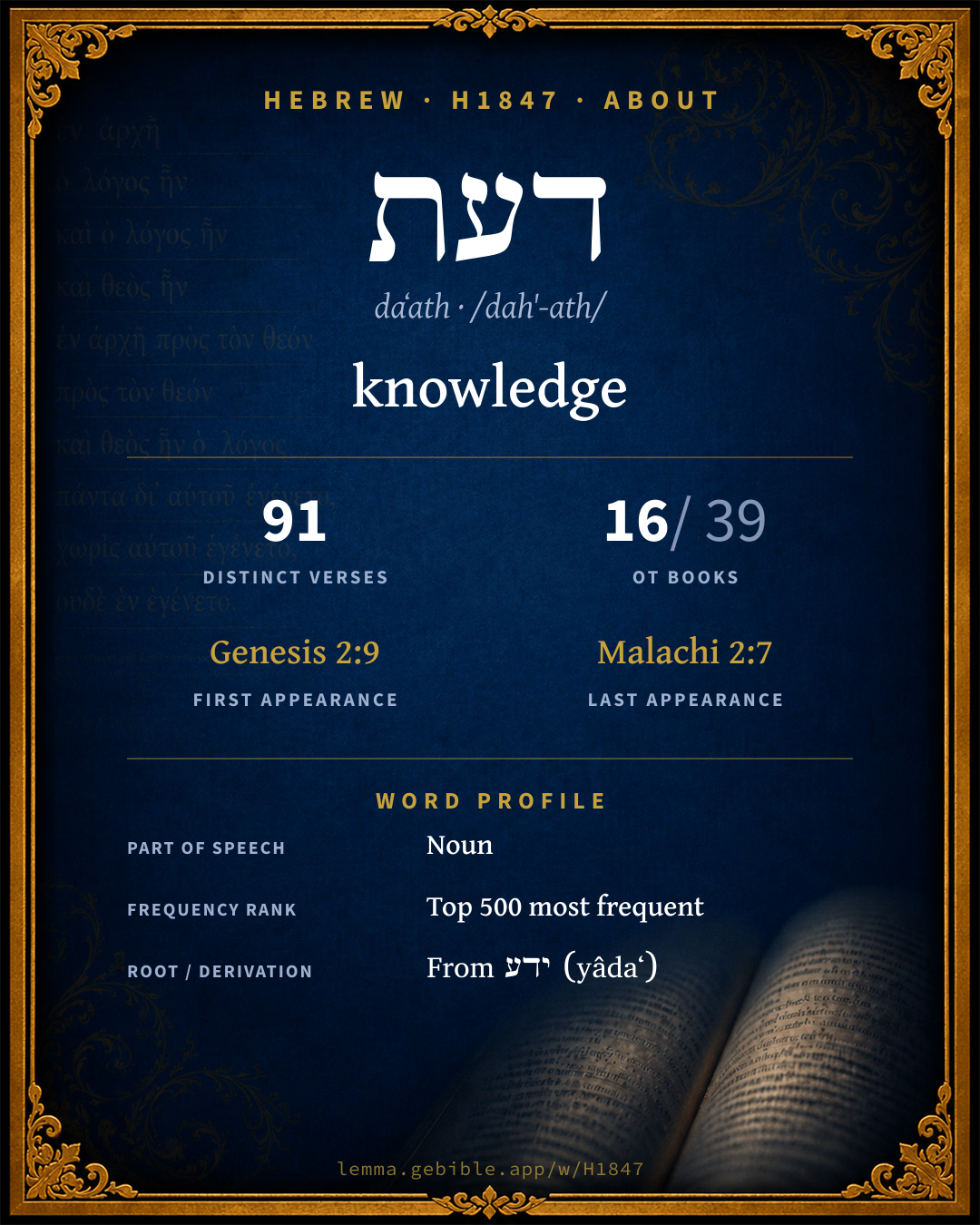
דַּ֫עַת
knowledge
‘knowledge’ is one of 3 main senses fuller range ↓
Full lexicon entry — Brown-Driver-Briggs (BDB)
From Brown-Driver-Briggs (BDB)
Where this word appears
See every Construct-state word in the Hebrew Bible →
Grammar key — what these labels mean
Part of speech
- Noun
- A naming word — a person, place, thing, or idea.
- Verb
- An action or state-of-being word.
Noun type
- Common
- A common noun — a general class of person, place, or thing (“king,” “city,” “water”), not a specific name.
Stem
- Qal
- The basic, simple active stem — the plain form of the verb (“he wrote”).
Form
- Infinitive Construct
- A bound verbal noun, frequently with prepositions (“to write / in writing”).
State
- Absolute
- The independent form of a noun, not bound to a following word.
- Construct
- A noun bound to a following noun in a possessive / “of” relationship (the construct chain).
Gender
- Feminine
- Grammatically feminine.
Number
- Singular
- One.
2 verses where H1847 appears in the Construct state in the Book of Hosea. Filtered view — show all forms. Click any verse to open its interlinear word-by-word view. Verse text shown in the World English Bible for context — . Each verse’s Hebrew form is shown with its reference; the English is not keyword-highlighted, since the data carries no word-level English alignment. Use “Compare translations” on any verse to read it across multiple English versions. This concordance covers the Hebrew Bible; Septuagint (Greek Old Testament) occurrences are not indexed here.
Hosea
- Hosea 4:1 דַּ֥עַת n c fs cs Hear the word of Yahweh, you children of Israel; For Yahweh has a charge against the inhabitants of the land: "Indeed there is no truth, Nor goodness, Nor knowledge of God in the land.
- Hosea 6:6 וְ/דַ֥עַת conj + n c fs cs For I desire mercy, and not sacrifice; And the knowledge of God more than burnt offerings.
About this entry
At a glance — auto-summarized from this page’s data, not written by a person. Every figure links to its source below. This summary describes the numbers; it doesn’t interpret them.
“knowledge” is the headline sense of the Hebrew noun דעת (daʻath). First canonically at Genesis 2:9, it enters the text early. It appears 91 verses across 16 books of the Hebrew Bible, among its moderately common vocabulary. More than a third of its appearances fall in Proverbs. Its meaning spans more than one sense — see its full sense range. See the sense tree, 91-verse concordance, and the renderings breakdown below.
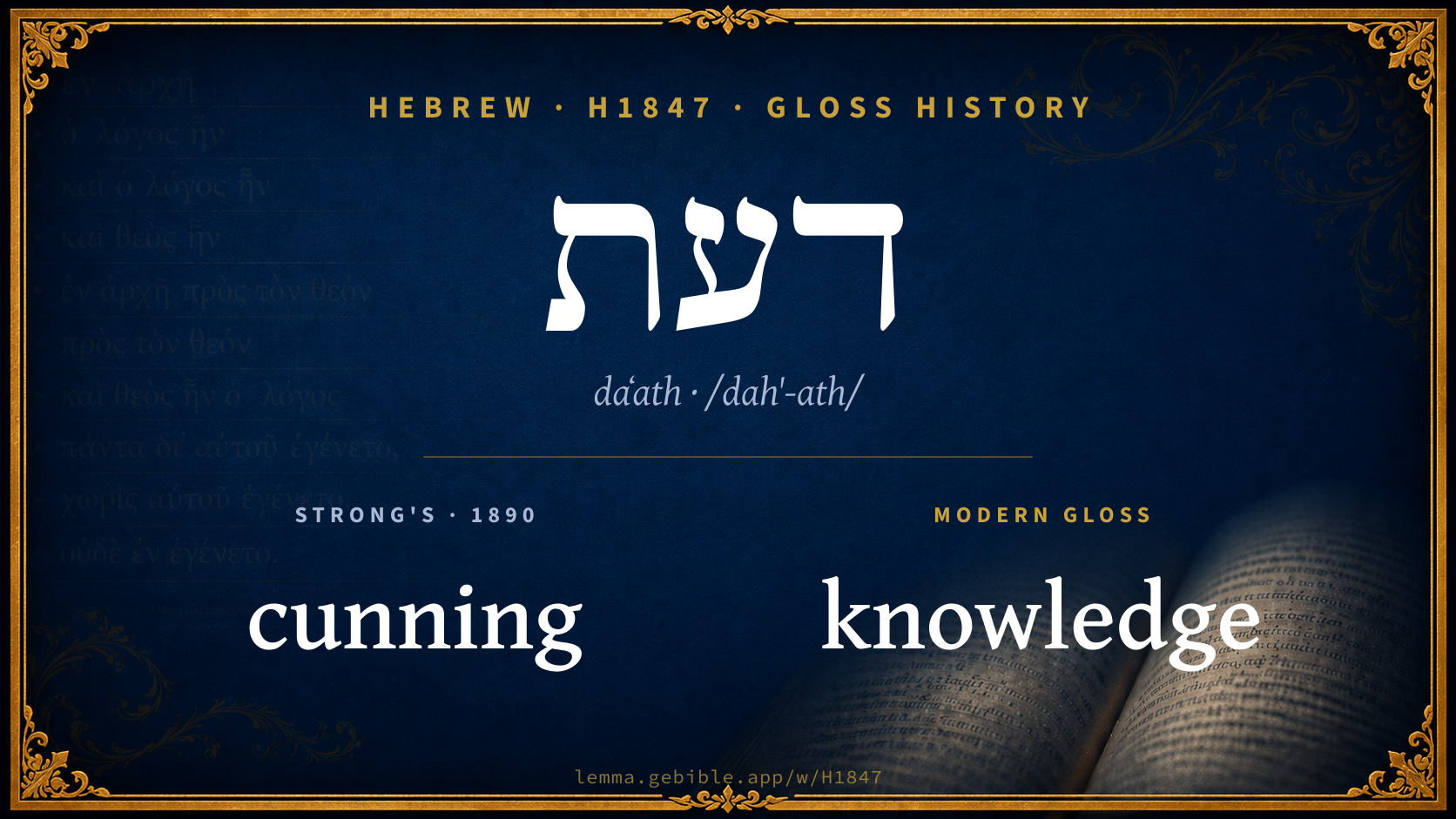
Gloss history
Strong's 1890 vs modern scholarship
About this word
Strong's H1847 catalogs a Hebrew word from the Hebrew Old Testament.
These counts are not copied from any lexicon or concordance. They are computed here, from the morphology-tagged Hebrew Old Testament. What Lemma adds →
- 91
- distinct verses
- The word appears in 91 distinct verses.
- 16 / 39
- OT books
- The word appears in 16 of 39 Old Testament books.
- #446
- by frequency
- Top 500 most frequent Hebrew words (rank 446 of 8,640 Hebrew words by occurrence).
View all 91 occurrences in the concordance →
By section of the Old Testament
By traditional corpus
Conventional, traditional groupings — biblical authorship is debated, so this is a traditional corpus grouping, not an authorship claim. Each share is this word’s portion of its verses in that division of the Hebrew canon. Each figure is a share of the word’s 91 distinct verses.
- Writings (Ketuvim) 63 verses · 69%
- Prophets (Nevi'im) 21 verses · 23%
- Torah (Pentateuch) 7 verses · 8%
How translations render this word
Counts come from each version’s own published word-to-Strong’s tagging or interlinear alignment — an approximate guide to how each version renders this word, not a word-level alignment the data otherwise carries. Because each total is that version’s own tagged count, the per-version totals vary from one another and need not match the appearance or distinct-verse counts above. These counts may also differ from a printed concordance because Lemma counts each distinctly tagged rendering and does not collapse phrase taggings into a single head-word total. This is a fixed set of word-tagged versions (KJV, ASV, BSB, ULT) and does not change with the reading translation you choose elsewhere. Each version’s license is shown beside its name below (and on Sources).
BDB lists this Strong’s number as 2 distinct words (homographs). Each count above pools all of them and is not split by sense — see the Senses section below. A low-frequency rendering may belong to a different one of those words, not the primary meaning.
- King James Version†: Knowledge 69×, Without knowledge 4×, Know 2×
- American Standard Version†: Knowledge 59×, Without knowledge 4×, Is without knowledge 2×
- Berean Standard Bible†: Knowledge 62×, Devoid of knowledge 2×, Know 2×
- unfoldingWord Literal Text†: Knowledge 69×, Knowledge of 13×, And 4×
King James Version Public Domain
Renders H1847 across 90† tagged occurrences — most commonly:
Plus 15 renderings that appear only once — usually multi-word phrases or single function words the recovered tagging swept in, not distinct renderings. Not rendered by a distinct English word in 3 further occurrences.
American Standard Version Public Domain
Renders H1847 across 90† tagged occurrences — most commonly:
Plus 21 renderings that appear only once — usually multi-word phrases or single function words the recovered tagging swept in, not distinct renderings.
Berean Standard Bible Public Domain
Renders H1847 across 84† tagged occurrences — most commonly:
Plus 14 renderings that appear only once — usually multi-word phrases or single function words the recovered tagging swept in, not distinct renderings. Not rendered by a distinct English word in 7 further occurrences.
unfoldingWord Literal Text CC BY-SA 4.0
Renders H1847 across 98† tagged occurrences — most commonly:
Plus 12 renderings that appear only once — usually multi-word phrases or single function words the recovered tagging swept in, not distinct renderings.
10 senses and sub-senses in the full BDB
What do BDB’s symbols mean?
BDB uses these scholarly abbreviations:
| Symbol | Meaning |
|---|---|
| 𝔊 | the Septuagint (the ancient Greek translation, LXX) |
| 𝔙 | the Vulgate (the Latin translation) |
| 𝔖 | the Syriac version (the Peshitta) |
| 𝔗 | the Targum (the Aramaic translation) |
| ψ | the Psalms |
| √ | root (the underlying root or stem) |
| ‖ | parallel passage (a synonymous or contrasted parallel) |
| † | the dagger: every passage where the word occurs is cited |
The 10 senses and sub-senses the full Brown-Driver-Briggs lexicon distinguishes for this word, in lexicon order (not ranked by frequency), with BDB’s own verbatim wording and sub-sense lettering. Shown in Hebrew script with BDB’s own scholarly abbreviations. The condensed entry is in the Lexicon Entry tab. See also the Forms in the corpus table below.
- 1.
- a. knowledge, perception in phrase בִּבְלִי ד׳ Dt 4:42 = unintentionally, 19:4 Jos 20:3 (where P’s synonym is בִּשְׁגָגָה v 3, 9, cf. Nu 35:11, 15), v 5; without knowing מִבְּלִי ד׳ Is 5:13 (= before they knew it, suddenly). e.g. Deuteronomy 4:42
- b. = skill (in workmanship) Ex 31:3; 35:31 (both P; both ‖ תְּבוּנָה and חָכְמָה), 1 K 7:14 (sq. inf.); creative skill Is 40:14 (‖ אֹרַח מִשְׁפָּט, דֶּרֶךְ תְּבוּנוֹת). e.g. Exodus 31:3
- c. of proph. knowledge יֹדֵעַ ד׳ עליון Nu 24:16 (JE), cf. ψ 19:3. e.g. Numbers 24:16
- d. especially knowledge with moral quality Gn 2:9, 17 (J; in both verbal force, הַדּ׳ טוֹב וָרַע the knowing good and evil). e.g. Genesis 2:9
- e. knowledge possessed by God Jb 10:7 ψ 139:6 Pr 3:20 (‖ חָכְמָה and תְּבוּנָה), 21:12; taught by God to men ψ 94:10; 119:66 (‖ טוּב טַעַם), Pr 2:6 (‖ תְּבוּנָה and חָכְמָה). f. דַּעַת־רוּחַ = windy (unreal) knowledge Jb 15:2. e.g. Job 10:7
- 2. especially in WisdLt = discernment, understanding, wisdom:
- a. Jb 13:2; 33:3 (ד׳ שְׂפָתַי), לֹא בְּדַעַת Jb 34:35 (‖ חכמה), Pr 8:9, 10 (‖ מוסר), 10:14; 11:9; 18:15(×15); 22:12; 29:7, cf. Is 32:4; 53:11 Je 10:14 = 51:17; בבלי דעת Jb 35:16; 36:12; בלי ד׳ 38:2; 42:3, בְּלֹא ד׳ Pr 19:2; ‖ תְּבוּנָה Pr 17:27; Is 44:19; ת׳ + חכמה Pr 24:4, ‖ מְזִמָּה Pr 1:4; 5:2; ד׳ מְזִמּוֹת 8:12; ‖ vb. עָרַם 19:25; ‖ מֹצֵעוֹת 22:20; ‖ מוּסָר 12:1; 19:27; 23:12; ‖ תּוֹרָה Mal 2:7; ‖ חכמה Pr 14:6; Ec 1:16, 18; 2:21, 26; 7:12; 9:10; connected with חָכָם Pr 21:11; Ec 12:9; דברי חכמים Pr 22:17; Is 33:6 (חכמת) Is 44:25 (חכמים); wisdom of magicians 47:10 Dn 1:4 (‖ חָכְמָה and מַדָּע). e.g. Job 13:2
- b. in highest sense, knowledge of God (incl. obedience) Ho 4:1, 6 (מִבְּלִי הַדַּעַת), v 6; 6:6 Jb 21:14; Pr 2:5 (‖ יראת י׳), so Is 11:2; 58:2; Je 22:16 (verbal force, c. acc.), Pr 9:10 (ד׳ קדשׁים, ‖ יראת י׳), 30:3 (id., ‖ חָכְמָה); v. also יִרְאַת י׳ ראשׁית ד׳ 1:7 (‖ חָכְמָה מוּסָר), v 22, 29 (‖ יִרְאַת י׳), 2:10 (‖ חָכְמָה). e.g. Hosea 4:1
- c. opp. אִוֶּלֶת Pr 12:23; 13:16; 14:18; 15:2 cf. v 7, also v 14. e.g. Proverbs 12:23
- d. שִׂפְתֵי־ד׳ Pr 14:7; 20:15; אישׁ ד׳ 24:5 (‖ גֶּבֶר חָכָם).—Dn 12:4 is dub.; 𝔊 Bev read ותרבה הָרָעֹת. e.g. Proverbs 14:7
Senses from the full Brown-Driver-Briggs lexicon (Brown, Driver, Briggs; Oxford 1906 — public domain), digitized via Sefaria, supplemented by the OpenScriptures HebrewLexicon (CC BY 4.0). Full attribution on Sources.
Word origin
n.f. ψ 139:6 Dn 12:4 (m. Pr 2:10; 14:6, poss. Jb 33:3 Ew§ 174 g) knowledge (proposes Inf., which appears clearly Gn 2:9, 17 Je 22:16)—abs. דַּ֫עַת Gn 2:9 + 35 times; דָּ֑עַת Jos 20:3 + 35 times; cstr. דַּ֫עַת Nu 24:16 + 10 times; sf. דַּעְתִּי Pr 22:17; דַּעְתְּךָ Jb 10:7; דַּעְתֵּךְ Is 47:10; דַּעְתּוֹ Pr 3:20 Is 53:11; דַּעְתְּכֶם Jb 13:2; דַּעְתָּם Is 44:25;—
— Brown-Driver-Briggs (Oxford 1906, public domain), digitized via Sefaria, supplemented by the OpenScriptures HebrewLexicon (CC BY 4.0). See Sources.
Derived from ידע (yâdaʻ) (H3045) — to know.
Jastrow Dictionary
A second Hebrew/Aramaic lexicon for comparison, covering Aramaic and post-biblical (Talmudic, Targumic, Midrashic) usage that the biblical-Hebrew BDB does not. Matched by lemma rather than by Strong’s number, so a lemma may carry more than one Jastrow headword (shown separately below), and the entries cover usage well beyond the Bible.
דַּעַת
- v. דֵּעָה) knowledge, mind; temperament, physical disposition, constitution. עלתה על ד׳ to occur to one’s mind, to strike. Sot. IX, 6 (45ᵇ); a. fr.—שיקול הד׳ weighing of opinions, i.e. decision between opposite views. Snh. 6ᵃ טעה בש׳ הד׳ made a mistake in deciding, against the common practice, a case concerning which there are opposite authorities, opp. to a decision against an established law; ib. 33ᵃ; Y. Keth. IX, 33ᵃ; Y. Snh. I, 18ᵃ bot.—Y. Ḥag. II, 77ᵇ top אין דַּעְתָּן נקיה their mind is not pure (unfit to study esoterics).—B. Mets. 11ᵇ, a. e. ד׳ אחרת מקנה a deputized person (or fictitious person, e.g. one’s ground) can take possession. Snh. 25ᵃ sq. תולה בד׳ עצמו one who makes the chance of a game dependent on his own action, e.g. throwing dice, תולה בד׳ יונו who makes it dependent on his dove’s flight.—Tosef. Ḥull. VII, 1 וד׳ מכרעת reason decides in favor &c.; Ḥull. 90ᵇ מאי ד׳ ד׳ תורה by saying ‘reason decides’ does he mean a reasonable interpretation of the Biblical law, or is he in doubt and ‘reason decides’ means ד׳ נוטה his opinion inclines in favor of &c.?—מִדַּ׳, לַדַּ׳ with the consent of, with the knowledge of, opp. בעל כרח־, v. כּוֹרַח. Kidd. 44ᵃ מד׳ אביה with her father’s consent; מִדַּעְתָּהּ with her consent. Ib. שלא לד׳ אביה without her father’s consent; a. fr.—ד׳ יפה good physical constitution, מי שדעתו י׳ not fastidious in taste, opp. אִיסְתְּנִיס q. v.—ד׳ קצרה impatience, greed, ד׳ רחבה contentedness. B. Bath. 145ᵇ bot.; Snh. 101ᵃ top.—Ber. 29ᵇ דַּעְתָּם קצרה they are impatient (Rashi: they do not understand how to express their wishes).—Pes. 113ᵇ אין הד׳ סובלתן whom the mind cannot endure; a. fr.—Pl. דֵּעוֹת, v. דֵּעָה.
A Dictionary of the Targumim, the Talmud Babli and Yerushalmi, and the Midrashic Literature (Marcus Jastrow; London, Luzac, 1903) — Public Domain. Digitized via Sefaria. Digitized via Sefaria. Full attribution on Sources.
Forms in the corpus
The 46 distinct written forms H1847 takes in the Hebrew Bible, most frequent first — each parse links to that state’s occurrences in the concordance. Hebrew forms include their vowel points and cantillation, so a single lemma takes many written forms.
Same root — word family
Other BDB entries built from the same root as H1847, grouped by Strong’s listed origin. These share a root / origin per the lexicon — not necessarily a shared meaning. Each links to that word’s own entry.
Derives from
Shares the same root
- דע dêaʻ H1843 knowledge
- ידע yᵉdaʻ H3046 to know
- ידעני yiddᵉʻônîy H3049 soothsayer
- מדע maddâʻ H4093 knowledge
- מודע môwdaʻ H4129 kinsman
- מודעת môwdaʻath H4130 kindred
Proper names from this root
People and places named from this root — a name, not an additional meaning of the word.
- דעואל Dᵉʻûwʼêl H1845 Deuel
- ידוע Yaddûwaʻ H3037 Jaddua
- ידיעאל Yᵉdîyʻăʼêl H3043 Jediael
- ידע Yâdâʻ H3047 Jada
- ידעיה Yᵉdaʻyâh H3048 Jedaiah
Compare all same-root words → Showing 4 of 13 — not the complete family. 5 of the same-root words are proper names (people or places). They share a root, not necessarily a meaning.
Septuagint verse parallels
This word appears in 89 verses that also exist in the Greek Old Testament (Septuagint), out of the 91 Hebrew verses it occurs in. You can read those verses in Greek by switching the Old Testament edition to the Septuagint.
Read these verses in the Septuagint
- Genesis 2:9
- Exodus 31:3
- Numbers 24:16
- Deuteronomy 4:42
- Joshua 20:3
- Judges 3:2
- 1 Kings 7:14
- Job 10:7
- Psalms 19:2
- Proverbs 1:4
- Ecclesiastes 1:16
- Isaiah 5:13
This is a verse-level parallel only — the same verses exist in both the Hebrew and Greek Old Testaments. No word-level Hebrew↔Greek correspondence is claimed: the data carries no such alignment, so no Greek word is shown as this Hebrew word’s translation. Coverage is not total — the Septuagint omits the deuterocanon and renumbers the Psalms, so some Hebrew verses have no direct Greek parallel.