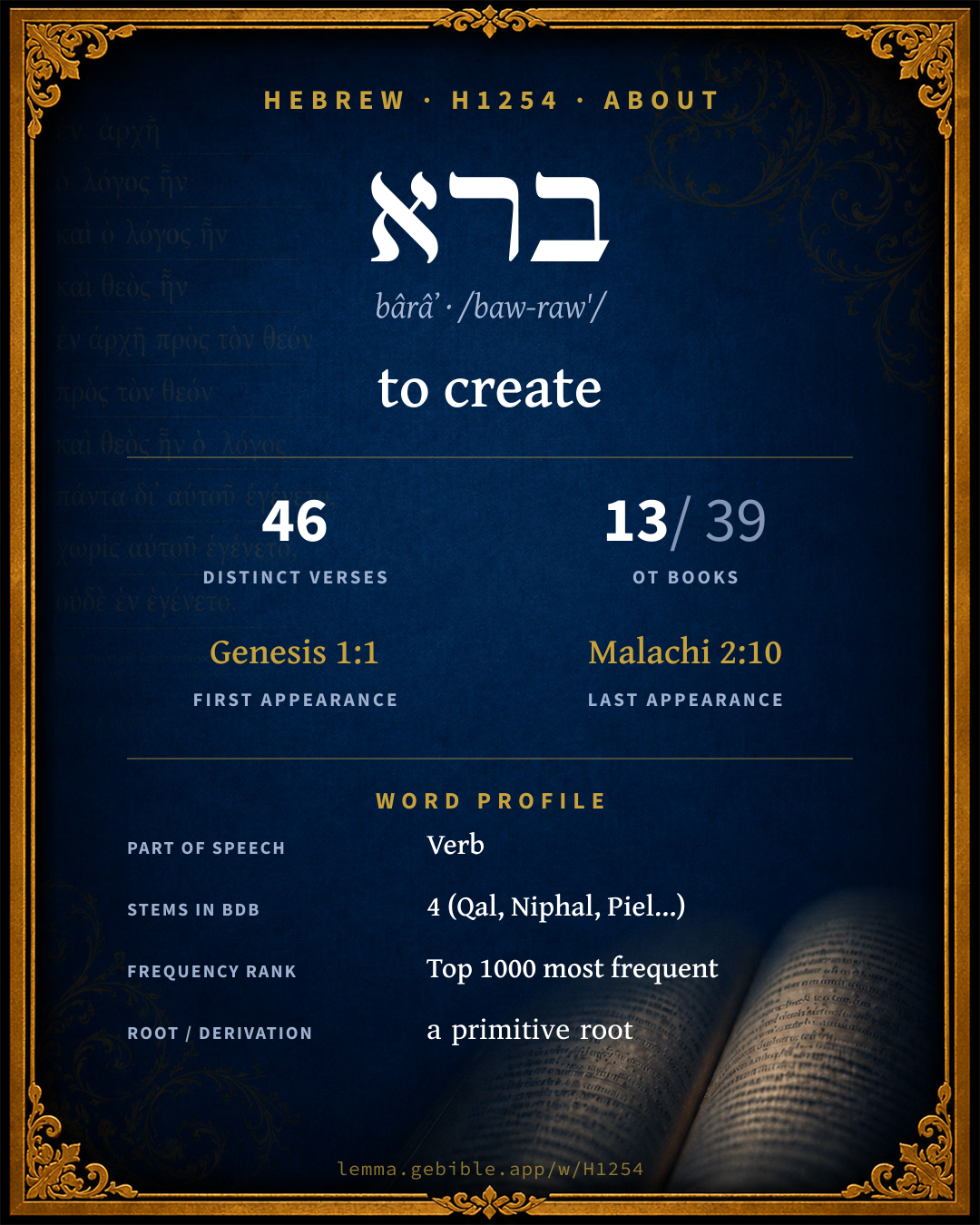
בָּרָא
to create
also: shape, form fuller range ↓
Full lexicon entry — Brown-Driver-Briggs (BDB)
From Brown-Driver-Briggs (BDB)
Where this word appears
See every Niphal verb in the Hebrew Bible →
Grammar key — what these labels mean
Part of speech
- Verb
- An action or state-of-being word.
Stem
- Qal
- The basic, simple active stem — the plain form of the verb (“he wrote”). Here: ‘obj. heaven and earth Gn 1’
- Niphal
- Usually the simple passive or reflexive of the Qal (“he was written”). Here: ‘be created’
- Piel
- An intensive or resultative active stem. Here: ‘cut down’
- Hiphil
- The causative active stem (“he caused / brought about”).
Form
- Perfect
- A completed action or state — Hebrew marks aspect (completeness) more than strict tense (“he wrote”).
- Participle Active
- A verbal adjective expressing ongoing or characteristic action (“writing / one who writes”).
- Sequential Imperfect
- An imperfect with prefixed waw — the standard past-narrative form (waw-consecutive imperfect).
- Infinitive Absolute
- An unbound verbal noun, often intensifying or standing in for a finite verb.
- Sequential Perfect
- A perfect with prefixed waw continuing a preceding imperfect or command (waw-consecutive perfect).
- Infinitive Construct
- A bound verbal noun, frequently with prepositions (“to write / in writing”).
- Imperfect
- An incomplete, ongoing, or future action (“he will / would write”).
- Imperative
- A direct command (“write!”).
State
- Absolute
- The independent form of a noun, not bound to a following word.
- Construct
- A noun bound to a following noun in a possessive / “of” relationship (the construct chain).
Person
- 3rd Person
- The one spoken about (“he / she / it / they”).
- 1st Person
- The speaker (“I / we”).
- 2nd Person
- The one addressed (“you”).
Gender
- Masculine
- Grammatically masculine.
- Common
- Either gender — not distinguished for this form.
- Feminine
- Grammatically feminine.
Number
- Singular
- One.
- Plural
- More than one (in Hebrew, generally three or more).
3 verses where H1254 appears in the Niphal stem in the Book of Ezekiel. Filtered view — show all forms. Click any verse to open its interlinear word-by-word view. Verse text shown in the World English Bible for context — . Each verse’s Hebrew form is shown with its reference; the English is not keyword-highlighted, since the data carries no word-level English alignment. Use “Compare translations” on any verse to read it across multiple English versions. This concordance covers the Hebrew Bible; Septuagint (Greek Old Testament) occurrences are not indexed here.
Ezekiel
- Ezekiel 21:30 נִבְרֵ֛את Niphal pf 2fs Cause it to return into its sheath. In the place where you were created, in the land of your birth, will I judge you.
- Ezekiel 28:13 הִבָּרַאֲ/ךָ֖ Niphal inf.cs + sfx pers 2ms You were in Eden, the garden of God; every precious stone adorned you: ruby, topaz, emerald, chrysolite, onx, jasper, sapphire, turquoise, and beryl. Gold work of tambourines and of pipes was in you. In the day that you were created they were prepared.
- Ezekiel 28:15 הִבָּֽרְאָ֑/ךְ Niphal inf.cs + sfx pers 2fs You were perfect in your ways from the day that you were created, until unrighteousness was found in you.
About this entry
At a glance — auto-summarized from this page’s data, not written by a person. Every figure links to its source below. This summary describes the numbers; it doesn’t interpret them.
The Hebrew verb ברא centers on the idea of “to create.” Across 4 stems, its meaning turns on the binyan (Qal, Niphal). It turns up in 46 verses across 13 books, a moderately common footprint. The word gravitates to Isaiah (37%), then Genesis and Psalms. Its earliest occurrence is Genesis 1:1. For the data behind this summary, explore the sense tree and the renderings breakdown below.
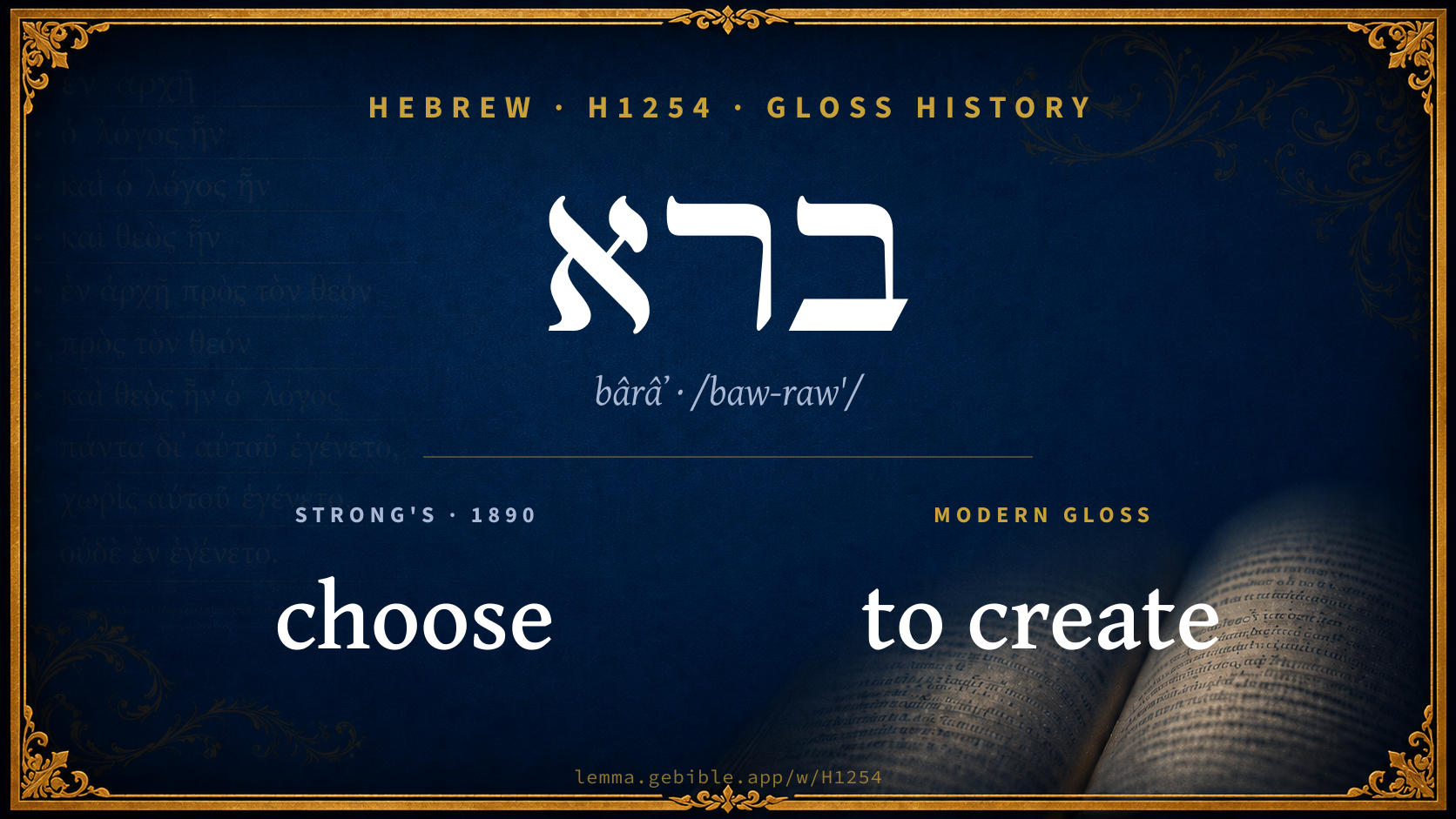
Gloss history
Strong's 1890 vs modern scholarship
About this word
Strong's H1254 catalogs a Hebrew word from the Hebrew Old Testament.
These counts are not copied from any lexicon or concordance. They are computed here, from the morphology-tagged Hebrew Old Testament. What Lemma adds →
- 46
- distinct verses
- The word appears in 46 distinct verses.
- 13 / 39
- OT books
- The word appears in 13 of 39 Old Testament books.
- #696
- by frequency
- Top 1000 most frequent Hebrew words (rank 696 of 8,640 Hebrew words by occurrence).
View all 46 occurrences in the concordance →
By section of the Old Testament
By traditional corpus
Conventional, traditional groupings — biblical authorship is debated, so this is a traditional corpus grouping, not an authorship claim. Each share is this word’s portion of its verses in that division of the Hebrew canon. Each figure is a share of the word’s 46 distinct verses.
- Prophets (Nevi'im) 28 verses · 61%
- Torah (Pentateuch) 11 verses · 24%
- Writings (Ketuvim) 7 verses · 15%
How translations render this word
Counts come from each version’s own published word-to-Strong’s tagging or interlinear alignment — an approximate guide to how each version renders this word, not a word-level alignment the data otherwise carries. Because each total is that version’s own tagged count, the per-version totals vary from one another and need not match the appearance or distinct-verse counts above. These counts may also differ from a printed concordance because Lemma counts each distinctly tagged rendering and does not collapse phrase taggings into a single head-word total. This is a fixed set of word-tagged versions (KJV, ASV, BSB, ULT) and does not change with the reading translation you choose elsewhere. Each version’s license is shown beside its name below (and on Sources).
BDB lists this Strong’s number as 2 distinct words (homographs). Each count above pools all of them and is not split by sense — see the Senses section below. A low-frequency rendering may belong to a different one of those words, not the primary meaning.
- King James Version†: Created 13×, Create 3×, Hath created 3×
- American Standard Version†: Created 11×, Create 3×, Creator 3×
- Berean Standard Bible†: Created 11×, Create 5×, Creator 3×
- unfoldingWord Literal Text†: Created 6×, Creating 6×, Creator of 3×
King James Version Public Domain
Renders H1254 across 54† tagged occurrences — most commonly:
Plus 16 renderings that appear only once — usually multi-word phrases or single function words the recovered tagging swept in, not distinct renderings.
American Standard Version Public Domain
Renders H1254 across 53† tagged occurrences — most commonly:
Plus 22 renderings that appear only once — usually multi-word phrases or single function words the recovered tagging swept in, not distinct renderings.
Berean Standard Bible Public Domain
Renders H1254 across 54† tagged occurrences — most commonly:
Plus 20 renderings that appear only once — usually multi-word phrases or single function words the recovered tagging swept in, not distinct renderings. Not rendered by a distinct English word in 1 further occurrence.
unfoldingWord Literal Text CC BY-SA 4.0
Renders H1254 across 59† tagged occurrences — most commonly:
Plus 29 renderings that appear only once — usually multi-word phrases or single function words the recovered tagging swept in, not distinct renderings.
13 senses and sub-senses in the full BDB
Hebrew verbs can shift meaning by stem (binyan): Qal is the basic action, Niphal is often passive or reflexive, Piel often intensifies or makes it factitive, and Hiphil is typically causative. The senses below are grouped under the stem BDB assigns to each.
What do BDB’s symbols mean?
BDB uses these scholarly abbreviations:
| Symbol | Meaning |
|---|---|
| 𝔊 | the Septuagint (the ancient Greek translation, LXX) |
| 𝔙 | the Vulgate (the Latin translation) |
| 𝔖 | the Syriac version (the Peshitta) |
| 𝔗 | the Targum (the Aramaic translation) |
| ψ | the Psalms |
| √ | root (the underlying root or stem) |
| ‖ | parallel passage (a synonymous or contrasted parallel) |
| † | the dagger: every passage where the word occurs is cited |
The 13 senses and sub-senses the full Brown-Driver-Briggs lexicon distinguishes for this word, in lexicon order (not ranked by frequency), with BDB’s own verbatim wording and sub-sense lettering. Shown in Hebrew script with BDB’s own scholarly abbreviations. The condensed entry is in the Lexicon Entry tab. See also the Forms in the corpus table below.
ברא I shape, create (cf. Arabic بَرَى, form, fashion by cutting, shape out, pare a reed for writing, a stick for an arrow
Qal
- Pf. Gn 1:1 + 19 times; Impf. יִבְרָא Gn 1:21, 27 Nu 16:30; Inf. בְּרֹא Gn 5:1; Imv. בְּרָא ψ 51:12; Pt. בּוֹרֵא Is 42:5 + 10 times; sf. בֹּרַאֲךָ Is 43:1; בּוֹרְאֶיךָ Ec 12:1;—shape, fashion, create, always of divine activity, with acc. rei, seldom except in P and Is 2. e.g. Genesis 1:1
- 1. obj. heaven and earth Gn 1:1; 2:3 (P) Is 45:18, 18; mankind Gn 1:27(×3); 5:1, 2 (P) 6:7 (J) Dt 4:32 ψ 89:48 Is 45:12; the host of heaven Is 40:26; heavens Is 42:5; ends of the earth Is 40:28; north and south ψ 89:13; wind Am 4:13; the תנינים Gn 1:21 (P). e.g. Genesis 1:1
- 2. the individual man Mal 2:10 (‖ father) Ec 12:1; the smith and the waster Is 54:16(×2) Israel as a nation Is 43:15; Jacob Is 43:1; the seed of Israel Is 43:7. e.g. Malachi 2:10
- 3. new conditions and circumstances: righteousness and salvation Is 45:8; darkness and evil Is 45:7; fruit of the lips Is 57:19; a new thing חֲדָשָׁה (a woman encompassing a man) Je 31:22; בְּרִיאָה (swallowing up the Korahites) Nu 16:30 (J); cloud and flame over Zion Is 4:5. e.g. Isaiah 45:8
- 4. of transformations: a clean heart ψ 51:12 (‖ חִדֵּשׁ; new heaven and earth Is 65:17 (in place of old); transformation of nature Is 41:20; with double acc. בורא ירושׁלם גילה transform Jerusalem into rejoicing Is 65:18. e.g. Psalms 51:12
Niphal
- Pf. 2 fs. נִבְרֵאתְ Ez 21:35; 3 pl. נִבְרְאוּ Ex 34:10 + 2 times; Impf. יִבָּרֵא֑וּן ψ 104:30; Inf. sf. הִבָּרַאֲךָ Ez 28:13; הִבָּֽרְאָךְ Ez 28:15; הִבָּֽרְאָם Gn 2:4; 5:2; Pt. נִבְרָא ψ 102:19;—Pass. e.g. Ezekiel 21:35
- 1. be created: heaven and earth Gn 2:4 (P); creatures ψ 104:30; mankind Gn 5:2 (P); heavens ψ 148:5. e.g. Genesis 2:4
- 2. with reference to birth: במקום אשׁר נבראת in the place where thou wast created (i.e. native land) Ez 21:35; יום הבראך day when thou wast created (king of Tyre) Ez 28:13, 15 (cf. היום ילדתיך ψ 2:7); עַם נִבְרָא ψ 102:19 (‖ עַם נוֹלָד ψ 22:32). e.g. Ezekiel 21:35
- 3. of something new, astonishing: miracles Ex 34:10 (J); new things, חדשׁית Is 48:6. e.g. Exodus 34:10
Piel
- Pf. בֵּרֵאתָ Jos 17:15; בֵּרֵאתוֹ Jos 17:18; Inf. abs. בָּרֵא Ez 21:24(×2) 23:47;— e.g. Joshua 17:15
- 1. cut down: a forest Jos 17:15, 18 (J); וּבָרֵא אוֹתְהֶן בְּחַרְבוֹתָם Ez 23:47. e.g. Joshua 17:15
- 2. cut out: יָד hand, as an index Ez 21:24(×2). e.g. Ezekiel 21:24
ברא II be fat (Arabic بَرِئَ be free from disease, debt
Hiphil
- Inf. לְהַבְרִיאֲכֶם 1 S 2:29 to make yourselves fat. e.g. 1 Samuel 2:29
Senses from the full Brown-Driver-Briggs lexicon (Brown, Driver, Briggs; Oxford 1906 — public domain), digitized via Sefaria, supplemented by the OpenScriptures HebrewLexicon (CC BY 4.0). Full attribution on Sources.
Word origin
I. vb. shape, create (cf. Arabic بَرَى, form, fashion by cutting, shape out, pare a reed for writing, a stick for an arrow; بَرَأَ, create (loan-word); Ph. הברא CISi. 347 incisor, a trade involving cutting; Assyrian barû, make, create, COTGloss & Hpt KAT2 Gloss 1 but dub.; Sab. ברא found, build, DHMZMG 1883, 413, synon. בנה; BaZA 1888, 58, comp. Assyrian banû, create, beget, with change of liquid; Aramaic בְּרָא, ܒܪܳܐ, create)—
II. vb. be fat (Arabic بَرِئَ be free from disease, debt; v. מרא)—
— Brown-Driver-Briggs (Oxford 1906, public domain), digitized via Sefaria, supplemented by the OpenScriptures HebrewLexicon (CC BY 4.0). See Sources.
Origin: a primitive root
Jastrow Dictionary
A second Hebrew/Aramaic lexicon for comparison, covering Aramaic and post-biblical (Talmudic, Targumic, Midrashic) usage that the biblical-Hebrew BDB does not. Matched by lemma rather than by Strong’s number, so a lemma may carry more than one Jastrow headword (shown separately below), and the entries cover usage well beyond the Bible.
בַּר
- 1. (= h. שָׂדֶה, יַעַר) forest, prairie &c. Targ. Ps. L, 10 sq. &c. Targ. Ps. L, 10 sq. Targ. O. Gen. III, 1; a. e.
- 2. (adj.) living in the forest &c., wild. Targ. Ps. l. c. Var. תרנגול ברא; Sabb. 78ᵃ תרנגולא ב׳ Ms. M. (ed. … לת) woodcock (hen of the prairie).—
- *3. peel. Ib. 139ᵇ ב׳ דתומא the peel of garlic; [Rashi, expl. צלע, must have read אברא].
- 4. (= h. חוּץ) outside, outdoors, street. Targ. Gen. XXXIV, 31 נפקת ב׳ a prostitute, v. חוּץ II; a. fr.—Y. Kil. IX, 32ᵇ מאן בעי לך לבר who wants thee outside? (an intimation to leave the room). Snh. 62ᵃ; 62ᵇ; Sabb. 106ᵃ, a. e. פוק תני לברא go out and teach it in the street (i.e. your tradition is rejected).—תנא ברא a Tannai not recorded in the Mishnah, v. בָּרַיְיתָא. M. Kat. 17ᵇ (Rashi: האי תנא דברייתא); B. Bath. 93ᵇ Ar. (ed. בתרא); cmp. בָּרָאָה.—4) (prep. a. adv.) outside; בר מן outside of, except, without. Targ. O. Gen. XIV, 24; a. fr.—Ber. 38ᵇ ב׳ מן דין וב׳ וכ׳ without this and without that, i.e. apart from these two arguments. Y. Erub. VII, end 24ᵈ ב׳ מדעתיה without his knowledge; a. fr.—Ḥull. 62ᵇ וסימניך ב̇ר̇ מיניה and thy mnemonical sign (as to צרדא a. ב̇ר̇דא, the one being forbidden, the other permitted) be: keep aloof from it (ב̇ר̇דא).—Trnsf. restriction (everywhere except …), proviso. Succ. 45ᵇ; Snh. 97ᵇ who enter the heavenly courts בב׳ with certain qualifications (by special grant), בלא ב׳ without any restrictions.—לְבַר, מִלְּבַר apart from, outside, exclusively. Cant. R. to VII, 8 לב׳ מישראל except the Israelites. Ḥull. 98ᵃ sixty one, בהדי דידה או … לב׳ מינה the one (egg) included or excluded? B. Bath. 90ᵇ שתותא מלב׳ the sixth part (as an addition) is outside, i.e. to each five portions one is added, an addition of twenty percent, opp. מִלְגֵו. B. Mets. 53ᵇ, v. חוּמְשָׁא.
בָּרָא I
- outside, forest &c., v. בַּר I ch.
בָּרָא II
- , בְּרָא I to create, v. ברי.
בְּרָא II
- son, v. בַּר II.
ברי I
- , v. ברר)
- 1. to hollow out, perforate, v. Hif. a. בָּרָה.
- 2. to think out, plan (cmp. בָּדָא, חָקַק); to create. Snh. 38ᵇ when the Lord wanted לִבְרֹאות את וכ׳ to create man. Gen. R. s. 8 שב׳ … ואח"כ בְּרָאוֹ for He first created all the means of his support and then created him (Adam); a. v. fr.—Part. act. בּוֹרֵא q. v.—Part. pass. בָּרוּא, f. בְּרוּאָה. Gen. R. s. 44 (ref. to Is. IV, 5 וּבָרָא) כבר היא ב׳ וכ׳ it (the futurity) is already created and prepared. e.g. Isaiah 4:5
- to be created. Ib. s. 8 אל יִבָּרֵא let him not be created. Snh. 38ᵃ; a. v. fr.
- 1. (denom. of (denom. of בַּר) to come outside, bore, perforate. Ḥull. 43ᵇ שמא ה׳ lest it (the thorn found in the throat) may have perforated (the gullet); v. infra.
- 2. (denom. of בָּרִיא) to get well, recover; to be strong or stout (fat). Meïl. 17ᵃ יכחיש או יַבְרִיא does he wish him to be lean (feeble) or to be strong?—Y. Peah III, 17ᵈ bot. שמא יבריא for he may get well again. Ḥull. 33ᵃ הרוצה שיַבְ׳ he who wants to be strong. Sabb. XIX, 5; a. fr. [Ḥull. 43ᵇ שמא ה׳ lest the wound created by perforation be healed, Rashi; v. supra.]
ברי
- 1. to create. Targ. Gen. I, 1; a. fr. [Targ. Prov. XX, 12 אלהא אברי, prob. to be read אלהא ברא as ib. XXII, 2.]—Snh. 65ᵇ ברו עלמא they might create a world. Ib. 67 לא מצי ברי he (the demon) cannot create. [Ib. ומיברי, ומיברו, v. Ithpe.]
- 2. (v. preced. Hif.) to get well, strong &c. Ḥull. 93ᵇ מדלא קא בַרְיִין since they do not grow (develop). Ib. 46ᵇ הדרא בַרְיָא gets well again. [Taan. 21ᵇ זיל בריא, v. Af.]
- 3. to cut, shape. Targ. Is. XL, 20.—
- *4. (v. בַּר I ch., Pi. 2) to expel, exile. Targ. Prov. XXIV, 24 (h. text זעם).
- 1. to strengthen, make well, make grow. Targ. II Sam. III, 35 (Var. לאוֹכָלָא, v. הַבְרָאָה). Succ. 44ᵇ; M. Kat. 3ᵃ אַבְרוּיֵי אילני to make the trees stronger (facilitate their growth); Ab. Zar. 50ᵇ אברויי וכ׳, opp. אוקומי to preserve the trees. Nidd. 47ᵇ; Yeb. 97ᵃ אַבְרְיוּהוּ make him grow fat (feed him well). Taan. 21ᵇ זיל אַבְרֵי נפשך (ed. בריא, v. Rabb. D. S. a. l.) go and strengthen thyself.
- 2. to permeate, perforate. Ḥull. 112ᵃ דאבריה (the blood) soaked through the bread. Ib. 93ᵇ דץ ביה מידי דמברי ליה Ar. (ed. only דץ ביה מידי) if he stuck something into it which perforated it (making a passage for the blood).
- , contr. אִיבְּרִי.
- 1. to be created. Targ. Gen. II, 4; a. fr.—Gen. R. s. 78 מן הן דאתבריין (to) where they were created from. Cant. R. to VIII, 5 וכדון אִתְבְּרִיַית וכ׳ now thou hast been created again a new creature (having escaped a great danger).—Ber. 54ᵇ איברי ליה וכ׳ a well was created (arose) before him. Snh. 65ᵇ; 67ᵇ ומִיבְּרִי להו וכ׳ (not ומיברו, Yalk. Ms. איברי, v. Rabb. D. S. a. l. note 4) and a three years’ calf was created (arose) before them (Yalk. Ex. 182 ומַבְרֵי they created).
- 2. to become strong. Y. Snh. VIII, 26ᶜ מכיון דאִבְּרִי ליביה עלוי וכ׳ since his heart (passion) became so strong over him as to do this (or דאַבְרֵי Af. he allowed his passion to become so strong &c.).
- 3. (v. בַּר I, בָּרָא) to grow wild. Nidd. 50ᵇ (explain. the expression תרנגול ברא used by a scholar) דאיבראי ממרה (= שמרדה) that became too wild (uncontrollable) to her owner.
A Dictionary of the Targumim, the Talmud Babli and Yerushalmi, and the Midrashic Literature (Marcus Jastrow; London, Luzac, 1903) — Public Domain. Digitized via Sefaria. Digitized via Sefaria. Full attribution on Sources.
Forms in the corpus
The 52 distinct written forms H1254 takes in the Hebrew Bible, most frequent first — each parse links to that stem’s occurrences in the concordance. Hebrew forms include their vowel points and cantillation, so a single lemma takes many written forms.
Same root — word family
Other BDB entries built from the same root as H1254, grouped by Strong’s listed origin. These share a root / origin per the lexicon — not necessarily a shared meaning. Each links to that word’s own entry.
Derived from this word
Proper names from this root
People and places named from this root — a name, not an additional meaning of the word.
Compare all same-root words → 1 of the same-root words is a proper name (a person or place). They share a root, not necessarily a meaning.
Septuagint verse parallels
This word appears in 45 verses that also exist in the Greek Old Testament (Septuagint), out of the 46 Hebrew verses it occurs in. You can read those verses in Greek by switching the Old Testament edition to the Septuagint.
Read these verses in the Septuagint
- Genesis 1:1
- Exodus 34:10
- Numbers 16:30
- Deuteronomy 4:32
- Joshua 17:15
- 1 Samuel 2:29
- Psalms 51:10
- Ecclesiastes 12:1
- Isaiah 4:5
- Jeremiah 31:22
- Ezekiel 21:19
- Amos 4:13
This is a verse-level parallel only — the same verses exist in both the Hebrew and Greek Old Testaments. No word-level Hebrew↔Greek correspondence is claimed: the data carries no such alignment, so no Greek word is shown as this Hebrew word’s translation. Coverage is not total — the Septuagint omits the deuterocanon and renumbers the Psalms, so some Hebrew verses have no direct Greek parallel.