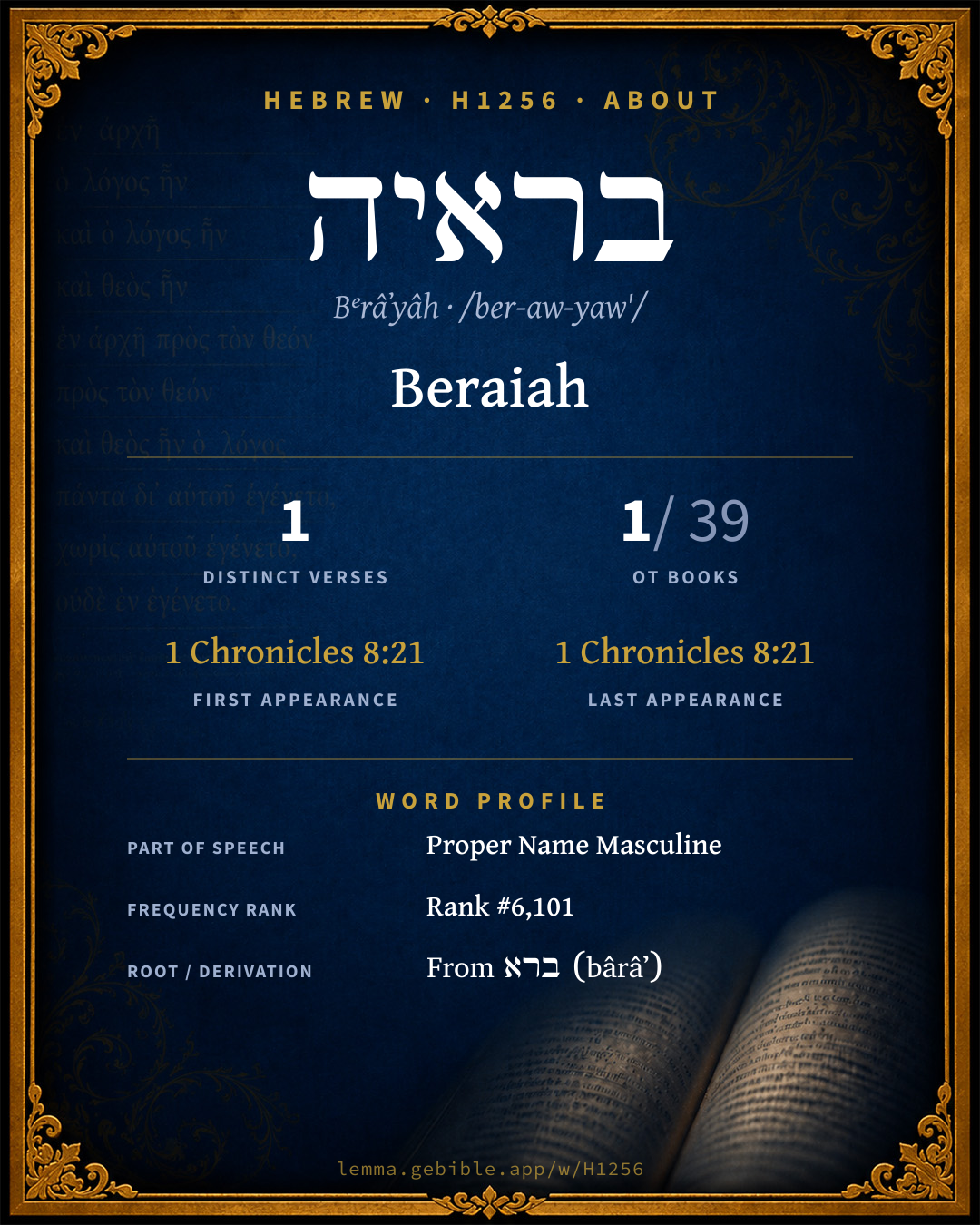
בְּרָאיָה
Beraiah
BDB lists 2 entries for ‘Beraiah’ fuller range ↓
Full lexicon entry — Brown-Driver-Briggs (BDB)
From Brown-Driver-Briggs (BDB)
Where this word appears
Grammar key — what these labels mean
Noun type
- Proper
- A name of a specific person, place, or people (e.g. Abraham, Zion, Israel).
Every verse where H1256 appears — 1 distinct verse across 1 book. Click any verse to open its interlinear word-by-word view. Verse text shown in the World English Bible for context — . Each verse’s Hebrew form is shown with its reference; the English is not keyword-highlighted, since the data carries no word-level English alignment. Use “Compare translations” on any verse to read it across multiple English versions. This concordance covers the Hebrew Bible; Septuagint (Greek Old Testament) occurrences are not indexed here.
1 Chronicles 1 verse
About this entry
At a glance — auto-summarized from this page’s data, not written by a person. Every figure links to its source below. This summary describes the numbers; it doesn’t interpret them.
At its core, בראיה (Bᵉrâʼyâh) means “Beraiah.” The Hebrew Bible uses it only 1 verse. The word gravitates to 1 Chronicles (100%). It occurs only once, in 1 Chronicles 8:21. Dig into 1-verse concordance and the renderings breakdown below.
Gloss history
Strong's 1890 vs modern scholarship
About this word
Strong's H1256 catalogs a Hebrew word from the Hebrew Old Testament.
These counts are not copied from any lexicon or concordance. They are computed here, from the morphology-tagged Hebrew Old Testament. What Lemma adds →
- 1
- distinct verses
- The word appears in 1 distinct verse.
- 1 / 39
- OT books
- The word appears in 1 of 39 Old Testament books.
- #6,101
- by frequency
- Rank #6,101 (rank 6,101 of 8,640 Hebrew words by occurrence).
View all 1 occurrence in the concordance →
Most concentrated in
- 1 Chronicles 1 verse 100%
By section of the Old Testament
By traditional corpus
Conventional, traditional groupings — biblical authorship is debated, so this is a traditional corpus grouping, not an authorship claim. Each share is this word’s portion of its verses in that division of the Hebrew canon. Each figure is a share of the word’s 1 distinct verse.
- Writings (Ketuvim) 1 verse · 100%
How translations render this word
Counts come from each version’s own published word-to-Strong’s tagging or interlinear alignment — an approximate guide to how each version renders this word, not a word-level alignment the data otherwise carries. Because each total is that version’s own tagged count, the per-version totals vary from one another and need not match the appearance or distinct-verse counts above. These counts may also differ from a printed concordance because Lemma counts each distinctly tagged rendering and does not collapse phrase taggings into a single head-word total. This is a fixed set of word-tagged versions (KJV, ASV, BSB, ULT) and does not change with the reading translation you choose elsewhere. Each version’s license is shown beside its name below (and on Sources).
- King James Version: Beraiah 1×
- American Standard Version: Beraiah 1×
- Berean Standard Bible: Beraiah 1×
- unfoldingWord Literal Text: Beraiah 1×
King James Version Public Domain
Renders H1256 across 1 tagged occurrence — most commonly:
American Standard Version Public Domain
Renders H1256 across 1 tagged occurrence — most commonly:
Berean Standard Bible Public Domain
Renders H1256 across 1 tagged occurrence — most commonly:
unfoldingWord Literal Text CC BY-SA 4.0
Renders H1256 across 1 tagged occurrence — most commonly:
Senses in BDB
The 2 senses BDB distinguishes for this word, in lexicon order (not ranked by frequency or importance). The full entry — with sub-senses — is in the Lexicon Entry tab.
- Beraiah = "Jehovah has created"
- son of Shimhi, a chief man of Benjamin
Word origin
בְּרָאיָה n.pr.m. ( י׳ hath created ) a Benjamite 1 Ch 8:21.
— Brown-Driver-Briggs (Oxford 1906, public domain), digitized via Sefaria, supplemented by the OpenScriptures HebrewLexicon (CC BY 4.0). See Sources.
Derived from ברא (bârâʼ) (H1254) — to create.
Jastrow Dictionary
A second Hebrew/Aramaic lexicon for comparison, covering Aramaic and post-biblical (Talmudic, Targumic, Midrashic) usage that the biblical-Hebrew BDB does not. Matched by lemma rather than by Strong’s number, so a lemma may carry more than one Jastrow headword (shown separately below), and the entries cover usage well beyond the Bible.
רְאִיָּה
- (רָאָה)
- 1. seeing, look, glance. B. Bath. 2ᵇ היזק ר׳ לאו וכ׳ the discomfort of being exposed to (a neighbor’s) sight is no claimable damage; ib. 3ᵃ; 59ᵇ. Nidd. 31ᵃ רְאִיַּית העיין the faculty of sight. Gen. R. s. 9 (ref. to Gen. I, 31) מלך … ר׳ אחת וכ׳ when a human king builds a palace, he casts one (examining) glance at the upper stories and another at the lower; אבל … ר׳ אחת but the Lord casts one look at both; העוה"ז … ר׳ אחת with one glance the Lord surveyed this world and the world to come; Yalk. ib. 15 בר׳. Lam. R. to V, 1 ר׳ מרחוק raah is used for looking from a distance, v. הַבָּטָה; a. fr.—Pl. רְאִיּוֹת, רְאִיּיוֹת. Ex. R. s. 3 (ref. to ראה ראיתי, Ex. III, 7) ואני רואה שתי ר׳, v. רָאָה; Tanḥ. Sh’moth 20; Ex. R. s. 42; a. e. e.g. Genesis 1:31
- 2. (sub. קרי, דם, זיבה &c.) feeling, affection, attack. Zab. I, 1 הרואה ר׳ אחת של זוב he who has had one attack of gonorrhœa. Ib. 6 מקצת הר׳ מהיום וכ׳ one of the attacks on one day, and another on the day after; a. fr.—Pl. as ab. Nidd. 37ᵇ מטמיא בר׳ כבימים becomes unclean by a certain number of attacks (even if they all be on one day) as well as by a certain number of days. B. Kam. 24ᵃ קירבה רְאִיּוֹתֶיהָ if she had her attacks at short intervals; ריחקה ר׳ at long intervals; a. e.
- 3. (with ref. to Ex. XXIII, 17) appearance in the Temple, pilgrimage. Ḥag. I, 1 הכל חייבים בר׳ וכ׳ all (males) are under obligation to appear in the Temple, except &c. Ib. 2 הר׳ מעה כסף the pilgrim’s burnt-offering must be worth a m’ʿah of silver (v. רֵאָיוֹן). Ib. 7ᵃ (ref. to ראיון, Peah I, 1) רְאִיַּית פנים בעזרה it means the appearance in the Temple (has no limits, you may visit the Temple during the festive season as often as you desire); (another opinion) ראיית פנים בקרבן it means the visit connected with a sacrifice (and you must offer a sacrifice as often as you appear); Y. Peah I, 15ᵃ bot. [read:] מתניתן בר׳ פנים אבל ר׳ קרבן יש לה שיעור the Mishnah in saying that reayon has no limits refers to the number of appearances, but as regards the visit attended with sacrifice, it has a limit (as to the minimum value of the sacrifice). Ḥag. 6ᵃ עולה … עולת ר׳ הואי the burnt-offering which the Israelites brought in the desert (Ex. XXIV, 15) was the offering of appearance before God; a. fr. e.g. Exodus 23:17
רַאֲיָה
- (preced. wds.) evidence, proof. Eduy. II, 2 לא ראינו אין ר׳ (Bab. ed. אין לא ראינו ר׳) ‘we have not seen’ is no evidence (that an act did not take place); Zeb. XII, 4; Keth. 23ᵃ. Ib. 15ᵇ (in Chald. dict.) אייתי ר׳ דישראל את produce evidence that thou art an Israelite. Snh. III, 8 כל זמן שמביא ר׳, v. סָתַר II. B. Kam. III, 11, a. fr. עליו הר׳ it rests on him to produce evidence, v. יָצָא. B. Bath. 154ᵃ top ר׳ במאי wherein must his evidence consist? ר׳ בעדים evidence by producing witnesses; ר׳ בקיום השטר evidence by which the document is identified. Pes. 15ᵃ, a. e. אין הנדון דומה לר׳ the case under discussion is not parallel to the evidence (the case which you cite is not analogous). Ber. 2ᵇ, a. fr. אע"פ שאין ר׳ וכ׳, v. זֵכֶר; a. v. fr.—Pl. רַאֲיוֹת. Snh. l. c. כל ר׳ שיש לך וכ׳ whatever new evidences you may have, you must produce within thirty days. Y. Shebu. VI, 37ᵃ top בכופר ברַאֲיוֹתָיו̇ when the opponent contests his evidence. Gen. R. s. 36, end, v. הַכְרָעָה; a. e.
רְאָיָה
- (b. h.) pr. n. m. Reaiah. Tanḥ. Ki Thissa 13 (ref. to I Chr. IV, 2) ר׳ שהראה וכ׳ Bezalel was surnamed Reaiah (v. preced.), for the Lord showed it to all Israel that &c. e.g. 1 Chronicles 4:2
A Dictionary of the Targumim, the Talmud Babli and Yerushalmi, and the Midrashic Literature (Marcus Jastrow; London, Luzac, 1903) — Public Domain. Digitized via Sefaria. Digitized via Sefaria. Full attribution on Sources.
Same root — word family
Other BDB entries built from the same root as H1256, grouped by Strong’s listed origin. These share a root / origin per the lexicon — not necessarily a shared meaning. Each links to that word’s own entry.
Derives from
Shares the same root
Compare all same-root words → They share a root, not necessarily a meaning.
Bible dictionary
Public-domain dictionary articles matched to this entry by name (Beraiah). A biblical name can be shared by more than one person or place, so an article may treat several.
Smith's Bible Dictionary · William Smith, 1863
(created by Jehovah), son of Shimhi, a chief man of Benjamin. (1 Chronicles 8:21)
Hitchcock's Bible Names Dictionary · Roswell D. Hitchcock, 1869
the choosing of the Lord
Classic public-domain reference works; full attribution on Sources.
Septuagint verse parallels
This word appears in 1 verse that also exists in the Greek Old Testament (Septuagint), out of the 1 Hebrew verse it occurs in. You can read those verses in Greek by switching the Old Testament edition to the Septuagint.
Read these verses in the Septuagint
This is a verse-level parallel only — the same verses exist in both the Hebrew and Greek Old Testaments. No word-level Hebrew↔Greek correspondence is claimed: the data carries no such alignment, so no Greek word is shown as this Hebrew word’s translation. Coverage is not total — the Septuagint omits the deuterocanon and renumbers the Psalms, so some Hebrew verses have no direct Greek parallel.