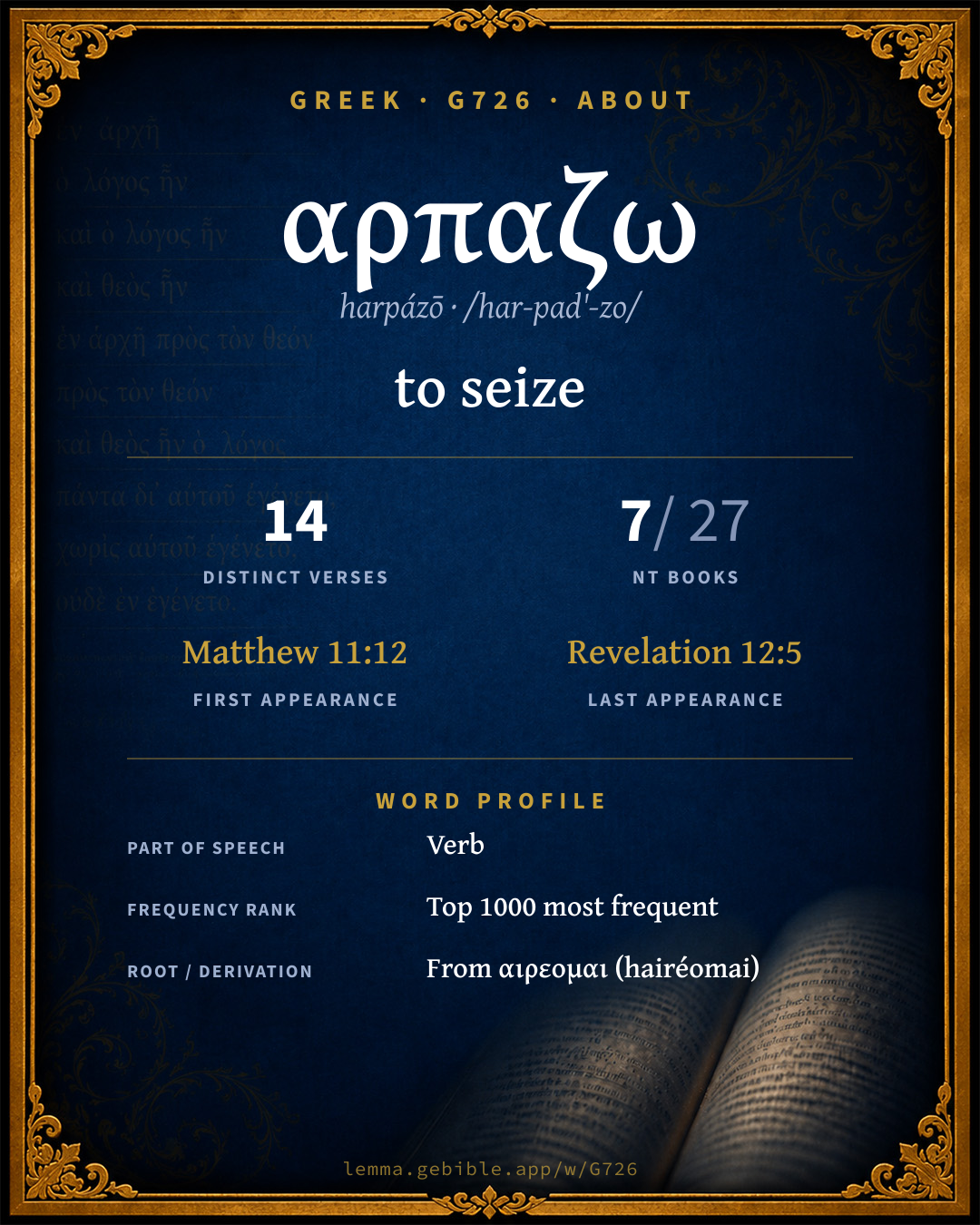
ἁρπάζω
to seize
‘to seize’ is one of 3 main senses fuller range ↓
Full lexicon entry — Thayer's Greek Lexicon
From Thayer's Greek Lexicon
Where this word appears
See every Aorist-tense verb in the Greek New Testament →
Grammar key — what these labels mean
Part of speech
- Verb
- An action or state-of-being word.
Tense
- Aorist
- Action viewed as a simple whole, without regard to duration — often past (perfective aspect).
- Present
- Ongoing or general action in present time (imperfective aspect).
- Future
- Action expected in future time.
Voice
- Active
- The subject performs the action.
- Passive
- The subject receives the action.
Mood
- Infinitive
- A verbal noun (“to write”), unmarked for person or number.
- Indicative
- States a fact or asks a factual question (the mood of reality).
- Participle
- A verbal adjective (“writing,” “having written”).
Case
- Accusative
- The case of the direct object and of extent.
- Nominative
- The case of the subject (and the predicate nominative).
Person
- 3rd person
- The one spoken about (“he / she / it / they”).
- 1st person
- The speaker (“I / we”).
Gender
- Masculine
- Grammatically masculine.
Number
- Singular
- One.
- Plural
- More than one.
2 distinct verses where G726 appears in the Future tense, across 2 books. Filtered view — show all forms. Click any verse to open its interlinear word-by-word view. Verse text shown in the World English Bible for context — . Each verse’s Greek form is shown with its reference; the English is not keyword-highlighted, since the data carries no word-level English alignment. Use “Compare translations” on any verse to read it across multiple English versions. This concordance covers the Greek New Testament; Septuagint (Greek Old Testament) occurrences of this word are not indexed here.
John 1 verse
1 Thessalonians 1 verse
About this entry
At a glance — auto-summarized from this page’s data, not written by a person. Every figure links to its source below. This summary describes the numbers; it doesn’t interpret them.
At its core, αρπαζω (harpázō) means “to seize.” It first appears in Matthew 11:12. It turns up in 14 verses across 7 books, an uncommon footprint. The word gravitates to John (29%), then Matthew and Acts. Ranging over 3 senses, it is not a single-sense word. Each statement above links to its evidence; the full detail follows below.
Gloss history
Strong's 1890 vs modern scholarship

About this word
Strong's G726 catalogs a Greek word from the Greek New Testament.
These counts are not copied from any lexicon or concordance. They are computed here, from the morphology-tagged Greek New Testament. What Lemma adds →
- 14
- distinct verses
- The word appears in 14 distinct verses.
- 7 / 27
- NT books
- The word appears in 7 of 27 New Testament books.
- #814
- by frequency
- Top 1000 most frequent Greek words (rank 814 of 5,347 Greek words by occurrence).
View all 14 occurrences in the concordance →
By section of the New Testament
By traditional corpus
Conventional, traditional groupings — biblical authorship is debated, so this is a traditional corpus grouping, not an authorship claim. Some books belong to more than one corpus (Luke is in both the Gospels and the Lukan corpus, and so on), so these shares overlap and need not total 100%. Each figure is a share of the word’s 14 distinct verses.
- Gospels 7 verses · 50%
- Johannine 5 verses · 36%
- Pauline corpus 3 verses · 21%
- Lukan (Luke–Acts) 2 verses · 14%
- General (Catholic) Epistles 1 verse · 7%
- Revelation 1 verse · 7%
How translations render this word
Counts come from each version’s own published word-to-Strong’s tagging or interlinear alignment — an approximate guide to how each version renders this word, not a word-level alignment the data otherwise carries. Because each total is that version’s own tagged count, the per-version totals vary from one another and need not match the appearance or distinct-verse counts above. These counts may also differ from a printed concordance because Lemma counts each distinctly tagged rendering and does not collapse phrase taggings into a single head-word total. This is a fixed set of word-tagged versions (KJV, ASV, BSB, ULT) and does not change with the reading translation you choose elsewhere. Each version’s license is shown beside its name below (and on Sources).
- King James Version: Force 3×, Take 3×
- American Standard Version: Force 3×, Take 3×, Snatch 2×
- Berean Standard Bible: Was caught up 3×
- unfoldingWord Literal Text: Seize 2×
King James Version Public Domain
Renders G726 across 17 tagged occurrences — most commonly:
Plus 11 renderings that appear only once — usually multi-word phrases or single function words the recovered tagging swept in, not distinct renderings.
American Standard Version Public Domain
Renders G726 across 17 tagged occurrences — most commonly:
Plus 9 renderings that appear only once — usually multi-word phrases or single function words the recovered tagging swept in, not distinct renderings.
Berean Standard Bible Public Domain
Renders G726 across 14 tagged occurrences — most commonly:
Plus 11 renderings that appear only once — usually multi-word phrases or single function words the recovered tagging swept in, not distinct renderings.
unfoldingWord Literal Text CC BY-SA 4.0
Renders G726 across 16 tagged occurrences — most commonly:
Plus 14 renderings that appear only once — usually multi-word phrases or single function words the recovered tagging swept in, not distinct renderings.
Senses in Thayer's
The 3 senses Thayer's distinguishes for this word, in lexicon order (not ranked by frequency or importance). The full entry — with sub-senses — is in the Lexicon Entry tab.
- to seize, carry off by force
- to seize on, claim for one's self eagerly
- to snatch out or away
Word origin
Derived from αιρεομαι (hairéomai) (G138) — to choose.
From a derivative of G138 ; to seize (in various applications): - catch (away up) pluck pull take (by force).
— Strong’s Exhaustive Concordance (1890), public domain.
Forms in the corpus
The 11 distinct written forms G726 takes in the Greek New Testament, most frequent first — each parse links to that tense’s occurrences in the concordance.
Same root — word family
Other Thayer's entries built from the same root as G726, grouped by Strong’s listed origin. These share a root / origin per the lexicon — not necessarily a shared meaning. Each links to that word’s own entry.
Derives from
Shares the same root
- αιρεσις haíresis G139 choice
- αιρετιζω hairetízō G140 to choose
- αλωσις hálōsis G259 capture
- ελκυω helkýō G1670 to draw
- ηλιος hḗlios G2246 sun
- θελω thélō G2309 to will
- ιλεως híleōs G2436 merciful
- σεληνη selḗnē G4582 moon
- σπειρα speîra G4686 cohort
- συλαω syláō G4813 to rob
- συρω sýrō G4951 to drag
- τιλλω tíllō G5089 to pluck
Derived from this word
- αρπαγη harpagḗ G724 plunder
- αρπαγμος harpagmós G725 seizing
- αρπαξ hárpax G727 rapacious
- καρπος karpós G2590 fruit
- κραιπαλη kraipálē G2897 drunkenness
Compare all same-root words → Showing 4 of 19 — not the complete family. They share a root, not necessarily a meaning.
Septuagint usage
The same Greek word αρπαζω appears 34 times in the Greek Old Testament (Septuagint), across 33 verses in 13 books.
- 34
- LXX occurrences
- Tagged occurrences of this Greek word in the Septuagint.
- 33
- verses
- Distinct Septuagint verses containing this word.
- 13 / 39
- OT books
- The word appears in 13 of the 39 Old Testament books.
Sample Septuagint occurrences
- Genesis 37:33 ἁρπάζω
- Leviticus 5:23 ἁρπάζω
- Deuteronomy 28:31 ἁρπάζω
- Judges 21:21 ἁρπάζω
- 2 Samuel 23:21 ἁρπάζω
- Job 20:19 ἁρπάζω
- Psalms 7:3 ἁρπάζω
- Isaiah 10:2 ἁρπάζω
- Ezekiel 18:7 ἁρπάζω
- Hosea 5:14 ἁρπάζω
- Amos 1:11 ἁρπάζω
- Micah 3:2 ἁρπάζω
Septuagint occurrences (same lexeme)
Every verse where the same Strong’s number (G726) appears in the Greek Septuagint. Verse text shown in the World English Bible for context; the Greek form is the matched word — the English is not keyword-highlighted.
- Genesis 37:33 ἁρπάζω He recognized it, and said, "It is my son's coat. An evil animal has devoured him. Joseph is without doubt torn in pieces."
- Leviticus 5:23 ἁρπάζω
- Leviticus 19:13 ἁρπάζω "'You shall not oppress your neighbor, nor rob him. The wages of a hired servant shall not remain with you all night until the morning.
- Deuteronomy 28:31 ἁρπάζω Your ox shall be slain before your eyes, and you shall not eat of it: your donkey shall be violently taken away from before your face, and shall not be restored to you: your sheep shall be given to your enemies, and you shall have none to save you.
- Judges 21:21 ἁρπάζω and see, and, behold, if the daughters of Shiloh come out to dance in the dances, then come you out of the vineyards, and catch you every man his wife of the daughters of Shiloh, and go to the land of Benjamin.
- Judges 21:23 ἁρπάζω The children of Benjamin did so, and took them wives, according to their number, of those who danced, whom they carried off: and they went and returned to their inheritance, and built the cities, and lived in them.
- 2 Samuel 23:21 ἁρπάζω He killed an Egyptian, a goodly man: and the Egyptian had a spear in his hand; but he went down to him with a staff, and plucked the spear out of the Egyptian's hand, and killed him with his own spear.
- Job 20:19 ἁρπάζω For he has oppressed and forsaken the poor. He has violently taken away a house, and he shall not build it up.
- Job 24:2 ἁρπάζω There are people who remove the landmarks. They violently take away flocks, and feed them.
- Job 24:9 ἁρπάζω There are those who pluck the fatherless from the breast, And take a pledge of the poor,
- Job 24:19 ἁρπάζω Drought and heat consume the snow waters; So does Sheol those who have sinned.
- Psalms 7:3 ἁρπάζω Yahweh, my God, if I have done this, If there is iniquity in my hands,
- Psalms 9:30 ἁρπάζω
- Psalms 21:14 ἁρπάζω
- Psalms 49:22 ἁρπάζω
- Psalms 68:5 ἁρπάζω A father of the fatherless, and a defender of the widows, Is God in his holy habitation.
- Psalms 103:21 ἁρπάζω Praise Yahweh, all you hosts of his, You servants of his, who do his pleasure.
- Isaiah 10:2 ἁρπάζω to turn aside the needy from justice, and to rob the poor of my people of their right, that widows may be their spoil, and that they may make the fatherless their prey!
- Ezekiel 18:7 ἁρπάζω and has not wronged any, but has restored to the debtor his pledge, has taken nothing by robbery, has given his bread to the hungry, and has covered the naked with a garment;
- Ezekiel 18:12 ἁρπάζω has wronged the poor and needy, has taken by robbery, has not restored the pledge, and has lifted up his eyes to the idols, has committed abomination,
- Ezekiel 18:16 ἁρπάζω neither has wronged any, has not taken anything to pledge, neither has taken by robbery, but has given his bread to the hungry, and has covered the naked with a garment;
- Ezekiel 18:18 ἁρπάζω As for his father, because he cruelly oppressed, robbed his brother, and did that which is not good among his people, behold, he shall die in his iniquity.
- Ezekiel 19:3 ἁρπάζω She brought up one of her cubs: he became a young lion, and he learned to catch the prey; he devoured men.
- Ezekiel 19:6 ἁρπάζω He went up and down among the lions; he became a young lion, and he learned to catch the prey; he devoured men.
- Ezekiel 22:25 ἁρπάζω There is a conspiracy of her prophets in the midst of it, like a roaring lion ravening the prey: they have devoured souls; they take treasure and precious things; they have made her widows many in the midst of it.
- Ezekiel 22:27 ἁρπάζω Her princes in the midst of it are like wolves ravening the prey, to shed blood, [and] to destroy souls, that they may get dishonest gain.
- Hosea 5:14 ἁρπάζω For I will be to Ephraim like a lion, And like a young lion to the house of Judah. I myself will tear in pieces and go away. I will carry off, and there will be no one to deliver.
- Hosea 6:1 ἁρπάζω "Come, and let us return to Yahweh; For he has torn us to pieces, And he will heal us; He has injured us, And he will bind up our wounds.
- Amos 1:11 ἁρπάζω Thus says Yahweh: "For three transgressions of Edom, yes, for four, I will not turn away its punishment; Because he pursued his brother with the sword, And cast off all pity, And his anger raged continually, And he kept his wrath forever;
- Amos 3:4 ἁρπάζω Will a lion roar in the thicket, When he has no prey? Does a young lion cry out of his den, If he has caught nothing?
- Micah 3:2 ἁρπάζω You who hate the good, And love the evil; Who tear off their skin, And their flesh from off their bones;
- Micah 5:7 ἁρπάζω The remnant of Jacob will be in the midst of many peoples, Like dew from Yahweh, Like showers on the grass, That don't wait for man, Nor wait for the sons of men.
- Nahum 2:13 ἁρπάζω "Behold, I am against you," says Yahweh of Hosts, "and I will burn her chariots in the smoke, and the sword will devour your young lions; and I will cut off your prey from the earth, and the voice of your messengers will no longer be heard."
These are occurrences of the same Greek lexeme (G726) in the Septuagint — not a translation of any one Hebrew word. The store carries no word-level Hebrew↔Greek alignment, so no Hebrew original is asserted here. Counts come from the recovered LXX Strong's tagging — high-frequency vocabulary is well covered, while rare or late forms may be untagged — so they reflect tagged occurrences and may slightly undercount.