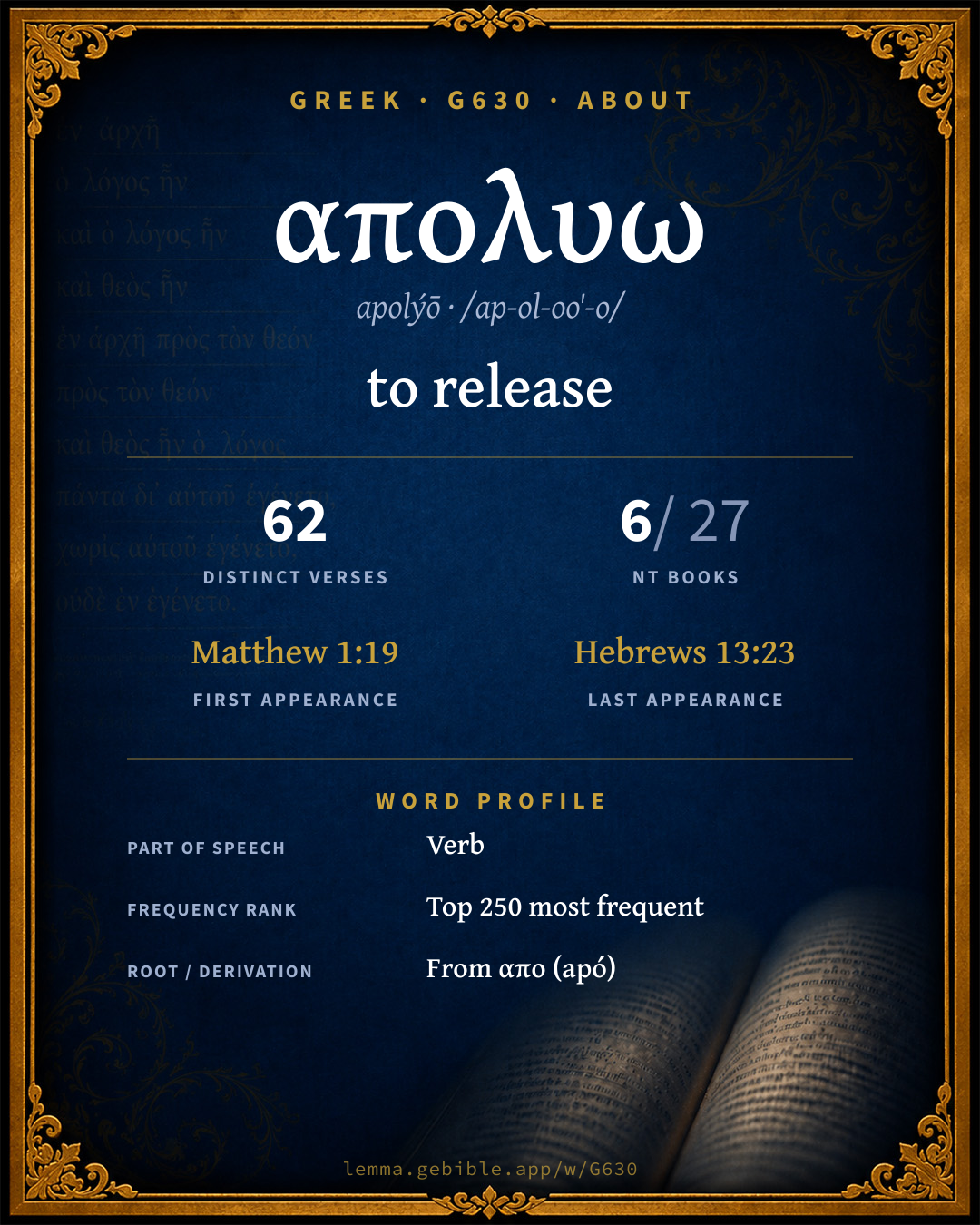
ἀπολύω
to release
‘to release’ is one of 8 main senses fuller range ↓
Full lexicon entry — Thayer's Greek Lexicon
From Thayer's Greek Lexicon
Where this word appears
See every Aorist-tense verb in the Greek New Testament →
Grammar key — what these labels mean
Part of speech
- Verb
- An action or state-of-being word.
Tense
- Aorist
- Action viewed as a simple whole, without regard to duration — often past (perfective aspect).
- Future
- Action expected in future time.
- Present
- Ongoing or general action in present time (imperfective aspect).
- Perfect
- A completed past action with continuing present results.
- Imperfect
- Continuous or repeated action in past time (“was writing”).
Voice
- Active
- The subject performs the action.
- Passive
- The subject receives the action.
- Middle
- The subject acts on or for itself, or with special interest in the action.
Mood
- Infinitive
- A verbal noun (“to write”), unmarked for person or number.
- Indicative
- States a fact or asks a factual question (the mood of reality).
- Imperative
- Expresses a command or request.
- Subjunctive
- Expresses probability, purpose, or possibility (the mood of contingency).
- Participle
- A verbal adjective (“writing,” “having written”).
Case
- Nominative
- The case of the subject (and the predicate nominative).
- Accusative
- The case of the direct object and of extent.
Person
- 3rd person
- The one spoken about (“he / she / it / they”).
- 2nd person
- The one addressed (“you”).
- 1st person
- The speaker (“I / we”).
Gender
- Masculine
- Grammatically masculine.
- Feminine
- Grammatically feminine.
Number
- Singular
- One.
- Plural
- More than one.
Grammatical forms 25 distinct
- Verb, Aorist, Active, Infinitive 12 times (18%)
- Verb, Aorist, Active, Indicative, 3rd person, Singular 9 times (13%)
- Verb, Aorist, Active, Imperative, 2nd person, Singular 6 times (9%)
- Verb, Aorist, Active, Subjunctive, 1st person, Singular 6 times (9%)
- Verb, Aorist, Active, Subjunctive, 3rd person, Singular 5 times (7%)
- Verb, Aorist, Active, Indicative, 3rd person, Plural 4 times (6%)
- Verb, Aorist, Active, Participle, Nominative, Singular, Masculine 2 times (3%)
- Verb, Aorist, Passive, Participle, Nominative, Plural, Masculine 2 times (3%)
+17 more forms (21 occurrences)
Parsed forms decoded from the imported morphology (Robinson–Tischendorf, public domain), counted across 67 parsed occurrences — not distinct verses.
Every verse where G630 appears — 62 distinct verses across 6 books. Click any verse to open its interlinear word-by-word view. Verse text shown in the World English Bible for context — . Each verse’s Greek form is shown with its reference; the English is not keyword-highlighted, since the data carries no word-level English alignment. Use “Compare translations” on any verse to read it across multiple English versions. This concordance covers the Greek New Testament; Septuagint (Greek Old Testament) occurrences of this word are not indexed here.
Matthew 18 verses
- Matthew 1:19 ἀπολῦσαι aor act inf Joseph, her husband, being a righteous man, and not willing to make her a public example, intended to put her away secretly.
- Matthew 5:31 ἀπολύσῃ aor act subj 3sg "It was also said, 'Whoever shall put away his wife, let him give her a writing of divorce,'
- Matthew 5:32 ἀπολύων ἀπολελυμένην pres act ptcp nom sg masc perf pass ptcp acc sg fem but I tell you that whoever puts away his wife, except for the cause of sexual immorality, makes her an adulteress; and whoever marries her when she is put away commits adultery.
- Matthew 14:15 ἀπόλυσον aor act impv 2sg When evening had come, his disciples came to him, saying, "This place is deserted, and the hour is already late. Send the multitudes away, that they may go into the villages, and buy themselves food."
- Matthew 14:22 ἀπολύσῃ aor act subj 3sg Immediately Jesus made the disciples get into the boat, and to go ahead of him to the other side, while he sent the multitudes away.
- Matthew 14:23 ἀπολύσας aor act ptcp nom sg masc After he had sent the multitudes away, he went up into the mountain by himself to pray. When evening had come, he was there alone.
- Matthew 15:23 ἀπόλυσον aor act impv 2sg But he answered her not a word. His disciples came and begged him, saying, "Send her away; for she cries after us."
- Matthew 15:32 ἀπολῦσαι aor act inf Jesus summoned his disciples and said, "I have compassion on the multitude, because they continue with me now three days and have nothing to eat. I don't want to send them away fasting, or they might faint on the way."
- Matthew 15:39 ἀπολύσας aor act ptcp nom sg masc Then he sent away the multitudes, got into the boat, and came into the borders of Magdala.
- Matthew 18:27 ἀπέλυσεν aor act ind 3sg The lord of that servant, being moved with compassion, released him, and forgave him the debt.
- Matthew 19:3 ἀπολῦσαι aor act inf Pharisees came to him, testing him, and saying, "Is it lawful for a man to divorce his wife for any reason?"
- Matthew 19:7 ἀπολῦσαι aor act inf They asked him, "Why then did Moses command us to give her a bill of divorce, and divorce her?"
- Matthew 19:8 ἀπολῦσαι aor act inf He said to them, "Moses, because of the hardness of your hearts, allowed you to divorce your wives, but from the beginning it has not been so.
- Matthew 19:9 ἀπολύσῃ aor act subj 3sg I tell you that whoever divorces his wife, except for sexual immorality, and marries another, commits adultery; and he who marries her when she is divorced commits adultery."
- Matthew 27:15 ἀπολύειν pres act inf Now at the feast the governor was accustomed to release to the multitude one prisoner, whom they desired.
- Matthew 27:17 ἀπολύσω aor act subj 1sg When therefore they were gathered together, Pilate said to them, "Whom do you want me to release to you? Barabbas, or Jesus, who is called Christ?"
- Matthew 27:21 ἀπολύσω aor act subj 1sg But the governor answered them, "Which of the two do you want me to release to you?" They said, "Barabbas!"
- Matthew 27:26 ἀπέλυσεν aor act ind 3sg Then he released to them Barabbas, but Jesus he flogged and delivered to be crucified.
Mark 12 verses
- Mark 6:36 ἀπόλυσον aor act impv 2sg Send them away, that they may go into the surrounding country and villages, and buy themselves bread, for they have nothing to eat."
- Mark 6:45 ἀπολύει pres act ind 3sg Immediately he made his disciples get into the boat, and to go ahead to the other side, to Bethsaida, while he himself sent the multitude away.
- Mark 8:3 ἀπολύσω aor act subj 1sg If I send them away fasting to their home, they will faint on the way, for some of them have come a long way."
- Mark 8:9 ἀπέλυσεν aor act ind 3sg Those who had eaten were about four thousand. Then he sent them away.
- Mark 10:2 ἀπολῦσαι aor act inf Pharisees came to him testing him, and asked him, "Is it lawful for a man to divorce his wife?"
- Mark 10:4 ἀπολῦσαι aor act inf They said, "Moses allowed a certificate of divorce to be written, and to divorce her."
- Mark 10:11 ἀπολύσῃ aor act subj 3sg He said to them, "Whoever divorces his wife, and marries another, commits adultery against her.
- Mark 10:12 ἀπολύσασα aor act ptcp nom sg fem If a woman herself divorces her husband, and marries another, she commits adultery."
- Mark 15:6 ἀπέλυεν impf act ind 3sg Now at the feast he used to release to them one prisoner, whom they asked of him.
- Mark 15:9 ἀπολύσω aor act subj 1sg Pilate answered them, saying, "Do you want me to release to you the King of the Jews?"
- Mark 15:11 ἀπολύσῃ aor act subj 3sg But the chief priests stirred up the multitude, that he should release Barabbas to them instead.
- Mark 15:15 ἀπέλυσεν aor act ind 3sg Pilate, wishing to please the multitude, released Barabbas to them, and handed over Jesus, when he had flogged him, to be crucified.
Luke 12 verses
- Luke 2:29 ἀπολύεις pres act ind 2sg "Now you are releasing your servant, Master, According to your word, in peace;
- Luke 6:37 ἀπολύετε ἀπολυθήσεσθε pres act impv 2pl fut pass ind 2pl Don't judge, And you won't be judged. Don't condemn, And you won't be condemned. Set free, And you will be set free.
- Luke 8:38 ἀπέλυσεν aor act ind 3sg But the man from whom the demons had gone out begged him that he might go with him, but Jesus sent him away, saying,
- Luke 9:12 ἀπόλυσον aor act impv 2sg The day began to wear away; and the twelve came, and said to him, "Send the multitude away, that they may go into the surrounding villages and farms, and lodge, and get food, for we are here in a deserted place."
- Luke 13:12 ἀπολέλυσαι perf pass ind 2sg When Jesus saw her, he called her, and said to her, "Woman, you are freed from your infirmity."
- Luke 14:4 ἀπέλυσεν aor act ind 3sg But they were silent. He took him, and healed him, and let him go.
- Luke 16:18 ἀπολύων ἀπολελυμένην pres act ptcp nom sg masc perf pass ptcp acc sg fem Everyone who divorces his wife, and marries another, commits adultery. He who marries one who is divorced from a husband commits adultery.
- Luke 23:16 ἀπολύσω fut act ind 1sg I will therefore chastise him and release him."
- Luke 23:18 ἀπόλυσον aor act impv 2sg But they all cried out together, saying, "Away with this man! Release to us Barabbas!" --
- Luke 23:20 ἀπολῦσαι aor act inf Then Pilate spoke to them again, wanting to release Jesus,
- Luke 23:22 ἀπολύσω fut act ind 1sg He said to them the third time, "Why? What evil has this man done? I have found no capital crime in him. I will therefore chastise him and release him."
- Luke 23:25 ἀπέλυσεν aor act ind 3sg He released him who had been thrown into prison for insurrection and murder, for whom they asked, but he delivered Jesus up to their will.
John 3 verses
- John 18:39 ἀπολύσω ἀπολύσω aor act subj 1sg aor act subj 1sg But you have a custom, that I should release someone to you at the Passover. Therefore do you want me to release to you the King of the Jews?"
- John 19:10 ἀπολῦσαί aor act inf Pilate therefore said to him, "Aren't you speaking to me? Don't you know that I have power to release you, and have power to crucify you?"
- John 19:12 ἀπολῦσαι ἀπολύσῃς aor act inf aor act subj 2sg At this, Pilate was seeking to release him, but the Jews cried out, saying, "If you release this man, you aren't Caesar's friend! Everyone who makes himself a king speaks against Caesar!"
Acts 16 verses
- Acts 3:13 ἀπολύειν pres act inf The God of Abraham, Isaac, and Jacob, the God of our fathers, has glorified his Servant Jesus, whom you delivered up, and denied in the presence of Pilate, when he had determined to release him.
- Acts 4:21 ἀπέλυσαν aor act ind 3pl When they had further threatened them, they let them go, finding no way to punish them, because of the people; for everyone glorified God for that which was done.
- Acts 4:23 Ἀπολυθέντες aor pass ptcp nom pl masc Being let go, they came to their own company, and reported all that the chief priests and the elders had said to them.
- Acts 5:40 ἀπέλυσαν aor act ind 3pl They agreed with him. Summoning the apostles, they beat them and charged them not to speak in the name of Jesus, and let them go.
- Acts 13:3 ἀπέλυσαν aor act ind 3pl Then, when they had fasted and prayed and laid their hands on them, they sent them away.
- Acts 15:30 ἀπολυθέντες aor pass ptcp nom pl masc So, when they were sent off, they came to Antioch. Having gathered the multitude together, they delivered the letter.
- Acts 15:33 ἀπελύθησαν aor pass ind 3pl After they had spent some time there, they were sent back with greetings from the brothers to the apostles.
- Acts 16:35 ἀπόλυσον aor act impv 2sg But when it was day, the magistrates sent the sergeants, saying, "Let those men go."
- Acts 16:36 ἀπολυθῆτε aor pass subj 2pl The jailer reported these words to Paul, saying, "The magistrates have sent to let you go; now therefore come out, and go in peace."
- Acts 17:9 ἀπέλυσαν aor act ind 3pl When they had taken security from Jason and the rest, they let them go.
- Acts 19:41 ἀπέλυσεν aor act ind 3sg When he had thus spoken, he dismissed the assembly.
- Acts 22:16 ἀπόλυσαι aor act inf Now why do you wait? Arise, be baptized, and wash away your sins, calling on the name of the Lord.'
- Acts 23:22 ἀπέλυσε aor act ind 3sg So the commanding officer let the young man go, charging him, "Tell no one that you have revealed these things to me."
- Acts 26:32 ἀπολελύσθαι perf pass inf Agrippa said to Festus, "This man might have been set free if he had not appealed to Caesar."
- Acts 28:18 ἀπολῦσαι aor act inf who, when they had examined me, desired to set me free, because there was no cause of death in me.
- Acts 28:25 ἀπελύοντο impf mid ind 3pl When they didn't agree among themselves, they departed after Paul had spoken one word, "The Holy Spirit spoke rightly through Isaiah, the prophet, to our fathers,
Hebrews 1 verse
About this entry
At a glance — auto-summarized from this page’s data, not written by a person. Every figure links to its source below. This summary describes the numbers; it doesn’t interpret them.
απολυω — transliterated apolýō — is a Greek verb carrying the sense “to release.” Its lexical range runs to 8 senses. Spanning 62 verses in 6 books, it ranks among the moderately common words of the Greek New Testament. Its uses concentrate in Matthew (29% of all occurrences). Debuting at Matthew 1:19, it then recurs through the corpus. Each statement above links to its evidence; the full detail follows below.
Gloss history
Strong's 1890 vs modern scholarship

About this word
Strong's G630 catalogs a Greek word from the Greek New Testament.
These counts are not copied from any lexicon or concordance. They are computed here, from the morphology-tagged Greek New Testament. What Lemma adds →
- 62
- distinct verses
- The word appears in 62 distinct verses.
- 6 / 27
- NT books
- The word appears in 6 of 27 New Testament books.
- #247
- by frequency
- Top 250 most frequent Greek words (rank 247 of 5,347 Greek words by occurrence).
View all 62 occurrences in the concordance →
By section of the New Testament
By traditional corpus
Conventional, traditional groupings — biblical authorship is debated, so this is a traditional corpus grouping, not an authorship claim. Some books belong to more than one corpus (Luke is in both the Gospels and the Lukan corpus, and so on), so these shares overlap and need not total 100%. Each figure is a share of the word’s 62 distinct verses.
- Gospels 45 verses · 73%
- Lukan (Luke–Acts) 28 verses · 45%
- Johannine 3 verses · 5%
- Hebrews 1 verse · 2%
How translations render this word
Counts come from each version’s own published word-to-Strong’s tagging or interlinear alignment — an approximate guide to how each version renders this word, not a word-level alignment the data otherwise carries. Because each total is that version’s own tagged count, the per-version totals vary from one another and need not match the appearance or distinct-verse counts above. These counts may also differ from a printed concordance because Lemma counts each distinctly tagged rendering and does not collapse phrase taggings into a single head-word total. This is a fixed set of word-tagged versions (KJV, ASV, BSB, ULT) and does not change with the reading translation you choose elsewhere. Each version’s license is shown beside its name below (and on Sources).
- King James Version: Away 12×, Release 8×, Go 6×
- American Standard Version: Away 14×, Release 7×, Send 5×
- Berean Standard Bible: Release 15×, Divorces 6×, Released 5×
- unfoldingWord Literal Text: Away 11×, Release 8×, Divorce 5×
King James Version Public Domain
Renders G630 across 89 tagged occurrences — most commonly:
Plus other, less common renderings. Plus 28 renderings that appear only once — usually multi-word phrases or single function words the recovered tagging swept in, not distinct renderings.
American Standard Version Public Domain
Renders G630 across 89 tagged occurrences — most commonly:
Plus other, less common renderings. Plus 35 renderings that appear only once — usually multi-word phrases or single function words the recovered tagging swept in, not distinct renderings.
Berean Standard Bible Public Domain
Renders G630 across 66 tagged occurrences — most commonly:
Plus 23 renderings that appear only once — usually multi-word phrases or single function words the recovered tagging swept in, not distinct renderings.
unfoldingWord Literal Text CC BY-SA 4.0
Renders G630 across 80 tagged occurrences — most commonly:
Plus other, less common renderings. Plus 27 renderings that appear only once — usually multi-word phrases or single function words the recovered tagging swept in, not distinct renderings.
8 senses in Thayer's, in lexicon order
The 8 senses Thayer's distinguishes for this word, in lexicon order (not ranked by frequency or importance). The full entry — with sub-senses — is in the Lexicon Entry tab.
- to set free
- to let go, dismiss, (to detain no longer)
- a captive i.e. to loose his bonds and bid him depart, to give him liberty to depart
- to acquit one accused of a crime and set him at liberty
- indulgently to grant a prisoner leave to depart
- to release a debtor, i.e. not to press one's claim against him, to remit his debt
- used of divorce, to dismiss from the house, to repudiate. The wife of a Greek or Roman may divorce her husband.
- to send one's self away, to depart
Word origin
Derived from απο (apó) (G575) — from.
From G575 and G3089 ; to free fully that is (literally) relieve release dismiss (reflexively depart ) or (figuratively) let die pardon or (specifically) divorce : - (let) depart dismiss divorce forgive let go loose put (send) away release set at liberty.
— Strong’s Exhaustive Concordance (1890), public domain.
Forms in the corpus
The 28 distinct written forms G630 takes in the Greek New Testament, most frequent first — each parse links to that tense’s occurrences in the concordance.
Same root — word family
Other Thayer's entries built from the same root as G630, grouped by Strong’s listed origin. These share a root / origin per the lexicon — not necessarily a shared meaning. Each links to that word’s own entry.
Derives from
Shares the same root
- απαγγελλω apangéllō G518 to report
- απαγχομαι apánchomai G519 to strangle
- απαγω apágō G520 to lead away
- απαιρω apaírō G522 to take away
- απαιτεω apaitéō G523 to demand back
- απαλγεω apalgéō G524 to cease grieving
- απαλλασσω apallássō G525 to depart
- απαλλοτριοω apallotrióō G526 to estrange
- απανταω apantáō G528 to meet
- απαρνεομαι aparnéomai G533 to deny
- απαρτι apárti G534 henceforth
- απαρχη aparchḗ G536 to offer firstfruits
- απαυγασμα apaúgasma G541 brightness
- απειδω apeídō G542 to look away
- απειμι ápeimi G548 to depart
- απειμι ápeimi G549 to depart
- απειπομην apeipómēn G550 to declare
- απεκδεχομαι apekdéchomai G553 waiting for
- απεκδυομαι apekdýomai G554 to despoil
- απελαυνω apelaúnō G556 to drive away
- απελεγμος apelegmós G557 censure
- απελευθερος apeleútheros G558 freedman
- απελπιζω apelpízō G560 not despairing
- απεναντι apénanti G561 opposite
+85 more words share this root (not shown).
Compare all same-root words → Showing 4 of 111 — not the complete family. They share a root, not necessarily a meaning.
Septuagint usage
The same Greek word απολυω appears 4 times in the Greek Old Testament (Septuagint), across 4 verses in 4 books.
- 4
- LXX occurrences
- Tagged occurrences of this Greek word in the Septuagint.
- 4
- verses
- Distinct Septuagint verses containing this word.
- 4 / 39
- OT books
- The word appears in 4 of the 39 Old Testament books.
Sample Septuagint occurrences
- Genesis 15:2 ἀπολύω
- Exodus 33:11 ἀπολύω
- Numbers 20:29 ἀπολύω
- Psalms 33:1 ἀπολύω
Septuagint occurrences (same lexeme)
Every verse where the same Strong’s number (G630) appears in the Greek Septuagint. Verse text shown in the World English Bible for context; the Greek form is the matched word — the English is not keyword-highlighted.
- Genesis 15:2 ἀπολύω Abram said, "Lord Yahweh, what will you give me, seeing I go childless, and he who will inherit my estate is Eliezer of Damascus?"
- Exodus 33:11 ἀπολύω Yahweh spoke to Moses face to face, as a man speaks to his friend. He turned again into the camp, but his servant Joshua, the son of Nun, a young man, didn't depart out of the Tent.
- Numbers 20:29 ἀπολύω When all the congregation saw that Aaron was dead, they wept for Aaron thirty days, even all the house of Israel.
- Psalms 33:1 ἀπολύω Rejoice in Yahweh, you righteous! Praise is fitting for the upright.
These are occurrences of the same Greek lexeme (G630) in the Septuagint — not a translation of any one Hebrew word. The store carries no word-level Hebrew↔Greek alignment, so no Hebrew original is asserted here. Counts come from the recovered LXX Strong's tagging — high-frequency vocabulary is well covered, while rare or late forms may be untagged — so they reflect tagged occurrences and may slightly undercount.