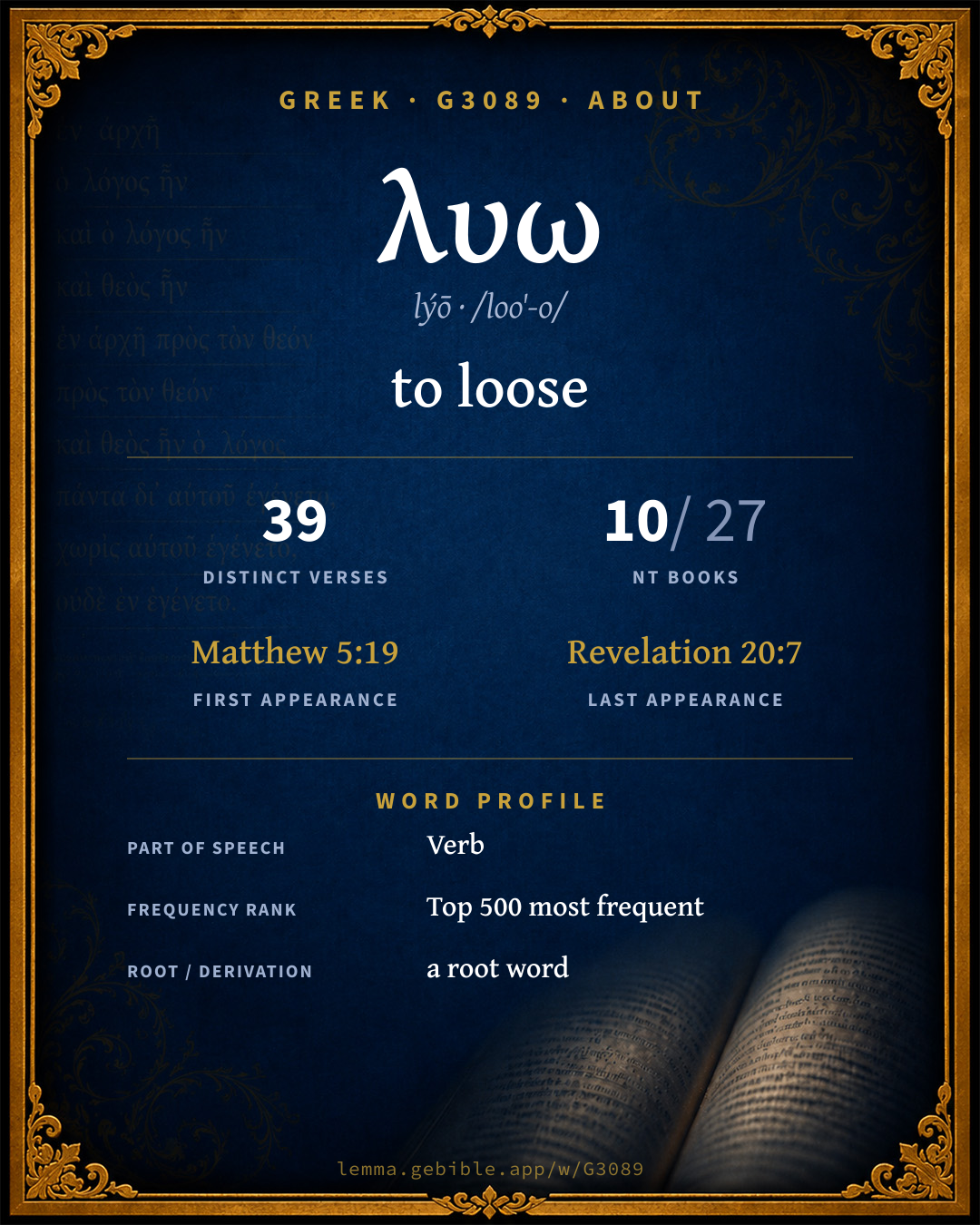
λύω
to loose
‘to loose’ is one of 3 main senses fuller range ↓
Full lexicon entry — Thayer's Greek Lexicon
From Thayer's Greek Lexicon
Where this word appears
See every Aorist-tense verb in the Greek New Testament →
Grammar key — what these labels mean
Part of speech
- Verb
- An action or state-of-being word.
Tense
- Aorist
- Action viewed as a simple whole, without regard to duration — often past (perfective aspect).
- Future
- Action expected in future time.
- Present
- Ongoing or general action in present time (imperfective aspect).
- Imperfect
- Continuous or repeated action in past time (“was writing”).
- Perfect
- A completed past action with continuing present results.
Voice
- Active
- The subject performs the action.
- Passive
- The subject receives the action.
Mood
- Infinitive
- A verbal noun (“to write”), unmarked for person or number.
- Imperative
- Expresses a command or request.
- Participle
- A verbal adjective (“writing,” “having written”).
- Subjunctive
- Expresses probability, purpose, or possibility (the mood of contingency).
- Indicative
- States a fact or asks a factual question (the mood of reality).
Case
- Nominative
- The case of the subject (and the predicate nominative).
- Dative
- The case of the indirect object, means, or location — “to / for / with / in.”
- Genitive
- The case of source, possession, or “of” — answers “whose / from what.”
Person
- 2nd person
- The one addressed (“you”).
- 3rd person
- The one spoken about (“he / she / it / they”).
- 1st person
- The speaker (“I / we”).
Gender
- Masculine
- Grammatically masculine.
- Feminine
- Grammatically feminine.
- Neuter
- Grammatically neuter.
Number
- Plural
- More than one.
- Singular
- One.
Grammatical forms 29 distinct
- Verb, Aorist, Active, Infinitive 4 times (10%)
- Verb, Aorist, Active, Imperative, 2nd person, Plural 3 times (7%)
- Verb, Aorist, Passive, Infinitive 3 times (7%)
- Verb, Aorist, Active, Imperative, 2nd person, Singular 2 times (5%)
- Verb, Aorist, Active, Participle, Nominative, Plural, Masculine 2 times (5%)
- Verb, Aorist, Active, Participle, Nominative, Singular, Masculine 2 times (5%)
- Verb, Aorist, Active, Subjunctive, 3rd person, Singular 2 times (5%)
- Verb, Future, Passive, Indicative, 3rd person, Singular 2 times (5%)
+21 more forms (22 occurrences)
Parsed forms decoded from the imported morphology (Robinson–Tischendorf, public domain), counted across 42 parsed occurrences — not distinct verses.
Every verse where G3089 appears — 39 distinct verses across 10 books. Click any verse to open its interlinear word-by-word view. Verse text shown in the World English Bible for context — . Each verse’s Greek form is shown with its reference; the English is not keyword-highlighted, since the data carries no word-level English alignment. Use “Compare translations” on any verse to read it across multiple English versions. This concordance covers the Greek New Testament; Septuagint (Greek Old Testament) occurrences of this word are not indexed here.
Matthew 4 verses
- Matthew 5:19 λύσῃ aor act subj 3sg Whoever, therefore, shall break one of these least commandments, and teach others to do so, shall be called least in the Kingdom of Heaven; but whoever shall do and teach them shall be called great in the Kingdom of Heaven.
- Matthew 16:19 λύσῃς λελυμένον aor act subj 2sg perf pass ptcp nom sg neut I will give to you the keys of the Kingdom of Heaven, and whatever you bind on earth will be bound in heaven; and whatever you release on earth will be released in heaven."
- Matthew 18:18 λύσητε λελυμένα aor act subj 2pl perf pass ptcp nom pl neut Most assuredly I tell you, whatever things you will bind on earth will be bound in heaven, and whatever things you will release on earth will be released in heaven.
- Matthew 21:2 λύσαντες aor act ptcp nom pl masc saying to them, "Go into the village that is opposite you, and immediately you will find a donkey tied, and a colt with her. Untie them, and bring them to me.
Mark 5 verses
- Mark 1:7 λῦσαι aor act inf He preached, saying, "After me comes he who is mightier than I, the thong of whose sandals I am not worthy to stoop down and loosen.
- Mark 7:35 ἐλύθη aor pass ind 3sg Immediately his ears were opened, and the impediment of his tongue was released, and he spoke clearly.
- Mark 11:2 λύσατε aor act impv 2pl and said to them, "Go your way into the village that is opposite you. Immediately as you enter into it, you will find a young donkey tied, on which no one has sat. Untie him, and bring him.
- Mark 11:4 λύουσιν pres act ind 3pl They went away, and found a young donkey tied at the door outside in the open street, and they untied him.
- Mark 11:5 λύοντες pres act ptcp nom pl masc Some of those who stood there asked them, "What are you doing, untying the young donkey?"
Luke 6 verses
- Luke 3:16 λῦσαι aor act inf John answered them all, "I indeed baptize you with water, but he comes who is mightier than I, the latchet of whose sandals I am not worthy to loosen. He will baptize you in the Holy Spirit and fire,
- Luke 13:15 λύει pres act ind 3sg Therefore the Lord answered him, "You hypocrites! Doesn't each one of you free his ox or his donkey from the stall on the Sabbath, and lead him away to water?
- Luke 13:16 λυθῆναι aor pass inf Ought not this woman, being a daughter of Abraham, whom Satan had bound eighteen long years, be freed from this bondage on the Sabbath day?"
- Luke 19:30 λύσαντες aor act ptcp nom pl masc saying, "Go your way into the village on the other side, in which, as you enter, you will find a colt tied, whereon no man ever yet sat. Untie it, and bring it.
- Luke 19:31 λύετε pres act ind 2pl If anyone asks you, 'Why are you untying it?' say to him: 'The Lord needs it.'"
- Luke 19:33 λυόντων λύετε pres act ptcp gen pl masc pres act ind 2pl As they were untying the colt, the owners of it said to them, "Why are you untying the colt?"
John 6 verses
- John 1:27 λύσω aor act subj 1sg He is the one who comes after me, who is preferred before me, whose sandal strap I'm not worthy to loosen."
- John 2:19 λύσατε aor act impv 2pl Jesus answered them, "Destroy this temple, and in three days I will raise it up."
- John 5:18 ἔλυεν impf act ind 3sg For this cause therefore the Jews sought all the more to kill him, because he not only broke the Sabbath, but also called God his own Father, making himself equal with God.
- John 7:23 λυθῇ aor pass subj 3sg If a boy receives circumcision on the Sabbath, that the law of Moses may not be broken, are you angry with me, because I made a man every bit whole on the Sabbath?
- John 10:35 λυθῆναι aor pass inf If he called them gods, to whom the word of God came (and the Scripture can't be broken),
- John 11:44 λύσατε aor act impv 2pl He who was dead came out, bound hand and foot with wrappings, and his face was wrapped around with a cloth. Jesus said to them, "Free him, and let him go."
Acts 6 verses
- Acts 2:24 λύσας aor act ptcp nom sg masc whom God raised up, having freed him from the agony of death, because it was not possible that he should be held by it.
- Acts 7:33 λῦσον aor act impv 2sg The Lord said to him, 'Take your sandals off of your feet, for the place where you stand is holy ground.
- Acts 13:25 λῦσαι aor act inf As John was fulfilling his course, he said, 'What do you suppose that I am? I am not he. But behold, one comes after me the sandals of whose feet I am not worthy to untie.'
- Acts 13:43 λυθείσης aor pass ptcp gen sg fem Now when the synagogue broke up, many of the Jews and of the devout proselytes followed Paul and Barnabas; who, speaking to them, urged them to continue in the grace of God.
- Acts 22:30 ἔλυσεν aor act ind 3sg But on the next day, desiring to know the truth about why he was accused by the Jews, he freed him from the bonds, and commanded the chief priests and all the council to come together, and brought Paul down and set him before them.
- Acts 27:41 ἐλύετο impf pass ind 3sg But coming to a place where two seas met, they ran the vessel aground. The bow struck and remained immovable, but the stern began to break up by the violence of the waves.
1 Corinthians 1 verse
Ephesians 1 verse
2 Peter 3 verses
- 2 Peter 3:10 λυθήσεται fut pass ind 3sg But the day of the Lord will come as a thief in the night; in which the heavens will pass away with a great noise, and the elements will be dissolved with fervent heat, and the earth and the works that are in it will be burned up.
- 2 Peter 3:11 λυομένων pres pass ptcp gen pl neut Therefore since all these things are thus to be destroyed, what manner of persons ought you to be in holy living and godliness,
- 2 Peter 3:12 λυθήσονται fut pass ind 3pl looking for and earnestly desiring the coming of the day of God, by reason of which the heavens being on fire will be dissolved, and the elements will melt with fervent heat?
1 John 1 verse
Revelation 6 verses
- Revelation 1:5 λύσαντι aor act ptcp dat sg masc and from Jesus Christ, the faithful witness, the firstborn of the dead, and the ruler of the kings of the earth. To him who loves us, and washed us from our sins by his blood;
- Revelation 5:2 λῦσαι aor act inf I saw a mighty angel proclaiming with a loud voice, "Who is worthy to open the book, and to break its seals?"
- Revelation 9:14 λῦσον aor act impv 2sg saying to the sixth angel who had one trumpet, "Free the four angels who are bound at the great river Euphrates!"
- Revelation 9:15 ἐλύθησαν aor pass ind 3pl The four angels were freed who had been prepared for that hour and day and month and year, so that they might kill one third of mankind.
- Revelation 20:3 λυθῆναι aor pass inf and cast him into the abyss, and shut it, and sealed it over him, that he should deceive the nations no more, until the thousand years were finished. After this, he must be freed for a short time.
- Revelation 20:7 λυθήσεται fut pass ind 3sg And after the thousand years, Satan will be released from his prison,
About this entry
At a glance — auto-summarized from this page’s data, not written by a person. Every figure links to its source below. This summary describes the numbers; it doesn’t interpret them.
The Greek verb λυω centers on the idea of “to loose.” Where the King James Version says “loose,” newer translations reach for “untie” (Berean Standard Bible); the renderings breakdown has the detail. It appears 39 verses across 10 books of the Greek New Testament, among its moderately common vocabulary. Debuting at Matthew 5:19, it then recurs through the corpus. Thayer's distinguishes 3 senses for it. Dig into 39-verse concordance and the renderings breakdown below.
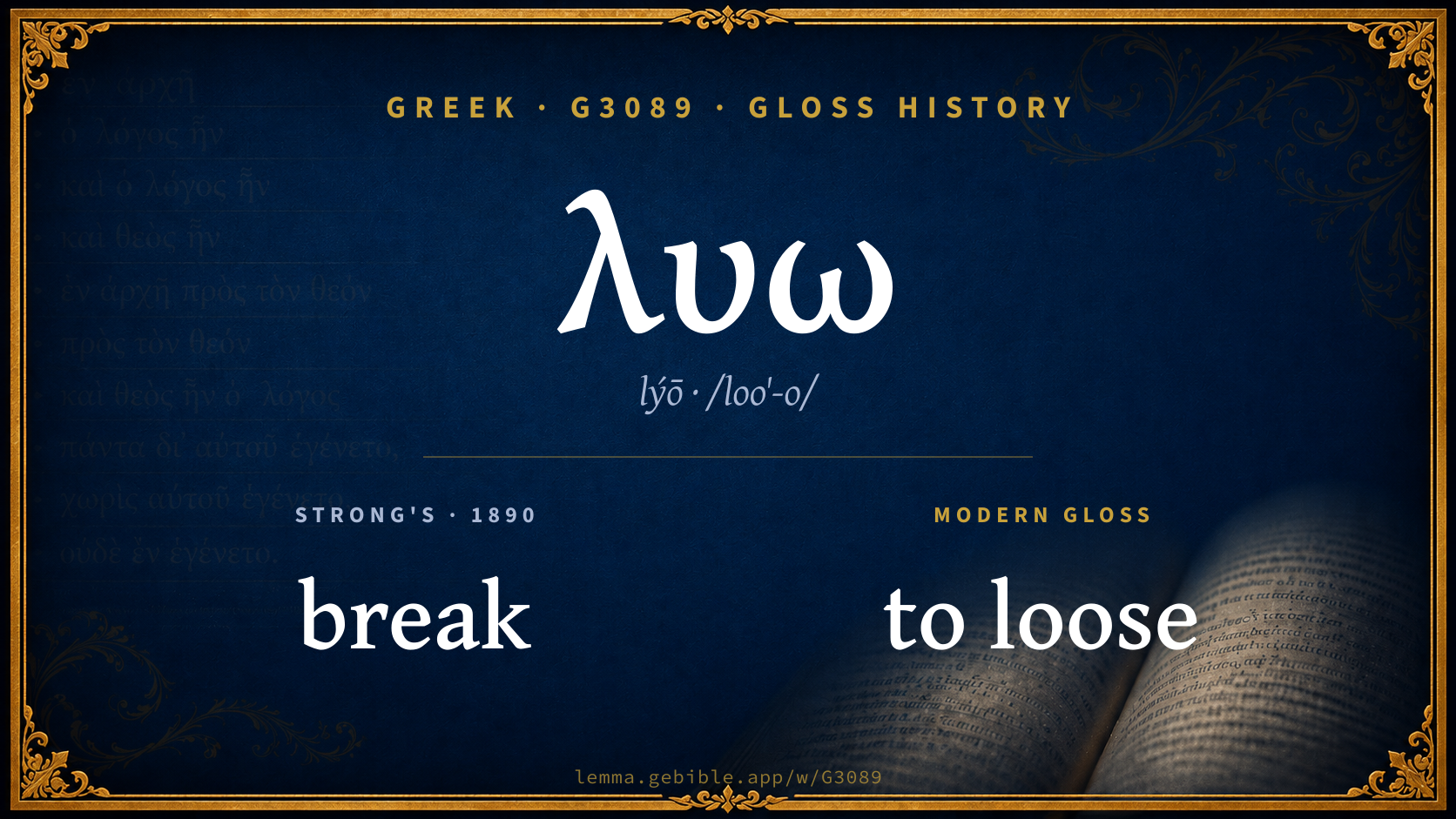
Gloss history
Strong's 1890 vs modern scholarship
About this word
Strong's G3089 catalogs a Greek word from the Greek New Testament.
These counts are not copied from any lexicon or concordance. They are computed here, from the morphology-tagged Greek New Testament. What Lemma adds →
- 39
- distinct verses
- The word appears in 39 distinct verses.
- 10 / 27
- NT books
- The word appears in 10 of 27 New Testament books.
- #356
- by frequency
- Top 500 most frequent Greek words (rank 356 of 5,347 Greek words by occurrence).
View all 39 occurrences in the concordance →
By section of the New Testament
By traditional corpus
Conventional, traditional groupings — biblical authorship is debated, so this is a traditional corpus grouping, not an authorship claim. Some books belong to more than one corpus (Luke is in both the Gospels and the Lukan corpus, and so on), so these shares overlap and need not total 100%. Each figure is a share of the word’s 39 distinct verses.
- Gospels 21 verses · 54%
- Johannine 13 verses · 33%
- Lukan (Luke–Acts) 12 verses · 31%
- Revelation 6 verses · 15%
- General (Catholic) Epistles 4 verses · 10%
- Pauline corpus 2 verses · 5%
How translations render this word
Counts come from each version’s own published word-to-Strong’s tagging or interlinear alignment — an approximate guide to how each version renders this word, not a word-level alignment the data otherwise carries. Because each total is that version’s own tagged count, the per-version totals vary from one another and need not match the appearance or distinct-verse counts above. These counts may also differ from a printed concordance because Lemma counts each distinctly tagged rendering and does not collapse phrase taggings into a single head-word total. This is a fixed set of word-tagged versions (KJV, ASV, BSB, ULT) and does not change with the reading translation you choose elsewhere. Each version’s license is shown beside its name below (and on Sources).
- King James Version: Loose 9×, Unloose 3×, Be broken 2×
- American Standard Version: Loose 9×, Unloose 4×, Loosed 3×
- Berean Standard Bible: Untie 8×, Will be destroyed 3×, Are you untying 2×
- unfoldingWord Literal Text: Untie 7×, Be broken 2×, Destroyed 2×
King James Version Public Domain
Renders G3089 across 46 tagged occurrences — most commonly:
Plus 26 renderings that appear only once — usually multi-word phrases or single function words the recovered tagging swept in, not distinct renderings.
American Standard Version Public Domain
Renders G3089 across 46 tagged occurrences — most commonly:
Plus 28 renderings that appear only once — usually multi-word phrases or single function words the recovered tagging swept in, not distinct renderings.
Berean Standard Bible Public Domain
Renders G3089 across 42 tagged occurrences — most commonly:
Plus 19 renderings that appear only once — usually multi-word phrases or single function words the recovered tagging swept in, not distinct renderings.
unfoldingWord Literal Text CC BY-SA 4.0
Renders G3089 across 49 tagged occurrences — most commonly:
Plus 32 renderings that appear only once — usually multi-word phrases or single function words the recovered tagging swept in, not distinct renderings.
Senses in Thayer's
The 3 senses Thayer's distinguishes for this word, in lexicon order (not ranked by frequency or importance). The full entry — with sub-senses — is in the Lexicon Entry tab.
- to loose any person (or thing) tied or fastened
- to loose one bound, i.e. to unbind, release from bonds, set free
- to loosen, undo, dissolve, anything bound, tied, or compacted together
Word origin
Origin: a root word
A primary verb; to loosen (literally or figuratively): - break (up) destroy dissolve (un-) loose melt put off. Compare G4486 .
— Strong’s Exhaustive Concordance (1890), public domain.
Forms in the corpus
The 29 distinct written forms G3089 takes in the Greek New Testament, most frequent first — each parse links to that tense’s occurrences in the concordance.
Same root — word family
Other Thayer's entries built from the same root as G3089, grouped by Strong’s listed origin. These share a root / origin per the lexicon — not necessarily a shared meaning. Each links to that word’s own entry.
Derived from this word
Compare all same-root words → They share a root, not necessarily a meaning.
Septuagint usage
The same Greek word λυω appears 16 times in the Greek Old Testament (Septuagint), across 16 verses in 8 books.
- 16
- LXX occurrences
- Tagged occurrences of this Greek word in the Septuagint.
- 16
- verses
- Distinct Septuagint verses containing this word.
- 8 / 39
- OT books
- The word appears in 8 of the 39 Old Testament books.
Sample Septuagint occurrences
- Genesis 42:27 λύω
- Exodus 3:5 λύω
- Joshua 5:15 λύω
- Job 5:20 λύω
- Psalms 101:21 λύω
- Isaiah 5:27 λύω
- Jeremiah 47:4 λύω
- Daniel 3:92 λύω
Septuagint occurrences (same lexeme)
Every verse where the same Strong’s number (G3089) appears in the Greek Septuagint. Verse text shown in the World English Bible for context; the Greek form is the matched word — the English is not keyword-highlighted.
- Genesis 42:27 λύω As one of them opened his sack to give his donkey food in the lodging-place, he saw his money. Behold, it was in the mouth of his sack.
- Exodus 3:5 λύω He said, "Don't come close. Take off your sandals from off your feet, for the place you are standing on is holy ground."
- Joshua 5:15 λύω The prince of Yahweh's host said to Joshua, Put off your shoe from off your foot; for the place whereon you stand is holy. Joshua did so.
- Job 5:20 λύω In famine he will redeem you from death; In war, from the power of the sword.
- Job 39:2 λύω Can you number the months that they fulfill? Or do you know the time when they give birth?
- Job 39:5 λύω "Who has set the wild donkey free? Or who has loosened the bonds of the swift donkey,
- Job 42:9 λύω So Eliphaz the Temanite and Bildad the Shuhite and Zophar the Naamathite went, and did what Yahweh commanded them, and Yahweh accepted Job.
- Psalms 101:21 λύω
- Psalms 104:20 λύω You make darkness, and it is night, In which all the animals of the forest prowl.
- Psalms 145:7 λύω They will utter the memory of your great goodness, And will sing of your righteousness.
- Isaiah 5:27 λύω None shall be weary nor stumble among them; None shall slumber nor sleep; Neither shall the belt of their loins be untied, Nor the latchet of their shoes be broken:
- Isaiah 14:17 λύω who made the world as a wilderness, and overthrew the cities of it; who didn't let loose his prisoners to their home?"
- Isaiah 40:2 λύω Speak comfortably to Jerusalem; and cry to her, that her warfare is accomplished, that her iniquity is pardoned, that she has received of Yahweh's hand double for all her sins.
- Isaiah 58:6 λύω Isn't this the fast that I have chosen: to loose the bonds of wickedness, to undo the bands of the yoke, and to let the oppressed go free, and that you break every yoke?
- Jeremiah 47:4 λύω because of the day that comes to destroy all the Philistines, to cut off from Tyre and Sidon every helper who remains: for Yahweh will destroy the Philistines, the remnant of the isle of Caphtor.
- Daniel 3:92 λύω
These are occurrences of the same Greek lexeme (G3089) in the Septuagint — not a translation of any one Hebrew word. The store carries no word-level Hebrew↔Greek alignment, so no Hebrew original is asserted here. Counts come from the recovered LXX Strong's tagging — high-frequency vocabulary is well covered, while rare or late forms may be untagged — so they reflect tagged occurrences and may slightly undercount.