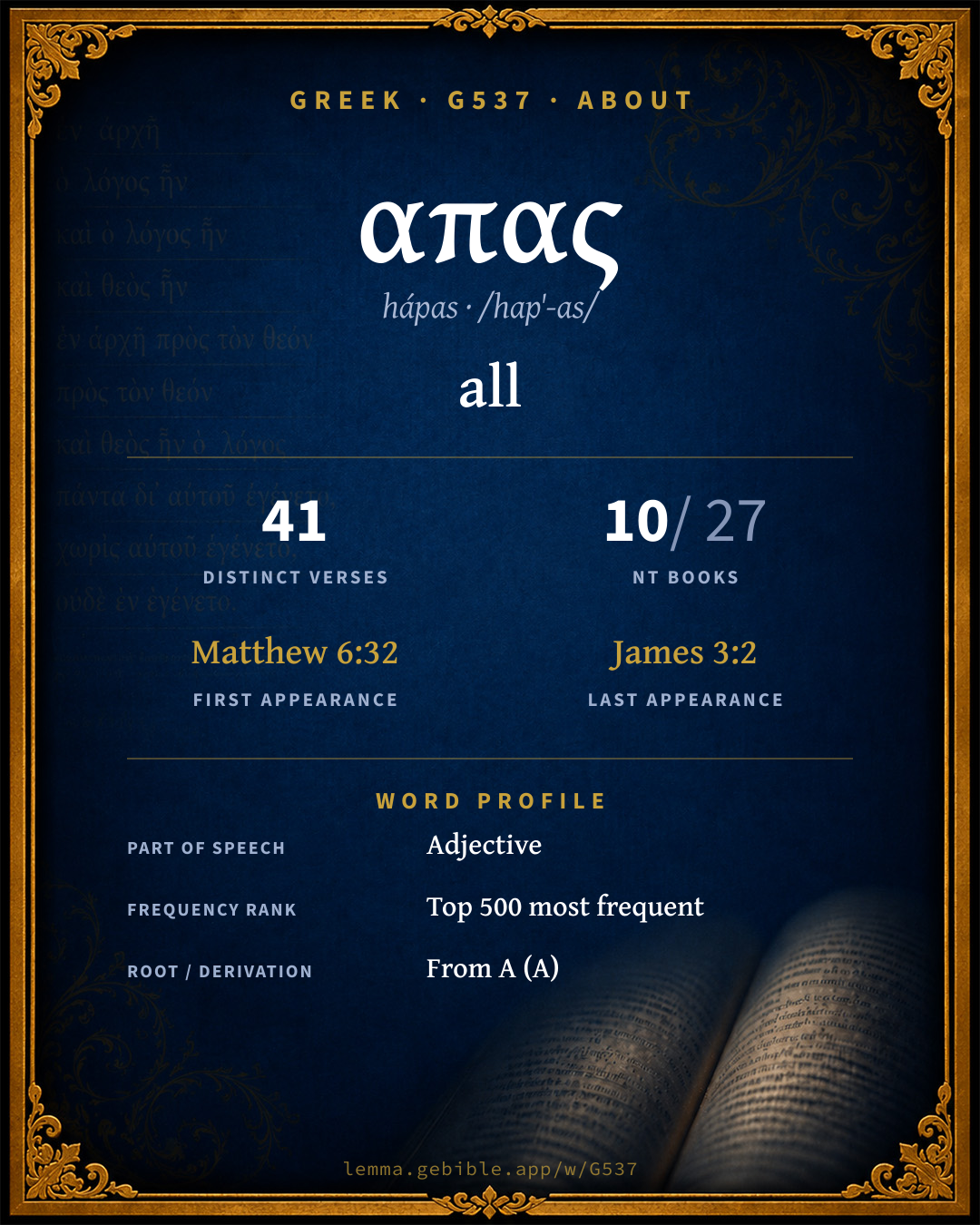
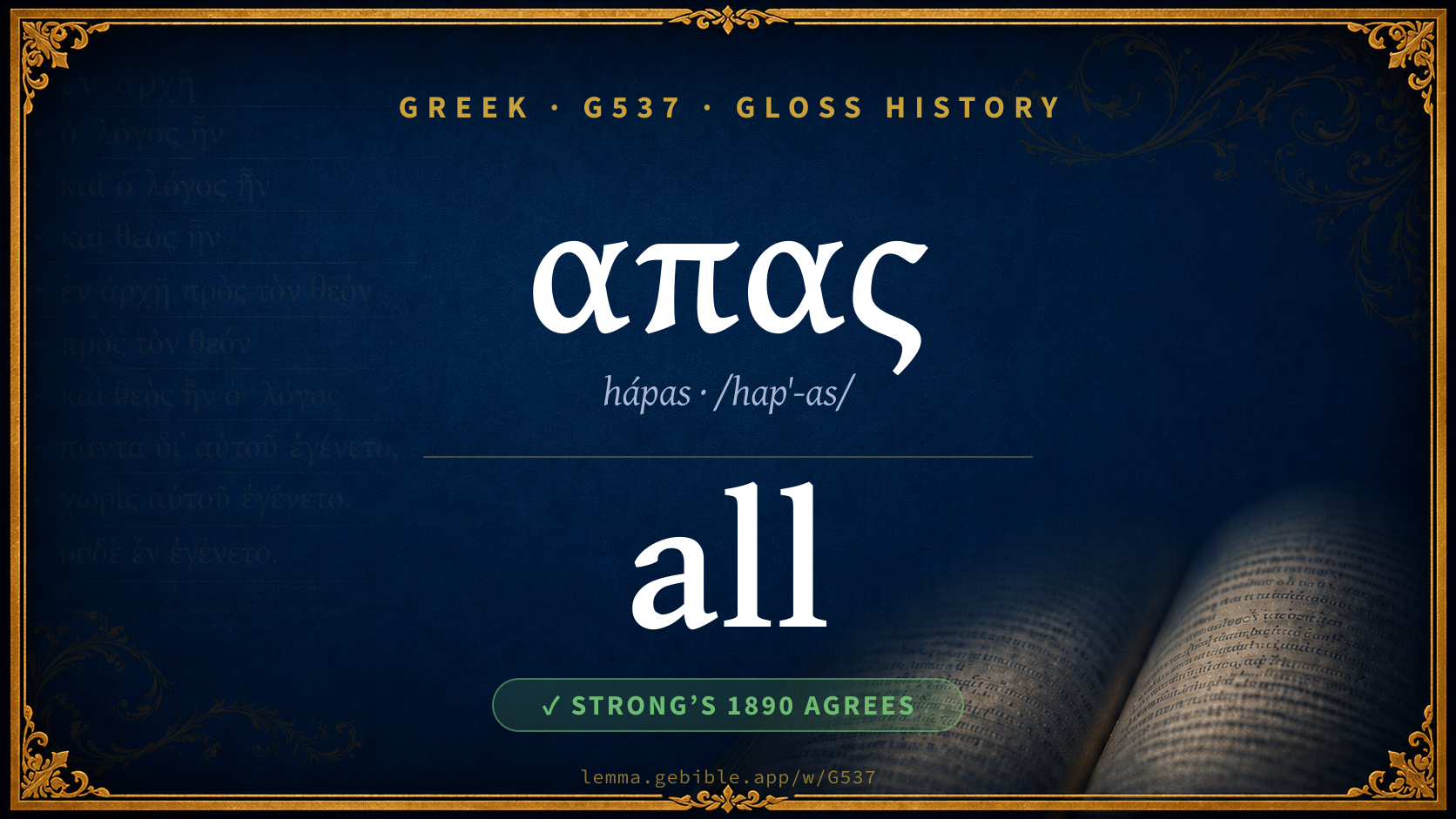
ἅπας
all
Full lexicon entry — Thayer's Greek Lexicon
From Thayer's Greek Lexicon
Where this word appears
Grammar key — what these labels mean
Part of speech
- Adjective
- A word that describes or qualifies a noun.
Case
- Nominative
- The case of the subject (and the predicate nominative).
- Accusative
- The case of the direct object and of extent.
- Genitive
- The case of source, possession, or “of” — answers “whose / from what.”
Gender
- Masculine
- Grammatically masculine.
- Neuter
- Grammatically neuter.
- Feminine
- Grammatically feminine.
Number
- Plural
- More than one.
- Singular
- One.
Every verse where G537 appears in the Book of Ephesians — 1 distinct verse. Click any verse to open its interlinear word-by-word view. Verse text shown in the World English Bible for context — . Each verse’s Greek form is shown with its reference; the English is not keyword-highlighted, since the data carries no word-level English alignment. Use “Compare translations” on any verse to read it across multiple English versions. This concordance covers the Greek New Testament; Septuagint (Greek Old Testament) occurrences of this word are not indexed here.
Ephesians
About this entry
At a glance — auto-summarized from this page’s data, not written by a person. Every figure links to its source below. This summary describes the numbers; it doesn’t interpret them.
απας — transliterated hápas — is a Greek adjective carrying the sense “all.” Debuting at Matthew 6:32, it then recurs through the corpus. Spanning 41 verses in 10 books, it ranks among the moderately common words of the Greek New Testament. Its uses concentrate in Luke (37% of all occurrences). From the same root come Α, αβαρης and αβυσσος. Each statement above links to its evidence; the full detail follows below.
Gloss history
Strong's 1890 vs modern scholarship
About this word
Strong's G537 catalogs a Greek word from the Greek New Testament.
These counts are not copied from any lexicon or concordance. They are computed here, from the morphology-tagged Greek New Testament. What Lemma adds →
- 41
- distinct verses
- The word appears in 41 distinct verses.
- 10 / 27
- NT books
- The word appears in 10 of 27 New Testament books.
- #356
- by frequency
- Top 500 most frequent Greek words (rank 356 of 5,347 Greek words by occurrence).
View all 41 occurrences in the concordance →
By section of the New Testament
By traditional corpus
Conventional, traditional groupings — biblical authorship is debated, so this is a traditional corpus grouping, not an authorship claim. Some books belong to more than one corpus (Luke is in both the Gospels and the Lukan corpus, and so on), so these shares overlap and need not total 100%. Each figure is a share of the word’s 41 distinct verses.
- Lukan (Luke–Acts) 28 verses · 68%
- Gospels 23 verses · 56%
- Pauline corpus 4 verses · 10%
- Johannine 1 verse · 2%
- General (Catholic) Epistles 1 verse · 2%
How translations render this word
Counts come from each version’s own published word-to-Strong’s tagging or interlinear alignment — an approximate guide to how each version renders this word, not a word-level alignment the data otherwise carries. Because each total is that version’s own tagged count, the per-version totals vary from one another and need not match the appearance or distinct-verse counts above. These counts may also differ from a printed concordance because Lemma counts each distinctly tagged rendering and does not collapse phrase taggings into a single head-word total. This is a fixed set of word-tagged versions (KJV, ASV, BSB, ULT) and does not change with the reading translation you choose elsewhere. Each version’s license is shown beside its name below (and on Sources).
- King James Version: All 34×, All things 3×, Whole 3×
- American Standard Version: All 33×, All things 4×, Whole 2×
- Berean Standard Bible: All 11×, Everything 5×, Whole 3×
- unfoldingWord Literal Text: All 19×, Everything 5×, Whole 4×
King James Version Public Domain
Renders G537 across 44 tagged occurrences — most commonly:
Plus 4 renderings that appear only once — usually multi-word phrases or single function words the recovered tagging swept in, not distinct renderings.
American Standard Version Public Domain
Renders G537 across 46 tagged occurrences — most commonly:
Plus 7 renderings that appear only once — usually multi-word phrases or single function words the recovered tagging swept in, not distinct renderings.
Berean Standard Bible Public Domain
Renders G537 across 25 tagged occurrences — most commonly:
Plus 4 renderings that appear only once — usually multi-word phrases or single function words the recovered tagging swept in, not distinct renderings. Not rendered by a distinct English word in 4 further occurrences.
unfoldingWord Literal Text CC BY-SA 4.0
Renders G537 across 32 tagged occurrences — most commonly:
Plus 4 renderings that appear only once — usually multi-word phrases or single function words the recovered tagging swept in, not distinct renderings.
Senses in Thayer's
The 1 sense Thayer's distinguishes for this word, in lexicon order (not ranked by frequency or importance). The full entry — with sub-senses — is in the Lexicon Entry tab.
- quite, all, the whole, all together, all
Word origin
Derived from Α (A) (G1) — alpha.
Forms in the corpus
The 7 distinct written forms G537 takes in the Greek New Testament, most frequent first — each parse links to that case’s occurrences in the concordance.
| Form | Parsing | Example | Uses |
|---|---|---|---|
| ἅπαντες hápantes | Adjective, Nominative, Plural, Masculine | Mark 1:27 | 14 |
| ἅπαντα hápanta | Adjective, Accusative, Plural, Neuter | Matthew 28:11 | 12 |
| ἅπαντας hápantas | Adjective, Accusative, Plural, Masculine | Matthew 24:39 | 7 |
| ἅπαν hápan | Adjective, Nominative, Singular, Neuter | Luke 8:37 | 4 |
| ἅπας hápas | Adjective, Nominative, Singular, Masculine | Luke 19:48 | 2 |
| ἅπασαν hápasan | Adjective, Accusative, Singular, Feminine | Luke 4:6 | 2 |
| ἁπάντων hapántōn | Adjective, Genitive, Plural, Neuter | Matthew 6:32 | 1 |
Same root — word family
Other Thayer's entries built from the same root as G537, grouped by Strong’s listed origin. These share a root / origin per the lexicon — not necessarily a shared meaning. Each links to that word’s own entry.
Derives from
Shares the same root
- αβαρης abarḗs G4 light
- αβυσσος ábyssos G12 abyss
- αγαμος ágamos G22 unmarried
- αγενεαλογητος agenealógētos G35 without genealogy
- αγενης agenḗs G36 ignoble
- αγναφος ágnaphos G46 unprocessed
- αγνοεω agnoéō G50 to be ignorant
- αγνωσια agnōsía G56 ignorance
- αγνωστος ágnōstos G57 unknown
- αγραμματος agrámmatos G62 unlearned
- αγρυπνεω agrypnéō G69 to watch
- αδαπανος adápanos G77 free
- αδελφος adelphós G80 brother
- αδηλος ádēlos G82 obscure
- αδης háidēs G86 hell
- αδιακριτος adiákritos G87 clear
- αδιαλειπτος adiáleiptos G88 continual
- αδικος ádikos G94 unjust
- αδοκιμος adókimos G96 unapproved
- αδολος ádolos G97 guileless
- αδυνατος adýnatos G102 weak
- αζυμος ázymos G106 unleavened
- αθανασια athanasía G110 immortal
- αθεμιτος athémitos G111 unlawful
+149 more words share this root (not shown).
Derived from this word
Proper names from this root
People and places named from this root — a name, not an additional meaning of the word.
Compare all same-root words → Showing 4 of 177 — not the complete family. 1 of the same-root words is a proper name (a person or place). They share a root, not necessarily a meaning.
Septuagint usage
The same Greek word απας appears 38 times in the Greek Old Testament (Septuagint), across 36 verses in 14 books.
- 38
- LXX occurrences
- Tagged occurrences of this Greek word in the Septuagint.
- 36
- verses
- Distinct Septuagint verses containing this word.
- 14 / 39
- OT books
- The word appears in 14 of the 39 Old Testament books.
Sample Septuagint occurrences
- Genesis 19:4 ἅπας
- Leviticus 6:15 ἅπας
- Deuteronomy 22:19 ἅπας
- Joshua 6:13 ἅπας
- 2 Samuel 3:25 ἅπας
- 1 Kings 2:26 ἅπας
- 1 Chronicles 10:11 ἅπας
- Esther 9:28 ἅπας
- Psalms 21:24 ἅπας
- Proverbs 25:4 ἅπας
- Jeremiah 1:18 ἅπας
- Ezekiel 38:8 ἅπας
Septuagint occurrences (same lexeme)
Every verse where the same Strong’s number (G537) appears in the Greek Septuagint. Verse text shown in the World English Bible for context; the Greek form is the matched word — the English is not keyword-highlighted.
- Genesis 19:4 ἅπας But before they lay down, the men of the city, the men of Sodom, surrounded the house, both young and old, all the people from every quarter.
- Leviticus 6:15 ἅπας He shall take from there his handful of the fine flour of the meal offering, and of its oil, and all the frankincense which is on the meal offering, and shall burn it on the altar for a sweet savor, as its memorial, to Yahweh.
- Leviticus 8:27 ἅπας He put all these in Aaron's hands and in his sons' hands, and waved them for a wave offering before Yahweh.
- Deuteronomy 22:19 ἅπας and they shall fine him one hundred [shekels] of silver, and give them to the father of the young lady, because he has brought up an evil name on a virgin of Israel: and she shall be his wife; he may not put her away all his days.
- Deuteronomy 22:29 ἅπας then the man who lay with her shall give to the lady's father fifty [shekels] of silver, and she shall be his wife, because he has humbled her; he may not put her away all his days.
- Joshua 6:13 ἅπας The seven priests bearing the seven trumpets of rams' horns before the ark of Yahweh went on continually, and blew the trumpets: and the armed men went before them; and the rearward came after the ark of Yahweh, [the priests] blowing the trumpets as they went.
- Joshua 6:20 ἅπας So the people shouted, and [the priests] blew the trumpets; and it happened, when the people heard the sound of the trumpet, that the people shouted with a great shout, and the wall fell down flat, so that the people went up into the city, every man straight before him, and they took the city.
- 2 Samuel 3:25 ἅπας You know Abner the son of Ner, that he came to deceive you, and to know your going out and your coming in, and to know all that you do.
- 1 Kings 2:26 ἅπας To Abiathar the priest said the king, Get you to Anathoth, to your own fields; for you are worthy of death: but I will not at this time put you to death, because you bear the ark of the Lord Yahweh before David my father, and because you were afflicted in all in which my father was afflicted.
- 1 Kings 12:24 ἅπας Thus says Yahweh, You shall not go up, nor fight against your brothers the children of Israel: return every man to his house; for this thing is of me. So they listened to the word of Yahweh, and returned and went their way, according to the word of Yahweh.
- 1 Kings 13:11 ἅπας Now there lived an old prophet in Bethel; and one of his sons came and told him all the works that the man of God had done that day in Bethel: the words which he had spoken to the king, them also they told to their father.
- 1 Chronicles 10:11 ἅπας When all Jabesh Gilead heard all that the Philistines had done to Saul,
- 1 Chronicles 16:43 ἅπας All the people departed every man to his house: and David returned to bless his house.
- 1 Chronicles 17:10 ἅπας and [as] from the day that I commanded judges to be over my people Israel; and I will subdue all your enemies. Moreover I tell you that Yahweh will build you a house.
- Esther 9:28 ἅπας and that these days should be remembered and kept throughout every generation, every family, every province, and every city; and that these days of Purim should not fail from among the Jews, nor the memory of them perish from their seed.
- Psalms 21:24 ἅπας
- Proverbs 25:4 ἅπας Take away the dross from the silver, And material comes out for the refiner;
- Jeremiah 1:18 ἅπας For, behold, I have made you this day a fortified city, and an iron pillar, and brazen walls, against the whole land, against the kings of Judah, against the princes of it, against the priests of it, and against the people of the land.
- Jeremiah 5:19 ἅπας It shall happen, when you shall say, Why has Yahweh our God done all these things to us? then shall you say to them, Like as you have forsaken me, and served foreign gods in your land, so shall you serve strangers in a land that is not yours.
- Jeremiah 16:10 ἅπας It shall happen, when you shall show this people all these words, and they shall tell you, Why has Yahweh pronounced all this great evil against us? or what is our iniquity? or what is our sin that we have committed against Yahweh our God?
- Jeremiah 18:23 ἅπας Yet, Yahweh, you know all their counsel against me to kill me; don't forgive their iniquity, neither blot out their sin from your sight; but let them be overthrown before you; deal you with them in the time of your anger.
- Jeremiah 19:15 ἅπας Thus says Yahweh of Hosts, the God of Israel, Behold, I will bring on this city and on all its towns all the evil that I have pronounced against it; because they have made their neck stiff, that they may not hear my words.
- Jeremiah 23:8 ἅπας but, As Yahweh lives, who brought up and who led the seed of the house of Israel out of the north country, and from all the countries where I had driven them. They shall dwell in their own land.
- Jeremiah 29:2 ἅπας (after that Jeconiah the king, and the queen-mother, and the eunuchs, [and] the princes of Judah and Jerusalem, and the craftsmen, and the smiths, were departed from Jerusalem),
- Jeremiah 33:2 ἅπας Thus says Yahweh who does it, Yahweh who forms it to establish it; Yahweh is his name:
- Jeremiah 36:1 ἅπας It happened in the fourth year of Jehoiakim the son of Josiah, king of Judah, that this word came to Jeremiah from Yahweh, saying,
- Jeremiah 39:23 ἅπας
- Jeremiah 43:11 ἅπας He shall come, and shall strike the land of Egypt; such as are for death [shall be given] to death, and such as are for captivity to captivity, and such as are for the sword to the sword.
- Jeremiah 43:16 ἅπας
- Jeremiah 43:32 ἅπας
- Jeremiah 47:5 ἅπας Baldness is come on Gaza; Ashkelon is brought to nothing, the remnant of their valley: how long will you cut yourself?
- Jeremiah 48:12 ἅπας Therefore, behold, the days come, says Yahweh, that I will send to him those who pour off, and they shall pour him off; and they shall empty his vessels, and break their bottles in pieces.
- Jeremiah 51:1 ἅπας Thus says Yahweh: Behold, I will raise up against Babylon, and against those who dwell in Lebkamai, a destroying wind.
- Ezekiel 38:8 ἅπας After many days you shall be visited: in the latter years you shall come into the land that is brought back from the sword, that is gathered out of many peoples, on the mountains of Israel, which have been a continual waste; but it is brought forth out of the peoples, and they shall dwell securely, all of them.
- Amos 7:10 ἅπας Then Amaziah the priest of Beth El sent to Jeroboam king of Israel, saying, "Amos has conspired against you in the midst of the house of Israel. The land is not able to bear all his words.
- Zechariah 7:5 ἅπας "Speak to all the people of the land, and to the priests, saying, 'When you fasted and mourned in the fifth and in the seventh month for these seventy years, did you at all fast to me, really to me?
These are occurrences of the same Greek lexeme (G537) in the Septuagint — not a translation of any one Hebrew word. The store carries no word-level Hebrew↔Greek alignment, so no Hebrew original is asserted here. Counts come from the recovered LXX Strong's tagging — high-frequency vocabulary is well covered, while rare or late forms may be untagged — so they reflect tagged occurrences and may slightly undercount.