
Jeremiah 48:12

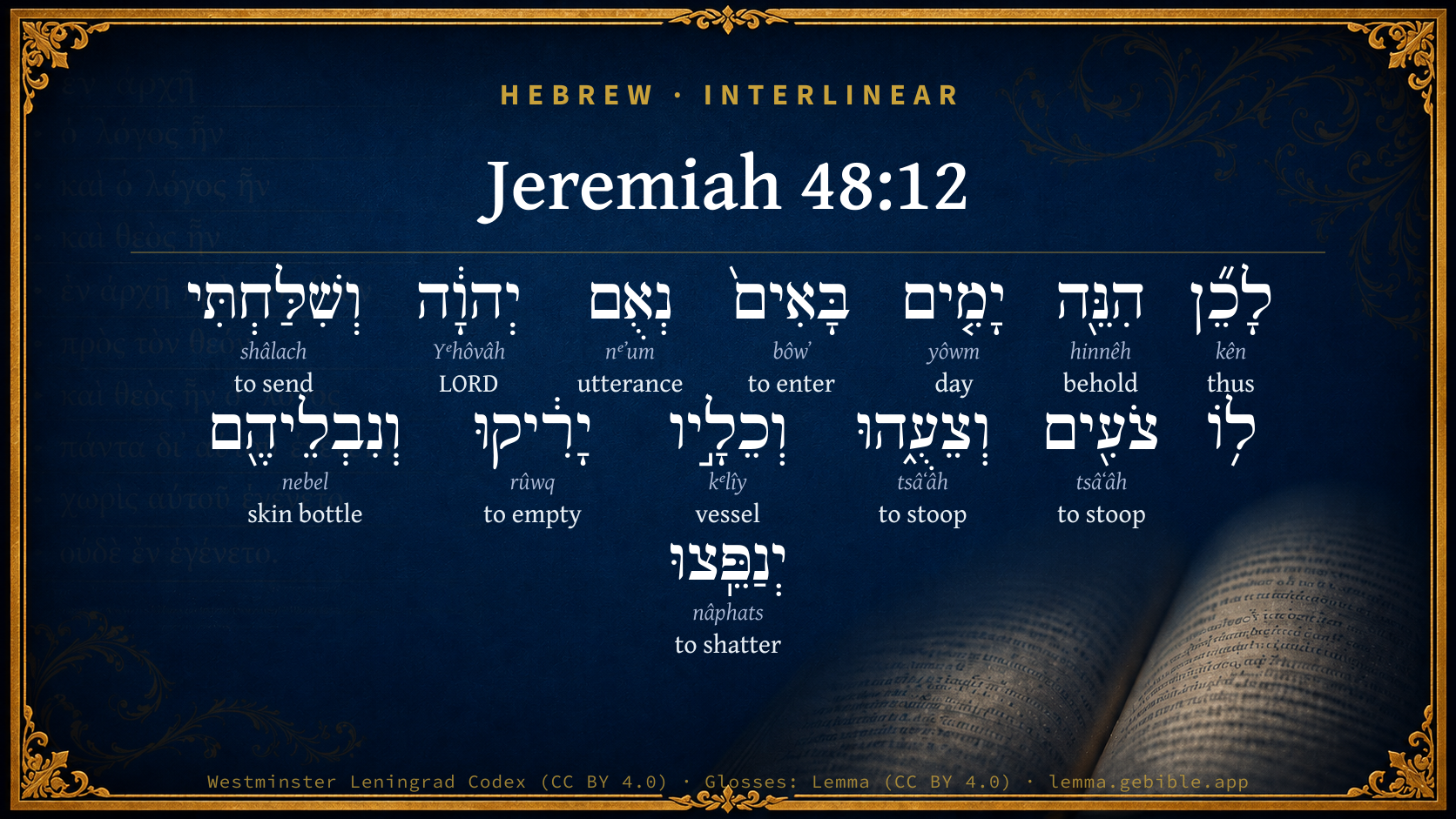
Hebrew (Westminster Leningrad Codex) Jeremiah 48:12 appears in the Hebrew Old Testament. The text above is from the Westminster Leningrad Codex. Each word links to its Strong’s number, a concise gloss, and parsing drawn from the Open Scriptures Hebrew Bible morphology. Click any word for its full Brown-Driver-Briggs (BDB) entry.
Download image
Cite this verse

Jeremiah 48:12 (World English Bible). Public Domain. Lemma interlinear Bible study tool, https://lemma.gebible.app/v/jeremiah/48/12.

Show BibTeX & RIS
BibTeX
RIS
English Translation
Therefore, behold, the days come, says Yahweh, that I will send to him those who pour off, and they shall pour him off; and they shall empty his vessels, and break their bottles in pieces.
World English Bible · Public Domain
Download a study sheet

One document with this verse’s original text, its word-by-word gloss line, the meaning frame, cross-references with their text, attributed commentary, and full source and license credits — printable, and it pastes into notes with its structure intact.

This verse Autodidact and up

Study sheet (.html) Plain text (.txt)

A passage Seminary Student

Up to 50 verses in one chapter. A passage sheet keeps up to 6 commentary sources and 12 cross-references per verse, in the order this page ranks them, and says so on the sheet whenever that leaves anything out. Ask for a single verse and you get the Autodidact verse sheet above.

Everything on this page stays free to read, with no account — the sheet is a download of what is already on screen, not access to it.

Want to remove ads? Support Godless Engineer
Compare translations 3

The same verse in 3 English versions, stacked beneath the original-language interlinear above. Click any original word for its lexicon entry.

Each is an independent rendering of the whole verse — the interlinear is not word-aligned to these translations.

Highlighted words mark where these versions differ — a whole-verse word diff, not a word-by-word alignment.

  • World English Bible Public Domain
    Therefore, behold, the days come, says Yahweh, that I will send to him those who pour off, and they shall pour him off; and they shall empty his vessels, and break their bottles in pieces.
  • King James Version Public Domain
    Therefore, behold, the days come, saith the LORD, that I will send unto him wanderers, that shall cause him to wander, and shall empty his vessels, and break their bottles.
  • unfoldingWord Literal Text CC BY-SA 4.0
    So see, the days are coming—this is Yahweh’s declaration—when I will send him those who will tip him over and pour out all his pots and shatter his jars.

unfoldingWord Literal Text — © unfoldingWord, licensed CC BY-SA 4.0. Word-aligned USFM3 via Door43 (git.door43.org/unfoldingWord/en_ult).

Versions to compare (up to 4)

3 of 4 selected

Show all 18 translations

Every available English version of this verse, each an independent rendering of the whole verse.

  • World English Bible Public Domain
    Therefore, behold, the days come, says Yahweh, that I will send to him those who pour off, and they shall pour him off; and they shall empty his vessels, and break their bottles in pieces.
  • Berean Standard Bible Public Domain
    Therefore behold, the days are coming, declares the LORD, when I will send to him wanderers, who will pour him out. They will empty his vessels and shatter his jars.
  • Majority Standard Bible Public Domain
    Therefore behold, the days are coming, declares the LORD, when I will send to him wanderers, who will pour him out. They will empty his vessels and shatter his jars.
  • King James Version Public Domain
    Therefore, behold, the days come, saith the LORD, that I will send unto him wanderers, that shall cause him to wander, and shall empty his vessels, and break their bottles.
  • American Standard Version (1901) Public Domain
    Therefore, behold, the days come, saith Jehovah, that I will send unto him them that pour off, and they shall pour him off; and they shall empty his vessels, and break their bottles in pieces.
  • Revised Version (1885) Public Domain
    Therefore, behold, the days come, saith the LORD, that I will send unto him them that pour off, and they shall pour him off; and they shall empty his vessels, and break their bottles in pieces.
  • Geneva Bible (1599) Public Domain
    Therefore beholde, the dayes come, saith the Lord, that I will send vnto him such as shall carie him away, and shall emptie his vessels, and breake their bottels.
  • Douay-Rheims (1899) Public Domain
    Therefore behold the days come, saith the Lord, and I will send him men that shall order and overturn his bottles, and they shall cast him down, and shall empty his vessels, and break their bottles one against another.
  • Young's Literal Translation Public Domain
    Therefore, lo, days are coming, An affirmation of Jehovah, And I have sent to him wanderers, And they have caused him to wander, And his vessels they empty out, And his bottles they dash in pieces.
  • Literal Standard Version CC BY-SA 4.0
    Therefore, behold, days are coming, || A declaration of YHWH, || And I have sent wanderers to him, || And they have caused him to wander, || And they empty out his vessels, || And they dash his bottles in pieces.
  • Unlocked Literal Bible CC BY-SA 4.0
    So see, the days are coming—this is Yahweh's declaration—when I will send him those who will tip him over and pour out all his pots and shatter his jars.
  • unfoldingWord Literal Text CC BY-SA 4.0
    So see, the days are coming—this is Yahweh’s declaration—when I will send him those who will tip him over and pour out all his pots and shatter his jars.
  • Darby Bible Public Domain
    Therefore behold, days come, saith Jehovah, that I will send unto him pourers that shall pour him off, and shall empty his vessels, and break in pieces his flagons.
  • World Messianic Bible Public Domain
    Therefore behold, the days come,” says the LORD, “that I will send to him those who pour off, and they will pour him off; and they will empty his vessels, and break their containers in pieces.
  • Webster's Bible Public Domain
    Therefore, behold, the days come, saith the LORD, that I will send to him wanderers that shall cause him to wander, and shall empty his vessels, and break their bottles.
  • Free Bible Version CC BY-SA 4.0
    But watch out, the time is coming, declares the Lord, when I will send them “winemakers” who will pour them out like wine. They will empty out the Moabites, and smash them like jars.
  • Bible in Basic English Public Domain
    So truly, the days are coming, says the Lord, when I will send to him men who will have him turned over till there is no more wine in his vessels, and his wine-skins will be completely broken.
  • JPS Tanakh (1917) Public Domain
    Therefore, behold, the days come, saith the LORD, that I will send unto him them that tilt up, and they shall tilt him up; and they shall empty his vessels, and break their bottles in pieces.

Literal Standard Version (2020), Covenant Press — licensed CC BY-SA 4.0. Text via the HelloAO Bible API (eBible.org). Unlocked Literal Bible (unfoldingWord) — licensed CC BY-SA 4.0. Text via the HelloAO Bible API (eBible.org). unfoldingWord Literal Text — © unfoldingWord, licensed CC BY-SA 4.0. Word-aligned USFM3 via Door43 (git.door43.org/unfoldingWord/en_ult). Free Bible Version, Dr. Jonathan Gallagher — licensed CC BY-SA 4.0. Text via the HelloAO Bible API (eBible.org).

Word by word

More ways to search: Search by grammar → Find every occurrence → Compare this word →

Practice this passage: Drill this verse → Learn its vocabulary →

צֹעִ֖ים
tsâʻâh
H6808
“stooping”
Verb, Qal, Participle Active, Masculine, Plural, Absolute
Part of Speech
Verb
Stem
Qal
Form
Participle Active
Gender
Masculine
Number
Plural
State
Absolute
Full BDB Definition

Origin: a primitive root

TWOT: 1944

to stoop, bend, incline - (Qal) - to stoop, bend - to incline, tip - (Piel) to tip over
  1. לָכֵ֞ן kên H3651 “to/for · thus” Preposition + Adverb
  2. הִנֵּ֖ה hinnêh H2009 “behold” Particle, Demonstrative
  3. יָמִ֤ים yôwm H3117 “days” Noun, Common, Masculine, Plural, Absolute
  4. בָּאִים֙ bôwʼ H935 “entering” Verb, Qal, Participle Active, Masculine, Plural, Absolute
  5. נְאֻם nᵉʼum H5002 “utterance of” Noun, Common, Masculine, Singular, Construct
  6. יְהוָ֔ה Yᵉhôvâh H3068 “LORD” Noun, Proper
  7. וְשִׁלַּחְתִּי shâlach H7971 “and · to send” Conjunction + Verb, Piel, Sequential Perfect, 1st Person, Common, Singular
  8. וְצֵעֻ֑הוּ tsâʻâh H6808 “and · to stoop · him” Conjunction + Verb, Piel, Sequential Perfect, 3rd Person, Common, Plural + Suffix, Personal, 3rd Person, Masculine, Singular
  9. וְכֵלָ֣יו kᵉlîy H3627 “and · vessels · his” Conjunction + Noun, Common, Masculine, Plural, Construct + Suffix, Personal, 3rd Person, Masculine, Singular
  10. יָרִ֔יקוּ rûwq H7324 “to empty” Verb, Hiphil, Imperfect, 3rd Person, Masculine, Plural
  11. וְנִבְלֵיהֶ֖ם nebel H5035 “and · skin bottles · their” Conjunction + Noun, Common, Masculine, Plural, Construct + Suffix, Personal, 3rd Person, Masculine, Plural
  12. יְנַפֵּֽצוּ nâphats H5310 “to shatter” Verb, Piel, Imperfect, 3rd Person, Masculine, Plural

About this verse

These counts appear in no published source. They are computed here, from the morphology-tagged text and Lemma’s own curated glosses. What Lemma adds →

14
words
12
distinct lemmas
Prophets
section

Notable vocabulary

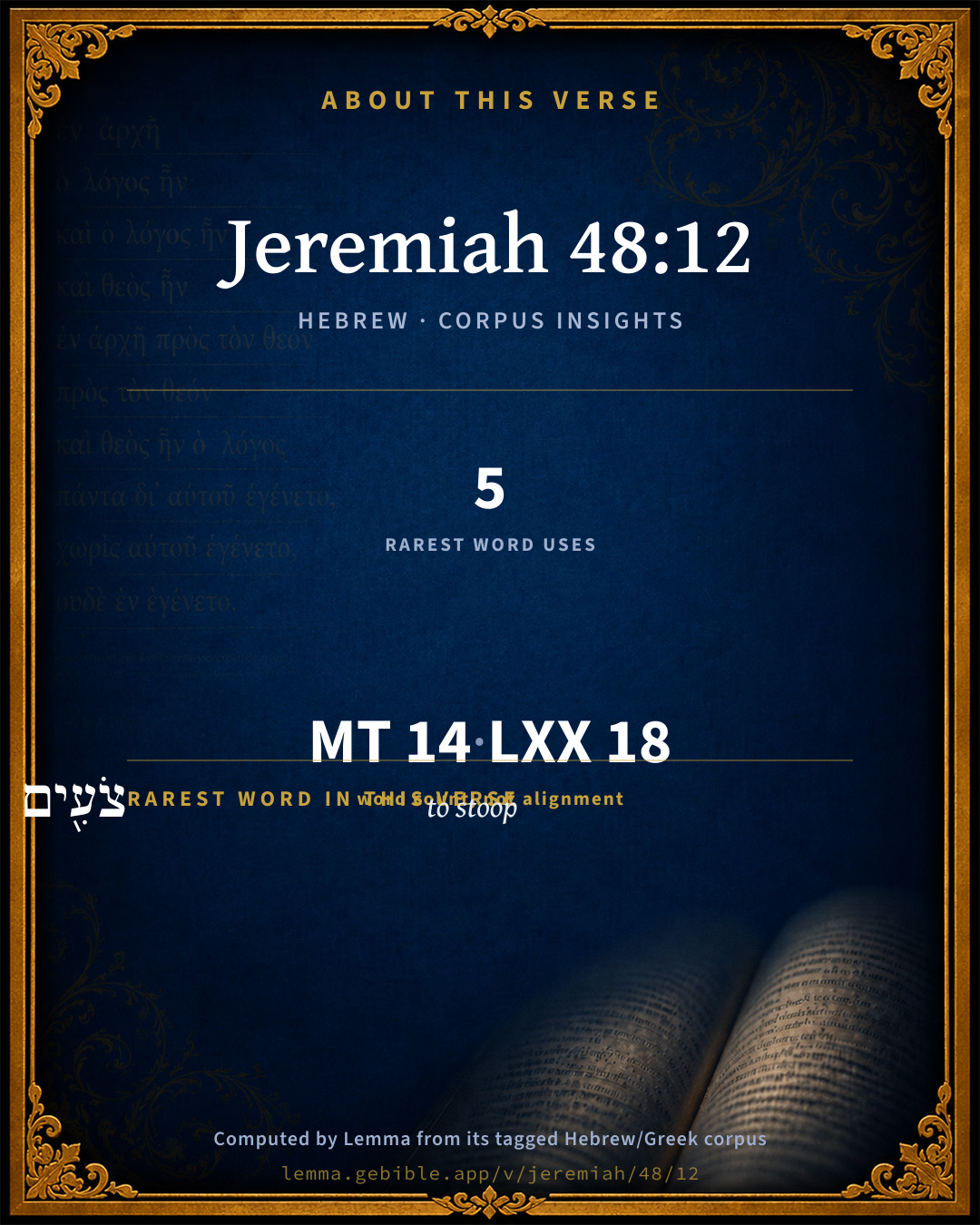
The rarest word here is צֹעִ֖ים to stoop H6808 — appearing just 5 times in the whole Hebrew Bible.

Shared distinctive vocabulary

צֹעִ֖ים to stoop H6808 occurs in 4 verses of the Hebrew Bible. Also found in:

Grammatical profile

  • 6 verbs
  • 5 nouns
  • 1 preposition
  • 1 adverb
  • 1 particle

Verb forms

  • בָּאִים֙ Qal · Participle Active
  • וְשִׁלַּחְתִּי Piel · Sequential Perfect
  • צֹעִ֖ים Qal · Participle Active
  • וְצֵעֻ֑הוּ Piel · Sequential Perfect
  • יָרִ֔יקוּ Hiphil · Imperfect
  • יְנַפֵּֽצוּ Piel · Imperfect

Repetition

A word recurs within this verse — often emphatic in Hebrew:

  • צֹעִ֖ים to stoop H6808 ×2

Hebrew & Septuagint length

In the original languages it is 14 Hebrew tokens and 18 Greek tokens — but the two are counted differently (Hebrew bundles its prefixes and suffixes into one token; the Greek is in lemma form), so that isn’t a like-for-like length.

Cross-references

13

Topical passages linked to Jeremiah 48:12 in the Treasury of Scripture Knowledge — connected by theme and wording, ordered by reader-vote popularity; previews shown in the World English Bible.

  • Nahum 2:2 For Yahweh restores the excellency of Jacob, as the excellency of Israel; for the destroyers have destroyed them, and ruined their vine branches.
  • Isaiah 30:14 He shall break it as a potter's vessel is broken, breaking it in pieces without sparing; so that there shall not be found among the pieces of it a broken piece with which to take fire from the hearth, or to dip up water out of the cistern."
  • Jeremiah 48:38 On all the housetops of Moab and in the streets of it there is lamentation every where; for I have broken Moab like a vessel in which none delights, says Yahweh.
  • Ezekiel 25:9–10 therefore, behold, I will open the side of Moab from the cities, from his cities which are on his frontiers, the glory of the country, Beth-jeshimoth, Baal Meon, and Kiriathaim,
  • Psalms 2:9 You shall break them with a rod of iron. You shall dash them in pieces like a potter's vessel."
  • Isaiah 16:2 For it shall be that, as wandering birds, as a scattered nest, so shall the daughters of Moab be at the fords of the Arnon.
  • Jeremiah 14:3 Their nobles send their little ones to the waters: they come to the cisterns, and find no water; they return with their vessels empty; they are disappointed and confounded, and cover their heads.
  • Jeremiah 19:10 Then shall you break the bottle in the sight of the men who go with you,
  • Jeremiah 25:9 behold, I will send and take all the families of the north, says Yahweh, and [I will send] to Nebuchadrezzar the king of Babylon, my servant, and will bring them against this land, and against the inhabitants of it, and against all these nations round about; and I will utterly destroy them, and make them an astonishment, and a hissing, and perpetual desolations.
  • Jeremiah 25:34 Wail, you shepherds, and cry; and wallow [in ashes], you principal of the flock; for the days of your slaughter and of your dispersions are fully come, and you shall fall like a goodly vessel.
  • Jeremiah 48:8 The destroyer shall come on every city, and no city shall escape; the valley also shall perish, and the plain shall be destroyed; as Yahweh has spoken.
  • Jeremiah 48:11 Moab has been at ease from his youth, and he has settled on his lees, and has not been emptied from vessel to vessel, neither has he gone into captivity: therefore his taste remains in him, and his scent is not changed.
  • Jeremiah 48:15 Moab is laid waste, and they are gone up into his cities, and his chosen young men are gone down to the slaughter, says the King, whose name is Yahweh of Hosts.

Cross-references courtesy of OpenBible.info (CC BY 4.0).

Hebrew and Greek witnesses Masoretic Hebrew ↔ Greek Septuagint

The same verse in the two great witnesses to the Old Testament, shown verse-for-verse.

These are two independent witnesses, not word-aligned to each other, and the Septuagint is shown in lemma (dictionary) form.

Hebrew Jeremiah 48:12 Masoretic · Westminster Leningrad Codex

לָכֵ֞ן הִנֵּ֖ה יָמִ֤ים בָּאִים֙ נְאֻם יְהוָ֔ה וְשִׁלַּחְתִּי ל֥וֹ צֹעִ֖ים וְצֵעֻ֑הוּ וְכֵלָ֣יו יָרִ֔יקוּ וְנִבְלֵיהֶ֖ם יְנַפֵּֽצוּ

Therefore, behold, the days come, says Yahweh, that I will send to him those who pour off, and they shall pour him off; and they shall empty his vessels, and break their bottles in pieces.

World English Bible · Public Domain

Greek LXX Structure differs

In the Septuagint, Jeremiah is about an eighth shorter than the Hebrew and arranges its material differently — the Oracles Against the Nations (Hebrew chapters 46–51) appear in the middle of the Greek book, after 25:13. Because the chapter and verse boundaries do not line up, a verse-for-verse comparison with the Hebrew is not shown.

A verse-for-verse comparison isn’t shown here because the chapters and verses don’t line up. Switch to the LXX edition with the MT / LXX toggle above to read the Greek directly.

On this verse, John Gill's Exposition discusses the Septuagint’s reading. Read the note in Commentary ↓

Hebrew: Westminster Leningrad Codex (CC BY 4.0). Greek: Septuagint (public domain); English from a public-domain English Septuagint. How the Septuagint differs from the Hebrew →

Targum (Aramaic paraphrase)

1

The Targum is the ancient Jewish Aramaic paraphrase of the Hebrew Scriptures — an interpretive translation, not the Hebrew text itself. Onkelos (literal) and Pseudo-Jonathan (expansive) render the Torah, and Jonathan the Prophets. Coverage is partial: where no permissively-licensed English translation exists for a verse, only the Aramaic is shown. This is verse-level text, not a word-by-word alignment to the Hebrew.

  1. Targum Jonathan Prophets (Joshua–Malachi)
    בְּכֵן הָא יוֹמַיָא אַתָן אֲמַר יְיָ וְאֶשְׁלַח עֲלֵיכוֹן בָּזוֹזִין וְיִבְזוּנוּנוּן וְנִכְסֵיהוֹן יְרוֹקְנוּן וְטוּב אַרְעֲהוֹן יְגַמְרוּן:

    (no public-domain English translation for this verse)

    Targum Jonathan — Aramaic: “Mikraot Gedolot” (public domain). English: “Sefaria Community Translation” (CC0 1.0 (public-domain dedication)); “London "Chaldee Paraphrase," 1871” (public domain). Text via Sefaria.

Commentary

Notes on Jeremiah 48:12 from classic Christian and Jewish commentators (each source and its license shown beneath its notes). The classic Christian expositions comment on the surrounding passage and are grouped to its opening verse, so a note may address several verses; the Jewish commentaries on the Tanakh (Rashi and others) are per-verse, so they appear only where the commentator wrote on this verse.

Lemma curates 59 commentaries, every one of them public domain or Creative Commons licensed, each selected and text-cleaned for this edition rather than reprinted as found. About our sources →

Trapp's Complete Commentary

John Trapp

Jer 48:12 Therefore, behold, the days come, saith the LORD, that I will send unto him wanderers, that shall cause him to wander, and shall empty his vessels, and break their bottles.

Ver. 12. That I will send him wanderers.] Peregrinantes qui peregre agant eum; the Chaldean vagrants, as he proudly calleth and counteth them; but they shall make a vagrant of him in good earnest.

And shall empty his vessels, &c.] Moab abounded with the best wine; but dwelling so near Sodom, his grapes also became grapes of Sodom and clusters of Gomorrah: his manners were Sodomitish too. It was but time therefore to send those that should empty his vessels and break his bottles, carry him into another country, where he might get a new taste, and his scent be changed.

John Trapp, A Commentary or Exposition upon All the Books of the Old and New Testament (1647–1656) — public domain. Text from a community e-Sword module.

Jamieson, Fausset & Brown

Robert Jamieson, A. R. Fausset & David Brown

wanderers--rather, "pourers out," retaining the image of Jer 48:11, that is, the Chaldeans who shall remove Moab from his settlements, as men pour wine from off the lees into other vessels. "His vessels" are the cities of Moab; the broken "bottles" the men slain [GROTIUS]. The Hebrew and the kindred Arabic word means, "to turn on one side," so as to empty a vessel [MAURER].

Jamieson, Fausset & Brown — Commentary Critical and Explanatory on the Whole Bible (1871) — public domain (CC PDM 1.0). Text via the HelloAO Bible API.

Adam Clarke's Commentary

Verse 12. I will send unto him wanderers that shall cause him to wander] Dr. Blayney renders צעים tsaim, tilters; those who elevate one end of the wine cask when nearly run out that the remains of the liquor may be the more effectually drawn off at the cock. And this seems to be well supported by the following words, -

And shall empty his vessels] I will send such as will carry the whole nation into captivity.

Adam Clarke's Commentary on the Bible (1810–1826) — public domain. Text from a community e-Sword/MySword module.

John Calvin's Commentaries

The Prophet said in the last lecture that the Moabites, as long as they lived prosperously, were very hardened, as impunity becomes an incentive to sin; for the ungodly, while God spares them, think that they shall never be called to an account. He now adds, that the days would come, in which God would suddenly execute vengeance on them. But he pursues the comparison which he had used; for he had said, that the Moabites were like wine which had not been poured from one vessel into another; and hence they retained their own odor, that is, they were inebriated with their own pleasures, because God had granted them peace and quietness for a long time.

Now, the Prophet, on the other hand, says that God would send to them drivers, to drive them away, and who would empty their vessels and scatter their bottles, — the containing for the contained; though I do not disapprove of another rendering, “and destroy their bottles;” for the verb is sometimes taken in this sense. Properly it means to scatter, to dissipate; but the verb נפף, nuphets, sometimes expresses a stronger idea, even to scatter or to cast forth with violence, so as to break what is thus cast forth. As to the real meaning there is not much difference: for we perceive what was God’s purpose, that he would send to the Moabites enemies to drive them into exile, and thus to deprive them of those pleasures in which they had so long indulged. But this was not said for the sake of the Moabites, but that the Jews might know, that though that land had been in a quiet state, yet it would not escape the hand of God; for its long continued felicity could not render void that decree of God of which the Prophet had spoken. It now follows —

John Calvin's Commentaries (1540-1563) — public domain. Text from the Calvin Translation Society English edition (1840s-50s) via the Christian Classics Ethereal Library (ccel.org). Calvin's coverage is partial (roughly two-thirds of the Bible); uncommented books and verses are honest gaps, never fabricated. The 19th-century editor's footnotes and remarks are omitted so the notes are faithfully Calvin's own voice.

The Cambridge Bible for Schools and Colleges

gen. ed. J. J. S. Perowne

12. pour off] rather as mg. tilt (a vessel). The figure of earthenware jars of wine is continued. They are emptied by being tilted on one side, an operation which was performed slowly and carefully, that the jars might be safe and the wine run off clear while the sediment was left. This work, however, in the case of Moab shall be done roughly.

bottles] rather as mg. jars.

The Cambridge Bible for Schools and Colleges (gen. ed. J. J. S. Perowne; Cambridge University Press, 1878–1918) — public domain. Text from a community e-Sword module.

John Gill's Exposition

Therefore, behold, the days come, saith the Lord,.... This being their case, they should not continue in it; a change would be made, and that in a very short time, as there was; for, according to Josephus (p), it was about five years after the destruction of Jerusalem that the Moabites were subdued by the king of Babylon:

that I will send unto him wanderers that shall cause him to wander; the Chaldeans, who wandered out of their own country to Moab, directed by the providence of God to come there to do his work; and who, at first, might be treated by the Moabites with contempt, as vagrants, but would soon be made to know that they would cause them to wander; or would remove them out of their own country into other lands, particularly Babylon, to be vagrants there. The word may be rendered "travellers" (q); and signifies such that walk with great strength of body, in a stately way, and with great agility and swiftness; in which manner the Chaldeans are described as coming to Moab, and who should cause them to travel back with them in all haste; see word in Isa 63:1. The Targum renders it "spoilers"; according to the metaphor of wine used in Jer 48:11, it may signify a sort of persons that cause wine to go, or empty it from one vessel to another; such as we call "wine coopers"; and this agrees with what follows:

and shall empty his vessels, and break their bottles; depopulate the cities of Moab; destroy the inhabitants of them, and make them barren and empty of men. The Targum is,

"I will send spoilers upon them, and they shall spoil them, and empty their substance, and consume the good of their land;''

see Jer 48:8. The Septuagint version is, "they shall cut in pieces his horns"; which, as Origen (r) interprets them, were a kind of cups anciently used; for in former times they drank out of horns, either of oxen, or other animals; and Pliny (s) says that the northern people used to drink out of the horns of buffaloes, a creature larger than a bull, and which the Muscovites call "thur"; the same is asserted by Athenaeus (t), and others, that the horns of beasts were drinking vessels before cups were invented.

(p) Antiqu. l. 10. c. 9. sect. 7. (q) "viatores", Tigurine version. (r) Apud Drusium in fragmentis in loc. (s) Nat. Hist. l. 11. e. 37. (t) Deipnosoph. l. 11. p. 235. Rhodigin. 1. 30.

John Gill's Exposition of the Whole Bible (1746–1763) — public domain (CC PDM 1.0). Text via the HelloAO Bible API.

Albert Barnes' Notes on the Bible

I will send - tilters “unto him and they shall” tilt “him, and they shall empty his vessels, and break their” pitchers “in pieces.” “Pitchers” originally meant “skins,” but the word came to signify small earthenware jars Isa 30:14 : thus the Chaldaeans shall destroy of Moab everything that has contained the wine of her political life both small and great.

Albert Barnes' Notes on the Bible (1834–1885) — public domain. Text from a community e-Sword/MySword module.

Matthew Poole's English Annotations

By the

wanderers here mentioned the Chaldeans are most certainly understood, who wandered from their own country to conquer other people; the word is variously translated, vagrants, travellers, removers, &c., who shall conquer the Moabites, and carry them into captivity.

And shall empty his vessels, and break their bottles: he had before compared the Moabites to wine settled upon the lees, here he saith that God would send those that should not only disturb and roll them, but ruin and destroy them.

Matthew Poole's English Annotations on the Holy Bible (1683–1685) — public domain. Text from a community e-Sword/MySword module.

Whedon's Commentary on the Bible

Daniel D. Whedon

12. Wanderers — As is patent on the very surface, and as all expositors agree, this word is a wrong translation, and misleading. Luther renders tapsters; Ewald, overturners; Nagelsbach, Smith, Noyes, and others, tilters. Keil’s rendering expresses well the exact sense. I will send him those who pour out, and they shall pour him out. The wine in the earthen vessels of the time could be poured off only by tilting the vessel instead of draining it off, as in a wooden vessel, by a hole for the purpose.

Daniel D. Whedon (gen. ed.), Commentary on the Old and New Testaments (1874–1909) — public domain. Text from a community e-Sword module.

The Pulpit Commentary

Wanderers, that shall cause him to wander; rather, taters, and they shall tilt him. The earthen jars of which Thevenot speaks were doubtless similar to those of the Israelites. They would be tilted on one side, that the wine might run off clear from the dregs. Their bottles; rather, flagons or pitchers (of earthenware). The confusion of numbers and pronouns is remarkable. First, Moab collectively is spoken of as a wine jar; then the Moabites individually as Moab"s jars; last of all, the Moabites are spoken of as possessing "jars" (i.e. all the institutions, public and private, of the state and of society).

The Pulpit Commentary (1880–1919), ed. H.D.M. Spence-Jones & Joseph S. Exell — public domain. Text from a community e-Sword module.

John Wesley's Explanatory Notes

Wanderers - The Chaldeans, who wandered from their own country to conquer other people. Break his bottles - He had before compared the Moabites, to wine settled upon the lees, here he saith, that God would send those that should not only disturb, but destroy them.

John Wesley, Explanatory Notes Upon the Whole Bible (1754–1765) — public domain. Text via the GEBible commentary corpus.

Rashi

Rabbi Shlomo Yitzchaki (Rashi)

men to pour Heb. ציעים, those who pour. Cf. “What must be poured out (צֹעֶה) hastened to be opened” (Isa. 51:14). That is the moving of the bowels by pouring.

his jars Heb. נבליהם [lit. their jars], the Moabites’ flasks.

smash Heb. ינפצו, they shall break. Cf. “How were they regarded as earthen jars (לְנִבְלֵי) (Lam. 4:2). Also, “Every bottle (נֵבֶל) will be filled with wine” (supra 13.12).

Rashi on the Tanakh — English translations: “The Judaica Press complete Tanach with Rashi, translated by A. J. Rosenberg” (CC BY 4.0); “Pentateuch with Rashi's commentary by M. Rosenbaum and A.M. Silbermann, 1929-1934” (public domain); “The Metsudah Tanach series, Lakewood, N.J” (CC BY 4.0); and “The Book of Joshua, Metsudah Publications, 1997” (CC BY 4.0). Text via Sefaria.

Lesson kit

Teaching starters — assembled from the data on this page, not authored interpretation. Every prompt links to the verse data it draws on. Edit before teaching.

Jeremiah, in the Prophets, opens this verse with 14 words (12 distinct Hebrew lemmas). Its most distinctive word is tsâʻâh (“to stoop”). A historical commentator’s framing appears above. Read the whole chapter for the surrounding context.

Discussion questions

  1. How does “to stoop” (tsâʻâh) shape what this verse is saying?
  2. Isaiah 51:14 shares the word «to stoop» with this verse. How do the two illuminate each other?
  3. “to stoop” occurs 2× in this one verse. What is the effect of the repetition?
  4. These translations render this verse differently. What is at stake in choosing one wording over another?
  5. The verb «בָּאִים֙» is Qal Participle Active. How does its form color the action?
  6. Reading how Trapp's Complete Commentary and Jamieson, Fausset & Brown read this verse, where do the two commentators agree and where do they part?

Things to notice

Reading settings

Reading text

Shown beneath each verse's original-language words.

Old Testament
Old Testament edition

Read the OT as the Masoretic Hebrew (MT) or the Greek Septuagint (LXX).

English shown for the Greek Septuagint (in the Hebrew ↔ Greek comparison).

Comparing translations? Open the Compare panel on any verse page to stack up to four side by side.