
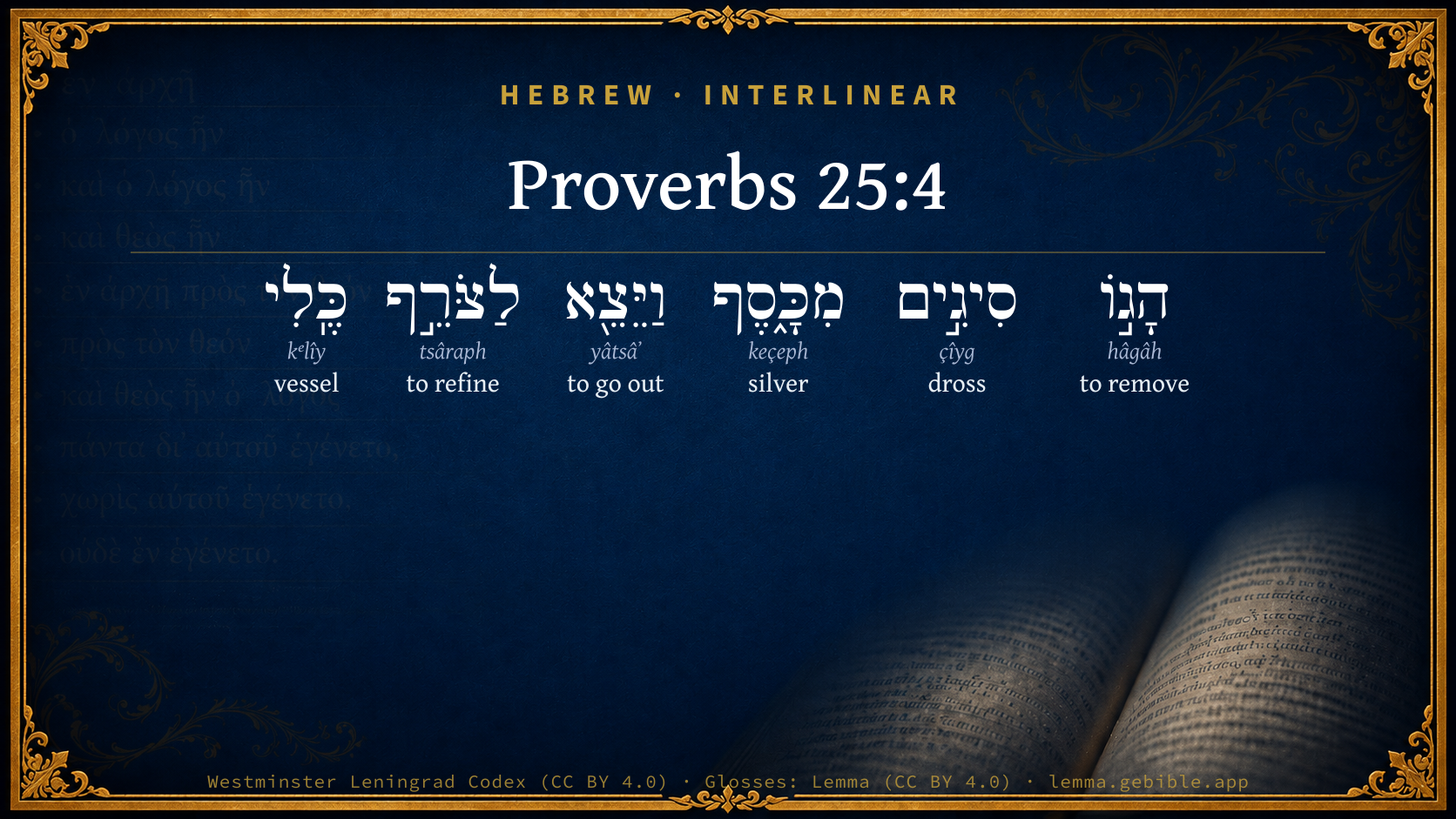
Proverbs 25:4

Hebrew (Westminster Leningrad Codex) Proverbs 25:4 appears in the Hebrew Old Testament. The text above is from the Westminster Leningrad Codex. Each word links to its Strong’s number, a concise gloss, and parsing drawn from the Open Scriptures Hebrew Bible morphology. Click any word for its full Brown-Driver-Briggs (BDB) entry.
Download image
Cite this verse

Proverbs 25:4 (World English Bible). Public Domain. Lemma interlinear Bible study tool, https://lemma.gebible.app/v/proverbs/25/4.

Show BibTeX & RIS
BibTeX
RIS
English Translation
Take away the dross from the silver, And material comes out for the refiner;
World English Bible · Public Domain
Highlights
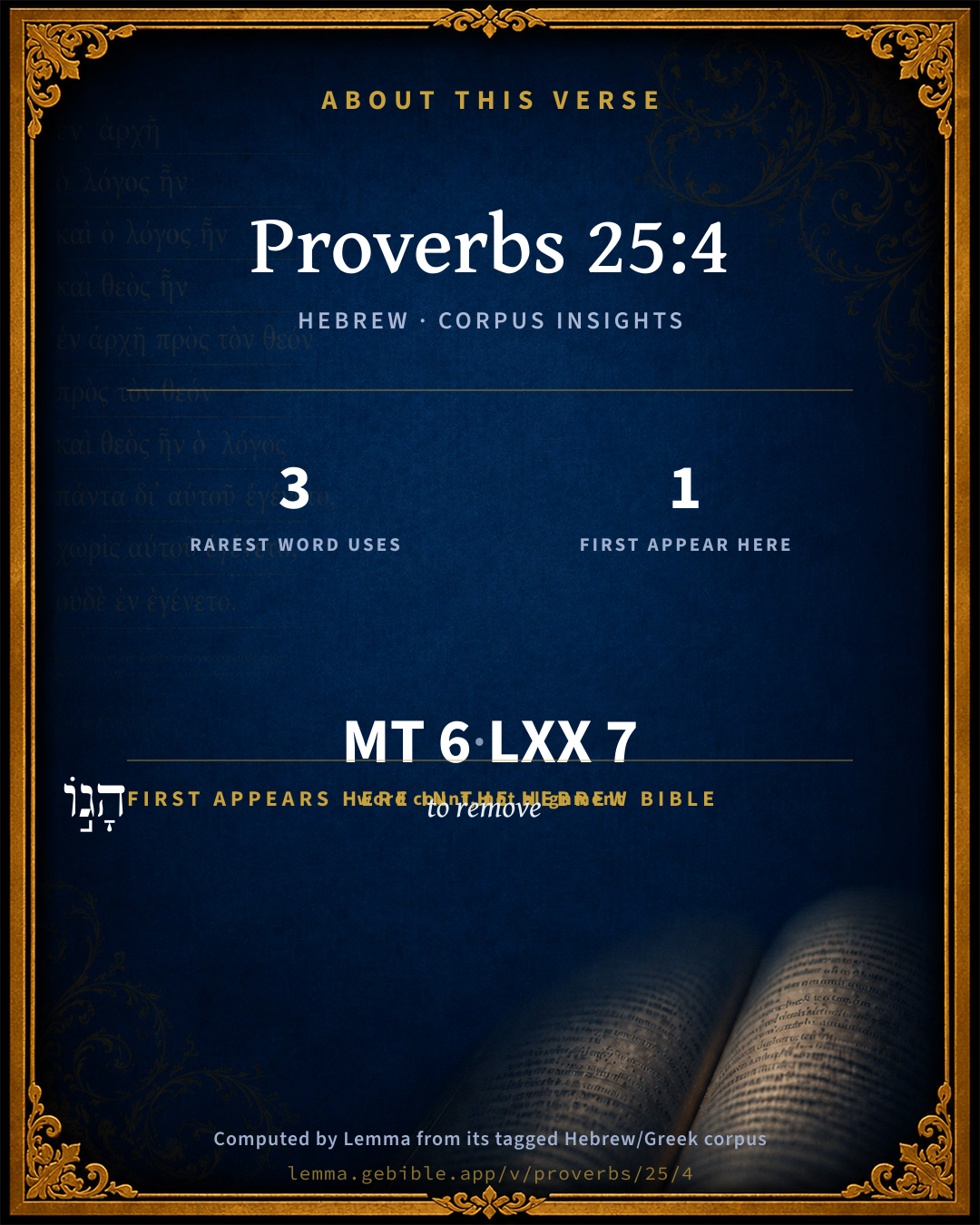
  • 1 first appearance in the Hebrew Bible
Full analysis ↓
Download a study sheet

One document with this verse’s original text, its word-by-word gloss line, the meaning frame, cross-references with their text, attributed commentary, and full source and license credits — printable, and it pastes into notes with its structure intact.

This verse Autodidact and up

Study sheet (.html) Plain text (.txt)

A passage Seminary Student

Up to 50 verses in one chapter. A passage sheet keeps up to 6 commentary sources and 12 cross-references per verse, in the order this page ranks them, and says so on the sheet whenever that leaves anything out. Ask for a single verse and you get the Autodidact verse sheet above.

Everything on this page stays free to read, with no account — the sheet is a download of what is already on screen, not access to it.

Want to remove ads? Support Godless Engineer
Compare translations 3

The same verse in 3 English versions, stacked beneath the original-language interlinear above. Click any original word for its lexicon entry.

Each is an independent rendering of the whole verse — the interlinear is not word-aligned to these translations.

Highlighted words mark where these versions differ — a whole-verse word diff, not a word-by-word alignment.

  • World English Bible Public Domain
    Take away the dross from the silver, And material comes out for the refiner;
  • King James Version Public Domain
    Take away the dross from the silver, and there shall come forth a vessel for the finer.
  • unfoldingWord Literal Text CC BY-SA 4.0
    Remove dross from silver and a vessel comes out for the refiner.

unfoldingWord Literal Text — © unfoldingWord, licensed CC BY-SA 4.0. Word-aligned USFM3 via Door43 (git.door43.org/unfoldingWord/en_ult).

Versions to compare (up to 4)

3 of 4 selected

Show all 18 translations

Every available English version of this verse, each an independent rendering of the whole verse.

  • World English Bible Public Domain
    Take away the dross from the silver, And material comes out for the refiner;
  • Berean Standard Bible Public Domain
    Remove the dross from the silver, and a vessel for a silversmith will come forth.
  • Majority Standard Bible Public Domain
    Remove the dross from the silver, and a vessel for a silversmith will come forth.
  • King James Version Public Domain
    Take away the dross from the silver, and there shall come forth a vessel for the finer.
  • American Standard Version (1901) Public Domain
    Take away the dross from the silver, And there cometh forth a vessel for the refiner:
  • Revised Version (1885) Public Domain
    Take away the dross from the silver, and there cometh forth a vessel for the finer:
  • Geneva Bible (1599) Public Domain
    Take the drosse from the siluer, and there shall proceede a vessell for the finer.
  • Douay-Rheims (1899) Public Domain
    Take away the rust from silver, and there shall come forth a most pure vessel:
  • Young's Literal Translation Public Domain
    Take away dross from silver, And a vessel for the refiner goeth forth,
  • Literal Standard Version CC BY-SA 4.0
    Take away dross from silver, || And a vessel goes forth for the refiner,
  • Unlocked Literal Bible CC BY-SA 4.0
    Remove the dross from the silver and a metal worker can use the silver in his craft.
  • unfoldingWord Literal Text CC BY-SA 4.0
    Remove dross from silver and a vessel comes out for the refiner.
  • Darby Bible Public Domain
    Take away the dross from the silver, and there cometh forth a vessel for the refiner:
  • World Messianic Bible Public Domain
    Take away the dross from the silver, and material comes out for the refiner.
  • Webster's Bible Public Domain
    Take away the dross from the silver, and there shall come forth a vessel for the finer.
  • Free Bible Version CC BY-SA 4.0
    Remove the waste from the silver, and the silversmith has pure silver to work with.
  • Bible in Basic English Public Domain
    Take away the waste from silver, and a vessel will come out for the silver-worker.
  • JPS Tanakh (1917) Public Domain
    Take away the dross from the silver, and there cometh forth a vessel for the refiner;

Literal Standard Version (2020), Covenant Press — licensed CC BY-SA 4.0. Text via the HelloAO Bible API (eBible.org). Unlocked Literal Bible (unfoldingWord) — licensed CC BY-SA 4.0. Text via the HelloAO Bible API (eBible.org). unfoldingWord Literal Text — © unfoldingWord, licensed CC BY-SA 4.0. Word-aligned USFM3 via Door43 (git.door43.org/unfoldingWord/en_ult). Free Bible Version, Dr. Jonathan Gallagher — licensed CC BY-SA 4.0. Text via the HelloAO Bible API (eBible.org).

Word by word

More ways to search: Search by grammar → Find every occurrence → Compare this word →

Practice this passage: Drill this verse → Learn its vocabulary →

About this verse

These counts appear in no published source. They are computed here, from the morphology-tagged text and Lemma’s own curated glosses. What Lemma adds →

6
words
6
distinct lemmas
Wisdom
section

Notable vocabulary

The rarest word here is הָג֣וֹ to remove H1898 — appearing just 3 times in the whole Hebrew Bible.

First appearance in Scripture

This word makes its first canonical appearance in the Hebrew Bible here:

  • הָג֣וֹ to remove H1898

Shared distinctive vocabulary

הָג֣וֹ to remove H1898 occurs in 3 verses of the Hebrew Bible. Also found in:

Grammatical profile

  • 3 verbs
  • 3 nouns

Verb forms

  • הָג֣וֹ Qal · Infinitive Absolute
  • וַיֵּצֵ֖א Qal · Sequential Imperfect
  • לַצֹּרֵ֣ף Qal · Participle Active

Hebrew & Septuagint length

In English translation the verse runs 14 words from the Hebrew and 11 from the Septuagint (LXX English) — closely comparable.

A rough comparison of the two English renderings, which tokenize alike — not a word-level alignment.

Word counts can differ between the Hebrew and the Greek without any difference in meaning — e.g. the Hebrew direct-object marker אֵת has no separate Greek word, and Greek often adds the article ὁ.

In the original languages it is 6 Hebrew tokens and 7 Greek tokens — but the two are counted differently (Hebrew bundles its prefixes and suffixes into one token; the Greek is in lemma form), so that isn’t a like-for-like length.

Cross-references

6

Topical passages linked to Proverbs 25:4 in the Treasury of Scripture Knowledge — connected by theme and wording, ordered by reader-vote popularity; previews shown in the World English Bible.

  • 2 Timothy 2:20–21 Now in a great house there are not only vessels of gold and of silver, but also of wood and of clay. Some are for honor, and some for dishonor.
  • Proverbs 17:3 The refining pot is for silver, and the furnace for gold, But Yahweh tests the hearts.
  • Ezekiel 22:18 Son of man, the house of Israel is become dross to me: all of them are brass and tin and iron and lead, in the midst of the furnace; they are the dross of silver.
  • Isaiah 1:25–27 And I will turn my hand on you, Thoroughly purge away your dross, And will take away all your tin.
  • Malachi 3:2–3 "But who can endure the day of his coming? And who will stand when he appears? For he is like a refiner's fire, and like launderer's soap;
  • 1 Peter 1:7 that the proof of your faith, which is more precious than gold that perishes even though it is tested by fire, may be found to result in praise, glory, and honor at the revelation of Jesus Christ--

Cross-references courtesy of OpenBible.info (CC BY 4.0).

Hebrew and Greek witnesses Masoretic Hebrew ↔ Greek Septuagint

The same verse in the two great witnesses to the Old Testament, shown verse-for-verse.

These are two independent witnesses, not word-aligned to each other, and the Septuagint is shown in lemma (dictionary) form.

Hebrew Proverbs 25:4 Masoretic · Westminster Leningrad Codex

הָג֣וֹ סִיגִ֣ים מִכָּ֑סֶף וַיֵּצֵ֖א לַצֹּרֵ֣ף כֶּֽלִי

Take away the dross from the silver, And material comes out for the refiner;

World English Bible · Public Domain

Greek LXX Proverbs 25:4 Septuagint · lemma form

τύπτω ἀδόκιμος ἀργύριον καί καθαρίζω καθαρός ἅπας

Beat the drossy silver, and it shall be made entirely pure.

LXX2012 (modern English Septuagint) · Public Domain

On this verse, The Pulpit Commentary discusses the Septuagint’s reading. Read the note in Commentary ↓

Hebrew: Westminster Leningrad Codex (CC BY 4.0). Greek: Septuagint (public domain); English from LXX2012 (modern English Septuagint) (Public Domain). How the Septuagint differs from the Hebrew →

Commentary

Notes on Proverbs 25:4 from classic Christian and Jewish commentators (each source and its license shown beneath its notes). The classic Christian expositions comment on the surrounding passage and are grouped to its opening verse, so a note may address several verses; the Jewish commentaries on the Tanakh (Rashi and others) are per-verse, so they appear only where the commentator wrote on this verse.

Lemma curates 59 commentaries, every one of them public domain or Creative Commons licensed, each selected and text-cleaned for this edition rather than reprinted as found. About our sources →

Trapp's Complete Commentary

John Trapp

Pro 25:4 Take away the dross from the silver, and there shall come forth a vessel for the finer.

Ver. 4. Take away the dross from the silver.] The holy prophets were not only most exactly seen in the peerless skill of divinity, but most exquisitely also furnished with the entire knowledge of all things natural. Hence their many similies wherewith they learnedly beautify their matter, and deck out their terms, words, and sentences, giving thereunto a certain kind of lively gesture, attiring the same with light, perspicuity, easiness, estimation, and dignity; stirring up thereby men’s drowsy minds to the acknowledgment of the truth, and pursuit of godliness.

John Trapp, A Commentary or Exposition upon All the Books of the Old and New Testament (1647–1656) — public domain. Text from a community e-Sword module.

The Biblical Illustrator

Joseph S. Exell

Pro_25:4-5

Take away the dross from the silver, and there shall come forth a vessel for the finer.

Purifying fires

No text in Scripture brings out with equal distinctness the higher office of affliction, i.e.,, to develop in us preparation for a true usefulness. The object of furnace fires is not to melt the precious metal, or even to release the dross, but to make the metal ready for the purposes of manufacture. Not the silver ingot, however, but the silver vessel, is the object of the assayer. When God tries His children, it is not simply that they shall come forth as gold, glorious as is purity of character, but that they may be both ready to be shaped for His purposes and capable of being used to fulfil His will. Paul seems to refer to this proverb in 2Ti_2:19-21, the only other passage in which the same truth is taught by the same figure. (Homiletic Review.)

Take away the wicked from before the king.

The removal of wicked men from influential positions

This shows that the vigorous endeavour of a prince to suppress vice, and reform the manners of his people is the most effectual way to support his government.

I. What the duty of magistrates is. To take away the wicked; to use their power for the terror of evil works and evil-workers, to banish those from the court who are vicious and profane, and to frighten them, and restrain them from spreading the infection of their wickedness among the people. Wicked people are the dross of a nation.

II. The advantage of doing this duty.

1. It will be the bettering of their subjects. They shall be made like silver refined; fit to be made vessels of honour.

2. It will be the settling of the prince. His throne shall be established in this righteousness, for God will bless his government, the people will be pliable to it, and so it will become durable. (Matthew Henry.)

The Biblical Illustrator, edited by Joseph S. Exell (c. 1880s–1900s) — public domain. Text from a community e-Sword module.

Joseph Benson's Commentary

Pro 25:4-5. Take away the dross from the silver, &c. — When the dross is separated from the silver, and not before, it becomes so pliable, that the finer may cast or work it into what form he pleases; thus, take away the wicked from before the king — Remove from his court and counsels those who, by their wicked advices and practices, provoke God’s displeasure against him, blast his reputation, and alienate the hearts of his subjects from him, and his throne shall be established in righteousness — By such impartial execution of justice, his kingdom will be settled in peace, and his government become as durable as it will be beneficial.

Joseph Benson's Commentary on the Old and New Testaments (1811–1818) — public domain. Text from a community e-Sword module.

Keil & Delitzsch

C. F. Keil & F. Delitzsch

There now follows an emblematic (vid., vol. i. p. 10) tetrastich:

4 Take away the dross from silver,

So there is ready a vessel for the goldsmith;

5 Take away the wicked from the king,

And his throne is established by righteousness.

The form הגו (cf. the inf. Poal הגו, Isa 59:13) is regarded by Schultens as showing a ground-form הגו; but there is also found e.g., עשׂו, whose ground-form is עשׂי; the verb הגה, R. הג (whence Arab. hajr, discedere), cf. יגה (whence הגה, semovit, Sa2 20:13 = Syr. âwagy, cf. Arab. âwjay, to withhold, to abstain from), signifies to separate, withdraw; here, of the separation of the סיגים, the refuse, i.e., the dross (vid., regarding the plena scriptio, Baer's krit. Ausg. des Jesaia, under Pro 1:22); the goldsmith is designated by the word צרף, from צרף morf, to turn, change, as he who changes the as yet drossy metal by means of smelting, or by purification in water, into that which is pure. In 5a הגה is, as at Isa 27:8, transferred to a process of moral purification; what kind of persons are to be removed from the neighbourhood of the king is shown by Isa 1:22-23. Here also (as at Isa. l.c.) the emblem or figure of Pro 25:4 is followed in Pro 25:5 by its moral antitype aimed at. The punctuation of both verses is wonderfully fine and excellent. In Pro 25:4, ויצא is not pointed ויצא, but as the consecutive modus ויּצא; this first part of the proverb refers to a well-known process of art: the dross is separated from the silver (inf. absol., as Pro 12:7; Pro 15:22), and so a vessel (utensil) proceeds from the goldsmith, for he manufactures pure silver; the ל is here similarly used as the designation of the subject in the passive, Pro 13:13; Pro 14:20. In Pro 25:5, on the contrary, ויּכּון (ויּכּן) is not the punctuation used, but the word is pointed indicatively ויכּון; this second part of the proverb expresses a moral demand (inf. absol. in the sense of the imperative, Gesen. 131, 4b like Pro 17:12, or an optative or concessive conjunction): let the godless be removed, לפני מלך, i.e., not from the neighbourhood of the king, for which the words are מלּפני מלך; also not those standing before the king, i.e., in his closest neighbourhood (Ewald, Bertheau); but since, in the absolute, הגה, not an act of another in the interest of the king, but of the king himself, is thought of: let the godless be removed from before the king, i.e., because he administers justice (Hitzig), or more generally: because after that Psalm (101), which is the "mirror of princes," he does not suffer him to come into his presence. Accordingly, the punctuation is בּצּדק, not בּצדק (Pro 16:12); because such righteousness is meant as separates the רשׁע from it and itself from him, as Isa 16:5 (vid., Hitzig), where the punctuation of בּחסד denotes that favour towards Moab seeking protection.

Keil & Delitzsch — Biblical Commentary on the Old Testament (1861–1891) — public domain (CC PDM 1.0). Text via the HelloAO Bible API. (Old Testament only.)

Tyndale Open Study Notes

Tyndale Open Resources

25:4-5 As silver is ready for use once it is refined of impurities, the king’s court can do justice when wicked people are removed. A little bit of evil can spoil much good (Eccl 10:1).

Tyndale Open Study Notes — © Tyndale Open Resources, licensed CC BY-SA 4.0. Text via the HelloAO Bible API.

Geneva Bible (1599)

Geneva Bible translators

When vice is removed from a king, he is a meet vessel for the Lord’s use.

Geneva Bible (1599) marginal notes — public domain. Text via Bolls.life.

Matthew Henry's Commentary

This shows that the vigorous endeavour of a prince to suppress vice, and reform the manners of his people, is the most effectual way to support his government. Observe, 1. what the duty of magistrates is: To take away the wicked, to use their power for the terror of evil works and evil workers, not only to banish those that are vicious and profane from their presence, and forbid them the court, but so to frighten them and restrain them that they may not spread the infection of their wickedness among their subjects. This is called taking away the dross from the silver, which is done by the force of fire. Wicked people are the dross of a nation, the scum of the country, and, as such, to be taken away. If men will not take them away, God will, Psa 119:119. If the wicked be taken away from before the king, if he abandon them and show his detestation of their wicked courses, it will go far towards the disabling of them to do mischief. The reformation of the court will promote the reformation of the kingdom, Psa 101:3, Psa 101:8. 2. What the advantage will be of their doing this duty. (1.) It will be the bettering of the subjects; they shall be made like silver refined, fit to be made vessels of honour. (2.) It will be the settling of the prince. His throne shall be established in this righteousness, for God will bless his government, the people will be pliable to it, and so it will become durable.

Matthew Henry's Commentary on the Whole Bible (1708–1710) — public domain (CC PDM 1.0). Text via the HelloAO Bible API.

Jamieson, Fausset & Brown

Robert Jamieson, A. R. Fausset & David Brown

As separating impurities from ore leaves pure silver, so taking from a king wicked counsellors leaves a wise and beneficent government.

Jamieson, Fausset & Brown — Commentary Critical and Explanatory on the Whole Bible (1871) — public domain (CC PDM 1.0). Text via the HelloAO Bible API.

Adam Clarke's Commentary

Verse 4. Take away the dross from the silver] You cannot have a pure silver vessel till you have purified the silver; and no nation can have a king a public blessing till the wicked - all bad counsellors, wicked and interested ministers, and sycophants - are banished from the court and cabinet. When the wise and good only are the king's ministers and advisers, then the throne will be established in righteousness, and his administration be a universal blessing.

Adam Clarke's Commentary on the Bible (1810–1826) — public domain. Text from a community e-Sword/MySword module.

Ellicott's Commentary for English Readers

(4) And there shall come forth a vessel for the finer.—Or, So there results a vessel to the refiner, or silversmith. He is able to make one.

A Bible Commentary for English Readers, edited by Charles John Ellicott (1878–1897) — public domain. Text from a community e-Sword module.

The Cambridge Bible for Schools and Colleges

gen. ed. J. J. S. Perowne

4. a vessel for the finer] Such pure metal as the refiner, who has with that very object taken away the dross, can make into a goodly vessel or vase. Egredietur vas purissimum, Vulg.

The Cambridge Bible for Schools and Colleges (gen. ed. J. J. S. Perowne; Cambridge University Press, 1878–1918) — public domain. Text from a community e-Sword module.

John Gill's Exposition

Take away the dross from the silver,.... By putting it into the furnace, and purging it from it:

and there shall come forth a vessel for the finer; not out of the furnace, a vessel formed and shaped, but pure silver shall come out of it for the refiner; of which a vessel may be made, very honourable, beautiful, and fit for use: the application of it is in Pro 25:5.

John Gill's Exposition of the Whole Bible (1746–1763) — public domain (CC PDM 1.0). Text via the HelloAO Bible API.

Matthew Poole's English Annotations

Then, and not till then, it is fit for that use.

Matthew Poole's English Annotations on the Holy Bible (1683–1685) — public domain. Text from a community e-Sword/MySword module.

Whedon's Commentary on the Bible

Daniel D. Whedon

4, 5. Take away the dross, etc. — Let wicked counsellors and companions be removed from the king, and their places filled with good men, and the government will be established by equity and justice. A good proverb this for kings, and all who are in authority. Compare Pro_16:12; Pro_20:8; Pro_29:14.

Daniel D. Whedon (gen. ed.), Commentary on the Old and New Testaments (1874–1909) — public domain. Text from a community e-Sword module.

The Pulpit Commentary

Vers. 4, 5. A tetrastich in an emblematical form.

Take away the dross from the silver. Silver was most extensively used by the Hebrews (see "Dictionary of the Bible," sub voc.), whether obtained from native mines or imported from foreign countries, and the process of separating the ore from the extraneous matters mixed with it was well known. (Psa_12:6 Eze_22:20, etc.; see on Pro_17:3) And there shall come forth a vessel for the finer (tsaraph); the goldsmith. The pure silver is ready for the artist s work, who from this material can make a beautiful vessel. Septuagint, "Beat untested silver, and all shall be made entirely pure," where the allusion is to the process of reducing minerals by lamination.

The Pulpit Commentary (1880–1919), ed. H.D.M. Spence-Jones & Joseph S. Exell — public domain. Text from a community e-Sword module.

John Wesley's Explanatory Notes

Take away - Then, and not 'till then it is fit for that use.

John Wesley, Explanatory Notes Upon the Whole Bible (1754–1765) — public domain. Text via the GEBible commentary corpus.

Bridges on Proverbs

Charles Bridges

The finer produces "the vessel unto honor," by taking away the dross from the silver (Mal 3:2 ), which mars its beauty and purity. Such is the destructive influence of the wicked in the royal counsels.†1 Take them then away from before the king. Let him purify his court and government from this dross. Let him exclude it from high places. Let him discountenance it in authority at any cost.†2 David thus established his throne in righteousness,†3 and commended this resolution by his dying counsel to his wise son.†4 This is political wisdom on scriptural principles. If "righteousness exalteth a nation,"†5 the open acknowledgment of it is the sure path to national prosperity.†6 And will not the throne of our great King be established by the entire and eternal removal of the wicked?†7 In the great day of trial and decision shall I be found reprobate or purified silver? Lord! let me, under the refiner’s hand, be "purified, and purged as gold and silver, that I may offer unto the LORD an offering in righteousness" in that day. (Mal 3:3 .)

Footnotes:

†1 1Ki 12:10-16 . 2Ch 24:17-24 .

†2 Pro 20:8, Pro 20:26 .

†3 Psa 101:4-8.

†4 1Ki 2:5-6, 1Ki 2:32-33, 1Ki 2:44-45 .

†5 Pro 14:34.

†6 1Ki 15:13 . 2Ch 14:1-7 .

†7 Mal 3:17-18. Mat 13:41-43 ; Mat 25:31-46 .

Charles Bridges, An Exposition of the Book of Proverbs (1846) — public domain. Text from a community e-Sword module.

unfoldingWord translationNotes

Door43 World Missions Community

dross

the material in a metal that people do not want and they remove by heating the metal

his throne will be established by doing

The throne is a metonym for the power to rule. These words can be translated in active form. AT: "the king will establish his throne by doing" or "he will have the power to rule because he does" (See: Metonymy and Active or Passive)

translationWords

silver

evil

king

throne

unfoldingWord translationNotes — © Distant Shores Media and the Door43 World Missions Community, licensed CC BY-SA 4.0. Source: git.door43.org/Door43/en_tn.

Rashi

Rabbi Shlomo Yitzchaki (Rashi)

Remove dross from silver Heb. הגו, draw away, as in (II Sam. 20:13): “When he was removed (הגה) from the highway.” Just as the silver vessel does not emerge for the work of the refiner until the copper dross is removed from it, similarly, the community cannot be freed from punishment until they remove the wicked from their midst and execute judgment upon them.

Rashi on the Tanakh — English translations: “The Judaica Press complete Tanach with Rashi, translated by A. J. Rosenberg” (CC BY 4.0); “Pentateuch with Rashi's commentary by M. Rosenbaum and A.M. Silbermann, 1929-1934” (public domain); “The Metsudah Tanach series, Lakewood, N.J” (CC BY 4.0); and “The Book of Joshua, Metsudah Publications, 1997” (CC BY 4.0). Text via Sefaria.

Lesson kit

Teaching starters — assembled from the data on this page, not authored interpretation. Every prompt links to the verse data it draws on. Edit before teaching.

Proverbs, in the Wisdom, opens this verse with 6 words (6 distinct Hebrew lemmas). Its most distinctive word is hâgâh (“to remove”). A historical commentator’s framing appears above. Read the whole chapter for the surrounding context.

Discussion questions

  1. How does “to remove” (hâgâh) shape what this verse is saying?
  2. The word “to remove” first appears here in Scripture. What is being introduced at this debut?
  3. Proverbs 25:5 shares the word «to remove» with this verse. How do the two illuminate each other?
  4. The translations on this page render this verse differently — a whole-verse word diff, not a word-by-word alignment. What might account for the different wordings?
  5. The verb «הָג֣וֹ» is Qal Infinitive Absolute. How does its form color the action?
  6. Reading how Trapp's Complete Commentary and The Biblical Illustrator read this verse, where do the two commentators agree and where do they part?

Things to notice

Reading settings

Reading text

Shown beneath each verse's original-language words.

Old Testament
Old Testament edition

Read the OT as the Masoretic Hebrew (MT) or the Greek Septuagint (LXX).

English shown for the Greek Septuagint (in the Hebrew ↔ Greek comparison).

Comparing translations? Open the Compare panel on any verse page to stack up to four side by side.