
Proverbs 3:15

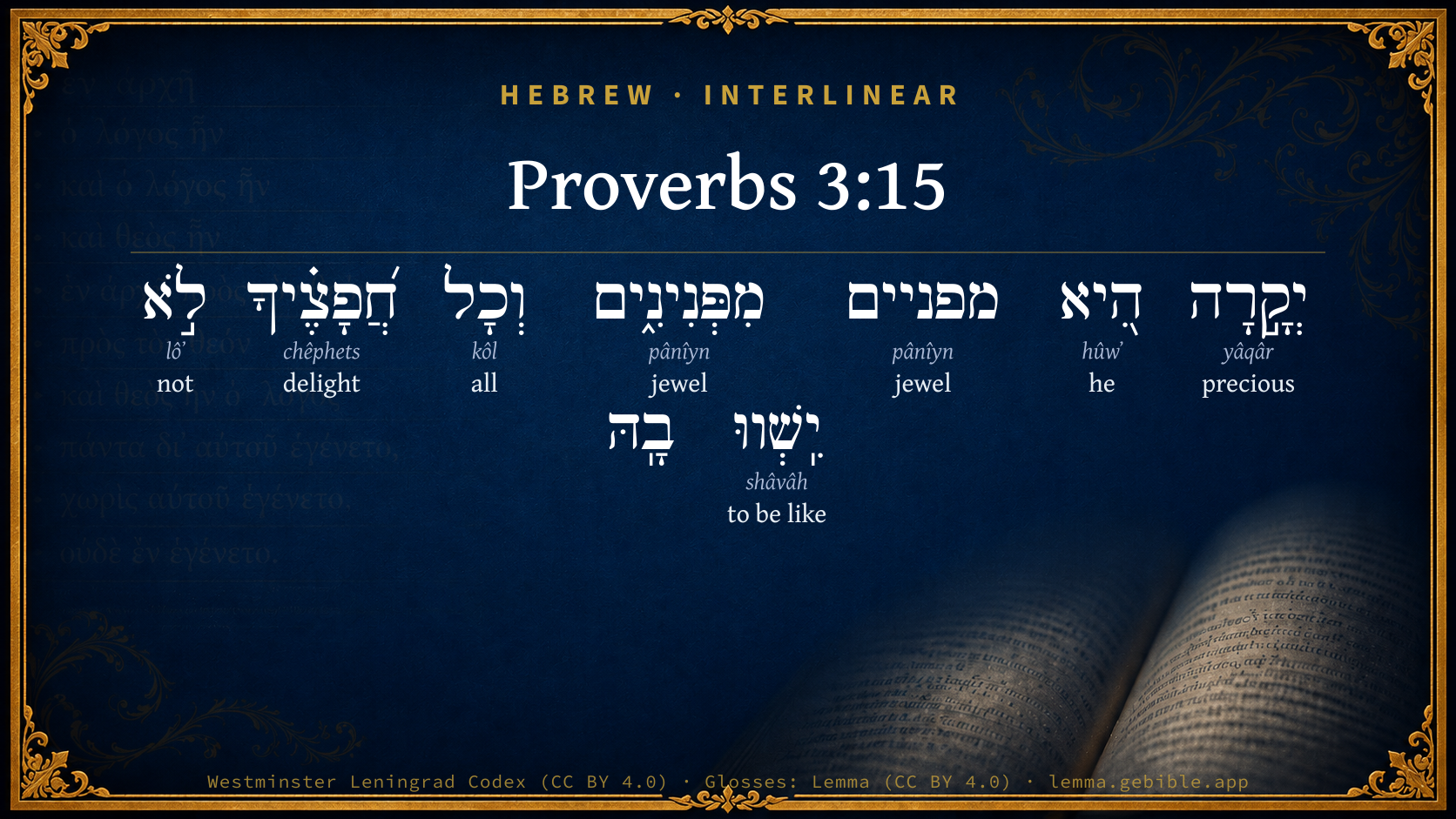
Hebrew (Westminster Leningrad Codex) Proverbs 3:15 appears in the Hebrew Old Testament. The text above is from the Westminster Leningrad Codex. Each word links to its Strong’s number, a concise gloss, and parsing drawn from the Open Scriptures Hebrew Bible morphology. Click any word for its full Brown-Driver-Briggs (BDB) entry.
Download image
Cite this verse

Proverbs 3:15 (World English Bible). Public Domain. Lemma interlinear Bible study tool, https://lemma.gebible.app/v/proverbs/3/15.

Show BibTeX & RIS
BibTeX
RIS
English Translation
She is more precious than rubies. None of the things you can desire are to be compared to her.
World English Bible · Public Domain
Download a study sheet

One document with this verse’s original text, its word-by-word gloss line, the meaning frame, cross-references with their text, attributed commentary, and full source and license credits — printable, and it pastes into notes with its structure intact.

This verse Autodidact and up

Study sheet (.html) Plain text (.txt)

A passage Seminary Student

Up to 50 verses in one chapter. A passage sheet keeps up to 6 commentary sources and 12 cross-references per verse, in the order this page ranks them, and says so on the sheet whenever that leaves anything out. Ask for a single verse and you get the Autodidact verse sheet above.

Everything on this page stays free to read, with no account — the sheet is a download of what is already on screen, not access to it.

Want to remove ads? Support Godless Engineer
Compare translations 3

The same verse in 3 English versions, stacked beneath the original-language interlinear above. Click any original word for its lexicon entry.

Each is an independent rendering of the whole verse — the interlinear is not word-aligned to these translations.

Highlighted words mark where these versions differ — a whole-verse word diff, not a word-by-word alignment.

  • World English Bible Public Domain
    She is more precious than rubies. None of the things you can desire are to be compared to her.
  • King James Version Public Domain
    She is more precious than rubies: and all the things thou canst desire are not to be compared unto her.
  • unfoldingWord Literal Text CC BY-SA 4.0
    She is more precious than coral pearls, and all your desired things do not compare with her.

unfoldingWord Literal Text — © unfoldingWord, licensed CC BY-SA 4.0. Word-aligned USFM3 via Door43 (git.door43.org/unfoldingWord/en_ult).

Versions to compare (up to 4)

3 of 4 selected

Show all 18 translations

Every available English version of this verse, each an independent rendering of the whole verse.

  • World English Bible Public Domain
    She is more precious than rubies. None of the things you can desire are to be compared to her.
  • Berean Standard Bible Public Domain
    She is more precious than rubies; nothing you desire compares with her.
  • Majority Standard Bible Public Domain
    She is more precious than rubies; nothing you desire compares with her.
  • King James Version Public Domain
    She is more precious than rubies: and all the things thou canst desire are not to be compared unto her.
  • American Standard Version (1901) Public Domain
    She is more precious than rubies: And none of the things thou canst desire are to be compared unto her.
  • Revised Version (1885) Public Domain
    She is more precious than rubies: and none of the things thou canst desire are to be compared unto her.
  • Geneva Bible (1599) Public Domain
    It is more precious then pearles: and all things that thou canst desire, are not to be compared vnto her.
  • Douay-Rheims (1899) Public Domain
    She is more precious than all riches: and all the things that are desired, are not to be compared with her.
  • Young's Literal Translation Public Domain
    Precious she `is' above rubies, And all thy pleasures are not comparable to her.
  • Literal Standard Version CC BY-SA 4.0
    She [is] precious above rubies, || And all your pleasures are not comparable to her.
  • Unlocked Literal Bible CC BY-SA 4.0
    Wisdom is more precious than jewels and nothing you desire can compare to her.
  • unfoldingWord Literal Text CC BY-SA 4.0
    She is more precious than coral pearls, and all your desired things do not compare with her.
  • Darby Bible Public Domain
    She is more precious than rubies; and all the things thou canst desire are not equal unto her.
  • World Messianic Bible Public Domain
    She is more precious than rubies. None of the things you can desire are to be compared to her.
  • Webster's Bible Public Domain
    She is more precious than rubies: and all the things thou canst desire are not to be compared to her.
  • Free Bible Version CC BY-SA 4.0
    She is more valuable than rubies—everything you could ever want just doesn't compare!
  • Bible in Basic English Public Domain
    She is of more value than jewels, and nothing for which you may have a desire is fair in comparison with her.
  • JPS Tanakh (1917) Public Domain
    She is more precious than rubies; and all the things thou canst desire are not to be compared unto her.

Literal Standard Version (2020), Covenant Press — licensed CC BY-SA 4.0. Text via the HelloAO Bible API (eBible.org). Unlocked Literal Bible (unfoldingWord) — licensed CC BY-SA 4.0. Text via the HelloAO Bible API (eBible.org). unfoldingWord Literal Text — © unfoldingWord, licensed CC BY-SA 4.0. Word-aligned USFM3 via Door43 (git.door43.org/unfoldingWord/en_ult). Free Bible Version, Dr. Jonathan Gallagher — licensed CC BY-SA 4.0. Text via the HelloAO Bible API (eBible.org).

Word by word

More ways to search: Search by grammar → Find every occurrence → Compare this word →

Practice this passage: Drill this verse → Learn its vocabulary →

About this verse

These counts appear in no published source. They are computed here, from the morphology-tagged text and Lemma’s own curated glosses. What Lemma adds →

9
words
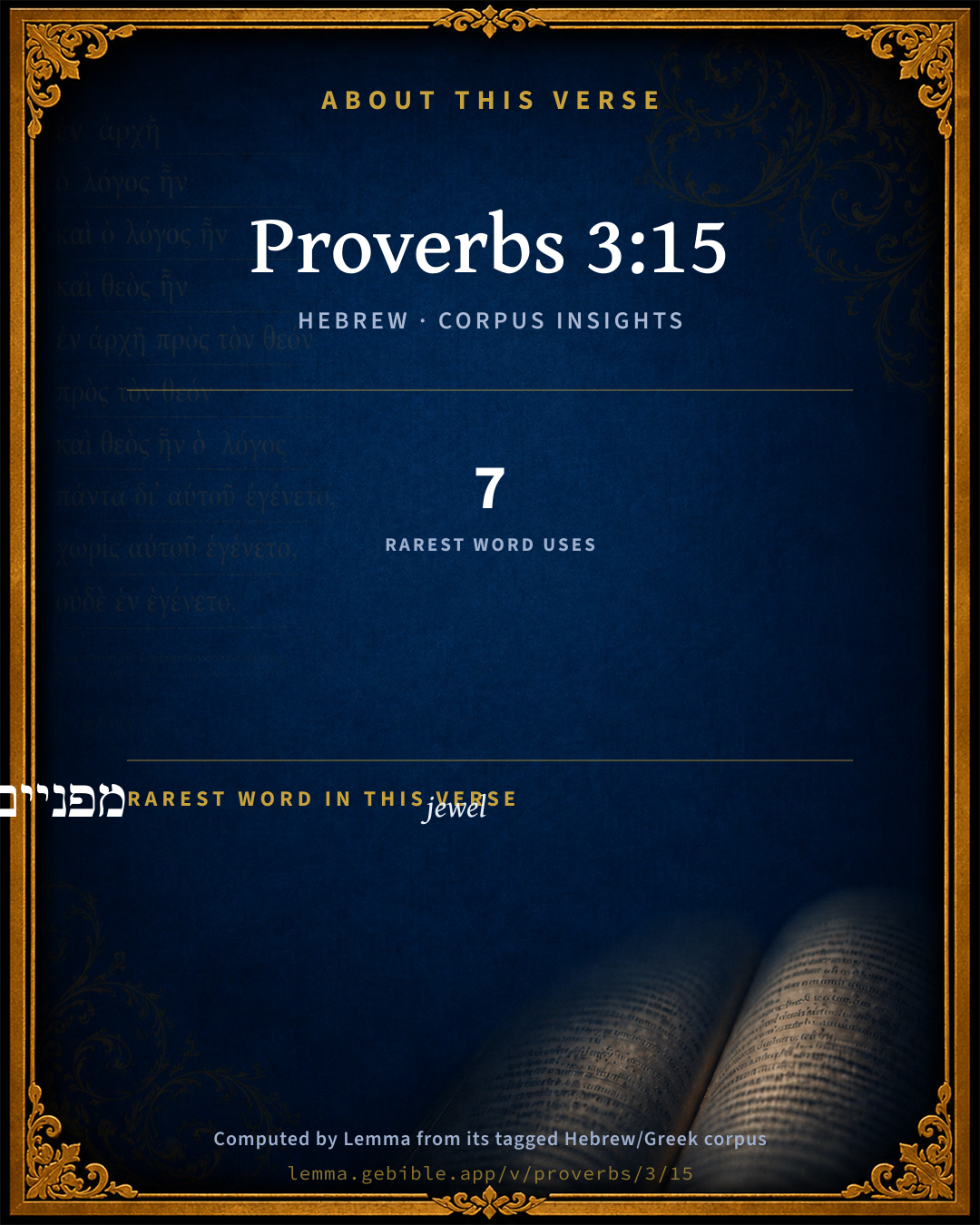
7
distinct lemmas
Wisdom
section

Notable vocabulary

The rarest word here is מפניים jewel H6443 — appearing just 7 times in the whole Hebrew Bible.

Shared distinctive vocabulary

מפניים jewel H6443 occurs in 6 verses of the Hebrew Bible. Also found in:

Grammatical profile

  • 1 verb
  • 4 nouns
  • 1 adjective
  • 1 pronoun
  • 1 preposition
  • 1 particle

Verb forms

  • יִֽשְׁווּ Qal · Imperfect

Repetition

A word recurs within this verse — often emphatic in Hebrew:

  • מפניים jewel H6443 ×2

Hebrew & Septuagint length

In English translation the verse runs 19 words from the Hebrew and 33 from the Septuagint (LXX English) — the Septuagint runs noticeably longer here. See the side-by-side →

A rough comparison of the two English renderings, which tokenize alike — not a word-level alignment.

Word counts can differ between the Hebrew and the Greek without any difference in meaning — e.g. the Hebrew direct-object marker אֵת has no separate Greek word, and Greek often adds the article ὁ.

Cross-references

8

Topical passages linked to Proverbs 3:15 in the Treasury of Scripture Knowledge — connected by theme and wording, ordered by reader-vote popularity; previews shown in the World English Bible.

  • Proverbs 8:11 For wisdom is better than rubies. All the things that may be desired can't be compared to it.
  • Job 28:18 No mention shall be made of coral or of crystal: Yes, the price of wisdom is above rubies.
  • Psalms 73:25–26 Who do I have in heaven? There is no one on earth who I desire besides you.
  • Proverbs 31:10 Who can find a worthy woman? For her price is far above rubies.
  • Romans 8:18 For I consider that the sufferings of this present time are not worthy to be compared with the glory which will be revealed toward us.
  • Psalms 63:3 Because your loving kindness is better than life, My lips shall praise you.
  • Proverbs 20:15 There is gold and abundance of rubies; But the lips of knowledge are a rare jewel.
  • Matthew 13:44–46 "Again, the Kingdom of Heaven is like a treasure hidden in the field, which a man found, and hid. In his joy, he goes and sells all that he has, and buys that field.

Cross-references courtesy of OpenBible.info (CC BY 4.0).

Hebrew and Greek witnesses Masoretic Hebrew ↔ Greek Septuagint

The same verse in the two great witnesses to the Old Testament, shown verse-for-verse.

Here the Septuagint runs noticeably longer than the Hebrew — LXX2012 (modern English Septuagint) 33 words vs World English Bible 19. A rough length comparison of the two English translations, not a word-level alignment — read both below.

These are two independent witnesses, not word-aligned to each other, and the Septuagint is shown in lemma (dictionary) form.

Hebrew Proverbs 3:15 Masoretic · Westminster Leningrad Codex

יְקָ֣רָה הִ֭יא מפניים מִפְּנִינִ֑ים וְכָל חֲ֝פָצֶ֗יךָ לֹ֣א יִֽשְׁווּ בָֽהּ

She is more precious than rubies. None of the things you can desire are to be compared to her.

World English Bible · Public Domain

Greek LXX Proverbs 3:15 Septuagint · lemma form

τίμιος δέ εἰμί λίθος πολυτελής οὐ ἀντιτάσσω αὐτός οὐδείς πονηρός εὔγνωστος εἰμί πᾶς ὁ ἐγγίζω αὐτός πᾶς δέ τίμιος οὐ ἄξιος αὐτός εἰμί

And she is more valuable than precious stones: no evil thing shall resist her: she is well known to all that approach her, and no precious thing is equal to her in value.

LXX2012 (modern English Septuagint) · Public Domain

On this verse, The Cambridge Bible for Schools and Colleges discusses the Septuagint’s reading. Read the note in Commentary ↓

Hebrew: Westminster Leningrad Codex (CC BY 4.0). Greek: Septuagint (public domain); English from LXX2012 (modern English Septuagint) (Public Domain). How the Septuagint differs from the Hebrew →

Commentary

Notes on Proverbs 3:15 from classic Christian and Jewish commentators (each source and its license shown beneath its notes). The classic Christian expositions comment on the surrounding passage and are grouped to its opening verse, so a note may address several verses; the Jewish commentaries on the Tanakh (Rashi and others) are per-verse, so they appear only where the commentator wrote on this verse.

Lemma curates 59 commentaries, every one of them public domain or Creative Commons licensed, each selected and text-cleaned for this edition rather than reprinted as found. About our sources →

Trapp's Complete Commentary

John Trapp

Pro 3:15 She [is] more precious than rubies: and all the things thou canst desire are not to be compared unto her.

Ver. 15. She is more precious than rubies.] Or, Pearls, which of old were most highly esteemed, {a} as Pliny testifieth; nostra etate multis aliis gemmis post ponunter. Today, there are many other gems of greater price, as rubies, carbuncles, &c. Cardan {b} tells us that every precious stone hath an egregious virtue in it; every spiritual grace hath, we are sure, and is of more value than large domains, stately buildings, and ten thousand rivers of oil. If the mountains were pearl, the huge rocks rubies, and the whole globe a shining chrysolite, yet all this were not to be named in the same day with wisdom.

{a} Principium culmenque omnium rerum precii marga ritae tenent. - Plin. Gener. Hist. de Aquat., lib. iv.

{b} Card., Subt., lib. vii.

John Trapp, A Commentary or Exposition upon All the Books of the Old and New Testament (1647–1656) — public domain. Text from a community e-Sword module.

The Biblical Illustrator

Joseph S. Exell

Pro_3:15

She is more precious than rubies.

The quality of virtue

The words wisdom, understanding, and knowledge partly translate the word virtue.

I. The wonderful effects virtue produces on the mind.

1. The effects bear no proportion to our immediate sentiments concerning it.

2. Observe the complete change which it produces upon the human character itself. It gives the human being all the value which he can possess.

3. Notice the power it possesses of communicating immediate happiness to the mind.

4. Virtue reaches beyond the agent himself, and affects all who stand in connection with him.

5. Observe the unexpected and amazing changes which it produces upon the great societies of the earth. It is, in fact, the great principle of national happiness and civilisation.

II. The argument suggested. Look beyond the appearances of the moment, and study and know your real interest, and your own natural and best connections. Placed among men, virtue operates incessantly for their benefit. She is incessantly employed in improving and comforting us. (John Mackenzie, D.D.)

The best of all blessings

1. We cannot get all that we desire, but we can get the grace of God.

2. If we could get all the things that we desire, they would not make us happy, but the grace of God will.

3. If we could get them, and they could make us happy, we cannot keep them; but we can keep the grace of God. The grace of God, or the religion of Jesus, is the most valuable thing in the world. Then how earnestly we should seek it. (R. Newton, D. D.)

The circumstances which enhance the value of virtue

Virtue is beautiful and lovely in itself. Her dictates are founded on the nature of things.

1. The more accurate and perspicuous our knowledge of the principle which gives birth to a virtuous act, or on which it is performed, the greater is the value of it.

2. The more generous and pure the motives to our good actions, the greater is the value of them.

3. The more the virtues that we practise are contrary to our natural dispositions, to our constitution, or to our darling propensities, the more resplendent and excellent are they.

4. The value of our virtue is greatly enhanced by the outward obstacles we have to contend with in the exercise of it, or in proportion to the little encouragement we meet with in it.

5. The more considerable the privation we undergo for the sake of virtue, the more various and inevitable the hazards that attend it, the greater is its value.

6. The satisfaction, or the willingness with which a virtue is practised, contributes in like manner very much to heighten its beauty or its worth.

7. Constancy in virtue is also a circumstance which enhances the value of it.

8. The more benign the influence of our virtue is upon the public interest, the greater is its value. (G. J. Zollikofer.)

The Biblical Illustrator, edited by Joseph S. Exell (c. 1880s–1900s) — public domain. Text from a community e-Sword module.

Jamieson, Fausset & Brown

Robert Jamieson, A. R. Fausset & David Brown

rubies--gems, or pearls.

Jamieson, Fausset & Brown — Commentary Critical and Explanatory on the Whole Bible (1871) — public domain (CC PDM 1.0). Text via the HelloAO Bible API.

Adam Clarke's Commentary

Verse 15. She is more precious than rubies] מפנינים mippeninim. The word principally means pearls, but may be taken for precious stones in general. The root is פנה panah, he looked, beheld; and as it gives the idea of the eye always being turned towards the observer, Mr. Parkhurst thinks that it means the loadstone; See Clarke on Job 28:18, where this subject is considered at large. If the oriental ruby, or any other precious stone, be intended here, the word may refer to their being cut and polished, so that they present different faces, and reflect the light to you in whatever direction you may look at them.

All the things thou canst desire] Superior to every thing that can be an object of desire here below. But who believes this?

Adam Clarke's Commentary on the Bible (1810–1826) — public domain. Text from a community e-Sword/MySword module.

Ellicott's Commentary for English Readers

(15) Rubies.—The meaning of the Hebrew penînîm is doubtful. Lam_4:7 shows the colour to have been red; “coral” is a probable rendering; that of “pearls” is unlikely. For the thought, comp. Job_28:15-19.

A Bible Commentary for English Readers, edited by Charles John Ellicott (1878–1897) — public domain. Text from a community e-Sword module.

The Cambridge Bible for Schools and Colleges

gen. ed. J. J. S. Perowne

15. rubies] This rendering is retained in R.V. text, with a reference to Job_28:18, where the alternative is given in the marg. of red coral, or pearls. The expression “more ruddy” (which those, however, who render “pearls,” take to mean “more bright”), Lam_4:7, would seem to confine our choice to rubies or red coral. The word occurs frequently in this Book (Pro_8:11, Pro_20:15, Pro_31:10). The LXX. evade the difficulty with λίθων πολυτελῶν, precious stones, and the Vulg. follows suit with cunctis opibus. See note in this Series on Lam_4:7, and Smith’s Dict. of Bible, Art. Rubies.

all the things … are not] This is the Hebrew way of saying, none of the things … are; and so it is rendered in R.V. Another example occurs in Psa_25:3, where the P.B.V. preserves the Heb. idiom, and A.V. and R.V. give the corresponding English form of expression.

The Cambridge Bible for Schools and Colleges (gen. ed. J. J. S. Perowne; Cambridge University Press, 1878–1918) — public domain. Text from a community e-Sword module.

John Gill's Exposition

She is more precious than rubies,.... Or "pearls" (u), as some; which were formerly esteemed above all precious stones; the eastern were the more valuable (w), which Solomon had most knowledge of; Christ is the pearl of great price, of more value than any pearl, or all put together, Mat 13:46; See Gill on Job 28:18; or "carbuncles" (x), as others. The Targum and Septuagint render it in general terms "precious stones"; and the Vulgate Latin version, "than all riches"; there is a beautiful gradation in this and Pro 3:14, wisdom is first preferred to silver, then to "fine gold" (y), and here, to "precious stones" Christ is precious, exceeding precious in his names and titles, Messiah, Jesus, Immanuel, &c. in his divine nature, and the perfections of it, which show his condescension and grace to become a Saviour, assure of his ability to save, and render his mediatorial performances valuable; in his person as God and man; in the beauty, fulness, and fitness of it; in his power, wisdom, grace, &c. in his offices, his priestly office; in his satisfaction, his blood, righteousness, and sacrifice, are precious; in his intercession, which is ever acceptable and prevalent; in his prophetic office, his Gospel is precious, every truth and promise of it; in his kingly office, all his ordinances and appointments, his commandments are more to be loved than gold, yea, than fine gold; in all his relations and characters, and in everything that belongs to him; he is so to them that believe, and to none else; Pe1 2:7; these see the need and worth of him, receive much from him, and live upon him; and especially he is precious to them at first conversion; and so he is after desertions, and long absence; and under temptations and afflictions, losses and disappointments; and in the hour of death: and he is superlatively precious, "more precious than rubies", or any precious stones; of a superior lustre and glory to them, being "the brightness of his Father's glory"; and of more intrinsic worth and value, of greater price than any pearls, and more enriching to his possessors, for such possess all things;

and all the things thou canst desire are not to be compared unto her; this takes in a very great compass: there are many things that are very desirable, and the desires of man's heart are very extensive, and not easily satisfied; there are the precious things of heaven, brought forth by the sun and moon; and the precious things of the earth, which are either upon it or in it, in the bowels of it, and upon the plains, and hills; but none of equal worth with Christ; there are many precious and excellent, and desirable persons in the world, neighbours, friends, relations, and acquaintance; saints on earth, and angels in heaven; yet none to be valued with Christ, and compared to him; see Psa 73:25.

(u) "prae margaritis", Montanus, Mercerus, Gejerus, Michaelis. (w) De Boot. Hist. Gemm. l. 2. c. 39. (x) "Carbunculis", Junius & Tremellius, Piscator. (y) "Vilius argentum est auro, virtutibus aurum", Horat. Ep. l. 1. Ep. 1. v. 52.

John Gill's Exposition of the Whole Bible (1746–1763) — public domain (CC PDM 1.0). Text via the HelloAO Bible API.

Albert Barnes' Notes on the Bible

Rubies - The פנינים pânı̂ynı̂ym were among the costly articles of traffic, and red or rose-colored Lam 4:7. The last fact has led some to identify them with coral, or (as in the King James Version) with “rubies.” Most commentators, however, have identified them with pearls, which may connect this passage with Mat 7:6; Mat 13:45. The words of the promise here are almost the echo of 1Ki 3:11-13.

Albert Barnes' Notes on the Bible (1834–1885) — public domain. Text from a community e-Sword/MySword module.

Haydock's Catholic Bible Commentary

Riches. Hebrew peninim, (Haydock) "pearls," Job xxviii. 18. (Calmet)

George Leo Haydock (1774–1849), Haydock's Catholic Family Bible and Commentary, 1859 edition — public domain. Excludes Psalms (Douay-Rheims chapter numbering differs from Protestant) and Deuterocanonical books (Catholic canon only).

Matthew Poole's English Annotations

For true worth and usefulness.

Matthew Poole's English Annotations on the Holy Bible (1683–1685) — public domain. Text from a community e-Sword/MySword module.

Whedon's Commentary on the Bible

Daniel D. Whedon

15. Rubies — Original word uncertain; pearls, red corals, or some kind of precious stones. Some think the magnet or loadstone intended.

Things thou canst desire — Or, desirable things, delights; that is, jewels, so much sought after in the East for the adornment of both sexes.

Daniel D. Whedon (gen. ed.), Commentary on the Old and New Testaments (1874–1909) — public domain. Text from a community e-Sword module.

unfoldingWord translationNotes

Door43 World Missions Community

General Information:

The author speaks of wisdom as if it were a woman. (See: Personification)

more precious

"more valuable"

She has length of days in her right hand; in her left hand are riches and honor

The writer speak of the benefits that one gains from having wisdom as if wisdom were a woman who held these qualities in her hands and offered them to people. AT: "Wisdom gives a person length of days and riches and honor" (See: Personification and Metaphor)

length of days

This idiom refers to a long life. AT: "long life" (See: Idiom)

translationWords

wise

honor

unfoldingWord translationNotes — © Distant Shores Media and the Door43 World Missions Community, licensed CC BY-SA 4.0. Source: git.door43.org/Door43/en_tn.

Rashi

Rabbi Shlomo Yitzchaki (Rashi)

and all your desirable things Heb. חפציך all that you desire.

cannot be compared to it They are not equal to its worth, nor their price to its price.

Rashi on the Tanakh — English translations: “The Judaica Press complete Tanach with Rashi, translated by A. J. Rosenberg” (CC BY 4.0); “Pentateuch with Rashi's commentary by M. Rosenbaum and A.M. Silbermann, 1929-1934” (public domain); “The Metsudah Tanach series, Lakewood, N.J” (CC BY 4.0); and “The Book of Joshua, Metsudah Publications, 1997” (CC BY 4.0). Text via Sefaria.

Lesson kit

Teaching starters — assembled from the data on this page, not authored interpretation. Every prompt links to the verse data it draws on. Edit before teaching.

Proverbs, in the Wisdom, opens this verse with 9 words (7 distinct Hebrew lemmas). Its most distinctive word is pânîyn (“jewel”). The Greek Septuagint runs longer here. A historical commentator’s framing appears above. Read the whole chapter for the surrounding context.

Discussion questions

  1. How does “jewel” (pânîyn) shape what this verse is saying?
  2. Job 28:18 shares the word «jewel» with this verse. How do the two illuminate each other?
  3. “jewel” occurs 2× in this one verse. What is the effect of the repetition?
  4. Compared with the Hebrew, the Septuagint runs longer here. What questions does that raise?
  5. The translations on this page render this verse differently — a whole-verse word diff, not a word-by-word alignment. What might account for the different wordings?
  6. The verb «יִֽשְׁווּ» is Qal Imperfect. How does its form color the action?
  7. Reading how Trapp's Complete Commentary and The Biblical Illustrator read this verse, where do the two commentators agree and where do they part?

Things to notice

Reading settings

Reading text

Shown beneath each verse's original-language words.

Old Testament
Old Testament edition

Read the OT as the Masoretic Hebrew (MT) or the Greek Septuagint (LXX).

English shown for the Greek Septuagint (in the Hebrew ↔ Greek comparison).

Comparing translations? Open the Compare panel on any verse page to stack up to four side by side.