1 Timothy 4:9

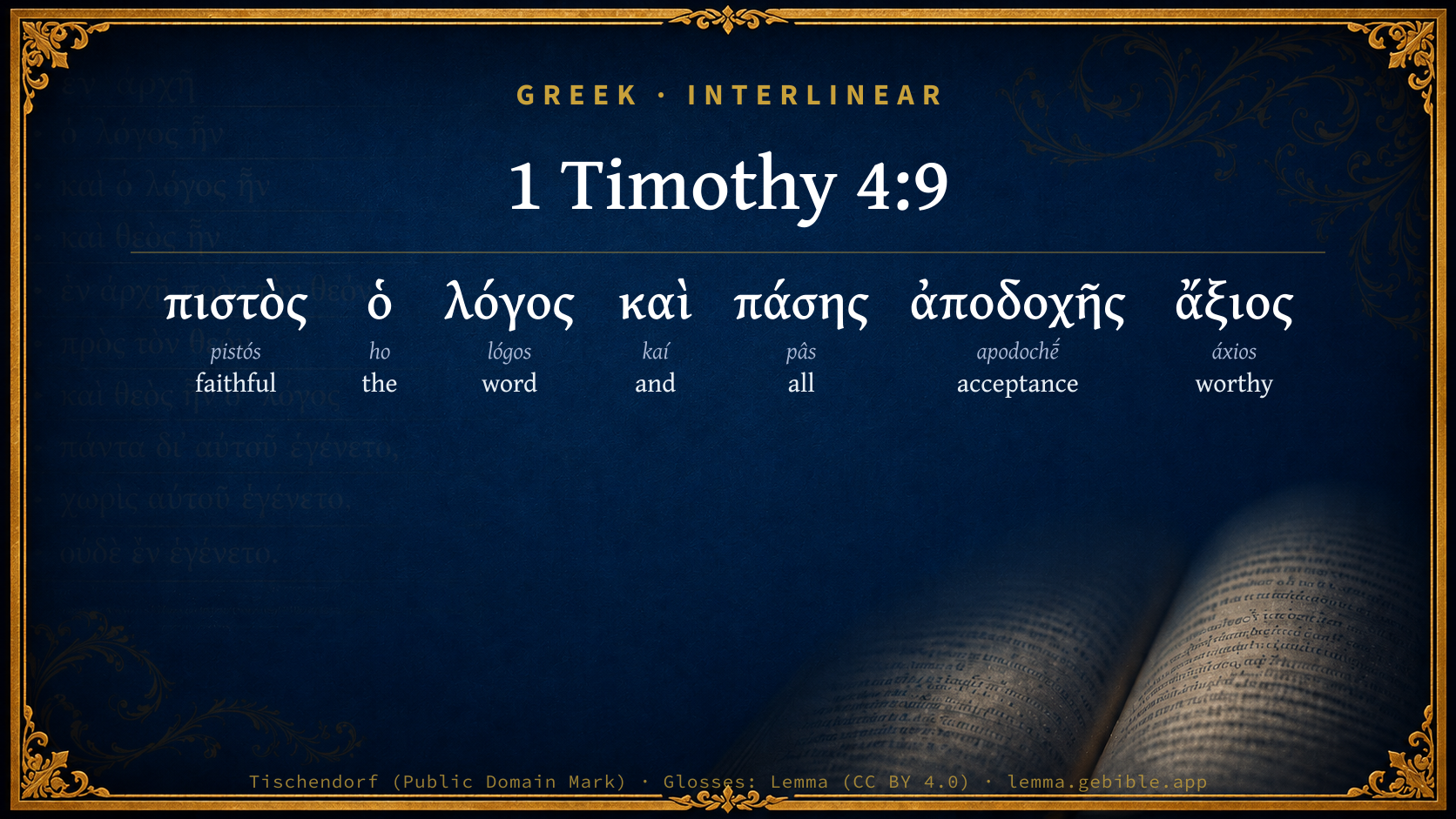
Greek (Tischendorf 8th ed.) 1 Timothy 4:9 appears in the Greek New Testament. The text above is from the Tischendorf 8th edition. Each word links to its Strong’s number and a concise gloss. Click any word for its full Thayer’s Greek Lexicon entry.
Download image
Cite this verse

1 Timothy 4:9 (World English Bible). Public Domain. Lemma interlinear Bible study tool, https://lemma.gebible.app/v/1-timothy/4/9.

Show BibTeX & RIS
BibTeX
RIS
English Translation
This saying is faithful and worthy of all acceptance.
World English Bible · Public Domain
Download a study sheet

One document with this verse’s original text, its word-by-word gloss line, the meaning frame, cross-references with their text, attributed commentary, and full source and license credits — printable, and it pastes into notes with its structure intact.

This verse Autodidact and up

Study sheet (.html) Plain text (.txt)

A passage Seminary Student

Up to 50 verses in one chapter. A passage sheet keeps up to 6 commentary sources and 12 cross-references per verse, in the order this page ranks them, and says so on the sheet whenever that leaves anything out. Ask for a single verse and you get the Autodidact verse sheet above.

Everything on this page stays free to read, with no account — the sheet is a download of what is already on screen, not access to it.

Want to remove ads? Support Godless Engineer
Compare translations 3

The same verse in 3 English versions, stacked beneath the original-language interlinear above. Click any original word for its lexicon entry.

Each is an independent rendering of the whole verse — the interlinear is not word-aligned to these translations.

Highlighted words mark where these versions differ — a whole-verse word diff, not a word-by-word alignment.

  • World English Bible Public Domain
    This saying is faithful and worthy of all acceptance.
  • King James Version Public Domain
    This is a faithful saying and worthy of all acceptation.
  • unfoldingWord Literal Text CC BY-SA 4.0
    The word trustworthy and worthy of all acceptance.

unfoldingWord Literal Text — © unfoldingWord, licensed CC BY-SA 4.0. Word-aligned USFM3 via Door43 (git.door43.org/unfoldingWord/en_ult).

Versions to compare (up to 4)

3 of 4 selected

Show all 19 translations

Every available English version of this verse, each an independent rendering of the whole verse.

  • World English Bible Public Domain
    This saying is faithful and worthy of all acceptance.
  • Berean Standard Bible Public Domain
    This is a trustworthy saying, worthy of full acceptance.
  • Majority Standard Bible Public Domain
    This is a trustworthy saying, worthy of full acceptance.
  • King James Version Public Domain
    This is a faithful saying and worthy of all acceptation.
  • American Standard Version (1901) Public Domain
    Faithful is the saying, and worthy of all acceptation.
  • Revised Version (1885) Public Domain
    Faithful is the saying, and worthy of all acceptation.
  • Geneva Bible (1599) Public Domain
    This is a true saying, and by all meanes worthie to be receiued.
  • Douay-Rheims (1899) Public Domain
    A faithful saying and worthy of all acceptation.
  • Young's Literal Translation Public Domain
    stedfast `is' the word, and of all acceptation worthy;
  • Literal Standard Version CC BY-SA 4.0
    the word [is] steadfast, and worthy of all acceptance;
  • Unlocked Literal Bible CC BY-SA 4.0
    This message is trustworthy and worthy of full acceptance.
  • unfoldingWord Literal Text CC BY-SA 4.0
    The word trustworthy and worthy of all acceptance.
  • Darby Bible Public Domain
    The word [is] faithful and worthy of all acceptation;
  • World Messianic Bible Public Domain
    This saying is faithful and worthy of all acceptance.
  • Webster's Bible Public Domain
    This is a faithful saying, and worthy of all acceptation.
  • Free Bible Version CC BY-SA 4.0
    You can trust this saying that should be accepted by everyone.
  • Bible in Basic English Public Domain
    This is a true saying, in which all may put their faith.
  • Text-Critical English NT CC BY 4.0
    This saying is trustworthy and deserving of full acceptance.
  • Tyndale New Testament (1534) Public Domain
    This is a sure sayinge and of all parties worthy to be receaved.

Literal Standard Version (2020), Covenant Press — licensed CC BY-SA 4.0. Text via the HelloAO Bible API (eBible.org). Unlocked Literal Bible (unfoldingWord) — licensed CC BY-SA 4.0. Text via the HelloAO Bible API (eBible.org). unfoldingWord Literal Text — © unfoldingWord, licensed CC BY-SA 4.0. Word-aligned USFM3 via Door43 (git.door43.org/unfoldingWord/en_ult). Free Bible Version, Dr. Jonathan Gallagher — licensed CC BY-SA 4.0. Text via the HelloAO Bible API (eBible.org).

Word by word

More ways to search: Search by grammar → Find every occurrence → Compare this word →

Practice this passage: Drill this verse → Learn its vocabulary →

About this verse

These counts appear in no published source. They are computed here, from the morphology-tagged text and Lemma’s own curated glosses. What Lemma adds →

7
words
7
distinct lemmas
Pauline Epistles
section

Notable vocabulary

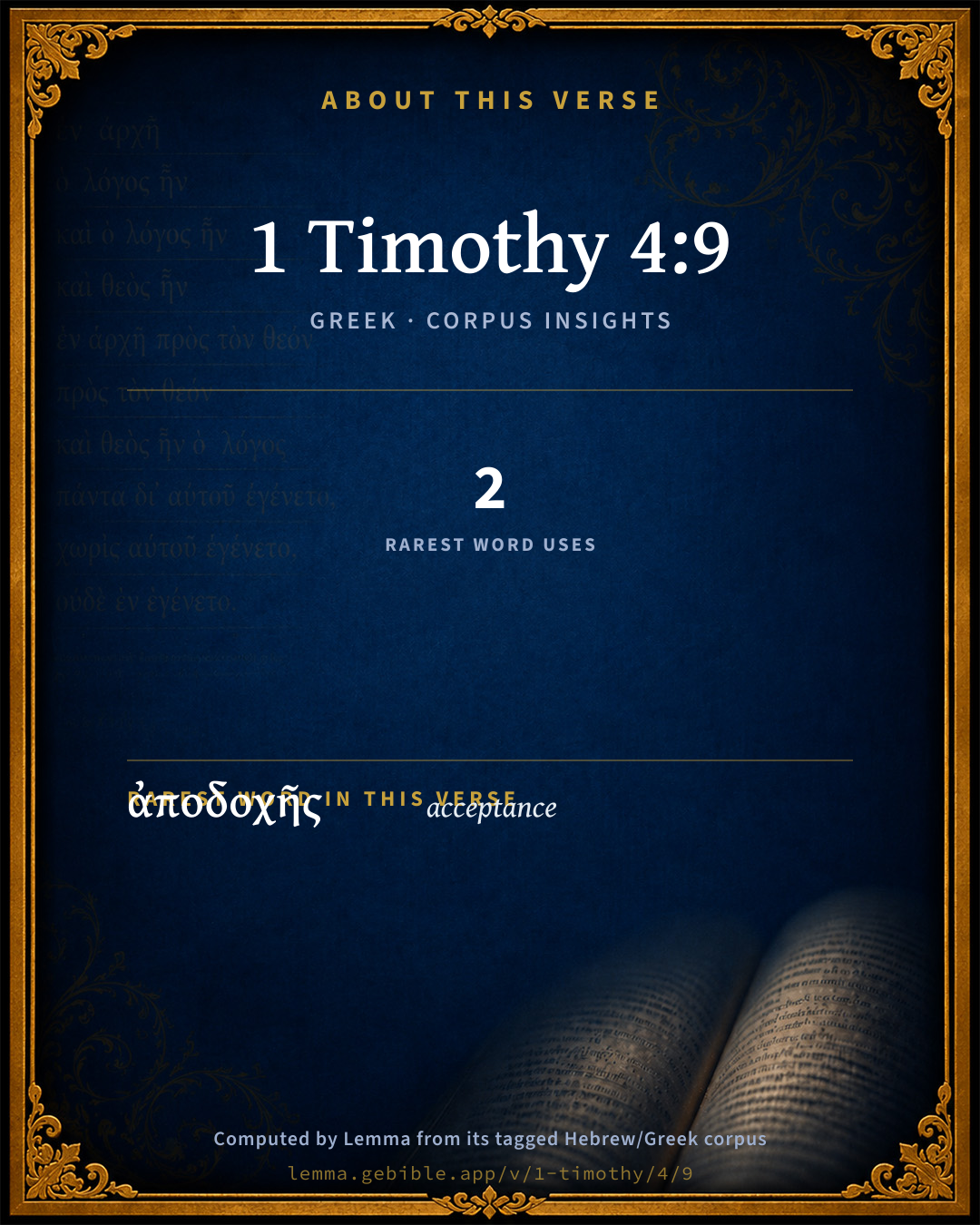
The rarest word here is ἀποδοχῆς acceptance G594 — appearing just 2 times in the whole Greek New Testament.

Shared distinctive vocabulary

ἀποδοχῆς acceptance G594 occurs in 2 verses of the Greek New Testament. Also found in:

Cross-references

1

Topical passages linked to 1 Timothy 4:9 in the Treasury of Scripture Knowledge — connected by theme and wording, ordered by reader-vote popularity; previews shown in the World English Bible.

  • 1 Timothy 1:15 The saying is faithful and worthy of all acceptance, that Christ Jesus came into the world to save sinners; of whom I am chief.

Cross-references courtesy of OpenBible.info (CC BY 4.0).

Commentary

Notes on 1 Timothy 4:9 from classic Christian and Jewish commentators (each source and its license shown beneath its notes). The classic Christian expositions comment on the surrounding passage and are grouped to its opening verse, so a note may address several verses; the Jewish commentaries on the Tanakh (Rashi and others) are per-verse, so they appear only where the commentator wrote on this verse.

Lemma curates 59 commentaries, every one of them public domain or Creative Commons licensed, each selected and text-cleaned for this edition rather than reprinted as found. About our sources →

Jamieson, Fausset & Brown

Robert Jamieson, A. R. Fausset & David Brown

(Ti1 1:15). This verse (Greek), "faithful is the saying, " &c. confirms the assertion as to the "promise" attached to "godliness," Ti1 4:8, and forms a prefatory introduction to Ti1 4:10, which is joined to Ti1 4:9 by "For." So Ti2 2:11. Godly men seem to suffer loss as to this life: Paul hereby refutes the notion [BENGEL]. "God is the Saviour specially of those that believe" (Ti1 4:10), both as to "the life that now is," and also as to "the life which is to come" (Ti1 4:8).

Jamieson, Fausset & Brown — Commentary Critical and Explanatory on the Whole Bible (1871) — public domain (CC PDM 1.0). Text via the HelloAO Bible API.

Joseph Benson's Commentary

1Ti 4:9-11. This — Concerning the advantage of godliness; is a faithful saying — A saying as important as it is true; and worthy of all acceptation — That is, of entire credit, and of the most earnest and continued attention and regard. For, therefore — On this account, because we are assured of the excellence and necessity of this godliness, and of the advantages attending it in time and in eternity; we both labour and suffer reproach — Take all manner of pains, and undergo all kinds of hardships, regarding neither wealth, nor honour, nor pleasure, nor any thing this world can offer; because we trust — Ηλπικαμεν, we have trusted, and at present do trust, (the word denoting continuation of action,) in the living God — Rest on him for the performance of his promises, fully persuaded he will give the life and felicity he has promised; who is the Saviour of all men — Saving them from many evils, and supplying them with manifold mercies; preserving them in this life, and willing to save them eternally; but especially — In a more eminent manner, is he the Saviour of those that believe — Saving them from their sins here, and from the consequences of them hereafter. These things command and teach — For they are of infinite importance.

Joseph Benson's Commentary on the Old and New Testaments (1811–1818) — public domain. Text from a community e-Sword module.

Bengel's Gnomon

Johann Albrecht Bengel

1Ti 4:9. Πιστὸς, faithful) The following verse is joined to this short preface by the for, as in 2Ti 2:11. Godly men appear often to suffer loss with respect to the enjoyment of the present life. Paul refutes this notion.

Bengel's Gnomon of the New Testament — English translation (T&T Clark, Edinburgh, 1860) — public domain. Text from a community e-Sword module.

Meyer's Critical & Exegetical Commentary

Heinrich August Wilhelm Meyer

1Ti_4:9 serves to strengthen the expression immediately preceding (not the thought in 1Ti_3:16, against Heinrichs), whereas in 1Ti_1:15 (comp. also 1Ti_3:1) the same words refer to what follows. The γάρ in 1Ti_4:10 prevents us from connecting them with what comes next. It is no less unsuitable to refer them, as Hofmann does, to the ὅτι following, and to regard εἰς τοῦτο … as a parenthesis. This connection is opposed not only by the harshness of the construction, but also by the consideration that, as a matter of fact, the conduct of the Christian, viz. ἠλπικέναι κ.τ.λ., needed for Timothy no such confirmation as is given in these words.[162]

[162] This difficulty is concealed in Hofmann by laying the emphasis on Θεῷ ζῶντι, so that πιστὸς ὁ λόγος κ.τ.λ. is to refer to the thought that God is a living God.

Meyer — Critical and Exegetical Commentary on the New Testament — English translation by Peter Christie, edited by Frederick Crombie (T&T Clark, 1880) — public domain. Text from a community e-Sword module.

Expositor's Greek Testament

ed. W. Robertson Nicoll

1Ti 4:9 . πιστὸς ἄξιος : This is parenthetical and retrospective. The teaching of 1Ti 4:8 is the λόγος . So Chrys.

The Expositor's Greek Testament, edited by W. Robertson Nicoll (1897–1910) — public domain. Text from a community e-Sword module.

Geneva Bible (1599)

Geneva Bible translators

He goeth a little from his matter, and showeth that they which give themselves to godliness, although they are afflicted and reproached, are notwithstanding not to be counted miserable as other men are, because they are not afflicted for that cause that other men are, and the end of them both is far different one from the other. For how can God forsake his, which is bountiful even towards his enemies? And he willeth that this doctrine be well beaten into their heads.

Geneva Bible (1599) marginal notes — public domain. Text via Bolls.life.

Adam Clarke's Commentary

Verse 9. This is a faithful saying] The truth of this doctrine none need doubt; and every man has it in his power to put this to the proof. See note on 1Ti 1:15.

Adam Clarke's Commentary on the Bible (1810–1826) — public domain. Text from a community e-Sword/MySword module.

John Calvin's Commentaries

9 This is a faithful saying He now sets down, at the conclusion of the argument, what he stated twice at the beginning of it; and he appears to do so expressly, because he will immediately subjoin the contrary objection. Yet it is not without good reason that he employs so strong an assertion; for it is a paradox strongly at variance with the feeling of the flesh, that God supplies his people, in this world, with everything that is necessary for a happy and joyful life; since they are often destitute of all good things, and, on that account, appear to be forsaken by God. Accordingly, not satisfied with the simple doctrine, he wards off all opposing temptations by this shield, and in this manner instructs believers to open the door to the grace of God, which our unbelief shuts out; for, undoubtedly if we were willing to receive God’s benefits, he would use greater liberality toward us.

John Calvin's Commentaries (1540-1563) — public domain. Text from the Calvin Translation Society English edition (1840s-50s) via the Christian Classics Ethereal Library (ccel.org). Calvin's coverage is partial (roughly two-thirds of the Bible); uncommented books and verses are honest gaps, never fabricated. The 19th-century editor's footnotes and remarks are omitted so the notes are faithfully Calvin's own voice.

Ellicott's Commentary for English Readers

(9) This is a faithful saying and worthy of all acceptation.—Again we have the striking formula which always calls attention to some great truth which, in the Church of the first days, had already obtained among the congregations a broad, if not a universal currency, as one of the great watchwords of the faith. Now we find one of these taken apparently from a Christian hymn, now from one of the public prayers or thanksgivings. The “faithful saying,” in this instance, was that “godliness,” that is, “active, living piety,” is profitable for all things, seeing it has the promise of the life that now is and of that which is to come.

A Bible Commentary for English Readers, edited by Charles John Ellicott (1878–1897) — public domain. Text from a community e-Sword module.

The Cambridge Bible for Schools and Colleges

gen. ed. J. J. S. Perowne

9. This is a faithful saying] R.V. again, Faithful is the saying, following the Greek construction. But ‘It is a faithful saying,’ is equally correct according to English idiom. The A.V. and R.V. end the verse with a full stop, leaving us apparently little liberty to make 1Ti_4:10 the ‘faithful saying.’ On the other hand A.V. (Parallel N.T.) gives a colon; and Drs Westcott and Hort alter the colon into a comma, as Conybeare gives it, Faithful is the saying and worthy of all acceptance,—‘For to this end we endure labour &c.’ Bp Ellicott’s objection to this, that the ‘for’ must be the Apostle’s and not part of the quotation, is set aside by the undoubted quotation from Aratus made by St Paul on Mars’ hill, Act_17:28, ‘For we are also his offspring:’ see the beginning of his Phaenomena:

‘We need him all,

For we are e’en his offspring.’

The Cambridge Bible for Schools and Colleges (gen. ed. J. J. S. Perowne; Cambridge University Press, 1878–1918) — public domain. Text from a community e-Sword module.

John Gill's Exposition

This is a faithful saying,.... A true one, and to be believed, that godliness has such promises annexed to it; see Pe1 3:10.

and worthy of all acceptation; by all godly persons, to encourage them to the exercise of godliness.

John Gill's Exposition of the Whole Bible (1746–1763) — public domain (CC PDM 1.0). Text via the HelloAO Bible API.

Trapp's Complete Commentary

John Trapp

9 This is a faithful saying and worthy of all acceptation.

Ver. 9. This is a faithful saying] And yet who hath believed our report? The promises are good freehold, and yet little looked after. Godliness hath but cold entertainment, because she lives much upon reversions.

John Trapp, A Commentary or Exposition upon All the Books of the Old and New Testament (1647–1656) — public domain. Text from a community e-Sword module.

Albert Barnes' Notes on the Bible

This is a faithful saying - see the notes on 1Ti 1:15.

Albert Barnes' Notes on the Bible (1834–1885) — public domain. Text from a community e-Sword/MySword module.

Matthew Poole's English Annotations

This saying about the advantage of godliness is true, and worthy to be received of all men. See the notes on 1Ti 1:15, where the same words are applied to the great proposition of the gospel: That Christ came into the world to save sinners. That Christ came into the world to save sinners, and that such sinners as from ungodly will become godly, and persevere in the practice of godliness, shall be happy in this life, and saved in the life to come, are two faithful and remarkable sayings, worthy the acceptation of all reasonable creatures.

Matthew Poole's English Annotations on the Holy Bible (1683–1685) — public domain. Text from a community e-Sword/MySword module.

Whedon's Commentary on the Bible

Daniel D. Whedon

9. This—The value of godliness for either life. Note on 1Ti_1:15.

Daniel D. Whedon (gen. ed.), Commentary on the Old and New Testaments (1874–1909) — public domain. Text from a community e-Sword module.

The Pulpit Commentary

Faithful is the saying for this is a faithful saying, A.V. (1Ti_1:15, note) Here, however, the pistogov is that which precedes, viz. that "godliness is profitable for all things," etc., which we thus learn was a proverbial saying.

The Pulpit Commentary (1880–1919), ed. H.D.M. Spence-Jones & Joseph S. Exell — public domain. Text from a community e-Sword module.

Fairbairn on Ezekiel, Jonah & the Pastoral Epistles

Patrick Fairbairn

Ver. 9. Faithful is the word, and worthy of all acceptation. This form of expression, peculiar to the Pastoral epistles, has already occurred in another connection, 1Ti 1:15. Here it is applied to the promise of life now and hereafter, as connected with the earnest pursuit of holiness, which the apostle not only sets forth, but commends as entitled to implicit confidence, and worthy of cordial acceptance. He proceeds also to confirm what he thus says of it by a reference to his own aim in the work of the ministry, and that of his fellow-labourers in the gospel.

Patrick Fairbairn — An Exposition of Ezekiel (1851), Jonah (1849), and The Pastoral Epistles (1874) — public domain. Text from a community e-Sword module.

Burkitt's Expository Notes on the New Testament

William Burkitt

Note, That this phrase of a faithful saying, and worthy of all acceptation, used here, was used before, 1Ti 1:15. That Christ came into the world to save sinners.

Learn thence, That this proposition, that Jesus Christ came into the world to save sinners, and this, that such sinners as of ungodly will become godly, and persevere in the practice of godliness, shall be happy in the life that now is, and that which is to come; these two propositions are faithful and remarkable sayings, worthy of the acceptation of all reasonable creatures.

Note farther, that the belief of this proposition, that godliness has the promise of this and the next life, will cause all Christians, as it did St. Paul, to labour in the work of God, to suffer reproach in the cause of God, and this without weariness and fainting.

Note, lastly, The title given to Almighty God, The Saviour of all men; that is, the preserver of all men, but especially of all good men, when their temporal preservation conduces most to the advantage of his glory and their good: or if it be understood of eternal salvation, we must take it thus; that he publishes and proclains, offers and tenders, salvation to all men, although believers only are actually saved, because they only accept the offers and conditions of salvation.

William Burkitt's Expository Notes on the New Testament (1700–1703) — public domain. Text from a community e-Sword module.

The People's New Testament

B. W. Johnson

9. This is a faithful saying. A trustworthy saying. Verse 8 is referred to.

B. W. Johnson's The People's New Testament with Notes (1889–1891) — public domain. Electronic text from the Christian Classics Ethereal Library (CCEL) ThML edition.

unfoldingWord translationNotes

Door43 World Missions Community

worthy of full acceptance

"worthy of your complete belief" or "worthy of your full trust"

For it is for this

"This is the reason"

struggle and work very hard

The words "struggle" and "work very hard" mean basically the same thing. Paul uses them together to emphasize the intensity with which they serve God. (See: Doublet and Metaphor)

we have hope in the living God

Here "living God" probably means, "God, who makes all things live."

but especially of believers

The understood information can be stated clearly. AT: "but he is especially the Savior of those people who believe" (See: Ellipsis)

translationWords

trust

confidence

God

Savior

believe

unfoldingWord translationNotes — © Distant Shores Media and the Door43 World Missions Community, licensed CC BY-SA 4.0. Source: git.door43.org/Door43/en_tn.

Cambridge Greek Testament for Schools and Colleges

9. πιστὸς ὁ λόγος καὶ πάσ. ἀπ. ἄξ. See above on 1Ti 1:15. It is not certain what the reference is. This formula refers without doubt to what follows in 1Ti 1:15, and equally without doubt to what precedes in Tit 3:8. Hence its reference in any given instance must be determined by the context. On the whole it seems more natural here to understand it of the saying at the close of 1Ti 4:8 about the blessings of εὐσέβεια. 1Ti 4:10 does not read like a familiar or proverbial saying, and the γάρ after εἰς τοῦτο seems to be explanatory. (Yet compare 2Ti 2:11.)

Cambridge Greek Testament for Schools and Colleges (Cambridge University Press, 1896; 21 vols, various authors incl. Carr, Maclear, Plummer, Farrar, Lumby, Moule, M. R. James, Simcox) — public domain. Text from a community e-Sword module.

Alford’s Greek Testament

Henry Alford

9.] Faithful is the saying, and worthy of all acceptation (see on ch. 1:15. The words refer to what follows, not as Heinr. to ch. 3:16, nor as De W., Huther, Wies., al., to what went immediately before: see on γάρ below. The connexion is with καὶ τῆς μελλούσης. Piety has the promise of that life attached to it, according to the well-known Christian saying which follows. Otherwise verse 10 comes in disjointedly and unaccountably): for (γάρ is introduced from a mixture of two constructions, rendering a reason for καὶ τῆς μελλούσης, as if πιστὸς ὁ λόγος had not been inserted. We have the same construction in 2Ti 2:11, where Huther, though he regards the γάρ as decisive against it here, refers the πιστὸς ὁ λόγος to what follows) to this end (viz. the σωτηρία implied in that which follows, introduced by ὅτι,—as in reff.: thus alone can the saying as a πιστὸς λόγος cohere together: and so Thdrt., Thl., Beza, Grot., Beng., Mosh., Wegsch., Leo, Wahl:—not, as De W., Huther, Ellic., al., for the obtaining of the promise mentioned above (De W. claims Thdrt. and Bengel for this meaning, but wrongly: the former says, τί δηποτε, &c. εἰ μὴ τίς ἐστι τῶν πόνων ἀντίδοσις; ὰλλὰ γάρ ἐστιν ἀντίδοσις. ἀΐδιος γὰρ θεὸς ἀγωνοθετεῖ τοῖς ἀθλοῦσι, καὶ πάντων ἐστὶν ἀνθρώπων σωτὴρ κ.τ.λ.; and the latter, ‘hoc nomine, hoc fine, hac spe,’ referring to ἠλπίκαμεν)) we (Christians in general) [both] toil (more than labour (ἐργαζόμεθα): it gives the idea of ‘toil and moil:’ see reff.) and suffer reproach (climax: we might toil and be had in honour, but as it is, we have both fatigue and shame to bear. The reading ἀγωνιζόμεθα is very strongly supported, but appears to have been introduced from Col 1:29), because we have fixed our hope (the same perfect occurs Joh 5:45: 2Co 1:10: ch. 5:5, 6:17: it refers to the time when the strong resolve and waiting began, and to its endurance since that time) on (for construction see reff., and Ellicott’s note here. Thus in Polyb. i. 12. 6, τὰς … ἀγοράς … ἐφʼ οἷς εἶχον τὰς μεγίστας ἐλπίδας) the living (inserted for emphasis and solemnity, to bring out the fact that the God in whom we trust is a veritable personal agent, not a creature of the imagination) God, who is the Saviour of all men (cf. ch. 2:4; Tit 2:11: His will is that all men should be saved, and He has made full and sufficient provision for the salvation of all: so that, as far as salvation stands in Him, He is the Saviour of all men. And it is in virtue of this universality of salvation offered by God, that we have rested our hopes on Him and become πιστοί), especially them that believe (in these alone does that universal salvation, which God has provided, become actual. He is the same σωτήρ towards and of all: but these alone appropriate His σωτηρία. Bengel rightly observes, ‘Latet nervus argumenti a minori ad majus:’ but he applies the σωτὴρ πάντων to this life, and μάλιστα πιστῶν to the life to come. So also Chrys.: εἰ δὲ τοὺς ἀπίστους σώζει ἐνταῦθα, πολλῷ μᾶλλον τοὺς πιστοὺς ἐκεῖ. But this does not seem to suit the context, nor the higher sense to which σωτήρ is every where in the N. T. confined, and most especially in these Epistles, where it occurs very frequently. The true ‘argumentum a minori ad majus’ lies in this—“if God be thus willing for all to be saved, how much more shall he save them that put their trust in Him.” For the expression, see reff., and especially Gal 6:10).

Henry Alford, The Greek Testament (1849–1861) — public domain. Text from a community e-Sword module.

International Critical Commentary

9. πιστὸς ὁ λόγος] probably the preceding verse, which is more stereotyped in form and wider in application than the Christian experience which supports it (γάρ).

πάσης] cf. 1:15 note: here perhaps anticipating σωτὴρ πάντων 10 as πιστός leads up to πιστῶν. Those who have faith have found this saying trustworthy, and it is worth all men’s while to accept it.

International Critical Commentary — older volumes (1896–1929), various authors — public domain. Text from a community e-Sword module.

Lesson kit

Teaching starters — assembled from the data on this page, not authored interpretation. Every prompt links to the verse data it draws on. Edit before teaching.

1 Timothy, in the Pauline Epistles, opens this verse with 7 words (7 distinct Greek lemmas). Its most distinctive word is apodochḗ (“acceptance”). A historical commentator’s framing appears above. Read the whole chapter for the surrounding context.

Discussion questions

  1. The word apodochḗ carries the sense “acceptance.” How does it shape the verse?
  2. 1 Timothy 1:15 shares the word «acceptance» with this verse. How do the two illuminate each other?
  3. These translations render this verse differently; the difference is in the English rendering, not the original. What questions does that raise?
  4. Reading how Jamieson, Fausset & Brown and Joseph Benson's Commentary read this verse, where do the two commentators agree and where do they part?

Things to notice

Reading settings

Reading text

Shown beneath each verse's original-language words.

Old Testament
Old Testament edition

Read the OT as the Masoretic Hebrew (MT) or the Greek Septuagint (LXX).

English shown for the Greek Septuagint (in the Hebrew ↔ Greek comparison).

Comparing translations? Open the Compare panel on any verse page to stack up to four side by side.