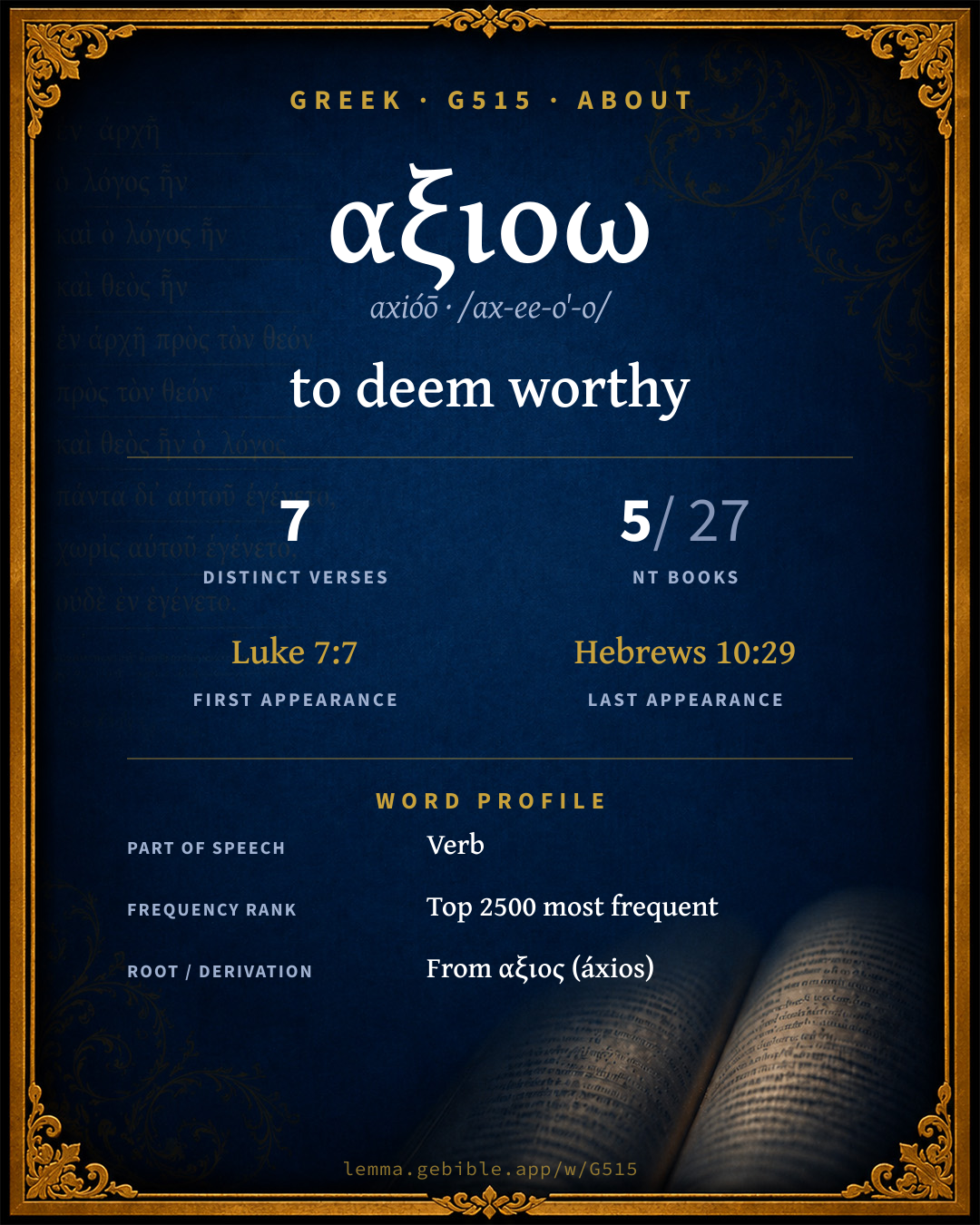
ἀξιόω
to deem worthy
‘to deem worthy’ is one of 2 main senses fuller range ↓
Full lexicon entry — Thayer's Greek Lexicon
From Thayer's Greek Lexicon
Where this word appears
See every Aorist-tense verb in the Greek New Testament →
Grammar key — what these labels mean
Part of speech
- Verb
- An action or state-of-being word.
Tense
- Aorist
- Action viewed as a simple whole, without regard to duration — often past (perfective aspect).
- Future
- Action expected in future time.
- Imperfect
- Continuous or repeated action in past time (“was writing”).
- Present
- Ongoing or general action in present time (imperfective aspect).
- Perfect
- A completed past action with continuing present results.
Voice
- Active
- The subject performs the action.
- Passive
- The subject receives the action.
Mood
- Indicative
- States a fact or asks a factual question (the mood of reality).
- Subjunctive
- Expresses probability, purpose, or possibility (the mood of contingency).
- Imperative
- Expresses a command or request.
Person
- 1st person
- The speaker (“I / we”).
- 3rd person
- The one spoken about (“he / she / it / they”).
Number
- Singular
- One.
- Plural
- More than one.
Grammatical forms
- Verb, Aorist, Active, Indicative, 1st person, Singular 1 time (14%)
- Verb, Aorist, Active, Subjunctive, 3rd person, Singular 1 time (14%)
- Verb, Future, Passive, Indicative, 3rd person, Singular 1 time (14%)
- Verb, Imperfect, Active, Indicative, 3rd person, Singular 1 time (14%)
- Verb, Present, Active, Indicative, 1st person, Plural 1 time (14%)
- Verb, Present, Passive, Imperative, 3rd person, Plural 1 time (14%)
- Verb, Perfect, Passive, Indicative, 3rd person, Singular 1 time (14%)
Parsed forms decoded from the imported morphology (Robinson–Tischendorf, public domain), counted across 7 parsed occurrences — not distinct verses.
Every verse where G515 appears — 7 distinct verses across 5 books. Click any verse to open its interlinear word-by-word view. Verse text shown in the World English Bible for context — . Each verse’s Greek form is shown with its reference; the English is not keyword-highlighted, since the data carries no word-level English alignment. Use “Compare translations” on any verse to read it across multiple English versions. This concordance covers the Greek New Testament; Septuagint (Greek Old Testament) occurrences of this word are not indexed here.
Luke 1 verse
Acts 2 verses
- Acts 15:38 ἠξίου impf act ind 3sg But Paul didn't think that it was a good idea to take with them someone who had withdrawn from them in Pamphylia, and didn't go with them to do the work.
- Acts 28:22 ἀξιοῦμεν pres act ind 1pl But we desire to hear from you what you think. For, as concerning this sect, it is known to us that everywhere it is spoken against."
2 Thessalonians 1 verse
1 Timothy 1 verse
Hebrews 2 verses
- Hebrews 3:3 ἠξίωται perf pass ind 3sg For he has been counted worthy of more glory than Moses, inasmuch as he who built the house has more honor than the house.
- Hebrews 10:29 ἀξιωθήσεται fut pass ind 3sg How much worse punishment, do you think, will he be judged worthy of, who has trodden under foot the Son of God, and has counted the blood of the covenant with which he was sanctified an unholy thing, and has insulted the Spirit of grace?
About this entry
At a glance — auto-summarized from this page’s data, not written by a person. Every figure links to its source below. This summary describes the numbers; it doesn’t interpret them.
αξιοω (axióō) is a Greek verb most often rendered “to deem worthy.” Debuting at Luke 7:7, it then recurs through the corpus. With 7 verses in 5 books, it is an uncommon word in the Greek New Testament. It concentrates in Acts, which alone accounts for 29% of its uses. Its lexical range runs to 2 senses. The sections below give every sense, occurrence, and version rendering.
Gloss history
Strong's 1890 vs modern scholarship

About this word
Strong's G515 catalogs a Greek word from the Greek New Testament.
These counts are not copied from any lexicon or concordance. They are computed here, from the morphology-tagged Greek New Testament. What Lemma adds →
- 7
- distinct verses
- The word appears in 7 distinct verses.
- 5 / 27
- NT books
- The word appears in 5 of 27 New Testament books.
- #1,358
- by frequency
- Top 2500 most frequent Greek words (rank 1,358 of 5,347 Greek words by occurrence).
View all 7 occurrences in the concordance →
By section of the New Testament
By traditional corpus
Conventional, traditional groupings — biblical authorship is debated, so this is a traditional corpus grouping, not an authorship claim. Some books belong to more than one corpus (Luke is in both the Gospels and the Lukan corpus, and so on), so these shares overlap and need not total 100%. Each figure is a share of the word’s 7 distinct verses.
- Lukan (Luke–Acts) 3 verses · 43%
- Pauline corpus 2 verses · 29%
- Hebrews 2 verses · 29%
- Gospels 1 verse · 14%
How translations render this word
Counts come from each version’s own published word-to-Strong’s tagging or interlinear alignment — an approximate guide to how each version renders this word, not a word-level alignment the data otherwise carries. Because each total is that version’s own tagged count, the per-version totals vary from one another and need not match the appearance or distinct-verse counts above. These counts may also differ from a printed concordance because Lemma counts each distinctly tagged rendering and does not collapse phrase taggings into a single head-word total. This is a fixed set of word-tagged versions (KJV, ASV, BSB, ULT) and does not change with the reading translation you choose elsewhere. Each version’s license is shown beside its name below (and on Sources).
- King James Version: Worthy 2×
- American Standard Version: Worthy 2×
- Berean Standard Bible: Are worthy 1×, Deserves 1×, Has been counted worthy 1×
- unfoldingWord Literal Text: Worthy 2×
King James Version Public Domain
Renders G515 across 11 tagged occurrences — most commonly:
Plus 9 renderings that appear only once — usually multi-word phrases or single function words the recovered tagging swept in, not distinct renderings.
American Standard Version Public Domain
Renders G515 across 11 tagged occurrences — most commonly:
Plus 9 renderings that appear only once — usually multi-word phrases or single function words the recovered tagging swept in, not distinct renderings.
Berean Standard Bible Public Domain
Renders G515 across 7 tagged occurrences — most commonly:
unfoldingWord Literal Text CC BY-SA 4.0
Renders G515 across 11 tagged occurrences — most commonly:
Plus 9 renderings that appear only once — usually multi-word phrases or single function words the recovered tagging swept in, not distinct renderings.
Senses in Thayer's
The 2 senses Thayer's distinguishes for this word, in lexicon order (not ranked by frequency or importance). The full entry — with sub-senses — is in the Lexicon Entry tab.
- to think meet, fit, right
- to judge worthy, deem, deserving
Word origin
Derived from αξιος (áxios) (G514) — worthy.
From G514 ; to deem entitled or fit : - desire think good count (think) worthy.
— Strong’s Exhaustive Concordance (1890), public domain.
Forms in the corpus
The 7 distinct written forms G515 takes in the Greek New Testament, most frequent first — each parse links to that tense’s occurrences in the concordance.
| Form | Parsing | Example | Uses |
|---|---|---|---|
| ἀξιούσθωσαν axioústhōsan | Verb, Present, Passive, Imperative, 3rd person, Plural | 1 Timothy 5:17 | 1 |
| ἀξιοῦμεν axioûmen | Verb, Present, Active, Indicative, 1st person, Plural | Acts 28:22 | 1 |
| ἀξιωθήσεται axiōthḗsetai | Verb, Future, Passive, Indicative, 3rd person, Singular | Hebrews 10:29 | 1 |
| ἀξιώσῃ axiṓsē | Verb, Aorist, Active, Subjunctive, 3rd person, Singular | 2 Thessalonians 1:11 | 1 |
| ἠξίου ēxíou | Verb, Imperfect, Active, Indicative, 3rd person, Singular | Acts 15:38 | 1 |
| ἠξίωσα ēxíōsa | Verb, Aorist, Active, Indicative, 1st person, Singular | Luke 7:7 | 1 |
| ἠξίωται ēxíōtai | Verb, Perfect, Passive, Indicative, 3rd person, Singular | Hebrews 3:3 | 1 |
Same root — word family
Other Thayer's entries built from the same root as G515, grouped by Strong’s listed origin. These share a root / origin per the lexicon — not necessarily a shared meaning. Each links to that word’s own entry.
Derives from
Shares the same root
Compare all same-root words → They share a root, not necessarily a meaning.
Septuagint usage
The same Greek word αξιοω appears 19 times in the Greek Old Testament (Septuagint), across 19 verses in 6 books.
- 19
- LXX occurrences
- Tagged occurrences of this Greek word in the Septuagint.
- 19
- verses
- Distinct Septuagint verses containing this word.
- 6 / 39
- OT books
- The word appears in 6 of the 39 Old Testament books.
Sample Septuagint occurrences
- Genesis 31:28 ἀξιόω
- Numbers 22:16 ἀξιόω
- Esther 4:8 ἀξιόω
- Isaiah 33:7 ἀξιόω
- Jeremiah 7:16 ἀξιόω
- Daniel 1:8 ἀξιόω
Septuagint occurrences (same lexeme)
Every verse where the same Strong’s number (G515) appears in the Greek Septuagint. Verse text shown in the World English Bible for context; the Greek form is the matched word — the English is not keyword-highlighted.
- Genesis 31:28 ἀξιόω and didn't allow me to kiss my sons and my daughters? Now have you done foolishly.
- Numbers 22:16 ἀξιόω They came to Balaam, and said to him, Thus says Balak the son of Zippor, Please let nothing hinder you from coming to me:
- Esther 4:8 ἀξιόω Also he gave him the copy of the writing of the decree that was given out in Shushan to destroy them, to show it to Esther, and to declare it to her, and to charge her that she should go in to the king, to make supplication to him, and to make request before him, for her people.
- Esther 5:4 ἀξιόω Esther said, If it seem good to the king, let the king and Haman come this day to the banquet that I have prepared for him.
- Esther 7:8 ἀξιόω Then the king returned out of the palace garden into the place of the banquet of wine; and Haman was fallen on the couch whereon Esther was. Then said the king, Will he even force the queen before me in the house? As the word went out of the king's mouth, they covered Haman's face.
- Esther 8:3 ἀξιόω Esther spoke yet again before the king, and fell down at his feet, and begged him with tears to put away the mischief of Haman the Agagite, and his device that he had devised against the Jews.
- Esther 9:12 ἀξιόω The king said to Esther the queen, The Jews have slain and destroyed five hundred men in Shushan the palace, and the ten sons of Haman; what then have they done in the rest of the king's provinces! Now what is your petition? and it shall be granted you: or what is your request further? and it shall be done.
- Isaiah 33:7 ἀξιόω Behold, their valiant ones cry outside; the ambassadors of peace weep bitterly.
- Jeremiah 7:16 ἀξιόω Therefore don't you pray for this people, neither lift up a cry nor prayer for them, neither make intercession to me; for I will not hear you.
- Jeremiah 11:14 ἀξιόω Therefore don't you pray for this people, neither lift up cry nor prayer for them; for I will not hear them in the time that they cry to me because of their trouble.
- Daniel 1:8 ἀξιόω But Daniel purposed in his heart that he would not defile himself with the king's dainties, nor with the wine which he drank: therefore he requested of the prince of the eunuchs that he might not defile himself.
- Daniel 2:16 ἀξιόω Daniel went in, and desired of the king that he would appoint him a time, and he would show the king the interpretation.
- Daniel 2:23 ἀξιόω I thank you, and praise you, you God of my fathers, who have given me wisdom and might, and have now made known to me what we desired of you; for you have made known to us the king's matter.
- Daniel 2:49 ἀξιόω Daniel requested of the king, and he appointed Shadrach, Meshach, and Abednego, over the affairs of the province of Babylon: but Daniel was in the gate of the king.
- Daniel 4:26 ἀξιόω Whereas they commanded to leave the stump of the roots of the tree; your kingdom shall be sure to you, after that you shall have known that the heavens do rule.
- Daniel 6:6 ἀξιόω Then these presidents and satraps assembled together to the king, and said thus to him, King Darius, live forever.
- Daniel 6:8 ἀξιόω Now, O king, establish the interdict, and sign the writing, that it not be changed, according to the law of the Medes and Persians, which doesn't alter.
- Daniel 6:9 ἀξιόω Therefore king Darius signed the writing and the interdict.
- Daniel 6:13 ἀξιόω Then answered they and said before the king, That Daniel, who is of the children of the captivity of Judah, doesn't regard you, O king, nor the interdict that you have signed, but makes his petition three times a day.
These are occurrences of the same Greek lexeme (G515) in the Septuagint — not a translation of any one Hebrew word. The store carries no word-level Hebrew↔Greek alignment, so no Hebrew original is asserted here. Counts come from the recovered LXX Strong's tagging — high-frequency vocabulary is well covered, while rare or late forms may be untagged — so they reflect tagged occurrences and may slightly undercount.