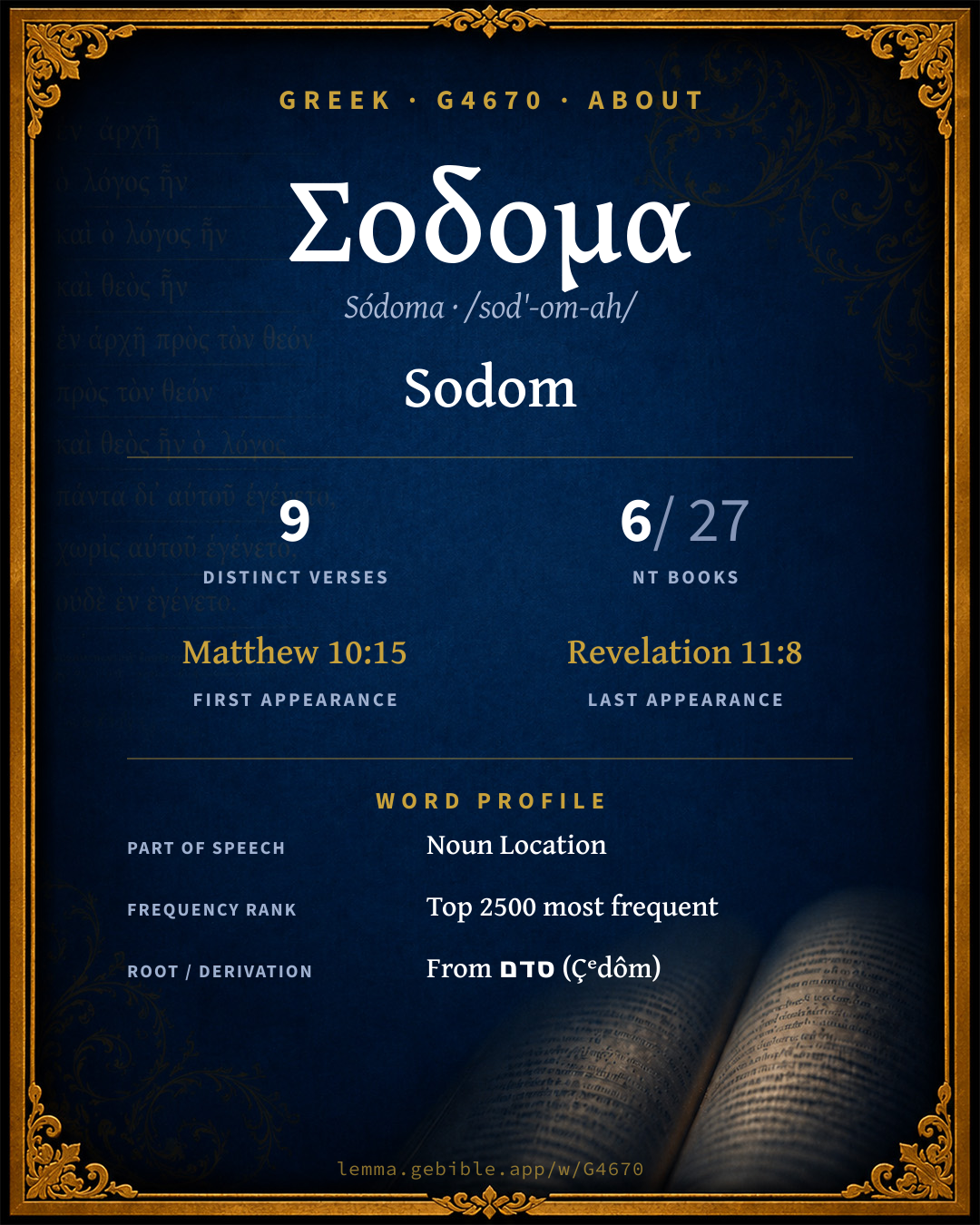
Σόδομα
Sodom
Thayer's lists 3 entries for ‘Sodom’ fuller range ↓
Full lexicon entry — Thayer's Greek Lexicon
From Thayer's Greek Lexicon
Where this word appears
See every Genitive-case word in the Greek New Testament →
Grammar key — what these labels mean
Part of speech
- Noun
- A naming word — a person, place, thing, or idea.
Case
- Genitive
- The case of source, possession, or “of” — answers “whose / from what.”
- Nominative
- The case of the subject (and the predicate nominative).
- Dative
- The case of the indirect object, means, or location — “to / for / with / in.”
Gender
- Neuter
- Grammatically neuter.
Number
- Plural
- More than one.
Grammatical forms
- Noun, Genitive, Plural, Neuter 4 times (44%)
- Noun, Nominative, Plural, Neuter 3 times (33%)
- Noun, Dative, Plural, Neuter 2 times (22%)
Parsed forms decoded from the imported morphology (Robinson–Tischendorf, public domain), counted across 9 parsed occurrences — not distinct verses.
Every verse where G4670 appears — 9 distinct verses across 6 books. Click any verse to open its interlinear word-by-word view. Verse text shown in the World English Bible for context — . Each verse’s Greek form is shown with its reference; the English is not keyword-highlighted, since the data carries no word-level English alignment. Use “Compare translations” on any verse to read it across multiple English versions. This concordance covers the Greek New Testament; Septuagint (Greek Old Testament) occurrences of this word are not indexed here.
Matthew 3 verses
- Matthew 10:15 Σοδόμων n gen pl neut Most assuredly I tell you, it will be more tolerable for the land of Sodom and Gomorrah in the day of judgment than for that city.
- Matthew 11:23 Σοδόμοις n dat pl neut You, Capernaum, who are exalted to Heaven, you will go down to Hades. For if the mighty works had been done in Sodom which were done in you, it would have remained until this day.
- Matthew 11:24 Σοδόμων n gen pl neut But I tell you that it will be more tolerable for the land of Sodom, on the day of judgment, than for you."
Luke 2 verses
Romans 1 verse
2 Peter 1 verse
Jude 1 verse
Revelation 1 verse
About this entry
At a glance — auto-summarized from this page’s data, not written by a person. Every figure links to its source below. This summary describes the numbers; it doesn’t interpret them.
Σοδομα — transliterated Sódoma — is a Greek name carrying the sense “Sodom.” Its earliest occurrence is Matthew 10:15. Spanning 9 verses in 6 books, it ranks among the uncommon words of the Greek New Testament. Its uses concentrate in Matthew (33% of all occurrences). See 9-verse concordance and the renderings breakdown below.
Gloss history
Strong's 1890 vs modern scholarship
About this word
Strong's G4670 catalogs a Greek word from the Greek New Testament.
These counts are not copied from any lexicon or concordance. They are computed here, from the morphology-tagged Greek New Testament. What Lemma adds →
- 9
- distinct verses
- The word appears in 9 distinct verses.
- 6 / 27
- NT books
- The word appears in 6 of 27 New Testament books.
- #1,140
- by frequency
- Top 2500 most frequent Greek words (rank 1,140 of 5,347 Greek words by occurrence).
View all 9 occurrences in the concordance →
By section of the New Testament
By traditional corpus
Conventional, traditional groupings — biblical authorship is debated, so this is a traditional corpus grouping, not an authorship claim. Some books belong to more than one corpus (Luke is in both the Gospels and the Lukan corpus, and so on), so these shares overlap and need not total 100%. Each figure is a share of the word’s 9 distinct verses.
- Gospels 5 verses · 56%
- Lukan (Luke–Acts) 2 verses · 22%
- General (Catholic) Epistles 2 verses · 22%
- Johannine 1 verse · 11%
- Pauline corpus 1 verse · 11%
- Revelation 1 verse · 11%
How translations render this word
Counts come from each version’s own published word-to-Strong’s tagging or interlinear alignment — an approximate guide to how each version renders this word, not a word-level alignment the data otherwise carries. Because each total is that version’s own tagged count, the per-version totals vary from one another and need not match the appearance or distinct-verse counts above. These counts may also differ from a printed concordance because Lemma counts each distinctly tagged rendering and does not collapse phrase taggings into a single head-word total. This is a fixed set of word-tagged versions (KJV, ASV, BSB, ULT) and does not change with the reading translation you choose elsewhere. Each version’s license is shown beside its name below (and on Sources).
- King James Version: Sodom 9×
- American Standard Version: Sodom 9×
- Berean Standard Bible: Sodom 9×
- unfoldingWord Literal Text: Sodom 9×
King James Version Public Domain
Renders G4670 across 10 tagged occurrences — most commonly:
Plus 1 rendering that appears only once — usually multi-word phrases or single function words the recovered tagging swept in, not distinct renderings.
American Standard Version Public Domain
Renders G4670 across 9 tagged occurrences — most commonly:
Berean Standard Bible Public Domain
Renders G4670 across 9 tagged occurrences — most commonly:
unfoldingWord Literal Text CC BY-SA 4.0
Renders G4670 across 9 tagged occurrences — most commonly:
Senses in Thayer's
The 3 senses Thayer's distinguishes for this word, in lexicon order (not ranked by frequency or importance). The full entry — with sub-senses — is in the Lexicon Entry tab.
- Sodom = "burning"
- a city destroyed by the Lord raining fire and brimstone on it
- metaph. Jerusalem Rev. 11:8
Word origin
Derived from סדם (Çᵉdôm) (H5467) — Sodom.
Plural of hebrew origin [ H5467 ]; Sodoma (that is Sedom ) a place in Palestine : - Sodom.
— Strong’s Exhaustive Concordance (1890), public domain.
Forms in the corpus
The 3 distinct written forms G4670 takes in the Greek New Testament, most frequent first — each parse links to that case’s occurrences in the concordance.
| Form | Parsing | Example | Uses |
|---|---|---|---|
| Σοδόμων Sodómōn | Noun, Genitive, Plural, Neuter | Matthew 10:15 | 4 |
| Σόδομα Sódoma | Noun, Nominative, Plural, Neuter | Romans 9:29 | 3 |
| Σοδόμοις Sodómois | Noun, Dative, Plural, Neuter | Matthew 11:23 | 2 |
Bible dictionary
Public-domain dictionary articles matched to this entry by name (Sodom). A biblical name can be shared by more than one person or place, so an article may treat several.
Easton's Bible Dictionary · M. G. Easton, 1897
Burning; the walled, a city in the vale of Siddim (Gen. 13:10; 14:1-16). The wickedness of its inhabitants brought down upon it fire from heaven, by which it was destroyed (18:16-33; 19:1-29; Deut. 23:17). This city and its awful destruction are frequently alluded to in Scripture (Deut. 29:23; 32:32; Isa. 1:9, 10; 3:9; 13:19; Jer. 23:14; Ezek. 16:46-56; Zeph. 2:9; Matt. 10:15; Rom. 9:29; 2 Pet. 2:6, etc.). No trace of it or of the other cities of the plain has been discovered, so complete was their destruction. Just opposite the site of Zoar, on the south-west coast of the Dead Sea, is a range of low hills, forming a mass of mineral salt called Jebel Usdum, "the hill of Sodom." It has been concluded, from this and from other considerations, that the cities of the plain stood at the southern end of the Dead Sea. Others, however, with much greater probability, contend that they stood at the northern end of the sea. [in 1897].
Smith's Bible Dictionary · William Smith, 1863
(burning), one of the most ancient cities of Syria. It is commonly mentioned in connection with Gomorrah, but also with Admah and Zeboim, and on one occasion-- (Genesis 14:1) ...--with Bela or Zoar. Sodom was evidently the chief town in the settlement. The four are first named in the ethnological records of (Genesis 10:19) as belonging to the Canaanites. The next mention of the name of Sodom, (Genesis 13:10-13) gives more certain indication of the position of the city. Abram and Lot are standing together between Bethel and Ai, ver. 3, taking a survey of the land around and below them. Eastward of them, and absolutely at their feet, lay the "circle of Jordan." The whole circle was one great oasis--"a garden of Jehovah." ver. 10. In the midst of the garden the four cities of Sodom, Gomorrah, Admah and Zeboim appear to have been situated. It is necessary to notice how absolutely the cities are identified with the district. In the subsequent account of their destruction, (Genesis 19:1) ... the topographical terms are employed with all the precision which is characteristic of such early times. The mention of the Jordan is conclusive as to the situation of the district, for the Jordan ceases where it enters the Dead Sea, and can have no existence south of that point. The catastrophe by which they were destroyed is described in (Genesis 19:1) ... as a shower of brimstone and fire from Jehovah. However we may interpret the words of the earliest narrative, one thing is certain--that the lake was not one of the agents in the catastrophe. From all these passages, though much is obscure, two things seem clear:
+ That Sodom and the rest of the cities of the plain of Jordan stood on the north of the Dead Sea; + That neither the cities nor the district were submerged by the lake, but that the cities were overthrown and the land spoiled, and that it may still be seen in its desolate condition. When, however, we turn to more modern views, we discover a remarkable variance from these conclusions. + The opinion long current that the five cities were submerged in the lake, and that their remains--walls, columns and capitals--might he still discerned below the water, hardly needs refutation after the distinct statement and the constant implication of Scripture. But, + A more serious departure from the terms of the ancient history is exhibited in the prevalent opinion that the cities stood at the south end of the lake. This appears to, have been the belief of Josephus and Jerome. It seems to have been universally held by the medieval historians and pilgrims, and it is adopted by modern topographers probably without exception. There are several grounds for this belief; but the main point on which Dr. Robinson rests his argument is the situation of Zoar. (a) "Lot," says he, "fled to Zoar, which was near to Sodom; and Zoar lay almost at the southern end of the present sea, probably in the month of Wady Kerak ." (b) Another consideration in favor of placing the cities at the southern end of the lake is the existence of similar names in that direction. (c) A third argument, and perhaps the weightiest of the three, is the existence of the salt mountain at the south of the lake, and its tendency to split off in columnar masses presenting a rude resemblance to the human form. But it is by no means certain that salt does not exist at other spots round the lake. (d) (A fourth and yet stronger argument is drawn from the fact that Abraham saw the smoke of the burning cities from Hebron. (e) A fifth argument is found in the numerous lime-pits found at that southern end of the Dead Sea. Robinson, Schaff, Baedeker, Lieutenant Lynch and others favor this view.--ED.) It thus appears that on the situation of Sodom no satisfactory conclusion can at present be readied: On the one hand, the narrative of Genesis seems to state positively that it lay at the northern end of the Dead Sea. On the other hand, long-continued tradition and the names of the existing spots seem to pronounce with almost equal positiveness that it was at its southern end. Of the catastrophe which destroyed the city and the district of Sodom we can hardly hope ever to form a satisfactory conception. Some catastrophe there undoubtedly was but what secondary agencies, besides fire, were employed in the accomplishment of the punishment cannot be safely determined in the almost total absence of exact scientific description of the natural features of the ground round the lake. We may suppose, however, that the actual agent in the ignition and destruction of the cities had been of the nature of a tremendous thunder-storm accompanied by a discharge of meteoric stones, (and that these set on fire the bitumen with which the soil was saturated, and which was used in building the city. And it may be that this burning out of the soil caused the plain to sink below the level of the Dead Sea, and the waters to flow over it--if indeed Sodom and its sister cities are really under the water.--ED.) The miserable fate of Sodom and Gomorrah is held up as a warning in numerous passages of the Old and New Testaments. (Mark 8:11; 2 Peter 2:6; Jude 1:4-7)
Hitchcock's Bible Names Dictionary · Roswell D. Hitchcock, 1869
their secret; their cement
Classic public-domain reference works; full attribution on Sources.
Septuagint usage
The same Greek word Σοδομα appears 37 times in the Greek Old Testament (Septuagint), across 36 verses in 7 books.
- 37
- LXX occurrences
- Tagged occurrences of this Greek word in the Septuagint.
- 36
- verses
- Distinct Septuagint verses containing this word.
- 7 / 39
- OT books
- The word appears in 7 of the 39 Old Testament books.
Sample Septuagint occurrences
- Genesis 10:19 σοδομα
- Deuteronomy 29:22 σοδομα
- Isaiah 1:9 σοδομα
- Jeremiah 23:14 σοδομα
- Ezekiel 16:46 σοδομα
- Amos 4:11 σοδομα
- Zephaniah 2:9 σοδομα
Septuagint occurrences (same lexeme)
Every verse where the same Strong’s number (G4670) appears in the Greek Septuagint. Verse text shown in the World English Bible for context; the Greek form is the matched word — the English is not keyword-highlighted.
- Genesis 10:19 σοδομα The border of the Canaanites was from Sidon, as you go toward Gerar, to Gaza; as you go toward Sodom, Gomorrah, Admah, and Zeboiim, to Lasha.
- Genesis 13:10 σοδομα Lot lifted up his eyes, and saw all the plain of the Jordan, that it was well watered every where, before Yahweh destroyed Sodom and Gomorrah, like the garden of Yahweh, like the land of Egypt, as you go to Zoar.
- Genesis 13:12 σοδομα Abram lived in the land of Canaan, and Lot lived in the cities of the plain, and moved his tent as far as Sodom.
- Genesis 13:13 σοδομα Now the men of Sodom were exceedingly wicked and sinners against Yahweh.
- Genesis 14:2 σοδομα that they made war with Bera, king of Sodom, and with Birsha, king of Gomorrah, Shinab, king of Admah, and Shemeber, king of Zeboiim, and the king of Bela (the same is Zoar).
- Genesis 14:8 σοδομα There went out the king of Sodom, and the king of Gomorrah, and the king of Admah, and the king of Zeboiim, and the king of Bela (the same is Zoar); and they set the battle in array against them in the valley of Siddim;
- Genesis 14:10 σοδομα Now the valley of Siddim was full of tar pits; and the kings of Sodom and Gomorrah fled, and they fell there, and those who remained fled to the mountain.
- Genesis 14:11 σοδομα They took all the goods of Sodom and Gomorrah, and all their food, and went their way.
- Genesis 14:12 σοδομα They took Lot, Abram's brother's son, who lived in Sodom, and his goods, and departed.
- Genesis 14:16 σοδομα He brought back all the goods, and also brought back his relative, Lot, and his goods, and the women also, and the people.
- Genesis 14:17 σοδομα The king of Sodom went out to meet him, after his return from the slaughter of Chedorlaomer and the kings who were with him, at the valley of Shaveh (the same is the King's Valley).
- Genesis 14:21 σοδομα The king of Sodom said to Abram, "Give me the people, and take the goods to yourself."
- Genesis 14:22 σοδομα Abram said to the king of Sodom, "I have lifted up my hand to Yahweh, God Most High, possessor of heaven and earth,
- Genesis 18:16 σοδομα The men rose up from there, and looked toward Sodom. Abraham went with them to see them on their way.
- Genesis 18:20 σοδομα Yahweh said, "Because the cry of Sodom and Gomorrah is great, and because their sin is very grievous,
- Genesis 18:22 σοδομα The men turned from there, and went toward Sodom, but Abraham stood yet before Yahweh.
- Genesis 18:26 σοδομα Yahweh said, "If I find in Sodom fifty righteous within the city, then I will spare all the place for their sake."
- Genesis 19:1 σοδομα The two angels came to Sodom at evening. Lot sat in the gate of Sodom. Lot saw them, and rose up to meet them. He bowed himself with his face to the earth,
- Genesis 19:24 σοδομα Then Yahweh rained on Sodom and on Gomorrah sulfur and fire from Yahweh out of the sky.
- Genesis 19:28 σοδομα He looked toward Sodom and Gomorrah, and toward all the land of the plain, and looked, and saw that the smoke of the land went up as the smoke of a furnace.
- Deuteronomy 29:22 σοδομα The generation to come, your children who shall rise up after you, and the foreigner who shall come from a far land, shall say, when they see the plagues of that land, and the sicknesses with which Yahweh has made it sick;
- Deuteronomy 32:32 σόδομα For their vine is of the vine of Sodom, Of the fields of Gomorrah: Their grapes are grapes of gall, Their clusters are bitter:
- Isaiah 1:9 σοδομα Unless Yahweh of hosts had left to us a very small remnant, We would have been as Sodom; We would have been like Gomorrah.
- Isaiah 1:10 σοδομα Hear the word of Yahweh, you rulers of Sodom! Listen to the law of our God, you people of Gomorrah!
- Isaiah 13:19 σοδομα Babylon, the glory of kingdoms, the beauty of the Chaldeans' pride, shall be as when God overthrew Sodom and Gomorrah.
- Jeremiah 23:14 σοδομα In the prophets of Jerusalem also I have seen a horrible thing: they commit adultery, and walk in lies; and they strengthen the hands of evil-doers, so that none does return from his wickedness: they are all of them become to me as Sodom, and the inhabitants of it as Gomorrah.
- Jeremiah 27:40 σοδομα
- Jeremiah 30:12 σοδομα For thus says Yahweh, Your hurt is incurable, and your wound grievous.
- Ezekiel 16:46 σοδομα Your elder sister is Samaria, who dwells at your left hand, she and her daughters; and your younger sister, who dwells at your right hand, is Sodom and her daughters.
- Ezekiel 16:48 σοδομα As I live, says the Lord Yahweh, Sodom your sister has not done, she nor her daughters, as you have done, you and your daughters.
- Ezekiel 16:49 σοδομα Behold, this was the iniquity of your sister Sodom: pride, fullness of bread, and prosperous ease was in her and in her daughters; neither did she strengthen the hand of the poor and needy.
- Ezekiel 16:53 σοδομα I will turn again their captivity, the captivity of Sodom and her daughters, and the captivity of Samaria and her daughters, and the captivity of your captives in the midst of them;
- Ezekiel 16:55 σοδομα Your sisters, Sodom and her daughters, shall return to their former estate; and Samaria and her daughters shall return to their former estate; and you and your daughters shall return to your former estate.
- Ezekiel 16:56 σοδομα For your sister Sodom was not mentioned by your mouth in the day of your pride,
- Amos 4:11 σοδομα "I have overthrown some of you, As when God overthrew Sodom and Gomorrah, And you were like a burning stick plucked out of the fire; Yet you haven't returned to me," says Yahweh.
- Zephaniah 2:9 σοδομα Therefore as I live, says Yahweh of Hosts, the God of Israel, surely Moab will be as Sodom, and the children of Ammon as Gomorrah, a possession of nettles, and salt pits, and a perpetual desolation. The remnant of my people will plunder them, and the survivors of my nation will inherit them.
These are occurrences of the same Greek lexeme (G4670) in the Septuagint — not a translation of any one Hebrew word. The store carries no word-level Hebrew↔Greek alignment, so no Hebrew original is asserted here. Counts come from the recovered LXX Strong's tagging — high-frequency vocabulary is well covered, while rare or late forms may be untagged — so they reflect tagged occurrences and may slightly undercount.