
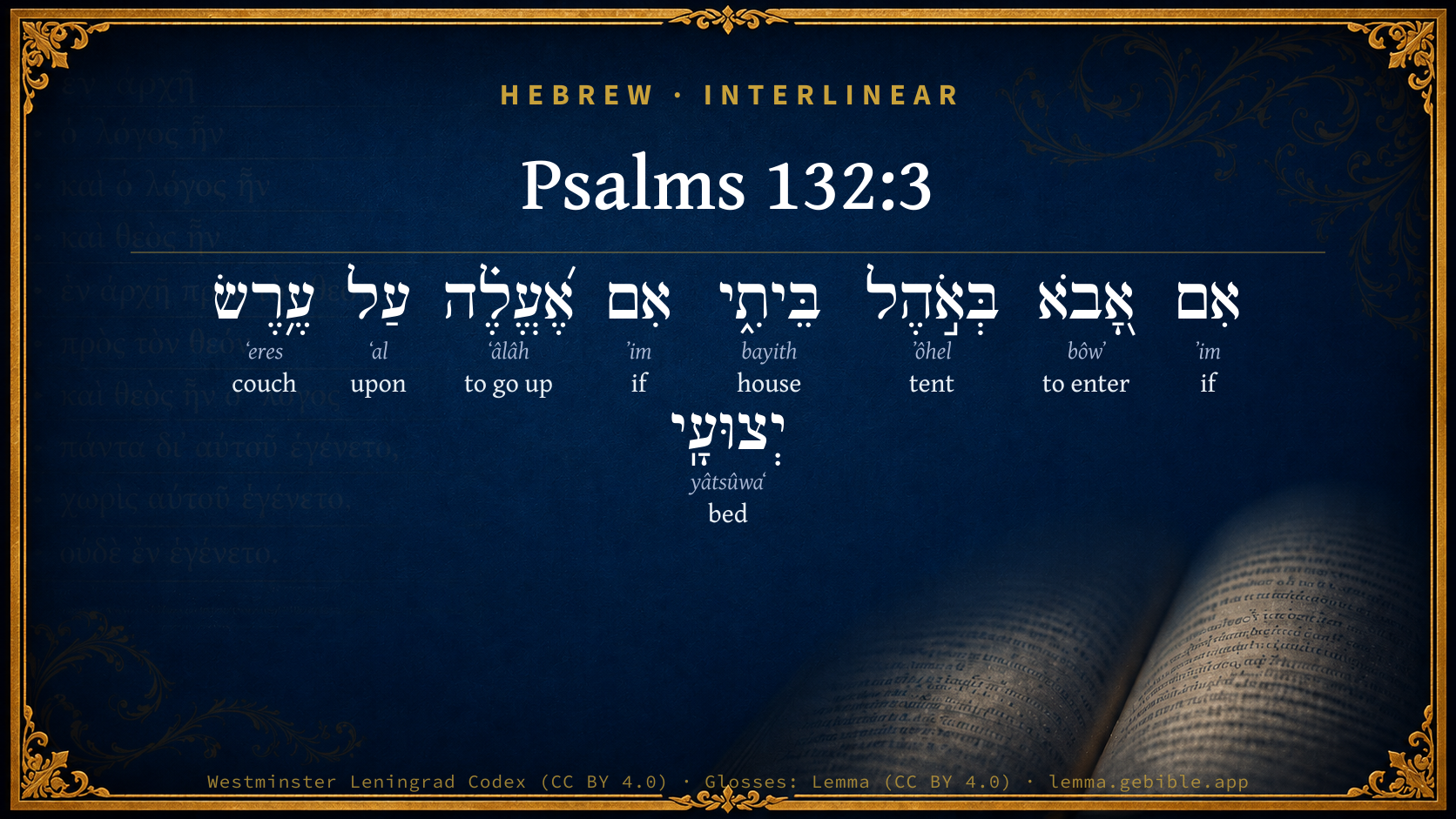
Psalms 132:3

Hebrew (Westminster Leningrad Codex) Psalms 132:3 appears in the Hebrew Old Testament. The text above is from the Westminster Leningrad Codex. Each word links to its Strong’s number, a concise gloss, and parsing drawn from the Open Scriptures Hebrew Bible morphology. Click any word for its full Brown-Driver-Briggs (BDB) entry.
Download image
Cite this verse

Psalms 132:3 (World English Bible). Public Domain. Lemma interlinear Bible study tool, https://lemma.gebible.app/v/psalms/132/3.

Show BibTeX & RIS
BibTeX
RIS
English Translation
"Surely I will not come into the structure of my house, Nor go up into my bed;
World English Bible · Public Domain
Download a study sheet

One document with this verse’s original text, its word-by-word gloss line, the meaning frame, cross-references with their text, attributed commentary, and full source and license credits — printable, and it pastes into notes with its structure intact.

This verse Autodidact and up

Study sheet (.html) Plain text (.txt)

A passage Seminary Student

Up to 50 verses in one chapter. A passage sheet keeps up to 6 commentary sources and 12 cross-references per verse, in the order this page ranks them, and says so on the sheet whenever that leaves anything out. Ask for a single verse and you get the Autodidact verse sheet above.

Everything on this page stays free to read, with no account — the sheet is a download of what is already on screen, not access to it.

Want to remove ads? Support Godless Engineer
Compare translations 3

The same verse in 3 English versions, stacked beneath the original-language interlinear above. Click any original word for its lexicon entry.

Each is an independent rendering of the whole verse — the interlinear is not word-aligned to these translations.

Highlighted words mark where these versions differ — a whole-verse word diff, not a word-by-word alignment.

  • World English Bible Public Domain
    "Surely I will not come into the structure of my house, Nor go up into my bed;
  • King James Version Public Domain
    Surely I will not come into the tabernacle of my house, nor go up into my bed;
  • unfoldingWord Literal Text CC BY-SA 4.0
    “If I go into the tent of my house, if I go up on the bed of my couch,

unfoldingWord Literal Text — © unfoldingWord, licensed CC BY-SA 4.0. Word-aligned USFM3 via Door43 (git.door43.org/unfoldingWord/en_ult).

Versions to compare (up to 4)

3 of 4 selected

Show all 18 translations

Every available English version of this verse, each an independent rendering of the whole verse.

  • World English Bible Public Domain
    "Surely I will not come into the structure of my house, Nor go up into my bed;
  • Berean Standard Bible Public Domain
    “I will not enter my house or get into my bed,
  • Majority Standard Bible Public Domain
    “I will not enter my house or get into my bed,
  • King James Version Public Domain
    Surely I will not come into the tabernacle of my house, nor go up into my bed;
  • American Standard Version (1901) Public Domain
    Surely I will not come into the tabernacle of my house, Nor go up into my bed;
  • Revised Version (1885) Public Domain
    Surely I will not come into the tabernacle of my house, nor go up into my bed;
  • Geneva Bible (1599) Public Domain
    I will not enter into the tabernacle of mine house, nor come vpon my pallet or bed,
  • Douay-Rheims (1899) Public Domain
    Let Israel hope in the Lord, from henceforth now and for ever.
  • Young's Literal Translation Public Domain
    `If I enter into the tent of my house, If I go up on the couch of my bed,
  • Literal Standard Version CC BY-SA 4.0
    “If I enter into the tent of my house, || If I go up on the couch of my bed,
  • Unlocked Literal Bible CC BY-SA 4.0
    He said, “I will not enter my house or get into my bed,
  • unfoldingWord Literal Text CC BY-SA 4.0
    “If I go into the tent of my house, if I go up on the bed of my couch,
  • Darby Bible Public Domain
    I will not come into the tent of my house, I will not go up to the couch of my bed;
  • World Messianic Bible Public Domain
    “Surely I will not come into the structure of my house, nor go up into my bed;
  • Webster's Bible Public Domain
    Surely I will not come into the tabernacle of my house, nor go up into my bed;
  • Free Bible Version CC BY-SA 4.0
    “I will not go home, I will not go to bed,
  • Bible in Basic English Public Domain
    Truly, I will not come into my house, or go to my bed,
  • JPS Tanakh (1917) Public Domain
    'Surely I will not come into the tent of my house, nor go up into the bed that is spread for me;

Literal Standard Version (2020), Covenant Press — licensed CC BY-SA 4.0. Text via the HelloAO Bible API (eBible.org). Unlocked Literal Bible (unfoldingWord) — licensed CC BY-SA 4.0. Text via the HelloAO Bible API (eBible.org). unfoldingWord Literal Text — © unfoldingWord, licensed CC BY-SA 4.0. Word-aligned USFM3 via Door43 (git.door43.org/unfoldingWord/en_ult). Free Bible Version, Dr. Jonathan Gallagher — licensed CC BY-SA 4.0. Text via the HelloAO Bible API (eBible.org).

Word by word

More ways to search: Search by grammar → Find every occurrence → Compare this word →

Practice this passage: Drill this verse → Learn its vocabulary →

About this verse

These counts appear in no published source. They are computed here, from the morphology-tagged text and Lemma’s own curated glosses. What Lemma adds →

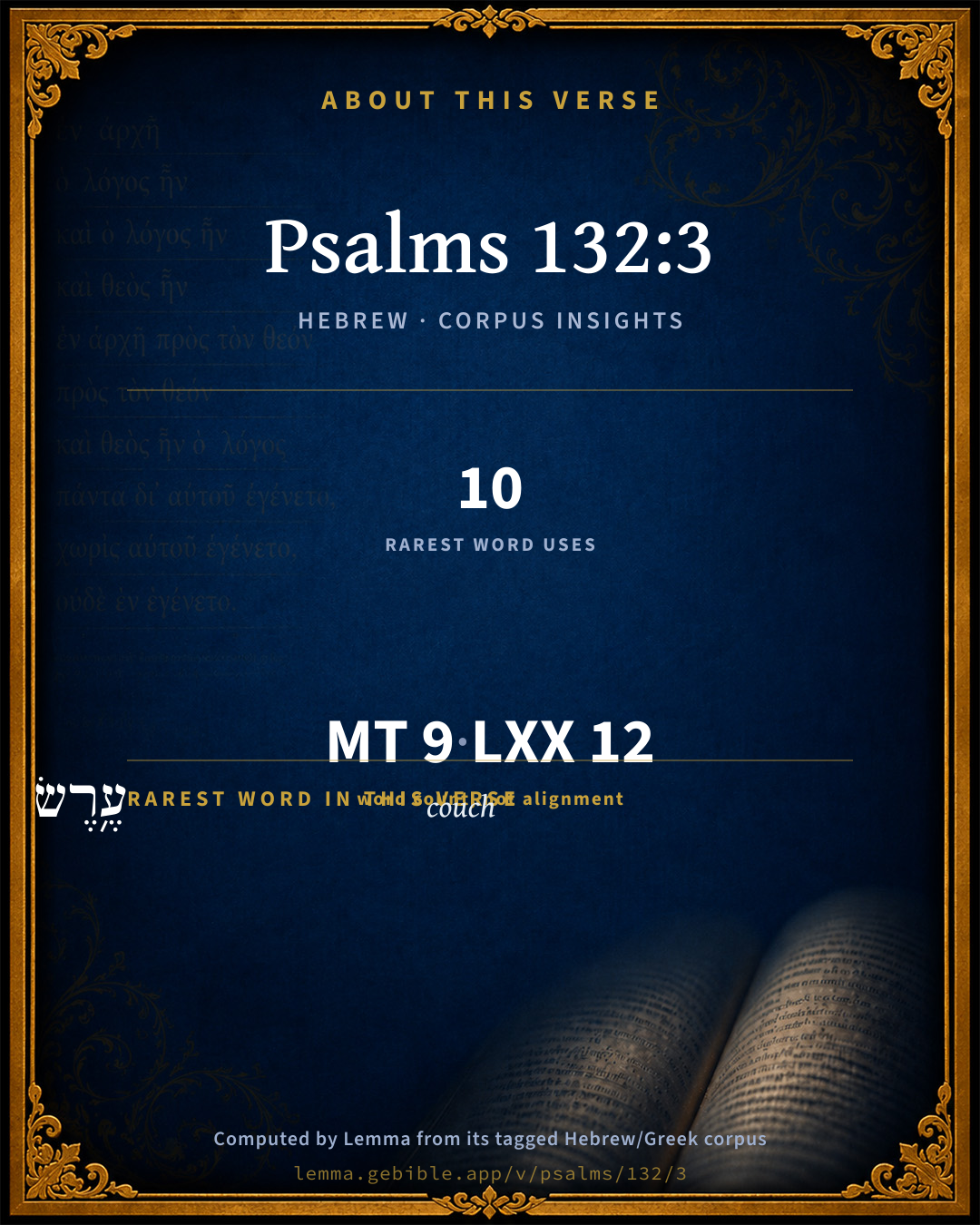
9
words
8
distinct lemmas
Wisdom
section

Notable vocabulary

The rarest word here is עֶ֥רֶשׂ couch H6210 — appearing just 10 times in the whole Hebrew Bible.

Shared distinctive vocabulary

עֶ֥רֶשׂ couch H6210 occurs in 9 verses of the Hebrew Bible. Also found in:

Grammatical profile

  • 2 verbs
  • 4 nouns
  • 1 preposition
  • 2 conjunctions

Verb forms

  • אָ֭בֹא Qal · Imperfect
  • אֶ֝עֱלֶ֗ה Qal · Imperfect

Repetition

A word recurs within this verse — often emphatic in Hebrew:

  • אִם if H518 ×2

Hebrew & Septuagint length

In English translation the verse runs 17 words from the Hebrew and 21 from the Septuagint (LXX English) — closely comparable.

A rough comparison of the two English renderings, which tokenize alike — not a word-level alignment.

Word counts can differ between the Hebrew and the Greek without any difference in meaning — e.g. the Hebrew direct-object marker אֵת has no separate Greek word, and Greek often adds the article ὁ.

In the original languages it is 9 Hebrew tokens and 12 Greek tokens — but the two are counted differently (Hebrew bundles its prefixes and suffixes into one token; the Greek is in lemma form), so that isn’t a like-for-like length.

Cross-references

3

Topical passages linked to Psalms 132:3 in the Treasury of Scripture Knowledge — connected by theme and wording, ordered by reader-vote popularity; previews shown in the World English Bible.

  • Ecclesiastes 9:10 Whatever your hand finds to do, do it with your might; for there is no work, nor device, nor knowledge, nor wisdom, in Sheol, where you are going.
  • Haggai 1:4 "Is it a time for you yourselves to dwell in your paneled houses, while this house lies waste?
  • Matthew 6:33 But seek first God's Kingdom, and his righteousness; and all these things will be given to you as well.

Cross-references courtesy of OpenBible.info (CC BY 4.0).

Hebrew and Greek witnesses Masoretic Hebrew ↔ Greek Septuagint

The same verse in the two great witnesses to the Old Testament, shown verse-for-verse.

You’re reading Greek Psalm 131 (Hebrew Psalm 132). The Septuagint counts the superscription, so verse numbers can differ from the Hebrew — chapter-level alignment, not verse-by-verse. Numbering follows Rahlfs.

These are two independent witnesses, not word-aligned to each other, and the Septuagint is shown in lemma (dictionary) form.

Hebrew Psalms 132:3 Masoretic · Westminster Leningrad Codex

אִם אָ֭בֹא בְּאֹ֣הֶל בֵּיתִ֑י אִם אֶ֝עֱלֶ֗ה עַל עֶ֥רֶשׂ יְצוּעָֽי

"Surely I will not come into the structure of my house, Nor go up into my bed;

World English Bible · Public Domain

Greek LXX Greek Psalm 131:3 Septuagint · lemma form

εἰ εἰςἔρχομαι εἰς σκήνωμα οἶκος ἐγώ εἰ ἀναβαίνω ἐπί κλίνη στρωμνη ἐγώ

I will not go into the tabernacle of my house; I will not go up to the couch of my bed;

LXX2012 (modern English Septuagint) · Public Domain

On this verse, Ellicott's Commentary for English Readers discusses the Septuagint’s reading. Read the note in Commentary ↓

Hebrew: Westminster Leningrad Codex (CC BY 4.0). Greek: Septuagint (public domain); English from LXX2012 (modern English Septuagint) (Public Domain). How the Septuagint differs from the Hebrew →

Commentary

Notes on Psalms 132:3 from classic Christian and Jewish commentators (each source and its license shown beneath its notes). The classic Christian expositions comment on the surrounding passage and are grouped to its opening verse, so a note may address several verses; the Jewish commentaries on the Tanakh (Rashi and others) are per-verse, so they appear only where the commentator wrote on this verse.

Lemma curates 59 commentaries, every one of them public domain or Creative Commons licensed, each selected and text-cleaned for this edition rather than reprinted as found. About our sources →

Trapp's Complete Commentary

John Trapp

Psa 132:3 Surely I will not come into the tabernacle of my house, nor go up into my bed;

Ver. 3. Surely I will not come into the tabernacle of my house] i.e. Of my newly built house, 1Ch 15:1 2Sa 1:2. Those in Malachi were not so well minded, Psa 1:4.

John Trapp, A Commentary or Exposition upon All the Books of the Old and New Testament (1647–1656) — public domain. Text from a community e-Sword module.

Joseph Benson's Commentary

Psa 132:3-5. Surely I will not, &c. — As if he had said, I value not my own private domestic enjoyments and accommodations, in comparison of the settlement of God’s public worship. “He was so highly concerned,” says Dr. Hammond, “for the service of God, that, having built himself a house, (1Ch 15:1; 1Ch 15:11, &c.) he immediately prepared a place for the ark of God, and brought it up thither in pomp, having, it seems, solemnly vowed to do so before ever he would dedicate and bless (or dwell in) his own house, chap. 1Ch 16:43. And, not content with that, his zeal further broke out to Nathan the prophet, (chap. Psa 17:1,) being troubled to think of the magnificence of his own house, while the ark was but in a tent. And he resolved, if God should permit him, to erect a magnificent structure wherein the ark of God should be placed, and God’s solemn worship performed.” Bishop Patrick’s paraphrase is to the same purport: “I will not come into the new palace which I have built for myself, much less go to dwell and take up my lodging there; nay, I will not lay myself down to rest, nor take a wink of sleep, until I have found out a convenient place for the ark of the Lord, a habitation for that mighty one; who there makes himself present to his people the posterity of Jacob.” Henry supposes that, having procrastinated too long, amidst his difficulties, upon his first accession to the throne, “he one morning made a vow, that, before night, he would come to a resolution in this matter, and would determine the place where the tent should be fixed for the reception of the ark.” Some think that the spot on which the temple should be built was intended, and that David made this vow on the morning of the day of the pestilence, which cut off so many in Israel because he had numbered the people; and that the thrashing- floor of Ornan was pointed out to him in consequence of this resolution.

Joseph Benson's Commentary on the Old and New Testaments (1811–1818) — public domain. Text from a community e-Sword module.

Whedon's Commentary on the Bible

Daniel D. Whedon

3. Surely I will not come—Literally, “If I shall go into the tent of my house.” The beginning of the sentence is the usual form of oath, which here is given in Psa_132:3-5, the oath form being repeated three times: If I shall go into my tent—If I shall go up upon my couch—If I shall give sleep to my eyes. The forfeiture of the oath is left to be supplied, as if he had said:

If I do these things before I find out a place for the Lord, etc., then let such and such things befall me. These solemn vows, that when he should come to power he would make it his first concern to provide for the ark and worship of God, were made by David in his affliction and trouble.

Daniel D. Whedon (gen. ed.), Commentary on the Old and New Testaments (1874–1909) — public domain. Text from a community e-Sword module.

J. A. Alexander on Psalms

Joseph Addison Alexander

3. (Psa 132:3) If I go into the tent (which is) my house, if I go upon the bed (which is) my couch. The elliptical form of swearing here used is equivalent to saying, I will not go. See above, on Psa 131:2. The tent my house, the couch my bed, are mere poetical expressions for the house where I dwell, the couch where I lie. Instead of being in apposition, however, they may be in regimen the tent of my house, the couch of my bed, i.e. the dwelling place of my house, the resting-place of my bed.

Joseph Addison Alexander, The Psalms Translated and Explained (1850) — public domain. Text from a community e-Sword module.

Geneva Bible (1599)

Geneva Bible translators

Because the chief charge of the king was to set forth God’s glory, he showeth that he could take no rest, neither would go about any worldly thing, were it never so necessary, before he had executed his office.

Geneva Bible (1599) marginal notes — public domain. Text via Bolls.life.

Adam Clarke's Commentary

Verse 3. Surely I will not come] This must refer to the situation of the temple; or, as we would express it, he would not pass another day till he had found out the ground on which to build the temple, and projected the plan, and devised ways and means to execute it. And we find that he would have acted in all things according to his oath and vow, had God permitted him. But even after the Lord told him that Solomon, not he, should build the house he still continued to show his good will by collecting treasure and materials for the building, all the rest of his life.

Adam Clarke's Commentary on the Bible (1810–1826) — public domain. Text from a community e-Sword/MySword module.

Ellicott's Commentary for English Readers

(3) Tabernacle.—We have in the mention of tent either a reminiscence of the old nomadic times of the race, or an allusion to David’s own wandering and warlike habits.

(3-5) It is vain to search the historical accounts for this vow. It may be implied from 2Sa_7:2, and from the persistent purpose which David certainly nourished. The LXX. and Vulg. give the vow in even greater detail, adding, “and rest to my temples.”

A Bible Commentary for English Readers, edited by Charles John Ellicott (1878–1897) — public domain. Text from a community e-Sword module.

The Cambridge Bible for Schools and Colleges

gen. ed. J. J. S. Perowne

3. the tabernacle of my house … my bed] Lit. the tent of my house … the couch of my bed.

3–5. David’s oath not to rest till he had found a resting-place for the Ark after all its wanderings in form of course is poetical hyperbole.

The Cambridge Bible for Schools and Colleges (gen. ed. J. J. S. Perowne; Cambridge University Press, 1878–1918) — public domain. Text from a community e-Sword module.

John Gill's Exposition

I will not give sleep to mine eyes, or slumber to mine eyelids. Not that he never would or did take any sleep till this thing was brought about he had so much at heart; but that he could not and would not suffer himself to sleep comfortably and quietly because of it. Aben Ezra interprets it of sleep at noon; the phrases express his great desire and solicitude to have this affair accomplished, and his eager and diligent pursuit of it; see Pro 6:4; of the eager desire of Christ to suffer and die for his people, that they might be brought near to God, and be his dwelling place, see Luk 12:50.

.

Psalms 132:5

psa 132:5

psa 132:5

psa 132:5Until I find a place for the Lord,.... To build a house on for the Lord; which it seems was unknown till the times of David; for though mention had been made of a place the Lord would choose to cause his name to dwell in, yet the particular place was not pointed out, Deu 12:11. David was very solicitous to find it out, and did, Ch1 22:1;

an habitation for the mighty God of Jacob; See Gill on Psa 132:2; or "habitations", or "tabernacles" (t); the temple, which is meant, consisting of three parts, the court, the holy place, and the holy of holies; this was typical of the human nature of Christ, the temple of his body, the tabernacle of God's pitching, Joh 2:19; in which the fulness of the Godhead dwells, the glory of God is seen, and through whom he grants his presence to his people; and also of the church of God, the temple of the living God, where he dwells and is worshipped: and that this might be a fit habitation for God was the great desire of the Messiah, and not only the end and issue of his sufferings and death, but also the design of his preparations and intercession in heaven, Joh 14:2.

(t) "habitacula", Pagninus, Montanus; "tabernacula", Musculus, Vatablus, Cocceius.

John Gill's Exposition of the Whole Bible (1746–1763) — public domain (CC PDM 1.0). Text via the HelloAO Bible API.

Albert Barnes' Notes on the Bible

Surely I will not come into the tabernacle of my house - The tent of my dwelling; the place where I abide. Nor go up into my bed The couch of my bed, or where I sleep. I will make it my first business to find a dwelling-place for the Lord; a place where the ark may repose.

Albert Barnes' Notes on the Bible (1834–1885) — public domain. Text from a community e-Sword/MySword module.

Matthew Poole's English Annotations

This and the following clauses are not to be understood strictly and properly, as if he would never come into his house or bed till this was done, which is confuted by the history, 2Sa 11:2; but figuratively as an hyperbolical expression, such as are usual both in Scripture and in all other authors, to signify his passionate desire of doing this work, which was so earnest, that neither his house, nor bed, nor sleep could give him any content till this work was done, or in some forwardness.

Matthew Poole's English Annotations on the Holy Bible (1683–1685) — public domain. Text from a community e-Sword/MySword module.

The Treasury of David

Charles H. Spurgeon

Ver. 3. Surely I will not come into the tabernacle of my house, nor go up into my bed. Our translators give the meaning, though not the literal form, of David's vow, which ran thus, "If I go" "If I go up", etc. This was an elliptical form of imprecation, implying more than it expressed, and having therefore about it a mystery which made it all the more solemn. David would not take his ease in his house, nor his rest in his bed, till he had determined upon a place for the worship of Jehovah. The ark had been neglected, the Tabernacle had fallen into disrespect; he would find the ark, and build for it a suitable house; he felt that he could not take pleasure in his own palace till this was done. David meant well, but he spake more than he could carry out. His language was hyperbolical, and the Lord knew what he meant: zeal does not always measure its terms, for it is not thoughtful of the criticisms of men, but is carried away with love to the Lord, who reads the hearts of his people. David would not think himself housed till he had built a house for the Lord, nor would he reckon himself rested till he had said, "Arise, O Lord, into thy rest." Alas, we have many around us who will never carry their care for the Lord's worship too far! No fear of their being indiscreet? They are housed and bedded, and as for the Lord, his people may meet in a barn, or never meet at all, it will be all the same to them. Observe that Jacob in his vow spoke of the stone being God's house, and David's vow also deals with a house for God.

Ver. 3. Surely I will not come into the tabernacle of my house, etc. To avoid the absurdity of thinking that David should make such a rash and unwarrantable vow as this might seem to be, that till he had his desire satisfied in that which is afterwards expressed he would abide in the open air, and never go within his doors, nor ever take any rest, either by day or by night, some say that David spake this with reference to his purpose of taking the fort of Zion from the Jebusites (2Sa 5:6), where by revelation he knew that God meant to have the ark settled, and which he might probably think would be accomplished within some short time. And then others again say, that he meant it only of that stately cedar house, which he had lately built for himself at Jerusalem (2Sa 7:1-2), to wit, that he would not go into that house; and so also that he would not go up unto his bed, nor (Ps 132:4) give any sleep to his eyes, nor slumber to his eyelids, to wit, in that house. But neither of these expositions gives me any satisfaction. I rather take these to be hyperbolical expressions of the continual, exceeding great care wherewith he was perplexed about providing a settled place for the ark to rest in, like that in Pr 6:4-5: "Give not sleep to thine eyes, nor slumber to thine eyelids; deliver thyself as a roe from the hand of the hunter", etc. Neither is it any more in effect than if he had said, I will never lay by this care to mind myself in anything whatsoever: I shall never with any content abide in mine own house, nor with any quiet rest in my bed, until, etc. Arthur Jackson, 1593-1666.

Ver. 3. Surely I will not come into the tabernacle of my house, etc. When lie had built himself a palace (1Ch 15:1), it appears by the context, that he did not bless it (1Ch 16:43), nor consequently live in it (for that he might not do till it were blest) until he had first prepared a place, and brought up the ark to it. Henry Hammond.

Ver. 3. Surely I will not come, etc. Our translation of the verse is justified by Aben Ezra, who remarks that oa is here to be translated not in its usual sense of "if", "if I shall come" but as introducing a vow, "I will not come." This idiom, it may be observed, is more or less missed by our existing translation of Heb 4:5: "And in this place again, If they shall enter into my rest" a translation which is the more curious from the fact that the idiom in the present Psalm is hit off exactly in the preceding chapter, Heb 3:11: "So I sware in my wrath, They shall not enter into my rest." H. T. Armfield.

Ver. 3. I will not come into the tent which is my house. What does this singular form of expression denote? Is it "an instance of the way in which the associations of the old patriarchal tent life fixed themselves in the language of the people", as Perowne suggests? or does David deliberately select it to imply that even his palace is but a tent as compared with the Huse that he will rear for God? Samuel Cox.

Ver. 3. Nor go up into my bed. From the expression of the Psalmist it would seem that a lofty bed was not only a necessary luxury, but a sign of superior rank. This idea was very prevalent in the period of the revival of the arts on the Continent, whole the state bed, often six feet high, always stood on a dais in an alcove, richly curtained off from tile saloon. In the East the same custom still continues, and a verse in the Koran declares it to be one of the delights of the faithful in paradise that "they shall repose themselves on lofty beds" (Cap. 56, "The Inevitable"). Frequently these state beds were composed of the most costly and magnificent materials. The prophet Amos speaks of ivory beds (Am 6:4); Nero had a golden one; that of the Mogul Aurungzeebe was jewelled; and, lastly, in the privy purse expenses of our own profligate Charles II., we read of a "silver bedstead for Mrs. Gwynn." And to this day the state bedsteads in the viceregal palace at Cairo are executed in the same metal, and are supposed to have cost upwards of 3,000 pounds sterling each. From "The Biblical Museum", 1879.

Ver. 3-5. Surely I will not Come, etc. These were all types and figures of Christ, the true David, who, in his desire of raising a living temple, and an everlasting tabernacle to God, spent whole nights in prayer, and truly, neither entered his house, nor went up into his bed, nor gave slumber to his eyelids, nor rest to his temples, and presented to himself "a glorious church, not having spot, nor wrinkle, nor any such thing", nor built "with corruptible gold or silver", but with his own precious sweat and more precious blood; it was with them he built that city in heaven that was seen by St. John in the Apocalypse, and "was ornamented with all manner of precious stones." Hecen, we can all understand the amount of care, cost and labour we need to erect a becoming temple in our hearts to God. Robert Bellarmine (1542-1621), in "A Commentary on the Book of Psalms."

Ver. 3-5. This admirable zeal of this pious king condemns the indifference of those who leave the sacred places which are dependent upon their care in a condition of shameful, neglect, while they lavish all their care to make for themselves sumptuous houses. Pasquier Quesnel (1634-1719), dans "Les Pseaumes, avec des Reflexions, "1700.

Ver. 3-5.

1. We should desire a habitation for God more than for ourselves. God should have the best of everything. "See, now, I dwell in a house of cedar, but the ark of God dwelleth within curtains."

2. We should be guided by the house of God in seeking a house for ourselves: "Surely I will not come", etc.

3. We should labour for the prosperity of God's house even more than of our own. Nothing should make sleep more sweet to us than when the church of God prospers; nothing keep us more awake than when it declines: "I will not give sleep", etc. (Ps 132:4); "Is it time for you, O ye, to dwell in your ceiled houses, and this house lie waste?" G. R.

Psalms 132:4*

Charles H. Spurgeon's The Treasury of David (1869–1885) — public domain. Psalms only. Text from a community e-Sword/MySword module.

The Pulpit Commentary

Surely I will not come into the tabernacle of my house. I will not take up my abode quietly and comfortably in my own solid and substantial house. (see 2Sa_5:11) Nor go up into my bed. Indulge, i.e., in luxurious repose. (Fur a contrary feeling on the part of some Israelites, see Hag_1:4)

The Pulpit Commentary (1880–1919), ed. H.D.M. Spence-Jones & Joseph S. Exell — public domain. Text from a community e-Sword module.

unfoldingWord translationNotes

Door43 World Missions Community

He said

"King David said"

I will not give sleep to my eyes or rest to my eyelids

Sleep and rest are spoken of as if they are things that can be given. Here eyes and eyelids represent the whole person. AT: "I will not allow my eyes to sleep or my eyelids to rest" or "I will not sleep or close my eyes and rest" (See: Metaphor and Synecdoche)

until I find a place for Yahweh

Building a place for Yahweh is spoken of as finding a place for him. AT: "until I build a place for Yahweh" (See: Metonymy)

the Mighty One of Jacob

This refers to God.

translationWords

asleep

rest

tabernacle

unfoldingWord translationNotes — © Distant Shores Media and the Door43 World Missions Community, licensed CC BY-SA 4.0. Source: git.door43.org/Door43/en_tn.

Lesson kit

Teaching starters — assembled from the data on this page, not authored interpretation. Every prompt links to the verse data it draws on. Edit before teaching.

Psalms, in the Wisdom, opens this verse with 9 words (8 distinct Hebrew lemmas). Its most distinctive word is ʻeres (“couch”). A historical commentator’s framing appears above. Read the whole chapter for the surrounding context.

Discussion questions

  1. What does “couch” (ʻeres) contribute to the verse as a whole?
  2. How does Deuteronomy 3:11, which shares the word «couch», read alongside this verse?
  3. What does the repetition of “if” (2× in this one verse) do in this verse?
  4. These translations render this verse differently. What is at stake in choosing one wording over another?
  5. «אָ֭בֹא» is a Qal Imperfect verb. How does that grammatical form shape the action described?
  6. Compare how Trapp's Complete Commentary and Joseph Benson's Commentary read this verse. Where do they agree or differ?

Things to notice

Reading settings

Reading text

Shown beneath each verse's original-language words.

Old Testament
Old Testament edition

Read the OT as the Masoretic Hebrew (MT) or the Greek Septuagint (LXX).

English shown for the Greek Septuagint (in the Hebrew ↔ Greek comparison).

Comparing translations? Open the Compare panel on any verse page to stack up to four side by side.