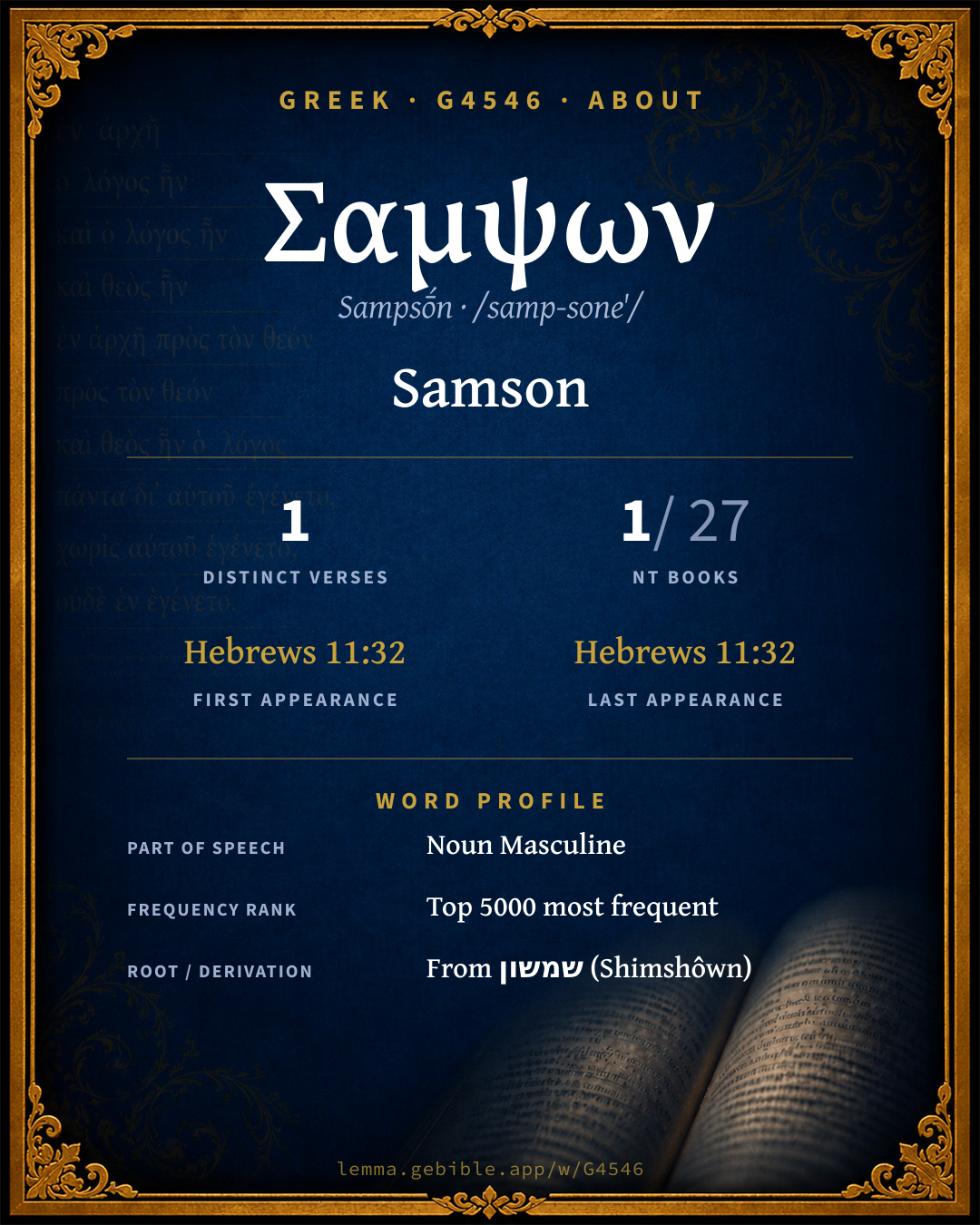
Σαμψών
Samson
Thayer's lists 2 entries for ‘Samson’ fuller range ↓
Full lexicon entry — Thayer's Greek Lexicon
From Thayer's Greek Lexicon
Where this word appears
Every verse where G4546 appears — 1 distinct verse across 1 book. Click any verse to open its interlinear word-by-word view. Verse text shown in the World English Bible for context — . Each verse’s Greek form is shown with its reference; the English is not keyword-highlighted, since the data carries no word-level English alignment. Use “Compare translations” on any verse to read it across multiple English versions. This concordance covers the Greek New Testament; Septuagint (Greek Old Testament) occurrences of this word are not indexed here.
Hebrews 1 verse
About this entry
At a glance — auto-summarized from this page’s data, not written by a person. Every figure links to its source below. This summary describes the numbers; it doesn’t interpret them.
Σαμψων — transliterated Sampsṓn — is a Greek name carrying the sense “Samson.” With only 1 verse it sits in the long tail of Greek New Testament vocabulary. Its uses cluster heavily in Hebrews (100% of all occurrences). Found nowhere else but Hebrews 11:32. See 1-verse concordance and the renderings breakdown below.
Gloss history
Strong's 1890 vs modern scholarship
About this word
Strong's G4546 catalogs a Greek word from the Greek New Testament.
These counts are not copied from any lexicon or concordance. They are computed here, from the morphology-tagged Greek New Testament. What Lemma adds →
- 1
- distinct verses
- The word appears in 1 distinct verse.
- 1 / 27
- NT books
- The word appears in 1 of 27 New Testament books.
- #3,503
- by frequency
- Top 5000 most frequent Greek words (rank 3,503 of 5,347 Greek words by occurrence).
View all 1 occurrence in the concordance →
Most concentrated in
- Hebrews 1 verse 100%
By section of the New Testament
By traditional corpus
Conventional, traditional groupings — biblical authorship is debated, so this is a traditional corpus grouping, not an authorship claim. Some books belong to more than one corpus (Luke is in both the Gospels and the Lukan corpus, and so on), so these shares overlap and need not total 100%. Each figure is a share of the word’s 1 distinct verse.
- Hebrews 1 verse · 100%
How translations render this word
Counts come from each version’s own published word-to-Strong’s tagging or interlinear alignment — an approximate guide to how each version renders this word, not a word-level alignment the data otherwise carries. Because each total is that version’s own tagged count, the per-version totals vary from one another and need not match the appearance or distinct-verse counts above. These counts may also differ from a printed concordance because Lemma counts each distinctly tagged rendering and does not collapse phrase taggings into a single head-word total. This is a fixed set of word-tagged versions (KJV, ASV, BSB, ULT) and does not change with the reading translation you choose elsewhere. Each version’s license is shown beside its name below (and on Sources).
- King James Version: Samson 1×
- American Standard Version: Samson 1×
- Berean Standard Bible: Samson 1×
- unfoldingWord Literal Text: Samson 1×
King James Version Public Domain
Renders G4546 across 1 tagged occurrence — most commonly:
American Standard Version Public Domain
Renders G4546 across 1 tagged occurrence — most commonly:
Berean Standard Bible Public Domain
Renders G4546 across 1 tagged occurrence — most commonly:
unfoldingWord Literal Text CC BY-SA 4.0
Renders G4546 across 1 tagged occurrence — most commonly:
Senses in Thayer's
The 2 senses Thayer's distinguishes for this word, in lexicon order (not ranked by frequency or importance). The full entry — with sub-senses — is in the Lexicon Entry tab.
- Samson = "like the sun"
- a famous judge of Israel renowned for his physical strength
Word origin
Derived from שמשון (Shimshôwn) (H8123) — Samson.
Of hebrew origin [ H8123 ]; Sampson (that is Shimshon ) an Israelite : - Samson.
— Strong’s Exhaustive Concordance (1890), public domain.
Bible dictionary
Public-domain dictionary articles matched to this entry by name (Samson). A biblical name can be shared by more than one person or place, so an article may treat several.
Easton's Bible Dictionary · M. G. Easton, 1897
Of the sun, the son of Manoah, born at Zorah. The narrative of his life is given in Judg. 13-16. He was a "Nazarite unto God" from his birth, the first Nazarite mentioned in Scripture (Judg. 13:3-5; comp. Num. 6:1-21). The first recorded event of his life was his marriage with a Philistine woman of Timnath (Judg. 14:1-5). Such a marriage was not forbidden by the law of Moses, as the Philistines did not form one of the seven doomed Canaanite nations (Ex. 34:11-16; Deut. 7:1-4). It was, however, an ill-assorted and unblessed marriage. His wife was soon taken from him and given "to his companion" (Judg. 14:20). For this Samson took revenge by burning the "standing corn of the Philistines" (15:1-8), who, in their turn, in revenge "burnt her and her father with fire." Her death he terribly avenged (15:7-19). During the twenty years following this he judged Israel; but we have no record of his life. Probably these twenty years may have been simultaneous with the last twenty years of Eli's life. After this we have an account of his exploits at Gaza (16:1-3), and of his infatuation for Delilah, and her treachery (16:4-20), and then of his melancholy death (16:21-31). He perished in the last terrible destruction he brought upon his enemies. "So the dead which he slew at his death were more [in social and political importance=the elite of the people] than they which he slew in his life."
"Straining all his nerves, he bowed: As with the force of winds and waters pent, When mountains tremble, those two massy pillars With horrible convulsion to and fro He tugged, he shook, till down they came, and drew The whole roof after them, with burst of thunder Upon the heads of all who sat beneath, Lords, ladies, captains, counsellors, or priests, Their choice nobility and flower." Milton's Samson Agonistes.
Smith's Bible Dictionary · William Smith, 1863
(like the sun), son of Manoah, a man of the town of Zorah in the tribe of Dan, on the border of Judah. (Joshua 15:33; 19:41) (B.C. 1161). The miraculous circumstances of his birth are recorded in Judges 13; and the three following chapters are devoted to the history of his life and exploits. Samson takes his place in Scripture, (1) as a judge--an office which he filled for twenty years, (Judges 15:20; 16:31) (2) as a Nazarite, (Judges 13:5; 16:17) and (3) as one endowed with supernatural power by the Spirit of the Lord. (Judges 13:25; 14:6,19; 15:14) As a judge his authority seems to have been limited to the district bordering upon the country of the Philistines. The divine inspiration which Samson shared with Othniel, Gideon and Jephthah assumed in him the unique form of vast personal strength, inseparably connected with the observance of his vow as a Nazarite: "his strength was in his hair." He married a Philistine woman whom he had seen at Timnath. One day, on his way to that city, he was attacked by a lion, which he killed; and again passing that way he saw a swarm of bees in the carcass of the lion, and he ate of the honey, but still he told no one. He availed himself of this circumstance, and of the custom of proposing riddles at marriage feasts, to lay a snare for the Philistines. But Samson told the riddle to his wife and she told it to the men of the city, whereupon Samson slew thirty men of the city. Returning to his own house, he found his wife married to another, and was refused permission to see her. Samson revenged himself by taking 300 foxes (or rather jackals) and tying them together two by two by the tails, with a firebrand between every pair of tails, and so he let them loose into the standing corn of the Philistines, which was ready for harvest, The Philistines took vengeance by burning Samson's wife and her father; but he fell hip upon them in return, and smote them with a great slaughter," after which he took refuge on the top of the rock of Etam, in the territory of Judah. The Philistines gathered an army to revenge themselves when the men of Judah hastened to make peace by giving up Samson, who was hound with cords, these, however, he broke like burnt flax and finding a jawbone of an ass at hand, he slew with it a thousand of the Philistines. The supernatural character of this exploit was confirmed by the miraculous bursting out of a spring of water to revive the champion as he was ready to die of thirst. This achievement raised Samson to the position of a judge, which he held for twenty years. After a time he began to fall into the temptations which addressed themselves to his strong animal nature; but he broke through every snare in which he was caught so long as he kept his Nazarite vow. While he was visiting a harlot in Gaza, the Philistines shut the gates of the city, intending to kill him in the morning; but at midnight he went out and tore away the gates, with the posts and bar and carried them to the top of a hill looking toward Hebron. Next he formed his fatal connection with Delilah, a woman who lived in the valley of Sorek. Thrice he suffered himself to be bound with green withes, with new ropes, but released himself until finally, wearied out with her importunity, he "told her all his heart," and while he was asleep she had him shaven of his seven locks of hair. His enemies put out his eyes, and led him down to Gaza, bound in brazen fetters, and made him grind in the prison. Then they held a great festival in the temple of Dagon, to celebrate their victory over Samson. They brought forth the blind champion to make sport for them, end placed him between the two chief pillars which supported the roof that surrounded the court. Samson asked the lad who guided him to let him feel the pillars, to lean upon them. Then, with a fervent prayer that God would strengthen him only this once, to be avenged on the Philistines, he bore with all his might upon the two pillars; they yielded, and the house fell upon the lords and all the people. So the dead which he slew at his death were more than they which he slew in his life." In (Hebrews 11:32) his name is enrolled among the worthies of the Jewish Church.
Hitchcock's Bible Names Dictionary · Roswell D. Hitchcock, 1869
his sun; his service; there the second time
Classic public-domain reference works; full attribution on Sources.
Septuagint usage
The same Greek word Σαμψων appears 45 times in the Greek Old Testament (Septuagint), across 41 verses in 1 book.
- 45
- LXX occurrences
- Tagged occurrences of this Greek word in the Septuagint.
- 41
- verses
- Distinct Septuagint verses containing this word.
- 1 / 39
- OT books
- The word appears in 1 of the 39 Old Testament books.
Sample Septuagint occurrences
- Judges 13:24 σαμψων
Septuagint occurrences (same lexeme)
Every verse where the same Strong’s number (G4546) appears in the Greek Septuagint. Verse text shown in the World English Bible for context; the Greek form is the matched word — the English is not keyword-highlighted.
- Judges 13:24 σαμψων The woman bore a son, and named him Samson: and the child grew, and Yahweh blessed him.
- Judges 14:1 σαμψων Samson went down to Timnah, and saw a woman in Timnah of the daughters of the Philistines.
- Judges 14:3 σαμψων Then his father and his mother said to him, Is there never a woman among the daughters of your brothers, or among all my people, that you go to take a wife of the uncircumcised Philistines? Samson said to his father, Get her for me; for she pleases me well.
- Judges 14:5 σαμψων Then went Samson down, and his father and his mother, to Timnah, and came to the vineyards of Timnah: and, behold, a young lion roared against him.
- Judges 14:7 σαμψων He went down, and talked with the woman, and she pleased Samson well.
- Judges 14:10 σαμψων His father went down to the woman: and Samson made there a feast; for so used the young men to do.
- Judges 14:12 σαμψων Samson said to them, Let me now put forth a riddle to you: if you can declare it to me within the seven days of the feast, and find it out, then I will give you thirty linen garments and thirty changes of clothing;
- Judges 14:15 σαμψων It happened on the seventh day, that they said to Samson's wife, Entice your husband, that he may declare to us the riddle, lest we burn you and your father's house with fire: have you called us to impoverish us? is it not [so]?
- Judges 14:16 σαμψων Samson's wife wept before him, and said, You do but hate me, and don't love me: you have put forth a riddle to the children of my people, and haven't told it me. He said to her, Behold, I haven't told it my father nor my mother, and shall I tell you?
- Judges 14:18 σαμψων The men of the city said to him on the seventh day before the sun went down, What is sweeter than honey? and what is stronger than a lion? He said to them, If you hadn't plowed with my heifer, You wouldn't have found out my riddle.
- Judges 14:19 σαμψων The Spirit of Yahweh came mightily on him, and he went down to Ashkelon, and struck thirty men of them, and took their spoil, and gave the changes [of clothing] to those who declared the riddle. His anger was kindled, and he went up to his father's house.
- Judges 14:20 σαμψων But Samson's wife was [given] to his companion, whom he had used as his friend.
- Judges 15:1 σαμψων But it happened after a while, in the time of wheat harvest, that Samson visited his wife with a kid; and he said, I will go in to my wife into the chamber. But her father wouldn't allow him to go in.
- Judges 15:3 σαμψων Samson said to them, This time shall I be blameless in regard of the Philistines, when I do them a mischief.
- Judges 15:4 σαμψων Samson went and caught three hundred foxes, and took firebrands, and turned tail to tail, and put a firebrand in the midst between every two tails.
- Judges 15:6 σαμψων Then the Philistines said, Who has done this? They said, Samson, the son-in-law of the Timnite, because he has taken his wife, and given her to his companion. The Philistines came up, and burnt her and her father with fire.
- Judges 15:7 σαμψων Samson said to them, If you do after this manner, surely I will be avenged of you, and after that I will cease.
- Judges 15:10 σαμψων The men of Judah said, Why are you come up against us? They said, To bind Samson are we come up, to do to him as he has done to us.
- Judges 15:11 σαμψων Then three thousand men of Judah went down to the cleft of the rock of Etam, and said to Samson, "Don't you know that the Philistines are rulers over us? What then is this that you have done to us?" He said to them, As they did to me, so have I done to them.
- Judges 15:12 σαμψων They said to him, We have come down to bind you, that we may deliver you into the hand of the Philistines. Samson said to them, Swear to me that you will not fall on me yourselves.
- Judges 15:16 σαμψων Samson said, With the jawbone of a donkey, heaps on heaps, With the jawbone of a donkey I have struck a thousand men.
- Judges 16:1 σαμψων Samson went to Gaza, and saw there a prostitute, and went in to her.
- Judges 16:2 σαμψων [It was told] the Gazites, saying, Samson is come here. They compassed him in, and laid wait for him all night in the gate of the city, and were quiet all the night, saying, [Let be] until morning light, then we will kill him.
- Judges 16:3 σαμψων Samson lay until midnight, and arose at midnight, and laid hold of the doors of the gate of the city, and the two posts, and plucked them up, bar and all, and put them on his shoulders, and carried them up to the top of the mountain that is before Hebron.
- Judges 16:6 σαμψων Delilah said to Samson, Tell me, Please, in which your great strength lies, and with which you might be bound to afflict you.
- Judges 16:7 σαμψων Samson said to her, If they bind me with seven green cords that were never dried, then shall I become weak, and be as another man.
- Judges 16:9 σαμψων Now she had liers-in-wait abiding in the inner chamber. She said to him, The Philistines are on you, Samson. He broke the cords, as a string of tow is broken when it touches the fire. So his strength was not known.
- Judges 16:10 σαμψων Delilah said to Samson, Behold, you have mocked me, and told me lies: now tell me, Please, with which you might be bound.
- Judges 16:12 σαμψων So Delilah took new ropes, and bound him therewith, and said to him, The Philistines are on you, Samson. The liers-in-wait were abiding in the inner chamber. He broke them off his arms like a thread.
- Judges 16:13 σαμψων Delilah said to Samson, Hitherto you have mocked me, and told me lies: tell me with which you might be bound. He said to her, If you weave the seven locks of my head with the web.
- Judges 16:14 σαμψων She fastened it with the pin, and said to him, The Philistines are on you, Samson. He awakened out of his sleep, and plucked away the pin of the beam, and the web.
- Judges 16:15 σαμψων She said to him, How can you say, I love you, when your heart is not with me? you have mocked me these three times, and have not told me in which your great strength lies.
- Judges 16:19 σαμψων She made him sleep on her knees; and she called for a man, and shaved off the seven locks of his head; and she began to afflict him, and his strength went from him.
- Judges 16:20 σαμψων She said, The Philistines are on you, Samson. He awoke out of his sleep, and said, I will go out as at other times, and shake myself free. But he didn't know that Yahweh had departed from him.
- Judges 16:23 σαμψων The lords of the Philistines gathered them together to offer a great sacrifice to Dagon their god, and to rejoice; for they said, Our god has delivered Samson our enemy into our hand.
- Judges 16:25 σαμψων It happened, when their hearts were merry, that they said, Call for Samson, that he may make us sport. They called for Samson out of the prison-house; and he made sport before them. They set him between the pillars:
- Judges 16:26 σαμψων and Samson said to the boy who held him by the hand, Allow me that I may feel the pillars whereupon the house rests, that I may lean on them.
- Judges 16:27 σαμψων Now the house was full of men and women; and all the lords of the Philistines were there; and there were on the roof about three thousand men and women, who saw while Samson made sport.
- Judges 16:28 σαμψων Samson called to Yahweh, and said, Lord Yahweh, remember me, Please, and strengthen me, Please, only this once, God, that I may be at once avenged of the Philistines for my two eyes.
- Judges 16:29 σαμψων Samson took hold of the two middle pillars on which the house rested, and leaned on them, the one with his right hand, and the other with his left.
- Judges 16:30 σαμψων Samson said, Let me die with the Philistines. He bowed himself with all his might; and the house fell on the lords, and on all the people who were therein. So the dead that he killed at his death were more than those who he killed in his life.
These are occurrences of the same Greek lexeme (G4546) in the Septuagint — not a translation of any one Hebrew word. The store carries no word-level Hebrew↔Greek alignment, so no Hebrew original is asserted here. Counts come from the recovered LXX Strong's tagging — high-frequency vocabulary is well covered, while rare or late forms may be untagged — so they reflect tagged occurrences and may slightly undercount.