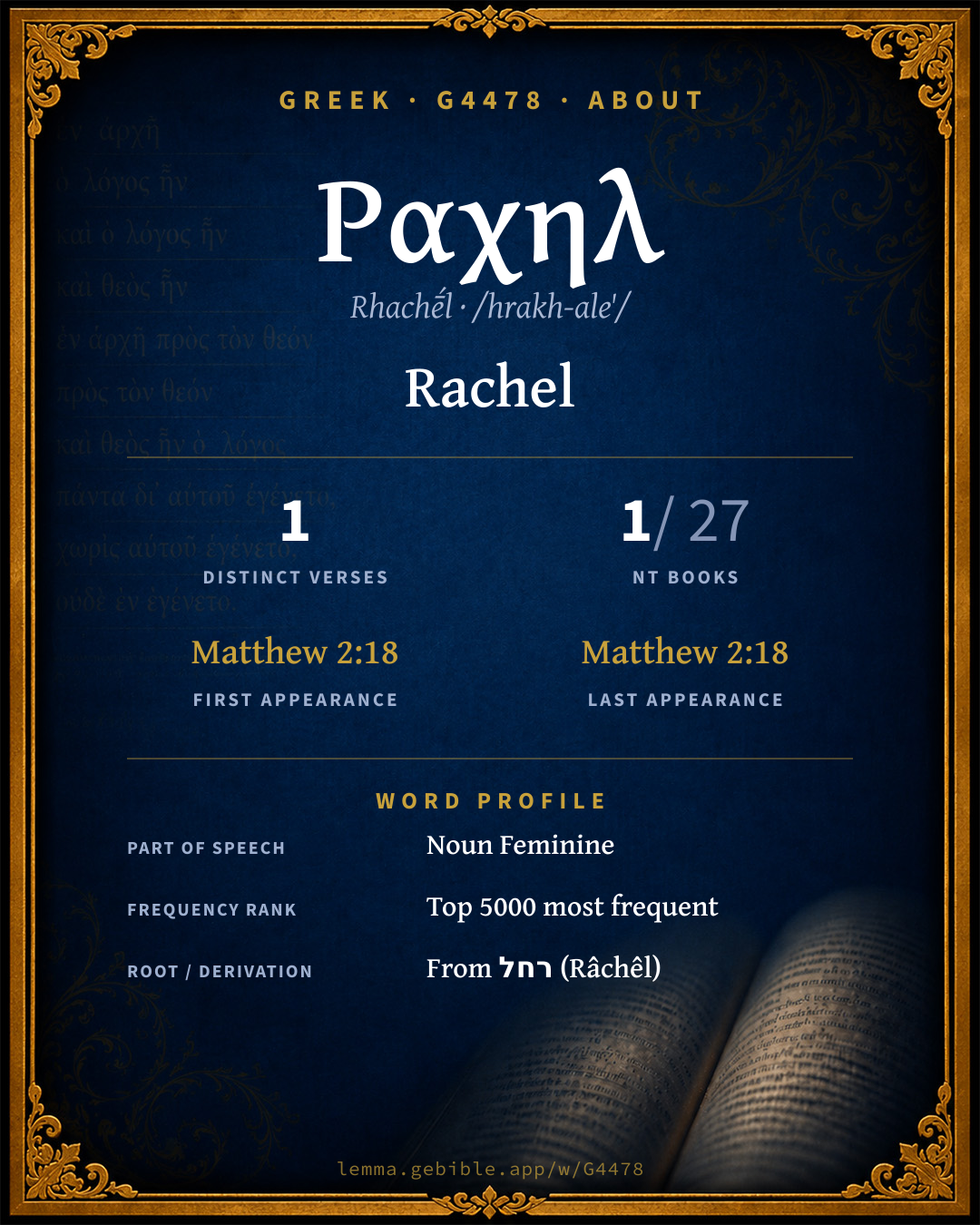
Ῥαχήλ
Rachel
Thayer's lists 2 entries for ‘Rachel’ fuller range ↓
Full lexicon entry — Thayer's Greek Lexicon
From Thayer's Greek Lexicon
Where this word appears
Every verse where G4478 appears — 1 distinct verse across 1 book. Click any verse to open its interlinear word-by-word view. Verse text shown in the World English Bible for context — . Each verse’s Greek form is shown with its reference; the English is not keyword-highlighted, since the data carries no word-level English alignment. Use “Compare translations” on any verse to read it across multiple English versions. This concordance covers the Greek New Testament; Septuagint (Greek Old Testament) occurrences of this word are not indexed here.
Matthew 1 verse
About this entry
At a glance — auto-summarized from this page’s data, not written by a person. Every figure links to its source below. This summary describes the numbers; it doesn’t interpret them.
Ραχηλ — transliterated Rhachḗl — is a Greek name carrying the sense “Rachel.” With only 1 verse it sits in the long tail of Greek New Testament vocabulary. More than three-quarters of its appearances fall in Matthew. Found nowhere else but Matthew 2:18. Each statement above links to its evidence; the full detail follows below.
Gloss history
Strong's 1890 vs modern scholarship
About this word
Strong's G4478 catalogs a Greek word from the Greek New Testament.
These counts are not copied from any lexicon or concordance. They are computed here, from the morphology-tagged Greek New Testament. What Lemma adds →
- 1
- distinct verses
- The word appears in 1 distinct verse.
- 1 / 27
- NT books
- The word appears in 1 of 27 New Testament books.
- #3,503
- by frequency
- Top 5000 most frequent Greek words (rank 3,503 of 5,347 Greek words by occurrence).
View all 1 occurrence in the concordance →
Most concentrated in
- Matthew 1 verse 100%
By section of the New Testament
By traditional corpus
Conventional, traditional groupings — biblical authorship is debated, so this is a traditional corpus grouping, not an authorship claim. Some books belong to more than one corpus (Luke is in both the Gospels and the Lukan corpus, and so on), so these shares overlap and need not total 100%. Each figure is a share of the word’s 1 distinct verse.
- Gospels 1 verse · 100%
How translations render this word
Counts come from each version’s own published word-to-Strong’s tagging or interlinear alignment — an approximate guide to how each version renders this word, not a word-level alignment the data otherwise carries. Because each total is that version’s own tagged count, the per-version totals vary from one another and need not match the appearance or distinct-verse counts above. These counts may also differ from a printed concordance because Lemma counts each distinctly tagged rendering and does not collapse phrase taggings into a single head-word total. This is a fixed set of word-tagged versions (KJV, ASV, BSB, ULT) and does not change with the reading translation you choose elsewhere. Each version’s license is shown beside its name below (and on Sources).
- King James Version: Rachel 1×
- American Standard Version: Rachel 1×
- Berean Standard Bible: Rachel 1×
- unfoldingWord Literal Text: Rachel 1×
King James Version Public Domain
Renders G4478 across 1 tagged occurrence — most commonly:
American Standard Version Public Domain
Renders G4478 across 1 tagged occurrence — most commonly:
Berean Standard Bible Public Domain
Renders G4478 across 1 tagged occurrence — most commonly:
unfoldingWord Literal Text CC BY-SA 4.0
Renders G4478 across 1 tagged occurrence — most commonly:
Senses in Thayer's
The 2 senses Thayer's distinguishes for this word, in lexicon order (not ranked by frequency or importance). The full entry — with sub-senses — is in the Lexicon Entry tab.
- Rachel = "ewe or sheep"
- the wife of Jacob
Word origin
Derived from רחל (Râchêl) (H7354) — Rachel.
Of hebrew origin [ H7354 ]; Rachel the wife of Jacob : - Rachel.
— Strong’s Exhaustive Concordance (1890), public domain.
Bible dictionary
Public-domain dictionary articles matched to this entry by name (Rachel). A biblical name can be shared by more than one person or place, so an article may treat several.
Easton's Bible Dictionary · M. G. Easton, 1897
Ewe, "the daughter", "the somewhat petulant, peevish, and self-willed though beautiful younger daughter" of Laban, and one of Jacob's wives (Gen. 29:6, 28). He served Laban fourteen years for her, so deep was Jacob's affection for her. She was the mother of Joseph (Gen. 30:22-24). Afterwards, on Jacob's departure from Mesopotamia, she took with her her father's teraphim (31:34, 35). As they journeyed on from Bethel, Rachel died in giving birth to Benjamin (35:18, 19), and was buried "in the way to Ephrath, which is Bethlehem. And Jacob set a pillar upon her grave". Her sepulchre is still regarded with great veneration by the Jews. Its traditional site is about half a mile from Jerusalem.
This name is used poetically by Jeremiah (31:15-17) to denote God's people mourning under their calamities. This passage is also quoted by Matthew as fulfilled in the lamentation at Bethlehem on account of the slaughter of the infants there at the command of Herod (Matt. 2:17, 18).
Smith's Bible Dictionary · William Smith, 1863
(ewe, or sheep), the younger of the daughters of Laban, the wife of Jacob (B.C. 1753) and mother of Joseph and Benjamin. The incidents of her life may be found in Genesis29-33, 35. The story of Jacob and Rachel has always had a peculiar interest. The beauty of Rachel, Jacob's deep love and long servitude for her, their marriage, and Rachel's death on giving birth to Benjamin, with Jacob's grief at her loss, (Genesis 48:7) makes a touching tale. Yet from what is related to us concerning her character there does not seem much to claim any high degree of admiration and esteem. She appears to have shared all the duplicity and falsehood of her family. See, for instance, Rachel's stealing her father's images, and the ready dexterity and presence of mind with which she concealed her theft. (Genesis 31:1) ... "Rachel died and was buried on the way to Ephrath, which is Bethlehem. (B.C. 1729.) And Jacob set a pillar upon her grave; that is the pillar of Rachel's grave unto this day." (Genesis 35:19,20) The site of Rachel's tomb, "on the way to Bethlehem," "a little way to come to Ephrath," "in the border of Benjamin," never been questioned. It Is about two miles south of Jerusalem and one mile north of Bethlehem.
Hitchcock's Bible Names Dictionary · Roswell D. Hitchcock, 1869
sheep
Classic public-domain reference works; full attribution on Sources.
Septuagint usage
The same Greek word Ραχηλ appears 50 times in the Greek Old Testament (Septuagint), across 47 verses in 4 books.
- 50
- LXX occurrences
- Tagged occurrences of this Greek word in the Septuagint.
- 47
- verses
- Distinct Septuagint verses containing this word.
- 4 / 39
- OT books
- The word appears in 4 of the 39 Old Testament books.
Sample Septuagint occurrences
- Genesis 29:6 ραχηλ
- Ruth 4:11 ραχηλ
- 1 Samuel 10:2 ραχηλ
- Jeremiah 38:15 ραχηλ
Septuagint occurrences (same lexeme)
Every verse where the same Strong’s number (G4478) appears in the Greek Septuagint. Verse text shown in the World English Bible for context; the Greek form is the matched word — the English is not keyword-highlighted.
- Genesis 29:6 ραχηλ He said to them, "Is it well with him?" They said, "It is well. See, Rachel, his daughter, is coming with the sheep."
- Genesis 29:9 ραχηλ While he was yet speaking with them, Rachel came with her father's sheep, for she kept them.
- Genesis 29:10 ραχηλ It happened, when Jacob saw Rachel the daughter of Laban, his mother's brother, and the sheep of Laban, his mother's brother, that Jacob went near, and rolled the stone from the well's mouth, and watered the flock of Laban his mother's brother.
- Genesis 29:11 ραχηλ Jacob kissed Rachel, and lifted up his voice, and wept.
- Genesis 29:12 ραχηλ Jacob told Rachel that he was her father's brother, and that he was Rebekah's son. She ran and told her father.
- Genesis 29:16 ραχηλ Laban had two daughters. The name of the elder was Leah, and the name of the younger was Rachel.
- Genesis 29:17 ραχηλ Leah's eyes were weak, but Rachel was beautiful and well favored.
- Genesis 29:18 ραχηλ Jacob loved Rachel. He said, "I will serve you seven years for Rachel, your younger daughter."
- Genesis 29:20 ραχηλ Jacob served seven years for Rachel. They seemed to him but a few days, for the love he had for her.
- Genesis 29:25 ραχηλ It happened in the morning that, behold, it was Leah. He said to Laban, "What is this you have done to me? Didn't I serve with you for Rachel? Why then have you deceived me?"
- Genesis 29:28 ραχηλ Jacob did so, and fulfilled her week. He gave him Rachel his daughter as wife.
- Genesis 29:29 ραχηλ Laban gave to Rachel his daughter Bilhah, his handmaid, to be her handmaid.
- Genesis 29:30 ραχηλ He went in also to Rachel, and he loved also Rachel more than Leah, and served with him yet seven other years.
- Genesis 29:31 ραχηλ Yahweh saw that Leah was hated, and he opened her womb, but Rachel was barren.
- Genesis 30:1 ραχηλ When Rachel saw that she bore Jacob no children, Rachel envied her sister. She said to Jacob, "Give me children, or else I will die."
- Genesis 30:2 ραχηλ Jacob's anger was kindled against Rachel, and he said, "Am I in God's place, who has withheld from you the fruit of the womb?"
- Genesis 30:3 ραχηλ She said, "Behold, my maid Bilhah. Go in to her, that she may bear on my knees, and I also may obtain children by her."
- Genesis 30:5 ραχηλ Bilhah conceived, and bore Jacob a son.
- Genesis 30:6 ραχηλ Rachel said, "God has judged me, and has also heard my voice, and has given me a son." Therefore called she his name Dan.
- Genesis 30:7 ραχηλ Bilhah, Rachel's handmaid, conceived again, and bore Jacob a second son.
- Genesis 30:8 ραχηλ Rachel said, "With mighty wrestlings have I wrestled with my sister, and have prevailed." She named him Naphtali.
- Genesis 30:14 ραχηλ Reuben went in the days of wheat harvest, and found mandrakes in the field, and brought them to his mother, Leah. Then Rachel said to Leah, "Please give me some of your son's mandrakes."
- Genesis 30:15 ραχηλ She said to her, "Is it a small matter that you have taken away my husband? Would you take away my son's mandrakes, also?" Rachel said, "Therefore he will lie with you tonight for your son's mandrakes."
- Genesis 30:22 ραχηλ God remembered Rachel, and God listened to her, and opened her womb.
- Genesis 30:23 ραχηλ She conceived, bore a son, and said, "God has taken away my reproach."
- Genesis 30:25 ραχηλ It happened, when Rachel had borne Joseph, that Jacob said to Laban, "Send me away, that I may go to my own place, and to my country.
- Genesis 31:4 ραχηλ Jacob sent and called Rachel and Leah to the field to his flock,
- Genesis 31:14 ραχηλ Rachel and Leah answered him, "Is there yet any portion or inheritance for us in our father's house?
- Genesis 31:19 ραχηλ Now Laban had gone to shear his sheep: and Rachel stole the teraphim that were her father's.
- Genesis 31:32 ραχηλ With whoever you find your gods, he shall not live. Before our relatives, discern what is yours with me, and take it." For Jacob didn't know that Rachel had stolen them.
- Genesis 31:33 ραχηλ Laban went into Jacob's tent, into Leah's tent, and into the tent of the two maid-servants; but he didn't find them. He went out of Leah's tent, and entered into Rachel's tent.
- Genesis 31:34 ραχηλ Now Rachel had taken the teraphim, put them in the camel's saddle, and sat on them. Laban felt about all the tent, but didn't find them.
- Genesis 33:1 ραχηλ Jacob lifted up his eyes, and looked, and, behold, Esau was coming, and with him four hundred men. He divided the children between Leah, Rachel, and to the two handmaids.
- Genesis 33:2 ραχηλ He put the handmaids and their children in front, Leah and her children after, and Rachel and Joseph at the rear.
- Genesis 33:7 ραχηλ Leah also and her children came near, and bowed themselves. After them, Joseph came near with Rachel, and they bowed themselves.
- Genesis 35:16 ραχηλ They traveled from Bethel. There was still some distance to come to Ephrath, and Rachel travailed. She had hard labor.
- Genesis 35:19 ραχηλ Rachel died, and was buried in the way to Ephrath (the same is Bethlehem).
- Genesis 35:20 ραχηλ Jacob set up a pillar on her grave. The same is the Pillar of Rachel's grave to this day.
- Genesis 35:24 ραχηλ The sons of Rachel: Joseph and Benjamin.
- Genesis 35:25 ραχηλ The sons of Bilhah (Rachel's handmaid): Dan and Naphtali.
- Genesis 46:19 ραχηλ The sons of Rachel, Jacob's wife: Joseph and Benjamin.
- Genesis 46:22 ραχηλ These are the sons of Rachel, who were born to Jacob: all the souls were fourteen.
- Genesis 46:25 ραχηλ These are the sons of Bilhah, whom Laban gave to Rachel, his daughter, and these she bore to Jacob: all the souls were seven.
- Genesis 48:7 ραχηλ As for me, when I came from Paddan, Rachel died by me in the land of Canaan in the way, when there was still some distance to come to Ephrath, and I buried her there in the way to Ephrath (the same is Bethlehem)."
- Ruth 4:11 ραχηλ All the people who were in the gate, and the elders, said, We are witnesses. Yahweh make the woman who has come into your house like Rachel and like Leah, which two built the house of Israel: and do you worthily in Ephrathah, and be famous in Bethlehem:
- 1 Samuel 10:2 ραχηλ When you are departed from me today, then you shall find two men by Rachel's tomb, in the border of Benjamin at Zelzah; and they will tell you, The donkeys which you went to seek are found; and, behold, your father has left off caring for the donkeys, and is anxious for you, saying, What shall I do for my son?
- Jeremiah 38:15 ραχηλ Then Jeremiah said to Zedekiah, If I declare it to you, will you not surely put me to death? and if I give you counsel, you will not listen to me.
These are occurrences of the same Greek lexeme (G4478) in the Septuagint — not a translation of any one Hebrew word. The store carries no word-level Hebrew↔Greek alignment, so no Hebrew original is asserted here. Counts come from the recovered LXX Strong's tagging — high-frequency vocabulary is well covered, while rare or late forms may be untagged — so they reflect tagged occurrences and may slightly undercount.