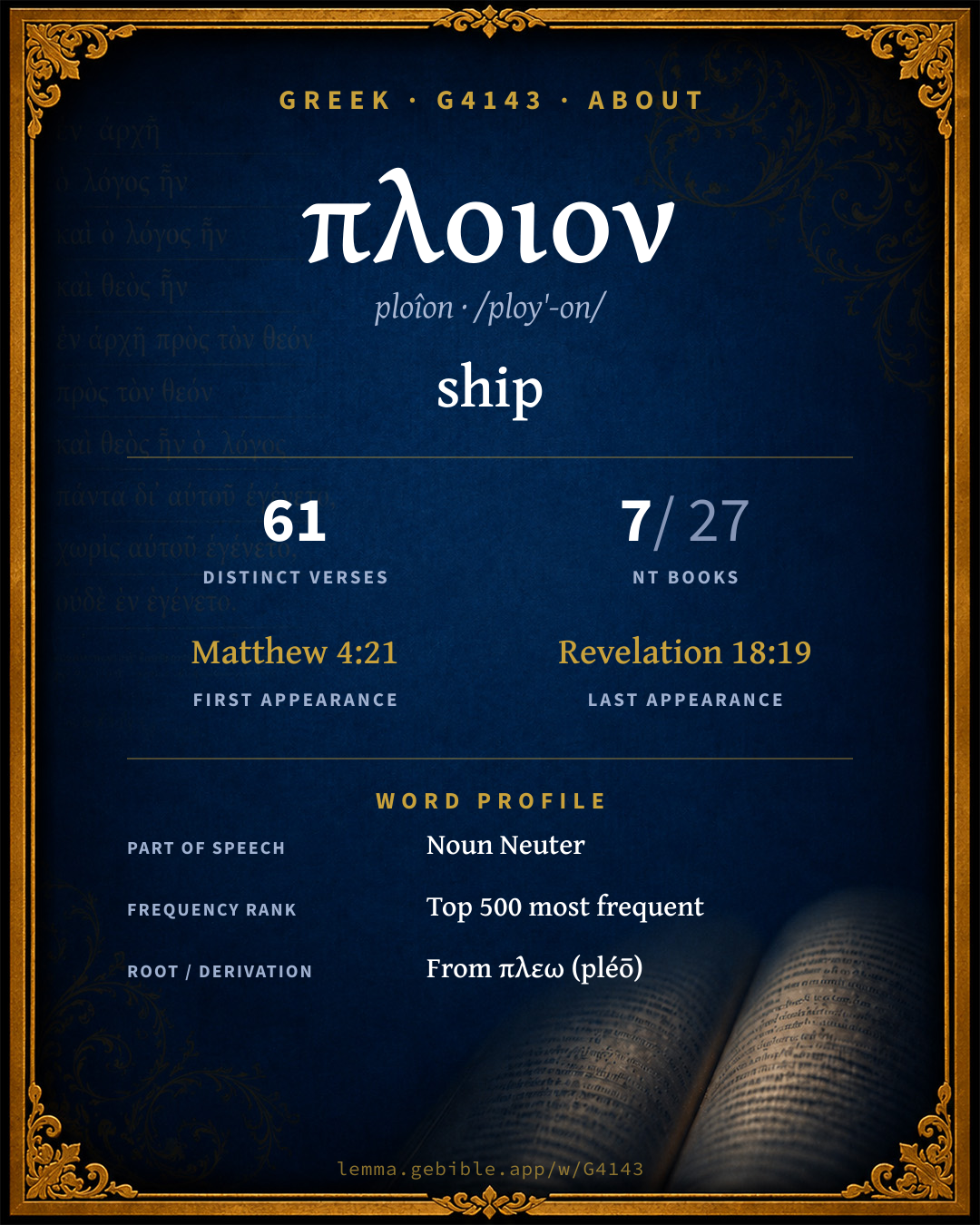
πλοῖον
ship
Full lexicon entry — Thayer's Greek Lexicon
From Thayer's Greek Lexicon
Where this word appears
See every Accusative-case word in the Greek New Testament →
Grammar key — what these labels mean
Part of speech
- Noun
- A naming word — a person, place, thing, or idea.
Case
- Accusative
- The case of the direct object and of extent.
- Dative
- The case of the indirect object, means, or location — “to / for / with / in.”
- Genitive
- The case of source, possession, or “of” — answers “whose / from what.”
- Nominative
- The case of the subject (and the predicate nominative).
Gender
- Neuter
- Grammatically neuter.
Number
- Singular
- One.
- Plural
- More than one.
Grammatical forms
- Noun, Accusative, Singular, Neuter 28 times (42%)
- Noun, Dative, Singular, Neuter 15 times (23%)
- Noun, Genitive, Singular, Neuter 11 times (17%)
- Noun, Nominative, Singular, Neuter 5 times (8%)
- Noun, Accusative, Plural, Neuter 3 times (5%)
- Noun, Genitive, Plural, Neuter 2 times (3%)
- Noun, Nominative, Plural, Neuter 2 times (3%)
Parsed forms decoded from the imported morphology (Robinson–Tischendorf, public domain), counted across 66 parsed occurrences — not distinct verses.
Every verse where G4143 appears — 61 distinct verses across 7 books. Click any verse to open its interlinear word-by-word view. Verse text shown in the World English Bible for context — . Each verse’s Greek form is shown with its reference; the English is not keyword-highlighted, since the data carries no word-level English alignment. Use “Compare translations” on any verse to read it across multiple English versions. This concordance covers the Greek New Testament; Septuagint (Greek Old Testament) occurrences of this word are not indexed here.
Matthew 13 verses
- Matthew 4:21 πλοίῳ n dat sg neut Going on from there, he saw two other brothers, James the son of Zebedee, and John his brother, in the boat with Zebedee their father, mending their nets. He called them.
- Matthew 4:22 πλοῖον n acc sg neut They immediately left the boat and their father, and followed him.
- Matthew 8:23 πλοῖον n acc sg neut When he got into a boat, his disciples followed him.
- Matthew 8:24 πλοῖον n nom sg neut Behold, a great tempest arose in the sea, so much that the boat was covered with the waves, but he was asleep.
- Matthew 9:1 πλοῖον n acc sg neut He entered into a boat, and crossed over, and came into his own city.
- Matthew 13:2 πλοῖον n acc sg neut Great multitudes gathered to him, so that he entered into a boat, and sat, and all the multitude stood on the beach.
- Matthew 14:13 πλοίῳ n dat sg neut Now when Jesus heard this, he withdrew from there in a boat, to a deserted place apart. When the multitudes heard it, they followed him on foot from the cities.
- Matthew 14:22 πλοῖον n acc sg neut Immediately Jesus made the disciples get into the boat, and to go ahead of him to the other side, while he sent the multitudes away.
- Matthew 14:24 πλοῖον n nom sg neut But the boat was now in the middle of the sea, distressed by the waves, for the wind was contrary.
- Matthew 14:29 πλοίου n gen sg neut He said, "Come!" Peter stepped down from the boat, and walked on the waters to come to Jesus.
- Matthew 14:32 πλοῖον n acc sg neut When they got up into the boat, the wind ceased.
- Matthew 14:33 πλοίῳ n dat sg neut Those who were in the boat came and worshiped him, saying, "You are truly the Son of God!"
- Matthew 15:39 πλοῖον n acc sg neut Then he sent away the multitudes, got into the boat, and came into the borders of Magdala.
Mark 15 verses
- Mark 1:19 πλοίῳ n dat sg neut Going on a little further from there, he saw James the son of Zebedee, and John, his brother, who were also in the boat mending the nets.
- Mark 1:20 πλοίῳ n dat sg neut Immediately he called them, and they left their father, Zebedee, in the boat with the hired servants, and went after him.
- Mark 4:1 πλοῖον n acc sg neut Again he began to teach by the seaside. A great multitude was gathered to him, so that he entered into a boat in the sea, and sat down. All the multitude were on the land by the sea.
- Mark 4:36 πλοίῳ πλοῖα n dat sg neut n nom pl neut Leaving the multitude, they took him with them, even as he was, in the boat. Other small boats were also with him.
- Mark 4:37 πλοῖον πλοῖον n acc sg neut n acc sg neut There arose a great wind storm, and the waves beat into the boat, so much that the boat was already filled.
- Mark 5:2 πλοίου n gen sg neut When he had come out of the boat, immediately there met him out of the tombs a man with an unclean spirit,
- Mark 5:18 πλοῖον n acc sg neut As he was entering into the boat, he who had been possessed by demons begged him that he might be with him.
- Mark 5:21 πλοίῳ n dat sg neut When Jesus had crossed back over in the boat to the other side, a great multitude was gathered to him; and he was by the sea.
- Mark 6:32 πλοίῳ n dat sg neut They went away in the boat to a desert place by themselves.
- Mark 6:45 πλοῖον n acc sg neut Immediately he made his disciples get into the boat, and to go ahead to the other side, to Bethsaida, while he himself sent the multitude away.
- Mark 6:47 πλοῖον n nom sg neut When evening had come, the boat was in the midst of the sea, and he was alone on the land.
- Mark 6:51 πλοῖον n acc sg neut He got into the boat with them; and the wind ceased, and they were very amazed among themselves, and marveled;
- Mark 6:54 πλοίου n gen sg neut When they had come out of the boat, immediately the people recognized him,
- Mark 8:10 πλοῖον n acc sg neut Immediately he entered into the boat with his disciples, and came into the region of Dalmanutha.
- Mark 8:14 πλοίῳ n dat sg neut They forgot to take bread; and they didn't have more than one loaf in the boat with them.
Luke 5 verses
- Luke 5:3 πλοίων πλοίῳ n gen pl neut n dat sg neut He entered into one of the boats, which was Simon's, and asked him to put out a little from the land. He sat down and taught the multitudes from the boat.
- Luke 5:7 πλοίῳ πλοῖα n dat sg neut n acc pl neut They beckoned to their partners in the other boat, that they should come and help them. They came, and filled both boats, so that they began to sink.
- Luke 5:11 πλοῖα n acc pl neut When they had brought their boats to land, they left everything, and followed him.
- Luke 8:22 πλοῖον n acc sg neut Now it happened on one of those days, that he entered into a boat, himself and his disciples, and he said to them, "Let's go over to the other side of the lake." So they launched out.
- Luke 8:37 πλοῖον n acc sg neut All the people of the surrounding country of the Gadarenes asked him to depart from them, for they were very much afraid. He entered into the boat, and returned.
John 6 verses
- John 6:17 πλοῖον n acc sg neut and they entered into the boat, and were going over the sea to Capernaum. It was now dark, and Jesus had not come to them.
- John 6:19 πλοίου n gen sg neut When therefore they had rowed about twenty-five or thirty stadia, they saw Jesus walking on the sea, and drawing near to the boat; and they were afraid.
- John 6:21 πλοῖον πλοῖον n acc sg neut n nom sg neut They were willing therefore to receive him into the boat. Immediately the boat was at the land where they were going.
- John 6:22 πλοῖον n acc sg neut On the next day, the multitude that stood on the other side of the sea saw that there was no other boat there, except the one in which his disciples had embarked, and that Jesus hadn't entered with his disciples into the boat, but his disciples had gone away alone.
- John 21:3 πλοῖον n acc sg neut Simon Peter said to them, "I'm going fishing." They told him, "We are also coming with you." They immediately went out, and entered into the boat. That night, they caught nothing.
- John 21:6 πλοίου n gen sg neut He said to them, "Cast the net on the right side of the boat, and you will find some." They cast it therefore, and now they weren't able to draw it in for the multitude of fish.
Acts 19 verses
- Acts 20:13 πλοῖον n acc sg neut But we who went ahead to the ship set sail for Assos, intending to take Paul aboard there, for he had so arranged, intending himself to go by land.
- Acts 20:38 πλοῖον n acc sg neut sorrowing most of all because of the word which he had spoken, that they should see his face no more. And they accompanied him to the ship.
- Acts 21:2 πλοῖον n acc sg neut Having found a ship crossing over to Phoenicia, we went aboard, and set sail.
- Acts 21:3 πλοῖον n nom sg neut When we had come in sight of Cyprus, leaving it on the left hand, we sailed to Syria, and landed at Tyre, for there the ship was to unload her cargo.
- Acts 21:6 πλοῖον n acc sg neut After saying goodbye to each other, we went on board the ship, and they returned home again.
- Acts 27:2 πλοίῳ n dat sg neut Embarking in a ship of Adramyttium, which was about to sail to places on the coast of Asia, we put to sea; Aristarchus, a Macedonian of Thessalonica, being with us.
- Acts 27:6 πλοῖον n acc sg neut There the centurion found a ship of Alexandria sailing for Italy, and he put us on board.
- Acts 27:10 πλοίου n gen sg neut and said to them, "Sirs, I perceive that the voyage will be with injury and much loss, not only of the cargo and the ship, but also of our lives."
- Acts 27:15 πλοίου n gen sg neut When the ship was caught, and couldn't face the wind, we gave way to it, and were driven along.
- Acts 27:17 πλοῖον n acc sg neut After they had hoisted it up, they used cables to help reinforce the ship. Fearing that they would run aground on the Syrtis sand bars, they lowered the sea anchor, and so were driven along.
- Acts 27:19 πλοίου n gen sg neut On the third day, they threw out the ship's tackle with their own hands.
- Acts 27:22 πλοίου n gen sg neut Now I exhort you to cheer up, for there will be no loss of life among you, but only of the ship.
- Acts 27:30 πλοίου n gen sg neut As the sailors were trying to flee out of the ship, and had lowered the boat into the sea, pretending that they would lay out anchors from the bow,
- Acts 27:31 πλοίῳ n dat sg neut Paul said to the centurion and to the soldiers, "Unless these stay in the ship, you can't be saved."
- Acts 27:37 πλοίῳ n dat sg neut In all, we were two hundred seventy-six souls on the ship.
- Acts 27:38 πλοῖον n acc sg neut When they had eaten enough, they lightened the ship, throwing out the wheat into the sea.
- Acts 27:39 πλοῖον n acc sg neut When it was day, they didn't recognize the land, but they noticed a certain bay with a beach, and they decided to try to drive the ship onto it.
- Acts 27:44 πλοίου n gen sg neut and the rest should follow, some on planks, and some on other things from the ship. So it happened that they all escaped safely to the land.
- Acts 28:11 πλοίῳ n dat sg neut After three months, we set sail in a ship of Alexandria which had wintered in the island, whose sign was "The Twin Brothers."
James 1 verse
Revelation 2 verses
- Revelation 8:9 πλοίων n gen pl neut and one third of the living creatures which were in the sea died. One third of the ships were destroyed.
- Revelation 18:19 πλοῖα n acc pl neut They cast dust on their heads, and cried, weeping and mourning, saying, 'Woe, woe, the great city, in which all who had their ships in the sea were made rich by reason of her great wealth!' For in one hour is she made desolate.
About this entry
At a glance — auto-summarized from this page’s data, not written by a person. Every figure links to its source below. This summary describes the numbers; it doesn’t interpret them.
At its core, πλοιον (ploîon) means “ship.” Older and newer Bibles part ways — “ship” in the King James Version, “boat” (Berean Standard Bible) in modern versions. See the renderings breakdown. It appears 61 verses across 7 books of the Greek New Testament, among its moderately common vocabulary. The word gravitates to Acts (31%), then Mark and Matthew. Scripture first uses it in Matthew 4:21. Each statement above links to its evidence; the full detail follows below.
Gloss history
Strong's 1890 vs modern scholarship

About this word
Strong's G4143 catalogs a Greek word from the Greek New Testament.
These counts are not copied from any lexicon or concordance. They are computed here, from the morphology-tagged Greek New Testament. What Lemma adds →
- 61
- distinct verses
- The word appears in 61 distinct verses.
- 7 / 27
- NT books
- The word appears in 7 of 27 New Testament books.
- #251
- by frequency
- Top 500 most frequent Greek words (rank 251 of 5,347 Greek words by occurrence).
View all 61 occurrences in the concordance →
By section of the New Testament
By traditional corpus
Conventional, traditional groupings — biblical authorship is debated, so this is a traditional corpus grouping, not an authorship claim. Some books belong to more than one corpus (Luke is in both the Gospels and the Lukan corpus, and so on), so these shares overlap and need not total 100%. Each figure is a share of the word’s 61 distinct verses.
- Gospels 39 verses · 64%
- Lukan (Luke–Acts) 24 verses · 39%
- Johannine 8 verses · 13%
- Revelation 2 verses · 3%
- General (Catholic) Epistles 1 verse · 2%
How translations render this word
Counts come from each version’s own published word-to-Strong’s tagging or interlinear alignment — an approximate guide to how each version renders this word, not a word-level alignment the data otherwise carries. Because each total is that version’s own tagged count, the per-version totals vary from one another and need not match the appearance or distinct-verse counts above. These counts may also differ from a printed concordance because Lemma counts each distinctly tagged rendering and does not collapse phrase taggings into a single head-word total. This is a fixed set of word-tagged versions (KJV, ASV, BSB, ULT) and does not change with the reading translation you choose elsewhere. Each version’s license is shown beside its name below (and on Sources).
- King James Version: Ship 57×, Ships 8×
- American Standard Version: Boat 40×, Ship 17×, Boats 5×
- Berean Standard Bible: Boat 39×, Ship 16×, Boats 4×
- unfoldingWord Literal Text: Boat 40×, Ship 19×, Boats 6×
King James Version Public Domain
Renders G4143 across 66 tagged occurrences — most commonly:
Plus 1 rendering that appears only once — usually multi-word phrases or single function words the recovered tagging swept in, not distinct renderings. Not rendered by a distinct English word in 1 further occurrence.
American Standard Version Public Domain
Renders G4143 across 67 tagged occurrences — most commonly:
Plus 2 renderings that appear only once — usually multi-word phrases or single function words the recovered tagging swept in, not distinct renderings.
Berean Standard Bible Public Domain
Renders G4143 across 64 tagged occurrences — most commonly:
Plus 2 renderings that appear only once — usually multi-word phrases or single function words the recovered tagging swept in, not distinct renderings. Not rendered by a distinct English word in 3 further occurrences.
unfoldingWord Literal Text CC BY-SA 4.0
Renders G4143 across 70 tagged occurrences — most commonly:
Senses in Thayer's
The 1 sense Thayer's distinguishes for this word, in lexicon order (not ranked by frequency or importance). The full entry — with sub-senses — is in the Lexicon Entry tab.
- a ship
Word origin
Derived from πλεω (pléō) (G4126) — to sail.
From G4126 ; a sailer that is vessel : - ship (-ping).
— Strong’s Exhaustive Concordance (1890), public domain.
Forms in the corpus
The 5 distinct written forms G4143 takes in the Greek New Testament, most frequent first — each parse links to that case’s occurrences in the concordance.
| Form | Parsing | Example | Uses |
|---|---|---|---|
| πλοῖον ploîon | Noun, Accusative, Singular, Neuter | Matthew 4:22 | 33 |
| πλοίῳ ploíō | Noun, Dative, Singular, Neuter | Matthew 4:21 | 15 |
| πλοίου ploíou | Noun, Genitive, Singular, Neuter | Matthew 14:29 | 11 |
| πλοῖα ploîa | Noun, Accusative, Plural, Neuter | Luke 5:7 | 5 |
| πλοίων ploíōn | Noun, Genitive, Plural, Neuter | Luke 5:3 | 2 |
Same root — word family
Other Thayer's entries built from the same root as G4143, grouped by Strong’s listed origin. These share a root / origin per the lexicon — not necessarily a shared meaning. Each links to that word’s own entry.
Derives from
Shares the same root
Derived from this word
Compare all same-root words → They share a root, not necessarily a meaning.
Septuagint usage
The same Greek word πλοιον appears 30 times in the Greek Old Testament (Septuagint), across 27 verses in 10 books.
- 30
- LXX occurrences
- Tagged occurrences of this Greek word in the Septuagint.
- 27
- verses
- Distinct Septuagint verses containing this word.
- 10 / 39
- OT books
- The word appears in 10 of the 39 Old Testament books.
Sample Septuagint occurrences
- Genesis 49:13 πλοῖον
- Deuteronomy 28:68 πλοῖον
- Judges 5:17 πλοῖον
- 2 Chronicles 8:18 πλοῖον
- Job 40:31 πλοῖον
- Psalms 47:8 πλοῖον
- Isaiah 2:16 πλοῖον
- Ezekiel 27:9 πλοῖον
- Daniel 11:40 πλοῖον
- Jonah 1:3 πλοῖον
Septuagint occurrences (same lexeme)
Every verse where the same Strong’s number (G4143) appears in the Greek Septuagint. Verse text shown in the World English Bible for context; the Greek form is the matched word — the English is not keyword-highlighted.
- Genesis 49:13 πλοῖον "Zebulun will dwell at the haven of the sea. He will be for a haven of ships. His border will be on Sidon.
- Deuteronomy 28:68 πλοῖον Yahweh will bring you into Egypt again with ships, by the way of which I said to you, You shall see it no more again: and there you shall sell yourselves to your enemies for bondservants and for bondmaids, and no man shall buy you.
- Judges 5:17 πλοῖον Gilead abode beyond the Jordan: Dan, why did he remain in ships? Asher sat still at the haven of the sea, Abode by his creeks.
- 2 Chronicles 8:18 πλοῖον Huram sent him by the hands of his servants ships, and servants who had knowledge of the sea; and they came with the servants of Solomon to Ophir, and fetched from there four hundred fifty talents of gold, and brought them to king Solomon.
- 2 Chronicles 9:21 πλοῖον For the king had ships that went to Tarshish with the servants of Huram; once every three years came the ships of Tarshish, bringing gold, and silver, ivory, and apes, and peacocks.
- 2 Chronicles 20:36 πλοῖον and he joined himself with him to make ships to go to Tarshish; and they made the ships in Ezion Geber.
- 2 Chronicles 20:37 πλοῖον Then Eliezer the son of Dodavahu of Mareshah prophesied against Jehoshaphat, saying, Because you have joined yourself with Ahaziah, Yahweh has destroyed your works. The ships were broken, so that they were not able to go to Tarshish.
- Job 40:31 πλοῖον
- Psalms 47:8 πλοῖον God reigns over the nations. God sits on his holy throne.
- Psalms 103:26 πλοῖον
- Psalms 106:23 πλοῖον Therefore he said that he would destroy them, Had Moses, his chosen, not stood before him in the breach, To turn away his wrath, so that he wouldn't destroy them.
- Isaiah 2:16 πλοῖον For all the ships of Tarshish, And for all pleasant imagery.
- Isaiah 11:14 πλοῖον They shall fly down on the shoulder of the Philistines on the west; together shall they despoil the children of the east: they shall put forth their hand on Edom and Moab; and the children of Ammon shall obey them.
- Isaiah 18:1 πλοῖον Ah, the land of the rustling of wings, which is beyond the rivers of Ethiopia;
- Isaiah 23:1 πλοῖον The burden of Tyre. Howl, you ships of Tarshish; for it is laid waste, so that there is no house, no entering in: from the land of Kittim it is revealed to them.
- Isaiah 23:10 πλοῖον Pass through your land as the Nile, daughter of Tarshish; there is no restraint any more.
- Isaiah 23:14 πλοῖον Howl, you ships of Tarshish; for your stronghold is laid waste.
- Isaiah 33:21 πλοῖον But there Yahweh will be with us in majesty, a place of broad rivers and streams, in which shall go no galley with oars, neither shall gallant ship pass thereby.
- Isaiah 43:14 πλοῖον Thus says Yahweh, your Redeemer, the Holy One of Israel: For your sake I have sent to Babylon, and I will bring down all of them as fugitives, even the Chaldeans, in the ships of their rejoicing.
- Isaiah 60:9 πλοῖον Surely the isles shall wait for me, and the ships of Tarshish first, to bring your sons from far, their silver and their gold with them, for the name of Yahweh your God, and for the Holy One of Israel, because he has glorified you.
- Ezekiel 27:9 πλοῖον The old men of Gebal and the wise men of it were in you your repairers of ship seams: all the ships of the sea with their mariners were in you to deal in your merchandise.
- Ezekiel 27:25 πλοῖον The ships of Tarshish were your caravans for your merchandise: and you were replenished, and made very glorious in the heart of the seas.
- Ezekiel 27:29 πλοῖον All who handled the oar, the mariners, [and] all the pilots of the sea, shall come down from their ships; they shall stand on the land,
- Daniel 11:40 πλοῖον At the time of the end shall the king of the south contend with him; and the king of the north shall come against him like a whirlwind, with chariots, and with horsemen, and with many ships; and he shall enter into the countries, and shall overflow and pass through.
- Jonah 1:3 πλοῖον But Jonah rose up to flee to Tarshish from the presence of Yahweh. He went down to Joppa, and found a ship going to Tarshish; so he paid its fare, and went down into it, to go with them to Tarshish from the presence of Yahweh.
- Jonah 1:4 πλοῖον But Yahweh sent out a great wind on the sea, and there was a mighty tempest on the sea, so that the ship was likely to break up.
- Jonah 1:5 πλοῖον Then the mariners were afraid, and cried every man to his god. They threw the cargo that was in the ship into the sea, to lighten it. But Jonah had gone down into the innermost parts of the ship, and he was laying down, and was fast asleep.
These are occurrences of the same Greek lexeme (G4143) in the Septuagint — not a translation of any one Hebrew word. The store carries no word-level Hebrew↔Greek alignment, so no Hebrew original is asserted here. Counts come from the recovered LXX Strong's tagging — high-frequency vocabulary is well covered, while rare or late forms may be untagged — so they reflect tagged occurrences and may slightly undercount.