2 Chronicles 20:36

Hebrew (Westminster Leningrad Codex) 2 Chronicles 20:36 appears in the Hebrew Old Testament. The text above is from the Westminster Leningrad Codex. Each word links to its Strong’s number, a concise gloss, and parsing drawn from the Open Scriptures Hebrew Bible morphology. Click any word for its full Brown-Driver-Briggs (BDB) entry.
Download image
Cite this verse

2 Chronicles 20:36 (World English Bible). Public Domain. Lemma interlinear Bible study tool, https://lemma.gebible.app/v/2-chronicles/20/36.

Show BibTeX & RIS
BibTeX
RIS
English Translation
and he joined himself with him to make ships to go to Tarshish; and they made the ships in Ezion Geber.
World English Bible · Public Domain
Download a study sheet

One document with this verse’s original text, its word-by-word gloss line, the meaning frame, cross-references with their text, attributed commentary, and full source and license credits — printable, and it pastes into notes with its structure intact.

This verse Autodidact and up

Study sheet (.html) Plain text (.txt)

A passage Seminary Student

Up to 50 verses in one chapter. A passage sheet keeps up to 6 commentary sources and 12 cross-references per verse, in the order this page ranks them, and says so on the sheet whenever that leaves anything out. Ask for a single verse and you get the Autodidact verse sheet above.

Everything on this page stays free to read, with no account — the sheet is a download of what is already on screen, not access to it.

Want to remove ads? Support Godless Engineer
Compare translations 3

The same verse in 3 English versions, stacked beneath the original-language interlinear above. Click any original word for its lexicon entry.

Each is an independent rendering of the whole verse — the interlinear is not word-aligned to these translations.

Highlighted words mark where these versions differ — a whole-verse word diff, not a word-by-word alignment.

  • World English Bible Public Domain
    and he joined himself with him to make ships to go to Tarshish; and they made the ships in Ezion Geber.
  • King James Version Public Domain
    And he joined himself with him to make ships to go to Tarshish: and they made the ships in Eziongaber.
  • unfoldingWord Literal Text CC BY-SA 4.0
    And he allied himself with him to make ships to go to Tarshish. And they made ships at Ezion Geber.

unfoldingWord Literal Text — © unfoldingWord, licensed CC BY-SA 4.0. Word-aligned USFM3 via Door43 (git.door43.org/unfoldingWord/en_ult).

Versions to compare (up to 4)

3 of 4 selected

Show all 18 translations

Every available English version of this verse, each an independent rendering of the whole verse.

  • World English Bible Public Domain
    and he joined himself with him to make ships to go to Tarshish; and they made the ships in Ezion Geber.
  • Berean Standard Bible Public Domain
    They agreed to make ships to go to Tarshish, and these were built in Ezion-geber.
  • Majority Standard Bible Public Domain
    They agreed to make ships to go to Tarshish, and these were built in Ezion-geber.
  • King James Version Public Domain
    And he joined himself with him to make ships to go to Tarshish: and they made the ships in Eziongaber.
  • American Standard Version (1901) Public Domain
    and he joined himself with him to make ships to go to Tarshish; and they made the ships in Ezion-geber.
  • Revised Version (1885) Public Domain
    and he joined himself with him to make ships to go to Tarshish: and they made the ships in Ezion-geber.
  • Geneva Bible (1599) Public Domain
    And he ioyned with him, to make ships to go to Tarshish: and they made the shippes in Ezion Gaber.
  • Douay-Rheims (1899) Public Domain
    And he was partner with him in making ships, to go to Tharsis: and they made the ships in Asiongaber.
  • Young's Literal Translation Public Domain
    and he joineth him with himself to make ships to go to Tarshish, and they make ships in Ezion-Geber,
  • Literal Standard Version CC BY-SA 4.0
    and he joins him with himself to make ships to go to Tarshish, and they make ships in Ezion-Geber,
  • Unlocked Literal Bible CC BY-SA 4.0
    He allied himself with him to build ships to go to Tarshish. They built the ships at Ezion Geber.
  • unfoldingWord Literal Text CC BY-SA 4.0
    And he allied himself with him to make ships to go to Tarshish. And they made ships at Ezion Geber.
  • Darby Bible Public Domain
    And he joined himself with him to make ships to go to Tarshish; and they made the ships in Ezion-geber.
  • World Messianic Bible Public Domain
    He joined himself with him to make ships to go to Tarshish. They made the ships in Ezion Geber.
  • Webster's Bible Public Domain
    And he joined himself with him to make ships to go to Tarshish: and they made the ships in Ezion-geber.
  • Free Bible Version CC BY-SA 4.0
    They agreed to work together and send ships to Tarshish. The ships were built in Ezion-geber.
  • Bible in Basic English Public Domain
    Together they made ships to go to Tarshish, building them in Ezion-geber.
  • JPS Tanakh (1917) Public Domain
    and he joined him with himself to make ships to go to Tarshish; and they made the ships in Ezion-geber.

Literal Standard Version (2020), Covenant Press — licensed CC BY-SA 4.0. Text via the HelloAO Bible API (eBible.org). Unlocked Literal Bible (unfoldingWord) — licensed CC BY-SA 4.0. Text via the HelloAO Bible API (eBible.org). unfoldingWord Literal Text — © unfoldingWord, licensed CC BY-SA 4.0. Word-aligned USFM3 via Door43 (git.door43.org/unfoldingWord/en_ult). Free Bible Version, Dr. Jonathan Gallagher — licensed CC BY-SA 4.0. Text via the HelloAO Bible API (eBible.org).

Word by word

More ways to search: Search by grammar → Find every occurrence → Compare this word →

Practice this passage: Drill this verse → Learn its vocabulary →

בְּעֶצְי֥וֹן
ʻEtsyôwn Geber
H6100
“in/at · Ezion-geber”
Preposition + Noun, Proper
Part of Speech
Preposition + Noun
Type
Proper
Full BDB Definition

Origin: from H6096 and H1397

TWOT: None

Ezion-geber = "backbone of a man" - the last station during the exodus of the Israelites before they came to the wilderness of Zin; located near Elath at the head of the Gulf of Akaba
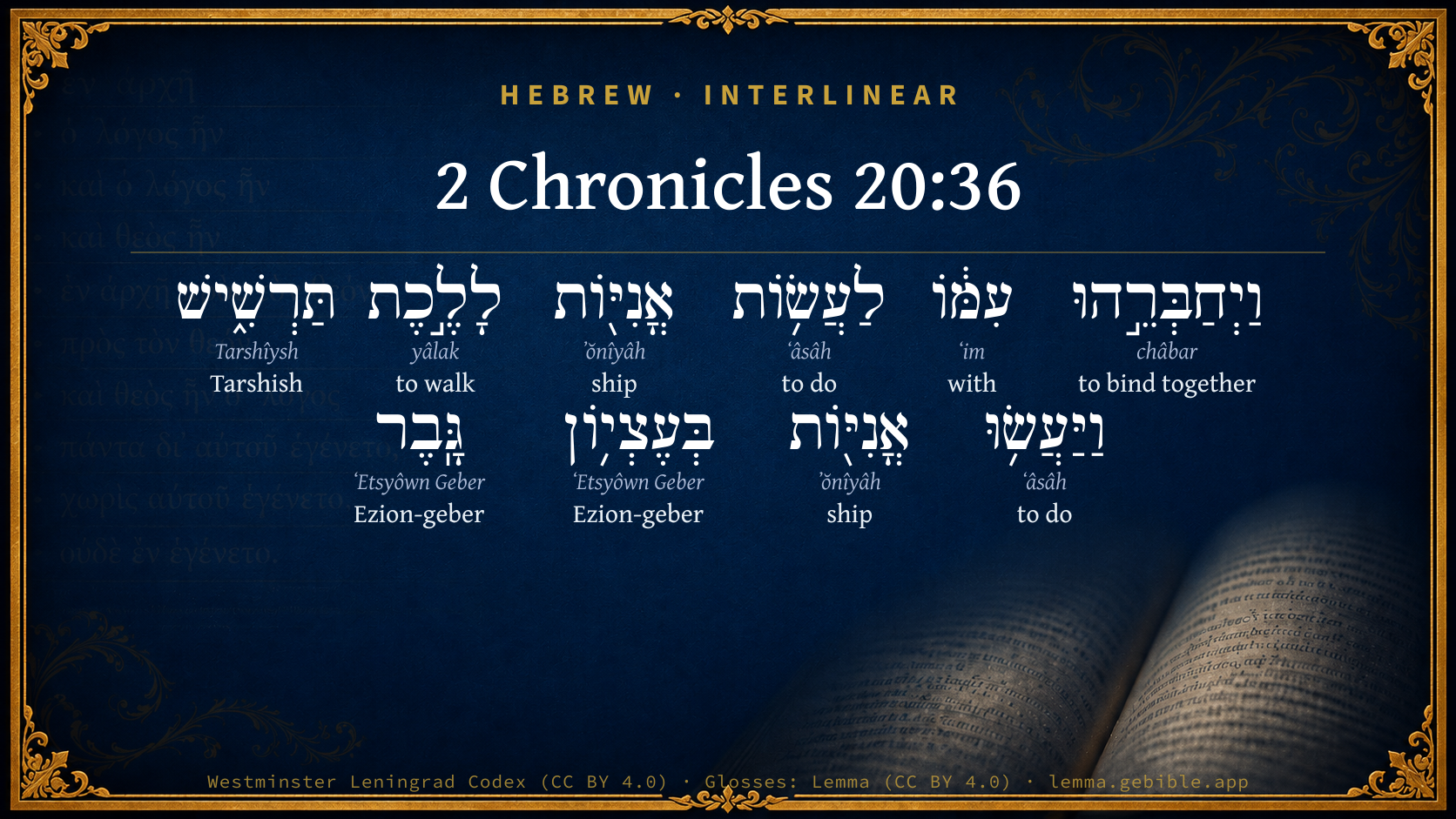
  1. וַיְחַבְּרֵ֣הוּ châbar H2266 “and · to bind together · him” Conjunction + Verb, Piel, Sequential Imperfect, 3rd Person, Masculine, Singular + Suffix, Personal, 3rd Person, Masculine, Singular
  2. עִמּ֔וֹ ʻim H5973 “with · him” Preposition + Suffix, Personal, 3rd Person, Masculine, Singular
  3. לַעֲשׂ֥וֹת ʻâsâh H6213 “to do” Preposition + Verb, Qal, Infinitive Construct
  4. אֳנִיּ֖וֹת ʼŏnîyâh H591 “ships” Noun, Common, Feminine, Plural, Absolute
  5. לָלֶ֣כֶת yâlak H3212 “to walk” Preposition + Verb, Qal, Infinitive Construct
  6. תַּרְשִׁ֑ישׁ Tarshîysh H8659 “Tarshish” Noun, Proper
  7. וַיַּעֲשׂ֥וּ ʻâsâh H6213 “and · to do” Conjunction + Verb, Qal, Sequential Imperfect, 3rd Person, Masculine, Plural
  8. אֳנִיּ֖וֹת ʼŏnîyâh H591 “ships” Noun, Common, Feminine, Plural, Absolute
  9. גָּֽבֶר ʻEtsyôwn Geber H6100 “Ezion-geber” Noun, Proper

About this verse

These counts appear in no published source. They are computed here, from the morphology-tagged text and Lemma’s own curated glosses. What Lemma adds →

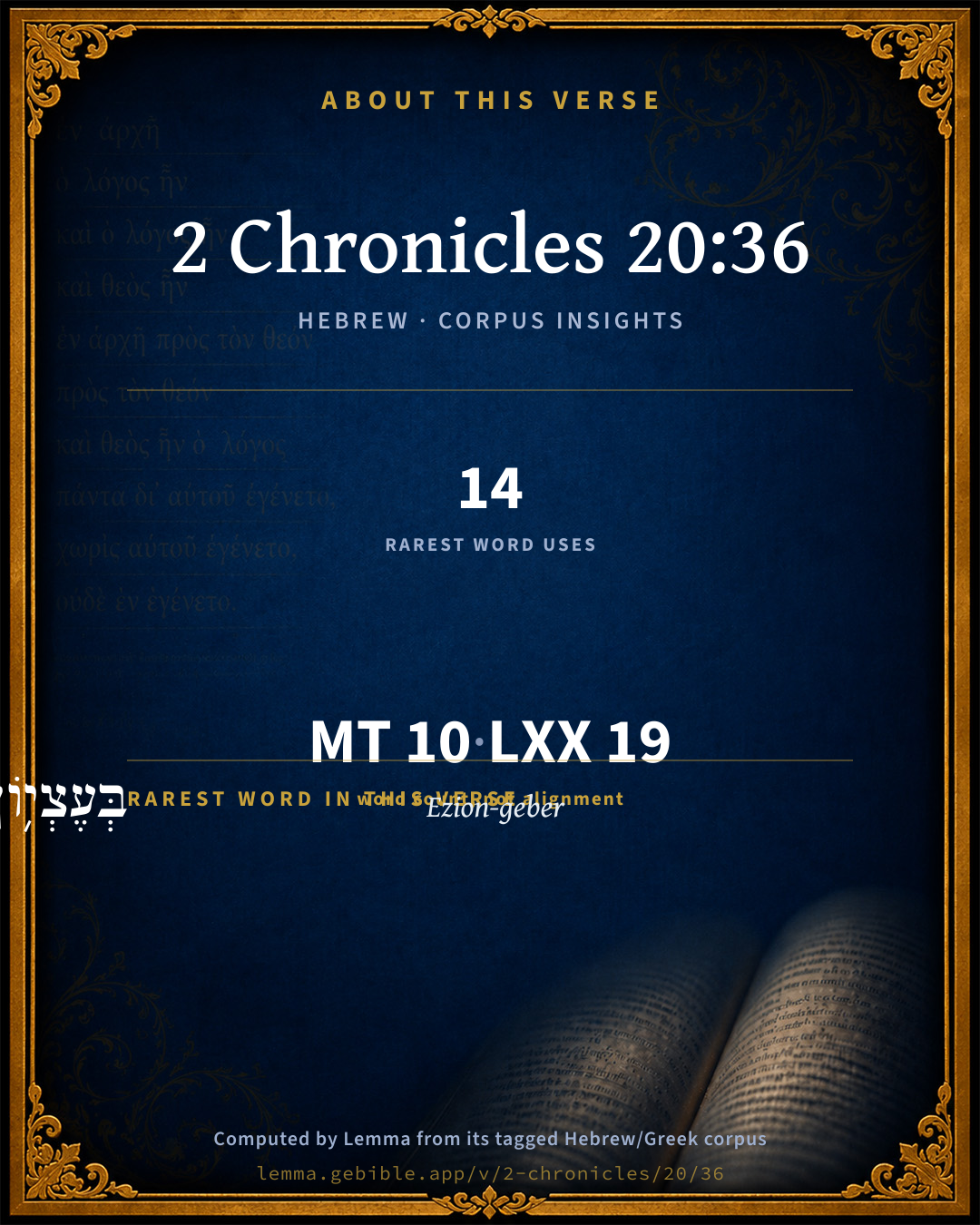
10
words
7
distinct lemmas
Historical
section

Notable vocabulary

The rarest word here is בְּעֶצְי֥וֹן Ezion-geber H6100 — appearing just 14 times in the whole Hebrew Bible.

Shared distinctive vocabulary

בְּעֶצְי֥וֹן Ezion-geber H6100 occurs in 7 verses of the Hebrew Bible. Also found in:

Grammatical profile

  • 4 verbs
  • 5 nouns
  • 1 preposition

Verb forms

  • וַיְחַבְּרֵ֣הוּ Piel · Sequential Imperfect
  • לַעֲשׂ֥וֹת Qal · Infinitive Construct
  • לָלֶ֣כֶת Qal · Infinitive Construct
  • וַיַּעֲשׂ֥וּ Qal · Sequential Imperfect

Repetition

Words recur within this verse — often emphatic in Hebrew:

  • לַעֲשׂ֥וֹת to do H6213 ×2
  • אֳנִיּ֖וֹת ship H591 ×2
  • בְּעֶצְי֥וֹן Ezion-geber H6100 ×2

Hebrew & Septuagint length

In English translation the verse runs 21 words from the Hebrew and 21 from the Septuagint (LXX English) — the same length.

A rough comparison of the two English renderings, which tokenize alike — not a word-level alignment.

Word counts can differ between the Hebrew and the Greek without any difference in meaning — e.g. the Hebrew direct-object marker אֵת has no separate Greek word, and Greek often adds the article ὁ.

In the original languages it is 10 Hebrew tokens and 19 Greek tokens — but the two are counted differently (Hebrew bundles its prefixes and suffixes into one token; the Greek is in lemma form), so that isn’t a like-for-like length.

Cross-references

3

Topical passages linked to 2 Chronicles 20:36 in the Treasury of Scripture Knowledge — connected by theme and wording, ordered by reader-vote popularity; previews shown in the World English Bible.

  • 1 Kings 9:26 King Solomon made a navy of ships in Ezion Geber, which is beside Eloth, on the shore of the Red Sea, in the land of Edom.
  • 1 Kings 10:22 For the king had at sea a navy of Tarshish with the navy of Hiram: once every three years came the navy of Tarshish, bringing gold, and silver, ivory, and apes, and peacocks.
  • 2 Chronicles 9:21 For the king had ships that went to Tarshish with the servants of Huram; once every three years came the ships of Tarshish, bringing gold, and silver, ivory, and apes, and peacocks.

Cross-references courtesy of OpenBible.info (CC BY 4.0).

Hebrew and Greek witnesses Masoretic Hebrew ↔ Greek Septuagint

The same verse in the two great witnesses to the Old Testament, shown verse-for-verse.

These are two independent witnesses, not word-aligned to each other, and the Septuagint is shown in lemma (dictionary) form.

Hebrew 2 Chronicles 20:36 Masoretic · Westminster Leningrad Codex

וַיְחַבְּרֵ֣הוּ עִמּ֔וֹ לַעֲשׂ֥וֹת אֳנִיּ֖וֹת לָלֶ֣כֶת תַּרְשִׁ֑ישׁ וַיַּעֲשׂ֥וּ אֳנִיּ֖וֹת בְּעֶצְי֥וֹן גָּֽבֶר

and he joined himself with him to make ships to go to Tarshish; and they made the ships in Ezion Geber.

World English Bible · Public Domain

Greek LXX 2 Chronicles 20:36 Septuagint · lemma form

ἐν ὁ ποιέω καί πορεύομαι πρός αὐτός ὁ ποιέω πλοῖον ὁ πορεύομαι εἰς θαρσις καί ποιέω πλοῖον ἐν γασιωνγαβερ

by acting with and going to him, to build ships to go to Tharsis: and he built ships in Gasion Gaber.

LXX2012 (modern English Septuagint) · Public Domain

Hebrew: Westminster Leningrad Codex (CC BY 4.0). Greek: Septuagint (public domain); English from LXX2012 (modern English Septuagint) (Public Domain). How the Septuagint differs from the Hebrew →

Commentary

Notes on 2 Chronicles 20:36 from classic Christian and Jewish commentators (each source and its license shown beneath its notes). The classic Christian expositions comment on the surrounding passage and are grouped to its opening verse, so a note may address several verses; the Jewish commentaries on the Tanakh (Rashi and others) are per-verse, so they appear only where the commentator wrote on this verse.

Lemma curates 59 commentaries, every one of them public domain or Creative Commons licensed, each selected and text-cleaned for this edition rather than reprinted as found. About our sources →

Trapp's Complete Commentary

John Trapp

2Ch 20:36 And he joined himself with him to make ships to go to Tarshish: and they made the ships in Eziongeber.

Ver. 36. And he joined himself.] See 1Ki 22:48-49.

John Trapp, A Commentary or Exposition upon All the Books of the Old and New Testament (1647–1656) — public domain. Text from a community e-Sword module.

Adam Clarke's Commentary

Verse 36. To go to Tarshish] "In the great sea." - Targum. By which expression they always meant the Mediterranean Sea.

Adam Clarke's Commentary on the Bible (1810–1826) — public domain. Text from a community e-Sword/MySword module.

Ellicott's Commentary for English Readers

(36) And he joined himself with him.—Literally, and he joined him with himself, an expression only occurring here.

To make ships to go to Tarshish.—In 1Ki_22:48-49, we read: “Jehoshaphat made ships (i.e., a fleet) of Tarshish, to go to Ophir for gold; and it went not; for the ships were broken (i.e., wrecked) in Ezion-geber. Then said Ahaziah the son of Ahab unto Jehoshaphat, Let my servants go with thy servants in the ships; and Jehoshaphat consented not.” There is no mention of a previous alliance and partnership in the ship-building with Ahaziah. Moreover, the expression of our text, “ships to go to Tarshish,” appears to be an erroneous paraphrase of “ships of Tarshish,” or “Tarshish-men,” as we might say; a phrase which really means, vessels built for long sea-voyages. According to Kings, the ships were built “to go to Ophir for gold;” in other words, to renew Solomon’s traffic with India from the port on the Red Sea.

And they made the ships in Ezion-gaber.—The Edomite port at the head of the Gulf of Akaba. If Tarshish means the Phoenician Tartessus in Spain, the fleet could only go thither by doubling the Cape, or crossing the Isthmus of Suez. Therefore some have supposed another Tarshish somewhere in the Persian Gulf or on the north-west coast of India. (See on 2Ch_9:21.)

A Bible Commentary for English Readers, edited by Charles John Ellicott (1878–1897) — public domain. Text from a community e-Sword module.

The Cambridge Bible for Schools and Colleges

gen. ed. J. J. S. Perowne

36. ships to go to Tarshish] In Kings, ships of Tarshish to go to Ophir: cp. 2Ch_9:21 (= 1Ki_10:22), note. In both passages the reading of Kings, “ships (or ‘navy’) of Tarshish,” i.e. large sea-going ships (cp. Psa_48:7) is to be preferred, because (1) Ezion-geber was a port for vessels sailing eastward, while Tarshish was in the west, (2) gold, the object of the voyage (cp. 1Ki_22:48), came from Ophir (2Ch_8:18; 1Ki_9:28; 1Ki_10:11; Psa_45:9).

Tarshish] Cp. 1Ch_1:7 (note).

Ezion-geber] Cp. 2Ch_8:17 (note).

The Cambridge Bible for Schools and Colleges (gen. ed. J. J. S. Perowne; Cambridge University Press, 1878–1918) — public domain. Text from a community e-Sword module.

John Gill's Exposition

Then Eliezer the son of Dodavah of Mareshah,.... A city in the tribe of Judah, Jos 15:44.

prophesied against Jehoshaphat, saying, because thou hast joined thyself with Ahaziah; an idolatrous prince, with whom he ought to have had no fellowship, even in civil things, it being both a countenancing him, and exposing himself and people to danger:

the Lord hath broken thy works; the ships built at the joint expense of the two kings, that is, the Lord had determined to break them, and now foretold that he would; the Targum is,"the Word of the Lord hath destroyed thy works:"

and the ships were broken, that they were not able to go to Tarshish; see Gill on Kg1 22:48.

Next: 2 Chronicles Chapter 21

John Gill's Exposition of the Whole Bible (1746–1763) — public domain (CC PDM 1.0). Text via the HelloAO Bible API.

Haydock's Catholic Bible Commentary

Tharsis; probably Cilicia, (C.) or some part of the ocean. --- Asion-gaber was on the Red Sea; and ships would not have been built there, to trade on the Mediterranean, C. ix. 21. T.

George Leo Haydock (1774–1849), Haydock's Catholic Family Bible and Commentary, 1859 edition — public domain. Excludes Psalms (Douay-Rheims chapter numbering differs from Protestant) and Deuterocanonical books (Catholic canon only).

Matthew Poole's English Annotations

To make ships to go to Tarshish; of which See Poole "1Ki 10:22 22:48".

They made the ships in Ezion-gaber; of which see on 1Ki 9:26.

Matthew Poole's English Annotations on the Holy Bible (1683–1685) — public domain. Text from a community e-Sword/MySword module.

The Pulpit Commentary

This verse tells us the object with which Jehoshaphat had joined himself with Ahaziah, and 1Ki_22:49 tells us how at last, by a point-blank refusal to Ahaziah, he withdrew from the very brief commercial alliance after he had not merely been witnessed against by the Prophet Eliezer spoken of in our next verse, but more decisively witnessed against by the shattering of his ships. To go to Tarshish. This clause, even if the text is not corrupt, yet cannot mean what it seems to say; but in the word "to go" (Hebrew, tkll) must mean, of the sort that were wont to go to Tarshish, i.e. that were used for the Tarshish trade. We are guided to some such explanation by 1Ki_22:48, where it is said the ships were "ships of Tarshish to go to Ophir" (1Ki_10:22; 2Ch_8:18) That the ships could not be to go to Tarshish is plain from the fact of the place, Ezion-geber (2Ch_8:17, 2Ch_8:18; 1Ki_9:26) on the Red Sea, where they were built. Some, however, have suggested that some other Tarshish (e.g. in the Gulf of Persia) than that of Spain (Tartessus) may conceivably be meant. The clear statement of the parallel saves the necessity of any such supposition, however.

The Pulpit Commentary (1880–1919), ed. H.D.M. Spence-Jones & Joseph S. Exell — public domain. Text from a community e-Sword module.

Lesson kit

Teaching starters — assembled from the data on this page, not authored interpretation. Every prompt links to the verse data it draws on. Edit before teaching.

2 Chronicles, in the Historical, opens this verse with 10 words (7 distinct Hebrew lemmas). Its most distinctive word is ʻEtsyôwn Geber (“Ezion-geber”). A historical commentator’s framing appears above. Read the whole chapter for the surrounding context.

Discussion questions

  1. The word ʻEtsyôwn Geber carries the sense “Ezion-geber.” How does it shape the verse?
  2. How does Numbers 33:35, which shares the word «Ezion-geber», read alongside this verse?
  3. What does the repetition of “to do” (2× in this one verse) do in this verse?
  4. These translations render this verse differently. What is at stake in choosing one wording over another?
  5. «וַיְחַבְּרֵ֣הוּ» is a Piel Sequential Imperfect verb. How does that grammatical form shape the action described?
  6. Compare how Trapp's Complete Commentary and Adam Clarke's Commentary read this verse. Where do they agree or differ?

Things to notice

Reading settings

Reading text

Shown beneath each verse's original-language words.

Old Testament
Old Testament edition

Read the OT as the Masoretic Hebrew (MT) or the Greek Septuagint (LXX).

English shown for the Greek Septuagint (in the Hebrew ↔ Greek comparison).

Comparing translations? Open the Compare panel on any verse page to stack up to four side by side.