
Isaiah 2:16

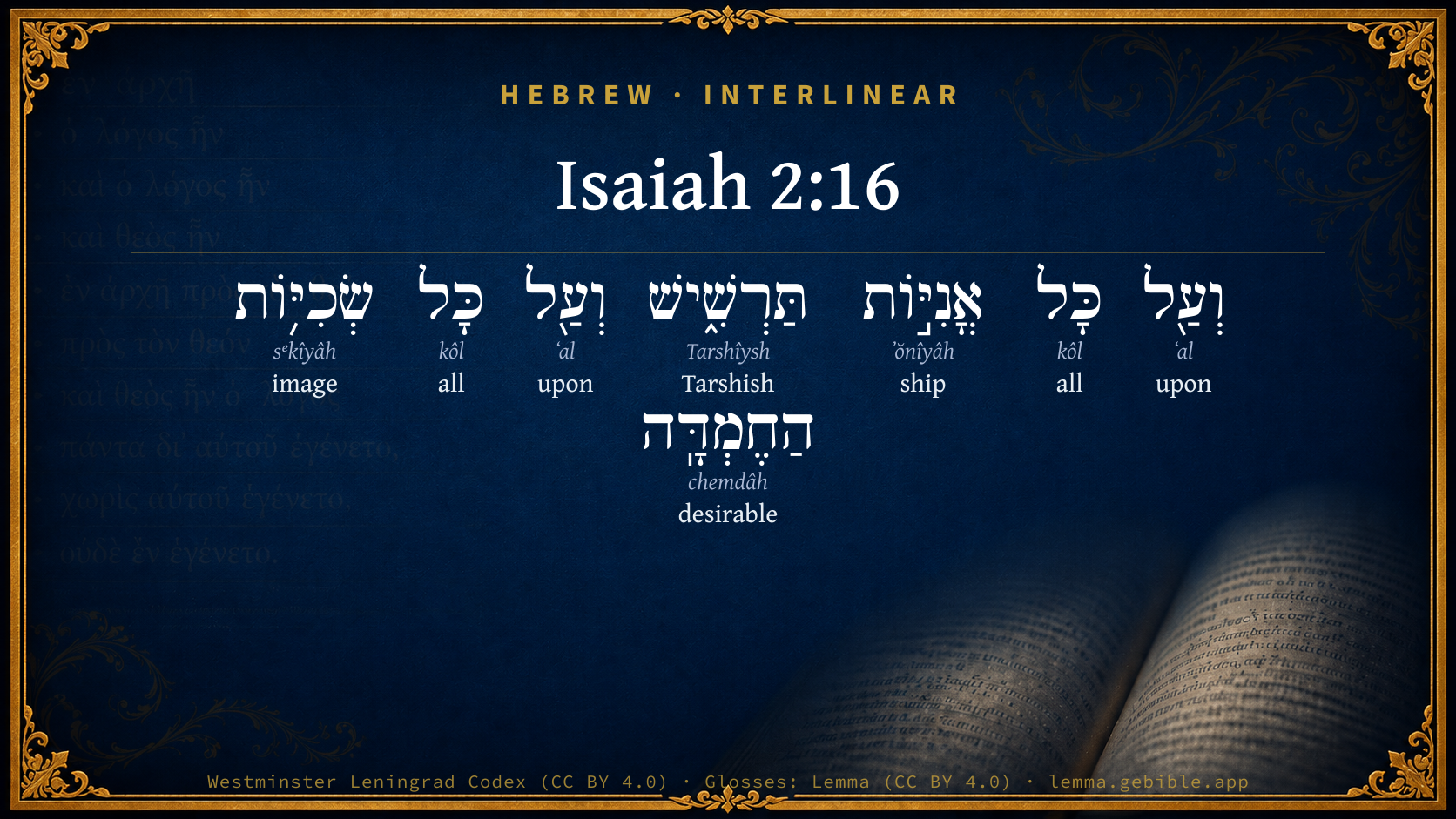
Hebrew (Westminster Leningrad Codex) Isaiah 2:16 appears in the Hebrew Old Testament. The text above is from the Westminster Leningrad Codex. Each word links to its Strong’s number, a concise gloss, and parsing drawn from the Open Scriptures Hebrew Bible morphology. Click any word for its full Brown-Driver-Briggs (BDB) entry.
Download image
Cite this verse

Isaiah 2:16 (World English Bible). Public Domain. Lemma interlinear Bible study tool, https://lemma.gebible.app/v/isaiah/2/16.

Show BibTeX & RIS
BibTeX
RIS
English Translation
For all the ships of Tarshish, And for all pleasant imagery.
World English Bible · Public Domain
Highlights
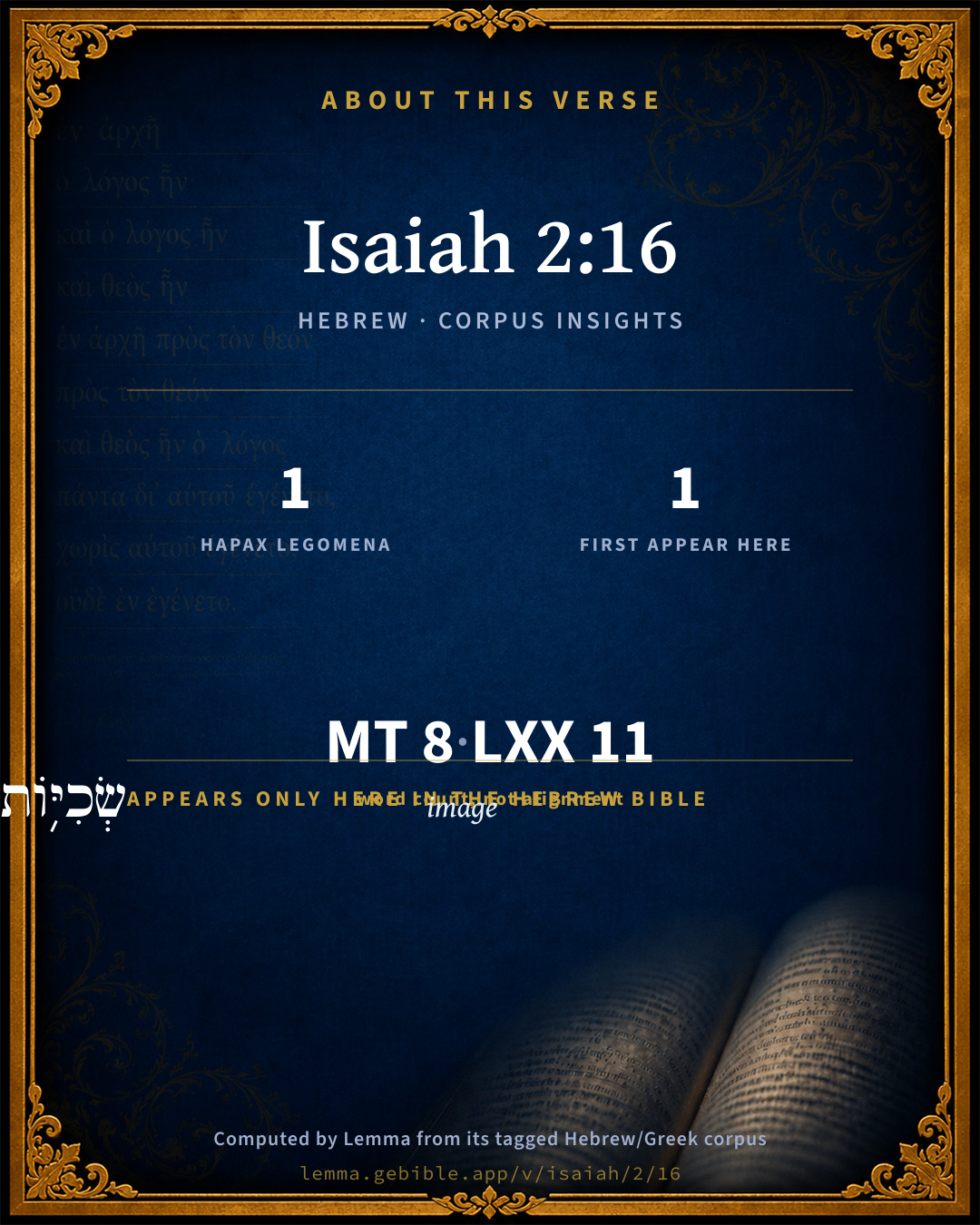
  • 1 hapax legomenon — only here in the Hebrew Bible
  • 1 first appearance in the Hebrew Bible
Full analysis ↓
Download a study sheet

One document with this verse’s original text, its word-by-word gloss line, the meaning frame, cross-references with their text, attributed commentary, and full source and license credits — printable, and it pastes into notes with its structure intact.

This verse Autodidact and up

Study sheet (.html) Plain text (.txt)

A passage Seminary Student

Up to 50 verses in one chapter. A passage sheet keeps up to 6 commentary sources and 12 cross-references per verse, in the order this page ranks them, and says so on the sheet whenever that leaves anything out. Ask for a single verse and you get the Autodidact verse sheet above.

Everything on this page stays free to read, with no account — the sheet is a download of what is already on screen, not access to it.

Want to remove ads? Support Godless Engineer
Compare translations 3

The same verse in 3 English versions, stacked beneath the original-language interlinear above. Click any original word for its lexicon entry.

Each is an independent rendering of the whole verse — the interlinear is not word-aligned to these translations.

Highlighted words mark where these versions differ — a whole-verse word diff, not a word-by-word alignment.

  • World English Bible Public Domain
    For all the ships of Tarshish, And for all pleasant imagery.
  • King James Version Public Domain
    And upon all the ships of Tarshish, and upon all pleasant pictures.
  • unfoldingWord Literal Text CC BY-SA 4.0
    and against all of the ships of Tarshish, and against all of the boats of delight.

unfoldingWord Literal Text — © unfoldingWord, licensed CC BY-SA 4.0. Word-aligned USFM3 via Door43 (git.door43.org/unfoldingWord/en_ult).

Versions to compare (up to 4)

3 of 4 selected

Show all 18 translations

Every available English version of this verse, each an independent rendering of the whole verse.

  • World English Bible Public Domain
    For all the ships of Tarshish, And for all pleasant imagery.
  • Berean Standard Bible Public Domain
    against every ship of Tarshish, and against every stately vessel.
  • Majority Standard Bible Public Domain
    against every ship of Tarshish, and against every stately vessel.
  • King James Version Public Domain
    And upon all the ships of Tarshish, and upon all pleasant pictures.
  • American Standard Version (1901) Public Domain
    and upon all the ships of Tarshish, and upon all pleasant imagery.
  • Revised Version (1885) Public Domain
    and upon all the ships of Tarshish; and upon all pleasant imagery.
  • Geneva Bible (1599) Public Domain
    And vpon all the shippes of Tarshish, and vpon all pleasant pictures.
  • Douay-Rheims (1899) Public Domain
    And upon all the ships of Tharsis, and upon all that is fair to behold.
  • Young's Literal Translation Public Domain
    And for all ships of Tarshish, And for all desirable pictures.
  • Literal Standard Version CC BY-SA 4.0
    And for all ships of Tarshish, || And for all desirable pictures.
  • Unlocked Literal Bible CC BY-SA 4.0
    and against all the ships of Tarshish, and against all beautiful sailing vessels.
  • unfoldingWord Literal Text CC BY-SA 4.0
    and against all of the ships of Tarshish, and against all of the boats of delight.
  • Darby Bible Public Domain
    and upon all the ships of Tarshish, and upon all pleasant works of art.
  • World Messianic Bible Public Domain
    for all the ships of Tarshish, and for all pleasant imagery.
  • Webster's Bible Public Domain
    And upon all the ships of Tarshish, and upon all pleasant pictures.
  • Free Bible Version CC BY-SA 4.0
    He will wipe out all the commercial ships of Tarshish as well as the pleasure vessels.
  • Bible in Basic English Public Domain
    And on all the ships of Tarshish, and on all the fair boats.
  • JPS Tanakh (1917) Public Domain
    And upon all the ships of Tarshish, and upon all delightful imagery.

Literal Standard Version (2020), Covenant Press — licensed CC BY-SA 4.0. Text via the HelloAO Bible API (eBible.org). Unlocked Literal Bible (unfoldingWord) — licensed CC BY-SA 4.0. Text via the HelloAO Bible API (eBible.org). unfoldingWord Literal Text — © unfoldingWord, licensed CC BY-SA 4.0. Word-aligned USFM3 via Door43 (git.door43.org/unfoldingWord/en_ult). Free Bible Version, Dr. Jonathan Gallagher — licensed CC BY-SA 4.0. Text via the HelloAO Bible API (eBible.org).

Word by word

More ways to search: Search by grammar → Find every occurrence → Compare this word →

Practice this passage: Drill this verse → Learn its vocabulary →

About this verse

These counts appear in no published source. They are computed here, from the morphology-tagged text and Lemma’s own curated glosses. What Lemma adds →

8
words
6
distinct lemmas
Prophets
section

Notable vocabulary

1 hapax legomenon — a word that appears only here in the entire Hebrew Bible:

  • שְׂכִיּ֥וֹת image H7914

First appearance in Scripture

This word makes its first canonical appearance in the Hebrew Bible here:

  • שְׂכִיּ֥וֹת image H7914

Shared distinctive vocabulary

הַחֶמְדָּֽה desirable H2532 occurs in 18 verses of the Hebrew Bible. Also found in:

Grammatical profile

  • 6 nouns
  • 2 prepositions

Repetition

Words recur within this verse — often emphatic in Hebrew:

  • וְעַ֖ל upon H5921 ×2
  • כָּל all H3605 ×2

Hebrew & Septuagint length

In English translation the verse runs 11 words from the Hebrew and 14 from the Septuagint (LXX English) — closely comparable.

A rough comparison of the two English renderings, which tokenize alike — not a word-level alignment.

Word counts can differ between the Hebrew and the Greek without any difference in meaning — e.g. the Hebrew direct-object marker אֵת has no separate Greek word, and Greek often adds the article ὁ.

In the original languages it is 8 Hebrew tokens and 11 Greek tokens — but the two are counted differently (Hebrew bundles its prefixes and suffixes into one token; the Greek is in lemma form), so that isn’t a like-for-like length.

Cross-references

8

Topical passages linked to Isaiah 2:16 in the Treasury of Scripture Knowledge — connected by theme and wording, ordered by reader-vote popularity; previews shown in the World English Bible.

  • 1 Kings 10:22 For the king had at sea a navy of Tarshish with the navy of Hiram: once every three years came the navy of Tarshish, bringing gold, and silver, ivory, and apes, and peacocks.
  • Isaiah 23:1 The burden of Tyre. Howl, you ships of Tarshish; for it is laid waste, so that there is no house, no entering in: from the land of Kittim it is revealed to them.
  • Numbers 33:52 then you shall drive out all the inhabitants of the land from before you, and destroy all their figured [stones], and destroy all their molten images, and demolish all their high places:
  • 1 Kings 22:48–49 Jehoshaphat made ships of Tarshish to go to Ophir for gold: but they didn't go; for the ships were broken at Ezion Geber.
  • Psalms 47:7 For God is the King of all the earth. Sing praises with understanding.
  • Isaiah 60:9 Surely the isles shall wait for me, and the ships of Tarshish first, to bring your sons from far, their silver and their gold with them, for the name of Yahweh your God, and for the Holy One of Israel, because he has glorified you.
  • Revelation 18:11 The merchants of the earth weep and mourn over her, for no one buys their merchandise any more;
  • Revelation 18:17–19 For in an hour such great riches are made desolate.' Every shipmaster, and everyone who sails anywhere, and mariners, and as many as gain their living by sea, stood far away,

Cross-references courtesy of OpenBible.info (CC BY 4.0).

Hebrew and Greek witnesses Masoretic Hebrew ↔ Greek Septuagint

The same verse in the two great witnesses to the Old Testament, shown verse-for-verse.

These are two independent witnesses, not word-aligned to each other, and the Septuagint is shown in lemma (dictionary) form.

Hebrew Isaiah 2:16 Masoretic · Westminster Leningrad Codex

וְעַ֖ל כָּל אֳנִיּ֣וֹת תַּרְשִׁ֑ישׁ וְעַ֖ל כָּל שְׂכִיּ֥וֹת הַחֶמְדָּֽה

For all the ships of Tarshish, And for all pleasant imagery.

World English Bible · Public Domain

Greek LXX Isaiah 2:16 Septuagint · lemma form

καί ἐπί πᾶς πλοῖον θάλασσα καί ἐπί πᾶς θεά πλοῖον κάλλος

and upon every ship of the sea, and upon every display of fine ships.

LXX2012 (modern English Septuagint) · Public Domain

On this verse, Albert Barnes' Notes on the Bible discusses the Septuagint’s reading. Read the note in Commentary ↓

Hebrew: Westminster Leningrad Codex (CC BY 4.0). Greek: Septuagint (public domain); English from LXX2012 (modern English Septuagint) (Public Domain). How the Septuagint differs from the Hebrew →

Targum (Aramaic paraphrase)

1

The Targum is the ancient Jewish Aramaic paraphrase of the Hebrew Scriptures — an interpretive translation, not the Hebrew text itself. Onkelos (literal) and Pseudo-Jonathan (expansive) render the Torah, and Jonathan the Prophets. Coverage is partial: where no permissively-licensed English translation exists for a verse, only the Aramaic is shown. This is verse-level text, not a word-by-word alignment to the Hebrew.

  1. Targum Jonathan Prophets (Joshua–Malachi)
    וְעַל כָּל דְיָתְבִין בְּנִיסֵי יַמָא וְעַל כָּל דְשָׁרָן בְּבִירַנְיָתָא שַׁפִּירָן:

    And upon all that dwell in the islands of the sea; and upon all that dwell in beautiful palaces.

    Targum Jonathan — Aramaic: “Mikraot Gedolot” (public domain). English: “Sefaria Community Translation” (CC0 1.0 (public-domain dedication)); “London "Chaldee Paraphrase," 1871” (public domain). Text via Sefaria.

Commentary

Notes on Isaiah 2:16 from classic Christian and Jewish commentators (each source and its license shown beneath its notes). The classic Christian expositions comment on the surrounding passage and are grouped to its opening verse, so a note may address several verses; the Jewish commentaries on the Tanakh (Rashi and others) are per-verse, so they appear only where the commentator wrote on this verse.

Lemma curates 59 commentaries, every one of them public domain or Creative Commons licensed, each selected and text-cleaned for this edition rather than reprinted as found. About our sources →

Trapp's Complete Commentary

John Trapp

Isa 2:16 And upon all the ships of Tarshish, and upon all pleasant pictures.

Ver. 16. And upon all the ships of Tarshish.] Or, Of the Mediterranean Sea, the ships whereof were of great bulk and burden, and perhaps were garnished and inlaid with curious pictures, called here pictures of desire:

“ Pictasque innare carinas. ” - Virg.

John Trapp, A Commentary or Exposition upon All the Books of the Old and New Testament (1647–1656) — public domain. Text from a community e-Sword module.

The Biblical Illustrator

Joseph S. Exell

Isa_2:16

Pleasant pictures

The proper use of art

Sir Joshua Reynolds wisely, stated the canon for artists when, referring to the choice of subjects, he said.

No subject can be proper that is not generally interesting. It ought to be either some eminent instance of heroic action or heroic suffering. There must be something, either in the action or in the object, in which men are universally concerned, and which publicly strikes upon the public sympathy. They who are not content to copy what is ignoble, or reproduce what is insignificant--who use art to expound and apply the teaching of God in nature and revelation--who design to address the heart, and so elevate the imaginations and judgments of men, are benefactors of their race--ministers at the altar of truth and righteousness. The work of such artists can be regarded as eminently sacred. (J. H. Hitchens, D. D.)

The far-reaching influence of art

The preachers voice must be occasionally silenced by weariness, and ultimately hushed by death; but the artists pictures continue to tell their own tale, and enforce their own lessons to all spectators, night and day, so long as they may be preserved. The authors book, upon the loftiest possible theme, can be read only by those who are familiar with the language in which it is written, and among the would-be readers will be some who, being unaccustomed to the laws of thought, will lay the book aside as uninteresting; but pictures are biographies, histories, homilies, poems which, without words, can be studied at a glance. (J. H. Hitchens, D. D.)

Pictures

Pictures are by some relegated to the realm of the trivial, accidental, sentimental, or worldly, but the text shows that God scrutinises pictures, and whether they are good or bad, whether used for right or wrong purposes, is a matter of Divine observation and judgment. (T. DeWitt Talmage, D. D.)

The prostitution of art

That the artists pencil and the engravers knife have sometimes been made subservient to the kingdom of evil is frankly admitted. After the ashes and sconce were removed from Herculaneum and Pompeii the walls of those cities discovered to the explorers a degradation in art which cannot be exaggerated. Satan and all his imps have always wanted the fingering of the easel; they would rather have possession of that than the art of printing, for types are not so potent and quick for evil as pictures. (T. De Witt Talmage, D. D.)

Bad pictures should be avoided

Pliny the elder lost his life by going near enough to see the eruption of Vesuvius, and the further you can stand off from the burning crater of sin, the better. Never till the books of the Last Day are opened shall we know what has been the dire harvest of evil pictorials and unbecoming art galleries. Despoil a mans imagination and he becomes a moral carcase. The show windows of English and American cities in which have sometimes hung long lines of brazen actors and actresses in style insulting to all propriety, have made a broad path to death for multitudes of people. (T. De Witt Talmage, D. D.)

The value of Bible pictures

I refer to your memory and mine when I ask if your knowledge of the Holy Scriptures has not been mightily augmented by the woodcuts or engravings in the old family Bible, which father and mother read out of, and laid on the table in the old homestead when you were boys and girls. The Bible scenes which we all carry in our minds were not gotten from the Bible typology, but from the Bible pictures. To prove the truth of it in my own case, the other day I took up the old family Bible which I inherited. Sure enough, what I have carried in my mind of Jacobs ladder was exactly the Bible engraving of Jacobs ladder; and so with Samson carrying off the gates of Gaza; Elisha restoring the Shunamite son; the massacre of the innocents; Christ blessing little children; the Crucifixion, and the Last Judgment. My idea of all these is that of the old Bible engravings which I scanned before I could read a word. (T. De Witt Talmage, D. D.)

Gustave Dores pictures

In 1833 forth from Strasburg, Germany, there came a child that was to eclipse in speed and boldness and grandeur anything and everything that the world had seen since the first colour appeared on the sky at the creation, Paul Gustave Dore. At eleven years of age he published marvellous lithographs of his own. Saying nothing of what he did for Miltons Paradise Lost, emblazoning it on the attention of the world, he takes up the Book of books, the monarch of literature, the Bible, and in his pictures The Creation of Light, The Trial of Abrahams Faith, The Burial of Sarah, Joseph Sold by his Brethren, The Brazen Serpent, Boaz and Ruth, David and Goliath, The Transfiguration, The Marriage in Cana, Babylon Fallen,--two hundred and five Scriptural scenes in all,--and that with a boldness and grasp and almost supernatural afflatus that make the heart throb, and the brain reel, and the tears start, and the cheeks blanch, and the entire nature quake with the tremendous things of God and eternity and the dead. I actually staggered down the steps of the London Art Gallery under the power of Dores Christ Leaving the Praetorium. Profess you to be a Christian man or woman, and see no Divine mission in art, and acknowledge you no obligation either in thanks to God or man? (T. De Witt Talmage, D. D.)

The Biblical Illustrator, edited by Joseph S. Exell (c. 1880s–1900s) — public domain. Text from a community e-Sword module.

Tyndale Open Study Notes

Tyndale Open Resources

2:16 every magnificent vessel: Ornate sea-going vessels were a sign of prosperity.

Tyndale Open Study Notes — © Tyndale Open Resources, licensed CC BY-SA 4.0. Text via the HelloAO Bible API.

Geneva Bible (1599)

Geneva Bible translators

He condemneth their vain confidence, which they had in strongholds, and in their rich merchandise, which brought in vain pleasures, wherewith men’s minds became effeminate.

Geneva Bible (1599) marginal notes — public domain. Text via Bolls.life.

Jamieson, Fausset & Brown

Robert Jamieson, A. R. Fausset & David Brown

Tarshish--Tartessus in southwest Spain, at the mouth of the Guadalquivir, near Gibraltar. It includes the adjoining region: a Phœnician colony; hence its connection with Palestine and the Bible (Ch2 9:21). The name was also used in a wide sense for the farthest west, as our West Indies (Isa 66:19; Psa 48:7; Psa 72:10). "Ships of Tarshish" became a phrase for richly laden and far-voyaging vessels. The judgment shall be on all that minister to man's luxury (compare Rev 18:17-19).

pictures--ordered to be destroyed (Num 33:52). Still to be seen on the walls of Nineveh's palaces. It is remarkable that whereas all other ancient civilized nations, Egypt, Assyria, Greece, Rome, have left monuments in the fine arts, Judea, while rising immeasurably above them in the possession of "the living oracles," has left none of the former. The fine arts, as in modern Rome, were so often associated with polytheism, that God required His people in this, as in other respects, to be separate from the nations (Deu 4:15-18). But Vulgate translation is perhaps better, "All that is beautiful to the sight"; not only paintings, but all luxurious ornaments. One comprehensive word for all that goes before (compare Rev 18:12, Rev 18:14, Rev 18:16).

Jamieson, Fausset & Brown — Commentary Critical and Explanatory on the Whole Bible (1871) — public domain (CC PDM 1.0). Text via the HelloAO Bible API.

Adam Clarke's Commentary

Verse 16. See Clarke on Isa 2:13.

Adam Clarke's Commentary on the Bible (1810–1826) — public domain. Text from a community e-Sword/MySword module.

Ellicott's Commentary for English Readers

(16) And upon all the ships of Tarshish.—The words point to the commerce in the Red Sea carried on by the fleets of Uzziah and Jotham (1Ki_22:48); perhaps also to that in the Mediterranean with Tarshish, or Tartessus (Spain), as in Jon_1:3. The “ships of Tarshish” had come to be used generically for all ships of the class used in such commerce, whether crossing the Mediterranean to Spain, or circumnavigating Africa, or passing over the Persian Gulf to Ophir.

Upon all pleasant pictures.—Literally, upon all imagery of delight (Comp. Lev_26:1; Num_33:52.) The combination of the phrase with “the ships of Tarshish” suggests the inference that it includes the works of art which were brought by them from East and West. For these, it would seem, there was a mania among the higher classes in Jerusalem, like that which in later times has fastened upon china, or pictures, or carvings in ivory. So the ships of Solomon brought gold and silver, and “ivory and apes and peacocks” (1Ki_10:22). The “ivory beds” of Amo_6:4, the “gold rings set with the beryl,” the “ivory overlaid with sapphires,” the “pillars of marble set upon sockets of fine gold” of Son_5:14-15, the precious things in the treasury of Hezekiah (Isa_39:2), may be taken as examples of this form of luxury. The æstheticism of the Roman Empire, of the Renaissance of the fifteenth century, of the age of Louis XIV., of our own time and country, presents obvious parallels.

A Bible Commentary for English Readers, edited by Charles John Ellicott (1878–1897) — public domain. Text from a community e-Sword module.

The Cambridge Bible for Schools and Colleges

gen. ed. J. J. S. Perowne

16. ships of Tarshish] The largest class of merchant vessels then used. They were first built by the Phœnicians for the long voyage to Tartessus (Tarshish) in Spain; but the name (like our “Indiaman”) was applied to large ships whatever their destination. Since the harbour of Elath was at this time in the possession of Judah the prophet may allude to fleets sailing thence to the East in the service of Jotham. More likely, however, he is thinking of the Phœnician argosies which he had seen in the Mediterranean. pleasant pictures] An obscure expression, found only here. The noun is thought to be derived from a verb meaning “to see,” but this lends itself to a variety of senses. The rendering of A.V. seems to rest on the Vulg., “omne quod visu pulchrum est”; or perhaps like that of R.V. (“imagery”) on the analogy of a cognate Heb. noun (Num_33:52; Pro_25:11); “watch-towers” (R.V. marg.) is based on the Peshito (see Cheyne, Comm. II. p. 137),

The Cambridge Bible for Schools and Colleges (gen. ed. J. J. S. Perowne; Cambridge University Press, 1878–1918) — public domain. Text from a community e-Sword module.

John Gill's Exposition

And the loftiness of man shall be bowed down,.... This, with what follows in this verse, is repeated for the confirmation and certainty of it; and also for the further explanation of what is before figuratively and metaphorically expressed. See Gill on Isa 2:11. Jarchi interprets "that day", here spoken of, of the day of judgment; and then indeed every tongue shall confess, whether they will or not, that Jesus Christ is Lord, to the glory of God the Father, Phi 2:11.

.

Isaiah 2:18

isa 2:18

isa 2:18

isa 2:18And the idols he shall utterly abolish. The images of saints worshipped by the Papists: after the destruction of antichrist, and when the spiritual reign of Christ takes place, there will be no idolatry or worshipping of images any more, see Zac 13:2. The word used for "idols", signifies things that are not, for an idol is nothing in the world, Co1 8:4 these the Lord "will cause to pass away", even all of them, they shall disappear.

John Gill's Exposition of the Whole Bible (1746–1763) — public domain (CC PDM 1.0). Text via the HelloAO Bible API.

Albert Barnes' Notes on the Bible

And upon all the ships of Tarshish - Ships of Tarshish are often mentioned in the Old Testament, but the meaning of the expression is not quite obvious; see 1Ki 10:22; 2Ch 9:21; 2Ch 20:36-37; Psa 48:7, ... It is evident that “Tarshish” was some distant land from which was imported silver, iron, lead, tin, etc. It is now generally agreed that “Tartessus” in Spain is referred to by the Tarshish of Scripture. Bruce, however, supposes that it was in Africa, south of Abyssinia; see the note at Isa 60:9. That it was in the “west” is evident from Gen 10:4; compare Psa 72:10. In Eze 28:13, it is mentioned as an important place of trade; in Jer 10:9, it is said that silver was procured there; and in Eze 28:12, it is said that iron, lead, silver, and tin, were imported from it. In 2Ch 9:21, it is said that the ships of Tarshish returned every three years, bringing gold and silver, ivory, apes and peacocks. These are productions chiefly of India, but they might have been obtained in trade during the voyage. In Isa 23:1; Isa 60:9, the phrase, ‘ships of Tarshish,’ seems to denote ships that were bound on long voyages, and it is probable that they came to denote a particular kind of ships adapted to long voyages, in the same way as the word “Indiaman” does with us. The precise situation of “Tarshish” is not necessary to be known in order to understand the passage here. The phrase, ‘ships of Tarshish,’ denotes clearly ships employed in foreign trade, and in introducing articles of commerce, and particularly of luxury. The meaning is, that God would embarrass, and destroy this commerce; that his judgments would be on their articles of luxury, The Septuagint renders it, ‘and upon every ship of the sea, and upon every beautiful appearance of ships.’ The Targum, ‘and upon those who dwell in the isles of the sea, and upon those who dwell in beautiful palaces.’

And upon all pleasant pictures - Margin, ‘pictures of desire;’ that is, such as it should be esteemed desirable to possess, and gaze upon; pictures of value or beauty. Tatum, ‘costly palaces.’ The word rendered ‘pictures,’ שׂכיות s'ekı̂yôth, denotes properly “sights,” or objects to be looked at; and does not designate “paintings” particularly, but everything that was designed for ornament or luxury. Whether the art of painting was much known among the Hebrews, it is not now possible to determine. To a certain extent, it may be presumed to have been practiced; but the meaning of this place is, that the divine judgment should rest on all that was designed for mere ornament and luxury; and, from the description in the previous verses, there can be no doubt that such ornaments would abound.

Albert Barnes' Notes on the Bible (1834–1885) — public domain. Text from a community e-Sword/MySword module.

Haydock's Catholic Bible Commentary

Tharsis. In Cilicia, denoting large ships for merchandise. --- Fair. Hebrew, "desirable pictures." Septuagint, "ships." (Calmet)

George Leo Haydock (1774–1849), Haydock's Catholic Family Bible and Commentary, 1859 edition — public domain. Excludes Psalms (Douay-Rheims chapter numbering differs from Protestant) and Deuterocanonical books (Catholic canon only).

Matthew Poole's English Annotations

The ships of Tarshish; the ships of the sea, as that word is used, Psa 48:7, whereby you fetched riches and precious things from the remote parts of the world.

Matthew Poole's English Annotations on the Holy Bible (1683–1685) — public domain. Text from a community e-Sword/MySword module.

Whedon's Commentary on the Bible

Daniel D. Whedon

16. Ships of Tarshish — Meaning, perhaps, large and strong ships, suitable for distant voyages. “Tarshish” is supposed to be Tartessus, in the southwest of Spain. But it denotes, by way of figure, commerce in general.

Pleasant pictures — Deu_4:15-18. It is not known that the Jews indulged in paintings. Whatever represented splendour may be all that is meant — a parallel sentence, a rhythmical effect merely. Jehovah is to destroy every thing in which the pride of man has indulged.

Daniel D. Whedon (gen. ed.), Commentary on the Old and New Testaments (1874–1909) — public domain. Text from a community e-Sword module.

The Pulpit Commentary

All the ships of Tarshish. "Ships of Tarshish" meant originally "ships built to sail to Tarshish;" but was used by the later writers for ships of a certain class or size. (1Ki_22:48 Psa_48:7 Eze_27:25) Tarshish was Tartessus, in Spain, and voyages thither were regarded as long and dangerous (Herod., 1:163). Consequently, the ships which were built for the Tartessian trade were of unusual size and strength. Uzziah had "built i.e. rebuilt Elath," in the eastern arm of the Red Sea, early in his reign, (2Ki_14:22) and no doubt maintained a fleet there, as Jehoshaphat had done. (1Ki_22:48) Elath remained in the possession of the Jews till the reign of Ahaz, when it was taken by Rezin, and restored to Edom (see "Speaker"s Commentary" on 2Ki_16:6). Upon all pleasant pictures; Revised Version, all pleasant imagery. The exact word hero translated "pictures" does not occur elsewhere in the Old Testament; but a cognate word is not uncommon. From the passages in which this cognate word occurs, (especially Lev_26:1 Num_33:52 Pro_25:11 Eze_8:12) it is concluded that works of art, of some sort or other, are intended. More than this can scarcely be determined. Dr. Kay thinks the term to include "sculptures and fresco-paintings." Mr. Cheyne translates "all delightful works of imagery.

The sentiment is that the judgment of God will fall on the most valued contents of palaces and grand houses, no less than upon the forests and the mountains, the fortified places, and the national navy. All wilt be involved in one sweeping destruction.

The Pulpit Commentary (1880–1919), ed. H.D.M. Spence-Jones & Joseph S. Exell — public domain. Text from a community e-Sword module.

John Wesley's Explanatory Notes

Tarshish - The ships of the sea, as that word is used, Psalm xlviii, 7, whereby you fetched riches from the remote parts of the world.

John Wesley, Explanatory Notes Upon the Whole Bible (1754–1765) — public domain. Text via the GEBible commentary corpus.

J. A. Alexander on Isaiah

Joseph Addison Alexander

The Prophet now concludes his catalogue of lofty and conspicuous objects by adding, first, as a specific item, maritime vessels of the largest class, and then a general expression, summing up the whole in one descriptive phrase, as things attractive and imposing to the eye. “And upon all ships of Tarshish” (such as were built to navigate the whole length of the Mediterranean sea) “and upon all images (i.e., visible objects) of desire,” or rather admiration and delight.

It is a very old opinion that Tarshish means the sea, and ships of Tarshish seafaring vessels, as distinguished from mere coast or river craft. From the earliest times, however, it has also been explained as the name of a place, either Tarsus in Cilicia or Cilicia itself, or Carthage, or a port in Ethiopia, or Africa in general, or a port in India, or, which is now the common opinion, Tartessus, a Phoenician settlement in the southwest of Spain, between the mouths of the Baetis or Guadalquivir {Rivers), sometimes put for the extreme west (Psa 72:10). As the principal maritime trade, with which the Hebrews were acquainted, was to this region, ships of Tarshish would suggest the idea of the largest class of vessels, justly included in this catalogue of lofty and imposing objects. To suppose a direct allusion either to commercial wealth or naval strength, is inconsistent with the context, although these ideas would of course be suggested by association.

Most writers understand the last clause, like the first, as a specific addition to the foregoing catalogue, denoting some particular object or class of objects, such as pictures, statues, lofty images or obelisks, palaces, tapestry, and ships But this indefinite diversity of explanation, as well as the general form of the expression, makes it probable that this clause, notwithstanding the parallelism, was intended as a general expression for such lofty and imposing objects as had just been enumerated, ‘cedars, oaks, mountains, hills, towers, walls, ships, and in short, all attractive and majestic objects.’

Joseph Addison Alexander, The Prophecies of Isaiah (1846–1847; New York: Scribner, 1870–1878) — public domain. Text from a community e-Sword module.

Rashi

Rabbi Shlomo Yitzchaki (Rashi)

And over all the ships Jonathan renders: And over all those who inhabit the islands of the sea, who go and come by ship.

Tarshish The name of a sea called Tarshish.

and over all coveted floors Heb. שְׂכִיוֹת, palaces paved with coverings of marble floors, similar to: (Lev. 26:1) and a covering stone (וְְאֶבֶן מַשְׂכִּית), since they cover the ground with it.

Rashi on the Tanakh — English translations: “The Judaica Press complete Tanach with Rashi, translated by A. J. Rosenberg” (CC BY 4.0); “Pentateuch with Rashi's commentary by M. Rosenbaum and A.M. Silbermann, 1929-1934” (public domain); “The Metsudah Tanach series, Lakewood, N.J” (CC BY 4.0); and “The Book of Joshua, Metsudah Publications, 1997” (CC BY 4.0). Text via Sefaria.

Ibn Ezra

Rabbi Abraham ibn Ezra

Ships of Tarshish. If taken figuratively, they signify the merchants; literally, they are ships which belong to Israelites, and are going to Tarshish.

שכיות Pictures. Comp. אבן משנית A stone with a picture (Lev. 26:1)

Ibn Ezra on the Tanakh — English translations: “Sefaria Community Translation” (CC0 1.0 (public-domain dedication)); “Yalkut, Sifsei Chachomim Chumash, Metsudah Publications, 2009” (CC BY 4.0); and “Commentary of Ibn Ezra on Isaiah - trans. by M. Friedlander, 1873” (public domain). Text via Sefaria.

Lesson kit

Teaching starters — assembled from the data on this page, not authored interpretation. Every prompt links to the verse data it draws on. Edit before teaching.

Isaiah, in the Prophets, opens this verse with 8 words (6 distinct Hebrew lemmas). Its most distinctive word is sᵉkîyâh (“image”). A historical commentator’s framing appears above. Read the whole chapter for the surrounding context.

Discussion questions

  1. The word sᵉkîyâh carries the sense “image.” How does it shape the verse?
  2. This verse holds 1 word here found nowhere else in the Hebrew Bible. What might the rare word draw attention to?
  3. The word “image” first appears here in Scripture. What is being introduced at this debut?
  4. Genesis 27:15 shares the word «desirable» with this verse. How do the two illuminate each other?
  5. “upon” occurs 2× in this one verse. What is the effect of the repetition?
  6. These translations render this verse differently. What is at stake in choosing one wording over another?
  7. Reading how Trapp's Complete Commentary and The Biblical Illustrator read this verse, where do the two commentators agree and where do they part?

Things to notice

  • 1 word in this verse appears nowhere else in the Hebrew Bible.
  • 1 word makes its first canonical appearance in Scripture here.
  • This verse counts 8 Hebrew ↔ 11 Greek words.
  • These translations choose different wording for 7 words in this verse.
  • “upon” occurs 2× in this single verse.

Reading settings

Reading text

Shown beneath each verse's original-language words.

Old Testament
Old Testament edition

Read the OT as the Masoretic Hebrew (MT) or the Greek Septuagint (LXX).

English shown for the Greek Septuagint (in the Hebrew ↔ Greek comparison).

Comparing translations? Open the Compare panel on any verse page to stack up to four side by side.