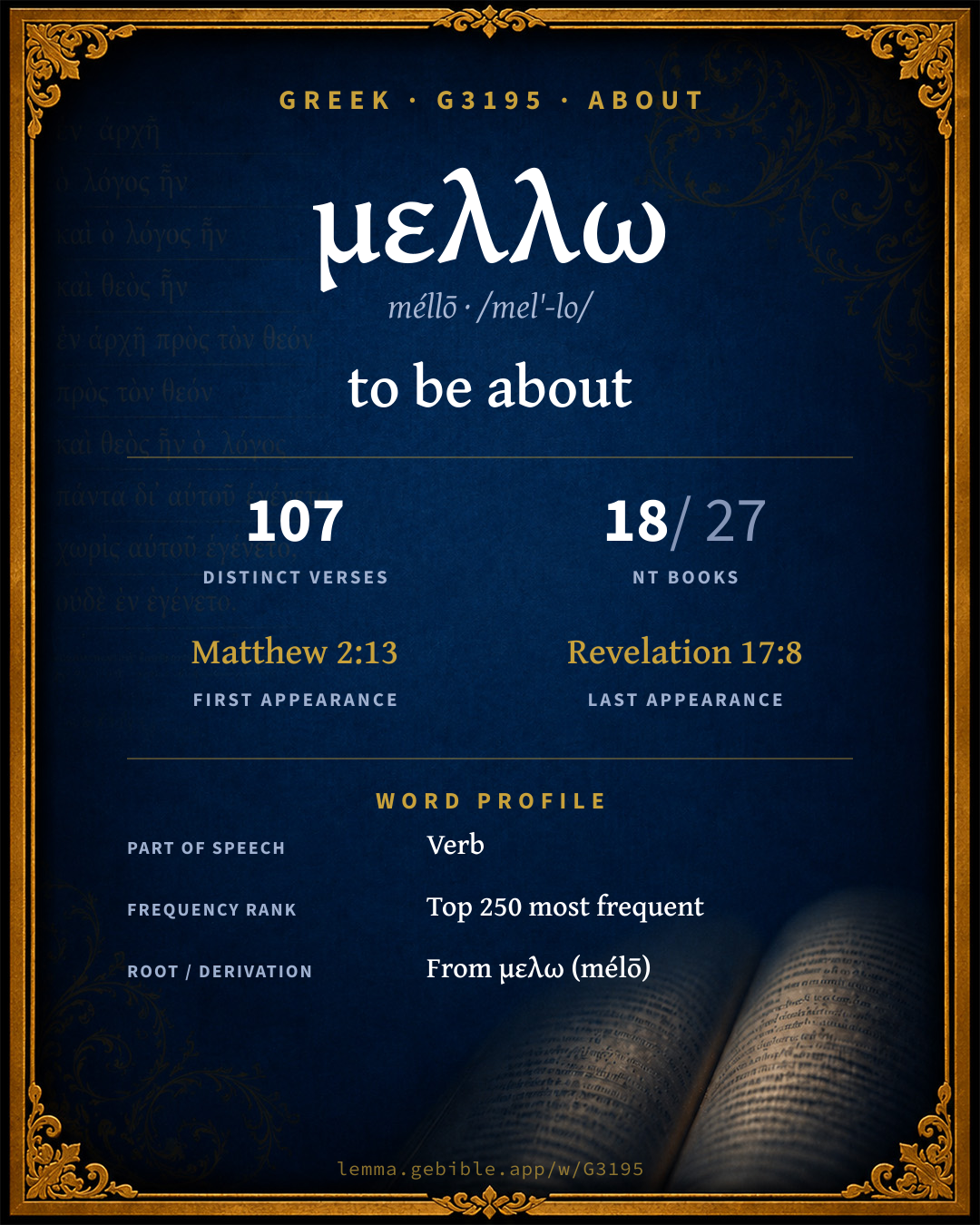
μέλλω
to be about
‘to be about’ is one of 2 main senses fuller range ↓
Full lexicon entry — Thayer's Greek Lexicon
From Thayer's Greek Lexicon
Where this word appears
See every Present-tense verb in the Greek New Testament →
Grammar key — what these labels mean
Part of speech
- Verb
- An action or state-of-being word.
Tense
- Present
- Ongoing or general action in present time (imperfective aspect).
- Imperfect
- Continuous or repeated action in past time (“was writing”).
- Future
- Action expected in future time.
Voice
- Active
- The subject performs the action.
Mood
- Indicative
- States a fact or asks a factual question (the mood of reality).
- Participle
- A verbal adjective (“writing,” “having written”).
- Infinitive
- A verbal noun (“to write”), unmarked for person or number.
- Subjunctive
- Expresses probability, purpose, or possibility (the mood of contingency).
Case
- Nominative
- The case of the subject (and the predicate nominative).
- Genitive
- The case of source, possession, or “of” — answers “whose / from what.”
- Accusative
- The case of the direct object and of extent.
- Dative
- The case of the indirect object, means, or location — “to / for / with / in.”
Person
- 3rd person
- The one spoken about (“he / she / it / they”).
- 2nd person
- The one addressed (“you”).
- 1st person
- The speaker (“I / we”).
Gender
- Masculine
- Grammatically masculine.
- Feminine
- Grammatically feminine.
- Neuter
- Grammatically neuter.
Number
- Singular
- One.
- Plural
- More than one.
Every verse where G3195 appears in the Book of Acts — 33 distinct verses. Click any verse to open its interlinear word-by-word view. Verse text shown in the World English Bible for context — . Each verse’s Greek form is shown with its reference; the English is not keyword-highlighted, since the data carries no word-level English alignment. Use “Compare translations” on any verse to read it across multiple English versions. This concordance covers the Greek New Testament; Septuagint (Greek Old Testament) occurrences of this word are not indexed here.
Acts
- Acts 3:3 μέλλοντας pres act ptcp acc pl masc Seeing Peter and John about to go into the temple, he asked to receive gifts for the needy.
- Acts 5:35 μέλλετε pres act ind 2pl He said to them, "You men of Israel, be careful concerning these men, what you are about to do.
- Acts 11:28 μέλλειν pres act inf One of them named Agabus stood up, and indicated by the Spirit that there should be a great famine all over the world, which also happened in the days of Claudius.
- Acts 12:6 ἤμελλεν impf act ind 3sg attic The same night when Herod was about to bring him out, Peter was sleeping between two soldiers, bound with two chains. Guards in front of the door kept the prison.
- Acts 13:34 μέλλοντα pres act ptcp acc sg masc "Concerning that he raised him up from the dead, now no more to return to corruption, he has spoken thus: 'I will give you the holy and sure blessings of David.'
- Acts 16:27 ἤμελλεν impf act ind 3sg attic The jailer, being roused out of sleep and seeing the prison doors open, drew his sword and was about to kill himself, supposing that the prisoners had escaped.
- Acts 17:31 μέλλει pres act ind 3sg because he has appointed a day in which he will judge the world in righteousness by the man whom he has ordained; of which he has given assurance to all men, in that he has raised him from the dead."
- Acts 18:14 μέλλοντος pres act ptcp gen sg masc But when Paul was about to open his mouth, Gallio said to the Jews, "If indeed it were a matter of wrong or of wicked crime, you Jews, it would be reasonable that I should bear with you;
- Acts 19:27 μέλλειν pres act inf Not only is there danger that this our trade come into disrepute, but also that the temple of the great goddess Artemis will be counted as nothing, and her majesty destroyed, whom all Asia and the world worships."
- Acts 20:3 μέλλοντι pres act ptcp dat sg masc When he had spent three months there, and a plot was made against him by Jews as he was about to set sail for Syria, he determined to return through Macedonia.
- Acts 20:7 μέλλων pres act ptcp nom sg masc On the first day of the week, when the disciples were gathered together to break bread, Paul talked with them, intending to depart on the next day, and continued his speech until midnight.
- Acts 20:13 μέλλοντες μέλλων pres act ptcp nom pl masc pres act ptcp nom sg masc But we who went ahead to the ship set sail for Assos, intending to take Paul aboard there, for he had so arranged, intending himself to go by land.
- Acts 20:38 μέλλουσιν pres act ind 3pl sorrowing most of all because of the word which he had spoken, that they should see his face no more. And they accompanied him to the ship.
- Acts 21:27 ἔμελλον impf act ind 3pl When the seven days were almost completed, the Jews from Asia, when they saw him in the temple, stirred up all the multitude and laid hands on him,
- Acts 21:37 μέλλων pres act ptcp nom sg masc As Paul was about to be brought into the barracks, he asked the commanding officer, "May I speak to you?" He said, "Do you know Greek?
- Acts 22:16 μέλλεις pres act ind 2sg Now why do you wait? Arise, be baptized, and wash away your sins, calling on the name of the Lord.'
- Acts 22:26 μέλλεις pres act ind 2sg When the centurion heard it, he went to the commanding officer and told him, "Watch what you are about to do, for this man is a Roman!"
- Acts 22:29 μέλλοντες pres act ptcp nom pl masc Immediately those who were about to examine him departed from him, and the commanding officer also was afraid when he realized that he was a Roman, because he had bound him.
- Acts 23:3 μέλλει pres act ind 3sg Then Paul said to him, "God will strike you, you whitewashed wall! Do you sit to judge me according to the law, and command me to be struck contrary to the law?"
- Acts 23:15 μέλλοντας pres act ptcp acc pl masc Now therefore, you with the council inform the commanding officer that he should bring him down to you tomorrow, as though you were going to judge his case more exactly. We are ready to kill him before he comes near."
- Acts 23:20 μέλλων pres act ptcp nom sg masc He said, "The Jews have agreed to ask you to bring Paul down to the council tomorrow, as though intending to inquire somewhat more accurately concerning him.
- Acts 23:27 μέλλοντα pres act ptcp acc sg masc "This man was seized by the Jews, and was about to be killed by them, when I came with the soldiers and rescued him, having learned that he was a Roman.
- Acts 24:15 μέλλειν pres act inf having hope toward God, which these also themselves look for, that there will be a resurrection of the dead, both of the just and unjust.
- Acts 24:25 μέλλοντος pres act ptcp gen sg neut As he reasoned about righteousness, self-control, and the judgment to come, Felix was terrified, and answered, "Go your way for this time, and when it is convenient for me, I will summon you."
- Acts 25:4 μέλλειν pres act inf However Festus answered that Paul should be kept in custody at Caesarea, and that he himself was about to depart shortly.
- Acts 26:2 μέλλων pres act ptcp nom sg masc "I think myself happy, King Agrippa, that I am to make my defense before you this day concerning all the things that I am accused by the Jews,
- Acts 26:22 μελλόντων pres act ptcp gen pl neut Having therefore obtained the help that is from God, I stand to this day testifying both to small and great, saying nothing but what the prophets and Moses said would happen,
- Acts 26:23 μέλλει pres act ind 3sg how the Christ must suffer, and how, by the resurrection of the dead, he would be first to proclaim light both to these people and to the Gentiles."
- Acts 27:2 μέλλοντι pres act ptcp dat sg masc Embarking in a ship of Adramyttium, which was about to sail to places on the coast of Asia, we put to sea; Aristarchus, a Macedonian of Thessalonica, being with us.
- Acts 27:10 μέλλειν pres act inf and said to them, "Sirs, I perceive that the voyage will be with injury and much loss, not only of the cargo and the ship, but also of our lives."
- Acts 27:30 μελλόντων pres act ptcp gen pl masc As the sailors were trying to flee out of the ship, and had lowered the boat into the sea, pretending that they would lay out anchors from the bow,
- Acts 27:33 ἔμελλεν impf act ind 3sg While the day was coming on, Paul begged them all to take some food, saying, "This day is the fourteenth day that you wait and continue fasting, having taken nothing.
- Acts 28:6 μέλλειν pres act inf But they expected that he would have swollen or fallen down dead suddenly, but when they watched for a long time and saw nothing bad happen to him, they changed their minds, and said that he was a god.
About this entry
At a glance — auto-summarized from this page’s data, not written by a person. Every figure links to its source below. This summary describes the numbers; it doesn’t interpret them.
The Greek verb μελλω centers on the idea of “to be about.” The King James Version usually renders it “shall,” while modern versions prefer “will” (Berean Standard Bible) and “being about” (unfoldingWord Literal Text) — see the renderings breakdown. Spanning 107 verses in 18 books, it ranks among the common words of the Greek New Testament. Acts dominates its distribution — 33 of 107 verses. Thayer's distinguishes 2 senses for it. Dig into 107-verse concordance and the renderings breakdown below.
Gloss history
Strong's 1890 vs modern scholarship

About this word
Strong's G3195 catalogs a Greek word from the Greek New Testament.
These counts are not copied from any lexicon or concordance. They are computed here, from the morphology-tagged Greek New Testament. What Lemma adds →
- 107
- distinct verses
- The word appears in 107 distinct verses.
- 18 / 27
- NT books
- The word appears in 18 of 27 New Testament books.
- #150
- by frequency
- Top 250 most frequent Greek words (rank 150 of 5,347 Greek words by occurrence).
View all 107 occurrences in the concordance →
Most concentrated in
- Acts 33 verses 31%
- Luke 12 verses 11%
- Revelation 12 verses 11%
By section of the New Testament
By traditional corpus
Conventional, traditional groupings — biblical authorship is debated, so this is a traditional corpus grouping, not an authorship claim. Some books belong to more than one corpus (Luke is in both the Gospels and the Lukan corpus, and so on), so these shares overlap and need not total 100%. Each figure is a share of the word’s 107 distinct verses.
- Lukan (Luke–Acts) 45 verses · 42%
- Gospels 34 verses · 32%
- Johannine 23 verses · 21%
- Pauline corpus 14 verses · 13%
- Revelation 12 verses · 11%
- Hebrews 10 verses · 9%
- General (Catholic) Epistles 4 verses · 4%
How translations render this word
Counts come from each version’s own published word-to-Strong’s tagging or interlinear alignment — an approximate guide to how each version renders this word, not a word-level alignment the data otherwise carries. Because each total is that version’s own tagged count, the per-version totals vary from one another and need not match the appearance or distinct-verse counts above. These counts may also differ from a printed concordance because Lemma counts each distinctly tagged rendering and does not collapse phrase taggings into a single head-word total. This is a fixed set of word-tagged versions (KJV, ASV, BSB, ULT) and does not change with the reading translation you choose elsewhere. Each version’s license is shown beside its name below (and on Sources).
- King James Version: Shall 15×, Should 13×, Come 8×
- American Standard Version: Shall 13×, Come 8×, Should 8×
- Berean Standard Bible: Will 10×, Come 7×, Is about 7×
- unfoldingWord Literal Text: Being about 12×, Is about 12×, Coming 9×
King James Version Public Domain
Renders G3195 across 107 tagged occurrences — most commonly:
Plus other, less common renderings. Plus 43 renderings that appear only once — usually multi-word phrases or single function words the recovered tagging swept in, not distinct renderings. Not rendered by a distinct English word in 3 further occurrences.
American Standard Version Public Domain
Renders G3195 across 107 tagged occurrences — most commonly:
Plus other, less common renderings. Plus 43 renderings that appear only once — usually multi-word phrases or single function words the recovered tagging swept in, not distinct renderings.
Berean Standard Bible Public Domain
Renders G3195 across 101 tagged occurrences — most commonly:
Plus other, less common renderings. Plus 30 renderings that appear only once — usually multi-word phrases or single function words the recovered tagging swept in, not distinct renderings. Not rendered by a distinct English word in 6 further occurrences.
unfoldingWord Literal Text CC BY-SA 4.0
Renders G3195 across 115 tagged occurrences — most commonly:
Plus other, less common renderings. Plus 23 renderings that appear only once — usually multi-word phrases or single function words the recovered tagging swept in, not distinct renderings.
Senses in Thayer's
The 2 senses Thayer's distinguishes for this word, in lexicon order (not ranked by frequency or importance). The full entry — with sub-senses — is in the Lexicon Entry tab.
- to be on the point of doing or suffering something
- to intend, have in mind, think to
Word origin
Derived from μελω (mélō) (G3199) — to care about.
A strengthened form of G3199 (through the idea of expectation ); to intend that is be about to be do or suffer something (of persons or things especially events; in the sense of purpose duty necessity probability possibility or hesitation ): - about after that be (almost) (that which is things + which was for) to come intend was to (be) mean mind be at the point (be) ready + return shall (begin) (which that) should (after afterwards hereafter) tarry which was for will would be yet.
— Strong’s Exhaustive Concordance (1890), public domain.
Forms in the corpus
The 24 distinct written forms G3195 takes in the Greek New Testament, most frequent first — each parse links to that tense’s occurrences in the concordance.
Same root — word family
Other Thayer's entries built from the same root as G3195, grouped by Strong’s listed origin. These share a root / origin per the lexicon — not necessarily a shared meaning. Each links to that word’s own entry.
Derives from
Shares the same root
Compare all same-root words → They share a root, not necessarily a meaning.
Septuagint usage
The same Greek word μελλω appears 14 times in the Greek Old Testament (Septuagint), across 14 verses in 7 books.
- 14
- LXX occurrences
- Tagged occurrences of this Greek word in the Septuagint.
- 14
- verses
- Distinct Septuagint verses containing this word.
- 7 / 39
- OT books
- The word appears in 7 of the 39 Old Testament books.
Sample Septuagint occurrences
- Genesis 25:22 μέλλω
- Exodus 4:12 μέλλω
- Job 3:8 μέλλω
- Psalms 64:1 μέλλω
- Proverbs 15:18 μέλλω
- Isaiah 15:7 μέλλω
- Jeremiah 36:10 μέλλω
Septuagint occurrences (same lexeme)
Every verse where the same Strong’s number (G3195) appears in the Greek Septuagint. Verse text shown in the World English Bible for context; the Greek form is the matched word — the English is not keyword-highlighted.
- Genesis 25:22 μέλλω The children struggled together within her. She said, "If it be so, why do I live?" She went to inquire of Yahweh.
- Genesis 43:25 μέλλω They made ready the present for Joseph's coming at noon, for they heard that they should eat bread there.
- Exodus 4:12 μέλλω Now therefore go, and I will be with your mouth, and teach you what you shall speak."
- Job 3:8 μέλλω Let them curse it who curse the day, Who are ready to rouse up leviathan.
- Job 19:25 μέλλω But as for me, I know that my Redeemer lives. In the end, he will stand upon the earth.
- Job 26:2 μέλλω "How have you helped him who is without power! How have you saved the arm that has no strength!
- Psalms 64:1 μέλλω Hear my voice, God, in my complaint. Preserve my life from fear of the enemy.
- Proverbs 15:18 μέλλω A wrathful man stirs up contention, But one who is slow to anger appeases strife.
- Isaiah 15:7 μέλλω Therefore the abundance they have gotten, and that which they have laid up, shall they carry away over the brook of the willows.
- Isaiah 28:24 μέλλω Does he who plows to sow plow continually? does he [continually] open and harrow his ground?
- Isaiah 47:13 μέλλω You are wearied in the multitude of your counsels: let now the astrologers, the star-gazers, the monthly prognosticators, stand up, and save you from the things that shall come on you.
- Isaiah 48:6 μέλλω You have heard it; see all this; and you, will you not declare it? I have shown you new things from this time, even hidden things, which you have not known.
- Isaiah 59:5 μέλλω They hatch adders' eggs, and weave the spider's web: he who eats of their eggs dies; and that which is crushed breaks out into a viper.
- Jeremiah 36:10 μέλλω Then read Baruch in the book the words of Jeremiah in the house of Yahweh, in the chamber of Gemariah the son of Shaphan, the scribe, in the upper court, at the entry of the new gate of Yahweh's house, in the ears of all the people.
These are occurrences of the same Greek lexeme (G3195) in the Septuagint — not a translation of any one Hebrew word. The store carries no word-level Hebrew↔Greek alignment, so no Hebrew original is asserted here. Counts come from the recovered LXX Strong's tagging — high-frequency vocabulary is well covered, while rare or late forms may be untagged — so they reflect tagged occurrences and may slightly undercount.