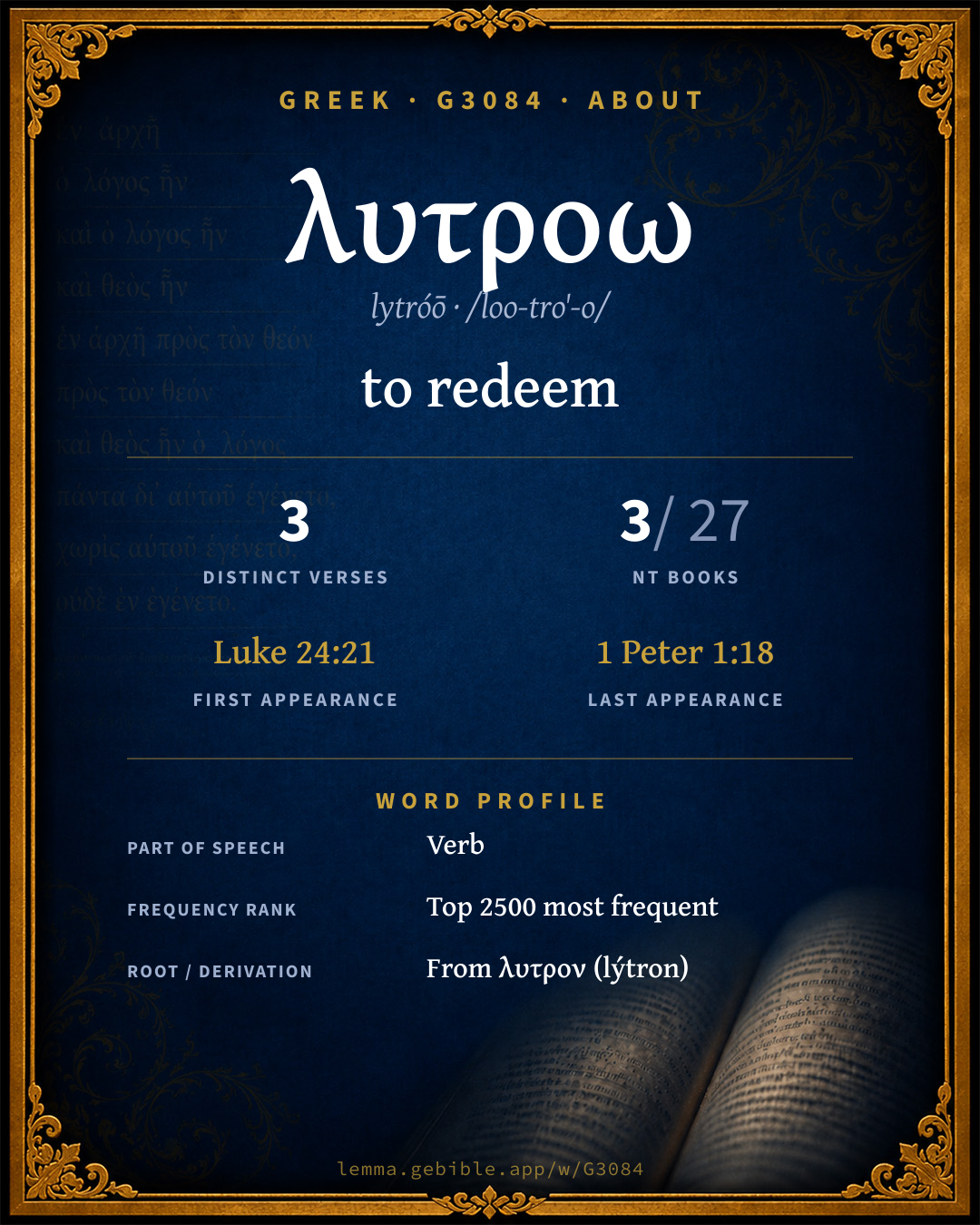
λυτρόω
to redeem
‘to redeem’ is one of 2 main senses fuller range ↓
Full lexicon entry — Thayer's Greek Lexicon
From Thayer's Greek Lexicon
Where this word appears
See every Aorist-tense verb in the Greek New Testament →
Grammar key — what these labels mean
Part of speech
- Verb
- An action or state-of-being word.
Tense
- Aorist
- Action viewed as a simple whole, without regard to duration — often past (perfective aspect).
- Present
- Ongoing or general action in present time (imperfective aspect).
Voice
- Middle
- The subject acts on or for itself, or with special interest in the action.
- Passive
- The subject receives the action.
Mood
- Subjunctive
- Expresses probability, purpose, or possibility (the mood of contingency).
- Indicative
- States a fact or asks a factual question (the mood of reality).
- Infinitive
- A verbal noun (“to write”), unmarked for person or number.
Person
- 3rd person
- The one spoken about (“he / she / it / they”).
- 2nd person
- The one addressed (“you”).
Number
- Singular
- One.
- Plural
- More than one.
2 distinct verses where G3084 appears in the Aorist tense, across 2 books. Filtered view — show all forms. Click any verse to open its interlinear word-by-word view. Verse text shown in the World English Bible for context — . Each verse’s Greek form is shown with its reference; the English is not keyword-highlighted, since the data carries no word-level English alignment. Use “Compare translations” on any verse to read it across multiple English versions. This concordance covers the Greek New Testament; Septuagint (Greek Old Testament) occurrences of this word are not indexed here.
Titus 1 verse
1 Peter 1 verse
About this entry
At a glance — auto-summarized from this page’s data, not written by a person. Every figure links to its source below. This summary describes the numbers; it doesn’t interpret them.
“to redeem” is the headline sense of the Greek verb λυτροω (lytróō). It is rare — just 3 verses in the entire Greek New Testament. It concentrates in Luke, which alone accounts for 33% of its uses. First canonically at Luke 24:21, it enters the text early. Lexicons map it across 2 senses. See the sense tree, 3-verse concordance, and the renderings breakdown below.
Gloss history
Strong's 1890 vs modern scholarship
About this word
Strong's G3084 catalogs a Greek word from the Greek New Testament.
These counts are not copied from any lexicon or concordance. They are computed here, from the morphology-tagged Greek New Testament. What Lemma adds →
- 3
- distinct verses
- The word appears in 3 distinct verses.
- 3 / 27
- NT books
- The word appears in 3 of 27 New Testament books.
- #2,203
- by frequency
- Top 2500 most frequent Greek words (rank 2,203 of 5,347 Greek words by occurrence).
View all 3 occurrences in the concordance →
By section of the New Testament
By traditional corpus
Conventional, traditional groupings — biblical authorship is debated, so this is a traditional corpus grouping, not an authorship claim. Some books belong to more than one corpus (Luke is in both the Gospels and the Lukan corpus, and so on), so these shares overlap and need not total 100%. Each figure is a share of the word’s 3 distinct verses.
- Gospels 1 verse · 33%
- Lukan (Luke–Acts) 1 verse · 33%
- Pauline corpus 1 verse · 33%
- General (Catholic) Epistles 1 verse · 33%
How translations render this word
Counts come from each version’s own published word-to-Strong’s tagging or interlinear alignment — an approximate guide to how each version renders this word, not a word-level alignment the data otherwise carries. Because each total is that version’s own tagged count, the per-version totals vary from one another and need not match the appearance or distinct-verse counts above. These counts may also differ from a printed concordance because Lemma counts each distinctly tagged rendering and does not collapse phrase taggings into a single head-word total. This is a fixed set of word-tagged versions (KJV, ASV, BSB, ULT) and does not change with the reading translation you choose elsewhere. Each version’s license is shown beside its name below (and on Sources).
- King James Version: Have redeemed 1×, He might redeem 1×, Redeemed 1×
- American Standard Version: He might redeem 1×, Redeem 1×, Redeemed 1×
- Berean Standard Bible: Redeem 2×
- unfoldingWord Literal Text: Redeem 2×
King James Version Public Domain
Renders G3084 across 4 tagged occurrences — most commonly:
American Standard Version Public Domain
Renders G3084 across 4 tagged occurrences — most commonly:
Berean Standard Bible Public Domain
Renders G3084 across 3 tagged occurrences — most commonly:
Plus 1 rendering that appears only once — usually multi-word phrases or single function words the recovered tagging swept in, not distinct renderings.
unfoldingWord Literal Text CC BY-SA 4.0
Renders G3084 across 3 tagged occurrences — most commonly:
Plus 1 rendering that appears only once — usually multi-word phrases or single function words the recovered tagging swept in, not distinct renderings.
Senses in Thayer's
The 2 senses Thayer's distinguishes for this word, in lexicon order (not ranked by frequency or importance). The full entry — with sub-senses — is in the Lexicon Entry tab.
- to release on receipt of ransom
- to redeem, liberate by payment of ransom
Word origin
Derived from λυτρον (lýtron) (G3083) — ransom.
From G3083 ; to ransom (literally or figuratively): - redeem.
— Strong’s Exhaustive Concordance (1890), public domain.
Forms in the corpus
The 3 distinct written forms G3084 takes in the Greek New Testament, most frequent first — each parse links to that tense’s occurrences in the concordance.
| Form | Parsing | Example | Uses |
|---|---|---|---|
| λυτροῦσθαι lytroûsthai | Verb, Present, Middle, Infinitive | Luke 24:21 | 1 |
| λυτρώσηται lytrṓsētai | Verb, Aorist, Middle, Subjunctive, 3rd person, Singular | Titus 2:14 | 1 |
| ἐλυτρώθητε elytrṓthēte | Verb, Aorist, Passive, Indicative, 2nd person, Plural | 1 Peter 1:18 | 1 |
Same root — word family
Other Thayer's entries built from the same root as G3084, grouped by Strong’s listed origin. These share a root / origin per the lexicon — not necessarily a shared meaning. Each links to that word’s own entry.
Derives from
Derived from this word
Compare all same-root words → They share a root, not necessarily a meaning.
Septuagint usage
The same Greek word λυτροω appears 97 times in the Greek Old Testament (Septuagint), across 85 verses in 18 books.
- 97
- LXX occurrences
- Tagged occurrences of this Greek word in the Septuagint.
- 85
- verses
- Distinct Septuagint verses containing this word.
- 18 / 39
- OT books
- The word appears in 18 of the 39 Old Testament books.
Sample Septuagint occurrences
- Exodus 6:6 λυτρόω
- Leviticus 19:20 λυτρόω
- Numbers 18:15 λυτρόω
- Deuteronomy 7:8 λυτρόω
- 2 Samuel 4:9 λυτρόω
- 1 Kings 1:29 λυτρόω
- 1 Chronicles 17:21 λυτρόω
- Ezra 11:10 λυτρόω
- Psalms 7:3 λυτρόω
- Proverbs 23:11 λυτρόω
- Isaiah 35:9 λυτρόω
- Jeremiah 15:21 λυτρόω
Septuagint occurrences (same lexeme)
Every verse where the same Strong’s number (G3084) appears in the Greek Septuagint — showing the first 50 of 85. Verse text shown in the World English Bible for context; the Greek form is the matched word — the English is not keyword-highlighted.
- Exodus 6:6 λυτρόω Therefore tell the children of Israel, 'I am Yahweh, and I will bring you out from under the burdens of the Egyptians, and I will rid you out of their bondage, and I will redeem you with an outstretched arm, and with great judgments:
- Exodus 13:13 λυτρόω Every firstborn of a donkey you shall redeem with a lamb; and if you will not redeem it, then you shall break its neck; and you shall redeem all the firstborn of man among your sons.
- Exodus 13:15 λυτρόω and it happened, when Pharaoh would hardly let us go, that Yahweh killed all the firstborn in the land of Egypt, both the firstborn of man, and the firstborn of animal. Therefore I sacrifice to Yahweh all that opens the womb, being males; but all the firstborn of my sons I redeem.'
- Exodus 15:13 λυτρόω "You, in your loving kindness, have led the people that you have redeemed. You have guided them in your strength to your holy habitation.
- Exodus 34:20 λυτρόω The firstborn of a donkey you shall redeem with a lamb: and if you will not redeem it, then you shall break its neck. All the firstborn of your sons you shall redeem. No one shall appear before me empty.
- Leviticus 19:20 λυτρόω "'If a man lies carnally with a woman who is a slave girl, pledged to be married to another man, and not ransomed, or given her freedom; they shall be punished. They shall not be put to death, because she was not free.
- Leviticus 25:25 λυτρόω "'If your brother becomes poor, and sells some of his possessions, then his kinsman who is next to him shall come, and redeem that which his brother has sold.
- Leviticus 25:30 λυτρόω If it isn't redeemed within the space of a full year, then the house that is in the walled city shall be made sure in perpetuity to him who bought it, throughout his generations. It shall not be released in the Jubilee.
- Leviticus 25:33 λυτρόω The Levites may redeem the house that was sold, and the city of his possession, and it shall be released in the Jubilee; for the houses of the cities of the Levites are their possession among the children of Israel.
- Leviticus 25:48 λυτρόω after he is sold he may be redeemed. One of his brothers may redeem him;
- Leviticus 25:49 λυτρόω or his uncle, or his uncle's son, may redeem him, or any who is a close relative to him of his family may redeem him; or if he has grown rich, he may redeem himself.
- Leviticus 25:54 λυτρόω "'If he isn't redeemed by these means, then he shall be released in the Year of Jubilee, he, and his children with him.
- Leviticus 27:13 λυτρόω But if he will indeed redeem it, then he shall add the fifth part of it to its valuation.
- Leviticus 27:15 λυτρόω If he who dedicates it will redeem his house, then he shall add the fifth part of the money of your valuation to it, and it shall be his.
- Leviticus 27:19 λυτρόω If he who dedicated the field will indeed redeem it, then he shall add the fifth part of the money of your valuation to it, and it shall remain his.
- Leviticus 27:20 λυτρόω If he will not redeem the field, or if he has sold the field to another man, it shall not be redeemed any more;
- Leviticus 27:27 λυτρόω If it is an unclean animal, then he shall buy it back according to your valuation, and shall add to it the fifth part of it: or if it isn't redeemed, then it shall be sold according to your valuation.
- Leviticus 27:28 λυτρόω "'Notwithstanding, no devoted thing, that a man shall devote to Yahweh of all that he has, whether of man or animal, or of the field of his possession, shall be sold or redeemed: every devoted thing is most holy to Yahweh.
- Leviticus 27:29 λυτρόω "'No one devoted, who shall be devoted from among men, shall be ransomed; he shall surely be put to death.
- Leviticus 27:31 λυτρόω If a man redeems anything of his tithe, he shall add a fifth part to it.
- Leviticus 27:33 λυτρόω He shall not search whether it is good or bad, neither shall he change it: and if he changes it at all, then both it and that for which it is changed shall be holy. It shall not be redeemed.'"
- Numbers 18:15 λυτρόω Everything that opens the womb, of all flesh which they offer to Yahweh, both of man and animal shall be yours: nevertheless the firstborn of man shall you surely redeem, and the firstborn of unclean animals shall you redeem.
- Numbers 18:17 λυτρόω But the firstborn of a cow, or the firstborn of a sheep, or the firstborn of a goat, you shall not redeem; they are holy: you shall sprinkle their blood on the altar, and shall burn their fat for an offering made by fire, for a sweet savor to Yahweh.
- Deuteronomy 7:8 λυτρόω but because Yahweh loves you, and because he would keep the oath which he swore to your fathers, has Yahweh brought you out with a mighty hand, and redeemed you out of the house of bondage, from the hand of Pharaoh king of Egypt.
- Deuteronomy 9:26 λυτρόω I prayed to Yahweh, and said, Lord Yahweh, don't destroy your people and your inheritance, that you have redeemed through your greatness, that you have brought forth out of Egypt with a mighty hand.
- Deuteronomy 13:6 λυτρόω If your brother, the son of your mother, or your son, or your daughter, or the wife of your bosom, or your friend, who is as your own soul, entice you secretly, saying, Let us go and serve other gods, which you have not known, you, nor your fathers;
- Deuteronomy 15:15 λυτρόω You shall remember that you were a bondservant in the land of Egypt, and Yahweh your God redeemed you: therefore I command you this thing today.
- Deuteronomy 21:8 λυτρόω Forgive, Yahweh, your people Israel, whom you have redeemed, and don't allow innocent blood [to remain] in the midst of your people Israel. The blood shall be forgiven them.
- Deuteronomy 24:18 λυτρόω but you shall remember that you were a bondservant in Egypt, and Yahweh your God redeemed you there: therefore I command you to do this thing.
- 2 Samuel 4:9 λυτρόω David answered Rechab and Baanah his brother, the sons of Rimmon the Beerothite, and said to them, As Yahweh lives, who has redeemed my soul out of all adversity,
- 2 Samuel 7:23 λυτρόω What one nation in the earth is like your people, even like Israel, whom God went to redeem to himself for a people, and to make him a name, and to do great things for you, and awesome things for your land, before your people, whom you redeem to you out of Egypt, [from] the nations and their gods?
- 1 Kings 1:29 λυτρόω The king swore, and said, As Yahweh lives, who has redeemed my soul out of all adversity,
- 1 Chronicles 17:21 λυτρόω What one nation in the earth is like your people Israel, whom God went to redeem to himself for a people, to make you a name by great and awesome things, in driving out nations from before your people, whom you redeem out of Egypt?
- Ezra 11:10 λυτρόω
- Psalms 7:3 λυτρόω Yahweh, my God, if I have done this, If there is iniquity in my hands,
- Psalms 24:22 λυτρόω
- Psalms 25:11 λυτρόω For your name's sake, Yahweh, Pardon my iniquity, for it is great.
- Psalms 30:6 λυτρόω As for me, I said in my prosperity, "I shall never be moved."
- Psalms 31:7 λυτρόω I will be glad and rejoice in your loving kindness, For you have seen my affliction. You have known my soul in adversities.
- Psalms 33:23 λυτρόω
- Psalms 43:27 λυτρόω
- Psalms 48:8 λυτρόω As we have heard, so we have seen, In the city of Yahweh of Hosts, in the city of our God. God will establish it forever. Selah.
- Psalms 48:16 λυτρόω
- Psalms 54:19 λυτρόω
- Psalms 58:2 λυτρόω No, in your heart you plot injustice. You measure out the violence of your hands in the earth.
- Psalms 68:19 λυτρόω Blessed be the Lord, who daily bears our burdens, Even the God who is our salvation. Selah.
- Psalms 70:23 λυτρόω
- Psalms 71:14 λυτρόω But I will always hope, And will add to all of your praise.
- Psalms 73:2 λυτρόω But as for me, my feet were almost gone. My steps had nearly slipped.
- Psalms 76:16 λυτρόω
These are occurrences of the same Greek lexeme (G3084) in the Septuagint — not a translation of any one Hebrew word. The store carries no word-level Hebrew↔Greek alignment, so no Hebrew original is asserted here. Counts come from the recovered LXX Strong's tagging — high-frequency vocabulary is well covered, while rare or late forms may be untagged — so they reflect tagged occurrences and may slightly undercount.