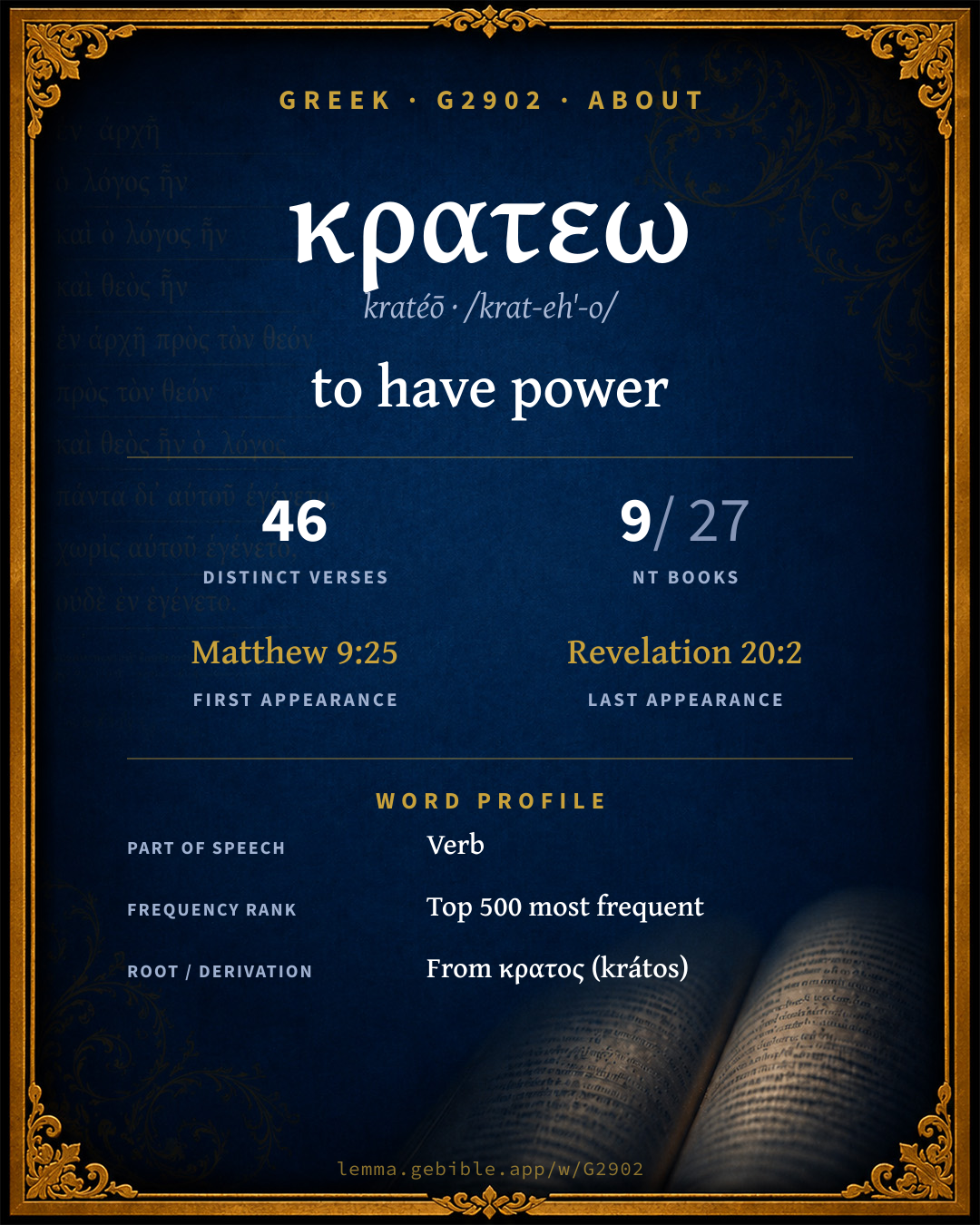
κρατέω
to have power
‘to have power’ is one of 7 main senses fuller range ↓
Full lexicon entry — Thayer's Greek Lexicon
From Thayer's Greek Lexicon
Where this word appears
See every Aorist-tense verb in the Greek New Testament →
Grammar key — what these labels mean
Part of speech
- Verb
- An action or state-of-being word.
Tense
- Aorist
- Action viewed as a simple whole, without regard to duration — often past (perfective aspect).
- Present
- Ongoing or general action in present time (imperfective aspect).
- Future
- Action expected in future time.
- Imperfect
- Continuous or repeated action in past time (“was writing”).
- Perfect
- A completed past action with continuing present results.
Voice
- Active
- The subject performs the action.
- Passive
- The subject receives the action.
Mood
- Participle
- A verbal adjective (“writing,” “having written”).
- Indicative
- States a fact or asks a factual question (the mood of reality).
- Infinitive
- A verbal noun (“to write”), unmarked for person or number.
- Imperative
- Expresses a command or request.
- Subjunctive
- Expresses probability, purpose, or possibility (the mood of contingency).
Case
- Nominative
- The case of the subject (and the predicate nominative).
- Accusative
- The case of the direct object and of extent.
- Genitive
- The case of source, possession, or “of” — answers “whose / from what.”
Person
- 3rd person
- The one spoken about (“he / she / it / they”).
- 2nd person
- The one addressed (“you”).
- 1st person
- The speaker (“I / we”).
Gender
- Masculine
- Grammatically masculine.
Number
- Singular
- One.
- Plural
- More than one.
1 verse where G2902 appears in the Aorist tense in the Book of Hebrews. Filtered view — show all forms. Click any verse to open its interlinear word-by-word view. Verse text shown in the World English Bible for context — . Each verse’s Greek form is shown with its reference; the English is not keyword-highlighted, since the data carries no word-level English alignment. Use “Compare translations” on any verse to read it across multiple English versions. This concordance covers the Greek New Testament; Septuagint (Greek Old Testament) occurrences of this word are not indexed here.
Hebrews
About this entry
At a glance — auto-summarized from this page’s data, not written by a person. Every figure links to its source below. This summary describes the numbers; it doesn’t interpret them.
At its core, κρατεω (kratéō) means “to have power.” Its English rendering has broadened — “took” classically, “arrest” (Berean Standard Bible) and “seize” (unfoldingWord Literal Text) in modern versions; see the renderings breakdown. Spanning 46 verses in 9 books, it ranks among the moderately common words of the Greek New Testament. Its uses concentrate in Mark (33% of all occurrences). Ranging over 7 senses, it is not a single-sense word. Dig into 46-verse concordance and the renderings breakdown below.
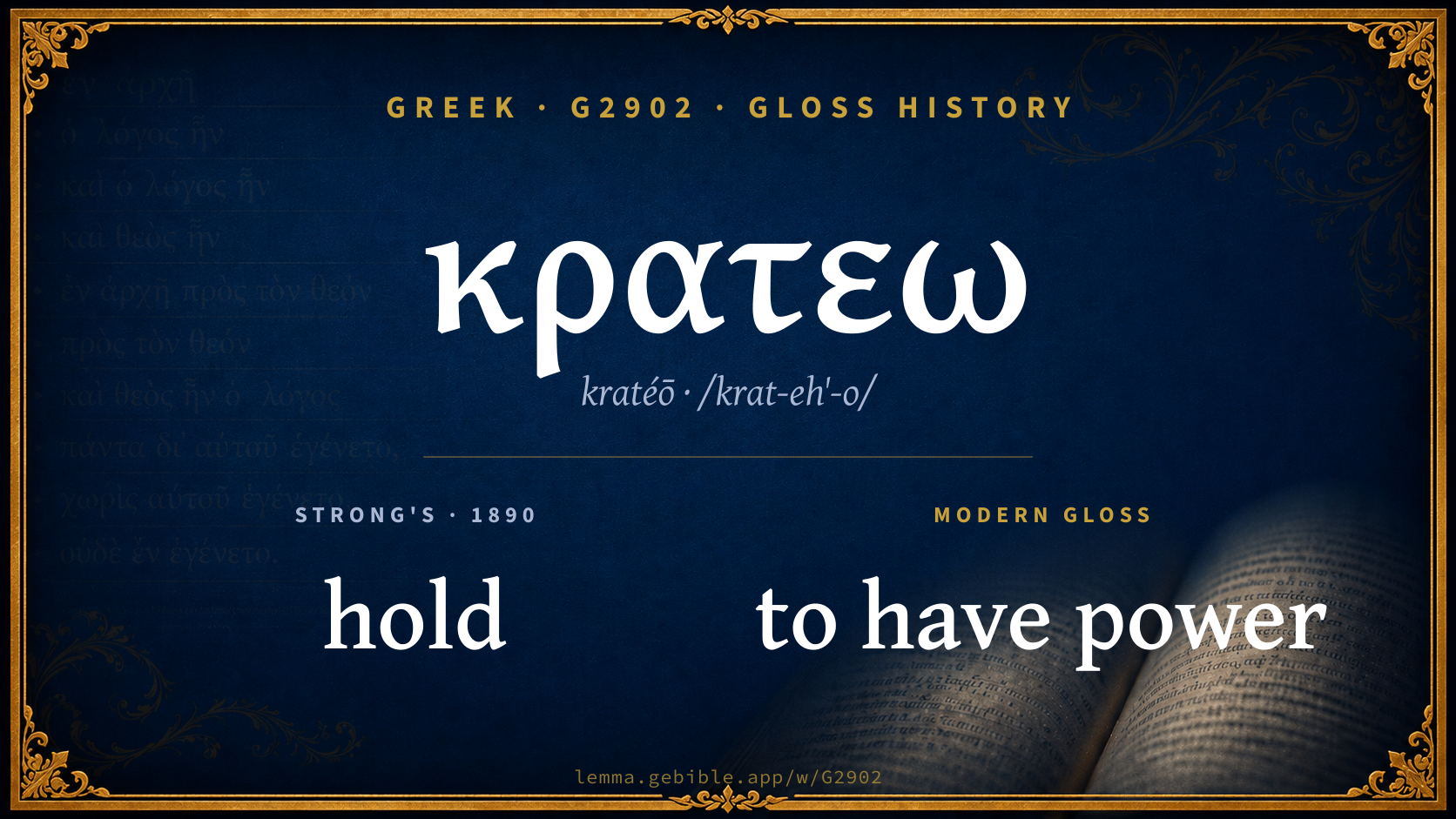
Gloss history
Strong's 1890 vs modern scholarship
About this word
Strong's G2902 catalogs a Greek word from the Greek New Testament.
These counts are not copied from any lexicon or concordance. They are computed here, from the morphology-tagged Greek New Testament. What Lemma adds →
- 46
- distinct verses
- The word appears in 46 distinct verses.
- 9 / 27
- NT books
- The word appears in 9 of 27 New Testament books.
- #326
- by frequency
- Top 500 most frequent Greek words (rank 326 of 5,347 Greek words by occurrence).
View all 46 occurrences in the concordance →
Most concentrated in
- Mark 15 verses 33%
- Matthew 12 verses 26%
- Revelation 8 verses 17%
By section of the New Testament
By traditional corpus
Conventional, traditional groupings — biblical authorship is debated, so this is a traditional corpus grouping, not an authorship claim. Some books belong to more than one corpus (Luke is in both the Gospels and the Lukan corpus, and so on), so these shares overlap and need not total 100%. Each figure is a share of the word’s 46 distinct verses.
- Gospels 30 verses · 65%
- Johannine 9 verses · 20%
- Revelation 8 verses · 17%
- Lukan (Luke–Acts) 6 verses · 13%
- Pauline corpus 2 verses · 4%
- Hebrews 2 verses · 4%
How translations render this word
Counts come from each version’s own published word-to-Strong’s tagging or interlinear alignment — an approximate guide to how each version renders this word, not a word-level alignment the data otherwise carries. Because each total is that version’s own tagged count, the per-version totals vary from one another and need not match the appearance or distinct-verse counts above. These counts may also differ from a printed concordance because Lemma counts each distinctly tagged rendering and does not collapse phrase taggings into a single head-word total. This is a fixed set of word-tagged versions (KJV, ASV, BSB, ULT) and does not change with the reading translation you choose elsewhere. Each version’s license is shown beside its name below (and on Sources).
- King James Version: Took 7×, Hold 6×, Lay hold 4×
- American Standard Version: Took 5×, Hold 4×, Holding 3×
- Berean Standard Bible: Arrest 6×, Took 4×, Arrested 2×
- unfoldingWord Literal Text: Seize 7×, Having seized 5×, Seized 4×
King James Version Public Domain
Renders G2902 across 50 tagged occurrences — most commonly:
Plus 24 renderings that appear only once — usually multi-word phrases or single function words the recovered tagging swept in, not distinct renderings.
American Standard Version Public Domain
Renders G2902 across 50 tagged occurrences — most commonly:
Plus 22 renderings that appear only once — usually multi-word phrases or single function words the recovered tagging swept in, not distinct renderings.
Berean Standard Bible Public Domain
Renders G2902 across 47 tagged occurrences — most commonly:
Plus 25 renderings that appear only once — usually multi-word phrases or single function words the recovered tagging swept in, not distinct renderings.
unfoldingWord Literal Text CC BY-SA 4.0
Renders G2902 across 51 tagged occurrences — most commonly:
Plus 26 renderings that appear only once — usually multi-word phrases or single function words the recovered tagging swept in, not distinct renderings.
7 senses in Thayer's, in lexicon order
The 7 senses Thayer's distinguishes for this word, in lexicon order (not ranked by frequency or importance). The full entry — with sub-senses — is in the Lexicon Entry tab.
- to have power, be powerful
- to become master of, to obtain
- to take hold of
- to take hold of, take, seize
- to hold in the hand
- to hold fast, i.e. not discard or let go
- to continue to hold, to retain
Word origin
Derived from κρατος (krátos) (G2904) — power.
From G2904 ; to use strength that is seize or retain (literally or figuratively): - hold (by fast) keep lay hand (hold) on obtain retain take (by).
— Strong’s Exhaustive Concordance (1890), public domain.
Forms in the corpus
The 25 distinct written forms G2902 takes in the Greek New Testament, most frequent first — each parse links to that tense’s occurrences in the concordance.
Same root — word family
Other Thayer's entries built from the same root as G2902, grouped by Strong’s listed origin. These share a root / origin per the lexicon — not necessarily a shared meaning. Each links to that word’s own entry.
Derives from
Shares the same root
- καρτερεω karteréō G2594 to be steadfast
- κραταιος krataiós G2900 mighty
- κρατιστος krátistos G2903 mightiest
- κρειττων kreíttōn G2909 more excellent
Compare all same-root words → Showing 4 of 6 — not the complete family. They share a root, not necessarily a meaning.
Septuagint usage
The same Greek word κρατεω appears 89 times in the Greek Old Testament (Septuagint), across 83 verses in 24 books.
- 89
- LXX occurrences
- Tagged occurrences of this Greek word in the Septuagint.
- 83
- verses
- Distinct Septuagint verses containing this word.
- 24 / 39
- OT books
- The word appears in 24 of the 39 Old Testament books.
Sample Septuagint occurrences
- Genesis 19:16 κρατέω
- Deuteronomy 2:34 κρατέω
- Joshua 18:1 κρατέω
- Judges 7:20 κρατέω
- Ruth 3:15 κρατέω
- 1 Samuel 15:27 κρατέω
- 2 Samuel 1:11 κρατέω
- 2 Kings 4:8 κρατέω
- 1 Chronicles 19:12 κρατέω
- 2 Chronicles 25:5 κρατέω
- Ezra 13:6 κρατέω
- Esther 1:1 κρατέω
Septuagint occurrences (same lexeme)
Every verse where the same Strong’s number (G2902) appears in the Greek Septuagint — showing the first 50 of 83. Verse text shown in the World English Bible for context; the Greek form is the matched word — the English is not keyword-highlighted.
- Genesis 19:16 κρατέω But he lingered; and the men laid hold on his hand, and on the hand of his wife, and on the hand of his two daughters, Yahweh being merciful to him; and they took him out, and set him outside of the city.
- Genesis 21:18 κρατέω Get up, lift up the boy, and hold him in your hand. For I will make him a great nation."
- Deuteronomy 2:34 κρατέω We took all his cities at that time, and utterly destroyed every inhabited city, with the women and the little ones; we left none remaining:
- Deuteronomy 3:4 κρατέω We took all his cities at that time; there was not a city which we didn't take from them; sixty cities, all the region of Argob, the kingdom of Og in Bashan.
- Joshua 18:1 κρατέω The whole congregation of the children of Israel assembled themselves together at Shiloh, and set up the tent of meeting there: and the land was subdued before them.
- Judges 7:20 κρατέω The three companies blew the trumpets, and broke the pitchers, and held the torches in their left hands, and the trumpets in their right hands with which to blow; and they cried, The sword of Yahweh and of Gideon.
- Judges 8:12 κρατέω Zebah and Zalmunna fled; and he pursued after them; and he took the two kings of Midian, Zebah and Zalmunna, and confused all the host.
- Judges 16:21 κρατέω The Philistines laid hold on him, and put out his eyes; and they brought him down to Gaza, and bound him with fetters of brass; and he did grind in the prison-house.
- Judges 16:26 κρατέω and Samson said to the boy who held him by the hand, Allow me that I may feel the pillars whereupon the house rests, that I may lean on them.
- Judges 16:29 κρατέω Samson took hold of the two middle pillars on which the house rested, and leaned on them, the one with his right hand, and the other with his left.
- Judges 19:29 κρατέω When he was come into his house, he took a knife, and laid hold on his concubine, and divided her, limb by limb, into twelve pieces, and sent her throughout all the borders of Israel.
- Judges 20:6 κρατέω I took my concubine, and cut her in pieces, and sent her throughout all the country of the inheritance of Israel; for they have committed lewdness and folly in Israel.
- Ruth 3:15 κρατέω He said, Bring the mantle that is on you, and hold it; and she held it; and he measured six [measures] of barley, and laid it on her: and he went into the city.
- 1 Samuel 15:27 κρατέω As Samuel turned about to go away, [Saul] laid hold on the skirt of his robe, and it tore.
- 1 Samuel 17:15 κρατέω Now David went back and forth from Saul to feed his father's sheep at Bethlehem.
- 2 Samuel 1:11 κρατέω Then David took hold on his clothes, and tore them; and likewise all the men who were with him:
- 2 Samuel 2:16 κρατέω They caught everyone his fellow by the head, and [thrust] his sword in his fellow's side; so they fell down together: therefore that place was called Helkath Hazzurim, which is in Gibeon.
- 2 Samuel 3:6 κρατέω It happened, while there was war between the house of Saul and the house of David, that Abner made himself strong in the house of Saul.
- 2 Samuel 3:29 κρατέω let it fall on the head of Joab, and on all his father's house; and let there not fail from the house of Joab one who has an issue, or who is a leper, or who leans on a staff, or who falls by the sword, or who lacks bread.
- 2 Samuel 6:6 κρατέω When they came to the threshing floor of Nacon, Uzzah put forth [his hand] to the ark of God, and took hold of it; for the oxen stumbled.
- 2 Samuel 20:9 κρατέω Joab said to Amasa, Is it well with you, my brother? Joab took Amasa by the beard with his right hand to kiss him.
- 2 Kings 4:8 κρατέω It fell on a day, that Elisha passed to Shunem, where was a great woman; and she constrained him to eat bread. So it was, that as often as he passed by, he turned in there to eat bread.
- 2 Kings 12:6 κρατέω But it was so, that in the three and twentieth year of king Jehoash the priests had not repaired the breaches of the house.
- 1 Chronicles 19:12 κρατέω He said, If the Syrians be too strong for me, then you shall help me; but if the children of Ammon be too strong for you, then I will help you.
- 2 Chronicles 25:5 κρατέω Moreover Amaziah gathered Judah together, and ordered them according to their fathers' houses, under captains of thousands and captains of hundreds, even all Judah and Benjamin: and he numbered them from twenty years old and upward, and found them three hundred thousand chosen men, able to go forth to war, who could handle spear and shield.
- Ezra 13:6 κρατέω
- Ezra 13:8 κρατέω
- Ezra 13:9 κρατέω
- Ezra 13:10 κρατέω
- Ezra 13:11 κρατέω
- Ezra 13:12 κρατέω
- Ezra 13:13 κρατέω
- Ezra 13:14 κρατέω
- Ezra 13:16 κρατέω
- Ezra 13:17 κρατέω
- Ezra 13:18 κρατέω
- Ezra 13:19 κρατέω
- Ezra 13:20 κρατέω
- Ezra 13:21 κρατέω
- Ezra 13:22 κρατέω
- Ezra 13:23 κρατέω
- Ezra 13:24 κρατέω
- Ezra 13:27 κρατέω
- Ezra 13:28 κρατέω
- Ezra 13:29 κρατέω
- Ezra 13:30 κρατέω
- Ezra 13:31 κρατέω
- Ezra 13:32 κρατέω
- Ezra 14:15 κρατέω
- Ezra 15:16 κρατέω
These are occurrences of the same Greek lexeme (G2902) in the Septuagint — not a translation of any one Hebrew word. The store carries no word-level Hebrew↔Greek alignment, so no Hebrew original is asserted here. Counts come from the recovered LXX Strong's tagging — high-frequency vocabulary is well covered, while rare or late forms may be untagged — so they reflect tagged occurrences and may slightly undercount.