Philippians 4:14

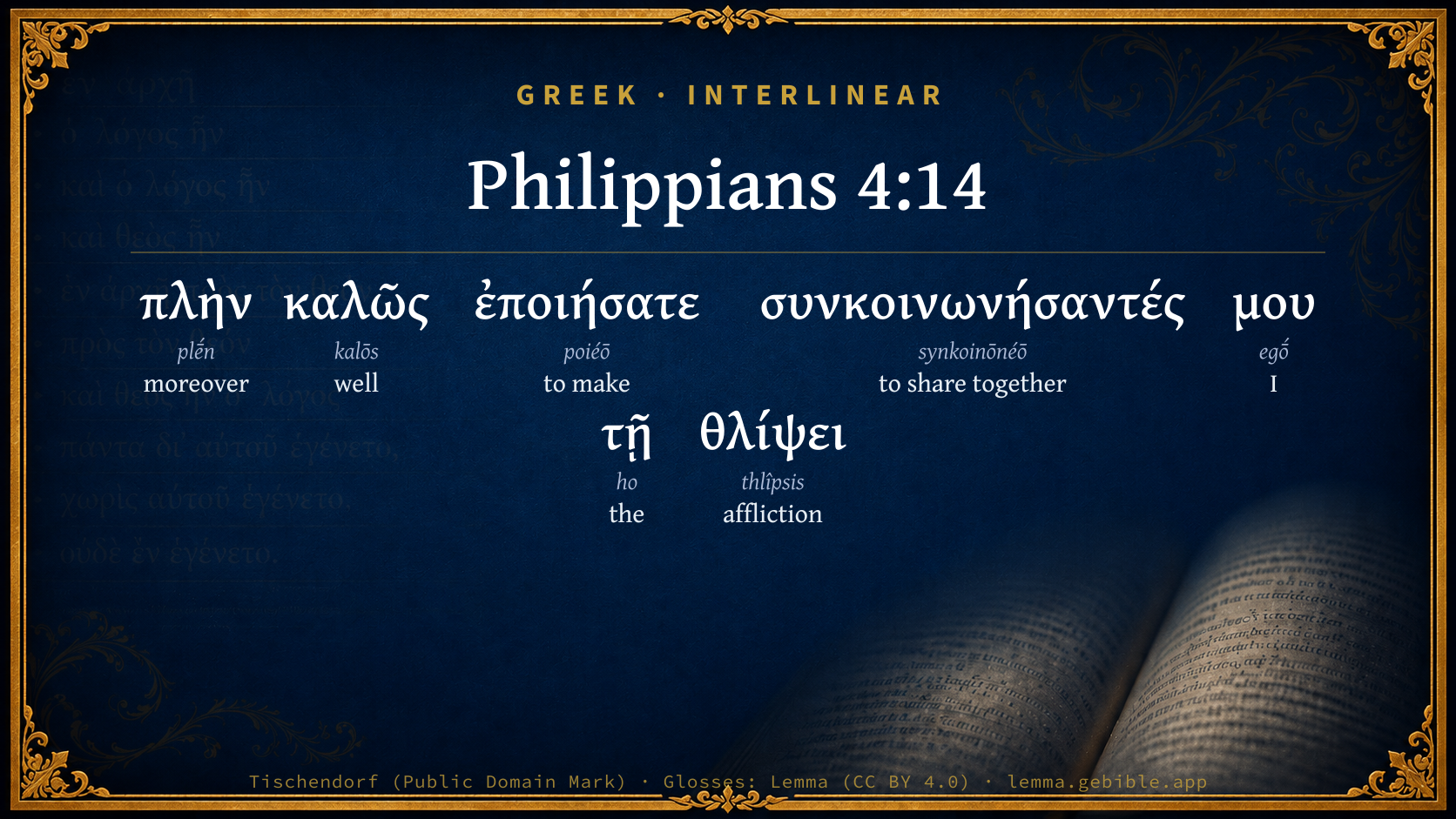
Greek (Tischendorf 8th ed.) Philippians 4:14 appears in the Greek New Testament. The text above is from the Tischendorf 8th edition. Each word links to its Strong’s number and a concise gloss. Click any word for its full Thayer’s Greek Lexicon entry.
Download image
Cite this verse

Philippians 4:14 (World English Bible). Public Domain. Lemma interlinear Bible study tool, https://lemma.gebible.app/v/philippians/4/14.

Show BibTeX & RIS
BibTeX
RIS
English Translation
However you did well that you shared in my affliction.
World English Bible · Public Domain
Download a study sheet

One document with this verse’s original text, its word-by-word gloss line, the meaning frame, cross-references with their text, attributed commentary, and full source and license credits — printable, and it pastes into notes with its structure intact.

This verse Autodidact and up

Study sheet (.html) Plain text (.txt)

A passage Seminary Student

Up to 50 verses in one chapter. A passage sheet keeps up to 6 commentary sources and 12 cross-references per verse, in the order this page ranks them, and says so on the sheet whenever that leaves anything out. Ask for a single verse and you get the Autodidact verse sheet above.

Everything on this page stays free to read, with no account — the sheet is a download of what is already on screen, not access to it.

Want to remove ads? Support Godless Engineer
Compare translations 3

The same verse in 3 English versions, stacked beneath the original-language interlinear above. Click any original word for its lexicon entry.

Each is an independent rendering of the whole verse — the interlinear is not word-aligned to these translations.

Highlighted words mark where these versions differ — a whole-verse word diff, not a word-by-word alignment.

  • World English Bible Public Domain
    However you did well that you shared in my affliction.
  • King James Version Public Domain
    Notwithstanding ye have well done, that ye did communicate with my affliction.
  • unfoldingWord Literal Text CC BY-SA 4.0
    However, you did well, having shared together in my affliction.

unfoldingWord Literal Text — © unfoldingWord, licensed CC BY-SA 4.0. Word-aligned USFM3 via Door43 (git.door43.org/unfoldingWord/en_ult).

Versions to compare (up to 4)

3 of 4 selected

Show all 19 translations

Every available English version of this verse, each an independent rendering of the whole verse.

  • World English Bible Public Domain
    However you did well that you shared in my affliction.
  • Berean Standard Bible Public Domain
    Nevertheless, you have done well to share in my affliction.
  • Majority Standard Bible Public Domain
    Nevertheless, you have done well to share in my affliction.
  • King James Version Public Domain
    Notwithstanding ye have well done, that ye did communicate with my affliction.
  • American Standard Version (1901) Public Domain
    Howbeit ye did well that ye had fellowship with my affliction.
  • Revised Version (1885) Public Domain
    Howbeit ye did well, that ye had fellowship with my affliction.
  • Geneva Bible (1599) Public Domain
    Notwithstanding yee haue well done, that yee did communicate to mine affliction.
  • Douay-Rheims (1899) Public Domain
    Nevertheless you have done well in communicating to my tribulation.
  • Young's Literal Translation Public Domain
    but ye did well, having communicated with my tribulation;
  • Literal Standard Version CC BY-SA 4.0
    but you did well, having shared in my tribulation;
  • Unlocked Literal Bible CC BY-SA 4.0
    However, you did well to share with me in my difficulties.
  • unfoldingWord Literal Text CC BY-SA 4.0
    However, you did well, having shared together in my affliction.
  • Darby Bible Public Domain
    But ye have done well in taking part in my affliction.
  • World Messianic Bible Public Domain
    However you did well that you shared in my affliction.
  • Webster's Bible Public Domain
    Notwithstanding ye have done well, that ye did communicate with my affliction.
  • Free Bible Version CC BY-SA 4.0
    Even so it was good of you to share with me during my troubles.
  • Bible in Basic English Public Domain
    But you did well to have care for me in my need.
  • Text-Critical English NT CC BY 4.0
    Nevertheless, you did well by sharing with me in my affliction.
  • Tyndale New Testament (1534) Public Domain
    Not wistondynge ye have well done that ye bare parte with me in my tribvlacion.

Literal Standard Version (2020), Covenant Press — licensed CC BY-SA 4.0. Text via the HelloAO Bible API (eBible.org). Unlocked Literal Bible (unfoldingWord) — licensed CC BY-SA 4.0. Text via the HelloAO Bible API (eBible.org). unfoldingWord Literal Text — © unfoldingWord, licensed CC BY-SA 4.0. Word-aligned USFM3 via Door43 (git.door43.org/unfoldingWord/en_ult). Free Bible Version, Dr. Jonathan Gallagher — licensed CC BY-SA 4.0. Text via the HelloAO Bible API (eBible.org).

Word by word

More ways to search: Search by grammar → Find every occurrence → Compare this word →

Practice this passage: Drill this verse → Learn its vocabulary →

About this verse

These counts appear in no published source. They are computed here, from the morphology-tagged text and Lemma’s own curated glosses. What Lemma adds →

7
words
7
distinct lemmas
Pauline Epistles
section

Notable vocabulary

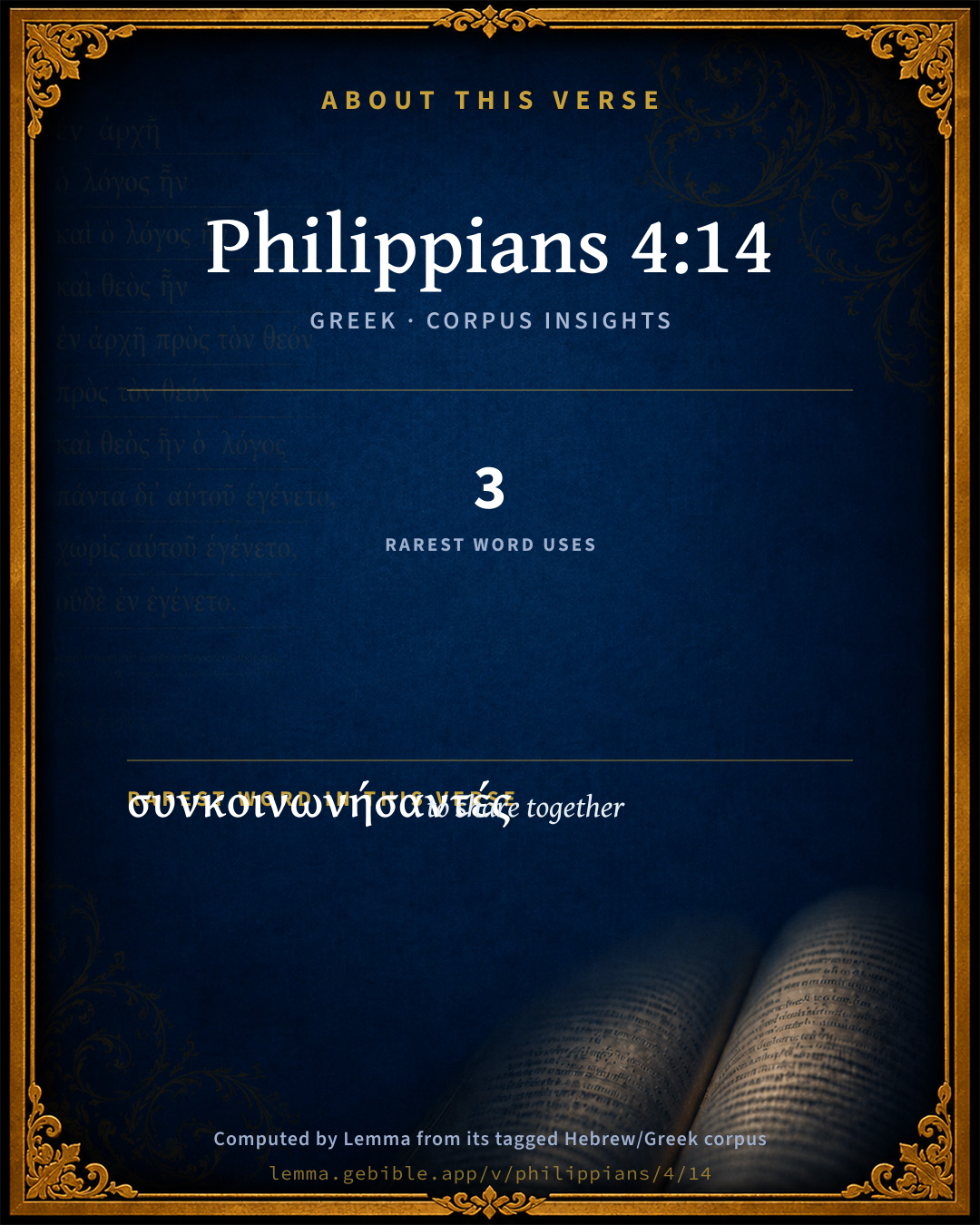
The rarest word here is συνκοινωνήσαντές to share together G4790 — appearing just 3 times in the whole Greek New Testament.

Shared distinctive vocabulary

συνκοινωνήσαντές to share together G4790 occurs in 3 verses of the Greek New Testament. Also found in:

Cross-references

13

Topical passages linked to Philippians 4:14 in the Treasury of Scripture Knowledge — connected by theme and wording, ordered by reader-vote popularity; previews shown in the World English Bible.

  • Hebrews 13:16 But don't forget to be doing good and sharing, for with such sacrifices God is well pleased.
  • Philippians 1:7 It is even right for me to think this way on behalf of all of you, because I have you in my heart, because, both in my bonds and in the defense and confirmation of the Gospel, you all are partakers with me of grace.
  • 1 Kings 8:18 But Yahweh said to David my father, Whereas it was in your heart to build a house for my name, you did well that it was in your heart:
  • Galatians 6:6 But let him who is taught in the word share all good things with him who teaches.
  • Hebrews 10:34 For you both had compassion on me in my chains, and joyfully accepted the plundering of your possessions, knowing that you have for yourselves a better possession and an enduring one in the heavens.
  • Matthew 25:21 "His lord said to him, 'Well done, good and faithful servant. You have been faithful over a few things, I will set you over many things. Enter into the joy of your lord.'
  • Philippians 4:18 But I have all things, and abound. I am filled, having received from Epaphroditus the things that came from you, a sweet-smelling fragrance, an acceptable and well-pleasing sacrifice to God.
  • 1 Timothy 6:18 that they do good, that they be rich in good works, that they be ready to distribute, willing to communicate;
  • 3 John 1:5–8 Beloved, you do a faithful work in whatever you accomplish for those who are brothers and strangers.
  • 2 Chronicles 6:8 But Yahweh said to David my father, Whereas it was in your heart to build a house for my name, you did well that it was in your heart:
  • Romans 15:27 Yes, it has been their good pleasure, and they are their debtors. For if the Gentiles have been made partakers of their spiritual things, they owe it to them also to serve them in fleshly things.
  • 1 Corinthians 9:10–11 or does he say it assuredly for our sake? Yes, it was written for our sake, because he who plows ought to plow in hope, and he who threshes in hope should partake of his hope.
  • Revelation 1:9 I John, your brother and partner with you in oppression, Kingdom, and perseverance in Christ Jesus, was on the isle that is called Patmos because of God's Word and the testimony of Jesus Christ.

Cross-references courtesy of OpenBible.info (CC BY 4.0).

Commentary

Notes on Philippians 4:14 from classic Christian and Jewish commentators (each source and its license shown beneath its notes). The classic Christian expositions comment on the surrounding passage and are grouped to its opening verse, so a note may address several verses; the Jewish commentaries on the Tanakh (Rashi and others) are per-verse, so they appear only where the commentator wrote on this verse.

Lemma curates 59 commentaries, every one of them public domain or Creative Commons licensed, each selected and text-cleaned for this edition rather than reprinted as found. About our sources →

Tyndale Open Study Notes

Tyndale Open Resources

4:14 The Philippians’ generosity and care were commendable, especially given Paul’s present difficulty in prison.

Tyndale Open Study Notes — © Tyndale Open Resources, licensed CC BY-SA 4.0. Text via the HelloAO Bible API.

Bengel's Gnomon

Johann Albrecht Bengel

Php 4:14. Συγκοινωνήσαντες) since you have communicated (imparted) to me in my affliction of your resources. It is indicated by the compound verb, that different persons also had communicated (κοινωνήσαντας) in a different way.[57]

[57] σὺν implying they joined together in doing so.—ED.

Bengel's Gnomon of the New Testament — English translation (T&T Clark, Edinburgh, 1860) — public domain. Text from a community e-Sword module.

Meyer's Critical & Exegetical Commentary

Heinrich August Wilhelm Meyer

Php_4:14. Πλήν] Nevertheless. (1Co_11:11; Eph_5:33), apart from the fact that with such moral power I am equal to all emergencies, and therefore, as far as want is concerned, do not need aid (comp. Php_4:11). Cavet, ne fortiter loquendo contemsisse ipsorum beneficium videatur, Calvin. Comp. Chrysostom and Theophylact.

καλῶς] in the moral sense.

συγκοιν. μου τῇ θλίψ.] characterizes the work according to its high ethical value (ὅρα σοφίαν, πῶς ἐπαίρει τὸ πρᾶγμα, Theophylact): that ye became partakers with me in my affliction. He who renders the aid enters into the relation of a participant in the position of the afflicted one, inasmuch as by his very work of love he, in common with the latter, shares and bears his θλῖψις. Comp. Rom_12:13. It is a practical participation, and not merely that of feeling and emotion. Comp. Eph_5:11; Rev_18:4; Rev_1:9. By τῇ θλίψ., Paul means his position at the time as a whole, not: want (which also in 2Co_8:13 it does not mean). The dative is governed by συγκοιν. (Eph_5:11; Rev_18:4; Rom_12:13; Rom_15:27, et al.); and μου is, in accordance with the well-known usage, to be taken as if μοι were in the text (comp on Php_2:2; and Stallbaum, ad Plat. Rep. p. 518 C, Symp. p. 215 C). The aorist participle coincides as to time with ἐποιήσατε (see on Eph_1:9); as to the participle with καλῶς ποιεῖν, see Winer, p. 323 f. [E. T. 434].

Meyer — Critical and Exegetical Commentary on the New Testament — English translation by Peter Christie, edited by Frederick Crombie (T&T Clark, 1880) — public domain. Text from a community e-Sword module.

Expositor's Greek Testament

ed. W. Robertson Nicoll

Phi 4:14 . πλήν . See on chap. Phi 3:16 . “All the same, I rejoice in your kindness.” καλῶς . Hort (on 1Pe 2:12 ) points out that καλός “denotes that kind of goodness which is at once seen to be good”. συνκ . (the preferable spelling). In classical usage (almost confined to Demosth.) this verb has the genitive of the thing in which a share is given. They had made common cause with his affliction (probably referring to his imprisonment). The bringing forward of μου emphasises their personal relation to the Apostle, which was apt to be obscured by the form of expression used.

The Expositor's Greek Testament, edited by W. Robertson Nicoll (1897–1910) — public domain. Text from a community e-Sword module.

Jamieson, Fausset & Brown

Robert Jamieson, A. R. Fausset & David Brown

He here guards against their thinking from what he has just said, that he makes light of their bounty.

ye did communicate with my affliction--that is, ye made yourselves sharers with me in my present affliction, namely, by sympathy; of which sympathy your contribution is the proof.

Jamieson, Fausset & Brown — Commentary Critical and Explanatory on the Whole Bible (1871) — public domain (CC PDM 1.0). Text via the HelloAO Bible API.

Adam Clarke's Commentary

Verse 14. Ye have well done] Though I have learned all these important lessons, and am never miserable in want, yet ye have done well in sending me relief in the time of affliction.

Adam Clarke's Commentary on the Bible (1810–1826) — public domain. Text from a community e-Sword/MySword module.

John Calvin's Commentaries

14 Nevertheless ye did well How prudently and cautiously he acts, looking round carefully in both directions, that he may not lean too much to the one side or to the other. By proclaiming in magnificent terms his steadfastness, he meant to provide against the Philippians supposing that he had given way under the pressure of want. He now takes care that it may not, from his speaking in high terms, appear as though he despised their kindness — a thing that would not merely shew cruelty and obstinacy, but also haughtiness. He at the same time provides for this, that if any other of the servants of Christ should stand in need of their assistance they may not be slow to give him help.

John Calvin's Commentaries (1540-1563) — public domain. Text from the Calvin Translation Society English edition (1840s-50s) via the Christian Classics Ethereal Library (ccel.org). Calvin's coverage is partial (roughly two-thirds of the Bible); uncommented books and verses are honest gaps, never fabricated. The 19th-century editor's footnotes and remarks are omitted so the notes are faithfully Calvin's own voice.

Ellicott's Commentary for English Readers

(14) Ye have well done.—Properly, Ye did well, in sending the offerings. In this, says St. Paul, they “did communicate with his affliction,” that is (see Php_1:7), they made it their own, helping him to bear it, by sympathy and sacrifice for his sake. The whole is an illustration of his own words (Act_20:35), “It is blessed to receive” what is lovingly given; but it is “rather blessed to give.” He had the lower blessedness, they the higher; and he rejoiced that it was so.

A Bible Commentary for English Readers, edited by Charles John Ellicott (1878–1897) — public domain. Text from a community e-Sword module.

The Cambridge Bible for Schools and Colleges

gen. ed. J. J. S. Perowne

14. Notwithstanding] “Again the Apostle’s nervous anxiety to clear himself interposes” (Lightfoot). We would rather call it loving care than nervous anxiety. He is tender over their feelings, as he thinks how “their deep poverty has abounded to the riches of their liberality” (2Co_8:1-2), in love to him and to the Lord; and not even his testimony to the power of Christ shall make him seem to slight their collection.

ye have well done] Better, perhaps, ye did well; when you gave and sent your alms.

communicate with] Better, as more intelligible to modern readers, take a share in. For the thought, cp. on Php_1:7. Their sympathy, coming out in self-denial, blent their experience with that of the imprisoned and impoverished Apostle.

The Cambridge Bible for Schools and Colleges (gen. ed. J. J. S. Perowne; Cambridge University Press, 1878–1918) — public domain. Text from a community e-Sword module.

John Gill's Exposition

Notwithstanding ye have well done,.... This he says lest they should think he slighted their kindness, and lest they should be discouraged from doing any such thing of this kind another time, either to himself or others; for though he was so well contented with his state, and knew how to be abased and to suffer need, and could do all things through the strength of Christ, yet he observes they did well in communicating to him; for communicating to poor saints or ministers is a considerable branch of well doing; it is a good work when it is done in faith, and from love, and with a view to the glory, honour, and interest of Christ; it is what is agreeable to the will of God, and is an odour of a sweet smell, and acceptable to him:

that ye did communicate with my affliction; by which is meant, not any affliction of mind, for he was in as comfortable a frame, had as clear views of his interest in God, as his covenant God, and was as contented and satisfied as ever he was in his life; nor any disorder or distemper of body; but he was in prison and penury: these Philippians communicated with him in it, both by sympathizing with him in his tribulation, and by sending their minister to visit him, and with him a present for his relief and support; in doing which they did well.

John Gill's Exposition of the Whole Bible (1746–1763) — public domain (CC PDM 1.0). Text via the HelloAO Bible API.

Trapp's Complete Commentary

John Trapp

14 Notwithstanding ye have well done, that ye did communicate with my affliction.

Ver. 14. Ye have well done] For hereby as you have sealed up your love to me, and engaged me to pray for you (as for Onesiphorus, 2Ti 1:16), so you have gotten a good testimony to yourselves that ye are members of Christ’s mystical body. The tongue is far enough from the toe, the heel from the head, yet when the toe or heel is hurt, the rest of the members sympathize and seek help for it. So here.

John Trapp, A Commentary or Exposition upon All the Books of the Old and New Testament (1647–1656) — public domain. Text from a community e-Sword module.

Albert Barnes' Notes on the Bible

Notwithstanding, ye have well done - Though he had learned the grace of contentment, and though he knew that Christ could enable him to do all things, it was well for them to show sympathy for his sufferings; for it evinced a proper regard for a benefactor and an apostle.

Ye did communicate - You took part with my affliction. That is, you sympathized with me, and assisted me in bearing it. The relief which they had sent, not only supplied his wants, but it sustained him by the certainty that he was not forgotten.

Albert Barnes' Notes on the Bible (1834–1885) — public domain. Text from a community e-Sword/MySword module.

Haydock's Catholic Bible Commentary

In communicating;[3] i.e. contributing to relieve my wants. (Witham)

===============================

[BIBLIOGRAPHY]

Communicantes, Greek: sugkoinonesantes. See Chap. i. 5. &c.

George Leo Haydock (1774–1849), Haydock's Catholic Family Bible and Commentary, 1859 edition — public domain. Excludes Psalms (Douay-Rheims chapter numbering differs from Protestant) and Deuterocanonical books (Catholic canon only).

Matthew Poole's English Annotations

Lest any should suspect, from what he had suggested of his contentment, that he was not much affected with their liberality, but might have done as well without as with it, and they might have spared their bounty and labour, he doth prudently commend their Christian commiseration, (as the phrase is, Act 10:33), and give them to understand how acceptable their seasonable supply was to him, who did so joyfully resent their kindness to him, in that it was well-pleasing to God, Rom 12:15; they did so effectually sympathize and take a share in the oppression he sustained for the cause of Christ, 2Co 1:7, and remember him in his bonds as if it were their own case, Heb 13:3; Rev 1:9.

Matthew Poole's English Annotations on the Holy Bible (1683–1685) — public domain. Text from a community e-Sword/MySword module.

Whedon's Commentary on the Bible

Daniel D. Whedon

14. Ye have well done—Ye did beautifully. There was a high moral beauty in this sympathy, in which they put themselves into fellowship with his condition.

Daniel D. Whedon (gen. ed.), Commentary on the Old and New Testaments (1874–1909) — public domain. Text from a community e-Sword module.

The Pulpit Commentary

Notwithstanding ye have well done, that ye did communicate with my affliction; rather, as R.V, ye had fellowship with my affliction. St. Paul values the sympathy, the fellow-feeling, more than the gifts; he could have done without the gifts, but they were precious as a proof of love.

Vers. 14-20. The sympathy of the Philippians with St. Paul.

I THEIR GIFTS.

1. They had fellowship with him in his affliction. They made it their own; they showed the reality of their sympathy by their gifts. They were themselves in a great trial of afflictions, in deep poverty. They did not make their afflictions or their poverty an excuse for not aiding the apostle; they assisted him again and again. They did well, he says. Christian sympathy is a beautiful thing; it sweetens the cup of sorrow; it is one of God"s most precious gifts. St. Paul felt it deeply. He did not seek their alms; that, indeed, helped him in his trouble. But he could have done without it, he had learned the great lesson of contentment. But the sympathy of Christian love was very precious to him; he yearned for it; it was his chiefest comfort next after the presence of Christ. He prized it for their sake as well as for his own; it proved that his labors had not been in vain. It was good for them too; it was good for them to show sympathy, as it was for the apostle to receive it. Christian sympathy, like mercy, is twice blest blesseth him that gives and him that takes.

2. They gave readily, spontaneously. It was "in the beginning of the gospel;" they had but just become Christians; St. Paul had but just left them. He was at Thessalonica, the chief city of Macedonia. The Philippians did not leave the duty of ministering to the apostle"s wants to the Thessalonians; they sent once and again, the little town to the great city, unto his necessities. They were the first, it seems, to have the great privilege of supporting St. Paul in his apostolic labors. They did not wait to see what others would give; they set the example; they gave what they could, and that at once.

3. They were not weary in well-doing. They sent again and again, twice at least, to Thessalonica; a third time, when St. Paul departed from Macedonia. "Brethren front Macedonia" supplied his wants at Corinth. (2Co_11:9) "The Churches of Macedonia" abounded in their liberality towards the poor brethren at Jerusalem; (2Co_8:1, 2Co_8:2) and now they sent Epaphroditus to relieve the apostle"s wants in his Roman imprisonment.

4. They gave unasked. St. Paul did not desire gifts; he was even unwilling to receive assistance from other Churches. "I seek not yours, but you," he said to the Corinthians. But the Philippians loved him for his work"s sake and for his own sake. They gave freely out of love; they gave gladly, for they had learned of the Lord Jesus Christ, the great Teacher, that "it is more blessed to give than to receive.

II ST. PAUL"S FEELINGS ON RECEIVING THEIR CONTRIBUTION.

1. His sensitive nature is deeply touched with the evidence of their love; but he shrinks from appearing to invite further liberality. It is not the gift, he says, that he seeks. He is pleased, he rejoices, but not for his own sake; it, is for the givers, for the sake of the Philippians, that St. Paul"s heart is touched with holy joy. It is good for them to give; he knows it. Their bounty is set down to their account in the treasury of heaven, and this thought is full of sweetness to the apostle"s soul.

2. His contentment. He needed nothing more, he said; Epaphroditus had brought all he wanted, and more than he wanted. Mark the unworldliness of the apostle. We are never satisfied; whatever we have we want more. He was satisfied amid hardships, in captivity. For he had the peace of God which passeth all understanding, and, having that, he could not crave for earthly comforts.

III THE ACCEPTABLENESS OF THEIR GIFT.

1. Those gifts relieved St. Pauls wants, but they had a far higher character they were, he tells us, an odour of a sweet smell, a sacrifice acceptable, well-pleasing to God. " Christian almsgiving is a very sacred thing; God accepts the gift as given to himself. It has a sacrificial character; for it issues out of that spiritual sacrifice offered to God by the royal priesthood the sacrifice of self. We are bidden to present our bodies as a living sacrifice. The offering of ourselves sanctifies the lesser offering of our earthly goods.

2. The reward. The cup of cold water given in the name of a prophet would bring a prophet"s reward. The Philippians had supplied the apostle"s needs; they had done it for Christ"s sake, whose servant he was; God would supply all their needs. They had given according to their means, out of their deep poverty; God would reward them according to his riches. What a word is this! The riches of God are infinite; infinite, then, is the reward, not of almsgiving in itself, but of the faith and love which prompted it. "Can two mites buy the kingdom?" asks St. Chrysostom. Yes, if they are given in the spirit of the poor widow, in undoubting faith and self-sacrificing love. God will reward those who minister to his saints, in glory in the glory of his grace and presence now, in the glory of heaven hereafter. He will reward them in Christ Jesus, in virtue of that living union with Christ, through which alone all spiritual blessings flow into the believer"s soul.

3. The thanksgiving. The glory is God"s. It is he who giveth his people a willing heart to offer willingly. The glory is his. Men see their good works and glorify their Father. All glory is his, all majesty, dominion, and power, and that throughout the ages of eternity.

Lessons. Learn:

1. The beauty of Christian sympathy.

2. The blessedness of Christian almsgiving.

3. To give like the Philippians, gladly.

4. To receive, if need be, like St. Paul, prizing the love more than the gift.

5. Always to ascribe the glory to God.

Vers. 14-18. The circumstances of their liberality.

The apostle guards against any appearance of slighting their gifts by specifying the grounds of his joy in them.

I THEIR LIBERALITY WAS NOT MERE ALMSGIVING, BUT AN ACT OF CHRISTIAN SYMPATHY. "Ye did well in communicating with my affliction." They were ready to share the burden of his troubles. There were no converts nearer to the heart of the apostle or more closely identified with his deepest trials.

II THE APOSTLE"S WILLINGNESS TO ACCEPT THEIR GIFTS WAS EXCEPTIONAL IN ITS CHARACTER. While he refused to receive gifts from the Corinthians (2Co_11:9) and from the Thessalonians (1Th_2:5 2Th_2:8) because he would not compromise his independence in the case of Churches which were only too ready to question his motives, he conferred on the Philippians the exceptional privilege of ministering to his wants. Once when he left Macedonia, and twice when he was in Thessalonica, they sent, "to relieve his want.

III THIS WILLINGNESS DID NOT IMPLY THAT HE COVETED THEIR GIFTS. "Not that I seek the gift, but I seek the fruit that aboundeth to your account." He does seek to stimulate their generosity, but rather to increase that recompense which every fresh proof of their love would be sure to enhance.

IV HIS ACKNOWLEDGMENT OF THEIR LATEST GIFTS BY EPAPHRODITUS. "I have all things and abound: I am full, having received from Epaphroditus the things sent from you, an odour of a sweet smell, a sacrifice acceptable, well-pleasing to God.

1. It was a thoughtful kindness to send him gifts while he was a prisoner at Rome. The Christians at Rome seem to have been lax in this duty. As he could not gain a living for himself in prison, he was the more dependent on outside generosity.

2. It was doubly pleasant to have the gifts from Philippi conveyed by one so faithful and so dear to the apostle as Epaphroditus.

3. The gifts in his eyes owed their chief value to their being acceptable in God"s sight. T.C.

Vers. 14-19. Almsgiving a part of Christian life and worship.

I THE RELATIONSHIP BETWEEN THOSE who GIVE AND THOSE WHO RECEIVE ALMS IS ONE OF COMMUNION. (Ver. 15) It is a mistake to suppose that the benefit of almsgiving is all on the side of the recipients. They who possess, possess in order that they may show their brotherhood with those who possess not. To receive is just as much an act of brotherhood as to give. Never regard the bestowing of alms as an act of patronage, or the receiving of them as an act of homage.

II THE BENEFIT OF ALMSGIVING TO THE ALMSGIVER. It is fruit (ver. 17), which abounds to his account. Fruit is the production of life.

III ALMSGIVING IN THE SIGHT OF GOD. A sacrifice well-pleasing to him (ver. 18). He sees in every act of self-denial a reflection of the sacrifice of his dearly beloved Son in whom he is well pleased.

IV ALMSGIVING A PART OF CHRISTIAN WORSHIP. Worship is the offering of ourselves and our substance to God. We can only do this through receiving of his grace. We give him back in offerings what he gives us in bounty He returns our offerings multiplied with his blessing and full of his grace (ver. 19). There is a Divine circulation of grace as there is a natural circulation of the blood. So long as we are true to Jesus, who is the very heart of God, so long does he pour forth his grace into us the living members of his body. We return that grace to him in the shape of our poor prayers and deeds of service, and we are again quickened by him from the boundless riches of his grace. VW.H.

The Pulpit Commentary (1880–1919), ed. H.D.M. Spence-Jones & Joseph S. Exell — public domain. Text from a community e-Sword module.

Kretzmann's Popular Commentary

Paul E. Kretzmann

The generosity of the Philippians and God’s reward:

v. 14. Notwithstanding ye have well done that ye did communicate with my affliction.

v. 15. Now ye Philippians know also that in the beginning of the Gospel, when I departed from Macedonia, no church communicated with me as concerning giving and receiving, but ye only.

v. 16. For even in Thessalonica ye sent once and again unto my necessity.

v. 17. Not because I desire a gift; but I desire fruit that may abound to your account.

v. 18. But I have all and abound; I am full, having received of Epaphroditus the things which were sent from you, an odor of a sweet smell, a sacrifice acceptable, well-pleasing to God.

v. 19. But my God shall supply all your need according to His riches in glory by Christ Jesus.

v. 20. Now unto God and our father be glory forever and ever! Amen.

The apostle now turns the attention of his readers back to the Philippians and their gift, his delicacy and tenderness being unwilling to leave them under the impression as though he did not appreciate their thoughtfulness and love to the full: All the same, you have done well that you shared in my affliction. It was a truly good work to remember him thus. It is also today a good and laudable thing if all Christians take proper care of their pastors in gifts of this world. That is an evidence of their love and appreciation of the Gospel.

Paul now mentions instances of the generosity of the Philippians: But you also know, Philippians, that at the beginning of the Gospel, when I departed from Macedonia, no church communicated with me in the matter of giving and receiving but you only. For also in Thessalonica you sent once and a second time to me for my need. Paul speaks commendingly of the fact that the Philippians, whom he singles out by the use of their name, had excelled in this particular work of taking care of his bodily needs. It was in the days when he first came to Macedonia, when he had preached the Gospel in Philippi and then had continued his journey to Thessalonica, which was situated just 100 Roman miles (about 92 English) west on the Via Egnatia. During Paul’s stay at Thessalonica, the congregation at Philippi had repeatedly remembered him with gifts of their gratitude; they had taken care of him when he was in need, certainly a splendid example for all Christian congregations.

But in praising the Philippians, Paul does not want to create a false impression: Not that I seek the gift, but I seek the fruit that abounds to your account. That was not Paul’s object in reminding of their kindness in the past; he was not giving them a hint to send him some more gifts. He was not interested so much, and for his own person, in the external gift as in the evidence which it presented as being a fruit of their faith, which would be charged to their credit. The account in their favor would be largely increased by such manifestations of their faith in love. They would in due time receive their returns, the reward of grace in full value. Eternity will reveal how many gifts of love individuals and congregations have made for the cause and to the ministers of Christ.

There was no need of worrying on his account: But I have all and have abundance; I am filled, having received of Epaphroditus the things from you, an odor of sweetness, a sacrifice acceptable and well-pleasing to God. Since the messenger of the Philippian congregation, Epaphroditus, had delivered their bounty, Paul now had more than his immediate needs required; he had nothing left to wish for, he had not only outward abundance, but inward satisfaction as well. He calls their gift a savor of sweetness, like the Old Testament sacrifices that were well-pleasing to God. Their work of love was acceptable to God, it found favor in His sight; it pleases Him when congregations show their loving appreciation of the spiritual gifts which they have received by imparting to their teachers of their earthly goods.

Paul now makes such returns as he is able to make: But my God will fill all your need according to His riches in glory in Christ Jesus. To God, however, and our Father be glory forever and ever! Amen. This is a prayer that God would fulfill every need of the Philippian brethren. What they still lack in spiritual gifts, in knowledge of Christ, God will supply, and abundantly, with the infinite possibilities of His riches. If believers supply the physical wants of their pastors in a spirit of true love and faith, God will let this good work redound to their furtherance in spiritual growth. Since He has all riches, in both the physical and spiritual domain, He can supply and donate spiritual gifts in endless variety and richness. For the greatest riches are those in the glory of Jesus Christ. Whatever good gifts in spiritual riches God gives have been made possible through the mediatory work and vicarious sacrifice of Christ. All spiritual gifts and blessings are ours in Him. And God gives them to the believers for Christ’s sake. For that reason all glory shall be given to God, who is also our Father, the Father of all believers in and through Jesus. This praise and glory shall be given to Him as His rightful due forever and ever. Amen. Thus Paul, after his custom, ends with a doxology, with an expression of praise to the Lord, the Giver of all good gifts.

Paul E. Kretzmann, Popular Commentary of the Bible (1921–1924) — public domain. Text from a community e-Sword module.

Burkitt's Expository Notes on the New Testament

William Burkitt

Although our apostle had declared in the foregoing verses, that he had fully learnt the lesson of contentment in all conditions, and could bear poverty and want without complaining, yet withal he assures them here, that they did well in sending such supplies to him in prison by Epaphroditus, as they had done; and thereby testifying, by their Christian commisseration, that they shared with him in his afflictions and sufferings for Christ.

Where note, 1. The apostle’s thankful acknowledgment of the Philippians’ present liberality towards him, now in bonds for preaching the gospel to them; and how he takes occasion from thence to make an honourable mention of their former bounty towards him, even from his first preaching of the gospel to them; nay, when he was gone from them at Philippi, and preached to those at Thessalonica, yet did the Philippians send their bounty after him more than once, which no other church had then done besides themselves.

Learn hence, 1. That there is a rule of equity to be observed, as between other relations, so between ministers and people, that as they bestow labour and pains, so they should receive encouragement and maintenance, and this not barely as a gratuity, but as a due debt.

2. That the faithful ministers of Christ, though they may challenge a supply of temporal things from their people, for their spiritual things, as a due debt; yet do they fully receive it, and gratefully acknowledge it, to the honour and commendation of their people, with fervent prayer to God, that it may be a fruit redounding to their account in the great day of account. O ye Philippians, know, that when no church communicated with me, ye sent once and again to my necessities.

William Burkitt's Expository Notes on the New Testament (1700–1703) — public domain. Text from a community e-Sword module.

The People's New Testament

B. W. Johnson

14. Ye have done well. Though Christ gave him strength to bear want, it was a good thing, a kind deed, that they supported him in his affliction. Communicate. Had fellowship with; shared.

B. W. Johnson's The People's New Testament with Notes (1889–1891) — public domain. Electronic text from the Christian Classics Ethereal Library (CCEL) ThML edition.

unfoldingWord translationNotes

Door43 World Missions Community

Connecting Statement:

Paul continues explaining that he is thanking the Philippians for their gift to him simply because he is grateful, not because he needs them to give him anything more (see Philippians 3:11).

in my difficulties

Paul speaks of his hardships as if they were a place that he was in. AT: "when things became difficult" (See: Metaphor)

the beginning of the gospel

Paul refers to the gospel here as meaning his preaching of the gospel. (See: Metonymy)

no church supported me in the matter of giving and receiving except you alone

This can be stated in the positive. AT: "you were the only church that sent me money or helped me" (See: Double Negatives)

I seek the fruit that increases to your credit

Paul is speaking of the Philippians' gift as if it were a person's bank account that increases more and more. In this case, it is God who acknowledges the good things done by the Philippian believers. Paul wants the Philippians to give gifts so they can receive spiritual blessings. AT: "I do want to see God give you more and more spiritual blessings" (See: Metaphor)

translationWords

good news

Macedonia

church

Thessalonica

fruit

unfoldingWord translationNotes — © Distant Shores Media and the Door43 World Missions Community, licensed CC BY-SA 4.0. Source: git.door43.org/Door43/en_tn.

Cambridge Greek Testament for Schools and Colleges

14. πλὴν καλῶς ἐποιήσατε. He is lovingly anxious lest his “ability in Christ” should even seem to blunt his gratitude to his friends, whose “deep poverty had abounded to the riches of their liberality” (2Co 8:1-2).

ἐποιήσατε. “Ye did”; when you sent your alms.

συνκοινωνήσαντες. “Unitedly sharing in.”—See above, Php 1:7.—Their practical sympathy, with its self-denial, blent their experience and that of the afflicted Apostle into one; and they were all of one mind (συν-) in so acting.

Cambridge Greek Testament for Schools and Colleges (Cambridge University Press, 1896; 21 vols, various authors incl. Carr, Maclear, Plummer, Farrar, Lumby, Moule, M. R. James, Simcox) — public domain. Text from a community e-Sword module.

Alford’s Greek Testament

Henry Alford

14.] ‘Cavet, ne fortiter loquendo contempsisse ipsorum beneficium videatur.’ Calv. μὴ γὰρ ἐπειδή, φησιν, ἐν χρείᾳ οὐ καθέστηκα, νομίσητε μὴ δεῖσθαί με τοῦ πράγματος· δέομαι διʼ ὑμᾶς. Chrys.

συγκοινωνήσαντές μου τῇ θλίψει] ὅρα σοφίαν, πῶς ἐπαίρει τὸ πρᾶγμα, Thl.: in that ye made yourselves partakers with my present tribulation (not poverty: by their sympathy for him they suffered with him; and their gift was a proof of this sympathy).

Henry Alford, The Greek Testament (1849–1861) — public domain. Text from a community e-Sword module.

International Critical Commentary

14. πλὴν: ‘nevertheless.’ (See on 1:18, 3:16.) ‘Nevertheless, do not think that, because I am thus independent of earthly contingencies, I lightly prize your gift.’

καλῶς ἐποιήσατε: ‘ye did nobly.’ Positive and generous praise: not a mere acknowledgment that they had simply done their duty. It was a beautiful deed, true to the gospel ideal of καλὸς. For the phrase καλῶς ποιεῖν, see Mar 7:37; Luk 6:27; 1Co 7:37.

συνκοινωνήσαντές μου τῇ θλίψει: ‘that ye made common cause with my affliction’; ‘went shares with’ (Lightf. on Gal 6:6). The A.V. ‘communicate’ is correct, if ‘communicate’ is understood in its older sense of ‘share,’ as Ben Jonson, “thousands that communicate our loss.” (Comp. Rom 12:13.) The verb occurs only in Eph 5:11; Rev 18:4. The participle, as the complement of ἐποι., specifies the act in which the καλ. ἐποι. was exhibited. For the construction, comp. Act 5:42; 2Th 3:13; Win. xlv. 4. The dative θλίψει expresses that with which common cause was made.

Their gift is not the first and only one which he has received. It is a repetition of former acts of the same kind, a new outgrowth from his long and affectionate relations with them. He might justly expect and could honorably accept help from those who had been the first to minister to his necessities, and who had so often repeated their ministry. The idea of a quasi-apology for his reproach of the Philippians, because his former relations with them had justified his disappointment in not receiving earlier supplies (Chr., Œc., Theoph.), is utterly without foundation, since no reproach had been uttered or implied. There is no specific praise of their earlier gifts, but the καλ. ἐποι. is confirmed by the fact that the last gift was a continued manifestation of the same spirit that had marked them from the beginning.

Baur’s inference from 2Co 11:9, that the Philippians had been accustomed to send him a regular annual contribution which had now for some time been intermitted, requires no notice.

International Critical Commentary — older volumes (1896–1929), various authors — public domain. Text from a community e-Sword module.

Vincent's Word Studies in the New Testament

Marvin R. Vincent

Notwithstanding. Lest, in declaring his independence of human aid, he should seem to disparage the Philippians' gift.

Marvin R. Vincent, Word Studies in the New Testament (1887–1900) — public domain. Text from a community e-Sword/MySword module.

Lesson kit

Teaching starters — assembled from the data on this page, not authored interpretation. Every prompt links to the verse data it draws on. Edit before teaching.

Philippians, in the Pauline Epistles, opens this verse with 7 words (7 distinct Greek lemmas). Its most distinctive word is synkoinōnéō (“to share together”). A historical commentator’s framing appears above. Read the whole chapter for the surrounding context.

Discussion questions

  1. What does “to share together” (synkoinōnéō) contribute to the verse as a whole?
  2. Ephesians 5:11 shares the word «to share together» with this verse. How do the two illuminate each other?
  3. The translations on this page render this verse differently — a whole-verse word diff, not a word-by-word alignment. What might account for the different wordings?
  4. Reading how Tyndale Open Study Notes and Bengel's Gnomon read this verse, where do the two commentators agree and where do they part?

Things to notice

Reading settings

Reading text

Shown beneath each verse's original-language words.

Old Testament
Old Testament edition

Read the OT as the Masoretic Hebrew (MT) or the Greek Septuagint (LXX).

English shown for the Greek Septuagint (in the Hebrew ↔ Greek comparison).

Comparing translations? Open the Compare panel on any verse page to stack up to four side by side.