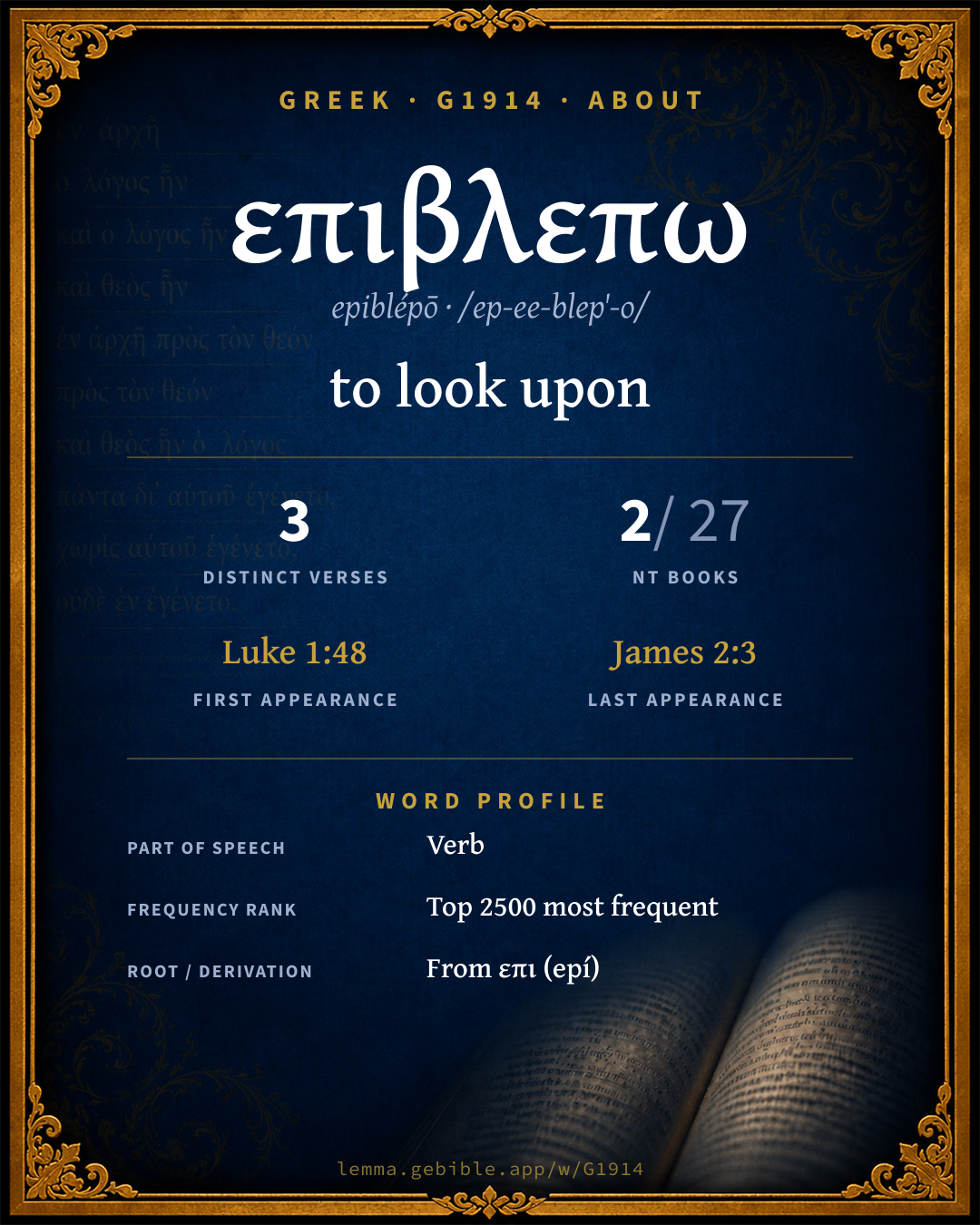
ἐπιβλέπω
to look upon
‘to look upon’ is one of 3 main senses fuller range ↓
Full lexicon entry — Thayer's Greek Lexicon
From Thayer's Greek Lexicon
Where this word appears
Grammar key — what these labels mean
Part of speech
- Verb
- An action or state-of-being word.
Tense
- Aorist
- Action viewed as a simple whole, without regard to duration — often past (perfective aspect).
Voice
- Active
- The subject performs the action.
Mood
- Indicative
- States a fact or asks a factual question (the mood of reality).
- Infinitive
- A verbal noun (“to write”), unmarked for person or number.
- Subjunctive
- Expresses probability, purpose, or possibility (the mood of contingency).
Person
- 3rd person
- The one spoken about (“he / she / it / they”).
- 2nd person
- The one addressed (“you”).
Number
- Singular
- One.
- Plural
- More than one.
Grammatical forms
- Verb, Aorist, Active, Indicative, 3rd person, Singular 1 time (33%)
- Verb, Aorist, Active, Infinitive 1 time (33%)
- Verb, Aorist, Active, Subjunctive, 2nd person, Plural 1 time (33%)
Parsed forms decoded from the imported morphology (Robinson–Tischendorf, public domain), counted across 3 parsed occurrences — not distinct verses.
Every verse where G1914 appears — 3 distinct verses across 2 books. Click any verse to open its interlinear word-by-word view. Verse text shown in the World English Bible for context — . Each verse’s Greek form is shown with its reference; the English is not keyword-highlighted, since the data carries no word-level English alignment. Use “Compare translations” on any verse to read it across multiple English versions. This concordance covers the Greek New Testament; Septuagint (Greek Old Testament) occurrences of this word are not indexed here.
Luke 2 verses
James 1 verse
About this entry
At a glance — auto-summarized from this page’s data, not written by a person. Every figure links to its source below. This summary describes the numbers; it doesn’t interpret them.
The Greek verb επιβλεπω centers on the idea of “to look upon.” It occurs a mere 3 verses across Scripture. The word gravitates to Luke (67%), then James. Its earliest occurrence is Luke 1:48. Thayer's distinguishes 3 senses for it. For the data behind this summary, explore the sense tree and the renderings breakdown below.
Gloss history
Strong's 1890 vs modern scholarship

About this word
Strong's G1914 catalogs a Greek word from the Greek New Testament.
These counts are not copied from any lexicon or concordance. They are computed here, from the morphology-tagged Greek New Testament. What Lemma adds →
- 3
- distinct verses
- The word appears in 3 distinct verses.
- 2 / 27
- NT books
- The word appears in 2 of 27 New Testament books.
- #2,203
- by frequency
- Top 2500 most frequent Greek words (rank 2,203 of 5,347 Greek words by occurrence).
View all 3 occurrences in the concordance →
By traditional corpus
Conventional, traditional groupings — biblical authorship is debated, so this is a traditional corpus grouping, not an authorship claim. Some books belong to more than one corpus (Luke is in both the Gospels and the Lukan corpus, and so on), so these shares overlap and need not total 100%. Each figure is a share of the word’s 3 distinct verses.
- Gospels 2 verses · 67%
- Lukan (Luke–Acts) 2 verses · 67%
- General (Catholic) Epistles 1 verse · 33%
How translations render this word
Counts come from each version’s own published word-to-Strong’s tagging or interlinear alignment — an approximate guide to how each version renders this word, not a word-level alignment the data otherwise carries. Because each total is that version’s own tagged count, the per-version totals vary from one another and need not match the appearance or distinct-verse counts above. These counts may also differ from a printed concordance because Lemma counts each distinctly tagged rendering and does not collapse phrase taggings into a single head-word total. This is a fixed set of word-tagged versions (KJV, ASV, BSB, ULT) and does not change with the reading translation you choose elsewhere. Each version’s license is shown beside its name below (and on Sources).
- King James Version: He hath regarded 1×, Look 1×, Ye have respect 1×
- American Standard Version: He hath looked 1×, Look 1×, Ye have regard 1×
- Berean Standard Bible: He has looked with favor 1×, Look 1×, You lavish attention 1×
- unfoldingWord Literal Text: He has looked 1×, Look 1×, You look 1×
King James Version Public Domain
Renders G1914 across 3 tagged occurrences — most commonly:
American Standard Version Public Domain
Renders G1914 across 3 tagged occurrences — most commonly:
Berean Standard Bible Public Domain
Renders G1914 across 3 tagged occurrences — most commonly:
unfoldingWord Literal Text CC BY-SA 4.0
Renders G1914 across 3 tagged occurrences — most commonly:
Senses in Thayer's
The 3 senses Thayer's distinguishes for this word, in lexicon order (not ranked by frequency or importance). The full entry — with sub-senses — is in the Lexicon Entry tab.
- to turn the eyes upon, to look upon, gaze upon
- to look up to, regard
- to have regard for, to regard
Word origin
Derived from επι (epí) (G1909) — upon.
Forms in the corpus
The 3 distinct written forms G1914 takes in the Greek New Testament, most frequent first — each parse links to that tense’s occurrences in the concordance.
| Form | Parsing | Example | Uses |
|---|---|---|---|
| ἐπέβλεψεν epéblepsen | Verb, Aorist, Active, Indicative, 3rd person, Singular | Luke 1:48 | 1 |
| ἐπιβλέψαι epiblépsai | Verb, Aorist, Active, Infinitive | Luke 9:38 | 1 |
| ἐπιβλέψητε epiblépsēte | Verb, Aorist, Active, Subjunctive, 2nd person, Plural | James 2:3 | 1 |
Same root — word family
Other Thayer's entries built from the same root as G1914, grouped by Strong’s listed origin. These share a root / origin per the lexicon — not necessarily a shared meaning. Each links to that word’s own entry.
Derives from
Shares the same root
- επαγγελλω epangéllō G1861 to announce
- επαγω epágō G1863 to bring upon
- επαγωνιζομαι epagōnízomai G1864 to contend
- επαθροιζω epathroízō G1865 to gather together
- επαινεω epainéō G1867 to approve
- επαινος épainos G1868 approval
- επαιρω epaírō G1869 to lift up
- επαισχυνομαι epaischýnomai G1870 to be ashamed
- επαιτεω epaitéō G1871 to ask repeatedly
- επακουω epakoúō G1873 to give ear to
- επακροαομαι epakroáomai G1874 to listen to
- επαν epán G1875 after
- επαναγκες epánankes G1876 necessarily
- επαναγω epanágō G1877 to lead back
- επαναμιμνησκω epanamimnḗskō G1878 to remind
- επαναπαυομαι epanapaúomai G1879 to rest upon
- επανερχομαι epanérchomai G1880 to return
- επανισταμαι epanístamai G1881 to raise up against
- επανορθωσις epanórthōsis G1882 correction
- επανω epánō G1883 above
- επαρκεω eparkéō G1884 to avail
- επαρχια eparchía G1885 office of governor
- επαυλις épaulis G1886 farm
- επαυριον epaúrion G1887 the next day
+110 more words share this root (not shown).
Proper names from this root
People and places named from this root — a name, not an additional meaning of the word.
Compare all same-root words → Showing 4 of 137 — not the complete family. 1 of the same-root words is a proper name (a person or place). They share a root, not necessarily a meaning.
Septuagint usage
The same Greek word επιβλεπω appears 91 times in the Greek Old Testament (Septuagint), across 84 verses in 28 books.
- 91
- LXX occurrences
- Tagged occurrences of this Greek word in the Septuagint.
- 84
- verses
- Distinct Septuagint verses containing this word.
- 28 / 39
- OT books
- The word appears in 28 of the 39 Old Testament books.
Sample Septuagint occurrences
- Genesis 19:26 ἐπιβλέπω
- Exodus 14:24 ἐπιβλέπω
- Leviticus 26:9 ἐπιβλέπω
- Numbers 12:10 ἐπιβλέπω
- Deuteronomy 9:27 ἐπιβλέπω
- Judges 20:40 ἐπιβλέπω
- 1 Samuel 1:11 ἐπιβλέπω
- 2 Samuel 1:7 ἐπιβλέπω
- 1 Kings 7:13 ἐπιβλέπω
- 2 Kings 3:14 ἐπιβλέπω
- 2 Chronicles 6:19 ἐπιβλέπω
- Psalms 12:4 ἐπιβλέπω
Septuagint occurrences (same lexeme)
Every verse where the same Strong’s number (G1914) appears in the Greek Septuagint — showing the first 50 of 84. Verse text shown in the World English Bible for context; the Greek form is the matched word — the English is not keyword-highlighted.
- Genesis 19:26 ἐπιβλέπω But his wife looked back from behind him, and she became a pillar of salt.
- Genesis 19:28 ἐπιβλέπω He looked toward Sodom and Gomorrah, and toward all the land of the plain, and looked, and saw that the smoke of the land went up as the smoke of a furnace.
- Exodus 14:24 ἐπιβλέπω It happened in the morning watch, that Yahweh looked out on the host of the Egyptians through the pillar of fire and of cloud, and confused the Egyptian army.
- Leviticus 26:9 ἐπιβλέπω "'I will have respect for you, and make you fruitful, and multiply you, and will establish my covenant with you.
- Numbers 12:10 ἐπιβλέπω The cloud removed from over the Tent; and, behold, Miriam was leprous, as [white as] snow: and Aaron looked at Miriam, and, behold, she was leprous.
- Numbers 21:9 ἐπιβλέπω Moses made a serpent of brass, and set it on the standard: and it happened, that if a serpent had bitten any man, when he looked to the serpent of brass, he lived.
- Deuteronomy 9:27 ἐπιβλέπω Remember your servants, Abraham, Isaac, and Jacob; don't look to the stubbornness of this people, nor to their wickedness, nor to their sin,
- Judges 20:40 ἐπιβλέπω But when the cloud began to arise up out of the city in a pillar of smoke, the Benjamites looked behind them; and, behold, the whole of the city went up in smoke to the sky.
- Judges 20:42 ἐπιβλέπω Therefore they turned their backs before the men of Israel to the way of the wilderness; but the battle followed hard after them; and those who came out of the cities destroyed them in the midst of it.
- Judges 20:45 ἐπιβλέπω They turned and fled toward the wilderness to the rock of Rimmon: and they gleaned of them in the highways five thousand men, and followed hard after them to Gidom, and struck of them two thousand men.
- Judges 20:47 ἐπιβλέπω But six hundred men turned and fled toward the wilderness to the rock of Rimmon, and abode in the rock of Rimmon four months.
- 1 Samuel 1:11 ἐπιβλέπω She vowed a vow, and said, Yahweh of hosts, if you will indeed look on the affliction of your handmaid, and remember me, and not forget your handmaid, but will give to your handmaid a man-child, then I will give him to Yahweh all the days of his life, and there shall no razor come on his head.
- 1 Samuel 2:29 ἐπιβλέπω Why kick you at my sacrifice and at my offering, which I have commanded in [my] habitation, and honor your sons above me, to make yourselves fat with the best of all the offerings of Israel my people?
- 1 Samuel 7:2 ἐπιβλέπω It happened, from the day that the ark abode in Kiriath Jearim, that the time was long; for it was twenty years: and all the house of Israel lamented after Yahweh.
- 1 Samuel 9:16 ἐπιβλέπω Tomorrow about this time I will send you a man out of the land of Benjamin, and you shall anoint him to be prince over my people Israel; and he shall save my people out of the hand of the Philistines: for I have looked on my people, because their cry is come to me.
- 1 Samuel 13:17 ἐπιβλέπω The spoilers came out of the camp of the Philistines in three companies: one company turned to the way that leads to Ophrah, to the land of Shual;
- 1 Samuel 13:18 ἐπιβλέπω and another company turned the way to Beth Horon; and another company turned the way of the border that looks down on the valley of Zeboim toward the wilderness.
- 1 Samuel 14:13 ἐπιβλέπω Jonathan climbed up on his hands and on his feet, and his armor bearer after him: and they fell before Jonathan; and his armor bearer killed them after him.
- 1 Samuel 16:7 ἐπιβλέπω But Yahweh said to Samuel, "Don't look on his face, or on the height of his stature; because I have rejected him: for [Yahweh sees] not as man sees; for man looks at the outward appearance, but Yahweh looks at the heart."
- 1 Samuel 24:9 ἐπιβλέπω David said to Saul, Why listen you to men's words, saying, Behold, David seeks your hurt?
- 2 Samuel 1:7 ἐπιβλέπω When he looked behind him, he saw me, and called to me. I answered, Here am I.
- 2 Samuel 2:20 ἐπιβλέπω Then Abner looked behind him, and said, Is it you, Asahel? He answered, It is I.
- 2 Samuel 9:8 ἐπιβλέπω He did obeisance, and said, "What is your servant, that you should look on such a dead dog as I am?"
- 1 Kings 7:13 ἐπιβλέπω King Solomon sent and fetched Hiram out of Tyre.
- 1 Kings 8:28 ἐπιβλέπω Yet have respect for the prayer of your servant, and for his supplication, Yahweh my God, to listen to the cry and to the prayer which your servant prays before you this day;
- 1 Kings 18:43 ἐπιβλέπω He said to his servant, Go up now, look toward the sea. He went up, and looked, and said, There is nothing. He said, Go again seven times.
- 1 Kings 19:6 ἐπιβλέπω He looked, and, behold, there was at his head a cake baked on the coals, and a jar of water. He ate and drink, and laid him down again.
- 2 Kings 3:14 ἐπιβλέπω Elisha said, As Yahweh of Hosts lives, before whom I stand, surely, were it not that I regard the presence of Jehoshaphat the king of Judah, I would not look toward you, nor see you.
- 2 Kings 13:23 ἐπιβλέπω But Yahweh was gracious to them, and had compassion on them, and had respect to them, because of his covenant with Abraham, Isaac, and Jacob, and would not destroy them, neither cast he them from his presence as yet.
- 2 Chronicles 6:19 ἐπιβλέπω Yet have you respect to the prayer of your servant, and to his supplication, Yahweh my God, to listen to the cry and to the prayer which your servant prays before you;
- 2 Chronicles 16:9 ἐπιβλέπω For the eyes of Yahweh run back and forth throughout the whole earth, to show himself strong in the behalf of them whose heart is perfect toward him. Herein you have done foolishly; for from henceforth you shall have wars.
- 2 Chronicles 20:24 ἐπιβλέπω When Judah came to the watch-tower of the wilderness, they looked at the multitude; and, behold, they were dead bodies fallen to the earth, and there were none who escaped.
- Psalms 12:4 ἐπιβλέπω Who have said, "With our tongue we will prevail. Our lips are our own. Who is lord over us?"
- Psalms 24:16 ἐπιβλέπω
- Psalms 32:13 ἐπιβλέπω
- Psalms 32:14 ἐπιβλέπω
- Psalms 65:7 ἐπιβλέπω Who stills the roaring of the seas, The roaring of their waves, And the turmoil of the nations.
- Psalms 68:17 ἐπιβλέπω The chariots of God are tens of thousands and thousands of thousands. The Lord is among them, from Sinai, into the sanctuary.
- Psalms 73:20 ἐπιβλέπω As a dream when one wakes up, So, Lord, when you awake, you will despise their fantasies.
- Psalms 79:15 ἐπιβλέπω
- Psalms 83:10 ἐπιβλέπω Who perished at Endor, Who became as dung for the earth.
- Psalms 85:16 ἐπιβλέπω
- Psalms 101:18 ἐπιβλέπω
- Psalms 101:20 ἐπιβλέπω
- Psalms 103:32 ἐπιβλέπω
- Psalms 118:6 ἐπιβλέπω Yahweh is on my side. I will not be afraid. What can man do to me?
- Psalms 118:132 ἐπιβλέπω
- Psalms 141:5 ἐπιβλέπω Let the righteous strike me, it is kindness; Let him reprove me, it is like oil on the head; Don't let my head refuse it; Yet my prayer is always against evil deeds.
- Proverbs 24:32 ἐπιβλέπω Then I saw, and considered well. I saw, and received instruction:
- Ecclesiastes 2:11 ἐπιβλέπω Then I looked at all the works that my hands had worked, and at the labor that I had labored to do; and, behold, all was vanity and a chasing after wind, and there was no profit under the sun.
These are occurrences of the same Greek lexeme (G1914) in the Septuagint — not a translation of any one Hebrew word. The store carries no word-level Hebrew↔Greek alignment, so no Hebrew original is asserted here. Counts come from the recovered LXX Strong's tagging — high-frequency vocabulary is well covered, while rare or late forms may be untagged — so they reflect tagged occurrences and may slightly undercount.