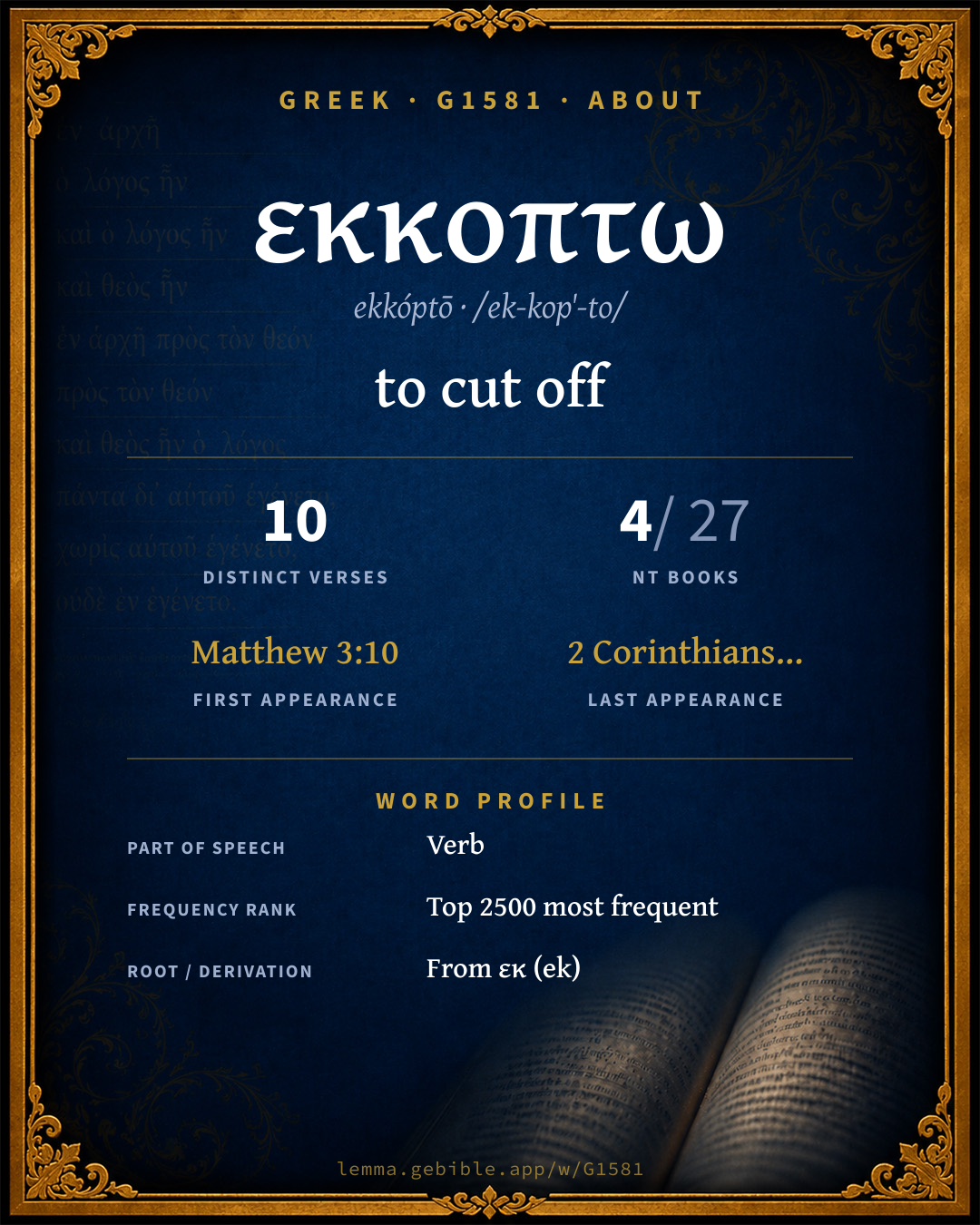
ἐκκόπτω
to cut off
‘to cut off’ is one of 2 main senses fuller range ↓
Full lexicon entry — Thayer's Greek Lexicon
From Thayer's Greek Lexicon
Where this word appears
See every Aorist-tense verb in the Greek New Testament →
Grammar key — what these labels mean
Part of speech
- Verb
- An action or state-of-being word.
Tense
- Aorist
- Action viewed as a simple whole, without regard to duration — often past (perfective aspect).
- Present
- Ongoing or general action in present time (imperfective aspect).
- Future
- Action expected in future time.
Voice
- Active
- The subject performs the action.
- Passive
- The subject receives the action.
Mood
- Imperative
- Expresses a command or request.
- Indicative
- States a fact or asks a factual question (the mood of reality).
- Subjunctive
- Expresses probability, purpose, or possibility (the mood of contingency).
Person
- 2nd person
- The one addressed (“you”).
- 3rd person
- The one spoken about (“he / she / it / they”).
- 1st person
- The speaker (“I / we”).
Number
- Singular
- One.
5 distinct verses where G1581 appears in the Aorist tense, across 4 books. Filtered view — show all forms. Click any verse to open its interlinear word-by-word view. Verse text shown in the World English Bible for context — . Each verse’s Greek form is shown with its reference; the English is not keyword-highlighted, since the data carries no word-level English alignment. Use “Compare translations” on any verse to read it across multiple English versions. This concordance covers the Greek New Testament; Septuagint (Greek Old Testament) occurrences of this word are not indexed here.
Matthew 2 verses
- Matthew 5:30 ἔκκοψον aor act impv 2sg If your right hand causes you to stumble, cut it off, and throw it away from you: for it is profitable for you that one of your members should perish, and not your whole body be thrown into Gehenna.
- Matthew 18:8 ἔκκοψον aor act impv 2sg If your hand or your foot causes you to stumble, cut it off, and cast it from you. It is better for you to enter into life maimed or crippled, rather than having two hands or two feet to be cast into the eternal fire.
Luke 1 verse
Romans 1 verse
2 Corinthians 1 verse
About this entry
At a glance — auto-summarized from this page’s data, not written by a person. Every figure links to its source below. This summary describes the numbers; it doesn’t interpret them.
At its core, εκκοπτω (ekkóptō) means “to cut off.” Scripture first uses it in Matthew 3:10. It turns up in 10 verses across 4 books, an uncommon footprint. The word gravitates to Matthew (40%), then Luke and Romans. Catalogued under 2 senses, its meaning is not single-sense. Dig into 10-verse concordance and the renderings breakdown below.
Gloss history
Strong's 1890 vs modern scholarship

About this word
Strong's G1581 catalogs a Greek word from the Greek New Testament.
These counts are not copied from any lexicon or concordance. They are computed here, from the morphology-tagged Greek New Testament. What Lemma adds →
- 10
- distinct verses
- The word appears in 10 distinct verses.
- 4 / 27
- NT books
- The word appears in 4 of 27 New Testament books.
- #1,056
- by frequency
- Top 2500 most frequent Greek words (rank 1,056 of 5,347 Greek words by occurrence).
View all 10 occurrences in the concordance →
By section of the New Testament
By traditional corpus
Conventional, traditional groupings — biblical authorship is debated, so this is a traditional corpus grouping, not an authorship claim. Some books belong to more than one corpus (Luke is in both the Gospels and the Lukan corpus, and so on), so these shares overlap and need not total 100%. Each figure is a share of the word’s 10 distinct verses.
- Gospels 7 verses · 70%
- Lukan (Luke–Acts) 3 verses · 30%
- Pauline corpus 3 verses · 30%
How translations render this word
Counts come from each version’s own published word-to-Strong’s tagging or interlinear alignment — an approximate guide to how each version renders this word, not a word-level alignment the data otherwise carries. Because each total is that version’s own tagged count, the per-version totals vary from one another and need not match the appearance or distinct-verse counts above. These counts may also differ from a printed concordance because Lemma counts each distinctly tagged rendering and does not collapse phrase taggings into a single head-word total. This is a fixed set of word-tagged versions (KJV, ASV, BSB, ULT) and does not change with the reading translation you choose elsewhere. Each version’s license is shown beside its name below (and on Sources).
- King James Version: Cut 3×, Is hewn down 3×, Down 2×
- American Standard Version: Cut 3×, Is hewn down 3×, Down 2×
- Berean Standard Bible: Cut it off 2×, Will be cut down 2×
- unfoldingWord Literal Text: Cut 3×, Down 2×, Is chopped down 2×
King James Version Public Domain
Renders G1581 across 16 tagged occurrences — most commonly:
Plus 6 renderings that appear only once — usually multi-word phrases or single function words the recovered tagging swept in, not distinct renderings.
American Standard Version Public Domain
Renders G1581 across 16 tagged occurrences — most commonly:
Plus 6 renderings that appear only once — usually multi-word phrases or single function words the recovered tagging swept in, not distinct renderings.
Berean Standard Bible Public Domain
Renders G1581 across 10 tagged occurrences — most commonly:
Plus 6 renderings that appear only once — usually multi-word phrases or single function words the recovered tagging swept in, not distinct renderings.
unfoldingWord Literal Text CC BY-SA 4.0
Renders G1581 across 15 tagged occurrences — most commonly:
Plus 6 renderings that appear only once — usually multi-word phrases or single function words the recovered tagging swept in, not distinct renderings.
Senses in Thayer's
The 2 senses Thayer's distinguishes for this word, in lexicon order (not ranked by frequency or importance). The full entry — with sub-senses — is in the Lexicon Entry tab.
- of a tree
- metaph. to cut off occasion
Word origin
Derived from εκ (ek) (G1537) — from.
Forms in the corpus
The 6 distinct written forms G1581 takes in the Greek New Testament, most frequent first — each parse links to that tense’s occurrences in the concordance.
| Form | Parsing | Example | Uses |
|---|---|---|---|
| ἐκκόπτεται ekkóptetai | Verb, Present, Passive, Indicative, 3rd person, Singular | Matthew 3:10 | 3 |
| ἔκκοψον ékkopson | Verb, Aorist, Active, Imperative, 2nd person, Singular | Matthew 5:30 | 3 |
| ἐκκοπήσῃ ekkopḗsē | Verb, Future, Passive, Indicative, 2nd person, Singular | Romans 11:22 | 1 |
| ἐκκόψεις ekkópseis | Verb, Future, Active, Indicative, 2nd person, Singular | Luke 13:9 | 1 |
| ἐκκόψω ekkópsō | Verb, Aorist, Active, Subjunctive, 1st person, Singular | 2 Corinthians 11:12 | 1 |
| ἐξεκόπης exekópēs | Verb, Aorist, Passive, Indicative, 2nd person, Singular | Romans 11:24 | 1 |
Same root — word family
Other Thayer's entries built from the same root as G1581, grouped by Strong’s listed origin. These share a root / origin per the lexicon — not necessarily a shared meaning. Each links to that word’s own entry.
Derives from
Shares the same root
- εκβαλλω ekbállō G1544 to cast out
- εκβασις ékbasis G1545 exit
- εκγαμιζω ekgamízō G1547 to give in marriage
- εκγαμισκω ekgamískō G1548 to give in marriage
- εκγονον ékgonon G1549 offspring
- εκδαπαναω ekdapanáō G1550 to spend
- εκδεχομαι ekdéchomai G1551 to receive
- εκδηλος ékdēlos G1552 evident
- εκδημεω ekdēméō G1553 to depart
- εκδιδωμι ekdídōmi G1554 to give out
- εκδιηγεομαι ekdiēgéomai G1555 to relate
- εκδικος ékdikos G1558 without justice
- εκδιωκω ekdiṓkō G1559 to banish
- εκδοτος ékdotos G1560 delivered up
- εκδυω ekdýō G1562 to put off
- εκζητεω ekzētéō G1567 to seek out
- εκθαμβος ékthambos G1569 astonished
- εκθετος ékthetos G1570 exposed
- εκκαθαιρω ekkathaírō G1571 to cleanse
- εκκαιω ekkaíō G1572 to burn
- εκκακεω ekkakéō G1573 to be exhausted
- εκκεντεω ekkentéō G1574 to pierce
- εκκλαω ekkláō G1575 to cut off
- εκκλειω ekkleíō G1576 to shut out
+88 more words share this root (not shown).
Compare all same-root words → Showing 4 of 114 — not the complete family. They share a root, not necessarily a meaning.
Septuagint usage
The same Greek word εκκοπτω appears 35 times in the Greek Old Testament (Septuagint), across 35 verses in 16 books.
- 35
- LXX occurrences
- Tagged occurrences of this Greek word in the Septuagint.
- 35
- verses
- Distinct Septuagint verses containing this word.
- 16 / 39
- OT books
- The word appears in 16 of the 39 Old Testament books.
Sample Septuagint occurrences
- Genesis 32:9 ἐκκόπτω
- Exodus 21:27 ἐκκόπτω
- Numbers 16:14 ἐκκόπτω
- Deuteronomy 7:5 ἐκκόπτω
- Joshua 15:16 ἐκκόπτω
- Judges 16:21 ἐκκόπτω
- 1 Kings 15:13 ἐκκόπτω
- 2 Chronicles 14:2 ἐκκόπτω
- Job 14:7 ἐκκόπτω
- Psalms 73:6 ἐκκόπτω
- Proverbs 30:17 ἐκκόπτω
- Isaiah 9:9 ἐκκόπτω
Septuagint occurrences (same lexeme)
Every verse where the same Strong’s number (G1581) appears in the Greek Septuagint. Verse text shown in the World English Bible for context; the Greek form is the matched word — the English is not keyword-highlighted.
- Genesis 32:9 ἐκκόπτω Jacob said, "God of my father Abraham, and God of my father Isaac, Yahweh, who said to me, 'Return to your country, and to your relatives, and I will do you good.'
- Genesis 36:35 ἐκκόπτω Husham died, and Hadad, the son of Bedad, who struck Midian in the field of Moab, reigned in his place. The name of his city was Avith.
- Exodus 21:27 ἐκκόπτω If he strikes out his man-servant's tooth, or his maid-servant's tooth, he shall let him go free for his tooth's sake.
- Exodus 34:13 ἐκκόπτω but you shall break down their altars, and dash in pieces their pillars, and you shall cut down their Asherim;
- Numbers 16:14 ἐκκόπτω Moreover you haven't brought us into a land flowing with milk and honey, nor given us inheritance of fields and vineyards: will you put out the eyes of these men? we won't come up.
- Deuteronomy 7:5 ἐκκόπτω But thus shall you deal with them: you shall break down their altars, and dash in pieces their pillars, and hew down their Asherim, and burn their engraved images with fire.
- Deuteronomy 12:3 ἐκκόπτω and you shall break down their altars, and dash in pieces their pillars, and burn their Asherim with fire; and you shall cut down the engraved images of their gods; and you shall destroy their name out of that place.
- Deuteronomy 20:19 ἐκκόπτω When you shall besiege a city a long time, in making war against it to take it, you shall not destroy the trees of it by wielding an axe against them; for you may eat of them, and you shall not cut them down; for is the tree of the field man, that it should be besieged of you?
- Deuteronomy 20:20 ἐκκόπτω Only the trees of which you know that they are not trees for food, you shall destroy and cut them down; and you shall build bulwarks against the city that makes war with you, until it fall.
- Joshua 15:16 ἐκκόπτω Caleb said, He who strikes Kiriath Sepher, and takes it, to him will I give Achsah my daughter as wife.
- Judges 16:21 ἐκκόπτω The Philistines laid hold on him, and put out his eyes; and they brought him down to Gaza, and bound him with fetters of brass; and he did grind in the prison-house.
- Judges 21:6 ἐκκόπτω The children of Israel repented them for Benjamin their brother, and said, There is one tribe cut off from Israel this day.
- 1 Kings 15:13 ἐκκόπτω Also Maacah his mother he removed from being queen, because she had made an abominable image for an Asherah; and Asa cut down her image, and burnt it at the brook Kidron.
- 2 Chronicles 14:2 ἐκκόπτω Asa did that which was good and right in the eyes of Yahweh his God:
- 2 Chronicles 14:13 ἐκκόπτω Asa and the people who were with him pursued them to Gerar: and there fell of the Ethiopians so many that they could not recover themselves; for they were destroyed before Yahweh, and before his host; and they carried away very much booty.
- 2 Chronicles 14:14 ἐκκόπτω They struck all the cities round about Gerar; for the fear of Yahweh came on them: and they despoiled all the cities; for there was much spoil in them.
- 2 Chronicles 31:1 ἐκκόπτω Now when all this was finished, all Israel who were present went out to the cities of Judah, and broke in pieces the pillars, and hewed down the Asherim, and broke down the high places and the altars out of all Judah and Benjamin, in Ephraim also and Manasseh, until they had destroyed them all. Then all the children of Israel returned, every man to his possession, into their own cities.
- Job 14:7 ἐκκόπτω "For there is hope for a tree, If it is cut down, that it will sprout again, That the tender branch of it will not cease.
- Job 19:10 ἐκκόπτω He has broken me down on every side, and I am gone. My hope he has plucked up like a tree.
- Job 42:17 ἐκκόπτω So Job died, being old and full of days.
- Psalms 73:6 ἐκκόπτω Therefore pride is like a chain around their neck. Violence covers them like a garment.
- Proverbs 30:17 ἐκκόπτω The eye that mocks at his father, And scorns obedience to his mother: The ravens of the valley shall pick it out, The young eagles shall eat it.
- Isaiah 9:9 ἐκκόπτω All the people shall know, [even] Ephraim and the inhabitant of Samaria, who say in pride and in arrogance of heart,
- Isaiah 27:9 ἐκκόπτω Therefore by this shall the iniquity of Jacob be forgiven, and this is all the fruit of taking away his sin: that he makes all the stones of the altar as chalk stones that are beaten in sunder, [so that] the Asherim and the sun-images shall rise no more.
- Jeremiah 6:6 ἐκκόπτω For thus has Yahweh of Hosts said, Hew you down trees, and cast up a mound against Jerusalem: this is the city to be visited; she is wholly oppression in the midst of her.
- Jeremiah 10:3 ἐκκόπτω For the customs of the peoples are vanity; for one cuts a tree out of the forest, the work of the hands of the workman with the axe.
- Jeremiah 22:7 ἐκκόπτω I will prepare destroyers against you, everyone with his weapons; and they shall cut down your choice cedars, and cast them into the fire.
- Jeremiah 26:23 ἐκκόπτω and they fetched forth Uriah out of Egypt, and brought him to Jehoiakim the king, who killed him with the sword, and cast his dead body into the graves of the common people.
- Jeremiah 51:7 ἐκκόπτω Babylon has been a golden cup in Yahweh's hand, who made all the earth drunken: the nations have drunk of her wine; therefore the nations are mad.
- Daniel 2:40 ἐκκόπτω The fourth kingdom shall be strong as iron, because iron breaks in pieces and subdues all things; and as iron that crushes all these, shall it break in pieces and crush.
- Daniel 4:7 ἐκκόπτω Then came in the magicians, the enchanters, the Chaldeans, and the soothsayers; and I told the dream before them; but they did not make known to me the interpretation of it.
- Daniel 4:10 ἐκκόπτω Thus were the visions of my head on my bed: I saw, and, behold, a tree in the midst of the earth; and the height of it was great.
- Daniel 4:16 ἐκκόπτω let his heart be changed from man's, and let a animal's heart be given to him; and let seven times pass over him.
- Micah 5:13 ἐκκόπτω I will cut off your engraved images and your pillars out of your midst; And you shall no more worship the work of your hands.
- Zechariah 12:11 ἐκκόπτω In that day there will be a great mourning in Jerusalem, like the mourning of Hadadrimmon in the valley of Megiddon.
These are occurrences of the same Greek lexeme (G1581) in the Septuagint — not a translation of any one Hebrew word. The store carries no word-level Hebrew↔Greek alignment, so no Hebrew original is asserted here. Counts come from the recovered LXX Strong's tagging — high-frequency vocabulary is well covered, while rare or late forms may be untagged — so they reflect tagged occurrences and may slightly undercount.