Daniel 4:16

Hebrew (Westminster Leningrad Codex) Daniel 4:16 appears in the Hebrew Old Testament. The text above is from the Westminster Leningrad Codex. Each word links to its Strong’s number, a concise gloss, and parsing drawn from the Open Scriptures Hebrew Bible morphology. Click any word for its full Brown-Driver-Briggs (BDB) entry.
Download image
Cite this verse

Daniel 4:16 (World English Bible). Public Domain. Lemma interlinear Bible study tool, https://lemma.gebible.app/v/daniel/4/16.

Show BibTeX & RIS
BibTeX
RIS
English Translation
let his heart be changed from man's, and let a animal's heart be given to him; and let seven times pass over him.
World English Bible · Public Domain
Highlights Full analysis ↓
Download a study sheet

One document with this verse’s original text, its word-by-word gloss line, the meaning frame, cross-references with their text, attributed commentary, and full source and license credits — printable, and it pastes into notes with its structure intact.

This verse Autodidact and up

Study sheet (.html) Plain text (.txt)

A passage Seminary Student

Up to 50 verses in one chapter. A passage sheet keeps up to 6 commentary sources and 12 cross-references per verse, in the order this page ranks them, and says so on the sheet whenever that leaves anything out. Ask for a single verse and you get the Autodidact verse sheet above.

Everything on this page stays free to read, with no account — the sheet is a download of what is already on screen, not access to it.

Want to remove ads? Support Godless Engineer
Compare translations 3

The same verse in 3 English versions, stacked beneath the original-language interlinear above. Click any original word for its lexicon entry.

Each is an independent rendering of the whole verse — the interlinear is not word-aligned to these translations.

Highlighted words mark where these versions differ — a whole-verse word diff, not a word-by-word alignment.

  • World English Bible Public Domain
    let his heart be changed from man's, and let a animal's heart be given to him; and let seven times pass over him.
  • King James Version Public Domain
    Let his heart be changed from man's, and let a beast's heart be given unto him; and let seven times pass over him.
  • unfoldingWord Literal Text CC BY-SA 4.0
    Let his mind be changed from that of a man, and let the mind of an animal be given to him, and let seven periods of time pass over him.

unfoldingWord Literal Text — © unfoldingWord, licensed CC BY-SA 4.0. Word-aligned USFM3 via Door43 (git.door43.org/unfoldingWord/en_ult).

Versions to compare (up to 4)

3 of 4 selected

Show all 18 translations

Every available English version of this verse, each an independent rendering of the whole verse.

  • World English Bible Public Domain
    let his heart be changed from man's, and let a animal's heart be given to him; and let seven times pass over him.
  • Berean Standard Bible Public Domain
    Let his mind be changed from that of a man, and let him be given the mind of a beast till seven times pass him by.
  • Majority Standard Bible Public Domain
    Let his mind be changed from that of a man, and let him be given the mind of a beast till seven times pass him by.
  • King James Version Public Domain
    Let his heart be changed from man's, and let a beast's heart be given unto him; and let seven times pass over him.
  • American Standard Version (1901) Public Domain
    let his heart be changed from man's, and let a beast's heart be given unto him; and let seven times pass over him.
  • Revised Version (1885) Public Domain
    let his heart be changed from man’s and let a beast’s heart be given unto him; and let seven times pass over him.
  • Geneva Bible (1599) Public Domain
    Then Daniel (whose name was Belteshazzar) held his peace by the space of one houre, and his thoughts troubled him, and the King spake and said, Belteshazzar, let neither the dreame, nor the interpretation thereof trouble thee. Belteshazzar answered and saide, My lord, the dreame be to them that hate thee, and the interpretation thereof to thine enemies.
  • Douay-Rheims (1899) Public Domain
    Let his heart be changed from man's, and let a beast's heart be given him; and let seven times pass over him.
  • Young's Literal Translation Public Domain
    his heart from man's is changed, and the heart of a beast is given to him, and seven times pass over him;
  • Literal Standard Version CC BY-SA 4.0
    his heart from man’s is changed, and the heart of a beast is given to him, and seven times pass over him;
  • Unlocked Literal Bible CC BY-SA 4.0
    Let his mind be changed from a man's mind, and let an animal's mind be given to him until seven years pass by.
  • unfoldingWord Literal Text CC BY-SA 4.0
    Let his mind be changed from that of a man, and let the mind of an animal be given to him, and let seven periods of time pass over him.
  • Darby Bible Public Domain
    Let his heart be changed from man's, and let a beast's heart be given unto him; and let seven times pass over him.
  • World Messianic Bible Public Domain
    Let his heart be changed from man’s, and let an animal’s heart be given to him. Then let seven times pass over him.
  • Webster's Bible Public Domain
    Let his heart be changed from man's, and let a beast's heart be given to him; and let seven times pass over him.
  • Free Bible Version CC BY-SA 4.0
    Let his mind become like that of an animal. Let him be like this for seven times.
  • Bible in Basic English Public Domain
    Let his heart be changed from that of a man, and the heart of a beast be given to him; and let seven times go by him.
  • JPS Tanakh (1917) Public Domain
    (4-13) Let his heart be changed from man's, and let a beast's heart be given unto him; and let seven times pass over him.

Literal Standard Version (2020), Covenant Press — licensed CC BY-SA 4.0. Text via the HelloAO Bible API (eBible.org). Unlocked Literal Bible (unfoldingWord) — licensed CC BY-SA 4.0. Text via the HelloAO Bible API (eBible.org). unfoldingWord Literal Text — © unfoldingWord, licensed CC BY-SA 4.0. Word-aligned USFM3 via Door43 (git.door43.org/unfoldingWord/en_ult). Free Bible Version, Dr. Jonathan Gallagher — licensed CC BY-SA 4.0. Text via the HelloAO Bible API (eBible.org).

Word by word

More ways to search: Search by grammar → Find every occurrence → Compare this word →

Practice this passage: Drill this verse → Learn its vocabulary →

יַחְלְפ֥וּן
chălaph
H2499
“to pass over”
Adjective, V
Part of Speech
Adjective
Full BDB Definition

Origin: corresponding to H2498

TWOT: 2731

to pass by, pass over - (Peal) to pass by, pass over
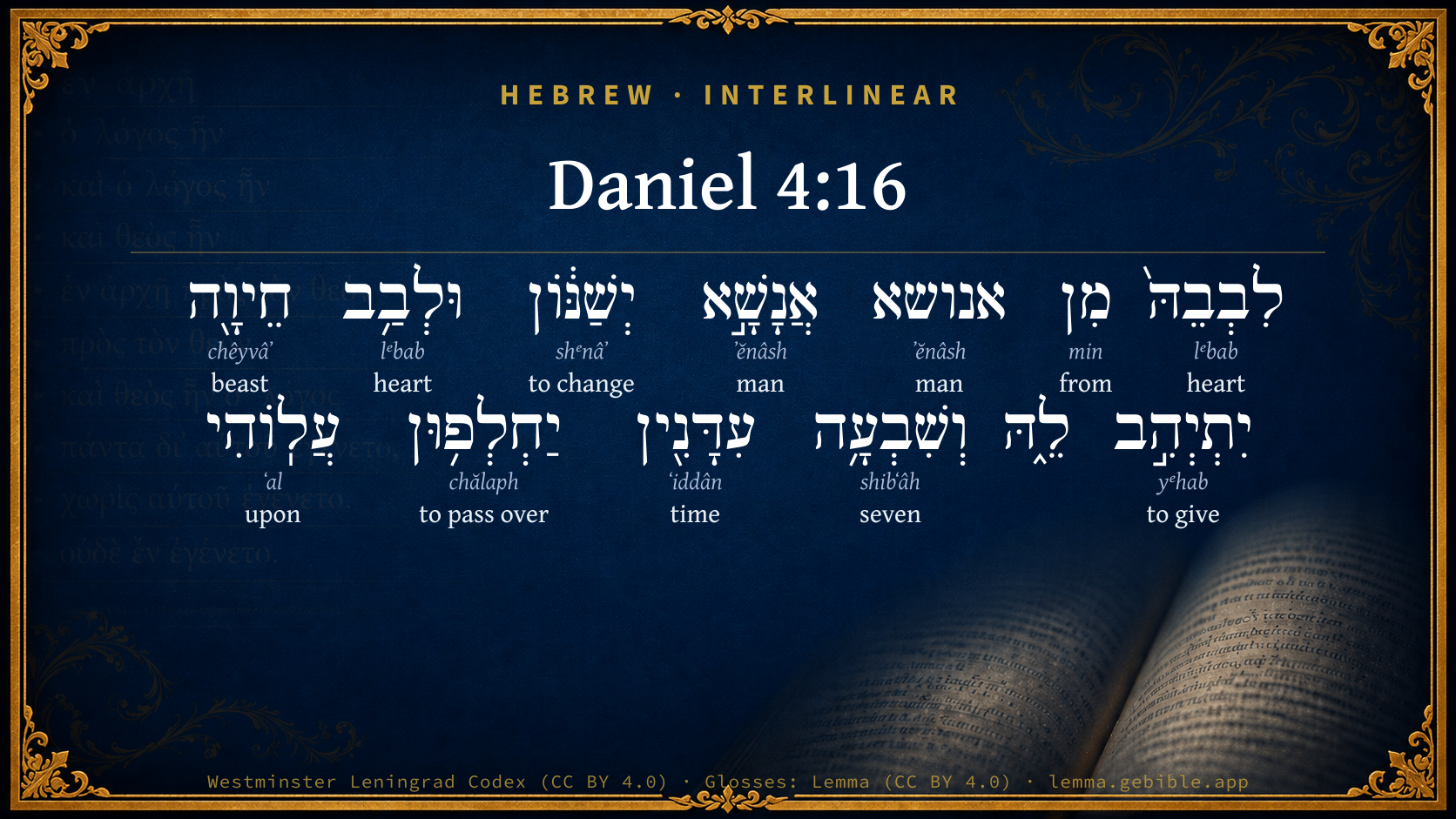
  1. לִבְבֵהּ֙ lᵉbab H3825 “heart · his” Adjective, N, Common + Suffix, Personal, 3rd Person, Masculine, Singular
  2. מִן min H4481 “from” Adjective, R
  3. אנושא ʼĕnâsh H606 “man · the” Adjective, N, Common + Particle, Definite Article
  4. אֲנָשָׁ֣א ʼĕnâsh H606 “man · the” Adjective, N, Common + Particle, Definite Article
  5. יְשַׁנּ֔וֹן shᵉnâʼ H8133 “to change” Adjective, V
  6. וּלְבַ֥ב lᵉbab H3825 “and · heart of” Adjective, C + Noun, Common, Masculine, Singular, Construct
  7. חֵיוָ֖ה chêyvâʼ H2423 “beast” Adjective, N, Common
  8. יִתְיְהִ֣ב yᵉhab H3052 “to give” Adjective, V
  9. וְשִׁבְעָ֥ה shibʻâh H7655 “and · seven” Adjective, C + Adjective, Cardinal number, Both, Singular, Absolute
  10. עִדָּנִ֖ין ʻiddân H5732 “times” Adjective, N, Common
  11. עֲלֽוֹהִי ʻal H5922 “upon · him” Adjective, R + Suffix, Personal, 3rd Person, Masculine, Singular

About this verse

These counts appear in no published source. They are computed here, from the morphology-tagged text and Lemma’s own curated glosses. What Lemma adds →

13
words
10
distinct lemmas
Prophets
section

Notable vocabulary

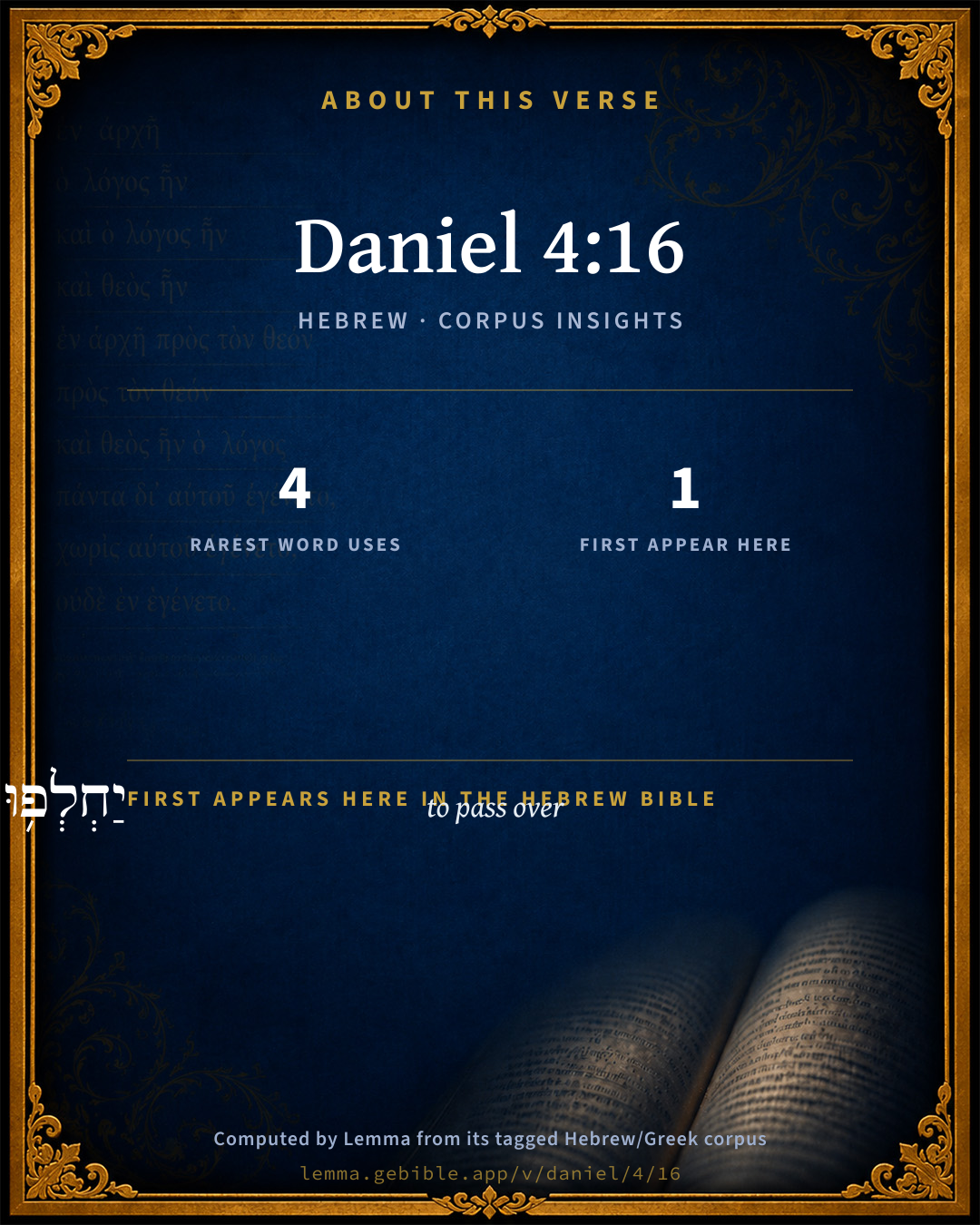
The rarest word here is יַחְלְפ֥וּן to pass over H2499 — appearing just 4 times in the whole Hebrew Bible.

First appearance in Scripture

This word makes its first canonical appearance in the Hebrew Bible here:

  • יַחְלְפ֥וּן to pass over H2499

Shared distinctive vocabulary

יַחְלְפ֥וּן to pass over H2499 occurs in 4 verses of the Hebrew Bible. Also found in:

Grammatical profile

  • 1 noun
  • 10 adjectives
  • 2 particles

Repetition

Words recur within this verse — often emphatic in Hebrew:

  • לִבְבֵהּ֙ heart H3825 ×2
  • אנושא man H606 ×2

Hebrew & Septuagint length

In English translation the verse runs 23 words from the Hebrew and 40 from the Septuagint (LXX English) — the Septuagint runs noticeably longer here. See the side-by-side →

A rough comparison of the two English renderings, which tokenize alike — not a word-level alignment.

Word counts can differ between the Hebrew and the Greek without any difference in meaning — e.g. the Hebrew direct-object marker אֵת has no separate Greek word, and Greek often adds the article ὁ.

Cross-references

11

Topical passages linked to Daniel 4:16 in the Treasury of Scripture Knowledge — connected by theme and wording, ordered by reader-vote popularity; previews shown in the World English Bible.

  • Daniel 4:23 Whereas the king saw a watcher and a holy one coming down from the sky, and saying, Hew down the tree, and destroy it; nevertheless leave the stump of the roots of it in the earth, even with a band of iron and brass, in the tender grass of the field, and let it be wet with the dew of the sky: and let his portion be with the animals of the field, until seven times pass over him;
  • Isaiah 6:10 Make the heart of this people fat; Make their ears heavy, and shut their eyes; Lest they see with their eyes, And hear with their ears, And understand with their heart, And turn again, and be healed."
  • Daniel 4:25 that you shall be driven from men, and your dwelling shall be with the animals of the field, and you shall be made to eat grass as oxen, and shall be wet with the dew of the sky, and seven times shall pass over you; until you know that the Most High rules in the kingdom of men, and gives it to whoever he will.
  • Revelation 12:14 Two wings of the great eagle were given to the woman, that she might fly into the wilderness to her place, so that she might be nourished for a time, and times, and half a time, from the face of the serpent.
  • Daniel 4:31–33 While the word was in the king's mouth, there fell a voice from the sky, [saying], O king Nebuchadnezzar, to you it is spoken: The kingdom is departed from you:
  • Daniel 7:25 He shall speak words against the Most High, and shall wear out the saints of the Most High; and he shall think to change the times and the law; and they shall be given into his hand until a time and times and half a time.
  • Daniel 11:13 The king of the north shall return, and shall set forth a multitude greater than the former; and he shall come on at the end of the times, [even of] years, with a great army and with much substance.
  • Daniel 12:7 I heard the man clothed in linen, who was above the waters of the river, when he held up his right hand and his left hand to heaven, and swore by him who lives forever that it shall be for a time, times, and a half; and when they have made an end of breaking in pieces the power of the holy people, all these things shall be finished.
  • Mark 5:4–5 because he had been often bound with fetters and chains, and the chains had been torn apart by him, and the fetters broken in pieces. Nobody had the strength to tame him.
  • Luke 8:27–29 When Jesus stepped ashore, a certain man out of the city who had demons for a long time met him. He wore no clothes, and didn't live in a house, but in the tombs.
  • Hebrews 1:11 They will perish, but you continue. They all will grow old like a garment does.

Cross-references courtesy of OpenBible.info (CC BY 4.0).

Hebrew and Greek witnesses Masoretic Hebrew ↔ Greek Septuagint

The same verse in the two great witnesses to the Old Testament, shown verse-for-verse.

Here the Septuagint runs noticeably longer than the Hebrew — LXX2012 (modern English Septuagint) 40 words vs World English Bible 23. A rough length comparison of the two English translations, not a word-level alignment — read both below.

These are two independent witnesses, not word-aligned to each other, and the Septuagint is shown in lemma (dictionary) form.

Hebrew Daniel 4:16 Masoretic · Westminster Leningrad Codex

לִבְבֵהּ֙ מִן אנושא אֲנָשָׁ֣א יְשַׁנּ֔וֹן וּלְבַ֥ב חֵיוָ֖ה יִתְיְהִ֣ב לֵ֑הּ וְשִׁבְעָ֥ה עִדָּנִ֖ין יַחְלְפ֥וּן עֲלֽוֹהִי

let his heart be changed from man's, and let a animal's heart be given to him; and let seven times pass over him.

World English Bible · Public Domain

Greek LXX Daniel 4:16 Septuagint · lemma form

καί ὁ ὅρασις ὅς ὁράω ὅτι ἄγγελος ἐν ἰσχύς ἀποστέλλω παρά ὁ κύριος καί ὅτι εἶπον ἐκαἴρω ὁ δένδρον καί ἐκκόπτω ὁ κρίσις ὁ θεός ὁ μέγας ἥκω ἐπί σύ

Then Daniel, whose name is Baltasar, was amazed about one hour, and his thoughts troubled him. And Baltasar answered and said, My lord, let the dream be to them that hate you, and the interpretation of it to your enemies.

LXX2012 (modern English Septuagint) · Public Domain

On this verse, The Pulpit Commentary discusses the Septuagint’s reading. Read the note in Commentary ↓

Hebrew: Westminster Leningrad Codex (CC BY 4.0). Greek: Septuagint (public domain); English from LXX2012 (modern English Septuagint) (Public Domain). How the Septuagint differs from the Hebrew →

Commentary

Notes on Daniel 4:16 from classic Christian and Jewish commentators (each source and its license shown beneath its notes). The classic Christian expositions comment on the surrounding passage and are grouped to its opening verse, so a note may address several verses; the Jewish commentaries on the Tanakh (Rashi and others) are per-verse, so they appear only where the commentator wrote on this verse.

Lemma curates 59 commentaries, every one of them public domain or Creative Commons licensed, each selected and text-cleaned for this edition rather than reprinted as found. About our sources →

Trapp's Complete Commentary

John Trapp

Dan 4:16 Let his heart be changed from man’s, and let a beast’s heart be given unto him; and let seven times pass over him.

Ver. 16. Let his heart be changed,] i.e., Obbrutescat, nihil humanum sapiat; a fearful judgment, and yet such as reprobates are usually delivered up to. {Rom 1:24}

And let a beast’s heart be given him.] Let his fantasy and appetite be so changed, that, upon a strong imagination that he is a beast, he may have affections carrying him in all things to do accordingly. Little is said of this in human history. The Chaldee chronicles are lost. Alpheus (as he is cited by Eusebius) {a} briefly saith that Nebuchadnezzar, rapt with madness, presently vanished out of the company of men, after that he had first foretold the overthrow of the Chaldean monarchy. The Chaldeans in Abidenus’ fragments record that he was blasted by some god, and spake of Babel’s fall by the Persians. {b}

And let seven times to pass over him,] i.e., Seven years; like as Solomon’s temple, that seven years’ work of many thousands, was by him destroyed.

{a} Lib. ix. de Praepar. Ev.

{b} Brought., Conc. of Script.

John Trapp, A Commentary or Exposition upon All the Books of the Old and New Testament (1647–1656) — public domain. Text from a community e-Sword module.

Albert Barnes' Notes on the Bible

Let his heart be changed from man’s, and let a beast’s heart be given unto him - Here the same thing occurs in a more marked form, showing that some man was represented by the vision, and indicating some change which was fitted to attract the deepest attention - as if the person referred to should cease to be a man, and become a beast. The word heart here seems to refer to nature - “let his nature or propensity cease to be that of a man, and become like that of a beast; let him cease to act as a man, and act as the beasts do - evincing as little mind, and living in the same manner.”

And let seven times pass over him - In this condition, or until he is restored. It is not indeed said that he would be restored, but this is implied

(a) in the very expression “until seven times shall pass over him,” as if he would then be restored in some way, or as if this condition would then terminate; and

(b) in the statement that “the stump of the roots “would be left in the earth as if it might still germinate again.

Everything, however, in the dream was fitted to produce perplexity as to what it could mean. The word rendered “times” (עדנין ‛ı̂ddânı̂yn - singular, עדן ‛iddân) is an important word in the interpretation of Daniel. It is of the same class of words as the Hebrew יעד yâ‛ad - to point out, to appoint, to fix; and would refer properly to time considered as “appointed” or “designated;” then it may mean any stated or designated period, as a year. The idea is that of time considered as designated or fixed by periods, and the word may refer to any such period, however long or short - a day, a month, a year, or any other measure of duration. What measurement or portion is intended in any particular case must be determined from the connection in which the word is found. The word used here does not occur in the Hebrew scripture, and is found only in the book of Daniel, where it is uniformly rendered “time” and “times.”

It is found only in the following places: Dan 2:8, “that ye would gain the time;” Dan 2:9, “till the time be changed;” Dan 2:21, “and he changeth the times;” Dan 3:5, Dan 3:15, “at what time ye shall hear;” Dan 4:16, Dan 4:23, “and let seven times pass over him,” Dan 4:25, Dan 4:32, “seven times shall pass over him;” Dan 7:12, “for a season and time;” Dan 7:25, “until a time and times and the dividing of time.” In the place before us, so far as the meaning of the word is concerned, it might mean a day, a week, a month, or a year. The more common interpretation is what supposes that it was a year, and this will agree better with all the circumstances of the case than any other period. The Greek of Theodotion here is: καὶ ἑππὰ καιροὶ ὰλλαγήσονται ἐπ ̓ ἀυτόν kai hepta kairoi allagēsontai ep' auton - “And seven times shall change upon him;” that is, until seven seasons revolve over him.

The most natural construction of this Greek phrase would be to refer it to years. The Latin Vulgate interprets it in a similar way - et septem tempora mutentur super eum - “And let seven times be changed” or revolve “over him.” In the Codex Chisianus it is: καὶ ἐππὰ ἔτη βοσκηθῆ σὺν αὐτοῖς kai hepta etē boskēthē sun autois - “and let him feed with them seven years.” Luther renders it “times.” Josephus understands by it “seven years.” - “Ant.” b. x. ch. 10: Section 6. While the Chaldee word is indeterminate in respect to the length of time, the most natural and obvious construction here and elsewhere, in the use of the word, is to refer it to years. Days or weeks would be obviously too short, and though in this place the word “months” would perhaps embrace all that would be necessary, yet in the other places where the word occurs in Daniel it undoubtedly refers to years, and there is, therefore, a propriety in understanding it in the same manner here.

Albert Barnes' Notes on the Bible (1834–1885) — public domain. Text from a community e-Sword/MySword module.

Tyndale Open Study Notes

Tyndale Open Resources

4:16 Seven periods of time may refer to a seven-year period (cp. 7:25; 9:24-25). • mind of a wild animal: See 4:31-33.

Tyndale Open Study Notes — © Tyndale Open Resources, licensed CC BY-SA 4.0. Text via the HelloAO Bible API.

Ibn Ezra

Rabbi Abraham ibn Ezra

[Daniel 4:16] Then... was perplexed (אֱדַ֨יִן... אֶשְׁתּוֹמַם֙): [Meaning] He was stunned/perplexed (הִשְׁתּוֹמֵם - hishtomem) for one moment/hour (שָׁעָה אַחַת - sha'ah achat).

My lord (מָרִ֕אי): [Means] my lord (אֲדוֹנִי - adoni).

For your foe (לְעָרָֽךְ): [The word arakh means "your foe," like the Hebrew word עָר (ar - foe/enemy)]. And this [phrase, "would that the dream were for your enemy... and its meaning for your foe"] is the proper etiquette (דֶּרֶךְ מוּסָר - derech musar) [when speaking] with the king. And some say that his [Daniel's] heart [in saying this] was [directed] towards God [i.e., wishing the evil away entirely], but there is no need [for such an interpretation], for it is correct according to its plain meaning.

Ibn Ezra on the Tanakh — English translations: “Sefaria Community Translation” (CC0 1.0 (public-domain dedication)); “Yalkut, Sifsei Chachomim Chumash, Metsudah Publications, 2009” (CC BY 4.0); and “Commentary of Ibn Ezra on Isaiah - trans. by M. Friedlander, 1873” (public domain). Text via Sefaria.

Geneva Bible (1599)

Geneva Bible translators

He was troubled for the great judgment of God, which he saw ordained against the king, and so the Prophets used on the one part to denounce God’s judgments for the zeal they bare to his glory, and on the other part to have compassion upon man, and also to consider that they should be subject to God’s judgments, if he did not regard them with pity.

Geneva Bible (1599) marginal notes — public domain. Text via Bolls.life.

Jamieson, Fausset & Brown

Robert Jamieson, A. R. Fausset & David Brown

heart--understanding (Isa 6:10).

times--that is, "years" (Dan 12:7). "Seven" is the perfect number: a week of years: a complete revolution of time accompanying a complete revolution in his state of mind.

Jamieson, Fausset & Brown — Commentary Critical and Explanatory on the Whole Bible (1871) — public domain (CC PDM 1.0). Text via the HelloAO Bible API.

Adam Clarke's Commentary

Verse 16. Let his heart be changed] Let him conceive himself to be a beast, and act as such, herding among the beasts of the field.

Let seven times pass over him.] Let him continue in this state for seven years. I knew a man who was thus changed in his heart - in his imagination. He believed himself to be a bear, and would imitate the ursal growl, c. and the case did not appear to be hypochondriacal. Whether he ever came to sound mind, I know not.

Adam Clarke's Commentary on the Bible (1810–1826) — public domain. Text from a community e-Sword/MySword module.

John Calvin's Commentaries

The reason for this punishment follows, when it is added, seven times shall pass over him; and then, do not cut off its lowest root, but let the rain of heaven water it; and next; his portion shall be with the wild beasts. Although the chastisement is hard and horrible, when Nebuchadnezzar is expelled from the society of men, and rendered like wild beasts; but it is something in his favor when God does not tear him up by the roots, but allows the root to remain, for the tree to spring up again and flourish, and be planted again in its own place, and recover new vigor through its roots. Here Daniel reviews the punishment inflicted on King Nebuchadnezzar, in which God afforded a specimen of his clemency, in sparing him and not utterly cutting him down, but in allowing his root to remain. Some here discourse about the mitigation of penalties when God sees those repent whom he has chastised with rods; but I do not think it applicable here. There was no true conversion in King Nebuchadnezzar, as we said before, and shall see again more clearly. God did not wish to press him too hard, and this we must attribute to his clemency; because when he seems to set no bounds to his punishment of men’s sins, yet in all temporal punishments he allows men to taste his pity; so that even the reprobate remain without excuse. The assertion of some—that punishments are not remitted without the fault being excused, is false; as we see in the example of Ahab. For God remitted the fault to the impious king, but because he seemed to shew some signs of repentance, God abstained from greater punishment. (1 Kings 21:29.) So also we may see the same in the case of Nebuchadnezzar. God was unwilling utterly to root him out—for the metaphor of the tree shews this—but he desired seven times to pass over him Some understand seven weeks, others seven years; but we shall treat this point more copiously by and bye. Lastly, we must notice this; in the midst of the time during which God’s wrath seemed to rage against this wretched king, his benefits were also mingled with it. We learn this from the words, his portion shall be with the beasts of the field; that is, he shall feed upon some food by which life shall be preserved; and then, it shall be watered or irrigated with the rain of heaven. For God signifies—though he wished to punish King Nebuchadnezzar, and to render him a remarkable example of his wrath—his knowledge of what he could bear; hence, he so tempers his punishment as to leave hope remaining for the future, Thus he took his food even with the beasts of the earth, but he is not deprived of the irrigation of the dew of heaven.

John Calvin's Commentaries (1540-1563) — public domain. Text from the Calvin Translation Society English edition (1840s-50s) via the Christian Classics Ethereal Library (ccel.org). Calvin's coverage is partial (roughly two-thirds of the Bible); uncommented books and verses are honest gaps, never fabricated. The 19th-century editor's footnotes and remarks are omitted so the notes are faithfully Calvin's own voice.

Ellicott's Commentary for English Readers

(16) Here the metaphor of Dan_4:15 is entirely discontinued, and a man is mentioned.

Seven times.—On the use of the number “seven” see Note on Dan_3:19. The period intended by “time” is very uncertain: from the use of the word in Jdg_17:10 it has been inferred that “years” are intended. This is purely conjectural. It is more probable that the word is used to signify some definite period of time, which, as appears from the words “over him,” was in some way marked out by the heavenly bodies. The word “time” is used by Daniel in the same sense (Dan_7:25). (Comp. Dan_12:7, where, however, a different word is employed.)

A Bible Commentary for English Readers, edited by Charles John Ellicott (1878–1897) — public domain. Text from a community e-Sword module.

The Cambridge Bible for Schools and Colleges

gen. ed. J. J. S. Perowne

16. his heart] i.e. his intelligence: let him receive the understanding of a beast (imagine himself an animal). The heart, in Hebrew psychology, is the seat not (as commonly with us) of tender feeling (a ‘heartless’ man), but of the intellect: cf. Hos_7:11, ‘a silly dove, without heart,’ i.e. without understanding, Jer_5:21, ‘a foolish people, without understanding,’ lit. without heart.

seven times] i.e. seven years: cf. Dan_7:25, Dan_12:7 (Heb. mô‘çd); Rev_12:14 (καιρός). With ‘pass over,’ comp. 1Ch_29:30.

The Cambridge Bible for Schools and Colleges (gen. ed. J. J. S. Perowne; Cambridge University Press, 1878–1918) — public domain. Text from a community e-Sword module.

John Gill's Exposition

Let his heart be changed from man's,.... Not as to the substance, but as to the quality:

and let a beast's heart be given unto him; from a human heart, let it be changed into a brutal one; let him be deprived of the use of reason, and have no more exercise of it than a brute has; let him be wholly governed by the animal senses, and behave and act as a beast does; be as senseless, stupid, and savage, as that: and such a heart Nebuchadnezzar had; not that his rational soul departed from him, then he must have died; but the powers of it were sadly vitiated and depraved; his understanding, imagining himself to be a beast, not a man; his judgment, in not distinguishing the actions of a beast from those of a man; his memory of things past utterly failed; he forgot what he had been, and was; his will, inclination, and fancy, were towards brutal things, and ran upon deserts, fields, and grass; and he shunned the society of men:

and let seven times pass over him: while in this condition; let him remain so long in it; not seven months, as Abarbinel, and others; nor seven half years, or three years and a half, as some in Theodoret; dividing the year into two parts, summer and winter; and suppose, that seven of these seasons passed over him before he recovered; but seven years are meant, as Jarchi, Saadiah, and Jacchiades, as the phrase is used in Dan 7:25, so many years the temple of Solomon was building, which Nebuchadnezzar had destroyed, and so long this madness must remain upon him: no notice is taken of this affair by Heathen writers, only Abydenus (n) says, that being under a divine afflatus, he foretold the destruction of the Babylonian empire by a Persian mule (meaning Cyrus), and by a Mede, and immediately, he disappeared; which some have understood of this time of his madness, which quickly followed upon this dream.

(n) Apud Euseb. Praepar. Evangel. l. 9. c. 41. p. 457.

John Gill's Exposition of the Whole Bible (1746–1763) — public domain (CC PDM 1.0). Text via the HelloAO Bible API.

Haydock's Catholic Bible Commentary

Hour. Chaldee: shaha, (Haydock) implies "a little while;" (Grotius) yet of some duration, not precisely like one of the modern hours. The prophet was silent, being troubled by the divine spirit, (Chap. x. 8.) at the view of impending misery; or unwilling to hurt the king’s feelings, till he should urge him to speak. (Calmet) --- He was sorry to denounce such calamities, yet must speak the truth. (Worthington) --- Trouble. Theodot.: "make thee hurry." He perceived the prophet’s anxiety, and encouraged him.

George Leo Haydock (1774–1849), Haydock's Catholic Family Bible and Commentary, 1859 edition — public domain. Excludes Psalms (Douay-Rheims chapter numbering differs from Protestant) and Deuterocanonical books (Catholic canon only).

Matthew Poole's English Annotations

Let him live seven years as a beast in man’s shape, among beasts of the field, let him become brutish, without human sense and understanding: and this appeared much also in his outward shape; nails like claws, and hair like feathers. Some think that he was truly changed into a beast, but this cannot be, for then the Chaldeans would never more have owned or restored him. Others judge that he was not changed at all but in appearance only to the beholders and in their fancies; but this is a false construction of God’s works, when the Scripture saith it was truly done. It is probable he was mute, and bellowed only, that he went naked, and bowed, and ate grass among the beasts, with whom his converse was: a dreadful example upon the greatest man on earth, for his brutish and raging tyranny, and inhuman carriage, abasing himself, and abusing his honours and great prerogatives to wickedness and savage cruelty, to be thus forsaken of God and men, and to be made a prodigy and spectacle to the world, and that upon record to all generations.

Matthew Poole's English Annotations on the Holy Bible (1683–1685) — public domain. Text from a community e-Sword/MySword module.

The Pulpit Commentary

Let his heart be changed from man"s, and let a beast"s heart be given unto him; and let seven times pass ever him. The Septuagint rendering seems to be taken from the previous verse, "And let his body be changed by the dew of heaven, and let him be pastured with them seven years." It seems difficult to imagine, either, on the one hand, Hbebli (libebayh) changed into Hrgpi (pigerah), the word by which Paulus Tellensis translates swma, though it suggests "carcase," or into hnedni (nid nayh), the word used in Dan_7:15; or, on the other, that either of these should be read l (e) bab. At the same time, l and n are not unlike in old inscriptions, nor b unlike d; any indistinctness in the third letter might easily lead to a mistake. It is not impossible that some of the words in the latter part of the previous verse have been modified from some word meaning "body." It is equally difficult to guess what word has been read by the Septuagint translator instead of Wpljy (yah-lephoon), "let them pass over." The greater brevity of the Septuagint is in its favour. Theodotion is, as usual, in closer agreement with the Massoretic; he renders min-anaosha"or anosha"for ajpopwn, "from men a possible translation, and one favoured by some recent commentators. The Peshitta agrees quite with the received text. According to the received text, the main change was mental the human heart is removed, and the heart of a beast given. On the other hand, in the twenty-third verse, in which we have the fulfilment of the dream, the change is mainly physical, and it is to be observed that the change is produced by "the dew of heaven." Seven times. The word iddanun, "times," is a matter of some difficulty; it means really "seasons" or "points" of time, as in Ecc_3:2, Targum, and Gen_38:1, Targum Onkelos, "It came to pass at this time." It is purely arbitrary to fix the meaning here as "years," as is done by the Septuagint and by many commentators. Theodotiom keeps the indefinite ness of the original by rendering the word here kairoi) The Peshitta transfers the word. It may be" months" as suggested by Lenormant; it maybe "seasons," in our usual sense of the word. Rendel Harris"s "Biblical Monuments," p. 73, says, "Summer and winter are the only seasons counted in Babylonia;" if so, seven iddaneen would be nearly four years. From the fact that exposure to weather is the point of importance, Mr. Harris"s view is not impossible; but pathological reasons suggest "months" (see Excursus at the end of chapter). Seven, with the Babylonians, as with most other Semites, is a round number of sacred import, and therefore may not be pressed.

The Pulpit Commentary (1880–1919), ed. H.D.M. Spence-Jones & Joseph S. Exell — public domain. Text from a community e-Sword module.

Keil & Delitzsch

C. F. Keil & F. Delitzsch

Here the angel declares by what means Nebuchadnezzar shall be brought into this condition. His heart shall be changed from a man's heart, according to the following passage, into the heart of a beast. מן שׁנּא, to change, to make different from, so that it is no longer what it was. The Kethiv אנושׁא is the Hebr. form for the Chald. אנששׁא of the Keri, here, as in v. 14, where along with it also stands the Hebr. plur. form אנשׁים. אנושׁא stands here for the abbreviated comparison frequent in Hebr., אנושׁא מן לבב, and the 3rd pers. plur. ישׁנּון impers. for the passive. לבב is the heart, the centre of the intelligent soul-life. The heart of man is dehumanized when his soul becomes like that of a beast; for the difference between the heart of a man and that of a beast has its foundation in the difference between the soul of a man and the soul of a beast (Delitzsch, bibl. Psych. p. 252). And seven times shall pass over him, viz., during the continuance of the circumstances described; i.e., his condition of bondage shall last for seven times. Following the example of the lxx and of Josephus, many ancient and recent interpreters, down to Maur., Hitz., and Kran., understood by the word עדּנין years, because the times in Dan 7:25; Dan 12:7, are also years, and because in Dan 4:29 mention is made of twelve months, and thereby the time is defined as one year. But from Dan 4:29 the duration of the עדּנין cannot at all be concluded, and in Dan 7:25 and Dan 12:7 the times are not years. עדּן designates generally a definite period of time, whose length or duration may be very different. Seven is the "measure and signature of the history of the development of the kingdom of God, and of all the factors and phenomena significant for it" (Lmmert's "Revision of the biblical Symbolical Numbers" in the Jahrbb.f. deutsche Theol. ix. p. 11); or as Leyrer, in Herzog's Realencykl. xviii. p. 366, expresses himself, "the signature for all the actions of God, in judgment and in mercy, punishments, expiations, consecrations, blessings, connected with the economy of redemption, perfecting themselves in time." Accordingly, "seven times" is the duration of the divine punishment which was decreed against Nebuchadnezzar for purposes connected with the history of redemption. Whether these times are to be understood as years, months, or weeks, is not said, and cannot at all be determined. The supposition that they were seven years "cannot well be adopted in opposition to the circumstance that Nebuchadnezzar was again restored to reason, a thing which very rarely occurs after so long a continuance of psychical disease" (J. B. Friedreich, Zur Bibel. Naturhist., anthrop. u. med. Fragmente, i. p. 316).

Keil & Delitzsch — Biblical Commentary on the Old Testament (1861–1891) — public domain (CC PDM 1.0). Text via the HelloAO Bible API. (Old Testament only.)

Scofield Reference Notes

C. I. Scofield

seven

The number of completeness.

The Scofield Reference Bible (1917 edition), notes by C. I. Scofield — public domain. Text from a community e-Sword module.

Rashi

Rabbi Shlomo Yitzchaki (Rashi)

Then Daniel, whose name is Belteshazzar, was bewildered He was silent.

and his thoughts [as translated,] and his thoughts.

alarmed him for he was afraid to interpret the dream for him.

My lord Aram. מָרִאי. Our Rabbis said (Shevu. 35b): “My Lord, may the dream be for Your enemies,” refers to God. He raised his eyes to the Holy One, blessed be He, and said, “May this dream be fulfilled upon this enemy of Yours.” But if you say that he said it to Nebuchadnezzar, was not Israel his enemy? Is it possible that he would curse them?

for your foes Aram. לְעָרָךְ, like (Sam. 28:16): “and has become [the supporter of] your foes (עָרֶךָ).”

Rashi on the Tanakh — English translations: “The Judaica Press complete Tanach with Rashi, translated by A. J. Rosenberg” (CC BY 4.0); “Pentateuch with Rashi's commentary by M. Rosenbaum and A.M. Silbermann, 1929-1934” (public domain); “The Metsudah Tanach series, Lakewood, N.J” (CC BY 4.0); and “The Book of Joshua, Metsudah Publications, 1997” (CC BY 4.0). Text via Sefaria.

Lesson kit

Teaching starters — assembled from the data on this page, not authored interpretation. Every prompt links to the verse data it draws on. Edit before teaching.

Daniel, in the Prophets, opens this verse with 13 words (10 distinct Hebrew lemmas). Its most distinctive word is chălaph (“to pass over”). The Greek Septuagint runs longer here. A historical commentator’s framing appears above. Read the whole chapter for the surrounding context.

Discussion questions

  1. How does “to pass over” (chălaph) shape what this verse is saying?
  2. The word “to pass over” first appears here in Scripture. What is being introduced at this debut?
  3. Daniel 4:23 shares the word «to pass over» with this verse. How do the two illuminate each other?
  4. “heart” occurs 2× in this one verse. What is the effect of the repetition?
  5. Compared with the Hebrew, the Septuagint runs longer here. What questions does that raise?
  6. The translations on this page render this verse differently — a whole-verse word diff, not a word-by-word alignment. What might account for the different wordings?
  7. Reading how Trapp's Complete Commentary and Albert Barnes' Notes on the Bible read this verse, where do the two commentators agree and where do they part?

Things to notice

  • 1 word makes its first canonical appearance in Scripture here.
  • These translations choose different wording for 10 words in this verse.
  • “heart” occurs 2× in this single verse.
  • 10 distinct Hebrew lemmas span 13 words in this verse.

Reading settings

Reading text

Shown beneath each verse's original-language words.

Old Testament
Old Testament edition

Read the OT as the Masoretic Hebrew (MT) or the Greek Septuagint (LXX).

English shown for the Greek Septuagint (in the Hebrew ↔ Greek comparison).

Comparing translations? Open the Compare panel on any verse page to stack up to four side by side.