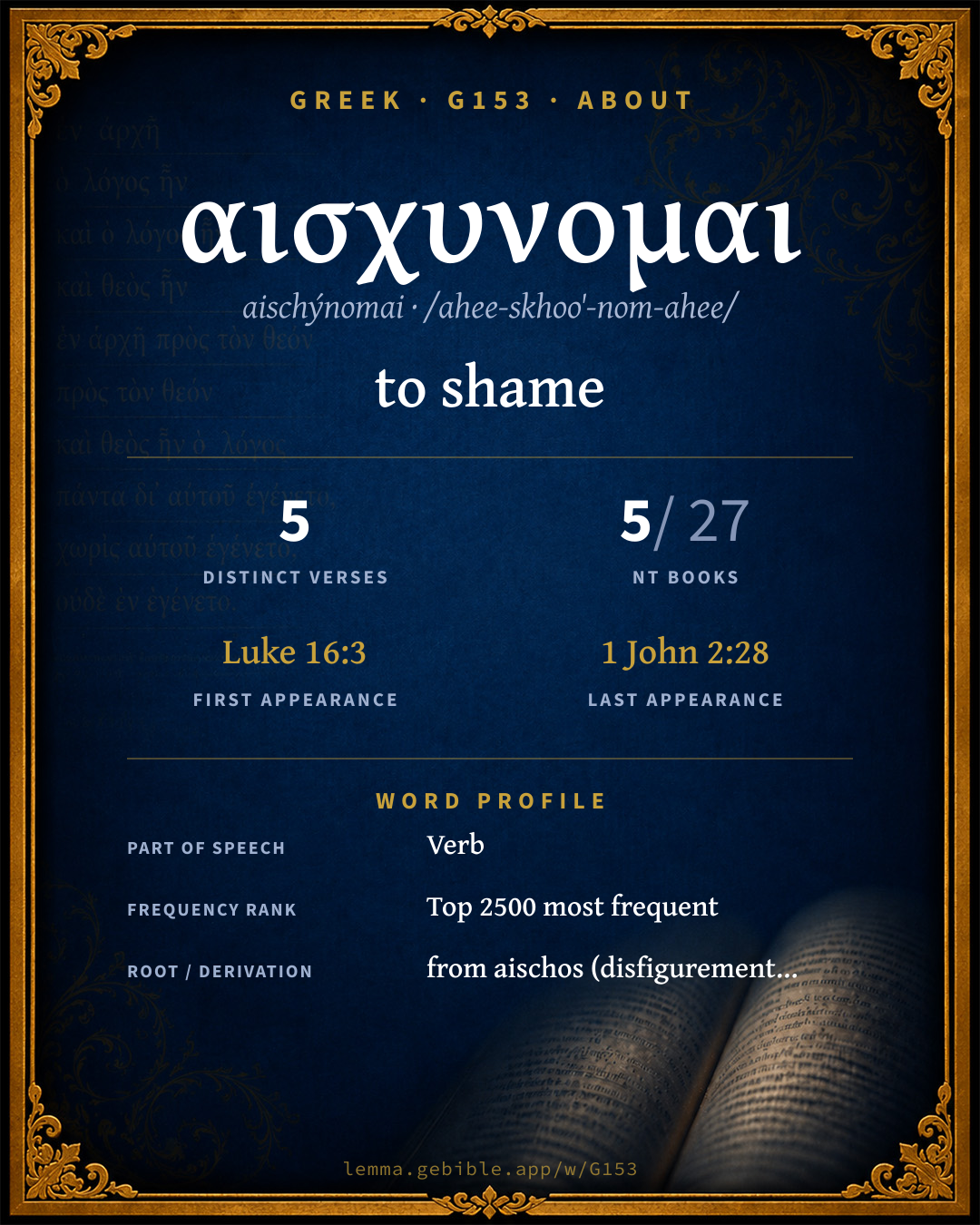
αἰσχύνομαι
to shame
‘to shame’ is one of 3 main senses fuller range ↓
Full lexicon entry — Thayer's Greek Lexicon
From Thayer's Greek Lexicon
Where this word appears
Grammar key — what these labels mean
Part of speech
- Verb
- An action or state-of-being word.
Tense
- Future
- Action expected in future time.
- Aorist
- Action viewed as a simple whole, without regard to duration — often past (perfective aspect).
- Present
- Ongoing or general action in present time (imperfective aspect).
Voice
- Passive
- The subject receives the action.
- Middle
- The subject acts on or for itself, or with special interest in the action.
Mood
- Indicative
- States a fact or asks a factual question (the mood of reality).
- Subjunctive
- Expresses probability, purpose, or possibility (the mood of contingency).
- Imperative
- Expresses a command or request.
Person
- 1st person
- The speaker (“I / we”).
- 3rd person
- The one spoken about (“he / she / it / they”).
Number
- Singular
- One.
- Plural
- More than one.
Every verse where G153 appears in the Book of Philippians — 1 distinct verse. Click any verse to open its interlinear word-by-word view. Verse text shown in the World English Bible for context — . Each verse’s Greek form is shown with its reference; the English is not keyword-highlighted, since the data carries no word-level English alignment. Use “Compare translations” on any verse to read it across multiple English versions. This concordance covers the Greek New Testament; Septuagint (Greek Old Testament) occurrences of this word are not indexed here.
Philippians
About this entry
At a glance — auto-summarized from this page’s data, not written by a person. Every figure links to its source below. This summary describes the numbers; it doesn’t interpret them.
αισχυνομαι (aischýnomai) is a Greek verb most often rendered “to shame.” It occurs a mere 5 verses across Scripture. It first appears in Luke 16:3. Ranging over 3 senses, it is not a single-sense word. Sharing its root, it stands alongside αισχρος and αισχυνη. For the data behind this summary, explore the sense tree and the renderings breakdown below.
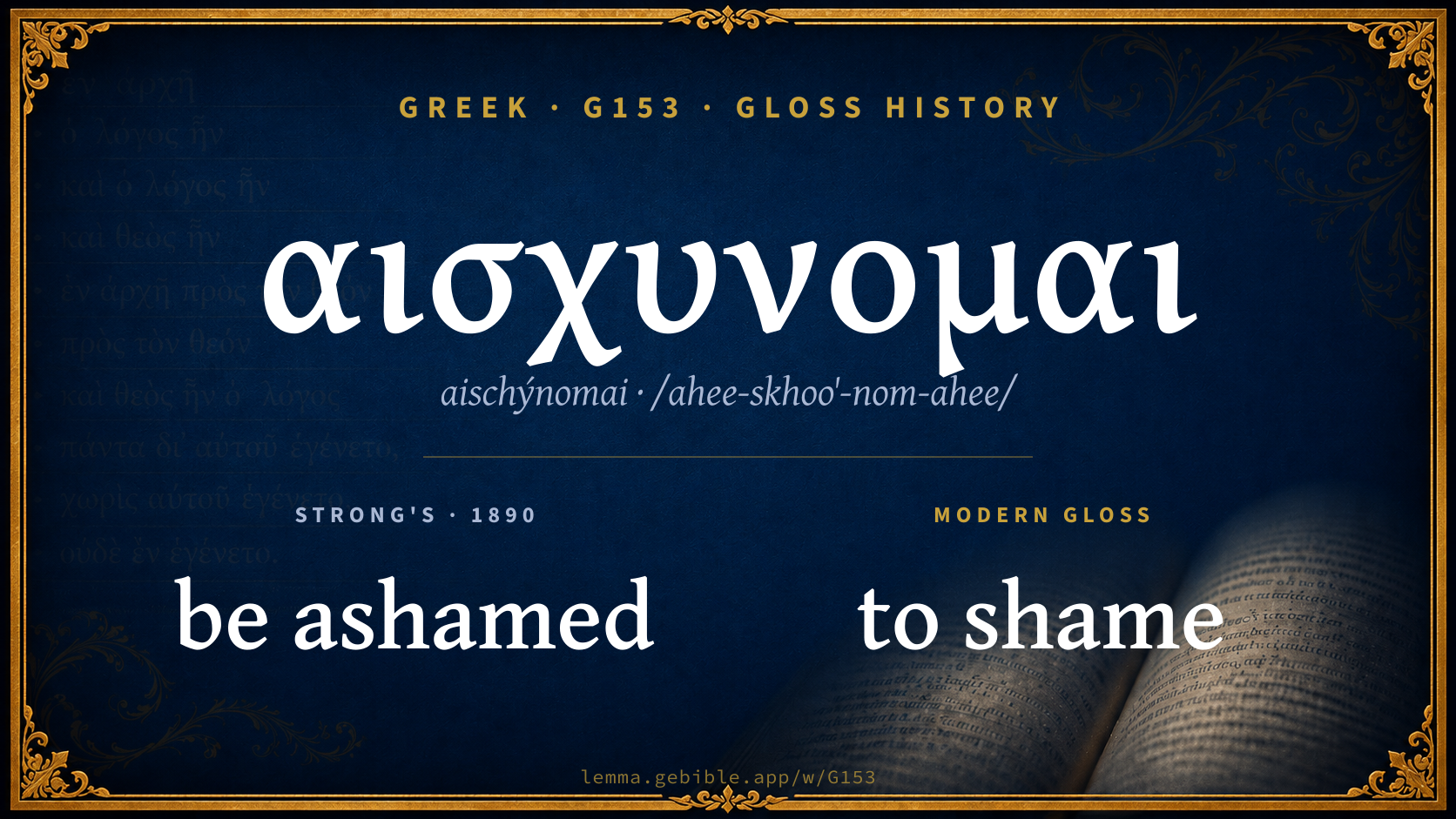
Gloss history
Strong's 1890 vs modern scholarship
About this word
Strong's G153 catalogs a Greek word from the Greek New Testament.
These counts are not copied from any lexicon or concordance. They are computed here, from the morphology-tagged Greek New Testament. What Lemma adds →
- 5
- distinct verses
- The word appears in 5 distinct verses.
- 5 / 27
- NT books
- The word appears in 5 of 27 New Testament books.
- #1,648
- by frequency
- Top 2500 most frequent Greek words (rank 1,648 of 5,347 Greek words by occurrence).
View all 5 occurrences in the concordance →
Most concentrated in
- Luke 1 verse 20%
- 2 Corinthians 1 verse 20%
- Philippians 1 verse 20%
By section of the New Testament
By traditional corpus
Conventional, traditional groupings — biblical authorship is debated, so this is a traditional corpus grouping, not an authorship claim. Some books belong to more than one corpus (Luke is in both the Gospels and the Lukan corpus, and so on), so these shares overlap and need not total 100%. Each figure is a share of the word’s 5 distinct verses.
- Pauline corpus 2 verses · 40%
- General (Catholic) Epistles 2 verses · 40%
- Gospels 1 verse · 20%
- Lukan (Luke–Acts) 1 verse · 20%
- Johannine 1 verse · 20%
How translations render this word
Counts come from each version’s own published word-to-Strong’s tagging or interlinear alignment — an approximate guide to how each version renders this word, not a word-level alignment the data otherwise carries. Because each total is that version’s own tagged count, the per-version totals vary from one another and need not match the appearance or distinct-verse counts above. These counts may also differ from a printed concordance because Lemma counts each distinctly tagged rendering and does not collapse phrase taggings into a single head-word total. This is a fixed set of word-tagged versions (KJV, ASV, BSB, ULT) and does not change with the reading translation you choose elsewhere. Each version’s license is shown beside its name below (and on Sources).
- King James Version: Be ashamed 3×
- American Standard Version: Be ashamed 2×
- Berean Standard Bible: Do not be ashamed 1×, I will in no way be ashamed 1×, I will not be ashamed 1×
- unfoldingWord Literal Text: Be ashamed 3×, I will 2×
King James Version Public Domain
Renders G153 across 7 tagged occurrences — most commonly:
Plus 4 renderings that appear only once — usually multi-word phrases or single function words the recovered tagging swept in, not distinct renderings.
American Standard Version Public Domain
Renders G153 across 7 tagged occurrences — most commonly:
Plus 5 renderings that appear only once — usually multi-word phrases or single function words the recovered tagging swept in, not distinct renderings.
Berean Standard Bible Public Domain
Renders G153 across 5 tagged occurrences — most commonly:
unfoldingWord Literal Text CC BY-SA 4.0
Renders G153 across 8 tagged occurrences — most commonly:
Plus 3 renderings that appear only once — usually multi-word phrases or single function words the recovered tagging swept in, not distinct renderings.
Senses in Thayer's
The 3 senses Thayer's distinguishes for this word, in lexicon order (not ranked by frequency or importance). The full entry — with sub-senses — is in the Lexicon Entry tab.
- to disfigure
- to dishonour
- to suffuse with shame, make ashamed, be ashamed
Word origin
Origin: from aischos (disfigurement, i.e. disgrace)
From αἶσχος aischos ( disfigurement that is disgrace ); to feel shame (for oneself): - be ashamed.
— Strong’s Exhaustive Concordance (1890), public domain.
Forms in the corpus
The 4 distinct written forms G153 takes in the Greek New Testament, most frequent first — each parse links to that tense’s occurrences in the concordance.
| Form | Parsing | Example | Uses |
|---|---|---|---|
| αἰσχυνθήσομαι aischynthḗsomai | Verb, Future, Passive, Indicative, 1st person, Singular | 2 Corinthians 10:8 | 2 |
| αἰσχυνέσθω aischynésthō | Verb, Present, Passive, Imperative, 3rd person, Singular | 1 Peter 4:16 | 1 |
| αἰσχυνθῶμεν aischynthō̂men | Verb, Aorist, Passive, Subjunctive, 1st person, Plural | 1 John 2:28 | 1 |
| αἰσχύνομαι aischýnomai | Verb, Present, Middle, Indicative, 1st person, Singular | Luke 16:3 | 1 |
Same root — word family
Other Thayer's entries built from the same root as G153, grouped by Strong’s listed origin. These share a root / origin per the lexicon — not necessarily a shared meaning. Each links to that word’s own entry.
Derived from this word
Compare all same-root words → They share a root, not necessarily a meaning.
Septuagint usage
The same Greek word αισχυνομαι appears 74 times in the Greek Old Testament (Septuagint), across 73 verses in 18 books.
- 74
- LXX occurrences
- Tagged occurrences of this Greek word in the Septuagint.
- 73
- verses
- Distinct Septuagint verses containing this word.
- 18 / 39
- OT books
- The word appears in 18 of the 39 Old Testament books.
Sample Septuagint occurrences
- Genesis 2:25 αἰσχύνω
- Judges 3:25 αἰσχύνω
- 1 Samuel 13:4 αἰσχύνω
- 2 Samuel 19:4 αἰσχύνω
- 2 Kings 2:17 αἰσχύνω
- 1 Chronicles 19:6 αἰσχύνω
- 2 Chronicles 12:6 αἰσχύνω
- Ezra 8:22 αἰσχύνω
- Job 19:3 αἰσχύνω
- Psalms 6:11 αἰσχύνω
- Proverbs 1:22 αἰσχύνω
- Ecclesiastes 10:17 αἰσχύνω
Septuagint occurrences (same lexeme)
Every verse where the same Strong’s number (G153) appears in the Greek Septuagint — showing the first 50 of 73. Verse text shown in the World English Bible for context; the Greek form is the matched word — the English is not keyword-highlighted.
- Genesis 2:25 αἰσχύνω They were both naked, the man and his wife, and were not ashamed.
- Judges 3:25 αἰσχύνω They waited until they were ashamed; and, behold, he didn't open the doors of the upper room: therefore they took the key, and opened [them], and, behold, their lord was fallen down dead on the earth.
- Judges 5:28 αἰσχύνω Through the window she looked forth, and cried, The mother of Sisera [cried] through the lattice, Why is his chariot so long in coming? Why do the wheels of his chariots wait?
- 1 Samuel 13:4 αἰσχύνω All Israel heard say that Saul had struck the garrison of the Philistines, and also that Israel was had in abomination with the Philistines. The people were gathered together after Saul to Gilgal.
- 1 Samuel 27:12 αἰσχύνω Achish believed David, saying, He has made his people Israel utterly to abhor him; therefore he shall be my servant forever.
- 2 Samuel 19:4 αἰσχύνω The king covered his face, and the king cried with a loud voice, my son Absalom, Absalom, my son, my son!
- 2 Kings 2:17 αἰσχύνω When they urged him until he was ashamed, he said, Send. They sent therefore fifty men; and they sought three days, but didn't find him.
- 1 Chronicles 19:6 αἰσχύνω When the children of Ammon saw that they had made themselves odious to David, Hanun and the children of Ammon sent one thousand talents of silver to hire them chariots and horsemen out of Mesopotamia, and out of Arammaacah, and out of Zobah.
- 2 Chronicles 12:6 αἰσχύνω Then the princes of Israel and the king humbled themselves; and they said, Yahweh is righteous.
- Ezra 8:22 αἰσχύνω For I was ashamed to ask of the king a band of soldiers and horsemen to help us against the enemy in the way, because we had spoken to the king, saying, The hand of our God is on all those who seek him, for good; but his power and his wrath is against all those who forsake him.
- Ezra 9:6 αἰσχύνω and I said, my God, I am ashamed and blush to lift up my face to you, my God; for our iniquities are increased over our head, and our guiltiness is grown up to the heavens.
- Job 19:3 αἰσχύνω You have reproached me ten times. You aren't ashamed that you attack me.
- Job 32:21 αἰσχύνω Please don't let me respect any man's person, Neither will I give flattering titles to any man.
- Psalms 6:11 αἰσχύνω
- Psalms 24:3 αἰσχύνω Who may ascend to Yahweh's hill? Who may stand in his holy place?
- Psalms 30:18 αἰσχύνω
- Psalms 34:4 αἰσχύνω I sought Yahweh, and he answered me, And delivered me from all my fears.
- Psalms 34:26 αἰσχύνω
- Psalms 68:7 αἰσχύνω God, when you went forth before your people, When you marched through the wilderness... Selah.
- Psalms 69:3 αἰσχύνω I am weary with my crying. My throat is dry. My eyes fail, looking for my God.
- Psalms 69:4 αἰσχύνω Those who hate me without a cause are more than the hairs of my head. Those who want to cut me off, being my enemies wrongfully, are mighty. I have to restore what I didn't take away.
- Psalms 70:13 αἰσχύνω
- Psalms 70:24 αἰσχύνω
- Psalms 82:18 αἰσχύνω
- Psalms 85:17 αἰσχύνω
- Psalms 96:7 αἰσχύνω Ascribe to Yahweh, you families of nations, Ascribe to Yahweh glory and strength.
- Psalms 108:28 αἰσχύνω
- Psalms 118:46 αἰσχύνω
- Psalms 118:78 αἰσχύνω
- Psalms 118:80 αἰσχύνω
- Psalms 128:5 αἰσχύνω May Yahweh bless you out of Zion, And may you see the good of Jerusalem all the days of your life.
- Proverbs 1:22 αἰσχύνω "How long, you simple ones, will you love simplicity? How long will mockers delight themselves in mockery, And fools hate knowledge?
- Proverbs 13:5 αἰσχύνω A righteous man hates lies, But a wicked man brings shame and disgrace.
- Proverbs 20:4 αἰσχύνω The sluggard will not plow by reason of the winter; Therefore he shall beg in harvest, and have nothing.
- Proverbs 22:26 αἰσχύνω Don't you be one of those who strike hands, Of those who are collateral for debts.
- Proverbs 28:21 αἰσχύνω To show partiality is not good; Yet a man will do wrong for a piece of bread.
- Proverbs 29:15 αἰσχύνω The rod of correction gives wisdom, But a child left to himself causes shame to his mother.
- Proverbs 29:25 αἰσχύνω The fear of man proves to be a snare, But whoever puts his trust in Yahweh is kept safe.
- Ecclesiastes 10:17 αἰσχύνω Happy are you, land, when your king is the son of nobles, And your princes eat in due season, For strength, and not for drunkenness!
- Isaiah 1:29 αἰσχύνω For they shall be ashamed of the oaks which you have desired, And you shall be confounded for the gardens that you have chosen.
- Isaiah 20:5 αἰσχύνω They shall be dismayed and confounded, because of Ethiopia their expectation, and of Egypt their glory.
- Isaiah 23:4 αἰσχύνω Be ashamed, Sidon; for the sea has spoken, the stronghold of the sea, saying, I have not travailed, nor brought forth, neither have I nourished young men, nor brought up virgins.
- Isaiah 24:9 αἰσχύνω They shall not drink wine with a song; strong drink shall be bitter to those who drink it.
- Isaiah 26:11 αἰσχύνω Yahweh, your hand is lifted up, yet they don't see: but they shall see [your] zeal for the people, and be disappointed; yes, fire shall devour your adversaries.
- Isaiah 29:22 αἰσχύνω Therefore thus says Yahweh, who redeemed Abraham, concerning the house of Jacob: Jacob shall not now be ashamed, neither shall his face now wax pale.
- Isaiah 33:9 αἰσχύνω The land mourns and languishes; Lebanon is confounded and withers away; Sharon is like a desert; and Bashan and Carmel shake off [their leaves].
- Isaiah 41:11 αἰσχύνω Behold, all those who are incensed against you shall be disappointed and confounded: those who strive with you shall be as nothing, and shall perish.
- Isaiah 42:17 αἰσχύνω They shall be turned back, they shall be utterly disappointed, who trust in engraved images, who tell molten images, You are our gods.
- Isaiah 44:9 αἰσχύνω Those who fashion an engraved image are all of them vanity; and the things that they delight in shall not profit; and their own witnesses don't see, nor know: that they may be disappointed.
- Isaiah 44:11 αἰσχύνω Behold, all his fellows shall be disappointed; and the workmen, they are of men: let them all be gathered together, let them stand up; they shall fear, they shall be put to shame together.
These are occurrences of the same Greek lexeme (G153) in the Septuagint — not a translation of any one Hebrew word. The store carries no word-level Hebrew↔Greek alignment, so no Hebrew original is asserted here. Counts come from the recovered LXX Strong's tagging — high-frequency vocabulary is well covered, while rare or late forms may be untagged — so they reflect tagged occurrences and may slightly undercount.