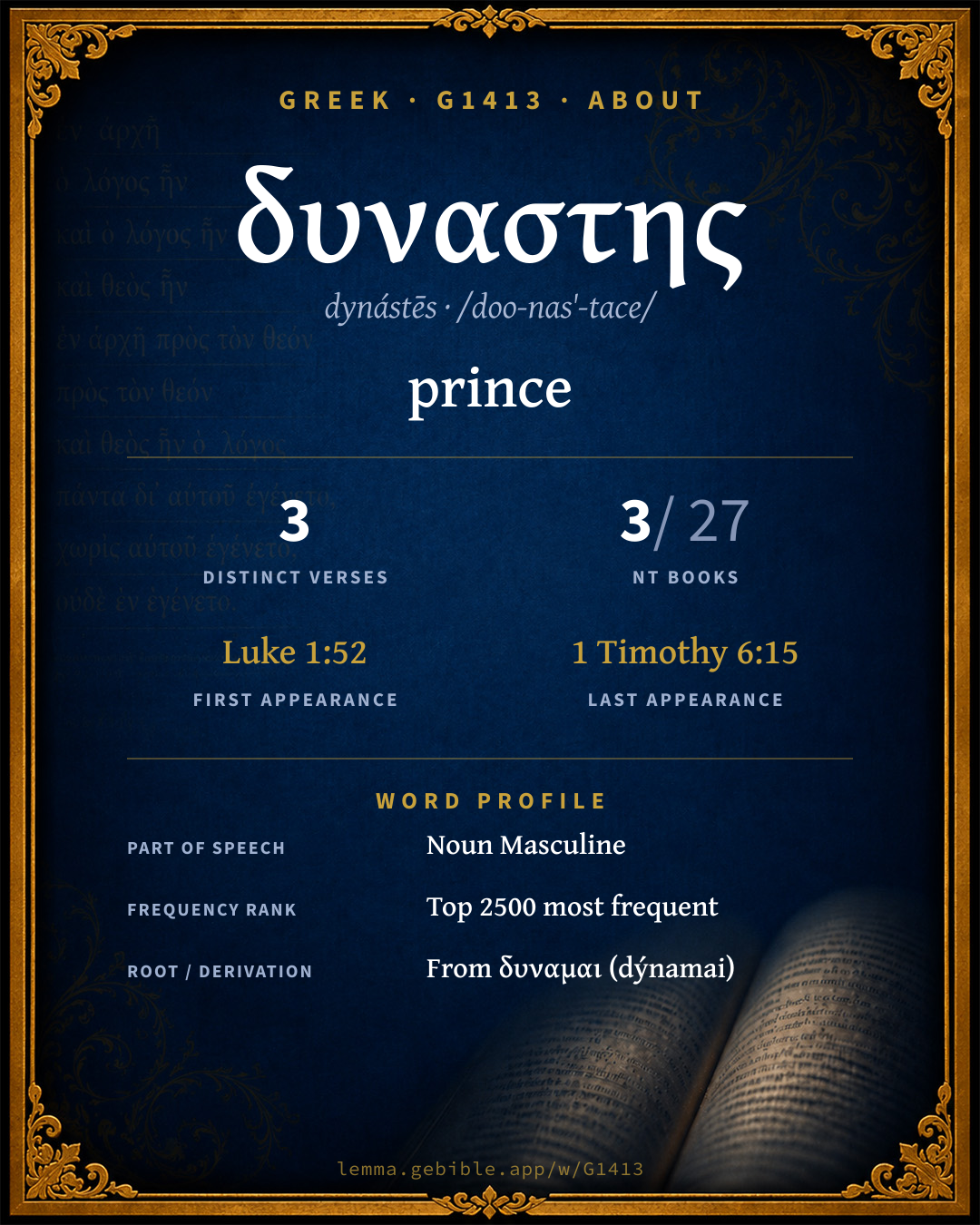
δυνάστης
prince
‘prince’ is one of 2 main senses fuller range ↓
Full lexicon entry — Thayer's Greek Lexicon
From Thayer's Greek Lexicon
Where this word appears
Grammar key — what these labels mean
Part of speech
- Noun
- A naming word — a person, place, thing, or idea.
Case
- Nominative
- The case of the subject (and the predicate nominative).
- Accusative
- The case of the direct object and of extent.
Gender
- Masculine
- Grammatically masculine.
Number
- Singular
- One.
- Plural
- More than one.
Every verse where G1413 appears in the Book of Acts — 1 distinct verse. Click any verse to open its interlinear word-by-word view. Verse text shown in the World English Bible for context — . Each verse’s Greek form is shown with its reference; the English is not keyword-highlighted, since the data carries no word-level English alignment. Use “Compare translations” on any verse to read it across multiple English versions. This concordance covers the Greek New Testament; Septuagint (Greek Old Testament) occurrences of this word are not indexed here.
Acts
About this entry
At a glance — auto-summarized from this page’s data, not written by a person. Every figure links to its source below. This summary describes the numbers; it doesn’t interpret them.
δυναστης (dynástēs) is a Greek noun most often rendered “prince.” It is rare — just 3 verses in the entire Greek New Testament. It concentrates in Luke, which alone accounts for 33% of its uses. Debuting at Luke 1:52, it then recurs through the corpus. Its lexical range runs to 2 senses. For the data behind this summary, explore the sense tree and the renderings breakdown below.
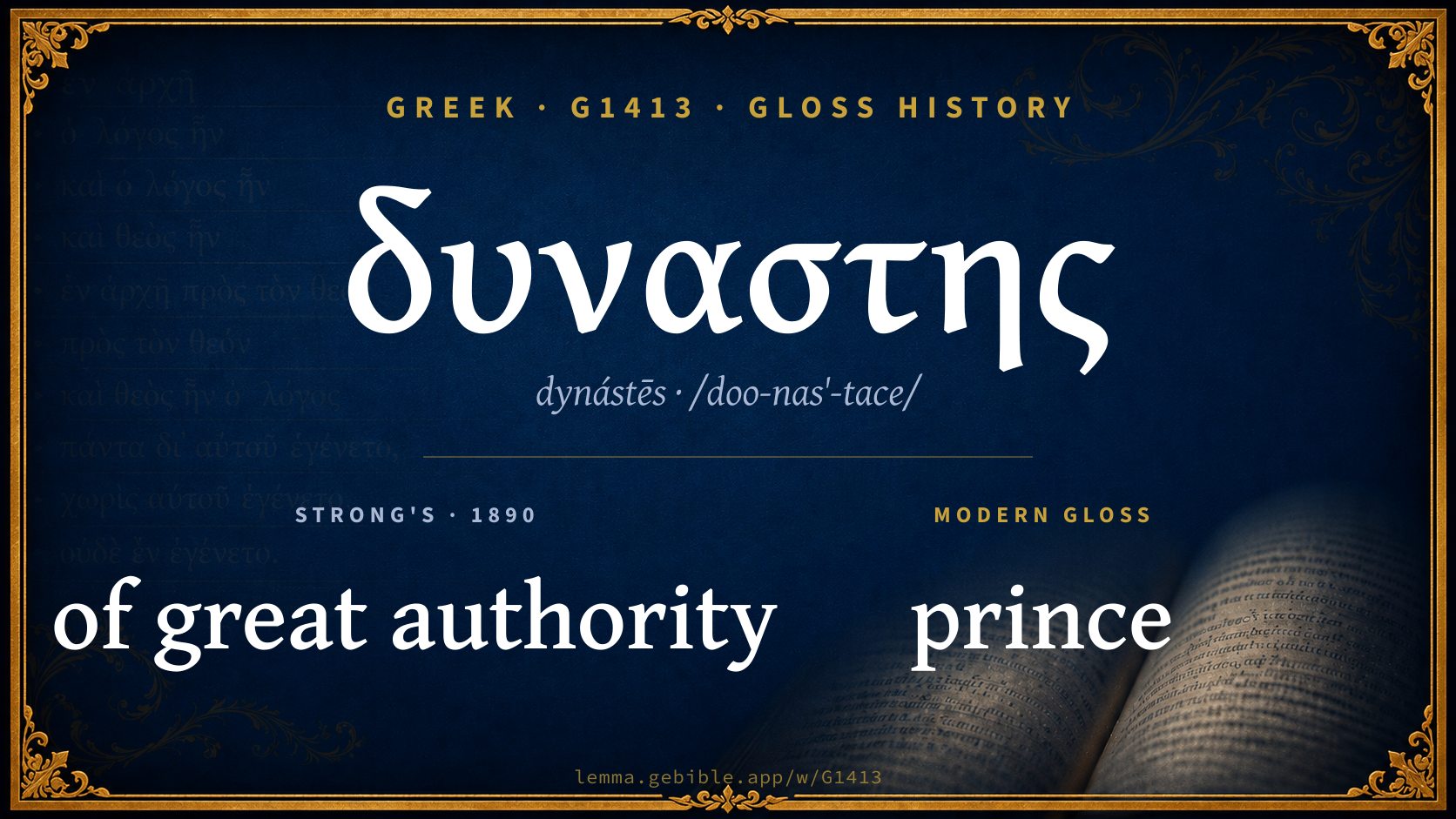
Gloss history
Strong's 1890 vs modern scholarship
About this word
Strong's G1413 catalogs a Greek word from the Greek New Testament.
These counts are not copied from any lexicon or concordance. They are computed here, from the morphology-tagged Greek New Testament. What Lemma adds →
- 3
- distinct verses
- The word appears in 3 distinct verses.
- 3 / 27
- NT books
- The word appears in 3 of 27 New Testament books.
- #2,203
- by frequency
- Top 2500 most frequent Greek words (rank 2,203 of 5,347 Greek words by occurrence).
View all 3 occurrences in the concordance →
By section of the New Testament
By traditional corpus
Conventional, traditional groupings — biblical authorship is debated, so this is a traditional corpus grouping, not an authorship claim. Some books belong to more than one corpus (Luke is in both the Gospels and the Lukan corpus, and so on), so these shares overlap and need not total 100%. Each figure is a share of the word’s 3 distinct verses.
- Lukan (Luke–Acts) 2 verses · 67%
- Gospels 1 verse · 33%
- Pauline corpus 1 verse · 33%
How translations render this word
Counts come from each version’s own published word-to-Strong’s tagging or interlinear alignment — an approximate guide to how each version renders this word, not a word-level alignment the data otherwise carries. Because each total is that version’s own tagged count, the per-version totals vary from one another and need not match the appearance or distinct-verse counts above. These counts may also differ from a printed concordance because Lemma counts each distinctly tagged rendering and does not collapse phrase taggings into a single head-word total. This is a fixed set of word-tagged versions (KJV, ASV, BSB, ULT) and does not change with the reading translation you choose elsewhere. Each version’s license is shown beside its name below (and on Sources).
- King James Version: Great authority 1×, Mighty 1×, Potentate 1×
- American Standard Version: Great authority 1×, Potentate 1×, Princes 1×
- Berean Standard Bible: Court official 1×, Rulers 1×, Sovereign 1×
- unfoldingWord Literal Text: Official 1×, Rulers 1×, Sovereign 1×
King James Version Public Domain
Renders G1413 across 3 tagged occurrences — most commonly:
American Standard Version Public Domain
Renders G1413 across 3 tagged occurrences — most commonly:
Berean Standard Bible Public Domain
Renders G1413 across 3 tagged occurrences — most commonly:
unfoldingWord Literal Text CC BY-SA 4.0
Renders G1413 across 3 tagged occurrences — most commonly:
Senses in Thayer's
The 2 senses Thayer's distinguishes for this word, in lexicon order (not ranked by frequency or importance). The full entry — with sub-senses — is in the Lexicon Entry tab.
- a prince, a potentate
- a courtier, high officer, royal minister of great authority
Word origin
Derived from δυναμαι (dýnamai) (G1410) — to be able.
From G1410 ; a ruler or officer : - of great authority mighty potentate.
— Strong’s Exhaustive Concordance (1890), public domain.
Forms in the corpus
The 2 distinct written forms G1413 takes in the Greek New Testament, most frequent first — each parse links to that case’s occurrences in the concordance.
| Form | Parsing | Example | Uses |
|---|---|---|---|
| δυνάστης dynástēs | Noun, Nominative, Singular, Masculine | Acts 8:27 | 2 |
| δυνάστας dynástas | Noun, Accusative, Plural, Masculine | Luke 1:52 | 1 |
Same root — word family
Other Thayer's entries built from the same root as G1413, grouped by Strong’s listed origin. These share a root / origin per the lexicon — not necessarily a shared meaning. Each links to that word’s own entry.
Derives from
Shares the same root
Compare all same-root words → They share a root, not necessarily a meaning.
Septuagint usage
The same Greek word δυναστης appears 39 times in the Greek Old Testament (Septuagint), across 39 verses in 13 books.
- 39
- LXX occurrences
- Tagged occurrences of this Greek word in the Septuagint.
- 39
- verses
- Distinct Septuagint verses containing this word.
- 13 / 39
- OT books
- The word appears in 13 of the 39 Old Testament books.
Sample Septuagint occurrences
- Genesis 49:24 δυνάστης
- Leviticus 19:15 δυνάστης
- 1 Samuel 2:8 δυνάστης
- 1 Chronicles 28:1 δυνάστης
- Job 5:15 δυνάστης
- Psalms 71:12 δυνάστης
- Proverbs 1:21 δυνάστης
- Isaiah 5:22 δυνάστης
- Jeremiah 41:19 δυνάστης
- Daniel 2:10 δυνάστης
- Amos 6:7 δυνάστης
- Nahum 3:18 δυνάστης
Septuagint occurrences (same lexeme)
Every verse where the same Strong’s number (G1413) appears in the Greek Septuagint. Verse text shown in the World English Bible for context; the Greek form is the matched word — the English is not keyword-highlighted.
- Genesis 49:24 δυνάστης But his bow abode in strength, The arms of his hands were made strong, By the hands of the Mighty One of Jacob, (From there is the shepherd, the stone of Israel),
- Genesis 50:4 δυνάστης When the days of weeping for him were past, Joseph spoke to the house of Pharaoh, saying, "If now I have found favor in your eyes, please speak in the ears of Pharaoh, saying,
- Leviticus 19:15 δυνάστης "'You shall do no injustice in judgment: you shall not be partial to the poor, nor show favoritism to the great; but in righteousness shall you judge your neighbor.
- 1 Samuel 2:8 δυνάστης He raises up the poor out of the dust, He lifts up the needy from the dunghill, To make them sit with princes, Inherit the throne of glory: For the pillars of the earth are Yahweh's, He has set the world on them.
- 1 Chronicles 28:1 δυνάστης David assembled all the princes of Israel, the princes of the tribes, and the captains of the companies who served the king by division, and the captains of thousands, and the captains of hundreds, and the rulers over all the substance and possessions of the king and of his sons, with the officers, and the mighty men, even all the mighty men of valor, to Jerusalem.
- 1 Chronicles 29:24 δυνάστης All the princes, the mighty men, and also all of the sons of king David submitted themselves to Solomon the king.
- Job 5:15 δυνάστης But he saves from the sword of their mouth, Even the needy from the hand of the mighty.
- Job 6:23 δυνάστης Or, 'Deliver me from the adversary's hand?' Or, 'Redeem me from the hand of the oppressors?'
- Job 9:22 δυνάστης "It is all the same. Therefore I say, He destroys the blameless and the wicked.
- Job 12:19 δυνάστης He leads priests away stripped, And overthrows the mighty.
- Job 13:15 δυνάστης Behold, he will kill me; I have no hope. Nevertheless, I will maintain my ways before him.
- Job 15:5 δυνάστης For your iniquity teaches your mouth, And you choose the language of the crafty.
- Job 15:20 δυνάστης The wicked man travails with pain all his days, Even the number of years that are laid up for the oppressor.
- Job 27:13 δυνάστης "This is the portion of a wicked man with God, The heritage of oppressors, which they receive from the Almighty.
- Job 29:12 δυνάστης Because I delivered the poor who cried, And the fatherless also, who had none to help him.
- Job 36:22 δυνάστης Behold, God is exalted in his power. Who is a teacher like him?
- Psalms 71:12 δυνάστης God, don't be far from me. My God, hurry to help me.
- Proverbs 1:21 δυνάστης She calls at the head of noisy places. At the entrance of the city gates, she utters her words:
- Proverbs 8:3 δυνάστης Beside the gates, at the entry of the city, At the entry doors, she cries aloud:
- Proverbs 8:15 δυνάστης By me kings reign, And princes decree justice.
- Proverbs 14:28 δυνάστης In the multitude of people is the king's glory, But in the lack of people is the destruction of the prince.
- Proverbs 17:26 δυνάστης Also to punish the righteous is not good, Nor to flog officials for their integrity.
- Proverbs 18:16 δυνάστης A man's gift makes room for him, And brings him before great men.
- Proverbs 18:18 δυνάστης The lot settles disputes, And keeps strong ones apart.
- Proverbs 23:1 δυνάστης When you sit to eat with a ruler, Consider diligently what is before you;
- Proverbs 25:6 δυνάστης Don't exalt yourself in the presence of the king, Or claim a place among great men;
- Proverbs 25:7 δυνάστης For it is better that it be said to you, "Come up here," Than that you should be put lower in the presence of the prince, Whom your eyes have seen.
- Proverbs 31:4 δυνάστης It is not for kings, Lemuel; It is not for kings to drink wine; Nor for princes to say, 'Where is strong drink?'
- Isaiah 5:22 δυνάστης Woe to those who are mighty to drink wine, And champions at mixing strong drink;
- Jeremiah 41:19 δυνάστης
- Daniel 2:10 δυνάστης The Chaldeans answered before the king, and said, There is not a man on the earth who can show the king's matter, because no king, lord, or ruler, has asked such a thing of any magician, or enchanter, or Chaldean.
- Daniel 8:24 δυνάστης His power shall be mighty, but not by his own power; and he shall destroy wonderfully, and shall prosper and do [his pleasure]; and he shall destroy the mighty ones and the holy people.
- Daniel 9:6 δυνάστης neither have we listened to your servants the prophets, who spoke in your name to our kings, our princes, and our fathers, and to all the people of the land.
- Daniel 9:8 δυνάστης Lord, to us belongs confusion of face, to our kings, to our princes, and to our fathers, because we have sinned against you.
- Daniel 11:5 δυνάστης The king of the south shall be strong, and [one] of his princes; and he shall be strong above him, and have dominion; his dominion shall be a great dominion.
- Daniel 11:15 δυνάστης So the king of the north shall come, and cast up a mound, and take a well-fortified city: and the forces of the south shall not stand, neither his chosen people, neither shall there be any strength to stand.
- Amos 6:7 δυνάστης Therefore they will now go captive with the first who go captive; And the feasting and lounging will end.
- Nahum 3:18 δυνάστης Your shepherds slumber, king of Assyria. Your nobles lie down. Your people are scattered on the mountains, and there is no one to gather them.
- Habakkuk 3:14 δυνάστης You pierced the heads of his warriors with their own spears. They came as a whirlwind to scatter me, Gloating as if to devour the wretched in secret.
These are occurrences of the same Greek lexeme (G1413) in the Septuagint — not a translation of any one Hebrew word. The store carries no word-level Hebrew↔Greek alignment, so no Hebrew original is asserted here. Counts come from the recovered LXX Strong's tagging — high-frequency vocabulary is well covered, while rare or late forms may be untagged — so they reflect tagged occurrences and may slightly undercount.