Proverbs 25:7

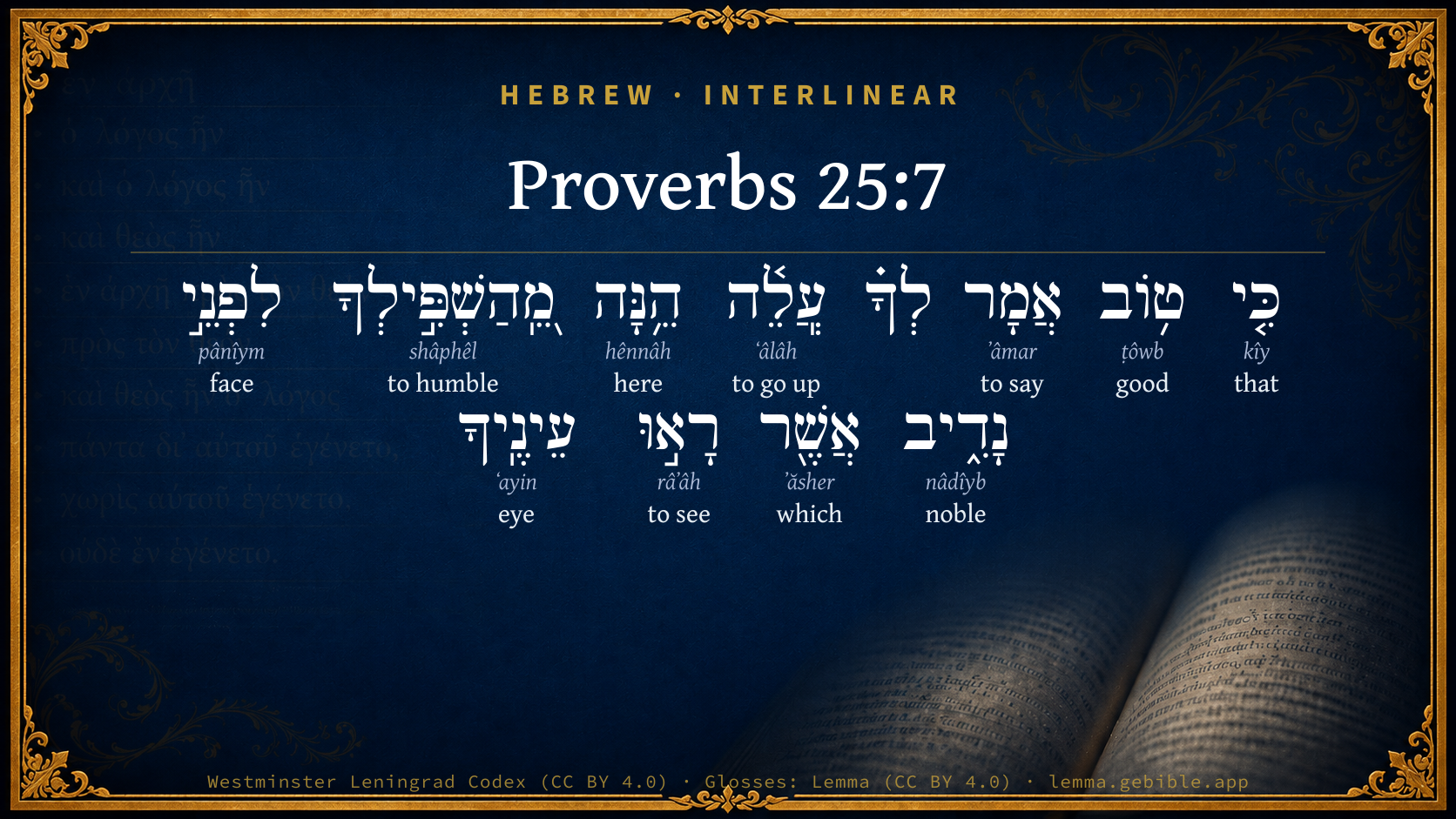
Hebrew (Westminster Leningrad Codex) Proverbs 25:7 appears in the Hebrew Old Testament. The text above is from the Westminster Leningrad Codex. Each word links to its Strong’s number, a concise gloss, and parsing drawn from the Open Scriptures Hebrew Bible morphology. Click any word for its full Brown-Driver-Briggs (BDB) entry.
Download image
Cite this verse

Proverbs 25:7 (World English Bible). Public Domain. Lemma interlinear Bible study tool, https://lemma.gebible.app/v/proverbs/25/7.

Show BibTeX & RIS
BibTeX
RIS
English Translation
For it is better that it be said to you, "Come up here," Than that you should be put lower in the presence of the prince, Whom your eyes have seen.
World English Bible · Public Domain
Download a study sheet

One document with this verse’s original text, its word-by-word gloss line, the meaning frame, cross-references with their text, attributed commentary, and full source and license credits — printable, and it pastes into notes with its structure intact.

This verse Autodidact and up

Study sheet (.html) Plain text (.txt)

A passage Seminary Student

Up to 50 verses in one chapter. A passage sheet keeps up to 6 commentary sources and 12 cross-references per verse, in the order this page ranks them, and says so on the sheet whenever that leaves anything out. Ask for a single verse and you get the Autodidact verse sheet above.

Everything on this page stays free to read, with no account — the sheet is a download of what is already on screen, not access to it.

Want to remove ads? Support Godless Engineer
Compare translations 3

The same verse in 3 English versions, stacked beneath the original-language interlinear above. Click any original word for its lexicon entry.

Each is an independent rendering of the whole verse — the interlinear is not word-aligned to these translations.

Highlighted words mark where these versions differ — a whole-verse word diff, not a word-by-word alignment.

  • World English Bible Public Domain
    For it is better that it be said to you, "Come up here," Than that you should be put lower in the presence of the prince, Whom your eyes have seen.
  • King James Version Public Domain
    For better it is that it be said unto thee, Come up hither; than that thou shouldest be put lower in the presence of the prince whom thine eyes have seen.
  • unfoldingWord Literal Text CC BY-SA 4.0
    For, better to say to you, “Come up here,” than to humiliate you to the face of a noble, whom your eyes have seen.

unfoldingWord Literal Text — © unfoldingWord, licensed CC BY-SA 4.0. Word-aligned USFM3 via Door43 (git.door43.org/unfoldingWord/en_ult).

Versions to compare (up to 4)

3 of 4 selected

Show all 18 translations

Every available English version of this verse, each an independent rendering of the whole verse.

  • World English Bible Public Domain
    For it is better that it be said to you, "Come up here," Than that you should be put lower in the presence of the prince, Whom your eyes have seen.
  • Berean Standard Bible Public Domain
    for it is better that he says to you, “Come up here!” than that you should be demoted in the presence of the prince. Even what you have seen with your own eyes,
  • Majority Standard Bible Public Domain
    for it is better to be told, “Come up here!” than to be demoted in the presence of the prince. Even what you have seen with your own eyes,
  • King James Version Public Domain
    For better it is that it be said unto thee, Come up hither; than that thou shouldest be put lower in the presence of the prince whom thine eyes have seen.
  • American Standard Version (1901) Public Domain
    For better is it that it be said unto thee, Come up hither, Than that thou shouldest be put lower in the presence of the prince, Whom thine eyes have seen.
  • Revised Version (1885) Public Domain
    For better is it that it be said unto thee, Come up hither; than that thou shouldest be put lower in the presence of the prince, whom thine eyes have seen.
  • Geneva Bible (1599) Public Domain
    For it is better, that it be saide vnto thee, Come vp hither, then thou to be put lower in the presece of the prince whom thine eyes haue seene.
  • Douay-Rheims (1899) Public Domain
    For it is better that it should be said to thee: Come up hither; than that thou shouldst be humbled before the prince.
  • Young's Literal Translation Public Domain
    For better `that' he hath said to thee, `Come thou up hither,' Than `that' he humble thee before a noble, Whom thine eyes have seen.
  • Literal Standard Version CC BY-SA 4.0
    For better [that] he has said to you, “Come up here,” || Than [that] he humbles you before a noble, || Whom your eyes have seen.
  • Unlocked Literal Bible CC BY-SA 4.0
    It is better for him to say to you, “Come up here,” than for him to humiliate you before a nobleman. What you have witnessed,
  • unfoldingWord Literal Text CC BY-SA 4.0
    For, better to say to you, “Come up here,” than to humiliate you to the face of a noble, whom your eyes have seen.
  • Darby Bible Public Domain
    for better it is that it be said unto thee, Come up hither, than that thou shouldest be put lower in the presence of the prince whom thine eyes see.
  • World Messianic Bible Public Domain
    for it is better that it be said to you, “Come up here,” than that you should be put lower in the presence of the prince, whom your eyes have seen.
  • Webster's Bible Public Domain
    For better it is that it be said to thee, Come up hither; than that thou shouldst be put lower in the presence of the prince whom thy eyes have seen.
  • Free Bible Version CC BY-SA 4.0
    for it's better to be told, “Come up here,” than to be humiliated before a nobleman. Even though you've seen something with your own eyes,
  • Bible in Basic English Public Domain
    For it is better to have it said to you, Come up here; than for you to be put down in a lower place before the ruler.
  • JPS Tanakh (1917) Public Domain
    For better is it that it be said unto thee: 'Come up hither', than that thou shouldest be put lower in the presence of the prince, whom thine eyes have seen.

Literal Standard Version (2020), Covenant Press — licensed CC BY-SA 4.0. Text via the HelloAO Bible API (eBible.org). Unlocked Literal Bible (unfoldingWord) — licensed CC BY-SA 4.0. Text via the HelloAO Bible API (eBible.org). unfoldingWord Literal Text — © unfoldingWord, licensed CC BY-SA 4.0. Word-aligned USFM3 via Door43 (git.door43.org/unfoldingWord/en_ult). Free Bible Version, Dr. Jonathan Gallagher — licensed CC BY-SA 4.0. Text via the HelloAO Bible API (eBible.org).

Word by word

More ways to search: Search by grammar → Find every occurrence → Compare this word →

Practice this passage: Drill this verse → Learn its vocabulary →

מֵֽ֭הַשְׁפִּ֣ילְךָ
shâphêl
H8213
“from · to humble · you”
Preposition + Verb, Hiphil, Infinitive Construct + Suffix, Personal, 2nd Person, Masculine, Singular
Part of Speech
Preposition + Verb
Stem
Hiphil
Form
Infinitive Construct
Full BDB Definition

Origin: a primitive root

TWOT: 2445

to be or become low, sink, be humbled, be abased - (Qal) to be or become low - (Hiphil) - to lay or bring low, humiliate - to set in a lower place, show abasement - to make low, sit down
  1. כִּ֤י kîy H3588 “that” Conjunction
  2. ט֥וֹב ṭôwb H2896 “good” Adjective, Adjective, Masculine, Singular, Absolute
  3. אֲמָר ʼâmar H559 “to say” Verb, Qal, Infinitive Construct
  4. עֲֽלֵ֫ה ʻâlâh H5927 “go up” Verb, Qal, Imperative, 2nd Person, Masculine, Singular
  5. הֵ֥נָּה hênnâh H2008 “here” Adverb
  6. לִפְנֵ֣י pânîym H6440 “to/for · face(s) of” Preposition + Noun, Common, Both, Plural, Construct
  7. נָדִ֑יב nâdîyb H5081 “noble” Adjective, Adjective, Masculine, Singular, Absolute
  8. אֲשֶׁ֖ר ʼăsher H834 “which” Particle, Relative
  9. רָא֣וּ râʼâh H7200 “to see” Verb, Qal, Perfect, 3rd Person, Common, Plural
  10. עֵינֶֽיךָ ʻayin H5869 “eyes · your” Noun, Common, Both, Dual, Construct + Suffix, Personal, 2nd Person, Masculine, Singular

About this verse

These counts appear in no published source. They are computed here, from the morphology-tagged text and Lemma’s own curated glosses. What Lemma adds →

12
words
11
distinct lemmas
Wisdom
section

Shared distinctive vocabulary

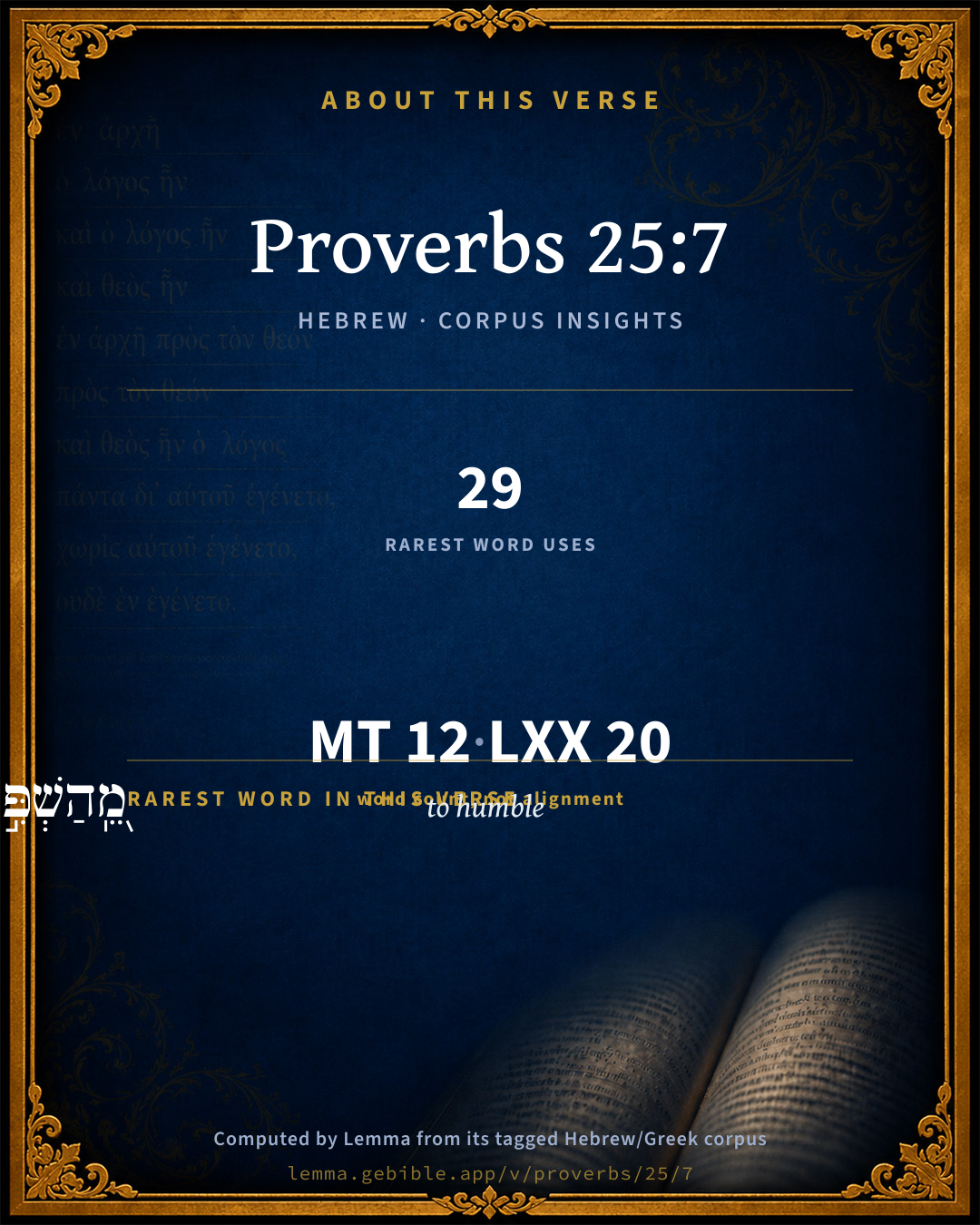
מֵֽ֭הַשְׁפִּ֣ילְךָ to humble H8213 occurs in 27 verses of the Hebrew Bible. Also found in:

Grammatical profile

  • 4 verbs
  • 2 nouns
  • 2 adjectives
  • 1 preposition
  • 1 conjunction
  • 1 adverb
  • 1 particle

Verb forms

  • אֲמָר Qal · Infinitive Construct
  • עֲֽלֵ֫ה Qal · Imperative
  • מֵֽ֭הַשְׁפִּ֣ילְךָ Hiphil · Infinitive Construct
  • רָא֣וּ Qal · Perfect

Hebrew & Septuagint length

In English translation the verse runs 31 words from the Hebrew and 35 from the Septuagint (LXX English) — closely comparable.

A rough comparison of the two English renderings, which tokenize alike — not a word-level alignment.

Word counts can differ between the Hebrew and the Greek without any difference in meaning — e.g. the Hebrew direct-object marker אֵת has no separate Greek word, and Greek often adds the article ὁ.

In the original languages it is 12 Hebrew tokens and 20 Greek tokens — but the two are counted differently (Hebrew bundles its prefixes and suffixes into one token; the Greek is in lemma form), so that isn’t a like-for-like length.

Cross-references

4

Topical passages linked to Proverbs 25:7 in the Treasury of Scripture Knowledge — connected by theme and wording, ordered by reader-vote popularity; previews shown in the World English Bible.

  • Luke 14:7–11 He spoke a parable to those who were invited, when he noticed how they chose the best seats, and said to them,
  • Luke 18:14 I tell you, this man went down to his house justified rather than the other; for everyone who exalts himself will be humbled, but he who humbles himself will be exalted."
  • 1 Peter 5:5 Likewise, you younger ones, be subject to the elder. Yes, all of you gird yourselves with humility, to subject yourselves to one another; for "God resists the proud, but gives grace to the humble."
  • Revelation 4:1 After these things I looked and saw a door opened in heaven, and the first voice that I heard, like a trumpet speaking with me, was one saying, "Come up here, and I will show you the things which must happen after this."

Cross-references courtesy of OpenBible.info (CC BY 4.0).

Hebrew and Greek witnesses Masoretic Hebrew ↔ Greek Septuagint

The same verse in the two great witnesses to the Old Testament, shown verse-for-verse.

These are two independent witnesses, not word-aligned to each other, and the Septuagint is shown in lemma (dictionary) form.

Hebrew Proverbs 25:7 Masoretic · Westminster Leningrad Codex

כִּ֤י ט֥וֹב אֲמָר לְךָ֗ עֲֽלֵ֫ה הֵ֥נָּה מֵֽ֭הַשְׁפִּ֣ילְךָ לִפְנֵ֣י נָדִ֑יב אֲשֶׁ֖ר רָא֣וּ עֵינֶֽיךָ

For it is better that it be said to you, "Come up here," Than that you should be put lower in the presence of the prince, Whom your eyes have seen.

World English Bible · Public Domain

Greek LXX Proverbs 25:7 Septuagint · lemma form

κρείσσων γάρ σύ ὁ εἶπον ἀναβαίνω πρός ἐγώ ἤ ταπεινόω σύ ἐν πρόσωπον δυνάστης ὅς ὁράω ὁ ὀφθαλμός σύ λέγω

for it is better for you that it should be said, Come up to me, than that one should humble you in the presence of the prince; speak of that which your eyes have seen.

LXX2012 (modern English Septuagint) · Public Domain

On this verse, The Pulpit Commentary discusses the Septuagint’s reading. Read the note in Commentary ↓

Hebrew: Westminster Leningrad Codex (CC BY 4.0). Greek: Septuagint (public domain); English from LXX2012 (modern English Septuagint) (Public Domain). How the Septuagint differs from the Hebrew →

Commentary

Notes on Proverbs 25:7 from classic Christian and Jewish commentators (each source and its license shown beneath its notes). The classic Christian expositions comment on the surrounding passage and are grouped to its opening verse, so a note may address several verses; the Jewish commentaries on the Tanakh (Rashi and others) are per-verse, so they appear only where the commentator wrote on this verse.

Lemma curates 59 commentaries, every one of them public domain or Creative Commons licensed, each selected and text-cleaned for this edition rather than reprinted as found. About our sources →

Trapp's Complete Commentary

John Trapp

Pro 25:7 For better [it is] that it be said unto thee, Come up hither; than that thou shouldest be put lower in the presence of the prince whom thine eyes have seen.

Ver. 7. For better it is that it be said unto thee.] From this text our Saviour takes that parable of his, put forth to those that were bidden to a feast. {Luk 14:10} Now, if before an earthly prince men should carry themselves thus modestly and humbly, how much more before the King of heaven! And if among guests at a feast, how much more among the saints and angels in the holy assemblies! That is an excellent saying of Bernard, Omnino oportet nos orationis tempore curiam intrare coelestern, in qua Rex regum stellato sedet solio, circumdante innumerabili et ineffabili beatorum spirituum exercitu. Quanta ergo cum reverentia, quanto timore, quanta illuc humilitate accedere debet e palude sua procedens et repens vilis ranuncula? {a} At prayer time we should enter into the court of heaven, where sitteth the King of kings with a guard of innumerable blessed spirits. With how great reverence then, with how great fear and self abasement, should we come, like so many vile vermin creeping and crawling out of some sorry pool or puddle!

{a} Bernard., De Divers.

John Trapp, A Commentary or Exposition upon All the Books of the Old and New Testament (1647–1656) — public domain. Text from a community e-Sword module.

Tyndale Open Study Notes

Tyndale Open Resources

25:7 Rash actions often result in shame.

Tyndale Open Study Notes — © Tyndale Open Resources, licensed CC BY-SA 4.0. Text via the HelloAO Bible API.

Adam Clarke's Commentary

Verse 7. Come up hither] Our Lord refers to this, see Lu 14:8, and the notes there. Be humble; affect not high things; let those who are desperate climb dangerous precipices; keep thyself quiet, and thou shalt live at ease, and in peace. Hear the speech of a wise heathen on this subject: -

Quid fuit, ut tutas agitaret Daedalus alas;

Icarus immensas nomine signet aquas?

Nempe quod hic alte, dimissus ille volabat.

Nam pennas ambo nonne habuere suas?

Crede mihi; bene qui latuit, bene vixit; et infra

Fortunam debet quisque manere suam.

Vive sine invidia; mollesque inglorius annos

Exige: amicitias et tibi junge pares.

OVID, Trist. lib. iii., El. 4, ver. 21.

"Why was it that Daedalus winged his way safely, while Icarus his son fell, and gave name to the Icarian sea? Was it not because the son flew aloft, and the father skimmed the ground? For both were furnished with the same kind of wings. Take my word for it, that he who lives privately lives safely; and every one should live within his own income. Envy no man; pray for a quiet life, though it should not be dignified. Seek a friend, and associate with thy equals."

Adam Clarke's Commentary on the Bible (1810–1826) — public domain. Text from a community e-Sword/MySword module.

Ellicott's Commentary for English Readers

(7) In the presence of the prince whom thine eyes have seen, and whose place thou hast shamelessly taken. The same lesson was repeated by our Lord in Luk_14:10, sqq., and enforced on the ground of His own example. (Mat_20:25, sqq.)

A Bible Commentary for English Readers, edited by Charles John Ellicott (1878–1897) — public domain. Text from a community e-Sword module.

The Cambridge Bible for Schools and Colleges

gen. ed. J. J. S. Perowne

7. Come up hither] Comp. Luk_14:8-10, and Introd. p. 33.

whom thine eyes have seen] This aggravates the disgrace: you have pressed presumptuously into the inner circle, so as to stand face to face with the prince, and there “in his presence” shalt thou be humiliated.

The Cambridge Bible for Schools and Colleges (gen. ed. J. J. S. Perowne; Cambridge University Press, 1878–1918) — public domain. Text from a community e-Sword module.

John Gill's Exposition

For better it is that it be said unto thee, Come up hither,.... It is much more to thine honour and credit to seat thyself in a place rather beneath than above thee; which being observed by some of the officers at court, or by him whose business it is to look after such things, he will beckon or call to thee to come up to a higher and more honourable place:

than that thou shouldest be put lower, in the presence of the prince whom thine eyes have seen; than that thou shouldest be thrust away with a severe rebuke for thy boldness and arrogance, in approaching too near the king's person, and taking the place of some great man, which did not become thee, and be forced down to a lower place, to thy great mortification; and the more, as this will be in the presence of the prince thou hadst the curiosity of seeing, and the ambition of making thyself acceptable to, by a gay and splendid appearance; and now with great disgrace turned out of his presence, or at least driven to a great distance from him. Our Lord seems to refer to this passage, in Luk 14:8.

John Gill's Exposition of the Whole Bible (1746–1763) — public domain (CC PDM 1.0). Text via the HelloAO Bible API.

Matthew Poole's English Annotations

For better it is, it is more for thy credit and comfort,

that it be said unto thee, by some public officer, or by the king himself. Whom thine eyes have seen; into whose presence and acquaintance thou hast so boldly intruded thyself, who as before he observed thy impudence, so now he sees and suffers this public disgrace to be cast upon thee.

Matthew Poole's English Annotations on the Holy Bible (1683–1685) — public domain. Text from a community e-Sword/MySword module.

The Pulpit Commentary

For better it is that it be said unto thee, Come up hither. It is better for the prince to select you for elevation to a high post; to call you up near his throne. The reference is not necessarily to position at a royal banquet, though the maxim lends itself readily to such application. This warbling against arrogance and presumption was used by our blessed Lord in enforcing a lesson of humility and self-discipline. (Luk_14:7, etc) Septuagint, "For it is better for thee that it should be said, Come up unto me (anabaine pro )". (prosanabhyi anwteron , Luk_14:7)

Than that thou shouldest be put lower in the presence of the prince whom thine eyes have seen. The last words have been variously interpreted: "to whom thou hast come with a request for preferment;" "into whose august presence thou hast been admitted, so as to see his face"; (2Sa_14:24) "who knows all about thee, and will thus make thee feel thy humiliation all the more." But nadib, rendered "prince," is not the king, but any noble or great man; and what the maxim means is this that it is wise to save yourself from the mortification of being turned out of a place which you have knowingly usurped. Your own eyes see that he is in the company; you are aware of what is his proper position; you have occupied a post which belongs to another; justly you are removed, and all present witness your humiliation. The moralist knew that the bad spirit of pride was fostered and encouraged by every act of self-assertion; hence the importance of his warning. The Septuagint makes a separate sentence of these last words, "Speak thou of what thine eyes saw," or, perhaps, like St. Jerome, the Syriac, and Symmachus, attach them to the next verse.

The Pulpit Commentary (1880–1919), ed. H.D.M. Spence-Jones & Joseph S. Exell — public domain. Text from a community e-Sword module.

unfoldingWord translationNotes

Door43 World Missions Community

It is better for him to say to you, "Come up here," than

Here "up" means to move to a place at the table that is closer to the king. It is a great honor for a person to sit closer to the king. AT: "It is better for someone to invite you to sit closer to the king than" (See: Assumed Knowledge and Implicit Information)

before a nobleman

"in front of a nobleman"

For what will you do in the end when your neighbor puts you to shame?

This question is asked to make the reader consider the possibility that he may have misunderstood the situation. The way in which the neighbor might put the reader to shame can be stated plainly. AT: "For you will not know what to do in the end when your neighbor puts you to shame." or "For if your neighbor has an explanation, he will put you to shame, and you will have nothing to say to defend yourself." (See: Rhetorical Question and Assumed Knowledge and Implicit Information)

translationWords

humiliate

noble

testimony

trial

neighbor

shame

unfoldingWord translationNotes — © Distant Shores Media and the Door43 World Missions Community, licensed CC BY-SA 4.0. Source: git.door43.org/Door43/en_tn.

Rashi

Rabbi Shlomo Yitzchaki (Rashi)

as your eyes have seen that this thing is true.

Rashi on the Tanakh — English translations: “The Judaica Press complete Tanach with Rashi, translated by A. J. Rosenberg” (CC BY 4.0); “Pentateuch with Rashi's commentary by M. Rosenbaum and A.M. Silbermann, 1929-1934” (public domain); “The Metsudah Tanach series, Lakewood, N.J” (CC BY 4.0); and “The Book of Joshua, Metsudah Publications, 1997” (CC BY 4.0). Text via Sefaria.

Lesson kit

Teaching starters — assembled from the data on this page, not authored interpretation. Every prompt links to the verse data it draws on. Edit before teaching.

Proverbs, in the Wisdom, opens this verse with 12 words (11 distinct Hebrew lemmas). Its most distinctive word is shâphêl (“to humble”). A historical commentator’s framing appears above. Read the whole chapter for the surrounding context.

Discussion questions

  1. What does “to humble” (shâphêl) contribute to the verse as a whole?
  2. How does 1 Samuel 2:7, which shares the word «to humble», read alongside this verse?
  3. The translations on this page render this verse differently — a whole-verse word diff, not a word-by-word alignment. What might account for the different wordings?
  4. «אֲמָר» is a Qal Infinitive Construct verb. How does that grammatical form shape the action described?
  5. Compare how Trapp's Complete Commentary and Tyndale Open Study Notes read this verse. Where do they agree or differ?

Things to notice

Reading settings

Reading text

Shown beneath each verse's original-language words.

Old Testament
Old Testament edition

Read the OT as the Masoretic Hebrew (MT) or the Greek Septuagint (LXX).

English shown for the Greek Septuagint (in the Hebrew ↔ Greek comparison).

Comparing translations? Open the Compare panel on any verse page to stack up to four side by side.