
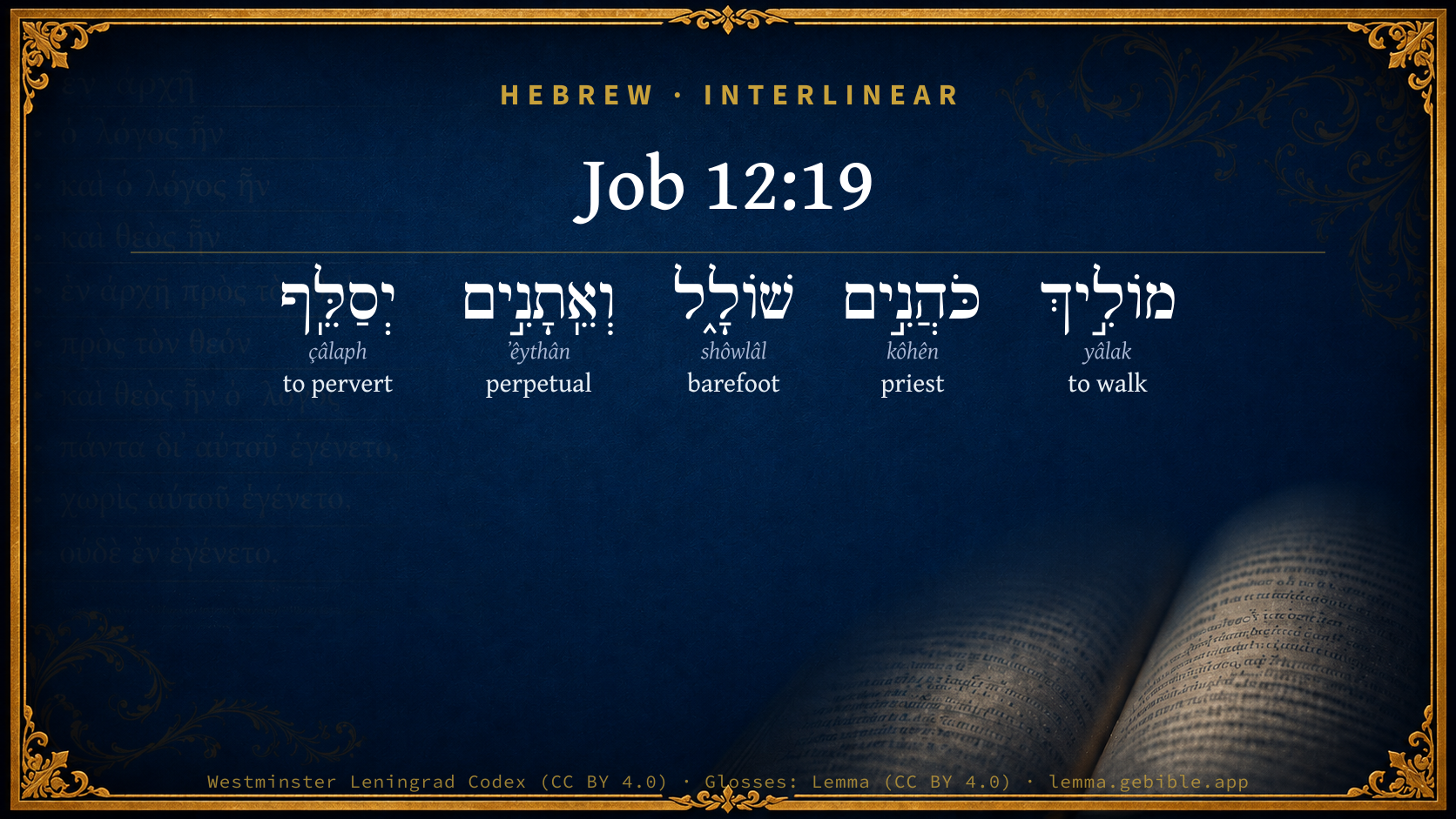
Job 12:19

Hebrew (Westminster Leningrad Codex) Job 12:19 appears in the Hebrew Old Testament. The text above is from the Westminster Leningrad Codex. Each word links to its Strong’s number, a concise gloss, and parsing drawn from the Open Scriptures Hebrew Bible morphology. Click any word for its full Brown-Driver-Briggs (BDB) entry.
Download image
Cite this verse

Job 12:19 (World English Bible). Public Domain. Lemma interlinear Bible study tool, https://lemma.gebible.app/v/job/12/19.

Show BibTeX & RIS
BibTeX
RIS
English Translation
He leads priests away stripped, And overthrows the mighty.
World English Bible · Public Domain
Download a study sheet

One document with this verse’s original text, its word-by-word gloss line, the meaning frame, cross-references with their text, attributed commentary, and full source and license credits — printable, and it pastes into notes with its structure intact.

This verse Autodidact and up

Study sheet (.html) Plain text (.txt)

A passage Seminary Student

Up to 50 verses in one chapter. A passage sheet keeps up to 6 commentary sources and 12 cross-references per verse, in the order this page ranks them, and says so on the sheet whenever that leaves anything out. Ask for a single verse and you get the Autodidact verse sheet above.

Everything on this page stays free to read, with no account — the sheet is a download of what is already on screen, not access to it.

Want to remove ads? Support Godless Engineer
Compare translations 3

The same verse in 3 English versions, stacked beneath the original-language interlinear above. Click any original word for its lexicon entry.

Each is an independent rendering of the whole verse — the interlinear is not word-aligned to these translations.

Highlighted words mark where these versions differ — a whole-verse word diff, not a word-by-word alignment.

  • World English Bible Public Domain
    He leads priests away stripped, And overthrows the mighty.
  • King James Version Public Domain
    He leadeth princes away spoiled, and overthroweth the mighty.
  • unfoldingWord Literal Text CC BY-SA 4.0
    the one leading priests away naked, and the incumbent ones, he overthrows;

unfoldingWord Literal Text — © unfoldingWord, licensed CC BY-SA 4.0. Word-aligned USFM3 via Door43 (git.door43.org/unfoldingWord/en_ult).

Versions to compare (up to 4)

3 of 4 selected

Show all 18 translations

Every available English version of this verse, each an independent rendering of the whole verse.

  • World English Bible Public Domain
    He leads priests away stripped, And overthrows the mighty.
  • Berean Standard Bible Public Domain
    He leads priests away barefoot and overthrows the established.
  • Majority Standard Bible Public Domain
    He leads priests away barefoot and overthrows the established.
  • King James Version Public Domain
    He leadeth princes away spoiled, and overthroweth the mighty.
  • American Standard Version (1901) Public Domain
    He leadeth priests away stripped, And overthroweth the mighty.
  • Revised Version (1885) Public Domain
    He leadeth priests away spoiled, and overthroweth the mighty.
  • Geneva Bible (1599) Public Domain
    He leadeth away the princes as a pray, and ouerthroweth the mightie.
  • Douay-Rheims (1899) Public Domain
    He leadeth away priests without glory, and overthroweth nobles.
  • Young's Literal Translation Public Domain
    Causing ministers to go away a spoil And strong ones He overthroweth.
  • Literal Standard Version CC BY-SA 4.0
    Causing ministers to go away [as] a spoil || And strong ones He overthrows.
  • Unlocked Literal Bible CC BY-SA 4.0
    He leads priests away barefoot in sorrow and overthrows mighty people.
  • unfoldingWord Literal Text CC BY-SA 4.0
    the one leading priests away naked, and the incumbent ones, he overthrows;
  • Darby Bible Public Domain
    He leadeth priests away spoiled, and overthroweth the mighty;
  • World Messianic Bible Public Domain
    He leads priests away stripped, and overthrows the mighty.
  • Webster's Bible Public Domain
    He leadeth princes away spoiled, and overthroweth the mighty.
  • Free Bible Version CC BY-SA 4.0
    He leads priests away stripped of their religious garments, he overthrows the powerful.
  • Bible in Basic English Public Domain
    He makes priests prisoners, overturning those in safe positions;
  • JPS Tanakh (1917) Public Domain
    He leadeth priests away stripped, and overthroweth the mighty.

Literal Standard Version (2020), Covenant Press — licensed CC BY-SA 4.0. Text via the HelloAO Bible API (eBible.org). Unlocked Literal Bible (unfoldingWord) — licensed CC BY-SA 4.0. Text via the HelloAO Bible API (eBible.org). unfoldingWord Literal Text — © unfoldingWord, licensed CC BY-SA 4.0. Word-aligned USFM3 via Door43 (git.door43.org/unfoldingWord/en_ult). Free Bible Version, Dr. Jonathan Gallagher — licensed CC BY-SA 4.0. Text via the HelloAO Bible API (eBible.org).

Word by word

More ways to search: Search by grammar → Find every occurrence → Compare this word →

Practice this passage: Drill this verse → Learn its vocabulary →

About this verse

These counts appear in no published source. They are computed here, from the morphology-tagged text and Lemma’s own curated glosses. What Lemma adds →

5
words
5
distinct lemmas
Wisdom
section

Notable vocabulary

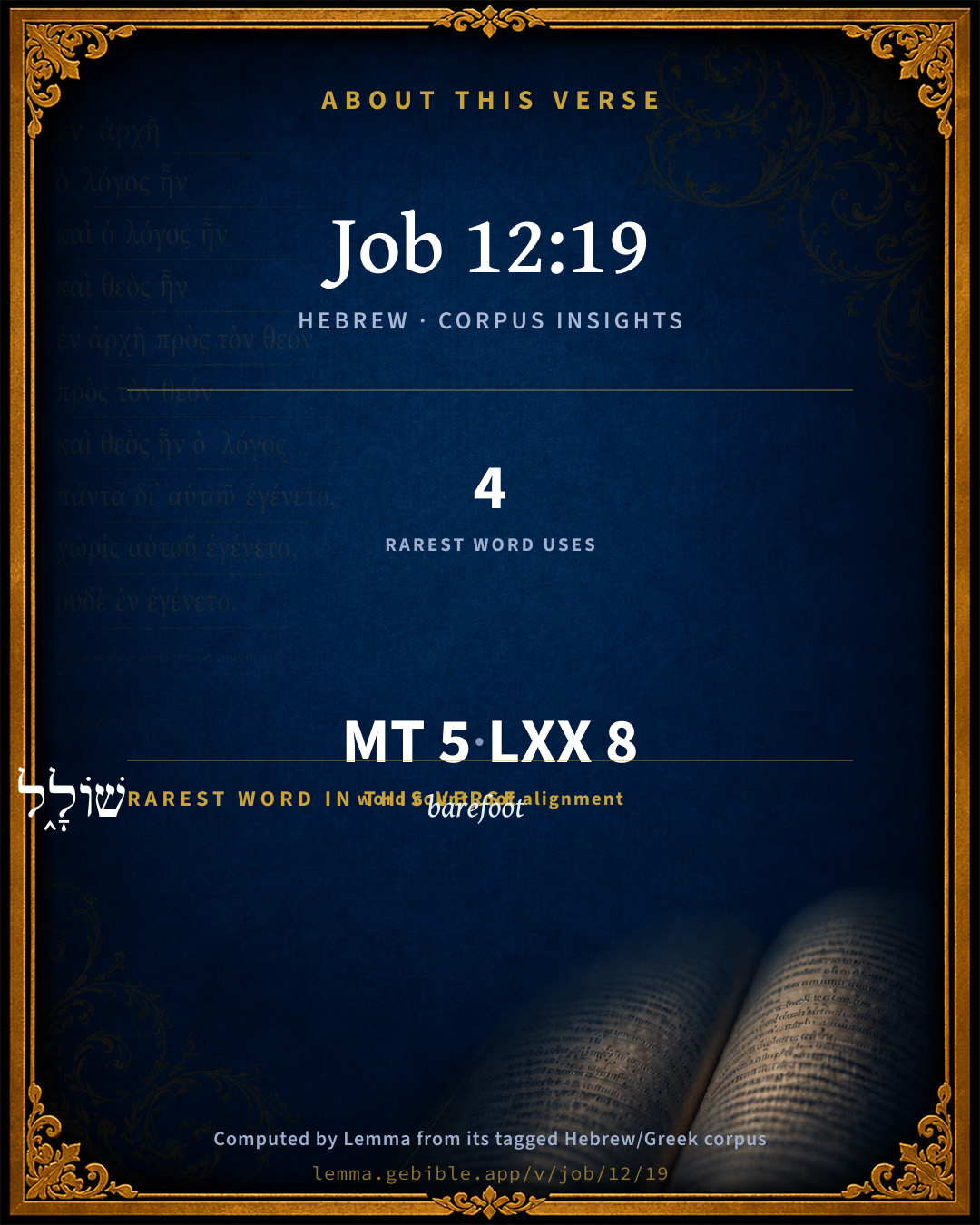
The rarest word here is שׁוֹלָ֑ל barefoot H7758 — appearing just 4 times in the whole Hebrew Bible.

Shared distinctive vocabulary

שׁוֹלָ֑ל barefoot H7758 occurs in 3 verses of the Hebrew Bible. Also found in:

Grammatical profile

  • 2 verbs
  • 1 noun
  • 2 adjectives

Verb forms

  • מוֹלִ֣יךְ Hiphil · Participle Active
  • יְסַלֵּֽף Piel · Imperfect

Hebrew & Septuagint length

In English translation the verse runs 9 words from the Hebrew and 14 from the Septuagint (LXX English) — the Septuagint runs noticeably longer here. See the side-by-side →

A rough comparison of the two English renderings, which tokenize alike — not a word-level alignment.

Word counts can differ between the Hebrew and the Greek without any difference in meaning — e.g. the Hebrew direct-object marker אֵת has no separate Greek word, and Greek often adds the article ὁ.

In the original languages it is 5 Hebrew tokens and 8 Greek tokens — but the two are counted differently (Hebrew bundles its prefixes and suffixes into one token; the Greek is in lemma form), so that isn’t a like-for-like length.

Cross-references

10

Topical passages linked to Job 12:19 in the Treasury of Scripture Knowledge — connected by theme and wording, ordered by reader-vote popularity; previews shown in the World English Bible.

  • Isaiah 37:36–38 The angel of Yahweh went forth, and struck in the camp of the Assyrians one hundred and eighty-five thousand; and when men arose early in the morning, behold, these were all dead bodies.
  • Isaiah 45:1 Thus says Yahweh to his anointed, to Cyrus, whose right hand I have held, to subdue nations before him, and I will loose the loins of kings; to open the doors before him, and the gates shall not be shut:
  • Joshua 10:24 It happened, when they brought forth those kings to Joshua, that Joshua called for all the men of Israel, and said to the chiefs of the men of war who went with him, Come near, put your feet on the necks of these kings. They came near, and put their feet on the necks of them.
  • Joshua 10:42 All these kings and their land did Joshua take at one time, because Yahweh, the God of Israel, fought for Israel.
  • 1 Samuel 17:45–46 Then said David to the Philistine, You come to me with a sword, and with a spear, and with a javelin: but I come to you in the name of Yahweh of hosts, the God of the armies of Israel, whom you have defied.
  • Job 24:22 Yet God preserves the mighty by his power. He rises up who has no assurance of life.
  • Job 34:28 So that they caused the cry of the poor to come to him, He heard the cry of the afflicted.
  • Job 35:9 "By reason of the multitude of oppressions they cry out; They cry for help by reason of the arm of the mighty.
  • Revelation 17:14 These will war against the Lamb, and the Lamb will overcome them, for he is Lord of lords, and King of kings. They also will overcome who are with him, called and chosen and faithful."
  • Revelation 19:19–21 I saw the beast, and the kings of the earth, and their armies, gathered together to make war against him who sat on the horse, and against his army.

Cross-references courtesy of OpenBible.info (CC BY 4.0).

Hebrew and Greek witnesses Masoretic Hebrew ↔ Greek Septuagint

The same verse in the two great witnesses to the Old Testament, shown verse-for-verse.

Here the Septuagint runs noticeably longer than the Hebrew — LXX2012 (modern English Septuagint) 14 words vs World English Bible 9. A rough length comparison of the two English translations, not a word-level alignment — read both below.

These are two independent witnesses, not word-aligned to each other, and the Septuagint is shown in lemma (dictionary) form.

Hebrew Job 12:19 Masoretic · Westminster Leningrad Codex

מוֹלִ֣יךְ כֹּהֲנִ֣ים שׁוֹלָ֑ל וְאֵֽתָנִ֣ים יְסַלֵּֽף

He leads priests away stripped, And overthrows the mighty.

World English Bible · Public Domain

Greek LXX Job 12:19 Septuagint · lemma form

ἐκ ἀποστέλλω ἱερεύς αἰχμάλωτος δυνάστης δέ γῆ καταστρέφω

He sends away priests into captivity, and overthrows the mighty ones of the earth.

LXX2012 (modern English Septuagint) · Public Domain

On this verse, Albert Barnes' Notes on the Bible discusses the Septuagint’s reading. Read the note in Commentary ↓

Hebrew: Westminster Leningrad Codex (CC BY 4.0). Greek: Septuagint (public domain); English from LXX2012 (modern English Septuagint) (Public Domain). How the Septuagint differs from the Hebrew →

Commentary

Notes on Job 12:19 from classic Christian and Jewish commentators (each source and its license shown beneath its notes). The classic Christian expositions comment on the surrounding passage and are grouped to its opening verse, so a note may address several verses; the Jewish commentaries on the Tanakh (Rashi and others) are per-verse, so they appear only where the commentator wrote on this verse.

Lemma curates 59 commentaries, every one of them public domain or Creative Commons licensed, each selected and text-cleaned for this edition rather than reprinted as found. About our sources →

Trapp's Complete Commentary

John Trapp

Job 12:19 He leadeth princes away spoiled, and overthroweth the mighty.

Ver. 19. He leadeth away princes spoiled] Or priests. Ducit sacerdotes inglorios, so the Vulgate translateth, He leadeth away the priests without glory, dishonoured. Priests were generally much esteemed and privileged in all ages. Alexander the Great gave greatest respect to Jaddus, the Jewish high priest. When the Gauls had burnt Rome, and were besieging the capitol, Gaius Fabius Dorso, attired as a priest, with his sacrifice and other necessaries in his hand, marched through the midst of the enemies, astonished at his resolution, offered his sacrifice on the hill Quirinalis, and returned in safety. The Bardi, a kind of priests, were here in Albion of such esteem among the greatest commanders, that if two armies were even at push of pike, and a bard had stepped in between them, they would have held their hands, hearkened to his advice, and not have offered to strike till he were out of danger: Magna fuit quondam capitis reverentia sacri. Howbeit, such also have been carried captive, and slain by the enemy, as was Seraiah, the high priest, by Nebuchadnezzar; and before him the two sons of Eli (whose white ephod covered foul sins), slain by the Philistines. "The Lord hath despised, in the indignation of his anger, both the king and the priest," Lam 2:6. "Both the prophet and the priest go about into a land that they know not," Jer 14:18. The word Cohen is used indifferently to signify a priest or prince, an ecclesiastical or secular governor. Broughton rendereth it here dukes; others, presidents or praefects of provinces. Honour is no shelter against the wrath of God.

And overthroweth the mighty] Such as might seem immoveable as a rock, or tree firmly rooted, these God shaketh and shattereth to pieces; he rooteth them up, and ruineth them. Let no man think to prevail by strength, 1Sa 2:9, since the weakness of God (if any such thing there were) is stronger than men, 1Co 1:25. He will smite his enemies (as so many puny boys) in the hinder parts, and so put them to a perpetual reproach, Psa 78:66. Yea, he will not only smite them on the loins, but through the loins, Deu 32:11, that they never rise again. Let them, therefore, learn to meddle with their match, Ecc 6:10, and take heed how they fall into the punishing hands of the living God.

John Trapp, A Commentary or Exposition upon All the Books of the Old and New Testament (1647–1656) — public domain. Text from a community e-Sword module.

Whedon's Commentary on the Bible

Daniel D. Whedon

Second double strophe, Job_12:19-25.

a. This wisdom confounds and overwhelms the best as well as the mightiest of the earth. Job_12:19-21.

19. Princes — The Hebrew also means priests. They who wait on God’s altars are not exempt from a similar doom. In many ancient states priests were held in esteem quite equal to that of the sovereign. Sometimes, as with Melchisedek, Jethro, and the Assyrians, the two characters of priest and prince were blended together in the same person.

The mighty — Those firmly established.

Daniel D. Whedon (gen. ed.), Commentary on the Old and New Testaments (1874–1909) — public domain. Text from a community e-Sword module.

Tyndale Open Study Notes

Tyndale Open Resources

12:19 The priests are figuratively stripped of status (the NLT adds “of status” for clarity) or are actually stripped of priestly robes; they might even be naked captives (12:18).

Tyndale Open Study Notes — © Tyndale Open Resources, licensed CC BY-SA 4.0. Text via the HelloAO Bible API.

Jamieson, Fausset & Brown

Robert Jamieson, A. R. Fausset & David Brown

princes--rather, "priests," as the Hebrew is rendered (Psa 99:6). Even the sacred ministers of religion are not exempt from reverses and captivity.

the mighty--rather, "the firm-rooted in power"; the Arabic root expresses ever-flowing water [UMBREIT].

Jamieson, Fausset & Brown — Commentary Critical and Explanatory on the Whole Bible (1871) — public domain (CC PDM 1.0). Text via the HelloAO Bible API.

Adam Clarke's Commentary

Verse 19. He leadeth princes away spoiled, and overthroweth the mighty.] What multitudes of proofs of this does the history of the world present! Even the late disastrous war with the French republic and empire, which began in 1793, and continued without intermission till 1814, was afterwards renewed, and had a catastrophe that went nearly to ruin Europe. How many princes, or rather priests, כהנים cohanim, have been spoiled of their power, influence, and authority; and how many mighty men - captains, generals, admirals, c., have been overthrown! But supposing that the writer of the Book of Job lived, as some think, after the captivity, how many priests were led away spoiled, both from Israel and Judah and how many kings and mighty men were overthrown in the disastrous wars between the Assyrians, Babylonians, and Jews!

Adam Clarke's Commentary on the Bible (1810–1826) — public domain. Text from a community e-Sword/MySword module.

Ellicott's Commentary for English Readers

(19) He leadeth princes.—Some understand priests rather than princes. The word appears to be used in both senses; here the parallelism seems to suit princes better. The latter part of this chapter seems to re-echo the sentiments of Eliphaz in Job_5:11-16; but, instead of giving them the optimist direction he had sketched, he confesses that his own position is rather one of blank despair. Eliphaz is quite sure he possesses the key to the interpretation of the ways of Providence. Job ever fears that his ignorance is so profound as to amount almost to sheer hopelessness, Job is thus the type of a man who has felt the hollowness and unreality of traditional orthodox), and is feeling his way in thick darkness, sustained, nevertheless, by an unquenchable faith that there is light, and that the light will eventually dawn. That this character is the more acceptable to the God of truth is made abundantly clear in the sequel. It is to be observed, however, that Job’s breadth of view far exceeds that of Eliphaz, inasmuch as the latter generalises vaguely, while Job declares that not men, but nations, are the subjects of God’s guiding providence.

A Bible Commentary for English Readers, edited by Charles John Ellicott (1878–1897) — public domain. Text from a community e-Sword module.

The Cambridge Bible for Schools and Colleges

gen. ed. J. J. S. Perowne

19. leadeth princes away spoiled] Rather, priests. In antiquity priests occupied influential places; cf. what is said of Melchizedek, Genesis 14, of Jethro, priest of Midian, Exo_2:16 seq., and of the influence of the priests in several crises of the history of Israel. On “spoiled’ see Job_12:17.

the mighty] lit. the established or perennial; being in apposition with priests, usually a hereditary caste, the word describes those who occupied high permanent place among men.

The Cambridge Bible for Schools and Colleges (gen. ed. J. J. S. Perowne; Cambridge University Press, 1878–1918) — public domain. Text from a community e-Sword module.

John Gill's Exposition

He removeth away the speech of the trusty,.... Speech is proper to mankind, and a benefit unto them, whereby they can converse together, and communicate their minds to each other; this is the gift of God, he gives to men in common the faculty of speaking; to some the tongue of the learned to speak various tongues, either in an ordinary or in an extraordinary manner; and he that gives can take away; he that made man's mouth or lip can make it speechless, as he does at death; when he takes away man's breath, he takes away his speech; the state of the dead is a state of silence; and sometimes he does it while living, by striking dumb, as he did Zechariah the father of John the Baptist; and even without so doing, as in the builders of Babel, he took away the speech they had, and gave them another; and sometimes he suffers not men to speak what they would, but what is contrary to their inclinations and desires, as in Balaam, who would willingly have cursed Israel, but could not. Now that God should take away by any means the speech of liars, and faithless persons, as Ananias and Sapphira, by striking them dead, Act 5:1; and of false teachers, deceivers, and bold blasphemers of God, and of his Son, and of the blessed Spirit, whose mouths ought to be stopped, is no wonder; but it seems strange that he should remove the speech of "trusty" or "faithful" (x) men, that speak the truth, and are to be credited and believed; and as the preceding words are understood of ecclesiastic persons, these may be continued concerning them; and the character agrees with ministers of the word, who are in trusted with the rich treasure of it; that is put in earthen vessels, and committed to the trust of faithful men; who appear to be such when they speak the word faithfully, declare the whole counsel of God, and keep back nothing profitable to men; when they speak plainly, without ambiguity, and sincerely, without mixing or adulterating it; and are faithful as to God, who has appointed them, and put them into the ministry, so to the souls of men under their care: now God sometimes takes away the speech of these, not by changing their voice, or ordering them, instead of the gracious promises of the Gospel, to deliver out the menaces and threatenings of the law; but either by commanding them to be dumb and silent, and speak no more to an incorrigible and rebellious people; as Ezekiel was bid to prophesy no more to the house of Israel, and the apostles to preach no more to the Jews; or by suffering them to be silenced by the edicts of wicked princes, and their violent persecutions of them, so that the teachers of men are removed into corners, and not to be seen or heard; and also by death, when their faces are no more seen, and their speech no more heard. Some, both Jewish and Christian interpreters, derive the word here used from the root "to speak", and render it "speakers" or "orators" (y); so Mr. Broughton translates the words, "he bereaveth the orators of lip"; he takes away their eloquence from them, deprives them of their speaking well, and strips them of their natural and acquired abilities, by which they have become good speakers; and such who use their talents well in this way are beneficial to a commonwealth, and it is a loss when they are removed, or their speech removed from them, see Isa 3:3;

and taketh away the understanding of the aged; or "elders" (z), as Mr. Broughton, either in age or office; elders in age, with whom understanding, reason, judgment, counsel, and wisdom, by all which the word is interpreted, may be thought to be, and it is expected they should, and oftentimes are, though not always; yet all this God can take away, and does when he pleases, and they become like children in understanding; through the infirmities of old age their memories fail them, their reason is impaired, their understanding and judgment are weakened, and they become unfit to give advice themselves, and are easily imposed on, and drawn aside by others, as may be observed in Solomon, the wisest of men, when he was grown old. This is to be understood of the natural understanding in things natural and civil, but not of the spiritual understanding, which is never taken away, but rather increased in old age; the true light of grace shines more and more unto the perfect day; it is a gift of God without repentance, which he never revokes and removes: it may intend the natural "taste" (a), as the word may be rendered; this is often and generally taken away from the aged, as in old Barzillai, who could not taste what he ate and drank, as to distinguish and relish it, Sa2 19:35; but not the spiritual taste, of the Lord as gracious, of the good word of God, and the fruits of divine grace; the taste and savour of which remain with the people of God in old age; or this may design men in office, either civil magistrates, called senators, the elders of the people, judges, and counsellors, who instead of being taught more wisdom, which their offices require, sometimes become infatuated, their understanding of civil things is taken away from them, their wise counsels become brutish, and they like children; or ecclesiastic persons, elders of churches, who, having talents for public usefulness, either neglect them, or make an ill use of them, and therefore are taken away from them; their right arm is dried up, and their right eye darkened, Mat 25:28.

(x) "veracibus", Pagninus, Montanus, Vatablus, Schultens; "fidis", Mercerus, Piscator; "fidelibus", Bolducius. (y) "Dicendi peritis", Beza; eloquentibus, Junius & Tremellius; so Kimchi, Ramban, Ben Gersom, Ben Melech, Sephorno. (z) "seniorum", Cocceius, Michaelis; "senatorum", Schultens. (a) "gustum", Drusius, Schultens.

John Gill's Exposition of the Whole Bible (1746–1763) — public domain (CC PDM 1.0). Text via the HelloAO Bible API.

Albert Barnes' Notes on the Bible

He leadeth princes away spoiled - That is, plundered. The word here rendered “princes” כהנים kôhênı̂ym means properly priests, and it is usually so rendered in the Scriptures. The ancient Hebrew interpreters suppose that the word sometimes also means prince. The Chaldee paraphrasist has not unfrequently so rendered it, using the word רבא to express it; Gen 41:45; Psa 110:4. In this place, the Vulgate renders it, “sacerdotes;” and the Septuagint, ἱερεῖς hiereis, “priests.” So Luther renders it, “Priester.” So Castellio. It can be applied to princes or statesmen only because priests were frequently engaged in performing the functions of civil officers, and were in fact to a certain extent officers of the government. But it seems to me that it is to be taken in its usual signification, and that it means that even the ministers of religion were at the control of God, and were subject to the same reverses as other people of distinction and power.

And overthroweth - The word used here (סלף sâlaph) has the notion of slipping, or gliding. So in Arabic, the word means to slip by, and to besmear; see Pro 13:6 : “Wickedness overthroweth תסלף tesâlaph, causes to slip) the sinner;” compare Pro 21:12; Pro 22:12. Here it means to overthrow, to prostrate. The most mighty chieftains cannot stand firm before him, but they glide away and fall.

Albert Barnes' Notes on the Bible (1834–1885) — public domain. Text from a community e-Sword/MySword module.

Haydock's Catholic Bible Commentary

Without. Hebrew, "despoiled." Septuagint, "captives." Cohanim, may comprise both sacred ministers and civil princes, 1 Kings viii. 18. All are equally subject to God. (Calmet)

George Leo Haydock (1774–1849), Haydock's Catholic Family Bible and Commentary, 1859 edition — public domain. Excludes Psalms (Douay-Rheims chapter numbering differs from Protestant) and Deuterocanonical books (Catholic canon only).

Matthew Poole's English Annotations

Princes; so this word, which usually signifies priests, is oft used, as Gen 41:45; 47:22,26; Exo 2:16; 2Sa 8:18, compared with 1Ch 18:17.

Matthew Poole's English Annotations on the Holy Bible (1683–1685) — public domain. Text from a community e-Sword/MySword module.

The Pulpit Commentary

He leadeth princes away spoiled; rather, priests ( as in the Revised Version. This is the only mention of "priests" in the Book of Job, and a priest-caste, such as that of Egypt or of Israel, can scarcely be meant. The priests are placed among the mighty, on a par with kings (ver. 18), princes (ver. 21), and "the strong" (ver. 21). This context makes us naturally think of those priest-kings whom we hear of in the olden times, such as were Melchizedek (Gen_19:18-20) and Jethro, (Exo_3:1 Exo_18:1-27) and the Egyptian kings of the twenty-first dynasty ("History of Ancient Egypt," vol. 2. pp. 408-415), and Ethbaal of Tyro ("History of Phoenicia," p. 435), and Sethos (Herod., 2, 141), and others. Job"s allusion is probably to persons of this exalted class, who no doubt were sometimes defeated and dragged into captivity, like other rulers and governors. And overthroweth the mighty. Schultens understands by ethanim ( "great teachers;" but the ordinary meaning of the word is "strong" or "mighty". (see Job_33:19 Mic_6:2)

The Pulpit Commentary (1880–1919), ed. H.D.M. Spence-Jones & Joseph S. Exell — public domain. Text from a community e-Sword module.

unfoldingWord translationNotes

Door43 World Missions Community

He leads priests away barefoot

Leading priests away barefoot represents taking away their authority. (See: Metaphor)

in sorrow

The abstract noun "sorrow" can be expressed with the words "sad" or "grieve" AT: "and they feel sad" or "and they grieve" (See: Abstract Nouns)

overthrows mighty people

"defeats powerful people"

He removes the speech of those who had been trusted

Removing their speech represents making them unable to speak. AT: "He makes those who were trusted unable to speak" or "He silences people whom others trusted" (See: Metonymy)

takes away the understanding of the elders

Taking away their understanding represents making them unable to understand or make good decisions. AT: "makes the elders unable to understand" or "makes the elders unable to make good decisions" (See: Metonymy)

the elders

Possible meanings are 1) the older people or 2) the leaders.

He pours contempt upon princes

Pouring contempt on princes is a metaphor for causing people to feel contempt for them. AT: "He causes people to greatly disrespect those who rule" (See: Metaphor)

unfastens the belt of strong people

The belt is a symbol of strength. Unfastening a strong person's belt represents taking away his strength and making him weak. AT: "makes the strong people weak" (See: Metaphor)

translationWords

priest

might

trust

elder

contempt

prince

unfoldingWord translationNotes — © Distant Shores Media and the Door43 World Missions Community, licensed CC BY-SA 4.0. Source: git.door43.org/Door43/en_tn.

Rashi

Rabbi Shlomo Yitzchaki (Rashi)

princes Heb. כהנים, like (Exod. 3:1), “the prince (כהן) of Midian”; (Gen. 41:45), “the prince (כהן) of On.”

Rashi on the Tanakh — English translations: “The Judaica Press complete Tanach with Rashi, translated by A. J. Rosenberg” (CC BY 4.0); “Pentateuch with Rashi's commentary by M. Rosenbaum and A.M. Silbermann, 1929-1934” (public domain); “The Metsudah Tanach series, Lakewood, N.J” (CC BY 4.0); and “The Book of Joshua, Metsudah Publications, 1997” (CC BY 4.0). Text via Sefaria.

Lesson kit

Teaching starters — assembled from the data on this page, not authored interpretation. Every prompt links to the verse data it draws on. Edit before teaching.

Job, in the Wisdom, opens this verse with 5 words (5 distinct Hebrew lemmas). Its most distinctive word is shôwlâl (“barefoot”). The Greek Septuagint runs longer here. A historical commentator’s framing appears above. Read the whole chapter for the surrounding context.

Discussion questions

  1. What does “barefoot” (shôwlâl) contribute to the verse as a whole?
  2. Job 12:17 shares the word «barefoot» with this verse. How do the two illuminate each other?
  3. Compared with the Hebrew, the Septuagint runs longer here. What questions does that raise?
  4. The translations on this page render this verse differently — a whole-verse word diff, not a word-by-word alignment. What might account for the different wordings?
  5. The verb «מוֹלִ֣יךְ» is Hiphil Participle Active. How does its form color the action?
  6. Reading how Trapp's Complete Commentary and Whedon's Commentary on the Bible read this verse, where do the two commentators agree and where do they part?

Things to notice

Reading settings

Reading text

Shown beneath each verse's original-language words.

Old Testament
Old Testament edition

Read the OT as the Masoretic Hebrew (MT) or the Greek Septuagint (LXX).

English shown for the Greek Septuagint (in the Hebrew ↔ Greek comparison).

Comparing translations? Open the Compare panel on any verse page to stack up to four side by side.