
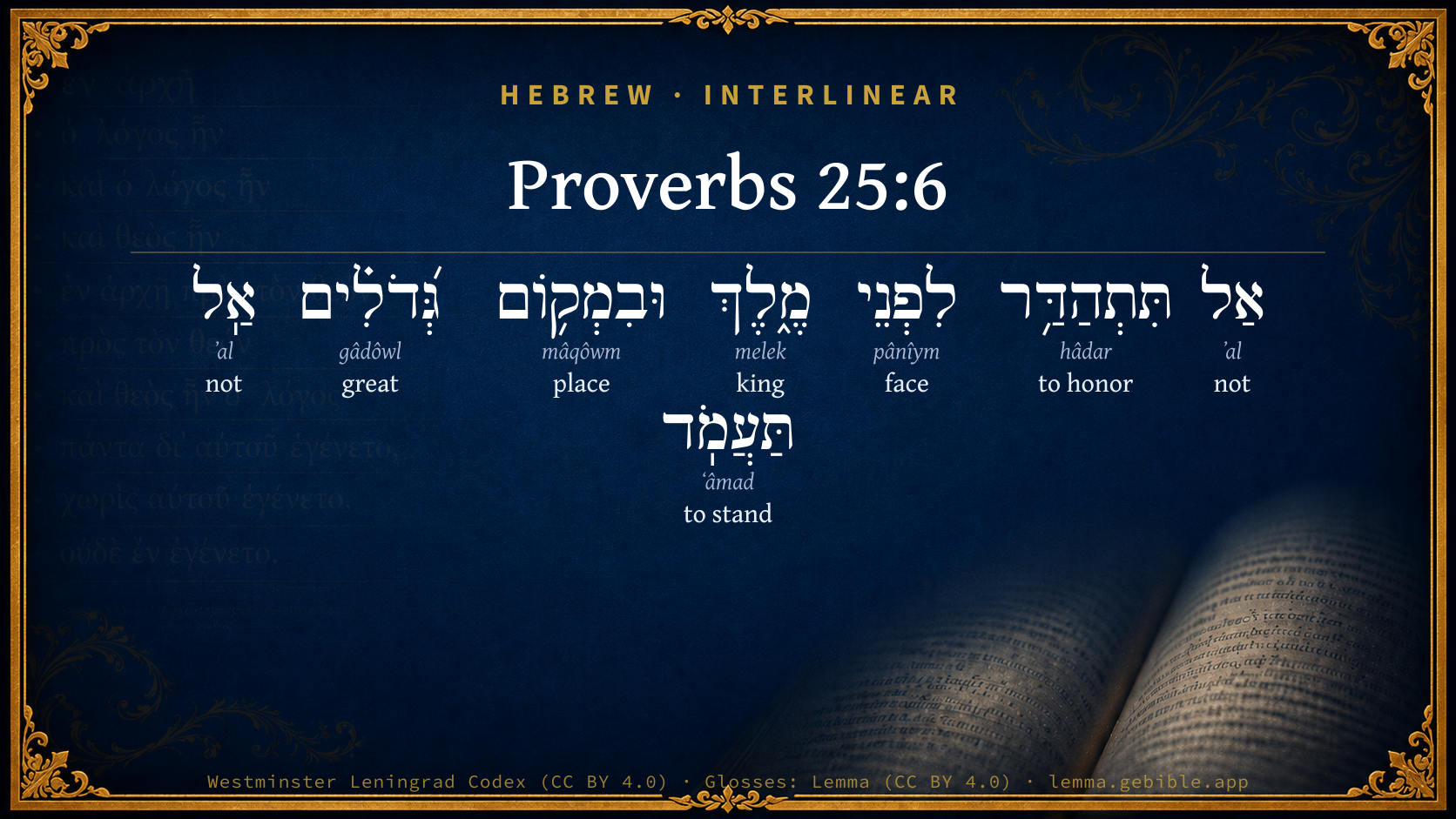
Proverbs 25:6

Hebrew (Westminster Leningrad Codex) Proverbs 25:6 appears in the Hebrew Old Testament. The text above is from the Westminster Leningrad Codex. Each word links to its Strong’s number, a concise gloss, and parsing drawn from the Open Scriptures Hebrew Bible morphology. Click any word for its full Brown-Driver-Briggs (BDB) entry.
Download image
Cite this verse

Proverbs 25:6 (World English Bible). Public Domain. Lemma interlinear Bible study tool, https://lemma.gebible.app/v/proverbs/25/6.

Show BibTeX & RIS
BibTeX
RIS
English Translation
Don't exalt yourself in the presence of the king, Or claim a place among great men;
World English Bible · Public Domain
Download a study sheet

One document with this verse’s original text, its word-by-word gloss line, the meaning frame, cross-references with their text, attributed commentary, and full source and license credits — printable, and it pastes into notes with its structure intact.

This verse Autodidact and up

Study sheet (.html) Plain text (.txt)

A passage Seminary Student

Up to 50 verses in one chapter. A passage sheet keeps up to 6 commentary sources and 12 cross-references per verse, in the order this page ranks them, and says so on the sheet whenever that leaves anything out. Ask for a single verse and you get the Autodidact verse sheet above.

Everything on this page stays free to read, with no account — the sheet is a download of what is already on screen, not access to it.

Want to remove ads? Support Godless Engineer
Compare translations 3

The same verse in 3 English versions, stacked beneath the original-language interlinear above. Click any original word for its lexicon entry.

Each is an independent rendering of the whole verse — the interlinear is not word-aligned to these translations.

Highlighted words mark where these versions differ — a whole-verse word diff, not a word-by-word alignment.

  • World English Bible Public Domain
    Don't exalt yourself in the presence of the king, Or claim a place among great men;
  • King James Version Public Domain
    Put not forth thyself in the presence of the king, and stand not in the place of great men:
  • unfoldingWord Literal Text CC BY-SA 4.0
    Do not honor yourself to the face of the king, and in the place of the great ones do not stand.

unfoldingWord Literal Text — © unfoldingWord, licensed CC BY-SA 4.0. Word-aligned USFM3 via Door43 (git.door43.org/unfoldingWord/en_ult).

Versions to compare (up to 4)

3 of 4 selected

Show all 18 translations

Every available English version of this verse, each an independent rendering of the whole verse.

  • World English Bible Public Domain
    Don't exalt yourself in the presence of the king, Or claim a place among great men;
  • Berean Standard Bible Public Domain
    Do not exalt yourself in the presence of the king, and do not stand in the place of great men;
  • Majority Standard Bible Public Domain
    Do not exalt yourself in the presence of the king, and do not stand in the place of great men;
  • King James Version Public Domain
    Put not forth thyself in the presence of the king, and stand not in the place of great men:
  • American Standard Version (1901) Public Domain
    Put not thyself forward in the presence of the king, And stand not in the place of great men:
  • Revised Version (1885) Public Domain
    Put not thyself forward in the presence of the king, and stand not in the place of great men:
  • Geneva Bible (1599) Public Domain
    Boast not thy selfe before the King, and stand not in the place of great men.
  • Douay-Rheims (1899) Public Domain
    Appear not glorious before the king, and stand not in the place of great men.
  • Young's Literal Translation Public Domain
    Honour not thyself before a king, And in the place of the great stand not.
  • Literal Standard Version CC BY-SA 4.0
    Do not honor yourself before a king, || And do not stand in the place of the great.
  • Unlocked Literal Bible CC BY-SA 4.0
    Do not honor yourself in the king's presence and do not stand in the place designated for great people.
  • unfoldingWord Literal Text CC BY-SA 4.0
    Do not honor yourself to the face of the king, and in the place of the great ones do not stand.
  • Darby Bible Public Domain
    Put not thyself forward in the presence of the king, and stand not in the place of the great;
  • World Messianic Bible Public Domain
    Don’t exalt yourself in the presence of the king, or claim a place among great men;
  • Webster's Bible Public Domain
    Put not forth thyself in the presence of the king, and stand not in the place of great men:
  • Free Bible Version CC BY-SA 4.0
    Don't try to make yourself look great before the king, and don't pretend to be among the important people,
  • Bible in Basic English Public Domain
    Do not take glory for yourself before the king, and do not put yourself in the place of the great:
  • JPS Tanakh (1917) Public Domain
    Glorify not thyself in the presence of the king, and stand not in the place of great men;

Literal Standard Version (2020), Covenant Press — licensed CC BY-SA 4.0. Text via the HelloAO Bible API (eBible.org). Unlocked Literal Bible (unfoldingWord) — licensed CC BY-SA 4.0. Text via the HelloAO Bible API (eBible.org). unfoldingWord Literal Text — © unfoldingWord, licensed CC BY-SA 4.0. Word-aligned USFM3 via Door43 (git.door43.org/unfoldingWord/en_ult). Free Bible Version, Dr. Jonathan Gallagher — licensed CC BY-SA 4.0. Text via the HelloAO Bible API (eBible.org).

Word by word

More ways to search: Search by grammar → Find every occurrence → Compare this word →

Practice this passage: Drill this verse → Learn its vocabulary →

About this verse

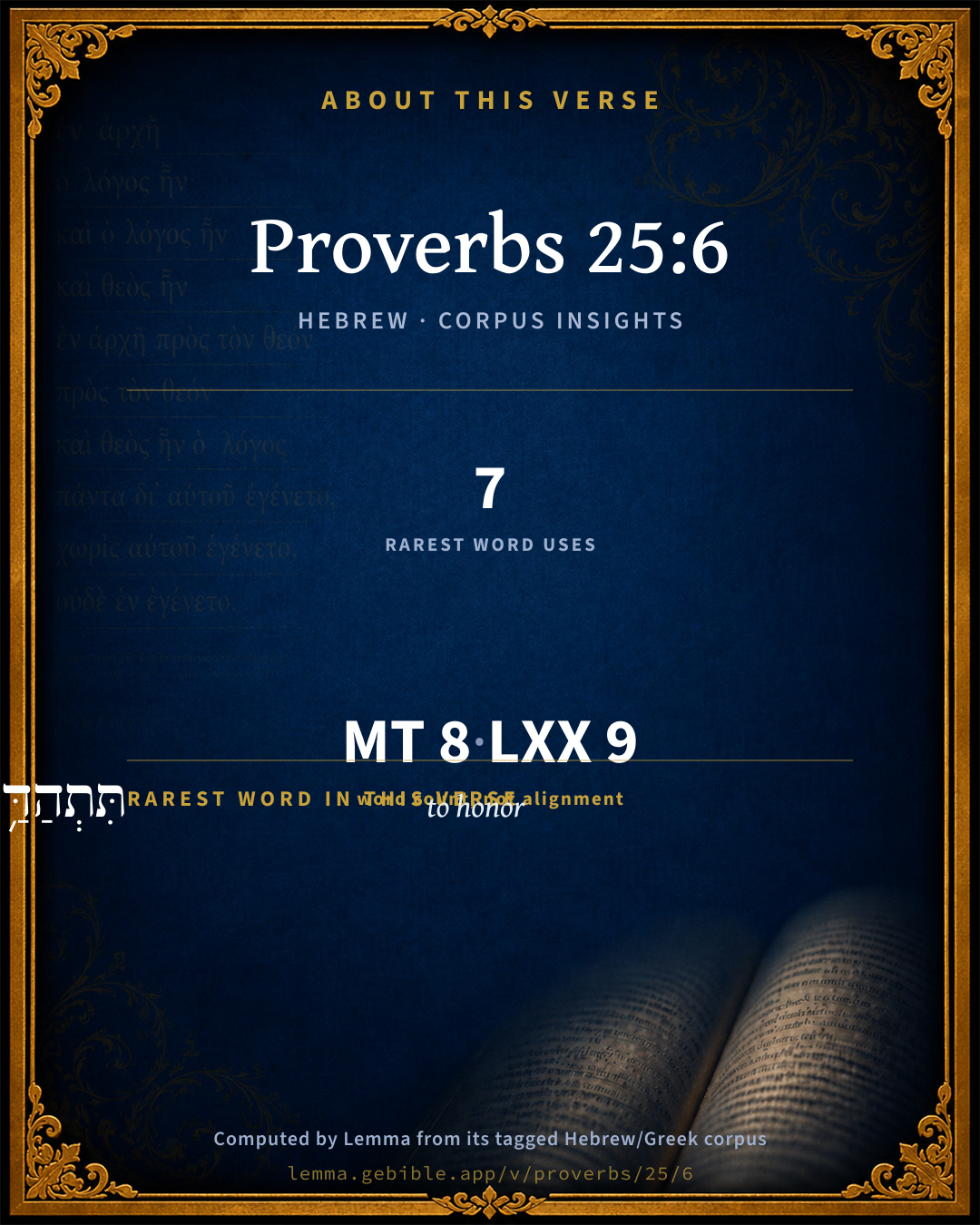
These counts appear in no published source. They are computed here, from the morphology-tagged text and Lemma’s own curated glosses. What Lemma adds →

8
words
7
distinct lemmas
Wisdom
section

Notable vocabulary

The rarest word here is תִּתְהַדַּ֥ר to honor H1921 — appearing just 7 times in the whole Hebrew Bible.

Shared distinctive vocabulary

תִּתְהַדַּ֥ר to honor H1921 occurs in 7 verses of the Hebrew Bible. Also found in:

Grammatical profile

  • 2 verbs
  • 3 nouns
  • 1 adjective
  • 2 particles

Verb forms

  • תִּתְהַדַּ֥ר Hithpael · Jussive
  • תַּעֲמֹֽד Qal · Jussive

Repetition

A word recurs within this verse — often emphatic in Hebrew:

  • אַל not H408 ×2

Hebrew & Septuagint length

In English translation the verse runs 16 words from the Hebrew and 17 from the Septuagint (LXX English) — closely comparable.

A rough comparison of the two English renderings, which tokenize alike — not a word-level alignment.

Word counts can differ between the Hebrew and the Greek without any difference in meaning — e.g. the Hebrew direct-object marker אֵת has no separate Greek word, and Greek often adds the article ὁ.

In the original languages it is 8 Hebrew tokens and 9 Greek tokens — but the two are counted differently (Hebrew bundles its prefixes and suffixes into one token; the Greek is in lemma form), so that isn’t a like-for-like length.

Cross-references

11

Topical passages linked to Proverbs 25:6 in the Treasury of Scripture Knowledge — connected by theme and wording, ordered by reader-vote popularity; previews shown in the World English Bible.

  • Proverbs 27:2 Let another man praise you, And not your own mouth; A stranger, and not your own lips.
  • Proverbs 16:19 It is better to be of a lowly spirit with the poor, Than to divide the plunder with the proud.
  • Proverbs 25:27 It is not good to eat much honey; Nor is it honorable to seek one's own honor.
  • Exodus 3:11 Moses said to God, "Who am I, that I should go to Pharaoh, and that I should bring forth the children of Israel out of Egypt?"
  • Psalms 131:1 Yahweh, my heart isn't haughty, nor my eyes lofty; Nor do I concern myself with great matters, Or things too wonderful for me.
  • 1 Samuel 9:20–22 As for your donkeys who were lost three days ago, don't set your mind on them; for they are found. For whom is all that is desirable in Israel? Is it not for you, and for all your father's house?
  • 1 Samuel 15:17 Samuel said, "Though you were little in your own sight, weren't you made the head of the tribes of Israel? Yahweh anointed you king over Israel;
  • 1 Samuel 18:18–23 David said to Saul, Who am I, and what is my life, [or] my father's family in Israel, that I should be son-in-law to the king?
  • 2 Samuel 7:8–17 Now therefore thus shall you tell my servant David, Thus says Yahweh of Hosts, I took you from the sheep pen, from following the sheep, that you should be prince over my people, over Israel;
  • Jeremiah 1:6–10 Then said I, Ah, Lord Yahweh! behold, I don't know how to speak; for I am a child.
  • Amos 7:12–15 Amaziah also said to Amos, "You seer, go, flee away into the land of Judah, and there eat bread, and prophesy there:

Cross-references courtesy of OpenBible.info (CC BY 4.0).

Hebrew and Greek witnesses Masoretic Hebrew ↔ Greek Septuagint

The same verse in the two great witnesses to the Old Testament, shown verse-for-verse.

These are two independent witnesses, not word-aligned to each other, and the Septuagint is shown in lemma (dictionary) form.

Hebrew Proverbs 25:6 Masoretic · Westminster Leningrad Codex

אַל תִּתְהַדַּ֥ר לִפְנֵי מֶ֑לֶךְ וּבִמְק֥וֹם גְּ֝דֹלִ֗ים אַֽל תַּעֲמֹֽד

Don't exalt yourself in the presence of the king, Or claim a place among great men;

World English Bible · Public Domain

Greek LXX Proverbs 25:6 Septuagint · lemma form

μή ἀλαζονεύομαι ἐνώπιον βασιλεύς μηδέ ἐν τόπος δυνάστης ὑποἵστημι

Be not boastful in the presence of the king, and remain not in the places of princes;

LXX2012 (modern English Septuagint) · Public Domain

On this verse, The Cambridge Bible for Schools and Colleges discusses the Septuagint’s reading. Read the note in Commentary ↓

Hebrew: Westminster Leningrad Codex (CC BY 4.0). Greek: Septuagint (public domain); English from LXX2012 (modern English Septuagint) (Public Domain). How the Septuagint differs from the Hebrew →

Commentary

Notes on Proverbs 25:6 from classic Christian and Jewish commentators (each source and its license shown beneath its notes). The classic Christian expositions comment on the surrounding passage and are grouped to its opening verse, so a note may address several verses; the Jewish commentaries on the Tanakh (Rashi and others) are per-verse, so they appear only where the commentator wrote on this verse.

Lemma curates 59 commentaries, every one of them public domain or Creative Commons licensed, each selected and text-cleaned for this edition rather than reprinted as found. About our sources →

Trapp's Complete Commentary

John Trapp

Pro 25:6 Put not forth thyself in the presence of the king, and stand not in the place of great [men]:

Ver. 6. Put not forth thyself in the presence of the king.] Ne te ornes coram reqe. Compare not, vie not with him in apparel, furniture, house keeping, &c., as the Hebrews sense it. This was the ruin of Cardinal Wolsey, and of Viscount Verulam.

And stand not in the place of great men.] Exalt not thyself, but wait till God shall reach out the hand from heaven and raise thee. {Psa 75:5-8} Adonijah is branded for this, that he exalted himself, saying, "I will be king." {1Ki 1:5} When none else would lift Hildebrand up into Peter’s chair, he got up himself: ‘for who,’ said he, ‘can better judge of my worth than I can?’ ‘Harden thy forehead,’ said Calvus to Vatinius, ‘and say boldly, that thou deservest the praetorship better than Cato.’ {a} Ambition rides without reins, as Tullia did over the dead body of her own father, to be made a queen. See my Common Place of Ambition.

{a} Quintil., lib. ix. cap. 2.

John Trapp, A Commentary or Exposition upon All the Books of the Old and New Testament (1647–1656) — public domain. Text from a community e-Sword module.

Joseph Benson's Commentary

Pro 25:6-7. Put not forth thyself in the presence of the king — Hebrew, אל תתהדר, do not magnify, or glorify thyself, before the king; namely, by vaunting or vain-glorious speech, or behaviour; but, which is implied, conduct thyself in an humble and modest manner, which is most pleasing to kings, princes, and other superiors, and most becoming and safe for thee; and stand not in the place of great men — Do not affect frequent and familiar society with greater persons than thyself; much less intrude thyself into places where none but the great officers or nobles ought to come. For better is it — It is more for thy credit and comfort; that it be said unto thee — By some public officer, or by the king himself, Come up hither — To a higher place, to which, of thyself, thou didst not dare to presume to go; than that thou shouldest be put lower — Shouldest have a check given thee for thy forwardness; in the presence of the prince, &c. — Into whose presence thou hadst so boldly intruded thyself, and who, as before he observed thy impudence, so now he sees and suffers this public disgrace to be cast upon thee.

Joseph Benson's Commentary on the Old and New Testaments (1811–1818) — public domain. Text from a community e-Sword module.

The Preacher's Complete Homiletical Commentary

Joseph S. Exell (gen. ed.)

CRITICAL NOTES.—

Pro_25:6. Put not forth, literally “bring not thy glory to view, do not display thyself.”

Pro_25:7. Whom thine eyes have seen. There is some difference of opinion as to the person to whom this sentence refers. Fleischer understands it as referring to the king, and to the additional humiliation felt when it comes upon one who has pressed so far forward that he can be perceived by the king. Delitzsch refers it not specially to the king, but to “any distinguished personage whose place he who has pressed forward has taken up, and from which he must now withdraw when the right possessor of it comes and lays claim to his place.… Thine eyes have seen him in the company, and thou canst say to thyself, this place belongs to him, according to his rank, and not to thee; the humiliation which thou endurest is thus well deserved, because, with eyes to see, thou wert so blind.” (Delitzsch).

MAIN HOMILETICS OF Pro_25:6-7

SELF-PROMOTION

I. A wise man will let others judge of his qualifications for a high place or position. Men who consult their happiness and reputation are not so anxious to rise in the world as they are to qualify themselves for rising. A wise man knows well that it is not merely the position he occupies which raises him in the estimation of others, but the ability which he shows to fill the post, and the fitness which men recognise as existing between him and his high place. He has no desire to step into a position which he could not fill with some credit to himself and advantage to others, knowing well that he would then be like the jackdaw in the peacock’s borrowed plumes, an object of derision to all beholders. He would rather occupy a low place with abilities to fill a higher, than be in one which was above his abilities, and he therefore gladly leaves the question of his social advancement in the hands of others.

II. Self-promotion is not likely to result in satisfaction to the only actor in the transaction.

1. It is generally short-lived. If a man is really fit for advancement, some one or some number of people are generally to be found to say to him, “Friend, go up higher.” The interests of men in general, are concerned in having the best men in the foremost places; and such men, in the end, are generally placed in them by common consent. But when a man without this call steps into a place of honour, it is very common for others to resent his self-conceit, and to call upon him to give place to a more worthy person. And so his self-constituted triumph is soon over.

2. It often ends in humiliation. It is hard to be obliged to take a lower place under any circumstances, but when we are thus retracing steps which our self-esteem alone prompted us to take, the chagrin is great indeed. And as the ascent in such a case is generally made before the eyes of many onlookers, so the descent will be equally public, and this adds much to the disappointment and the shame.

OUTLINES AND SUGGESTIVE COMMENTS

Ambition is to the mind what the cap is to the falcon, it first blinds us, and then compels us to lower by reason of our blindness.—E. Cook.

Now, it is not a little said in praise of him to whom it is said, “Come up higher.” For, first, it showeth his modest humility, which is the praise of all other virtues. Secondly, it showeth the worth of his quality, which deserveth advancement. Thirdly, it showeth that to be due unto him which is bestowed upon him. On the other side, it is not a little reproach unto him that is put lower. For, first, his pride is objected to him; the overthrow of all that is praiseworthy. Secondly, his unworthiness is rejected with an upbraiding of it. Thirdly, the due punishment of being placed lower is justly inflicted.… And as if he were one unworthy for the prince to look upon, it is not said, by whom thou art seen, but whom thine eyes have seen, as noting also the proud presumption of the unworthy intruder. Jermin.

The Preacher's Complete Homiletical Commentary (gen. ed. Joseph S. Exell; Funk & Wagnalls, c. 1892) — public domain (pre-1929). A full-Bible homiletical/sermon-outline anthology covering 65 of 66 books (2 John is absent from the source module). Text from a community e-Sword module.

Bridges on Proverbs

Charles Bridges

(Pro 25:6-7 quoted in the NT: Luk 14:8-10 )

Our Lord applies this proverb more generally. (Luk 14:8-11 .) Who needs not this caution against ambition? Even godly Baruch seems to have "sought great things for himself." (Jer 45:5 .) Not even the fellowship of the Savior, his heavenly instruction, his divine pattern of holiness (Mat 11:29 ), could restrain the "strife among the disciples — Who should be the greatest;"†1 repeated even after the most wondrous exhibition of humility;†2 nay, after they had just partaken with him of the holy feast.†3 "Loving to have the pre-eminence," is the bane of godliness in the Church.†4

Wolsey’s fall is an instructive beacon to ambitious men, not to put forth themselves to set out their glory in the presence of the king.†5 The usurpation also of the place of great men usually subjects man to be put lower, to his own mortification. Not that we would discountenance fit and able men from putting themselves forward in public responsibilities. But the eagerness for the outward name, with a manifest incapacity for the discharge of the work, is strongly censurable. "Before honor is humility" (Pro 18:12 ); shewn in a backwardness to obtrude either our presence or our opinion upon those in higher stations; shrinking from external respect, rather than courting the "vain show." Thus were Gideon,†6 Saul in his early and better days,†7 and David, advanced to honor.†8

Let each of us lay himself to the work of casting down our high tower of conceit; cultivating a deep sense of our utter worthlessness, and carefully pondering that example, which is at once our pattern and our principle. Oh! think of Him, who was "fairer than man," being the most humble of men — nay — of Him, who was infinitely more than man, making himself "a worm, and no man."†9 Think of that day, which will set us all on our own true base; when each of us shall stand before "the Great Prince" (Rev 1:5 ), just that, and that only, which he counts us to be? What will it be to be put lower; to be utterly cast out in his presence, whom our eyes shall then see to our eternal confusion! (Rev 1:7 .)

Footnotes:

†1 Mat 18:1-4.

†2 Joh 13:1-15.

†3 Luk 22:19-27.

†4 3Jn 1:9-10 .

†5 Compare Sir 7:4 . The poet elegantly contrasts Dædalus and Icarus — father and son, both provided with wings. The father, contenting himself with skimming the ground, was safe. The son, soaring aloft, perished. Hence a lesson of humility. Ovid, Trist. lib. iii. el. ii. 21.

†6 Jdg 6:15.

†7 1Sa 9:21-22 ; 1Sa 15:17 .

†8 1Sa 18:18 . Compare Psa 131:1 .

†9 Psa 45:2, with Psa 22:6 .

Charles Bridges, An Exposition of the Book of Proverbs (1846) — public domain. Text from a community e-Sword module.

Tyndale Open Study Notes

Tyndale Open Resources

25:6-7 To gain an audience with the king, a wise person will practice humility instead of pride (cp. Matt 20:20-28).

Tyndale Open Study Notes — © Tyndale Open Resources, licensed CC BY-SA 4.0. Text via the HelloAO Bible API.

Matthew Henry's Commentary

Here we see, 1. That religion is so far from destroying good manners that it reaches us to behave ourselves lowly and reverently towards our superiors, to keep our distance, and give place to those to whom it belongs "Put not forth thyself rudely and carelessly in the king's presence, or in the presence of great men; do not compare with them" (so some understand it); "do not vie with them in apparel, furniture, gardens, house-keeping, or retinue, for that is an affront to them and will waste thy own estate." 2. That religion teaches us humility and self-denial, which is a better lesson than that of good manners: "Deny thyself the place thou art entitled to; covet not to make a fair show, nor air at preferment, nor thrust thyself into the company of those that are above thee; be content in a low sphere if that is it which God has allotted to thee." The reason he gives is because this is really the way to advancement, as our Saviour shows in a parable that seems to be borrowed from this, Luk 14:9. Not that we must therefore pretend modesty and humility, and make a stratagem of it, for the courting of honour, but therefore we must really be modest and humble, because God will put honour on such and so will men too. It is better, more for a man's satisfaction and reputation, to be advanced above his pretensions and expectations, than to be thrust down below them, in the presence of the prince, whom it was a great piece of honour to be admitted to the sight of and a great piece of presumption to look upon without leave.

Matthew Henry's Commentary on the Whole Bible (1708–1710) — public domain (CC PDM 1.0). Text via the HelloAO Bible API.

Jamieson, Fausset & Brown

Robert Jamieson, A. R. Fausset & David Brown

Do not intrude into the presence of the king, for the elevation of the humble is honorable, but the humbling of the proud disgraceful (Luk 14:8-10).

Jamieson, Fausset & Brown — Commentary Critical and Explanatory on the Whole Bible (1871) — public domain (CC PDM 1.0). Text via the HelloAO Bible API.

The Cambridge Bible for Schools and Colleges

gen. ed. J. J. S. Perowne

6. Put not forth thyself] Better, Put not thyself forward, R.V.; Heb., Glorify not thyself; μὴ ἀλαζονεύου, LXX.; ne gloriosus appareas, Vulg.

The Cambridge Bible for Schools and Colleges (gen. ed. J. J. S. Perowne; Cambridge University Press, 1878–1918) — public domain. Text from a community e-Sword module.

John Gill's Exposition

Put not forth thyself in the presence of the king,.... Intrude not thyself into his presence; or rush not into it in a rude and irreverent way; or be not ambitious to be a courtier: or "do not appear glorious", as the Vulgate Latin version renders it; or "honour thyself" (a) as the word signifies; do not appear too gay at court, or make too splendid an appearance, above thy fortune and station; and which may seem to vie with and outdo the king himself, which will not be well taken; princes love not to be equalled, and much less excelled;

and stand not in the place of great men; where the king's family or his nobles should stand, his ministers and counsellors of state, and those that wait upon him.

(a) "ne tibi assumas honorem", Cocceius; "ne honores teipsum", Michaelis; "ne magnificum te facias", Schultens; "ne magnifices te", Pagninus, Mercerus, Gejerus.

John Gill's Exposition of the Whole Bible (1746–1763) — public domain (CC PDM 1.0). Text via the HelloAO Bible API.

Albert Barnes' Notes on the Bible

The pushing, boastful temper is, in the long run, suicidal. It is wiser as well as nobler to take the lower place at first in humility, than to take it afterward with shame. Compare Luk 14:8-10, which is one of the few instances in which our Lord’s teaching was fashioned, as to its outward form, upon that of this book.

Albert Barnes' Notes on the Bible (1834–1885) — public domain. Text from a community e-Sword/MySword module.

Haydock's Catholic Bible Commentary

Glorious, or a boaster. (Haydock) --- We must not seek the first places, Luke xiv. 10. Vive sine invidia, mollesque inglorius annos

Exige; amicitias et tibi junge pares. (Ovid, Trist. iii. 4.)

George Leo Haydock (1774–1849), Haydock's Catholic Family Bible and Commentary, 1859 edition — public domain. Excludes Psalms (Douay-Rheims chapter numbering differs from Protestant) and Deuterocanonical books (Catholic canon only).

Matthew Poole's English Annotations

Put not forth thyself, Heb. Do not magnify or glorify thyself, by vaunting speech or carriage, but, which is implied, carry thyself humbly and modestly, which is most pleasing to kings, and most becoming and safe for them.

Stand not in the place of great men; do not affect nor use frequent and familiar society with greater persons than thyself, whereby thou mayst easily involve thyself in much guilt, and expose thyself to envy or contempt, and to many other inconveniences.

Matthew Poole's English Annotations on the Holy Bible (1683–1685) — public domain. Text from a community e-Sword/MySword module.

Whedon's Commentary on the Bible

Daniel D. Whedon

6, 7. Put not forth thyself — The meaning is, “Do not bear thyself proudly.” — Conant. Do not make a display. “Spread not thyself” (Miller) before the king, to attract his attention, nor intrude among those of high rank. It is better to be exalted to a place thou hast not sought, than to be degraded from one into which thou hast pushed thyself. A good proverb for aspirants after office, whether in Church or State. Comp. Luk_14:8-10; Mat_23:12.

Daniel D. Whedon (gen. ed.), Commentary on the Old and New Testaments (1874–1909) — public domain. Text from a community e-Sword module.

The Pulpit Commentary

Vers. 6, 7. Another proverb (a pentastich) connected with kings and great men.

Put not forth thyself in the presence of the king. Do not make display of yourself as though vying with the king in outward circumstances. Septuagint, "Boast not thyself (mh alazoneuon ) in the presence of a king." Stand not in the place of great men. Do not pretend to be the equal of those who occupy high places in the kingdom. (Pro_18:16) Septuagint, "And take not your stand (ufistaso ) in the places of chieftains." Says a Latin gnome, "Qui cum fortuna convenit, dives est;" and Ovid wrote well ("Trist.," 3:4. 25, etc.)"Crede mihi; bene qui latuit, bene vixit; et intra Fortunam debet quisque manere suam... Tu quoque formida nimium sublimia semper; Propositique memor contrahe vela tui.

Vers. 6, 7. A lesson in courtly manners.

Nothing in conduct is unimportant. Fitting and graceful manners are those which become our station in life. Here the relations to our superiors are touched upon.

I WE SHOULD KNOW OUR PLACE, AND NOT STEP OUT OF IT. (Ver. 6) As the Arabic proverb finely says," Sit in thy place, and no man can make thee rise." "All that good manners demand," says a great writer," is composure and self-content." We may add to this "an equal willingness to allow the social claims of others as to rely upon our own." Self-respect is complemented by deference. We need a ready perception of worth and beauty in our companions. If it is folly to refuse respect to admitted external rank, much more to the native rank of the soul.

II WE SHOULD ASSUME THE LOWEST RATHER THAN THE HIGHEST PLACE. (Ver. 7) The lesson runs all through life, from the outward to the inward and the spiritual. (see Luk_14:8-11) Comme il faut we must be is the Frenchman"s description of good society." The lesson is mainly against presumption in any and all of its forms, an offence hateful to man and God. To take the lowly place in religion here becomes us, and it leads to exaltation; to grasp at more than our due is to lose all and earn our condemnation. Christianity has a deep relation to manners. There is nothing so beautiful as the code of manners given in the New Testament. "How near to good is what is fair! Which we no sooner see, But with the lines and outward air, Our senses taken be.

Vers. 6, 7. Modesty and self-assertion.

Some amount of self-assertion is no doubt necessary for honourable success and fruitful achievement. But nothing is more common than for this quality to go beyond its true limit and become distasteful and even offensive both to God and man. What Solomon here deprecates, our Lord also condemns; what he honours, the Divine Teacher also prefers. (see Luk_14:9)

I THE DANGER OF SELF-ASSERTION. Its temptation is to assume such proportions that

(1) it becomes immodesty, and this is a positive evil, a blemish in character, and a blot upon the life; and

(2) it defeats its own ends, for it provokes antagonism and is discomfited and dishonoured. Every one is pleased when the presumptuous man is humiliated.

II THE PREFERENCE OF MODESTY.

1. It is frequently successful. Modesty commends us to the good; we secure their good will; they are inclined to help us and to further our desires; they promote our prosperity. Every one is gratified when the man who "does not think more highly of himself than he ought to think" is the object of esteem, and takes the place of honour.

2. It is always beautiful. It is quite possible that, as a matter of worldly policy, modesty may not "answer." It may be, it will often happen, that a strong complacency and vigorous self-assertion will pass it in the race of life. Yet is it the fitting, the becoming, the beautiful thing. It is an adornment of the soul. (see 1Pe_3:3) It makes the other virtues and graces which are possessed to shine with peculiar lustre. It gives attractiveness to Christian character and lends a sweetness and influence which nothing else could confer. To be lowly minded is a far better portion than to have the gains and honours which an ugly assertiveness may command. (see homily on Luk_14:7-11) C.

The Pulpit Commentary (1880–1919), ed. H.D.M. Spence-Jones & Joseph S. Exell — public domain. Text from a community e-Sword module.

John Wesley's Explanatory Notes

Stand not - Do not affect frequent and familiar society with greater persons than thyself.

John Wesley, Explanatory Notes Upon the Whole Bible (1754–1765) — public domain. Text via the GEBible commentary corpus.

Keil & Delitzsch

C. F. Keil & F. Delitzsch

There now follows a second proverb with מלך, as the one just explained was a second with מלכים: a warning against arrogance before kings and nobles.

6 Display not thyself before the king,

And approach not to the place of the great.

7 For better than one say to thee, "Come up hither,"

Than that they humble thee before a prince,

Whom thine eyes had seen.

The גּדלים are those, like Pro 18:16, who by virtue of their descent and their office occupy a lofty place of honour in the court and in the state. נדיב (vid., under Pro 8:16) is the noble in disposition and the nobleman by birth, a general designation which comprehends the king and the princes. The Hithpa. התהדּר is like the reflex forms Pro 12:9; Pro 13:7, for it signifies to conduct oneself as הדוּר or נהדּר (vid., Pro 20:29), to play the part of one highly distinguished. עמד has, 6b, its nearest signification: it denotes, not like נצּב, standing still, but approaching to, e.g., Jer 7:2. The reason given in Pro 25:7 harmonizes with the rule of wisdom, Luk 14:10.: better is the saying to thee, i.e., that one say to thee (Ewald, 304b), עלה הנּה (so the Olewejored is to be placed), προσανάβηθι ἀνώτερον (thus in Luke), than that one humble thee לפני נדיב, not: because of a prince (Hitzig), for לפני nowhere means either pro (Pro 17:18) or propter, but before a prince, so that thou must yield to him (cf. Pro 14:19), before him whom thine eyes had seen, so that thou art not excused if thou takest up the place appropriate to him. Most interpreters are at a loss to explain this relative. Luther: "which thine eyes must see," and Schultens: ut videant oculi tui. Michaelis, syntactically admissible: quem videre gestiverunt oculi tui, viz., to come near to him, according to Bertheau, with the request that he receives some high office. Otherwise Fleischer: before the king by whom thou and thine are seen, so much the more felt is the humiliation when it comes upon one after he has pressed so far forward that he can be perceived by the king. But נדיב is not specially the king, but any distinguished personage whose place he who has pressed forward has taken up, and from which he must now withdraw when the right possessor of it comes and lays claim to his place. אשׁר is never used in poetry without emphasis. Elsewhere it is equivalent to נתנש, quippe quem, here equivalent to רפנש, quem quidem. Thine eyes have seen him in the company, and thou canst say to thyself, this place belongs to him, according to his rank, and not to thee - the humiliation which thou endurest is thus well deserved, because, with eyes to see, thou wert so blind. The lxx, Syr., Symmachus (who reads 8a, לרב, εις πλῆθος), and Jerome, refer the words "whom thine eyes had seen" to the proverb following; but אשר does not appropriately belong to the beginning of a proverb, and on the supposition that the word לרב is generally adopted, except by Symmachus, they are also heterogeneous to the following proverb:

Keil & Delitzsch — Biblical Commentary on the Old Testament (1861–1891) — public domain (CC PDM 1.0). Text via the HelloAO Bible API. (Old Testament only.)

unfoldingWord translationNotes

Door43 World Missions Community

translationWords

honor

king

unfoldingWord translationNotes — © Distant Shores Media and the Door43 World Missions Community, licensed CC BY-SA 4.0. Source: git.door43.org/Door43/en_tn.

Rashi

Rabbi Shlomo Yitzchaki (Rashi)

Do not glorify yourself before a king to show your honor and to be proud before one who is greater than you, because it is better that they say to you, “Come up here,” than that you should go without his permission, and they should tell you, “Go down, get out.”

Rashi on the Tanakh — English translations: “The Judaica Press complete Tanach with Rashi, translated by A. J. Rosenberg” (CC BY 4.0); “Pentateuch with Rashi's commentary by M. Rosenbaum and A.M. Silbermann, 1929-1934” (public domain); “The Metsudah Tanach series, Lakewood, N.J” (CC BY 4.0); and “The Book of Joshua, Metsudah Publications, 1997” (CC BY 4.0). Text via Sefaria.

Lesson kit

Teaching starters — assembled from the data on this page, not authored interpretation. Every prompt links to the verse data it draws on. Edit before teaching.

Proverbs, in the Wisdom, opens this verse with 8 words (7 distinct Hebrew lemmas). Its most distinctive word is hâdar (“to honor”). A historical commentator’s framing appears above. Read the whole chapter for the surrounding context.

Discussion questions

  1. What does “to honor” (hâdar) contribute to the verse as a whole?
  2. Exodus 23:3 shares the word «to honor» with this verse. How do the two illuminate each other?
  3. “not” occurs 2× in this one verse. What is the effect of the repetition?
  4. These translations render this verse differently; the difference is in the English rendering, not the original. What questions does that raise?
  5. The verb «תִּתְהַדַּ֥ר» is Hithpael Jussive. How does its form color the action?
  6. Reading how Trapp's Complete Commentary and Joseph Benson's Commentary read this verse, where do the two commentators agree and where do they part?

Things to notice

Reading settings

Reading text

Shown beneath each verse's original-language words.

Old Testament
Old Testament edition

Read the OT as the Masoretic Hebrew (MT) or the Greek Septuagint (LXX).

English shown for the Greek Septuagint (in the Hebrew ↔ Greek comparison).

Comparing translations? Open the Compare panel on any verse page to stack up to four side by side.