
Proverbs 17:26

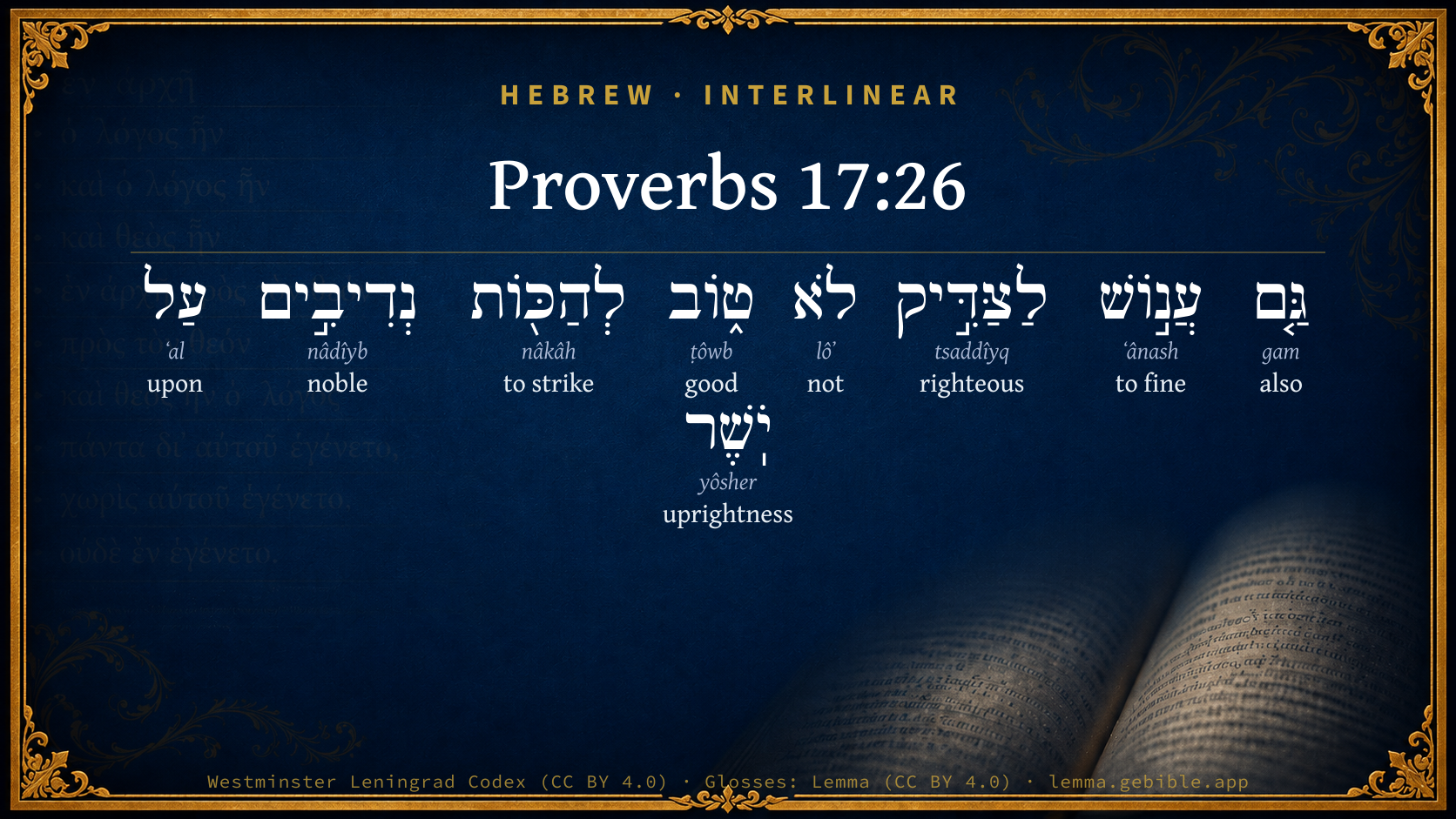
Hebrew (Westminster Leningrad Codex) Proverbs 17:26 appears in the Hebrew Old Testament. The text above is from the Westminster Leningrad Codex. Each word links to its Strong’s number, a concise gloss, and parsing drawn from the Open Scriptures Hebrew Bible morphology. Click any word for its full Brown-Driver-Briggs (BDB) entry.
Download image
Cite this verse

Proverbs 17:26 (World English Bible). Public Domain. Lemma interlinear Bible study tool, https://lemma.gebible.app/v/proverbs/17/26.

Show BibTeX & RIS
BibTeX
RIS
English Translation
Also to punish the righteous is not good, Nor to flog officials for their integrity.
World English Bible · Public Domain
Download a study sheet

One document with this verse’s original text, its word-by-word gloss line, the meaning frame, cross-references with their text, attributed commentary, and full source and license credits — printable, and it pastes into notes with its structure intact.

This verse Autodidact and up

Study sheet (.html) Plain text (.txt)

A passage Seminary Student

Up to 50 verses in one chapter. A passage sheet keeps up to 6 commentary sources and 12 cross-references per verse, in the order this page ranks them, and says so on the sheet whenever that leaves anything out. Ask for a single verse and you get the Autodidact verse sheet above.

Everything on this page stays free to read, with no account — the sheet is a download of what is already on screen, not access to it.

Want to remove ads? Support Godless Engineer
Compare translations 3

The same verse in 3 English versions, stacked beneath the original-language interlinear above. Click any original word for its lexicon entry.

Each is an independent rendering of the whole verse — the interlinear is not word-aligned to these translations.

Highlighted words mark where these versions differ — a whole-verse word diff, not a word-by-word alignment.

  • World English Bible Public Domain
    Also to punish the righteous is not good, Nor to flog officials for their integrity.
  • King James Version Public Domain
    Also to punish the just is not good, nor to strike princes for equity.
  • unfoldingWord Literal Text CC BY-SA 4.0
    Actually to fine the righteous not good; to strike nobles against uprightness.

unfoldingWord Literal Text — © unfoldingWord, licensed CC BY-SA 4.0. Word-aligned USFM3 via Door43 (git.door43.org/unfoldingWord/en_ult).

Versions to compare (up to 4)

3 of 4 selected

Show all 18 translations

Every available English version of this verse, each an independent rendering of the whole verse.

  • World English Bible Public Domain
    Also to punish the righteous is not good, Nor to flog officials for their integrity.
  • Berean Standard Bible Public Domain
    It is surely not good to punish the innocent or to flog a noble for his honesty.
  • Majority Standard Bible Public Domain
    It is surely not good to punish the innocent or to flog a noble for his honesty.
  • King James Version Public Domain
    Also to punish the just is not good, nor to strike princes for equity.
  • American Standard Version (1901) Public Domain
    Also to punish the righteous is not good, `Nor' to smite the noble for `their' uprightness.
  • Revised Version (1885) Public Domain
    Also to punish the righteous is not good, nor to smite the noble for their uprightness.
  • Geneva Bible (1599) Public Domain
    Surely it is not good to condemne the iust, nor that ye princes should smite such for equitie.
  • Douay-Rheims (1899) Public Domain
    It is no good thing to do hurt to the just: nor to strike the prince, who judgeth right.
  • Young's Literal Translation Public Domain
    Also, to fine the righteous is not good, To smite nobles for uprightness.
  • Literal Standard Version CC BY-SA 4.0
    Also, [it] is not good to fine the righteous, || To strike nobles for uprightness.
  • Unlocked Literal Bible CC BY-SA 4.0
    Also, it is never good to punish the righteous person; neither is it good to flog noble men who have integrity.
  • unfoldingWord Literal Text CC BY-SA 4.0
    Actually to fine the righteous not good; to strike nobles against uprightness.
  • Darby Bible Public Domain
    To punish a righteous [man] is not good, nor to strike nobles because of [their] uprightness.
  • World Messianic Bible Public Domain
    Also to punish the righteous is not good, nor to flog officials for their integrity.
  • Webster's Bible Public Domain
    Also to punish the just is not good, nor to strike princes for equity.
  • Free Bible Version CC BY-SA 4.0
    It's not right to impose a fine on someone who's innocent or to flog good leaders for their honesty.
  • Bible in Basic English Public Domain
    To give punishment to the upright is not good, or to give blows to the noble for their righteousness.
  • JPS Tanakh (1917) Public Domain
    To punish also the righteous is not good, nor to strike the noble for their uprightness.

Literal Standard Version (2020), Covenant Press — licensed CC BY-SA 4.0. Text via the HelloAO Bible API (eBible.org). Unlocked Literal Bible (unfoldingWord) — licensed CC BY-SA 4.0. Text via the HelloAO Bible API (eBible.org). unfoldingWord Literal Text — © unfoldingWord, licensed CC BY-SA 4.0. Word-aligned USFM3 via Door43 (git.door43.org/unfoldingWord/en_ult). Free Bible Version, Dr. Jonathan Gallagher — licensed CC BY-SA 4.0. Text via the HelloAO Bible API (eBible.org).

Word by word

More ways to search: Search by grammar → Find every occurrence → Compare this word →

Practice this passage: Drill this verse → Learn its vocabulary →

About this verse

These counts appear in no published source. They are computed here, from the morphology-tagged text and Lemma’s own curated glosses. What Lemma adds →

9
words
9
distinct lemmas
Wisdom
section

Notable vocabulary

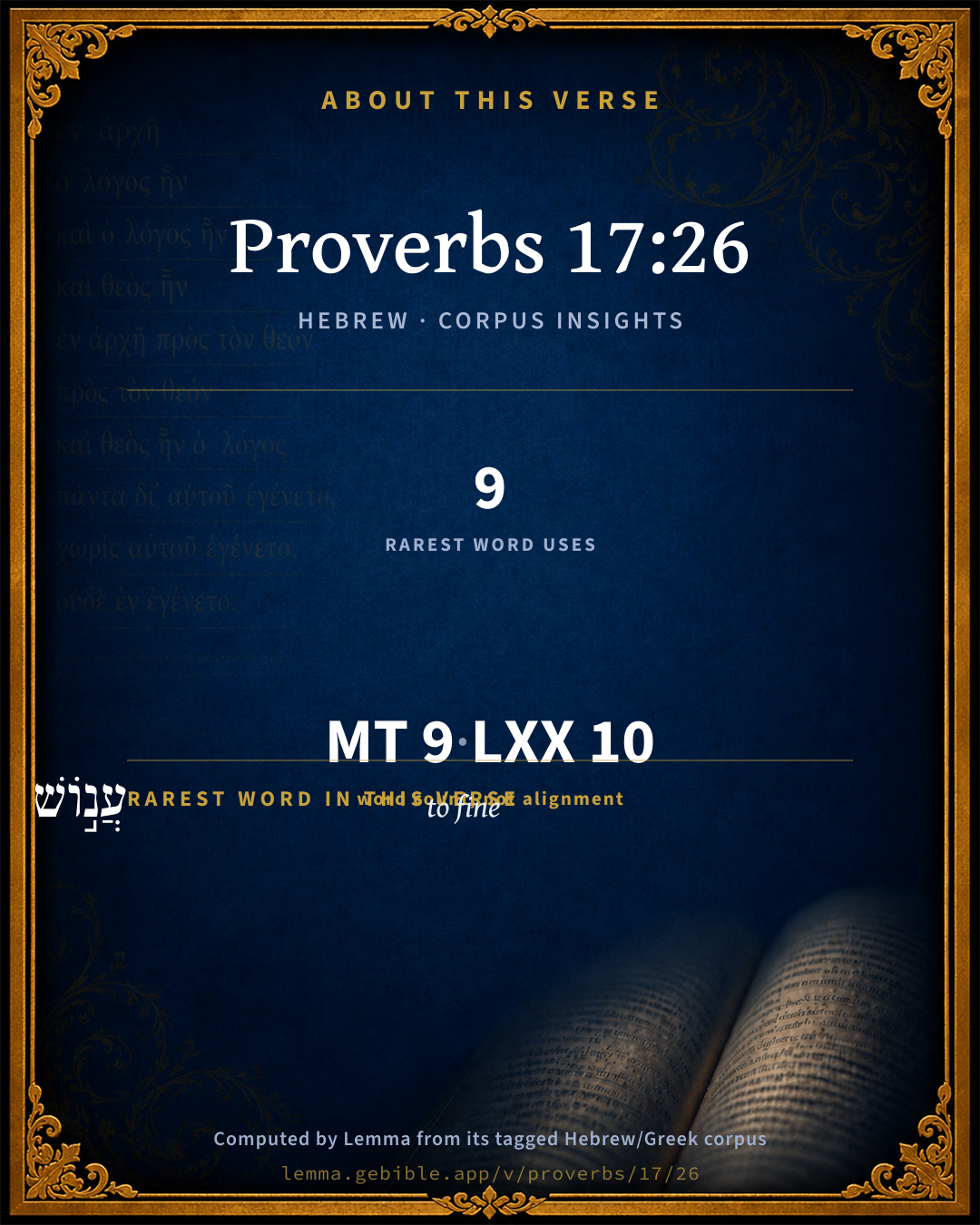
The rarest word here is עֲנ֣וֹשׁ to fine H6064 — appearing just 9 times in the whole Hebrew Bible.

Shared distinctive vocabulary

עֲנ֣וֹשׁ to fine H6064 occurs in 8 verses of the Hebrew Bible. Also found in:

Grammatical profile

  • 2 verbs
  • 1 noun
  • 3 adjectives
  • 1 preposition
  • 2 particles

Verb forms

  • עֲנ֣וֹשׁ Qal · Infinitive Construct
  • לְהַכּ֖וֹת Hiphil · Infinitive Construct

Hebrew & Septuagint length

In English translation the verse runs 15 words from the Hebrew and 18 from the Septuagint (LXX English) — closely comparable.

A rough comparison of the two English renderings, which tokenize alike — not a word-level alignment.

Word counts can differ between the Hebrew and the Greek without any difference in meaning — e.g. the Hebrew direct-object marker אֵת has no separate Greek word, and Greek often adds the article ὁ.

In the original languages it is 9 Hebrew tokens and 10 Greek tokens — but the two are counted differently (Hebrew bundles its prefixes and suffixes into one token; the Greek is in lemma form), so that isn’t a like-for-like length.

Cross-references

10

Topical passages linked to Proverbs 17:26 in the Treasury of Scripture Knowledge — connected by theme and wording, ordered by reader-vote popularity; previews shown in the World English Bible.

  • Proverbs 17:15 He who justifies the wicked, and he who condemns the righteous, Both of them alike are an abomination to Yahweh.
  • Proverbs 18:5 To be partial to the faces of the wicked is not good, Nor to deprive the innocent of justice.
  • John 18:22 When he had said this, one of the officers standing by slapped Jesus with his hand, saying, "Do you answer the high priest like that?"
  • Job 34:18–19 Who says to a king, 'Vile!' Or to nobles, 'Wicked!'
  • Genesis 18:25 Be it far from you to do things like that, to kill the righteous with the wicked, that so the righteous should be as the wicked. May that be far from you. Shouldn't the Judge of all the earth do right?"
  • 2 Samuel 3:39 I am this day weak, though anointed king; and these men the sons of Zeruiah are too hard for me. May Yahweh reward the evil-doer according to his wickedness."
  • Micah 5:1 Now you shall gather yourself in troops, Daughter of troops. He has laid siege against us; They will strike the judge of Israel with a rod on the cheek.
  • 2 Samuel 3:23–25 When Joab and all the host who was with him had come, they told Joab, saying, Abner the son of Ner came to the king, and he has sent him away, and he is gone in peace.
  • 2 Samuel 16:7–8 Thus said Shimei when he cursed, Be gone, be gone, you man of blood, and base fellow:
  • 2 Samuel 19:7 Now therefore arise, go forth, and speak comfortably to your servants; for I swear by Yahweh, if you don't go forth, there will not stay a man with you this night: and that will be worse to you than all the evil that has happened to you from your youth until now.

Cross-references courtesy of OpenBible.info (CC BY 4.0).

Hebrew and Greek witnesses Masoretic Hebrew ↔ Greek Septuagint

The same verse in the two great witnesses to the Old Testament, shown verse-for-verse.

These are two independent witnesses, not word-aligned to each other, and the Septuagint is shown in lemma (dictionary) form.

Hebrew Proverbs 17:26 Masoretic · Westminster Leningrad Codex

גַּ֤ם עֲנ֣וֹשׁ לַצַּדִּ֣יק לֹא ט֑וֹב לְהַכּ֖וֹת נְדִיבִ֣ים עַל יֹֽשֶׁר

Also to punish the righteous is not good, Nor to flog officials for their integrity.

World English Bible · Public Domain

Greek LXX Proverbs 17:26 Septuagint · lemma form

ζημιόω ἀνήρ δίκαιος οὐ καλός οὐδέ ὅσιος ἐπιβουλεύω δυνάστης δίκαιος

It is not right to punish a righteous man, nor is it holy to plot against righteous princes.

LXX2012 (modern English Septuagint) · Public Domain

On this verse, The Pulpit Commentary discusses the Septuagint’s reading. Read the note in Commentary ↓

Hebrew: Westminster Leningrad Codex (CC BY 4.0). Greek: Septuagint (public domain); English from LXX2012 (modern English Septuagint) (Public Domain). How the Septuagint differs from the Hebrew →

Commentary

Notes on Proverbs 17:26 from classic Christian and Jewish commentators (each source and its license shown beneath its notes). The classic Christian expositions comment on the surrounding passage and are grouped to its opening verse, so a note may address several verses; the Jewish commentaries on the Tanakh (Rashi and others) are per-verse, so they appear only where the commentator wrote on this verse.

Lemma curates 59 commentaries, every one of them public domain or Creative Commons licensed, each selected and text-cleaned for this edition rather than reprinted as found. About our sources →

Trapp's Complete Commentary

John Trapp

Pro 17:26 Also to punish the just [is] not good, [nor] to strike princes for equity.

Ver. 26. Also to punish the just is not good.] The righteous are to be cherished and protected, as those that uphold the state. Semen sanctum statumen terrae {Isa 6:13} What Aeneas Sylvius said of learning, may be more properly said of righteousness, "Vulgar men should esteem it as silver, noble men as gold, princes prize it as pearls," but they that punish it, as persecutors do, shall be punished to purpose, when "God makes inquisition for blood." {Psa 9:12}

Nor to strike princes for equity.] Righteous men are "princes in all lands," {Psa 45:16} yea, they are kings in righteousness, as Melchisedec. Indeed they are somewhat obscure kings, as he was, but kings they appear to be, by comparing Mat 13:17 Luk 10:24; "many righteous," saith Matthew "many kings," saith Luke. Now, to strike a king is high treason; and although princes have put up blows, as when one struck our Henry VI, he only said, ‘Forsooth you do wrong yourself more than me, to strike the Lord’s anointed.’ Another, also, that had drawn blood of him when he was in prison, he freely pardoned when he was restored to his kingdom, saying, ‘Alas, poor soul, he struck me more to win favour with others, than of any evil will he bare me.’ {a} So when one came to cry Cato mercy, for having struck him once in the bath, he answered, that he remembered no such matter. Likewise, Lycurgus is famous for pardoning him that smote out one of his eyes; yet he that shall touch the apple of God’s eye - as every one doth that wrongeth a righteous man, for equity especially - shall have God for a revenger. And "it is a fearful thing to fall into the hands of the living God." {Heb 10:31}

{a} Daniel’s Hist., 198.

John Trapp, A Commentary or Exposition upon All the Books of the Old and New Testament (1647–1656) — public domain. Text from a community e-Sword module.

The Biblical Illustrator

Joseph S. Exell

Pro_17:26

Also to punish the just is not good, nor to strike princes for equity.

Striking princes

The spirit of lawlessness, which sought a remedy for real or imaginary ills by striking at princes, was not a strange thing in the times of Solomon. The simple negative in Scripture is often stronger and more significant than the first blush of the expression suggests. It is not good to strike princes for equity means that it is absolutely bad. It is not good morally, for it is a heinous crime; it is not good socially, for it fosters a spirit of restlessness and insecurity; it is not good politically, for it fails to establish the peace and prosperity of a nation; it is not good spiritually, for in the eyes of the Eternal Judge it is an odious sin. Morally, socially, politically, and spiritually it is a gigantic error, a colossal folly, an abominable iniquity, to strike at princes. The expression is capable of three interpretations.

1. It may mean a dogged defiance of their authority--a fixed determination not to obey their laws.

2. It may mean an effort to supplant a prince, a secret or overt attempt to alienate the affections and confidence of the subjects, and transfer the same to another person; a concerted method for placing in the post of honour a rival candidate for popular favour.

3. It may mean assassination, a cruel and cowardly attempt on the life of the sovereign, an execrable conspiracy to hurry into the unseen world the occupant of the national throne. This is a most diabolical and detestable way of attempting to settle real or imaginary grievances; a sin which is sternly condemned by God, and denounced by all right-thinking men. (J. Hiles Hitchens, D. D.)

A discourse against rebellion

Treason and rebellion are such horrid and loathsome crimes that if they should appear in their native visage and genuine deformity they could never form a party nor allure men to divorce their allegiance. They always, therefore, insinuate into the affections of the unwary or easily deceived multitude under the specious pretences of piety and purity. Some render the second clause of this verse princes striking for equity instead of striking princes for equity. But this cannot be the true sense in this place. It is against the natural order of the words. The proverb has a double aspect; the one respects princes, forbidding them to punish their righteous subjects; the other respects the people, forbidding them to rebel against their princes for equitys sake. Dealing with this second part, consider--

I. The doom and censure. It is not good. It speaks only dislike, but means detestation. It implies that it is a crime most impious in itself, and most odious and abominable to God.

II. The action condemned. To strike princes.

1. We must not strike princes with the tongue, in their fame and reputation.

2. We must not strike princes in their authority, nor the exercise of it over us. This may be done by refusing to be subject to their laws, or by deposing them from their dominion.

3. It is sacrilege to strike them in their persons, and to offer violence to their liberty or life.

III. The cause, motive, or provocation to this abominable action. That is equity. Either the princes equity or the subjects equity. To strike for either is here censured as a heinous crime.

1. It may he understood of resisting and rebelling against them for their own equity and the execution of that justice which is committed to them.

2. It may be understood of striking them for their subjects equity. That is, it is a great injustice to strike princes upon any pretences of equity and justice in so doing. Never yet was there any insurrection against the lawful magistrate but what was prefaced with glorious pretences, the honour of God, the liberty of the subject, a due freedom for tender consciences, etc. These are all excellent things, and we can never too much prosecute them while we do it in a lawful and allowed manner. But a good purpose can never justify a wicked action, and God abhors that our sins should be made the means of His glory. (E. Hopkins, D. D.)

The Biblical Illustrator, edited by Joseph S. Exell (c. 1880s–1900s) — public domain. Text from a community e-Sword module.

The Preacher's Complete Homiletical Commentary

Joseph S. Exell (gen. ed.)

CRITICAL NOTES.—

Pro_17:26. Also, rather, even. It emphasizes the verb immediately following, viz., to punish, i.e., to inflict a pecuniary fine. Zockler renders the verse. “Also to punish the righteous is not good, to smile the noble contrary to justice,” and explains the meaning thus, “The fine as a comparatively light penalty which may easily at one time or another fall with a certain justice even on a just man, stands contrasted with the much severer punishment with stripes; and as these two verbal ideas are related, so are also the predicates ‘not good’ and ‘contrary to right’ (above desert, beyond all proportion to the just and reasonable) in the relation of a climax.” Delitzsch reads, “Also to inflict punishment on the righteous is not good; this, that one overthrows the noble on account of his righteousness,” i.e., it is not good when a ruler makes his power to punish to be felt by the innocent as well as by the guilty. Miller translates, “Even deserved punishment to the righteous does not seem good, when designed to chasten the willing with a view to holiness,” and explains his translation of the word generally translated princes, or the noble, by a reference to the Hebrew root from which it is derived and which may be rendered willing or generous.

MAIN HOMILETICS OF Pro_17:26

SMITING THE JUST

This verse has been variously rendered and explained. (See Critical Notes and the comments of different expositors). It suggests, however—

I. That punishment in itself is sometimes necessary and desirable. When the laws of the family are wise and good, it is a great misfortune for the children, and a great sin against them, not to visit their transgressions with a suitable punishment. And it is absolutely essential to the existence of a well-ordered state, that there should be punishment for those who rebel against righteous laws. Civil rule is of Divine ordination—“the powers that be are ordained of God” (Rom_13:1). When, therefore, there is no just cause for civil rebellion, it is a sin not only against the state but against the Ruler of all the kingdoms of the earth, to break the established laws. Punishment forms a necessary part of the government of the universe. God has, both by example and precept, shown its necessity. When there was rebellion in heaven against a perfect government, punishment followed, which was proportioned to the greatness of the transgression—the sentence passed upon the first rebel in the universe and upon those who were confederate with him was a terrible one, but it was only commensurate to the exceeding magnitude of the offence. If rebellion against such a government had been allowed to go unpunished, it would have made way for universal anarchy. And a community of any kind without punishment for transgressors, is lacking in a most essential element of its peace and stability.

II. But those whose moral character fits them to be the awarders of punishment are often the victims of it. The natural and right order of things in this respect is often exactly the reverse of what it ought to be, and just and noble men are treated as transgressors and suffer the punishment which ought to fall upon their persecutors. Might is very far from being right in this world, and even in this country Richard Baxter stood at the bar while Judge Jeffries sat upon the bench. The apostles of the Lord suffered scourging at the hands of the council at Jerusalem (Act_5:40); Paul was condemned to death by Nero, and Incarnate Righteousness was crucified between two thieves at the instigation of some of the worst men that the world has ever seen. In all these cases, and in ten thousand others, the just were smitten, and as a rule they have suffered, not merely although they were righteous, but because they were so—it was their integrity that aroused the enmity of their persecutors—these moral “princes” were “stricken for equity.”

III. Such an abuse of power will in its turn be visited with punishment. Those who have thus unjustly condemned the righteous, have found in their own personal experience that “to punish the just is not good”—“not good” for their own peace of mind—not good for their future reputation—not good for the nation who instigated them or permitted them to do the deed. Haman found that it was not good for him to aim a blow at the upright Mordecai when he was himself hanged upon his own gallows; the Persian princes found it was not good to strike a prince for equity when they were themselves cast into the den of lions; Judge Jeffries found it out when he lay face to face with death in the Tower. And among all the nations whose history has confirmed the truth of the text, none stands out so prominently as that one whose king was the author of the proverb. The punishment of the just—the striking of moral princes for equity—was one of the most prominent of their national crimes, and He whose death at their hands filled up the measure of their iniquity, declared that it was the great cause of their national ruin. “Woe unto you, Scribes and Pharisees, hypocrites! because ye build the tombs of the prophets, and garnish the sepulchres of the righteous, and say if we had been in the days of our fathers we would not have been partakers with them in the blood of the prophets. Wherefore ye be witnesses unto yourselves that ye are the children of them that killed the prophets … Wherefore, behold, I send unto you prophets, and wise men, and Scribes; and some of them ye shall kill and crucify; and some of them ye shall scourge in your synagogues, and persecute them from city to city; that upon you may come all the righteous blood shed upon the earth, from the blood of righteous Abel unto the blood of Zacharias son of Barachias, whom ye slew between the temple and the altar” (Mat_23:29-35). The Jewish nation has been for nearly nineteen centuries a witness that “to punish the just is not good, nor to strike princes for equity.”

OUTLINES AND SUGGESTIVE COMMENTS

Even deserved punishment to the righteous does not seem good when designed to chasten the willing with a view to holiness. “Even.” This seems to have been treated as a word de trop. King James’ men make it also; as though Solomon grew tired of sameness, and broke the monotone by a new opening vocable. But with the above rendering it takes its usual sense. “Righteous.” This word and “punishment” bear the weight of the word “even.” Even the righteous, who ought to know better; and “even punishment,” which the righteous, at least, ought to be willing to bear.—Miller.

Often is the wise man’s meaning much beyond his words. To punish the just not only is not good, but it is “the abomination” (Pro_17:15)—“an evident token of perdition” (Philip. Pro_1:28). If rulers are “a terror to good works,” they are ministers of God in authority, but ministers of Satan in administration. And how will such injustice “abide the day of His coming,” when He shall “lay judgment to the line, and righteousness to the plummet!”—Bridges.

The word prince signifies noble, and is differently understood. It may be applied to the nobility of station, or to that of mind. Some give preference to the latter; and by interpreting it of the noble-minded, and the “just” in the former clause, of the righteous or the people of God, make the two clauses thus to correspond, and to have much the same import. It seems, however, both more natural and more comprehensive to consider two ideas as expressed; the one relating to the duty of the ruler, and the other to that of the ruled. It is the incumbent duty of the ruler, on the one part, to administer justice with strict impartiality. It is the duty, on the other part, of subjects to countenance, encourage, and support the ruler in the equitable administration of his trust. To “strike” is evidently to be understood, not literally alone of actual striking, but of “smiting with the tongue” as well as with the fist or the rod,—of all kinds of vituperation and abuse, and attempts to bring the throne into disrepute and odium, and unsettle its stability, by shaking the confidence and attachment of the community. There are many occasions in which a man may be tempted to this. He may, in particular cases, have his mind biassed by pride, by self-interest, by partiality towards a friend, by political predilections; so that even when all has been done with impartial investigation, and the judgment pronounced according to the legitimate rules of evidence and demands of equity, there may be unfair, unreasonable and angry dissatisfaction; and the prince may be smitten for justice. Every man ought to be on his guard against this. The higher the responsibility,—the more burdensome and difficult the trust,—and the more serious the results of bringing authorities and the laws into disesteem, and unsettling public confidence in them,—ought to be the amount of our reluctant caution in pronouncing censure. Another remark may be ventured. One of the great difficulties with which governments of great nations have to contend, arises from the variety of crossing and contending interests with which they have to deal. How anxious soever they may honestly be, to allow no undue bias to draw them from the line of impartial justice, yet there is hardly a measure they can adopt that does not affect differently different classes of the community; so that, from their various predisposing circumstances, that shall appear to one class—to those in one particular department of trade or commerce—the very essence of injustice, which by another is lauded as a most unexceptionable exemplification of impartial equity. This ought surely to have the effect—I do not by any means say of forbidding the most vigilant observance and the freest and most searching scrutiny and discussion of every measure, and the exposure of its evil or questionable character and tendency—but assuredly of procuring some allowance for the difficulty of the task of pleasing all parties, and some moderation in the tone of censure even where to us the grounds for it are clear and palpable. No man who knows himself will affirm, in almost any case, that, placed, in other circumstances, he might not see with other eyes. I speak in general. There are cases in which the interests of a suffering country are, to a vast extent, involved, in which it becomes every man’s paramount duty to speak out and to speak plainly, and to make the ears of the rulers to tingle with the outcry of humanity and justice. I would further apply the spirit of this verse to the case of arbitrators. We have ourselves, it may be, consented to submit a litigated point to arbitration. We do so with a full persuasion of our being in the right—of our claim being the just one. But the arbiters unite in giving it against us. It would be most unreasonable on our part to retain a grudge, especially at the one appointed by ourselves, on this account. Our reference implied confidence in his impartiality and honour, and implied a pledge of cheerful acquiescence. To grumble, to censure, and to withdraw our friendship, would be indeed to “strike him for equity.” He would have proved himself unworthy of his trust, if his disposition to please and serve us had been too strong for principle, conscience, and oath. There is one government, in which “the just” are never “punished”—all whose laws and all whose sanctions are the perfection of equity. But alas! it is under that very government that the spirit expressed by the phrase “striking princes for equity” is most fearfully manifested. All the murmurings of sinners against either the law of God or its revealed and threatened penalty, are the very essence, in its deepest malignity, of this spirit.—Wardlaw.

Righteous men are princes in all lands (Psa_45:16); yea, they are kings in righteousness as Melchisedec. Indeed they are somewhat obscure kings as he was, but kings they appear to be, by comparing Mat_13:17 with Luk_10:24; “many righteous,” saith Matthew, “many kings,” saith Luke. Now, to strike a king is high treason; and although princes have put up blows, as when one struck our Henry VI., he only said, “Forsooth, you do wrong yourself more than me, to strike the Lord’s anointed.”—Trapp.

The Preacher's Complete Homiletical Commentary (gen. ed. Joseph S. Exell; Funk & Wagnalls, c. 1892) — public domain (pre-1929). A full-Bible homiletical/sermon-outline anthology covering 65 of 66 books (2 John is absent from the source module). Text from a community e-Sword module.

Geneva Bible (1599)

Geneva Bible translators

For their well doing.

Geneva Bible (1599) marginal notes — public domain. Text via Bolls.life.

Matthew Henry's Commentary

In differences that happen between magistrates and subjects, and such differences often arise, 1. Let magistrates see to it that they never punish the just, that they be in no case a terror to good works, for that is to abuse their power and betray that great trust which is reposed in them. It is not good, that is, it is a very evil thing, and will end ill, whatever end they may aim at in it. When princes become tyrants and persecutors their thrones will be neither easy nor firm. 2. Let subjects see to it that they do not find fault with the government for doing its duty, for it is a wicked thing to strike princes for equity, by defaming their administration or by any secret attempts against them to strike at them, as the ten tribes that revolted reflected upon Solomon for imposing necessary taxes. Some read it, Nor to strike the ingenuous for equity. Magistrates must take heed that none suffer under them for well doing; nor must parents provoke their children to wrath by unjust rebukes.

Matthew Henry's Commentary on the Whole Bible (1708–1710) — public domain (CC PDM 1.0). Text via the HelloAO Bible API.

Jamieson, Fausset & Brown

Robert Jamieson, A. R. Fausset & David Brown

Also--that is, Equally to be avoided are other sins: punishing good subjects, or resisting good rulers.

Jamieson, Fausset & Brown — Commentary Critical and Explanatory on the Whole Bible (1871) — public domain (CC PDM 1.0). Text via the HelloAO Bible API.

Adam Clarke's Commentary

Verse 26. Nor to strike princes for equity.] To fall out with the ruler of the people, and to take off his head under pretence of his not being a just or equitable governor, is unjust. To kill a king on the ground of justice is a most dreadful omen to any land. Where was it ever done, that it promoted the public prosperity? No experiment of this kind has ever yet succeeded, howsoever worthless the king might be.

Adam Clarke's Commentary on the Bible (1810–1826) — public domain. Text from a community e-Sword/MySword module.

Ellicott's Commentary for English Readers

(26) Also.—Among other evil things. The subject of perversion of justice is again taken up.

To punish.—Especially by fining.

To strike—i.e., scourge. (Comp. Deu_25:1-3.)

For equity—i.e., when they have acted uprightly.

A Bible Commentary for English Readers, edited by Charles John Ellicott (1878–1897) — public domain. Text from a community e-Sword module.

The Cambridge Bible for Schools and Colleges

gen. ed. J. J. S. Perowne

26. Also] beside other things that are “not good”; as “also” is used in Pro_19:2.

punish] Lit. mulct, or (as R.V. marg.) fine.

strike] i.e. inflict the severer punishment of scourging. Deu_25:1-3.

princes] Rather, the noble, R.V. The Heb. word properly denotes character, liberal, free-handed (Gesen. Lex. s.v.), and so comes to be applied to rank or office. See Pro_19:6, where the same word is rendered the prince, A.V., but, in keeping with the parallelism, the liberal man, R.V. text. For illustration of the proverb comp. Joh_18:23.

The Cambridge Bible for Schools and Colleges (gen. ed. J. J. S. Perowne; Cambridge University Press, 1878–1918) — public domain. Text from a community e-Sword module.

John Gill's Exposition

Also to punish the just is not good,.... It is evil, and an abomination to the Lord, Pro 17:15. Evildoers indeed should be punished; but to punish the righteous also, as well as them, is far from being commendable;

nor to strike princes for equity: to strike princes, judges, civil magistrates, for doing the duty of their place and office, for doing that which is just and equitable among men, is very criminal, who ought to be encouraged and supported therein. Or it may be rendered, nor "that princes should strike for that which is right" (b) or cause men to be stricken, scourged, and whipped for doing well. The Targum is,

"nor to smite the righteous, who say right things;''

and so the Syriac version renders it, "righteous ones"; and the word signifies ingenuous liberal persons, good men, such as princes are or ought to be; and who should neither be stricken in the due discharge of their office, nor strike others that do well.

(b) "principes percuiere ob rectitudinem", Mercerus; "propter recta facta", Piscator, Gataker.

John Gill's Exposition of the Whole Bible (1746–1763) — public domain (CC PDM 1.0). Text via the HelloAO Bible API.

Albert Barnes' Notes on the Bible

Nor to strike ... - Better, and to strike the noble (in character rather than in rank) is against right. Compare Joh 18:28.

Albert Barnes' Notes on the Bible (1834–1885) — public domain. Text from a community e-Sword/MySword module.

Haydock's Catholic Bible Commentary

No good. But very criminal. See Jeremias vii. 31.

George Leo Haydock (1774–1849), Haydock's Catholic Family Bible and Commentary, 1859 edition — public domain. Excludes Psalms (Douay-Rheims chapter numbering differs from Protestant) and Deuterocanonical books (Catholic canon only).

Matthew Poole's English Annotations

Also: this particle seems to have relation to the next foregoing proverb, to imply that it is a very evil thing for children to cause grief to their parents, as it is also to do what here follows.

To punish the just; for parents, or princes, or rulers, to whom alone this power belongs, to punish innocent and good men;

is not good; is highly evil and abominable, as is implied. See above, Pro 17:20; 16:29; 17:10, &c.

Nor to strike princes for equity; nor to smite magistrates, either with the hand or tongue, for the execution of justice, as condemned persons are apt to do. Or, as some learned interpreters render it, nor for princes to strike any man for equity, or for doing his duty, or what is just. So this clause best agrees with the former. Besides, it belongs to princes or ms, strafes to punish or strike.

Matthew Poole's English Annotations on the Holy Bible (1683–1685) — public domain. Text from a community e-Sword/MySword module.

Whedon's Commentary on the Bible

Daniel D. Whedon

26. To punish the just — The upright. The passage may be translated thus: To amerce (or punish) the righteous is not good. The latter clause presents an aggravation of the offence.

Not good — A meiosis, in which more is meant than is expressed. It is bad, wrong, so to do.

Daniel D. Whedon (gen. ed.), Commentary on the Old and New Testaments (1874–1909) — public domain. Text from a community e-Sword module.

The Pulpit Commentary

Also (gam). This may be intended to connect this verso with what was said above (ver. 23) about the perversion of justice; or, as is more probable, it is used to emphasize what is coming, To punish the just is not good. Damnum inferre justo, Vulgate; zhmioun , Septuagint; and the word has a special reference to punishment by fire. Nor to strike princes for equity; the expression, "is not good," being understood from the former clause. "Princes" are the noble in character rather than in position only. Two forms of evil are named, viz. to punish the innocent, and to visit with contumely and injury the man of high character who cannot be induced to pervert justice. Revised Version, nor to smite the noble for their uprightness. So virtually the Vulgate, Septuagint, and Syriac. Another rendering is, "to strike the noble is against right," which seems feeble and less suitable to the parallelism.

The Pulpit Commentary (1880–1919), ed. H.D.M. Spence-Jones & Joseph S. Exell — public domain. Text from a community e-Sword module.

John Wesley's Explanatory Notes

To strike - Nor to smite magistrates, either with the hand or tongue, for the execution of justice.

John Wesley, Explanatory Notes Upon the Whole Bible (1754–1765) — public domain. Text via the GEBible commentary corpus.

Keil & Delitzsch

C. F. Keil & F. Delitzsch

26 Also to inflict punishment on the righteous is not good;

This, that one overthrows the noble on account of his rectitude.

Does the גּם [also] refer to a connection from which the proverb is separated? or is it tacitly supposed that there are many kinds of worthless men in the world, and that one from among them is brought forward? or is it meant, that to lay upon the righteous a pecuniary punishment is also not good? None of all these. The proverb must have a meaning complete in itself; and if pecuniary punishment and corporeal punishment were regarded as opposed to one another, 26b would then have begun with אף כּי (quanto magis percutere ingenuos). Here it is with גם as at Pro 20:11, and as with אך at 11a, and רק at Pro 13:10 : according to the sense, it belongs not to the word next following, but to לצּדּיק; and ענשׁ (whence inf. ענושׁ, as Pro 21:11, with the ǎ in ע, cf. also עבד, Pro 11:10, for אבד) means here not specially to inflict a pecuniary fine, but generally to punish, for, as in mulctare, the meaning is generalized, elsewhere with the accus., Deu 22:19, here to give to any one to undergo punishment. The ruler is the servant of God, who has to preserve rectitude, εἰς ὀργὴν τῷ τὸ κακὸν πράσσοντι (Rom 13:14). It is not good when he makes his power to punish to be felt by the innocent as well as by the guilty.

In 26b, instead of הכּות, the proverb is continued with להכּות; לא־טוב, which is to be supplied, takes the inf. alone when it precedes, and the inf. with ל when it follows, Pro 18:5; Pro 28:21; Pro 21:9 (but cf. Pro 21:19). הכּות is the usual word for punishment by scourging, Deu 25:1-3, cf. Co2 11:24, N.T. μαστιγοῦν, δίρειν, Rabb. מכּות, strokes, or מלקוּת from לקה, vapulare, to receive stripes. נדיבים are here those noble in disposition. The idea of נדיב fluctuates between generosus in an outward and in a moral sense, wherefore על־ישׁר, or rather עלי־ישׁר, is added; for the old editions, correct MSS, and e.g., also Soncin. 1488, present עלי (vid., Norzi). Hitzig incorrectly explains this, "against what is due" (ישׁר, as Pro 11:24); also Psa 94:20, עלי־חק does not mean κατὰ προστάγματος (Symmachus), but ἐπὶ προστάγματι (lxx and Theod.), on the ground of right = praetextu juris (Vatabl.). Thus עלי־ישׁר means here neither against nor beyond what is due, but: on the ground of honourable conduct, making this (of course mistakenly) a lawful title to punishment; Aquila, ἐπὶ εὐθύτητι, cf. Mat 5:10, ἕνεκεν δικαιοσύνης. Besides, for על after הכּה, the causal signification lies nearest Num 22:32, cf. Isa 1:5 (על־מה, on account of anything). If the power of punishment is abused to the punishing of the righteous, yea, even to the corporeal chastisement of the noble, and their straight, i.e., conscientious, firm, open conduct, is made a crime against them, that is not good - it is perversion of the idea of justice, and an iniquity which challenges the penal rectitude of the Most High (Ecc 5:7 [8]).

Keil & Delitzsch — Biblical Commentary on the Old Testament (1861–1891) — public domain (CC PDM 1.0). Text via the HelloAO Bible API. (Old Testament only.)

Bridges on Proverbs

Charles Bridges

Often is the wise man’s meaning much beyond his words. To punish the just not only is not good,†1 but it is "the abomination" (Pro 17:15 ) — "an evident token of perdition." (Php 1:28 .) If rulers are "a terror to good works," they are Ministers of God in authority, but Ministers of Satan in administration.†2 And how will such injustice "abide the day of his coming," when he shall "lay judgment to the line, and righteousness to the plummet!"†3

Not less wicked is the sin of the people. To strike princes is high treason against God.†4 The Apostle confessed the unwilling sin of his smiting words.†5 Much more guilty is it to strike them for equity. A godly king — ruling in equity, "scattering away all evil with his eyes"†6 — will raise to himself many and powerful enemies. The evil-minded will undermine his influence,†7 or resist his authority.†8 If they dare not strike him openly, they will "curse him in their thoughts."†9 To strike, even in word, is our sin.†10 To pray is our duty. And who knoweth what a prayer-hearing God would send — a righteous administration, a covert and blessing to the land?†11

Footnotes:

†1 See this same meiosis. Pro 16:29 ; Pro 18:5 ; Pro 20:23 . Psa 51:17 . Eze 36:31 .

†2 1Ki 21:11-13 . Mat 26:3-4 . Act 4:1-3 .

†3 Isa 28:17, with Mal 3:2, Mal 3:5 .

†4 Job 34:18.

†5 Act 23:5. Compare 1Sa 24:5-6 ; 2Sa 16:5-7 .

†6 Pro 20:8.

†7 2Sa 15:1-6 .

†8 2Sa 20:1 .

†9 Ecc 10:20.

†10 2Pe 2:10 . Jud 1:8 .

†11 1Ti 2:1-3 . 2Sa 23:3 . Isa 32:1-2 .

Charles Bridges, An Exposition of the Book of Proverbs (1846) — public domain. Text from a community e-Sword module.

Kretzmann's Popular Commentary

Paul E. Kretzmann

v. 26. Also, to punish the just is not good, it is against the principles of justice to have the righteous bear any kind of punishment, nor to strike princes for equity, smiting the noble contrary to right, under the pretense of right and justice openly to dispense injustice.

Paul E. Kretzmann, Popular Commentary of the Bible (1921–1924) — public domain. Text from a community e-Sword module.

Rashi

Rabbi Shlomo Yitzchaki (Rashi)

To punish also the righteous man is not good The Holy One, blessed be He, did not decide to obliterate the name of Israel from upon the earth, as it was not good in his sight to punish all of them.

to strike the generous who possess uprightness To strike the good people among them, who were generous and possessing uprightness, as it is said (I Kings 19:18): “And I will leave over in Israel seven thousand—all the knees that did not kneel to the Baal.”

the generous who possess uprightness Heb. נדיבים עלי ישר, an analogy of what is stated elsewhere (Isa. 32:8): “But the generous person plans generous deeds, and he, because of generous deeds, shall stand.” We find “a generous man because of generous deeds.”

Rashi on the Tanakh — English translations: “The Judaica Press complete Tanach with Rashi, translated by A. J. Rosenberg” (CC BY 4.0); “Pentateuch with Rashi's commentary by M. Rosenbaum and A.M. Silbermann, 1929-1934” (public domain); “The Metsudah Tanach series, Lakewood, N.J” (CC BY 4.0); and “The Book of Joshua, Metsudah Publications, 1997” (CC BY 4.0). Text via Sefaria.

Lesson kit

Teaching starters — assembled from the data on this page, not authored interpretation. Every prompt links to the verse data it draws on. Edit before teaching.

Proverbs, in the Wisdom, opens this verse with 9 words (9 distinct Hebrew lemmas). Its most distinctive word is ʻânash (“to fine”). A historical commentator’s framing appears above. Read the whole chapter for the surrounding context.

Discussion questions

  1. How does “to fine” (ʻânash) shape what this verse is saying?
  2. How does Exodus 21:22, which shares the word «to fine», read alongside this verse?
  3. These translations render this verse differently; the difference is in the English rendering, not the original. What questions does that raise?
  4. «עֲנ֣וֹשׁ» is a Qal Infinitive Construct verb. How does that grammatical form shape the action described?
  5. Compare how Trapp's Complete Commentary and The Biblical Illustrator read this verse. Where do they agree or differ?

Things to notice

Reading settings

Reading text

Shown beneath each verse's original-language words.

Old Testament
Old Testament edition

Read the OT as the Masoretic Hebrew (MT) or the Greek Septuagint (LXX).

English shown for the Greek Septuagint (in the Hebrew ↔ Greek comparison).

Comparing translations? Open the Compare panel on any verse page to stack up to four side by side.