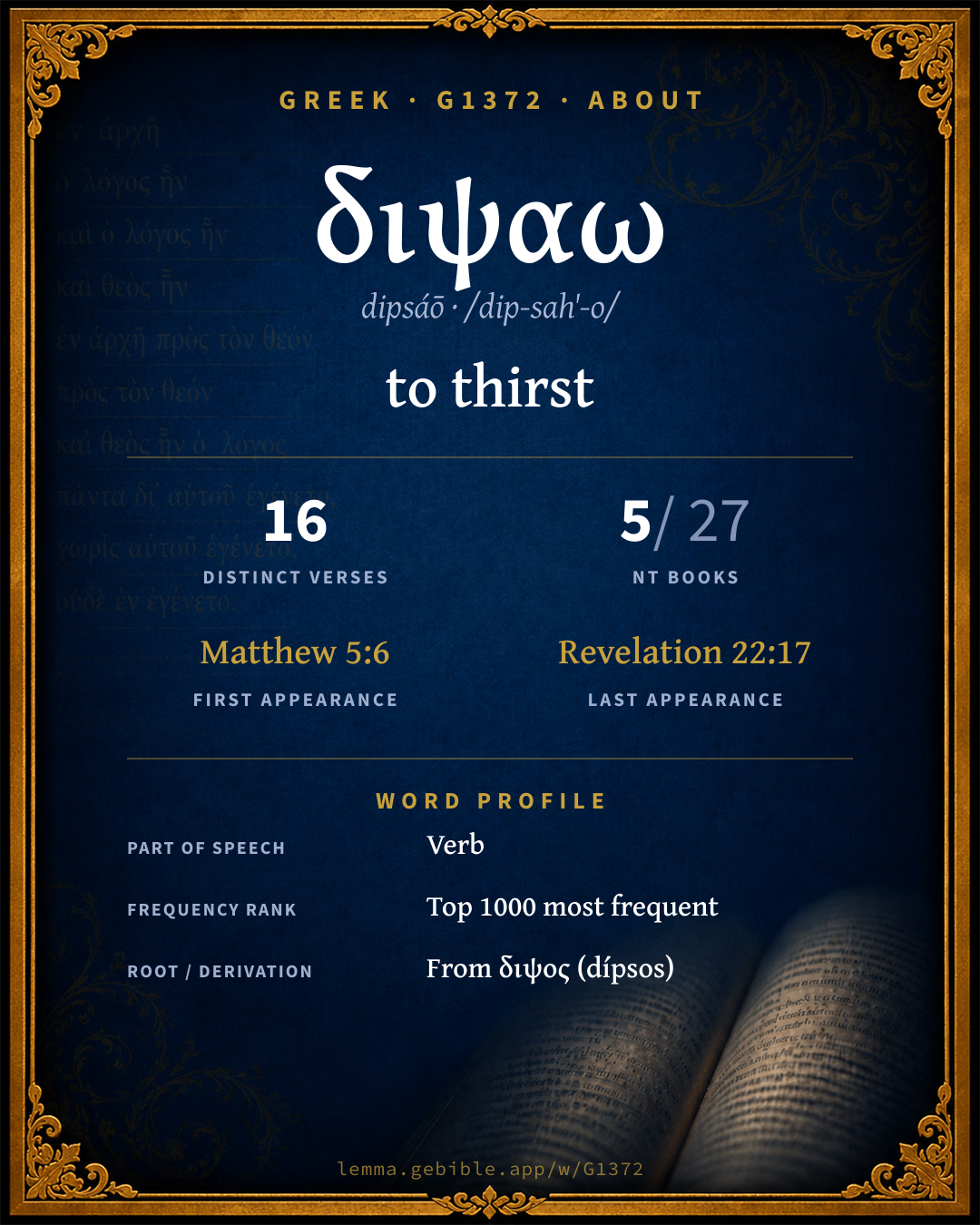
διψάω
to thirst
Full lexicon entry — Thayer's Greek Lexicon
From Thayer's Greek Lexicon
Where this word appears
See every Future-tense verb in the Greek New Testament →
Grammar key — what these labels mean
Part of speech
- Verb
- An action or state-of-being word.
Tense
- Future
- Action expected in future time.
- Aorist
- Action viewed as a simple whole, without regard to duration — often past (perfective aspect).
- Present
- Ongoing or general action in present time (imperfective aspect).
Voice
- Active
- The subject performs the action.
Mood
- Indicative
- States a fact or asks a factual question (the mood of reality).
- Participle
- A verbal adjective (“writing,” “having written”).
- Subjunctive
- Expresses probability, purpose, or possibility (the mood of contingency).
Case
- Accusative
- The case of the direct object and of extent.
- Dative
- The case of the indirect object, means, or location — “to / for / with / in.”
- Nominative
- The case of the subject (and the predicate nominative).
Person
- 3rd person
- The one spoken about (“he / she / it / they”).
- 1st person
- The speaker (“I / we”).
Gender
- Masculine
- Grammatically masculine.
Number
- Singular
- One.
- Plural
- More than one.
Every verse where G1372 appears in the Book of John — 6 distinct verses. Click any verse to open its interlinear word-by-word view. Verse text shown in the World English Bible for context — . Each verse’s Greek form is shown with its reference; the English is not keyword-highlighted, since the data carries no word-level English alignment. Use “Compare translations” on any verse to read it across multiple English versions. This concordance covers the Greek New Testament; Septuagint (Greek Old Testament) occurrences of this word are not indexed here.
John
- John 4:13 διψήσει fut act ind 3sg Jesus answered her, "Everyone who drinks of this water will thirst again,
- John 4:14 διψήσει fut act ind 3sg but whoever drinks of the water that I will give him will never thirst again; but the water that I will give him will become in him a well of water springing up to eternal life."
- John 4:15 διψῶ pres act subj 1sg The woman said to him, "Sir, give me this water, so that I don't get thirsty, neither come all the way here to draw."
- John 6:35 διψήσει fut act ind 3sg Jesus said to them, "I am the bread of life. He who comes to me will not be hungry, and he who believes in me will never be thirsty.
- John 7:37 διψᾷ pres act subj 3sg Now on the last and greatest day of the feast, Jesus stood and cried out, "If anyone is thirsty, let him come to me and drink!
- John 19:28 διψῶ pres act ind 1sg After this, Jesus, seeing that all things were now finished, that the Scripture might be fulfilled, said, "I am thirsty."
About this entry
At a glance — auto-summarized from this page’s data, not written by a person. Every figure links to its source below. This summary describes the numbers; it doesn’t interpret them.
διψαω — transliterated dipsáō — is a Greek verb carrying the sense “to thirst.” Its earliest occurrence is Matthew 5:6. Spanning 16 verses in 5 books, it ranks among the uncommon words of the Greek New Testament. Its uses concentrate in John (38% of all occurrences). Each statement above links to its evidence; the full detail follows below.
Gloss history
Strong's 1890 vs modern scholarship
About this word
Strong's G1372 catalogs a Greek word from the Greek New Testament.
These counts are not copied from any lexicon or concordance. They are computed here, from the morphology-tagged Greek New Testament. What Lemma adds →
- 16
- distinct verses
- The word appears in 16 distinct verses.
- 5 / 27
- NT books
- The word appears in 5 of 27 New Testament books.
- #726
- by frequency
- Top 1000 most frequent Greek words (rank 726 of 5,347 Greek words by occurrence).
View all 16 occurrences in the concordance →
Most concentrated in
- John 6 verses 38%
- Matthew 5 verses 31%
- Revelation 3 verses 19%
By section of the New Testament
By traditional corpus
Conventional, traditional groupings — biblical authorship is debated, so this is a traditional corpus grouping, not an authorship claim. Some books belong to more than one corpus (Luke is in both the Gospels and the Lukan corpus, and so on), so these shares overlap and need not total 100%. Each figure is a share of the word’s 16 distinct verses.
- Gospels 11 verses · 69%
- Johannine 9 verses · 56%
- Revelation 3 verses · 19%
- Pauline corpus 2 verses · 13%
How translations render this word
Counts come from each version’s own published word-to-Strong’s tagging or interlinear alignment — an approximate guide to how each version renders this word, not a word-level alignment the data otherwise carries. Because each total is that version’s own tagged count, the per-version totals vary from one another and need not match the appearance or distinct-verse counts above. These counts may also differ from a printed concordance because Lemma counts each distinctly tagged rendering and does not collapse phrase taggings into a single head-word total. This is a fixed set of word-tagged versions (KJV, ASV, BSB, ULT) and does not change with the reading translation you choose elsewhere. Each version’s license is shown beside its name below (and on Sources).
- King James Version: Thirst 6×, I thirst 2×, I was thirsty 2×
- American Standard Version: Thirst 5×, I thirst 2×, I was thirsty 2×
- Berean Standard Bible: Thirsty 4×, I was thirsty 2×, Is thirsty 2×
- unfoldingWord Literal Text: Thirst 3×, I was thirsty 2×, Thirsting 2×
King James Version Public Domain
Renders G1372 across 18 tagged occurrences — most commonly:
Plus 6 renderings that appear only once — usually multi-word phrases or single function words the recovered tagging swept in, not distinct renderings.
American Standard Version Public Domain
Renders G1372 across 17 tagged occurrences — most commonly:
Plus 8 renderings that appear only once — usually multi-word phrases or single function words the recovered tagging swept in, not distinct renderings.
Berean Standard Bible Public Domain
Renders G1372 across 16 tagged occurrences — most commonly:
Plus 6 renderings that appear only once — usually multi-word phrases or single function words the recovered tagging swept in, not distinct renderings.
unfoldingWord Literal Text CC BY-SA 4.0
Renders G1372 across 19 tagged occurrences — most commonly:
Plus 8 renderings that appear only once — usually multi-word phrases or single function words the recovered tagging swept in, not distinct renderings.
Senses in Thayer's
The 1 sense Thayer's distinguishes for this word, in lexicon order (not ranked by frequency or importance). The full entry — with sub-senses — is in the Lexicon Entry tab.
- to suffer thirst, suffer from thirst
Word origin
Derived from διψος (dípsos) (G1373) — thirst.
From a variation of G1373 ; to thirst for (literally or figuratively): - (be be a-) thirst (-y).
— Strong’s Exhaustive Concordance (1890), public domain.
Forms in the corpus
The 10 distinct written forms G1372 takes in the Greek New Testament, most frequent first — each parse links to that tense’s occurrences in the concordance.
| Form | Parsing | Example | Uses |
|---|---|---|---|
| διψήσει dipsḗsei | Verb, Future, Active, Indicative, 3rd person, Singular | John 4:13 | 3 |
| διψῶ dipsō̂ | Verb, Present, Active, Indicative, 1st person, Singular | John 19:28 | 2 |
| διψᾷ dipsâ | Verb, Present, Active, Subjunctive, 3rd person, Singular | John 7:37 | 2 |
| διψῶντα dipsō̂nta | Verb, Present, Active, Participle, Accusative, Singular, Masculine | Matthew 25:37 | 2 |
| ἐδίψησα edípsēsa | Verb, Aorist, Active, Indicative, 1st person, Singular | Matthew 25:35 | 2 |
| διψήσουσιν dipsḗsousin | Verb, Future, Active, Indicative, 3rd person, Plural | Revelation 7:16 | 1 |
| διψῶμεν dipsō̂men | Verb, Present, Active, Indicative, 1st person, Plural | 1 Corinthians 4:11 | 1 |
| διψῶν dipsō̂n | Verb, Present, Active, Participle, Nominative, Singular, Masculine | Revelation 22:17 | 1 |
| διψῶντες dipsō̂ntes | Verb, Present, Active, Participle, Nominative, Plural, Masculine | Matthew 5:6 | 1 |
| διψῶντι dipsō̂nti | Verb, Present, Active, Participle, Dative, Singular, Masculine | Revelation 21:6 | 1 |
Septuagint usage
The same Greek word διψαω appears 30 times in the Greek Old Testament (Septuagint), across 29 verses in 8 books.
- 30
- LXX occurrences
- Tagged occurrences of this Greek word in the Septuagint.
- 29
- verses
- Distinct Septuagint verses containing this word.
- 8 / 39
- OT books
- The word appears in 8 of the 39 Old Testament books.
Sample Septuagint occurrences
- Exodus 17:3 διψάω
- Judges 4:19 διψάω
- Ruth 2:9 διψάω
- Job 18:9 διψάω
- Psalms 41:3 διψάω
- Proverbs 25:21 διψάω
- Isaiah 21:14 διψάω
- Jeremiah 38:25 διψάω
Septuagint occurrences (same lexeme)
Every verse where the same Strong’s number (G1372) appears in the Greek Septuagint. Verse text shown in the World English Bible for context; the Greek form is the matched word — the English is not keyword-highlighted.
- Exodus 17:3 διψάω The people were thirsty for water there; and the people murmured against Moses, and said, "Why have you brought us up out of Egypt, to kill us, our children, and our livestock with thirst?"
- Judges 4:19 διψάω He said to her, Please give me a little water to drink; for I am thirsty. She opened a bottle of milk, and gave him drink, and covered him.
- Judges 15:18 διψάω He was very thirsty, and called on Yahweh, and said, You have given this great deliverance by the hand of your servant; and now shall I die for thirst, and fall into the hand of the uncircumcised.
- Ruth 2:9 διψάω Let your eyes be on the field that they reap, and go after them: haven't I charged the young men that they shall not touch you? and when you are thirsty, go to the vessels, and drink of that which the young men have drawn.
- Job 18:9 διψάω A snare shall take him by the heel; A trap shall lay hold on him.
- Job 22:7 διψάω You haven't given water to the weary to drink, And you have withheld bread from the hungry.
- Job 29:23 διψάω They waited for me as for the rain. Their mouths drank as with the spring rain.
- Psalms 41:3 διψάω Yahweh will sustain him on his sickbed, And restore him from his bed of illness.
- Psalms 62:2 διψάω He alone is my rock and my salvation, my fortress-- I will never be greatly shaken.
- Psalms 106:5 διψάω That I may see the prosperity of your chosen, That I may rejoice in the gladness of your nation, That I may glory with your inheritance.
- Proverbs 25:21 διψάω If your enemy is hungry, give him food to eat; If he is thirsty, give him water to drink:
- Proverbs 25:25 διψάω Like cold water to a thirsty soul, So is good news from a far country.
- Proverbs 28:15 διψάω As a roaring lion or a charging bear, So is a wicked ruler over helpless people.
- Isaiah 21:14 διψάω To him who was thirsty they brought water; the inhabitants of the land of Tema did meet the fugitives with their bread.
- Isaiah 25:4 διψάω For you have been a stronghold to the poor, a stronghold to the needy in his distress, a refuge from the storm, a shade from the heat, when the blast of the awesome ones is as a storm against the wall.
- Isaiah 25:5 διψάω As the heat in a dry place will you bring down the noise of strangers; as the heat by the shade of a cloud, the song of the awesome ones shall be brought low.
- Isaiah 29:8 διψάω It shall be as when a hungry man dreams, and, behold, he eats; but he awakes, and his soul is empty: or as when a thirsty man dreams, and, behold, he drinks; but he awakes, and, behold, he is faint, and his soul has appetite: so shall the multitude of all the nations be, that fight against Mount Zion.
- Isaiah 32:2 διψάω A man shall be as a hiding-place from the wind, and a covert from the tempest, as streams of water in a dry place, as the shade of a great rock in a weary land.
- Isaiah 32:6 διψάω For the fool will speak folly, and his heart will work iniquity, to practice profanity, and to utter error against Yahweh, to make empty the soul of the hungry, and to cause the drink of the thirsty to fail.
- Isaiah 35:1 διψάω The wilderness and the dry land shall be glad; and the desert shall rejoice, and blossom as the rose.
- Isaiah 35:6 διψάω Then shall the lame man leap as a hart, and the tongue of the mute shall sing; for in the wilderness shall waters break out, and streams in the desert.
- Isaiah 35:7 διψάω The glowing sand shall become a pool, and the thirsty ground springs of water: in the habitation of jackals, where they lay, shall be grass with reeds and rushes.
- Isaiah 41:18 διψάω I will open rivers on the bare heights, and springs in the midst of the valleys; I will make the wilderness a pool of water, and the dry land springs of water.
- Isaiah 48:21 διψάω They didn't thirst when he led them through the deserts; he caused the waters to flow out of the rock for them; he split the rock also, and the waters gushed out.
- Isaiah 49:10 διψάω They shall not hunger nor thirst; neither shall the heat nor sun strike them: for he who has mercy on them will lead them, even by springs of water will he guide them.
- Isaiah 53:2 διψάω For he grew up before him as a tender plant, and as a root out of a dry ground: he has no form nor comeliness; and when we see him, there is no beauty that we should desire him.
- Isaiah 55:1 διψάω Ho, everyone who thirsts, come you to the waters, and he who has no money; come you, buy, and eat; yes, come, buy wine and milk without money and without price.
- Isaiah 65:13 διψάω Therefore thus says the Lord Yahweh, Behold, my servants shall eat, but you shall be hungry; behold, my servants shall drink, but you shall be thirsty; behold, my servants shall rejoice, but you shall be disappointed;
- Jeremiah 38:25 διψάω But if the princes hear that I have talked with you, and they come to you, and tell you, Declare to us now what you have said to the king; don't hide it from us, and we will not put you to death; also what the king said to you:
These are occurrences of the same Greek lexeme (G1372) in the Septuagint — not a translation of any one Hebrew word. The store carries no word-level Hebrew↔Greek alignment, so no Hebrew original is asserted here. Counts come from the recovered LXX Strong's tagging — high-frequency vocabulary is well covered, while rare or late forms may be untagged — so they reflect tagged occurrences and may slightly undercount.