
Psalms 62:2

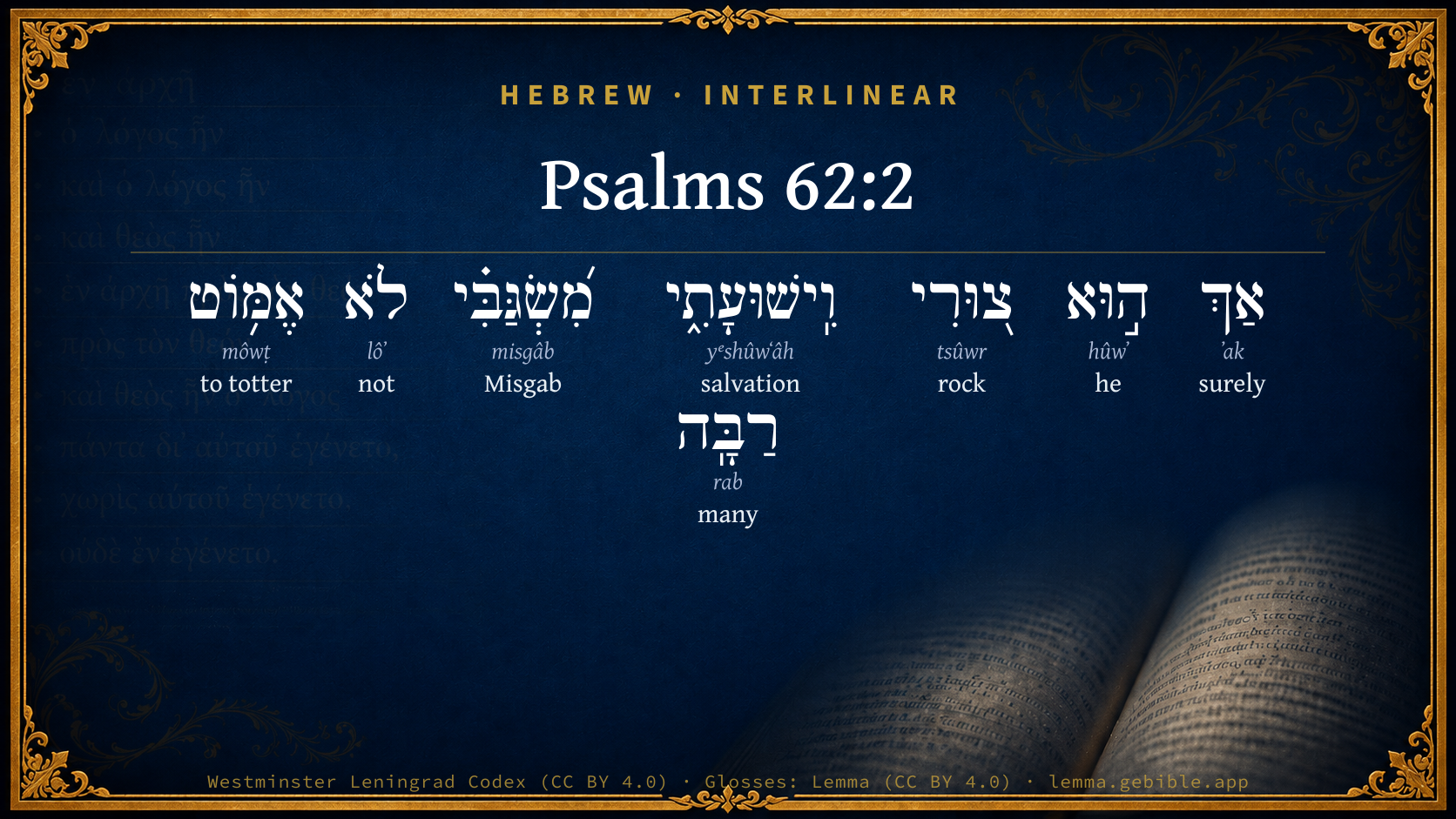
Hebrew (Westminster Leningrad Codex) Psalms 62:2 appears in the Hebrew Old Testament. The text above is from the Westminster Leningrad Codex. Each word links to its Strong’s number, a concise gloss, and parsing drawn from the Open Scriptures Hebrew Bible morphology. Click any word for its full Brown-Driver-Briggs (BDB) entry.
Download image
Cite this verse

Psalms 62:2 (World English Bible). Public Domain. Lemma interlinear Bible study tool, https://lemma.gebible.app/v/psalms/62/2.

Show BibTeX & RIS
BibTeX
RIS
English Translation
He alone is my rock and my salvation, my fortress-- I will never be greatly shaken.
World English Bible · Public Domain
Download a study sheet

One document with this verse’s original text, its word-by-word gloss line, the meaning frame, cross-references with their text, attributed commentary, and full source and license credits — printable, and it pastes into notes with its structure intact.

This verse Autodidact and up

Study sheet (.html) Plain text (.txt)

A passage Seminary Student

Up to 50 verses in one chapter. A passage sheet keeps up to 6 commentary sources and 12 cross-references per verse, in the order this page ranks them, and says so on the sheet whenever that leaves anything out. Ask for a single verse and you get the Autodidact verse sheet above.

Everything on this page stays free to read, with no account — the sheet is a download of what is already on screen, not access to it.

Want to remove ads? Support Godless Engineer
Compare translations 3

The same verse in 3 English versions, stacked beneath the original-language interlinear above. Click any original word for its lexicon entry.

Each is an independent rendering of the whole verse — the interlinear is not word-aligned to these translations.

Highlighted words mark where these versions differ — a whole-verse word diff, not a word-by-word alignment.

  • World English Bible Public Domain
    He alone is my rock and my salvation, my fortress-- I will never be greatly shaken.
  • King James Version Public Domain
    He only is my rock and my salvation; he is my defence; I shall not be greatly moved.
  • unfoldingWord Literal Text CC BY-SA 4.0
    He alone my rock and my salvation, my stronghold. I will not be greatly shaken.

unfoldingWord Literal Text — © unfoldingWord, licensed CC BY-SA 4.0. Word-aligned USFM3 via Door43 (git.door43.org/unfoldingWord/en_ult).

Versions to compare (up to 4)

3 of 4 selected

Show all 18 translations

Every available English version of this verse, each an independent rendering of the whole verse.

  • World English Bible Public Domain
    He alone is my rock and my salvation, my fortress-- I will never be greatly shaken.
  • Berean Standard Bible Public Domain
    He alone is my rock and my salvation. He is my fortress; I will never be shaken.
  • Majority Standard Bible Public Domain
    He alone is my rock and my salvation. He is my fortress; I will never be shaken.
  • King James Version Public Domain
    He only is my rock and my salvation; he is my defence; I shall not be greatly moved.
  • American Standard Version (1901) Public Domain
    He only is my rock and my salvation: `He is' my high tower; I shall not be greatly moved.
  • Revised Version (1885) Public Domain
    He only is my rock and my salvation: he is my high tower; I shall not be greatly moved.
  • Geneva Bible (1599) Public Domain
    Yet he is my strength and my saluation, and my defence: therefore I shall not much be mooued.
  • Douay-Rheims (1899) Public Domain
    Shall not my soul be subject to God? for from him is my salvation.
  • Young's Literal Translation Public Domain
    Only -- He `is' my rock, and my salvation, My tower, I am not much moved.
  • Literal Standard Version CC BY-SA 4.0
    He alone [is] my rock, and my salvation, || My tower, I am not much moved.
  • Unlocked Literal Bible CC BY-SA 4.0
    He alone is my rock and my salvation; he is my high tower; I will not be greatly moved.
  • unfoldingWord Literal Text CC BY-SA 4.0
    He alone my rock and my salvation, my stronghold. I will not be greatly shaken.
  • Darby Bible Public Domain
    He only is my rock and my salvation; my high fortress: I shall not be greatly moved.
  • World Messianic Bible Public Domain
    He alone is my rock, my salvation, and my fortress. I will never be greatly shaken.
  • Webster's Bible Public Domain
    \\62:1\\To the chief Musician, to Jeduthun, A Psalm of David. Truly my soul waiteth upon God: from him cometh my salvation.
  • Free Bible Version CC BY-SA 4.0
    He is the one who protects me and saves me; he keeps me safe so I will never be in danger.
  • Bible in Basic English Public Domain
    He only is my Rock and my salvation; he is my high tower; I will not be greatly moved.
  • JPS Tanakh (1917) Public Domain
    (62-3) He only is my rock and my salvation, my high tower, I shall not be greatly moved.

Literal Standard Version (2020), Covenant Press — licensed CC BY-SA 4.0. Text via the HelloAO Bible API (eBible.org). Unlocked Literal Bible (unfoldingWord) — licensed CC BY-SA 4.0. Text via the HelloAO Bible API (eBible.org). unfoldingWord Literal Text — © unfoldingWord, licensed CC BY-SA 4.0. Word-aligned USFM3 via Door43 (git.door43.org/unfoldingWord/en_ult). Free Bible Version, Dr. Jonathan Gallagher — licensed CC BY-SA 4.0. Text via the HelloAO Bible API (eBible.org).

Word by word

More ways to search: Search by grammar → Find every occurrence → Compare this word →

Practice this passage: Drill this verse → Learn its vocabulary →

מִ֝שְׂגַּבִּ֗י
misgâb
H4869
“Misgab · my”
Noun, Common, Masculine, Singular, Construct + Suffix, Personal, 1st Person, Common, Singular
Part of Speech
Noun
Type
Common
Gender
Masculine
Number
Singular
State
Construct
Full BDB Definition

Origin: from H7682

TWOT: 2234a

Misgab = "height" - high place, refuge, secure height, retreat (noun masculine) - stronghold - refuge (of God) - a place in Moab (noun proper locative)
  1. אַךְ ʼak H389 “surely” Particle, Accusative
  2. ה֣וּא hûwʼ H1931 “he” Pronoun, Personal, 3rd Person, Masculine, Singular
  3. צ֭וּרִי tsûwr H6697 “rock · my” Noun, Common, Masculine, Singular, Construct + Suffix, Personal, 1st Person, Common, Singular
  4. וִֽישׁוּעָתִ֑י yᵉshûwʻâh H3444 “and · salvation · my” Conjunction + Noun, Common, Feminine, Singular, Construct + Suffix, Personal, 1st Person, Common, Singular
  5. לֹא lôʼ H3808 “not” Particle, Negative
  6. אֶמּ֥וֹט môwṭ H4131 “to totter” Verb, Niphal, Imperfect, 1st Person, Common, Singular
  7. רַבָּֽה rab H7227 “many” Adjective, Adjective, Feminine, Singular, Absolute

About this verse

These counts appear in no published source. They are computed here, from the morphology-tagged text and Lemma’s own curated glosses. What Lemma adds →

8
words
8
distinct lemmas
Wisdom
section

Notable vocabulary

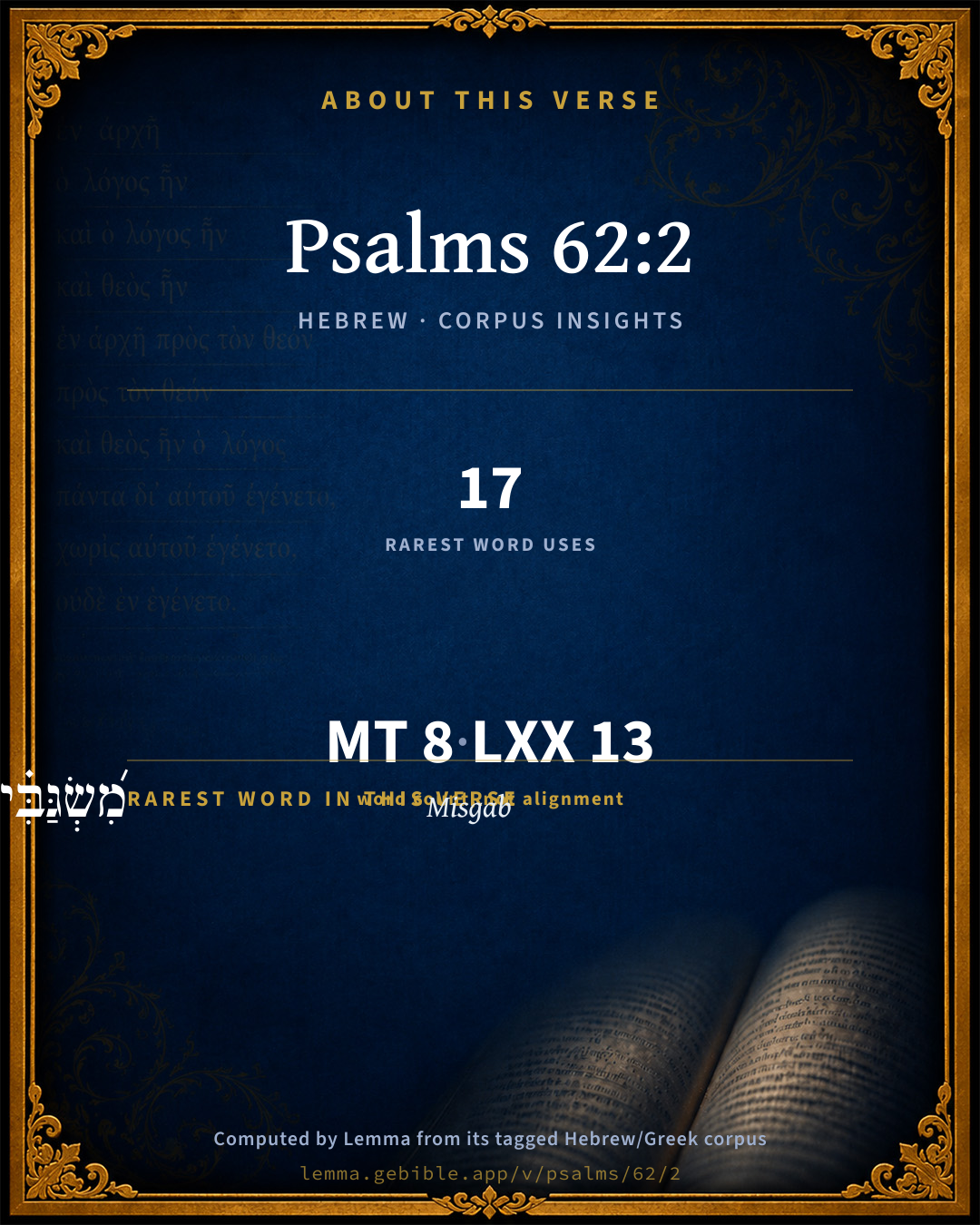
The rarest word here is מִ֝שְׂגַּבִּ֗י Misgab H4869 — appearing just 17 times in the whole Hebrew Bible.

Shared distinctive vocabulary

מִ֝שְׂגַּבִּ֗י Misgab H4869 occurs in 16 verses of the Hebrew Bible. Also found in:

Grammatical profile

  • 1 verb
  • 3 nouns
  • 1 adjective
  • 1 pronoun
  • 2 particles

Verb forms

  • אֶמּ֥וֹט Niphal · Imperfect

Hebrew & Septuagint length

In English translation the verse runs 16 words from the Hebrew and 17 from the Septuagint (LXX English) — closely comparable.

A rough comparison of the two English renderings, which tokenize alike — not a word-level alignment.

Word counts can differ between the Hebrew and the Greek without any difference in meaning — e.g. the Hebrew direct-object marker אֵת has no separate Greek word, and Greek often adds the article ὁ.

In the original languages it is 8 Hebrew tokens and 13 Greek tokens — but the two are counted differently (Hebrew bundles its prefixes and suffixes into one token; the Greek is in lemma form), so that isn’t a like-for-like length.

Cross-references

15

Topical passages linked to Psalms 62:2 in the Treasury of Scripture Knowledge — connected by theme and wording, ordered by reader-vote popularity; previews shown in the World English Bible.

  • Psalms 18:2 Yahweh is my rock, my fortress, and my deliverer; My God, my rock, in whom I take refuge; My shield, and the horn of my salvation, my high tower.
  • 2 Corinthians 4:8–9 We are pressed on every side, yet not crushed; perplexed, yet not to despair;
  • Psalms 62:6 He alone is my rock and my salvation, my fortress. I will not be shaken.
  • Isaiah 26:4 Trust in Yahweh forever; for in Yah, Yahweh, is an everlasting Rock.
  • Psalms 89:26 He will call to me, 'You are my Father, My God, and the rock of my salvation!'
  • Isaiah 32:2 A man shall be as a hiding-place from the wind, and a covert from the tempest, as streams of water in a dry place, as the shade of a great rock in a weary land.
  • Psalms 27:1 Yahweh is my light and my salvation. Whom shall I fear? Yahweh is the strength of my life. Of whom shall I be afraid?
  • Psalms 73:25–26 Who do I have in heaven? There is no one on earth who I desire besides you.
  • Psalms 37:24 Though he stumble, he shall not fall, For Yahweh holds him up with his hand.
  • Psalms 59:9 Oh, my Strength, I watch for you, For God is my high tower.
  • Psalms 59:17 To you, my strength, I will sing praises. For God is my high tower, the God of my mercy.
  • Deuteronomy 32:30–31 How should one chase a thousand, Two put ten thousand to flight, Except their Rock had sold them, Yahweh had delivered them up?
  • Psalms 21:1 The king rejoices in your strength, Yahweh! How greatly he rejoices in your salvation!
  • 1 Corinthians 10:13 No temptation has taken you except what is common to man. God is faithful, who will not allow you to be tempted above what you are able, but will with the temptation also make the way of escape, that you may be able to endure it.
  • Micah 7:8–9 Don't rejoice against me, my enemy. When I fall, I will arise. When I sit in darkness, Yahweh will be a light to me.

Cross-references courtesy of OpenBible.info (CC BY 4.0).

Hebrew and Greek witnesses Masoretic Hebrew ↔ Greek Septuagint

The same verse in the two great witnesses to the Old Testament, shown verse-for-verse.

You’re reading Greek Psalm 61 (Hebrew Psalm 62). The Septuagint counts the superscription, so verse numbers can differ from the Hebrew — chapter-level alignment, not verse-by-verse. Numbering follows Rahlfs.

These are two independent witnesses, not word-aligned to each other, and the Septuagint is shown in lemma (dictionary) form.

Hebrew Psalms 62:2 Masoretic · Westminster Leningrad Codex

אַךְ ה֣וּא צ֭וּרִי וִֽישׁוּעָתִ֑י מִ֝שְׂגַּבִּ֗י לֹא אֶמּ֥וֹט רַבָּֽה

He alone is my rock and my salvation, my fortress-- I will never be greatly shaken.

World English Bible · Public Domain

Greek LXX Greek Psalm 61:2 Septuagint · lemma form

οὐ ὁ θεός ὑποτάσσω ὁ ψυχή ἐγώ παρά αὐτός γάρ ὁ σωτήριον ἐγώ

For he is my God, and my savior; my helper, I shall not be moved very much.

LXX2012 (modern English Septuagint) · Public Domain

Hebrew: Westminster Leningrad Codex (CC BY 4.0). Greek: Septuagint (public domain); English from LXX2012 (modern English Septuagint) (Public Domain). How the Septuagint differs from the Hebrew →

Commentary

Notes on Psalms 62:2 from classic Christian and Jewish commentators (each source and its license shown beneath its notes). The classic Christian expositions comment on the surrounding passage and are grouped to its opening verse, so a note may address several verses; the Jewish commentaries on the Tanakh (Rashi and others) are per-verse, so they appear only where the commentator wrote on this verse.

Lemma curates 59 commentaries, every one of them public domain or Creative Commons licensed, each selected and text-cleaned for this edition rather than reprinted as found. About our sources →

Trapp's Complete Commentary

John Trapp

Psa 62:2 He only [is] my rock and my salvation; [he is] my defence; I shall not be greatly moved.

Ver. 2. He only is my rock, &c.] See Psa 18:2-3.

I shall not be greatly moved] Non labascam multo lapsu (Vatabl.), for the Lord putteth under his hand. I shall not be moved greatly, or into the great abyss, Tehom Rabi bah (as Aben Ezra hath it), into hell (as other Rabbis sense it); I shall not be tempted above that I am able, as 1Co 10:13; persecuted I may be, but not relinquished; cast down, but not cast off, 2Co 4:9 : shaken, but for my better settlement at last.

John Trapp, A Commentary or Exposition upon All the Books of the Old and New Testament (1647–1656) — public domain. Text from a community e-Sword module.

The Biblical Illustrator

Joseph S. Exell

Psa_62:2

He only is my rock and my salvation.

God alone the salvation of His people

My rock! What a history the rock might give you of the storms to which it has been exposed; of the tempests which have raged in the ocean at its base, and of the thunders which have disturbed the skies above its head; while it, itself, has stood unscathed by tempests, and unmoved by the bufetings of storms. So with our God. The rock is immutable; nought hath been worn from it. Yon old granite peak hath gleamed in the sun, or worn the white veil of winter snow--it hath sometimes worshipped God with bare, uncovered head, and at other times the clouds furnished it with veiling wings, that, like a cherub, it might adore its Maker; but yet itself hath stood unchanged. The frosts of winter have not destroyed it, nor have the heats of summer melted it. It is the same with God. The ten thousand uses of the rock, moreover, are full of ideas as to what God is. You see the fortress standing on a high rock, up which the clouds themselves can scarcely climb, and up whose precipices the assault cannot be carried, and the armed cannot travel, for the besieged laugh at them from their eminence. So is our God a sure defence; and we shall not be moved if He hath set our feet upon a rock, and established our goings. Many a giant rock is a source of admiration from its elevation; for on its summit we can see the world outspread below, like some small map; we mark the river or broadly spreading stream, as if it were a vein of silver inlaid in emerald. We discover the nations beneath our feet, like drops in a bucket, and the islands are very little things in the distance, while the sea itself seems but a basin of water, held in the hand of a mighty giant. The mighty God is such a rock; we stand on Him, and look down on the world, counting it to be a mean thing. We shall notice--

I. The great doctrine, that God only is our salvation.

II. The great experience, to know and to learn that He only is my rock and my salvation; and--

III. The great duty, which you may guess at, which is, to give all the glory and all the honour, and place all our faith on Him who only is our rock and our salvation. I must tell you a singular story, which was related at our Church meeting, because there may be some very poor people here, who may understand the way of salvation by it. One of the friends had been to see a person who was about to join the Church; and he said to him, Can you tell me what you would say to a poor sinner who came to ask you the way of salvation? Well, said he, I do not know--I think I can hardly tell you; but it so happened that a case of this sort did occur yesterday. A poor woman came into my shop, and I told her the way; but it was in such a homely manner that I dont like to tell you. Oh, yes, tell me; I should like to hear it. Well, she is a poor woman, who is always pawning her things, and by and by she redeems them again. I did not know how to tell her better than this. I said to her, Look here; your soul is in pawn to the devil; Christ has paid the redemption money; you take faith for your ticket, and so you will get your soul out of pawn. Now, that was the most simple, but the most excellent way of imparting a knowledge of salvation to this woman. (C. H. Spurgeon.)

The Rock confers immovability to the believer

In the old classic story Hercules the giant challenged the whole world to produce a man who could wrestle with him and come off victor. There stepped forward a man of feeble build and almost dwarfish stature. Hercules disdainfully advanced and, lightly closing with this weak-looking fellow, put forth just a little of his strength, but the little man held his feet. Hercules, wondering at this, grappled with the unpromising wrestler, and put forth every atom of his strength to fling him. But, instead of being hurled to the ground, the strangers feet are immovable, and he still stands. At last, strength gone, amid the laughter and jeers of the crowd over their broken idol, Hercules slunk away, completely beaten, utterly humiliated. That night a traitor friend of the dwarfs visited the tent of the discomfited giant and whispered, Gold! Gold, and I will tell you why you could not win to-day, but why you can to-morrow. The man you are wrestling with to-day is Antaeus, the son of Earth. While his feet touch the ground all the strength of his mother earth passes into him, and he cannot be thrown. But only sever his connection with the ground by a hairs breadth and you have him. Next day the crowds gathered vaster than ever to witness Hercules defeat again. Antaeus is there, too little suspecting that his secret is betrayed. The giant advances to his opponent, and, before the dwarf is aware, with a sudden spring lifts him off the ground, and in a moment has his knee on his breast. Oh, take hold of the strength of God. Keep your feet on the Rock of ages. While you do so you are invincible. (J. Robertson.)

The Biblical Illustrator, edited by Joseph S. Exell (c. 1880s–1900s) — public domain. Text from a community e-Sword module.

Joseph Benson's Commentary

Psa 62:2. He only is my rock — He hath been so often; in him I have found shelter, and strength, and succour; he hath, by his grace, supported me under, and delivered me out of my troubles, and by his providence he has defended me from my enemies, and therefore I trust he will still support, deliver, and defend me. I shall not be greatly moved — Though I may be shaken, I shall not be overthrown.

Joseph Benson's Commentary on the Old and New Testaments (1811–1818) — public domain. Text from a community e-Sword module.

J. A. Alexander on Psalms

Joseph Addison Alexander

3. (Psa 62:2). Only He (is) my rock and my salvation, my height (high place,refuge, or asylum); I shall not be shaken (moved from my firm position) much (or greatly). The adverbial use of much is the same in Hebrew and in English. This qualified expression seems to be intended to suggest, that he does not hope to escape all disaster and calamity, but only such as would be ruinous. See above, on Psa 37:24. As to the figures in the first clause, see above, on Psa 9:9. He only, God and no one else, can be such a protector.

Joseph Addison Alexander, The Psalms Translated and Explained (1850) — public domain. Text from a community e-Sword module.

Geneva Bible (1599)

Geneva Bible translators

It appeareth by the oft repetition of this word, that the Prophet abode manifold tentations, but by resting on God, and by patience he overcame them all.

Geneva Bible (1599) marginal notes — public domain. Text via Bolls.life.

Jamieson, Fausset & Brown

Robert Jamieson, A. R. Fausset & David Brown

The titles applied to God often occur (Psa 9:9; Psa 18:2).

be greatly moved-- (Psa 10:6). No injury shall be permanent, though devised by enemies.

Jamieson, Fausset & Brown — Commentary Critical and Explanatory on the Whole Bible (1871) — public domain (CC PDM 1.0). Text via the HelloAO Bible API.

Adam Clarke's Commentary

Verse 2. I shall not be greatly moved.] Having God for my rock - strong fortified place, for my salvation - continual safety, and my defence - my elevated tower, which places me out of the reach of my enemies; I shall not be greatly moved - I may be shaken, but cannot be cast down.

Adam Clarke's Commentary on the Bible (1810–1826) — public domain. Text from a community e-Sword/MySword module.

John Calvin's Commentaries

The particle אך, ach, in the second verse, I would render in the same way as in the first. The believer triumphs in one encounter with temptation only to enter upon another; and here David, who appeared to have emerged from his distress, shows that he had still to struggle with remaining difficulties. We meet with the same particle no fewer than six times throughout the psalm. This, too, may explain the many titles which he applies to God, each of which is to be considered as a foil by which he would ward off the attacks of the tempter. The expression in the close of the verse, I shall not be greatly moved, implies his persuasion that he might be overtaken with afflictions, (for he was well aware that he could claim no exemption from the common lot of humanity,) but his conviction, at the same time, that these would not overwhelm him, through the good help of God. We shall find him saying afterwards, in so many words, I shall not fall; perhaps because he felt, as he advanced in prayer, that he had greater boldness in despising affliction. Or the expressions may be taken as synonymous in the two places. The truth itself is unquestionable. The believer may be overthrown for a time; but as he is no sooner cast down than he is raised up again by God, he cannot properly be said to fall. He is supported by the Spirit of God, and is not therefore really prostrated and overcome.

John Calvin's Commentaries (1540-1563) — public domain. Text from the Calvin Translation Society English edition (1840s-50s) via the Christian Classics Ethereal Library (ccel.org). Calvin's coverage is partial (roughly two-thirds of the Bible); uncommented books and verses are honest gaps, never fabricated. The 19th-century editor's footnotes and remarks are omitted so the notes are faithfully Calvin's own voice.

Ellicott's Commentary for English Readers

(2) Defence.—Properly, high tower, as so often. The metaphor is important here from the contrast with the tottering wall of next verse.

Shall not be greatly moved . . .—i.e. (as in Psa_37:24), shall not be made to totter or fall.

A Bible Commentary for English Readers, edited by Charles John Ellicott (1878–1897) — public domain. Text from a community e-Sword module.

The Cambridge Bible for Schools and Colleges

gen. ed. J. J. S. Perowne

2. The same titles my rock, my salvation, my high tower, are combined in Psa_18:2. The title Rock is frequently used to symbolise the strength, faithfulness, and unchangeableness of Jehovah: here (cp. Psa_61:7) with the special thought of an asylum in danger.

I shall not be greatly moved] In other words, “though he may fall he shall not lie prostrate” (Psa_37:24; cp. Pro_24:16).

The Cambridge Bible for Schools and Colleges (gen. ed. J. J. S. Perowne; Cambridge University Press, 1878–1918) — public domain. Text from a community e-Sword module.

John Gill's Exposition

He only is my Rock and my salvation,.... The Rock on which the church is built, and every believer; and which was David's safety, shelter, and shade, and which made him easy in his present state; and he was the author of his salvation, and the rock and strength of it, Psa 95:1;

he is my defence; or refuge; see Psa 9:9;

I shall not be greatly moved; or "with much motion", as Kimchi; or "with great motions", as Jarchi: he could not be moved off of the rock on which he was built; nor out of the city of refuge, whither he had betook himself for safety; and though he might be troubled in spirit, and shaken in mind, and staggered in his faith, and fall from some degree of steadfastness of it; yet not fall so as to be utterly cast down, or finally and totally, and so as to perish eternally. Aben Ezra interprets it, "shall not be moved" into the great deep; into the abyss or bottomless pit; and so some of the ancient Midrashes expound of "hell" (g); but much better is the Targum,

"I shall not be moved in a day of great affliction;''

see Act 20:23.

(g) Vid. Jarchi & Yalkut Simeoni in loc.

John Gill's Exposition of the Whole Bible (1746–1763) — public domain (CC PDM 1.0). Text via the HelloAO Bible API.

Albert Barnes' Notes on the Bible

He only is my rock ... - See the notes at Psa 18:2.

I shall not be greatly moved - The word greatly here, or much - “I shall not be much moved,” implies that he did not anticipate perfect security from danger or calamity; he did not suppose that he would escape all disaster or trouble, but he felt that no great evil would befall him, that his most important interests were safe, and that he would be ultimately secure. He would be restored to his home and his throne, and would be favored with future peace and tranquility. None of us can hope wholly to escape calamity in this life. It is enough if we can be assured that our great interests will be ultimately secured; that we shall be safe at last in the heavenly world. Having that confidence the soul may be, and should be, calm; and we need little apprehend what will occur in this world.

Albert Barnes' Notes on the Bible (1834–1885) — public domain. Text from a community e-Sword/MySword module.

Matthew Poole's English Annotations

Though I may be shaken, yet I shall not be overthrown. Compare Psa 37:24; 2Co 4:9.

Matthew Poole's English Annotations on the Holy Bible (1683–1685) — public domain. Text from a community e-Sword/MySword module.

The Treasury of David

Charles H. Spurgeon

Ver. 2. He only is my rock and my salvation. Sometimes a metaphor may be more full of meaning and more suggestive than literal speech: hence the use of the figure of a rock, the very mention of which would awaken grateful memories in the psalmists's mind. David had often lain concealed in rocky caverns, and here he compares his God to such a secure refuge; and, indeed, declares him to be his only real protection, all-sufficient in himself and never failing. At the same time, as if to show us that what he wrote was not mere poetic sentiment but blessed reality, the literal word salvation follows the figurative expression: that our God is our refuge is no fiction, nothing in the world is more a matter of fact.

He is my defence, my height, my lofty rampart, my high fort. Here we have another and bolder image; the tried believer not only abides in God as in a cavernous rock; but dwells in him as a warrior in some bravely defiant tower or lordly castle.

I shall not be greatly moved. His personal weakness might cause him to be somewhat moved; but his faith would come in to prevent any very great disturbance; not much would he be tossed about. Moved, as one says, "but not removed." Moved like a ship at anchor which swings with the tide, but is not swept away by the tempest. When a man knows assuredly that the Lord is his salvation, he cannot be very much cast down: it would need more than all the devils in hell greatly to alarm a heart which knows God to be its salvation.

Ver. 2. I shall not be greatly moved. Grace makes the heart move leisurely to all things except God. A mortified man is as a sea that hath no winds, that ebbs not and flows not. The mortified man sings and is not light, and weeps and is not sad, is zealous but he can quit it for God. Ah! few can act but they over act. Alexander Carmichael, in "The Believer's Mortification of Sin, " 1677.

Ver. 2. God a rock. David speaks of him as high and strong, and as a rock to stand upon, a rock of defence and refuge, a rock of habitation (Ps 71:3, in Hebrew), and a rock to be praised. Ps 95:1. See the Concordance for many hints.

"Christ the Rock:" a Sermon on 1Co 10:4. By RALPH ROBINSON, in "Christ All and in All."

Ver. 2. (first clause). See "SPURGEON'S Sermons", No. 80, "God alone the Salvation of His People."

Ver. 2,6. I shall not be greatly moved. I shall not be moved. Growth in faith. How it is produced, preserved, and evidenced.

Psalms 62:3*

Ver. 2,6. I shall not be greatly moved. I shall not be moved. Growth in faith. How it is produced, preserved, and evidenced.

Psalms 62:7*

Charles H. Spurgeon's The Treasury of David (1869–1885) — public domain. Psalms only. Text from a community e-Sword/MySword module.

Whedon's Commentary on the Bible

Daniel D. Whedon

2. My rock—See on Psa_61:1.

My defence—My high place, an allusion to the high, rocky fortress, as 2Sa_5:6-9, the strongest defence known to ancient military life.

Greatly moved—The insurrection will disturb, and for the time disarrange, many surface elements, but will not overthrow or unsettle my kingdom. Thus far he had received answer to prayer.

Daniel D. Whedon (gen. ed.), Commentary on the Old and New Testaments (1874–1909) — public domain. Text from a community e-Sword module.

The Pulpit Commentary

He only is my Rock. (comp. Psa_61:2, and the comment ad loc.) And my Salvation. (so Psa_18:2 Psa_27:1 Psa_118:14, Psa_118:21) He is my Defence; or, my High Tower, my Strong Hold. I shall not be greatly moved. Comp. ver. 6, where, with still greater confidence, the waiter declares, "I shall not be moved," i.e. not moved, or shaken in my faith, at all.

The Pulpit Commentary (1880–1919), ed. H.D.M. Spence-Jones & Joseph S. Exell — public domain. Text from a community e-Sword module.

Rashi

Rabbi Shlomo Yitzchaki (Rashi)

does my soul hope Heb. דומיה. My soul hopes, as (above 37:7): “Wait (דום) for the Lord and hope for Him.”

Rashi on the Tanakh — English translations: “The Judaica Press complete Tanach with Rashi, translated by A. J. Rosenberg” (CC BY 4.0); “Pentateuch with Rashi's commentary by M. Rosenbaum and A.M. Silbermann, 1929-1934” (public domain); “The Metsudah Tanach series, Lakewood, N.J” (CC BY 4.0); and “The Book of Joshua, Metsudah Publications, 1997” (CC BY 4.0). Text via Sefaria.

Lesson kit

Teaching starters — assembled from the data on this page, not authored interpretation. Every prompt links to the verse data it draws on. Edit before teaching.

Psalms, in the Wisdom, opens this verse with 8 words (8 distinct Hebrew lemmas). Its most distinctive word is misgâb (“Misgab”). A historical commentator’s framing appears above. Read the whole chapter for the surrounding context.

Discussion questions

  1. What does “Misgab” (misgâb) contribute to the verse as a whole?
  2. 2 Samuel 22:3 shares the word «Misgab» with this verse. How do the two illuminate each other?
  3. These translations render this verse differently. What is at stake in choosing one wording over another?
  4. The verb «אֶמּ֥וֹט» is Niphal Imperfect. How does its form color the action?
  5. Reading how Trapp's Complete Commentary and The Biblical Illustrator read this verse, where do the two commentators agree and where do they part?

Things to notice

Reading settings

Reading text

Shown beneath each verse's original-language words.

Old Testament
Old Testament edition

Read the OT as the Masoretic Hebrew (MT) or the Greek Septuagint (LXX).

English shown for the Greek Septuagint (in the Hebrew ↔ Greek comparison).

Comparing translations? Open the Compare panel on any verse page to stack up to four side by side.