

Psalms 41:3

Hebrew (Westminster Leningrad Codex) Psalms 41:3 appears in the Hebrew Old Testament. The text above is from the Westminster Leningrad Codex. Each word links to its Strong’s number, a concise gloss, and parsing drawn from the Open Scriptures Hebrew Bible morphology. Click any word for its full Brown-Driver-Briggs (BDB) entry.
Download image
Cite this verse

Psalms 41:3 (World English Bible). Public Domain. Lemma interlinear Bible study tool, https://lemma.gebible.app/v/psalms/41/3.

Show BibTeX & RIS
BibTeX
RIS
English Translation
Yahweh will sustain him on his sickbed, And restore him from his bed of illness.
World English Bible · Public Domain
Download a study sheet

One document with this verse’s original text, its word-by-word gloss line, the meaning frame, cross-references with their text, attributed commentary, and full source and license credits — printable, and it pastes into notes with its structure intact.

This verse Autodidact and up

Study sheet (.html) Plain text (.txt)

A passage Seminary Student

Up to 50 verses in one chapter. A passage sheet keeps up to 6 commentary sources and 12 cross-references per verse, in the order this page ranks them, and says so on the sheet whenever that leaves anything out. Ask for a single verse and you get the Autodidact verse sheet above.

Everything on this page stays free to read, with no account — the sheet is a download of what is already on screen, not access to it.

Want to remove ads? Support Godless Engineer
Compare translations 3

The same verse in 3 English versions, stacked beneath the original-language interlinear above. Click any original word for its lexicon entry.

Each is an independent rendering of the whole verse — the interlinear is not word-aligned to these translations.

Highlighted words mark where these versions differ — a whole-verse word diff, not a word-by-word alignment.

  • World English Bible Public Domain
    Yahweh will sustain him on his sickbed, And restore him from his bed of illness.
  • King James Version Public Domain
    The LORD will strengthen him upon the bed of languishing: thou wilt make all his bed in his sickness.
  • unfoldingWord Literal Text CC BY-SA 4.0
    Yahweh will support him on the bed of suffering; you transformed each bed of his in his sickness.

unfoldingWord Literal Text — © unfoldingWord, licensed CC BY-SA 4.0. Word-aligned USFM3 via Door43 (git.door43.org/unfoldingWord/en_ult).

Versions to compare (up to 4)

3 of 4 selected

Show all 18 translations

Every available English version of this verse, each an independent rendering of the whole verse.

  • World English Bible Public Domain
    Yahweh will sustain him on his sickbed, And restore him from his bed of illness.
  • Berean Standard Bible Public Domain
    The LORD will sustain him on his bed of illness and restore him from his bed of sickness.
  • Majority Standard Bible Public Domain
    The LORD will sustain him on his bed of illness and restore him from his bed of sickness.
  • King James Version Public Domain
    The LORD will strengthen him upon the bed of languishing: thou wilt make all his bed in his sickness.
  • American Standard Version (1901) Public Domain
    Jehovah will support him upon the couch of languishing: Thou makest all his bed in his sickness.
  • Revised Version (1885) Public Domain
    The LORD will support him upon the couch of languishing: thou makest all his bed in his sickness.
  • Geneva Bible (1599) Public Domain
    The Lord wil strengthen him vpon ye bed of sorow: thou hast turned al his bed in his sicknes.
  • Douay-Rheims (1899) Public Domain
    The Lord preserve him and give him life, and make him blessed upon the earth: and deliver him not up to the will of his enemies.
  • Young's Literal Translation Public Domain
    Jehovah supporteth on a couch of sickness, All his bed Thou hast turned in his weakness.
  • Literal Standard Version CC BY-SA 4.0
    YHWH supports [him] on a bed of sickness, || You have turned his bed in his weakness.
  • Unlocked Literal Bible CC BY-SA 4.0
    Yahweh will support him on the bed of suffering; you will make his bed of sickness into a bed of healing.
  • unfoldingWord Literal Text CC BY-SA 4.0
    Yahweh will support him on the bed of suffering; you transformed each bed of his in his sickness.
  • Darby Bible Public Domain
    Jehovah will sustain him upon the bed of languishing: thou turnest all his bed in his sickness.
  • World Messianic Bible Public Domain
    The LORD will sustain him on his sickbed, and restore him from his bed of illness.
  • Webster's Bible Public Domain
    \\41:2\\The LORD will preserve him, and keep him alive; and he shall be blessed upon the earth: and thou wilt not deliver him to the will of his enemies.
  • Free Bible Version CC BY-SA 4.0
    The Lord looks after them when they're sick; he makes them well from their illness.
  • Bible in Basic English Public Domain
    The Lord will be his support on his bed of pain: by you will all his grief be turned to strength.
  • JPS Tanakh (1917) Public Domain
    (41-4) The LORD support him upon the bed of illness; mayest Thou turn all his lying down in his sickness.

Literal Standard Version (2020), Covenant Press — licensed CC BY-SA 4.0. Text via the HelloAO Bible API (eBible.org). Unlocked Literal Bible (unfoldingWord) — licensed CC BY-SA 4.0. Text via the HelloAO Bible API (eBible.org). unfoldingWord Literal Text — © unfoldingWord, licensed CC BY-SA 4.0. Word-aligned USFM3 via Door43 (git.door43.org/unfoldingWord/en_ult). Free Bible Version, Dr. Jonathan Gallagher — licensed CC BY-SA 4.0. Text via the HelloAO Bible API (eBible.org).

Word by word

More ways to search: Search by grammar → Find every occurrence → Compare this word →

Practice this passage: Drill this verse → Learn its vocabulary →

About this verse

These counts appear in no published source. They are computed here, from the morphology-tagged text and Lemma’s own curated glosses. What Lemma adds →

9
words
9
distinct lemmas
Wisdom
section

Notable vocabulary

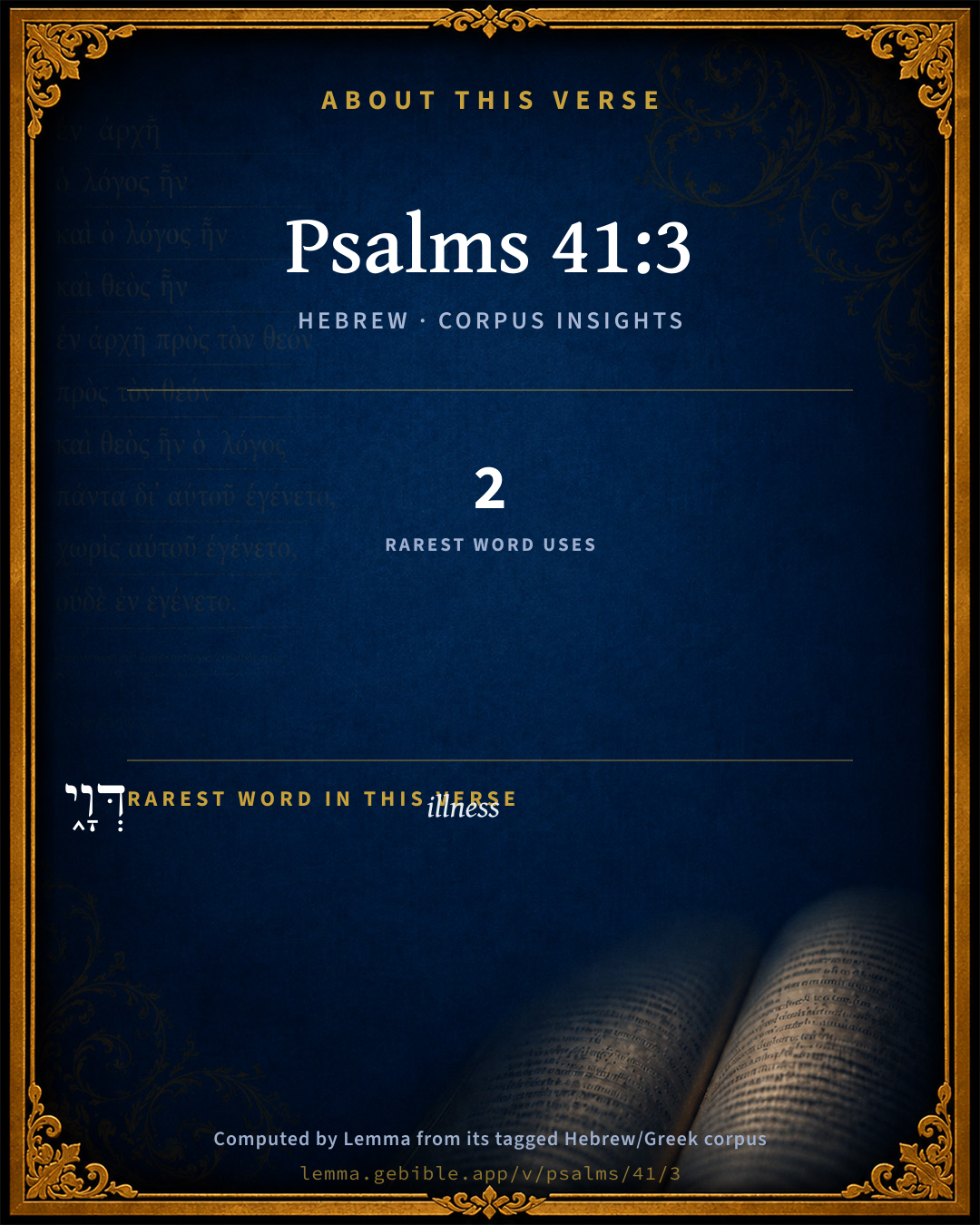
The rarest word here is דְּוָ֑י illness H1741 — appearing just 2 times in the whole Hebrew Bible.

Shared distinctive vocabulary

דְּוָ֑י illness H1741 occurs in 2 verses of the Hebrew Bible. Also found in:

Grammatical profile

  • 2 verbs
  • 6 nouns
  • 1 preposition

Verb forms

  • יִ֭סְעָדֶנּוּ Qal · Imperfect
  • הָפַ֥כְתָּ Qal · Perfect

Hebrew & Septuagint length

In English translation the verse runs 15 words from the Hebrew and 20 from the Septuagint (LXX English) — closely comparable.

A rough comparison of the two English renderings, which tokenize alike — not a word-level alignment.

Word counts can differ between the Hebrew and the Greek without any difference in meaning — e.g. the Hebrew direct-object marker אֵת has no separate Greek word, and Greek often adds the article ὁ.

Cross-references

6

Topical passages linked to Psalms 41:3 in the Treasury of Scripture Knowledge — connected by theme and wording, ordered by reader-vote popularity; previews shown in the World English Bible.

  • 2 Kings 20:5–6 Turn back, and tell Hezekiah the prince of my people, Thus says Yahweh, the God of David your father, I have heard your prayer, I have seen your tears: behold, I will heal you; on the third day you shall go up to the house of Yahweh.
  • Psalms 73:26 My flesh and my heart fails, But God is the strength of my heart and my portion forever.
  • Philippians 2:26–27 since he longed for you all, and was very troubled, because you had heard that he was sick.
  • 2 Corinthians 4:16–17 Therefore we don't faint, but though our outward man is decaying, yet our inward man is renewed day by day.
  • 2 Kings 1:16 He said to him, Thus says Yahweh, Because you have sent messengers to inquire of Baal Zebub, the god of Ekron, is it because there is no God in Israel to inquire of his word? therefore you shall not come down from the bed where you are gone up, but shall surely die.
  • 2 Kings 1:6 They said to him, There came up a man to meet us, and said to us, Go, turn again to the king who sent you, and tell him, Thus says Yahweh, Is it because there is no God in Israel, that you send to inquire of Baal Zebub, the god of Ekron? therefore you shall not come down from the bed where you are gone up, but shall surely die.

Cross-references courtesy of OpenBible.info (CC BY 4.0).

Hebrew and Greek witnesses Masoretic Hebrew ↔ Greek Septuagint

The same verse in the two great witnesses to the Old Testament, shown verse-for-verse.

You’re reading Greek Psalm 40 (Hebrew Psalm 41). The Septuagint counts the superscription, so verse numbers can differ from the Hebrew — chapter-level alignment, not verse-by-verse. Numbering follows Rahlfs.

These are two independent witnesses, not word-aligned to each other, and the Septuagint is shown in lemma (dictionary) form.

Hebrew Psalms 41:3 Masoretic · Westminster Leningrad Codex

יְֽהוָ֗ה יִ֭סְעָדֶנּוּ עַל עֶ֣רֶשׂ דְּוָ֑י כָּל מִ֝שְׁכָּב֗וֹ הָפַ֥כְתָּ בְחָלְיֽוֹ

Yahweh will sustain him on his sickbed, And restore him from his bed of illness.

World English Bible · Public Domain

Greek LXX Greek Psalm 40:3 Septuagint · lemma form

κύριος διαφυλάσσω αὐτός καί ζάω αὐτός καί μακαρίζω αὐτός ἐν ὁ γῆ καί μή παραδίδωμι αὐτός εἰς χείρ ἐχθρός αὐτός

May the Lord help him upon the bed of his pain; you have made all his bed in his sickness.

LXX2012 (modern English Septuagint) · Public Domain

On this verse, Albert Barnes' Notes on the Bible discusses the Septuagint’s reading. Read the note in Commentary ↓

Hebrew: Westminster Leningrad Codex (CC BY 4.0). Greek: Septuagint (public domain); English from LXX2012 (modern English Septuagint) (Public Domain). How the Septuagint differs from the Hebrew →

Commentary

Notes on Psalms 41:3 from classic Christian and Jewish commentators (each source and its license shown beneath its notes). The classic Christian expositions comment on the surrounding passage and are grouped to its opening verse, so a note may address several verses; the Jewish commentaries on the Tanakh (Rashi and others) are per-verse, so they appear only where the commentator wrote on this verse.

Lemma curates 59 commentaries, every one of them public domain or Creative Commons licensed, each selected and text-cleaned for this edition rather than reprinted as found. About our sources →

Jamieson, Fausset & Brown

Robert Jamieson, A. R. Fausset & David Brown

The figures of Psa 41:3 are drawn from the acts of a kind nurse.

Jamieson, Fausset & Brown — Commentary Critical and Explanatory on the Whole Bible (1871) — public domain (CC PDM 1.0). Text via the HelloAO Bible API.

Adam Clarke's Commentary

Verse 3. The Lord will strengthen him] Good, benevolent, and merciful as he is, he must also die: but he shall not die as other men; he shall have peculiar consolations, refreshment, and support, while passing through the valley of the shadow of death.

Thou wilt make all his bed] הפכת haphachta, thou hast turned up, tossed, and shaken it; and thou wilt do so to all his bed - thou wilt not leave one uneasy place in it-not one lump, or any unevenness, to prevent him from sleeping. Thou wilt do every thing, consistently with the accomplishment of the great decree, "Unto dust thou shalt return," to give him ease, refreshment, and rest. We may sum up the privileges of the merciful man:

1. He is generally blessed, Ps 41:1.

2. He will be delivered in the time of trouble, Ps 41:1.

3. He will be preserved by a particular providence, Ps 41:2.

4. He shall be kept alive amidst infection and danger, Ps 41:2.

5. He shall be blessed on the earth in his temporal concerns, Ps 41:2.

6. His enemies shall not be able to spoil or destroy him, Ps 41:2.

7. He shall be strengthened on a bed of languishing, to enable him to bear his afflictions, Ps 41:3.

8. He shall have ease, comfort, and support in his last hours, Ps 41:3.

Adam Clarke's Commentary on the Bible (1810–1826) — public domain. Text from a community e-Sword/MySword module.

Trapp's Complete Commentary

John Trapp

Psa 41:3 The LORD will strengthen him upon the bed of languishing: thou wilt make all his bed in his sickness.

Ver. 3. The Lord will strengthen him upon the bed of languishing] Whether through sickness of body, as Isa 38:2, or sorrow of heart; for in such case also men cast themselves upon their beds, 1Ki 21:4. This God, and not the physicians, will do for the sick man, die septimo, on the seventh day, saith R. Solomon, when he is at sickest.

Thou wilt make all his bed] Heb. Thou wilt turn, thou wilt stir up feathers under him, that he may lie at ease; and this by the hand of those poor whom he had considered. Or, Thou wilt turn all his bed, that is, his whole body, from sickness to health, as Kabvenaki senseth it.

John Trapp, A Commentary or Exposition upon All the Books of the Old and New Testament (1647–1656) — public domain. Text from a community e-Sword module.

The Biblical Illustrator

Joseph S. Exell

Psa_41:3

The Lord will strengthen him upon the bed of languishing: Thou wilt make all his bed in his sickness.

Sickness

No one who has not felt the pains of sickness can fully appreciate the blessing of health. The lassitude and sufferings of sickness are hard to bear; and yet it is a wholesome discipline, which all of us greatly need. The design of sickness may be threefold. Sometimes it is sent to punish the wicked (1Sa_5:6). Or to try the patience and constancy of the righteous. Or to show forth Gods glory (Joh_9:3; Joh_11:4).

I. Our duty toward the sick, who may need assistance, Those who are well off in life, can have things arranged to suit themselves. The large and well-ventilated room, the comfortable bed with its clean and wholesome linen, the varied delicacies to suit the morbid appetite, the gentle and unwearied attentions of kindred and friends--all this, and more, money may readily command. But there are many who can have no such alleviation to their suffering. The kind physician comes--may God reward at the last day the many visits of mercy which he makes to the afflicted poor. But he leaves directions that the sick man should be kept quiet. Quiet indeed! He may as well command the mill dam to stop its ceaseless roar, or the hard hailstones not to rattle upon the roof. The minister of God arrives he asks of the welfare of the sick. He prays for his recovery. His petition in such a case is nothing more nor less than asking God to work a miracle in the sufferers behalf, because he must be left in a condition much more likely to make a well man sick, than a sick man well.

II. Think seriously of the time when all will be called to lie down upon the bed of languishing. There will be some morning of your lives, when business will be going on in the shops, and on the streets, but you will be far otherwise engaged. And suppose you that the bed of sickness is a convenient or suitable place to arrange your long-neglected account with God? (A. M. Sadleir.)

The sick man healed

The precise meaning of this verse is questioned, some regarding both clauses as descriptive of tender nursing, which sustains the drooping head and smooths the crumpled bedding, while others, noting that the word rendered bed in the second clause means properly lying down, take that clause as descriptive of turning sickness into convalescence. The latter meaning gives it a more appropriate ending to the strophe, as it leaves the sick man healed, not tossing on a disordered bed, as the other explanation does. Jehovah does not half cure. (A. Maclaren, D. D.)

The Biblical Illustrator, edited by Joseph S. Exell (c. 1880s–1900s) — public domain. Text from a community e-Sword module.

The Treasury of David

Charles H. Spurgeon

Ver. 3. The Lord will strengthen him upon the bed of languishing. The everlasting arms shall stay up his soul as friendly hands and downy pillows stay up the body of the sick. How tender and sympathising is this image; how near it brings our God to our infirmities and sicknesses! Whoever heard this of the old heathen Jove, or of the gods of India or China? This is language peculiar to the God of Israel; he it is who deigns to become nurse and attendant upon good men. If he smites with one hand he sustains with the other. Oh, it is blessed fainting when one falls upon the Lord's own bosom, and is borne up thereby! Grace is the best of restoratives; divine love is the noblest stimulant for a languishing patient; it makes the soul strong as a giant, even when the aching bones are breaking through the skin. No physician like the Lord, no tonic like his promise, no wine like his love. Thou wilt make all his bed in his sickness. What, doth the Lord turn bed maker to his sick children? Herein is love indeed. Who would not consider the poor if such be the promised reward? A bed soon grows hard when the body is weary with tossing to and fro upon it, but grace gives patience, and God's smile gives peace, and the bed is made soft because the man's heart is content; the pillows are downy because the head is peaceful. Note that the Lord will make all his bed, from head to foot. What considerate and indefatigable kindness! Our dear and ever blessed Lord Jesus, though in all respects an inheritor of this promise, for our sakes condescended to forego the blessing, and died on a cross and not upon a bed; yet, even there, he was after awhile upheld and cheered by the Lord his God, so that he died in triumph.

We must not imagine that the benediction pronounced in these three verses belongs to all who casually give money to the poor, or leave it in their wills, or contribute to societies. Such do well, or act from mere custom, as the case may be, but they are not here alluded to. The blessing is for those whose habit it is to love their neighbour as themselves, and who for Christ's sake feed the hungry and clothe the naked. To imagine a man to be a saint who does not consider the poor as he has ability, is to conceive the fruitless fig tree to be acceptable; there will be sharp dealing with many professors on this point in the day when the King cometh in his glory.

Ver. 3. Thou wilt make all his bed in his sickness. Into what minuteness of exquisite and touching tenderness does the Lord condescend to enter! One feels almost as we may suppose Peter felt when the Saviour came to him and would have washed his feet, "Lord! thou shalt never wash my feet; "thou shalt never make my bed. And yet, "If I wash thee not, thou hast no part with me; "if the Lord make not our bed in our sickness, there is no peace nor comfort there. We have had David calling on God to bow down his ear, like a loving mother listening to catch the feeblest whisper of her child; and the image is full of the sweetest sympathy and condescension; but here the Lord, the great God of heaven, he that said when on earth, "I am among you as one that serveth, "does indeed take upon him the form, and is found in fashion as a servant, fulfilling all the loving and tender offices of an assiduous nurse. Barton Bouchier.

Ver. 3. Thou wilt make all his bed in his sickness. The meaning rather is, "it is no longer a sick bed, for thou hast healed him of his disease." J. J. Stewart Perowne.

Ver. 3. When a good man is ill at ease, God promises to make all his bed in his sickness. Pillow, bolster, head, feet, sides, all his bed. Surely that God who made him knows so well his measure and temper as to make his bed to please him. Herein his art is excellent, not fitting the bed to the person, but the person to the bed; infusing patience into him. But, oh! how shall God make my bed, who have no bed of mine own to make. Thou fool, he can make thy not having a bed to be a bed unto thee. When Jacob slept on the ground, who would not have had his hard lodging, therewithal to have his heavenly dream? Thomas Fuller.

Ver. 3. Sure that bed must need be soft which God will make. T. Watson.

Ver. 3. We must not forget that Oriental beds needed not to be made in the same sense as our own. They were never more than mattresses or quilts thickly padded, and were turned when they became uncomfortable, and that is just the word here used. C. H. S.

Ver. 3. When I visited one day, as he was dying, my beloved friend Benjamin Parsons, I said, "How are you today, Sir?" He said, "My head is resting very sweetly on three pillowsinfinite power, infinite love, and infinite wisdom." Preaching in the Canterbury Hall, in Brighton, I mentioned this some time since; and many months after I was requested to call upon a poor but holy young woman, apparently dying. She said, "I felt I must see you before I died." I heard you tell the story of Benjamin Parsons and his three pillows; and when I went through a surgical operation, and it was very cruel, I was leaning my head on pillows, and as they were taking them away I said, "May I keep them?" The surgeon said, "No, my dear, we must take them away." "But, "said I, "you cannot take away Benjamin Parsons three pillows. I can lay my head on infinite power, infinite love, and infinite wisdom." Paxton Hood, in "Dark Sayings on a Harp, "1865.

Ver. 3-4. What saith David from the very bottom of his heart, in his sickness? Not, take away this death only. No; but David being sick, first comforts himself with this promise, The Lord will strengthen him upon the bed of languishing: thou wilt make all his bed in his sickness; and then adds, I said, Lord, be merciful unto me, and heal my soul; that is, destroy my lusts, which are the diseases of my soul, Lord; and heal my soul, and renew life and communion with thee, which is the health and strength of my soul. Do not take this sickness and death only away; but this sin away, that hath dishonoured thee, hath separated between me and thee: Heal my soul, for I have sinned against thee. Thomas Goodwin.

Ver. 3. Strength in weakness. Inward strength, divinely given, continuously sustained, enduring to the end, triumphant in death, glorifying to God, proving the reality of grace, winning others to the faith.

Ver. 3. (last clause). The heavenly bed making.

Psalms 41:4*

Ver. 3-4. See Psalms on "Ps 41:3" for further information.

Charles H. Spurgeon's The Treasury of David (1869–1885) — public domain. Psalms only. Text from a community e-Sword/MySword module.

J. A. Alexander on Psalms

Joseph Addison Alexander

4. (Psa 41:3.) Jehovah will support him on the couch of languor; all his bed hast thou turned in his sickness. The images are borrowed from the usages of real life. The first is that of holding a sufferer up, sustaining him, in pain and weakness; the other that of changing, making, or adjusting his bed. The parallelism favours this interpretation of the second clause much more than that which makes it mean "thou has converted all his sickness into health." The words translated couch and languor are unusual equialents to bed and sickness in the other clause.

Joseph Addison Alexander, The Psalms Translated and Explained (1850) — public domain. Text from a community e-Sword module.

Tyndale Open Study Notes

Tyndale Open Resources

41:3 when they are sick: This illness might be physical or spiritual (see 6:2; Ps 38).

Tyndale Open Study Notes — © Tyndale Open Resources, licensed CC BY-SA 4.0. Text via the HelloAO Bible API.

Geneva Bible (1599)

Geneva Bible translators

When for sorrow and grief of mind he calleth himself upon his bed.

Thou hast restored him in his sick bed and sent him comfort.

Geneva Bible (1599) marginal notes — public domain. Text via Bolls.life.

Ellicott's Commentary for English Readers

(3) Will strengthen.—Literally, will prop him up, support him.

Wilt make.—Literally, hast turned. Some think with literal allusion to the fact that the Oriental bed was merely a mat, which could be turned while the sick man was propped up. But such literalness is not necessary. To turn here is to change, as in Psa_66:6; Psa_105:29, and what the poet says is that, as in past times, Divine help has come to change his sickness into health, so he confidently expects it will be now, “in his sickness” being equivalent to “in the time of his sickness.”

A Bible Commentary for English Readers, edited by Charles John Ellicott (1878–1897) — public domain. Text from a community e-Sword module.

The Cambridge Bible for Schools and Colleges

gen. ed. J. J. S. Perowne

3. The Lord will support him upon the couch of languishing (R.V.), uphold him (Psa_18:35) and preserve him from sinking into the grave.

thou wilt make all his bed] Lit. thou hast turned (or, changed) his lying down: changed his sickness into health. Cp. Psa_30:11. Instead of a general truth a particular example is appealed to: or perhaps faith pictures the result as already attained. ‘The Lord will support … nay, thou hast already raised him up.’

The verse is commonly explained as a metaphor from the nurse supporting the patient’s head and shifting the bed and pillows to give ease and relief, but usage does not seem to warrant this interpretation.

The Cambridge Bible for Schools and Colleges (gen. ed. J. J. S. Perowne; Cambridge University Press, 1878–1918) — public domain. Text from a community e-Sword module.

John Gill's Exposition

The Lord will strengthen him upon the bed of languishing,.... When on a sick bed, or a death bed, where he lies languishing, and ready to expire; when his natural strength, spirits, and heart fail him, then the Lord strengthens him with strength in his soul; and is the strength of his heart, and his portion for ever. The Targum is,

"the Word of the Lord shall help him in his life, and shall appear to him on the bed of his illness, to quicken him;''

thou wilt make all his bed in his sickness; or "all his bed thou hast turned" or "wilt turn in his sickness" (t); meaning not the recovery of him from a bed of sickness to a state of health, which is the sense given by many; much less a turning him from a state of ease and rest into trouble and distress; but making him easy and comfortable on a bed of sickness; which, in a literal sense, is done when a sick person's bed is turned or made, or he is turned upon it from side to side; so the Lord, by the comforts of his Spirit, makes a sick and death bed easy to them that believe in Christ, and often puts that triumphant song into their mouths in their dying moments, "O death! where is that sting?" &c. Co1 15:55; and this is the peaceful end and blissful state of such who wisely consider Christ and believe in him; low estate, through the sins of his the insults of his enemies, and the treachery of one of his disciples, is described in the following verses.

(t) "versasti", Pagninus, Montanus; "vertisti", Vatablus; "ita vertes", Michaelis; so Ainsworth; , Apollinarius.

John Gill's Exposition of the Whole Bible (1746–1763) — public domain (CC PDM 1.0). Text via the HelloAO Bible API.

Albert Barnes' Notes on the Bible

The Lord will strengthen him upon the bed of languishing - The word rendered strengthen here means to support; to uphold; to sustain. The idea here is, that God would enable him to bear his sickness, or would impart strength - inward strength - when his body failed, or when but for this aid he must sink under his disease and die. The word rendered languishing means properly languor or sickness; and more generally something sickening; that is, something unclean, unwholesome, nauseating, Job 6:6. The idea here, in accordance with what is stated above, is, that acts of religion will tend to promote our welfare and hap piness in this life; and more particularly that the man who shows favor Psa 41:1 to those who are weak, sick, helpless, will find in turn that God will support him when he is sick. Thus, Psa 18:25, “With the merciful thou wilt show thyself merciful.”

Thou wilt make all his bed in his sickness - Margin, as in Hebrew: “turn.” So the Septuagint, ἔστρεψας estrepsas. Luther renders it, “Thou dost help him.” The idea is, that God will turn his bed or his couch; that is, that he will render favor like turning his couch, or making his bed when he is sick; or, in other words, he will relieve his suffering, and make him comfortable on his bed. It does not mean that he will turn his sickness to health, but that he will relieve and comfort him, as one is relieved and soothed on a sick bed by having his bed made up. This, too, is in accordance with the general sentiment that God will show himself merciful to those who are merciful; kind to those who are kind. On the bed of languishing it will be much to be able to remember that we, in our health, have contributed to the comfort of the sick and the dying.

(a) The recollection itself will do much to impart inward satisfaction then, for we shall then appreciate better than we did when we performed the act the value of this trait of character, and have a deeper sense of gratitude that we have been able to relieve the sufferings of others;

(b) we may believe and trust that God will remember what we have done, and that he will manifest himself to us then as our gracious supporter and our comforter.

It will not be because by our own acts we have merited his favor, but because this is his gracious purpose, and because it is in accordance with his nature thus to bestow kindness on those who have been kind to others.

Albert Barnes' Notes on the Bible (1834–1885) — public domain. Text from a community e-Sword/MySword module.

Matthew Poole's English Annotations

Either,

1. Change or overturn his bed of sickness; which is done when a man is restored to health. Or rather,

2. Give him ease and comfort, which sick men receive by the help of those who turn and stir their whole bed, to make it soft and easy for them; for the words foregoing and following these suppose him to be and continue in a state of sickness. Thus the Lord elsewhere compares himself to a servant, waiting upon his people at table, Luk 12:37; as here, to one that makes their bed; metaphors implying strange condescension.

Matthew Poole's English Annotations on the Holy Bible (1683–1685) — public domain. Text from a community e-Sword/MySword module.

Whedon's Commentary on the Bible

Daniel D. Whedon

3. Strengthen him—The figure belongs to the sick bed, Thou wilt prop him up, support him, as a careful nurse would a sick person. See Son_2:6.

Make all his bed—Turn, turn over, change all his bed, namely, for the greater ease and comfort of the sick one. The most delicate and tender care is here described. God’s loving presence will make a sick bed easy. As the word rendered “make,” here, properly means to turn, and the word “bed” is derived from the verb to lie down, and sometimes means recumbency, it has been supposed that the turning the sick bed, that is, the recumbency or bedridden condition, denotes convalescence. Thus Delitzsch: “He gives complete turn to the sick bed towards recovery.” But the former is the more easy and natural sense.

Daniel D. Whedon (gen. ed.), Commentary on the Old and New Testaments (1874–1909) — public domain. Text from a community e-Sword module.

The Pulpit Commentary

The Lord will strengthen him upon the bed of languishing. If he falls into a sickness, God will support him through it. Thou wilt make all his bed in his sickness; literally, thou wilt turn all his bed; i.e. rearrange it, turn its cushions, make it such that he can comfortably lie on it (see Kay, who quotes Bellarmine). Others understand, "Thou wilt change his couch from one of sickness to one of convalescence."

The Pulpit Commentary (1880–1919), ed. H.D.M. Spence-Jones & Joseph S. Exell — public domain. Text from a community e-Sword module.

John Wesley's Explanatory Notes

Make his bed - Give him ease and comfort, which sick men receive by the help of those who turn and stir up their bed, to make it soft and easy for them.

John Wesley, Explanatory Notes Upon the Whole Bible (1754–1765) — public domain. Text via the GEBible commentary corpus.

Rashi

Rabbi Shlomo Yitzchaki (Rashi)

The Lord will preserve him and keep him alive i.e., the visitor and benefactor who visits him and benefits him.

Rashi on the Tanakh — English translations: “The Judaica Press complete Tanach with Rashi, translated by A. J. Rosenberg” (CC BY 4.0); “Pentateuch with Rashi's commentary by M. Rosenbaum and A.M. Silbermann, 1929-1934” (public domain); “The Metsudah Tanach series, Lakewood, N.J” (CC BY 4.0); and “The Book of Joshua, Metsudah Publications, 1997” (CC BY 4.0). Text via Sefaria.

Lesson kit

Teaching starters — assembled from the data on this page, not authored interpretation. Every prompt links to the verse data it draws on. Edit before teaching.

Psalms, in the Wisdom, opens this verse with 9 words (9 distinct Hebrew lemmas). Its most distinctive word is dᵉvay (“illness”). A historical commentator’s framing appears above. Read the whole chapter for the surrounding context.

Discussion questions

  1. What does “illness” (dᵉvay) contribute to the verse as a whole?
  2. Job 6:7 shares the word «illness» with this verse. How do the two illuminate each other?
  3. These translations render this verse differently. What is at stake in choosing one wording over another?
  4. The verb «יִ֭סְעָדֶנּוּ» is Qal Imperfect. How does its form color the action?
  5. Reading how Jamieson, Fausset & Brown and Adam Clarke's Commentary read this verse, where do the two commentators agree and where do they part?

Things to notice

Reading settings

Reading text

Shown beneath each verse's original-language words.

Old Testament
Old Testament edition

Read the OT as the Masoretic Hebrew (MT) or the Greek Septuagint (LXX).

English shown for the Greek Septuagint (in the Hebrew ↔ Greek comparison).

Comparing translations? Open the Compare panel on any verse page to stack up to four side by side.