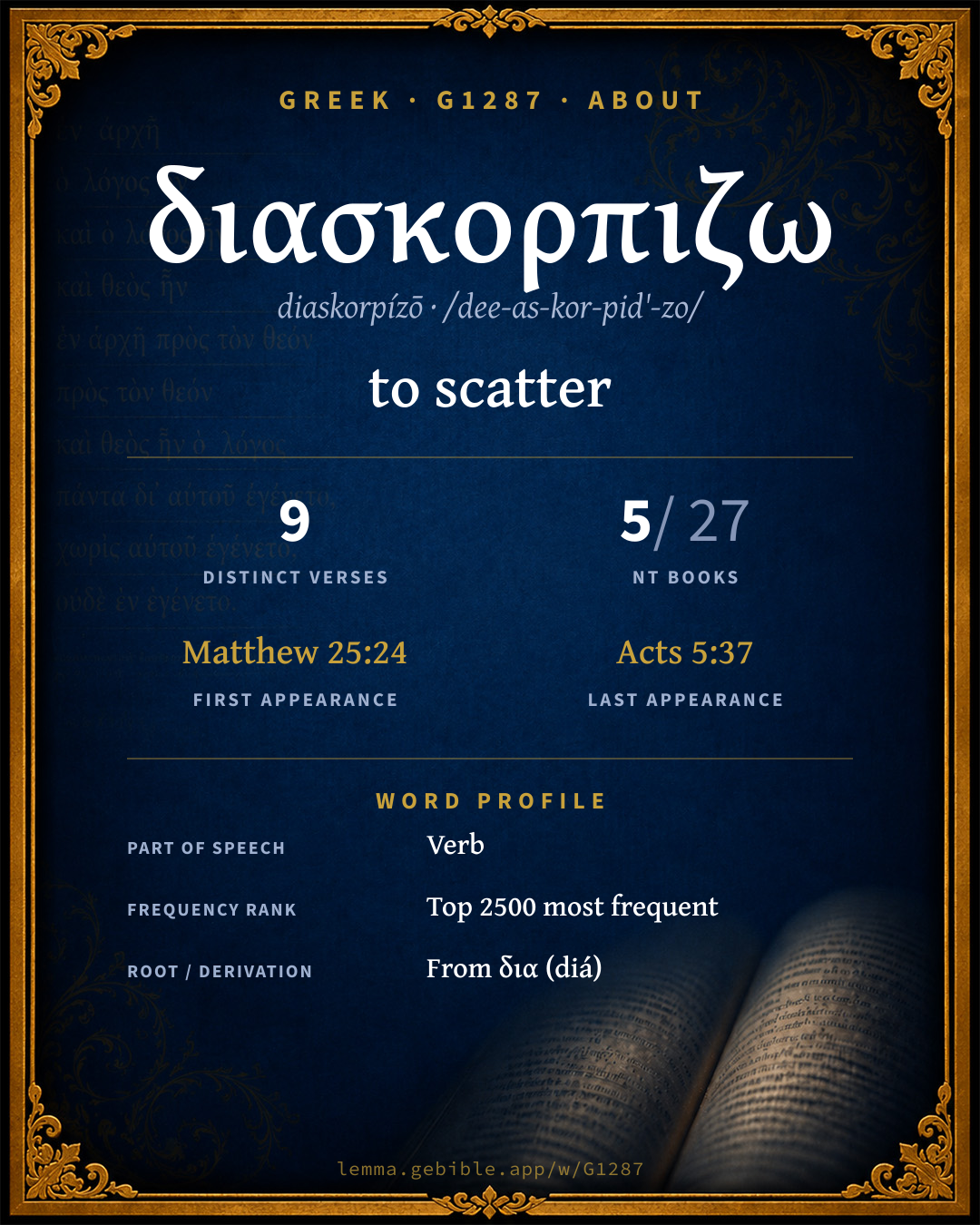
διασκορπίζω
to scatter
Full lexicon entry — Thayer's Greek Lexicon
From Thayer's Greek Lexicon
Where this word appears
Grammar key — what these labels mean
Part of speech
- Verb
- An action or state-of-being word.
Tense
- Aorist
- Action viewed as a simple whole, without regard to duration — often past (perfective aspect).
- Future
- Action expected in future time.
- Present
- Ongoing or general action in present time (imperfective aspect).
- Perfect
- A completed past action with continuing present results.
Voice
- Active
- The subject performs the action.
- Passive
- The subject receives the action.
Mood
- Indicative
- States a fact or asks a factual question (the mood of reality).
- Participle
- A verbal adjective (“writing,” “having written”).
Case
- Nominative
- The case of the subject (and the predicate nominative).
- Accusative
- The case of the direct object and of extent.
Person
- 3rd person
- The one spoken about (“he / she / it / they”).
- 1st person
- The speaker (“I / we”).
- 2nd person
- The one addressed (“you”).
Gender
- Masculine
- Grammatically masculine.
- Neuter
- Grammatically neuter.
Number
- Singular
- One.
- Plural
- More than one.
Every verse where G1287 appears in the Book of Mark — 1 distinct verse. Click any verse to open its interlinear word-by-word view. Verse text shown in the World English Bible for context — . Each verse’s Greek form is shown with its reference; the English is not keyword-highlighted, since the data carries no word-level English alignment. Use “Compare translations” on any verse to read it across multiple English versions. This concordance covers the Greek New Testament; Septuagint (Greek Old Testament) occurrences of this word are not indexed here.
Mark
About this entry
At a glance — auto-summarized from this page’s data, not written by a person. Every figure links to its source below. This summary describes the numbers; it doesn’t interpret them.
“to scatter” is the headline sense of the Greek verb διασκορπιζω (diaskorpízō). First canonically at Matthew 25:24, it enters the text early. The Greek New Testament uses it across 9 verses — uncommon. More than a third of its appearances fall in Matthew. It shares a root with δια, διαβαινω and διαβαλλω. The sections below give every sense, occurrence, and version rendering.
Gloss history
Strong's 1890 vs modern scholarship

About this word
Strong's G1287 catalogs a Greek word from the Greek New Testament.
These counts are not copied from any lexicon or concordance. They are computed here, from the morphology-tagged Greek New Testament. What Lemma adds →
- 9
- distinct verses
- The word appears in 9 distinct verses.
- 5 / 27
- NT books
- The word appears in 5 of 27 New Testament books.
- #1,140
- by frequency
- Top 2500 most frequent Greek words (rank 1,140 of 5,347 Greek words by occurrence).
View all 9 occurrences in the concordance →
By section of the New Testament
By traditional corpus
Conventional, traditional groupings — biblical authorship is debated, so this is a traditional corpus grouping, not an authorship claim. Some books belong to more than one corpus (Luke is in both the Gospels and the Lukan corpus, and so on), so these shares overlap and need not total 100%. Each figure is a share of the word’s 9 distinct verses.
- Gospels 8 verses · 89%
- Lukan (Luke–Acts) 4 verses · 44%
- Johannine 1 verse · 11%
How translations render this word
Counts come from each version’s own published word-to-Strong’s tagging or interlinear alignment — an approximate guide to how each version renders this word, not a word-level alignment the data otherwise carries. Because each total is that version’s own tagged count, the per-version totals vary from one another and need not match the appearance or distinct-verse counts above. These counts may also differ from a printed concordance because Lemma counts each distinctly tagged rendering and does not collapse phrase taggings into a single head-word total. This is a fixed set of word-tagged versions (KJV, ASV, BSB, ULT) and does not change with the reading translation you choose elsewhere. Each version’s license is shown beside its name below (and on Sources).
- King James Version: Strawed 2×
- American Standard Version: Scatter 2×, Shall be scattered abroad 2×
- Berean Standard Bible: Will be scattered 2×
- unfoldingWord Literal Text: Scatter 2×, Will be scattered 2×
King James Version Public Domain
Renders G1287 across 11 tagged occurrences — most commonly:
Plus 9 renderings that appear only once — usually multi-word phrases or single function words the recovered tagging swept in, not distinct renderings.
American Standard Version Public Domain
Renders G1287 across 11 tagged occurrences — most commonly:
Plus 7 renderings that appear only once — usually multi-word phrases or single function words the recovered tagging swept in, not distinct renderings.
Berean Standard Bible Public Domain
Renders G1287 across 9 tagged occurrences — most commonly:
Plus 7 renderings that appear only once — usually multi-word phrases or single function words the recovered tagging swept in, not distinct renderings.
unfoldingWord Literal Text CC BY-SA 4.0
Renders G1287 across 11 tagged occurrences — most commonly:
Plus 7 renderings that appear only once — usually multi-word phrases or single function words the recovered tagging swept in, not distinct renderings.
Senses in Thayer's
The 1 sense Thayer's distinguishes for this word, in lexicon order (not ranked by frequency or importance). The full entry — with sub-senses — is in the Lexicon Entry tab.
- to scatter abroad, disperse, to winnow
Word origin
Derived from δια (diá) (G1223) — through.
Forms in the corpus
The 7 distinct written forms G1287 takes in the Greek New Testament, most frequent first — each parse links to that tense’s occurrences in the concordance.
| Form | Parsing | Example | Uses |
|---|---|---|---|
| διασκορπισθήσονται diaskorpisthḗsontai | Verb, Future, Passive, Indicative, 3rd person, Plural | Matthew 26:31 | 2 |
| διεσκόρπισεν dieskórpisen | Verb, Aorist, Active, Indicative, 3rd person, Singular | Luke 1:51 | 2 |
| διασκορπίζων diaskorpízōn | Verb, Present, Active, Participle, Nominative, Singular, Masculine | Luke 16:1 | 1 |
| διεσκορπίσθησαν dieskorpísthēsan | Verb, Aorist, Passive, Indicative, 3rd person, Plural | Acts 5:37 | 1 |
| διεσκορπισμένα dieskorpisména | Verb, Perfect, Passive, Participle, Accusative, Plural, Neuter | John 11:52 | 1 |
| διεσκόρπισα dieskórpisa | Verb, Aorist, Active, Indicative, 1st person, Singular | Matthew 25:26 | 1 |
| διεσκόρπισας dieskórpisas | Verb, Aorist, Active, Indicative, 2nd person, Singular | Matthew 25:24 | 1 |
Same root — word family
Other Thayer's entries built from the same root as G1287, grouped by Strong’s listed origin. These share a root / origin per the lexicon — not necessarily a shared meaning. Each links to that word’s own entry.
Derives from
Shares the same root
- διαβαινω diabaínō G1224 to pass through
- διαβαλλω diabállō G1225 to slander
- διαβεβαιοομαι diabebaióomai G1226 to affirm strongly
- διαβλεπω diablépō G1227 to look through
- διαγγελλω diangéllō G1229 to proclaim
- διαγινομαι diagínomai G1230 to continue
- διαγινωσκω diaginṓskō G1231 to ascertain
- διαγογγυζω diagongýzō G1234 to murmur
- διαγρηγορεω diagrēgoréō G1235 to watch through
- διαγω diágō G1236 to lead through
- διαδεχομαι diadéchomai G1237 to receive in succession
- διαδημα diádēma G1238 diadem
- διαδιδωμι diadídōmi G1239 to distribute
- διαζωννυμι diazṓnnymi G1241 to gird around
- διαιρεω diairéō G1244 to divide
- διακαθαριζω diakatharízō G1245 to cleanse thoroughly
- διακατελεγχομαι diakatelénchomai G1246 to confute
- διακουομαι diakoúomai G1251 to hear fully
- διακρινω diakrínō G1252 to distinguish
- διακωλυω diakōlýō G1254 to hinder
- διαλαλεω dialaléō G1255 to converse
- διαλεγομαι dialégomai G1256 to discuss
- διαλειπω dialeípō G1257 to intermit
- διαλλασσω diallássō G1259 to reconcile
+62 more words share this root (not shown).
Compare all same-root words → Showing 4 of 88 — not the complete family. They share a root, not necessarily a meaning.
Septuagint usage
The same Greek word διασκορπιζω appears 48 times in the Greek Old Testament (Septuagint), across 42 verses in 9 books.
- 48
- LXX occurrences
- Tagged occurrences of this Greek word in the Septuagint.
- 42
- verses
- Distinct Septuagint verses containing this word.
- 9 / 39
- OT books
- The word appears in 9 of the 39 Old Testament books.
Sample Septuagint occurrences
- Numbers 10:34 διασκορπίζω
- Deuteronomy 30:1 διασκορπίζω
- Ezra 11:8 διασκορπίζω
- Job 37:11 διασκορπίζω
- Psalms 21:15 διασκορπίζω
- Jeremiah 9:15 διασκορπίζω
- Ezekiel 5:2 διασκορπίζω
- Daniel 9:7 διασκορπίζω
- Zechariah 2:2 διασκορπίζω
Septuagint occurrences (same lexeme)
Every verse where the same Strong’s number (G1287) appears in the Greek Septuagint. Verse text shown in the World English Bible for context; the Greek form is the matched word — the English is not keyword-highlighted.
- Numbers 10:34 διασκορπίζω The cloud of Yahweh was over them by day, when they set forward from the camp.
- Deuteronomy 30:1 διασκορπίζω It shall happen, when all these things are come on you, the blessing and the curse, which I have set before you, and you shall call them to mind among all the nations, where Yahweh your God has driven you,
- Deuteronomy 30:3 διασκορπίζω that then Yahweh your God will turn your captivity, and have compassion on you, and will return and gather you from all the peoples, where Yahweh your God has scattered you.
- Ezra 11:8 διασκορπίζω
- Job 37:11 διασκορπίζω Yes, he loads the thick cloud with moisture. He spreads abroad the cloud of his lightning.
- Psalms 21:15 διασκορπίζω
- Psalms 52:6 διασκορπίζω The righteous also will see it, and fear, And laugh at him, saying,
- Psalms 58:12 διασκορπίζω
- Psalms 58:16 διασκορπίζω
- Psalms 67:2 διασκορπίζω That your way may be known on earth, And your salvation among all nations,
- Psalms 67:31 διασκορπίζω
- Psalms 88:11 διασκορπίζω Is your loving kindness declared in the grave? Or your faithfulness in Destruction?
- Psalms 91:10 διασκορπίζω No evil shall happen to you, Neither shall any plague come near your dwelling.
- Psalms 105:27 διασκορπίζω They performed miracles among them, And wonders in the land of Ham.
- Psalms 140:7 διασκορπίζω Yahweh, the Lord, the strength of my salvation, You have covered my head in the day of battle.
- Jeremiah 9:15 διασκορπίζω therefore thus says Yahweh of Hosts, the God of Israel, Behold, I will feed them, even this people, with wormwood, and give them water of gall to drink.
- Jeremiah 10:21 διασκορπίζω For the shepherds are become brutish, and have not inquired of Yahweh: therefore they have not prospered, and all their flocks are scattered.
- Jeremiah 13:14 διασκορπίζω I will dash them one against another, even the fathers and the sons together, says Yahweh: I will not pity, nor spare, nor have compassion, that I should not destroy them.
- Jeremiah 23:1 διασκορπίζω Woe to the shepherds who destroy and scatter the sheep of my pasture! says Yahweh.
- Jeremiah 23:2 διασκορπίζω Therefore thus says Yahweh, the God of Israel, against the shepherds who feed my people: You have scattered my flock, and driven them away, and have not visited them; behold, I will visit on you the evil of your doings, says Yahweh.
- Jeremiah 27:37 διασκορπίζω
- Jeremiah 28:20 διασκορπίζω
- Jeremiah 28:21 διασκορπίζω
- Jeremiah 28:22 διασκορπίζω
- Jeremiah 28:23 διασκορπίζω
- Ezekiel 5:2 διασκορπίζω A third part shall you burn in the fire in the midst of the city, when the days of the siege are fulfilled; and you shall take a third part, and strike with the sword round about it; and a third part you shall scatter to the wind, and I will draw out a sword after them.
- Ezekiel 5:10 διασκορπίζω Therefore the fathers shall eat the sons in the midst of you, and the sons shall eat their fathers; and I will execute judgments on you; and the whole remnant of you will I scatter to all the winds.
- Ezekiel 6:5 διασκορπίζω I will lay the dead bodies of the children of Israel before their idols; and I will scatter your bones round about your altars.
- Ezekiel 10:2 διασκορπίζω He spoke to the man clothed in linen, and said, Go in between the whirling [wheels], even under the cherub, and fill both your hands with coals of fire from between the cherubim, and scatter them over the city. He went in as I watched.
- Ezekiel 11:16 διασκορπίζω Therefore say, Thus says the Lord Yahweh: Whereas I have removed them far off among the nations, and whereas I have scattered them among the countries, yet will I be to them a sanctuary for a little while in the countries where they are come.
- Ezekiel 12:15 διασκορπίζω They shall know that I am Yahweh, when I shall disperse them among the nations, and scatter them through the countries.
- Ezekiel 20:23 διασκορπίζω Moreover I swore to them in the wilderness, that I would scatter them among the nations, and disperse them through the countries;
- Ezekiel 20:34 διασκορπίζω and I will bring you out from the peoples, and will gather you out of the countries in which you are scattered, with a mighty hand, and with an outstretched arm, and with wrath poured out;
- Ezekiel 20:41 διασκορπίζω As a sweet savor will I accept you, when I bring you out from the peoples, and gather you out of the countries in which you have been scattered; and I will be sanctified in you in the sight of the nations.
- Ezekiel 22:15 διασκορπίζω I will scatter you among the nations, and disperse you through the countries; and I will consume your filthiness out of you.
- Ezekiel 28:25 διασκορπίζω Thus says the Lord Yahweh: When I shall have gathered the house of Israel from the peoples among whom they are scattered, and shall be sanctified in them in the sight of the nations, then shall they dwell in their own land which I gave to my servant Jacob.
- Ezekiel 29:13 διασκορπίζω For thus says the Lord Yahweh: At the end of forty years will I gather the Egyptians from the peoples where they were scattered;
- Ezekiel 46:18 διασκορπίζω Moreover the prince shall not take of the people's inheritance, to thrust them out of their possession; he shall give inheritance to his sons out of his own possession, that my people not be scattered every man from his possession.
- Daniel 9:7 διασκορπίζω Lord, righteousness belongs to you, but to us confusion of face, as at this day; to the men of Judah, and to the inhabitants of Jerusalem, and to all Israel, who are near, and who are far off, through all the countries where you have driven them, because of their trespass that they have trespassed against you.
- Zechariah 2:2 διασκορπίζω Then I asked, "Where are you going?" He said to me, "To measure Jerusalem, to see what is its breadth and what is its length."
- Zechariah 2:4 διασκορπίζω and said to him, "Run, speak to this young man, saying, 'Jerusalem will be inhabited as villages without walls, because of the multitude of men and cattle in it.
- Zechariah 11:16 διασκορπίζω For, behold, I will raise up a shepherd in the land, who will not visit those who are cut off, neither will seek those who are scattered, nor heal that which is broken, nor feed that which is sound; but he will eat the flesh of the fat sheep, and will tear their hoofs in pieces.
These are occurrences of the same Greek lexeme (G1287) in the Septuagint — not a translation of any one Hebrew word. The store carries no word-level Hebrew↔Greek alignment, so no Hebrew original is asserted here. Counts come from the recovered LXX Strong's tagging — high-frequency vocabulary is well covered, while rare or late forms may be untagged — so they reflect tagged occurrences and may slightly undercount.