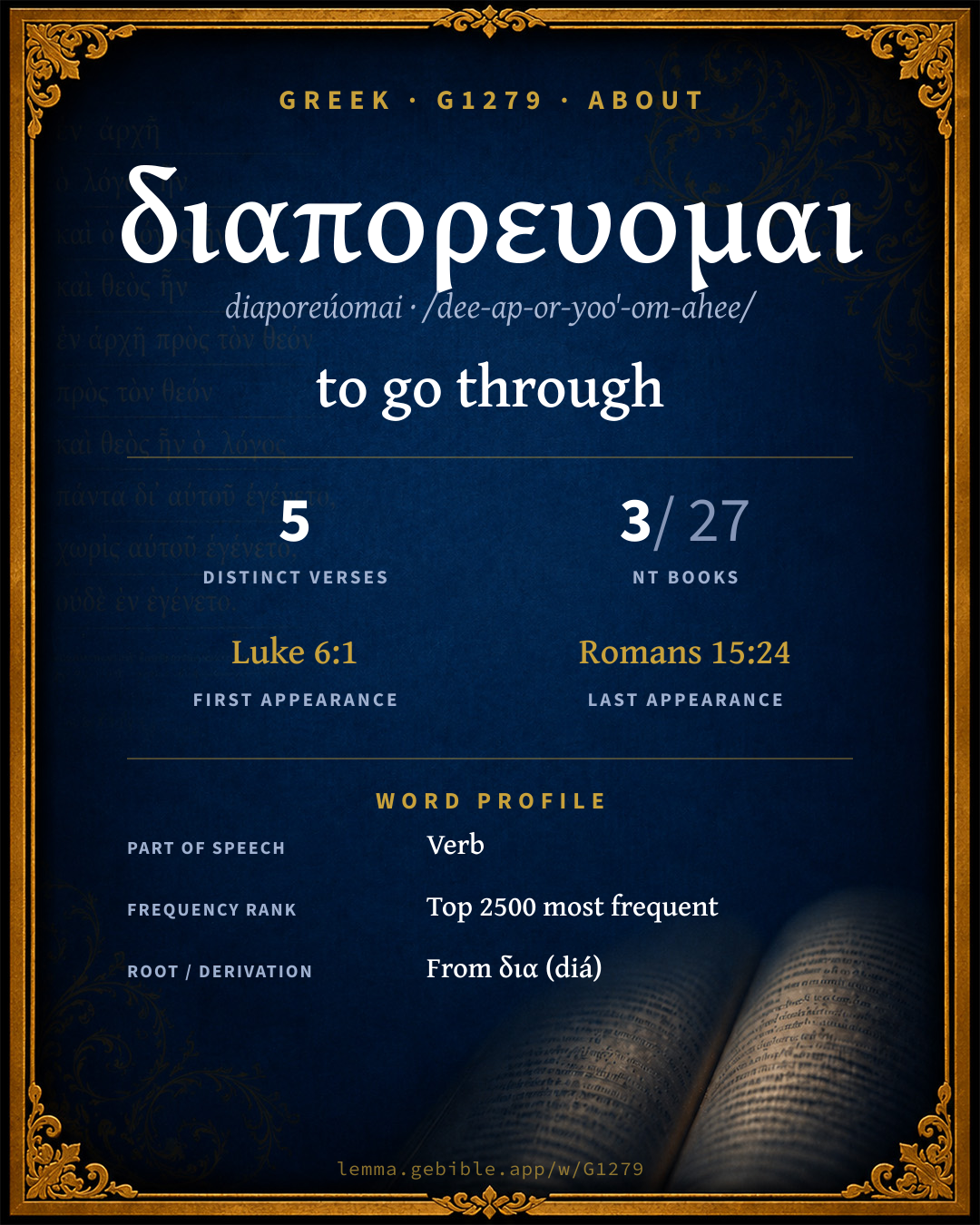
διαπορεύομαι
to go through
‘to go through’ is one of 4 main senses fuller range ↓
Full lexicon entry — Thayer's Greek Lexicon
From Thayer's Greek Lexicon
Where this word appears
See every Present-tense verb in the Greek New Testament →
Grammar key — what these labels mean
Part of speech
- Verb
- An action or state-of-being word.
Tense
- Imperfect
- Continuous or repeated action in past time (“was writing”).
- Present
- Ongoing or general action in present time (imperfective aspect).
Voice
- Middle or Passive deponent
- Middle/passive in form but active in meaning.
Mood
- Indicative
- States a fact or asks a factual question (the mood of reality).
- Infinitive
- A verbal noun (“to write”), unmarked for person or number.
- Participle
- A verbal adjective (“writing,” “having written”).
Case
- Genitive
- The case of source, possession, or “of” — answers “whose / from what.”
- Nominative
- The case of the subject (and the predicate nominative).
Person
- 3rd person
- The one spoken about (“he / she / it / they”).
Gender
- Masculine
- Grammatically masculine.
Number
- Plural
- More than one.
- Singular
- One.
Grammatical forms
- Verb, Imperfect, Middle or Passive deponent, Indicative, 3rd person, Plural 1 time (20%)
- Verb, Imperfect, Middle or Passive deponent, Indicative, 3rd person, Singular 1 time (20%)
- Verb, Present, Middle or Passive deponent, Infinitive 1 time (20%)
- Verb, Present, Middle or Passive deponent, Participle, Genitive, Singular, Masculine 1 time (20%)
- Verb, Present, Middle or Passive deponent, Participle, Nominative, Singular, Masculine 1 time (20%)
Parsed forms decoded from the imported morphology (Robinson–Tischendorf, public domain), counted across 5 parsed occurrences — not distinct verses.
Every verse where G1279 appears — 5 distinct verses across 3 books. Click any verse to open its interlinear word-by-word view. Verse text shown in the World English Bible for context — . Each verse’s Greek form is shown with its reference; the English is not keyword-highlighted, since the data carries no word-level English alignment. Use “Compare translations” on any verse to read it across multiple English versions. This concordance covers the Greek New Testament; Septuagint (Greek Old Testament) occurrences of this word are not indexed here.
Luke 3 verses
- Luke 6:1 διαπορεύεσθαι pres mid/pass.dep inf Now it happened on the second Sabbath after the first, that he was going through the grain fields. His disciples plucked the heads of grain, and ate, rubbing them in their hands.
- Luke 13:22 διεπορεύετο impf mid/pass.dep ind 3sg He went on his way through cities and villages, teaching, and traveling on to Jerusalem.
- Luke 18:36 διαπορευομένου pres mid/pass.dep ptcp gen sg masc Hearing a multitude going by, he asked what this meant.
Acts 1 verse
Romans 1 verse
About this entry
At a glance — auto-summarized from this page’s data, not written by a person. Every figure links to its source below. This summary describes the numbers; it doesn’t interpret them.
“to go through” is the headline sense of the Greek verb διαπορευομαι (diaporeúomai). With only 5 verses it sits in the long tail of Greek New Testament vocabulary. It clusters heavily in Luke, which alone accounts for 60% of its uses. Scripture first uses it in Luke 6:1. Catalogued under 4 senses, its meaning is not single-sense. See the sense tree, 5-verse concordance, and the renderings breakdown below.
Gloss history
Strong's 1890 vs modern scholarship

About this word
Strong's G1279 catalogs a Greek word from the Greek New Testament.
These counts are not copied from any lexicon or concordance. They are computed here, from the morphology-tagged Greek New Testament. What Lemma adds →
- 5
- distinct verses
- The word appears in 5 distinct verses.
- 3 / 27
- NT books
- The word appears in 3 of 27 New Testament books.
- #1,648
- by frequency
- Top 2500 most frequent Greek words (rank 1,648 of 5,347 Greek words by occurrence).
View all 5 occurrences in the concordance →
By section of the New Testament
By traditional corpus
Conventional, traditional groupings — biblical authorship is debated, so this is a traditional corpus grouping, not an authorship claim. Some books belong to more than one corpus (Luke is in both the Gospels and the Lukan corpus, and so on), so these shares overlap and need not total 100%. Each figure is a share of the word’s 5 distinct verses.
- Lukan (Luke–Acts) 4 verses · 80%
- Gospels 3 verses · 60%
- Pauline corpus 1 verse · 20%
How translations render this word
Counts come from each version’s own published word-to-Strong’s tagging or interlinear alignment — an approximate guide to how each version renders this word, not a word-level alignment the data otherwise carries. Because each total is that version’s own tagged count, the per-version totals vary from one another and need not match the appearance or distinct-verse counts above. These counts may also differ from a printed concordance because Lemma counts each distinctly tagged rendering and does not collapse phrase taggings into a single head-word total. This is a fixed set of word-tagged versions (KJV, ASV, BSB, ULT) and does not change with the reading translation you choose elsewhere. Each version’s license is shown beside its name below (and on Sources).
- King James Version: He went 1×, Journey 1×, Pass by 1×
- American Standard Version: Came 1×, Going by 1×, He went 1×
- Berean Standard Bible: Going by 1×, They went from 1×, Traveled 1×
- unfoldingWord Literal Text: Going by 1×, He was traveling 1×, Passing through 1×
King James Version Public Domain
Renders G1279 across 5 tagged occurrences — most commonly:
American Standard Version Public Domain
Renders G1279 across 7 tagged occurrences — most commonly:
Berean Standard Bible Public Domain
Renders G1279 across 4 tagged occurrences — most commonly:
Not rendered by a distinct English word in 1 further occurrence.
unfoldingWord Literal Text CC BY-SA 4.0
Renders G1279 across 5 tagged occurrences — most commonly:
Senses in Thayer's
The 4 senses Thayer's distinguishes for this word, in lexicon order (not ranked by frequency or importance). The full entry — with sub-senses — is in the Lexicon Entry tab.
- to cause to pass through a place
- to carry across
- to journey through a place, go through
- to travel through
Word origin
Derived from δια (diá) (G1223) — through.
Forms in the corpus
The 5 distinct written forms G1279 takes in the Greek New Testament, most frequent first — each parse links to that tense’s occurrences in the concordance.
| Form | Parsing | Example | Uses |
|---|---|---|---|
| διαπορευομένου diaporeuoménou | Verb, Present, Middle or Passive deponent, Participle, Genitive, Singular, Masculine | Luke 18:36 | 1 |
| διαπορευόμενος diaporeuómenos | Verb, Present, Middle or Passive deponent, Participle, Nominative, Singular, Masculine | Romans 15:24 | 1 |
| διαπορεύεσθαι diaporeúesthai | Verb, Present, Middle or Passive deponent, Infinitive | Luke 6:1 | 1 |
| διεπορεύετο dieporeúeto | Verb, Imperfect, Middle or Passive deponent, Indicative, 3rd person, Singular | Luke 13:22 | 1 |
| διεπορεύοντο dieporeúonto | Verb, Imperfect, Middle or Passive deponent, Indicative, 3rd person, Plural | Acts 16:4 | 1 |
Same root — word family
Other Thayer's entries built from the same root as G1279, grouped by Strong’s listed origin. These share a root / origin per the lexicon — not necessarily a shared meaning. Each links to that word’s own entry.
Derives from
Shares the same root
- διαβαινω diabaínō G1224 to pass through
- διαβαλλω diabállō G1225 to slander
- διαβεβαιοομαι diabebaióomai G1226 to affirm strongly
- διαβλεπω diablépō G1227 to look through
- διαγγελλω diangéllō G1229 to proclaim
- διαγινομαι diagínomai G1230 to continue
- διαγινωσκω diaginṓskō G1231 to ascertain
- διαγογγυζω diagongýzō G1234 to murmur
- διαγρηγορεω diagrēgoréō G1235 to watch through
- διαγω diágō G1236 to lead through
- διαδεχομαι diadéchomai G1237 to receive in succession
- διαδημα diádēma G1238 diadem
- διαδιδωμι diadídōmi G1239 to distribute
- διαζωννυμι diazṓnnymi G1241 to gird around
- διαιρεω diairéō G1244 to divide
- διακαθαριζω diakatharízō G1245 to cleanse thoroughly
- διακατελεγχομαι diakatelénchomai G1246 to confute
- διακουομαι diakoúomai G1251 to hear fully
- διακρινω diakrínō G1252 to distinguish
- διακωλυω diakōlýō G1254 to hinder
- διαλαλεω dialaléō G1255 to converse
- διαλεγομαι dialégomai G1256 to discuss
- διαλειπω dialeípō G1257 to intermit
- διαλλασσω diallássō G1259 to reconcile
+62 more words share this root (not shown).
Compare all same-root words → Showing 4 of 88 — not the complete family. They share a root, not necessarily a meaning.
Septuagint usage
The same Greek word διαπορευομαι appears 36 times in the Greek Old Testament (Septuagint), across 36 verses in 15 books.
- 36
- LXX occurrences
- Tagged occurrences of this Greek word in the Septuagint.
- 36
- verses
- Distinct Septuagint verses containing this word.
- 15 / 39
- OT books
- The word appears in 15 of the 39 Old Testament books.
Sample Septuagint occurrences
- Numbers 11:8 διαπορεύομαι
- Joshua 15:3 διαπορεύομαι
- 1 Samuel 12:2 διαπορεύομαι
- 1 Kings 9:8 διαπορεύομαι
- 2 Kings 4:9 διαπορεύομαι
- 2 Chronicles 7:21 διαπορεύομαι
- Job 2:2 διαπορεύομαι
- Psalms 8:9 διαπορεύομαι
- Proverbs 5:16 διαπορεύομαι
- Isaiah 11:15 διαπορεύομαι
- Jeremiah 18:16 διαπορεύομαι
- Ezekiel 20:26 διαπορεύομαι
Septuagint occurrences (same lexeme)
Every verse where the same Strong’s number (G1279) appears in the Greek Septuagint. Verse text shown in the World English Bible for context; the Greek form is the matched word — the English is not keyword-highlighted.
- Numbers 11:8 διαπορεύομαι The people went about, and gathered it, and ground it in mills, or beat it in mortars, and boiled it in pots, and made cakes of it: and the taste of it was as the taste of fresh oil.
- Numbers 31:23 διαπορεύομαι everything that may abide the fire, you shall make to go through the fire, and it shall be clean; nevertheless it shall be purified with the water for impurity: and all that doesn't withstand the fire you shall make to go through the water.
- Joshua 15:3 διαπορεύομαι and it went out southward of the ascent of Akrabbim, and passed along to Zin, and went up by the south of Kadesh-barnea, and passed along by Hezron, and went up to Addar, and turned about to Karka;
- 1 Samuel 12:2 διαπορεύομαι Now, behold, the king walks before you; and I am old and gray-headed; and, behold, my sons are with you: and I have walked before you from my youth to this day.
- 1 Samuel 29:3 διαπορεύομαι Then said the princes of the Philistines, What [do] these Hebrews [here]? Achish said to the princes of the Philistines, Isn't this David, the servant of Saul the king of Israel, who has been with me these days, or [rather] these years, and I have found no fault in him since he fell away [to me] to this day?
- 1 Kings 9:8 διαπορεύομαι Though this house is so high, yet shall everyone who passes by it be astonished, and shall hiss; and they shall say, Why has Yahweh done thus to this land, and to this house?
- 1 Kings 18:35 διαπορεύομαι The water ran round about the altar; and he filled the trench also with water.
- 2 Kings 4:9 διαπορεύομαι She said to her husband, See now, I perceive that this is a holy man of God, that passes by us continually.
- 2 Kings 6:26 διαπορεύομαι As the king of Israel was passing by on the wall, there cried a woman to him, saying, Help, my lord, O king.
- 2 Kings 6:30 διαπορεύομαι It happened, when the king heard the words of the woman, that he tore his clothes (now he was passing by on the wall); and the people looked, and, behold, he had sackcloth within on his flesh.
- 2 Chronicles 7:21 διαπορεύομαι This house, which is so high, everyone who passes by it shall be astonished, and shall say, Why has Yahweh done thus to this land, and to this house?
- 2 Chronicles 30:10 διαπορεύομαι So the posts passed from city to city through the country of Ephraim and Manasseh, even to Zebulun: but they ridiculed them, and mocked them.
- Job 2:2 διαπορεύομαι Yahweh said to Satan, "Where have you come from?" Satan answered Yahweh, and said, "From going back and forth in the earth, and from walking up and down in it."
- Job 22:14 διαπορεύομαι Thick clouds are a covering to him, so that he doesn't see. He walks on the vault of the sky.'
- Psalms 8:9 διαπορεύομαι Yahweh, our Lord, How majestic is your name in all the earth!
- Psalms 38:7 διαπορεύομαι For my loins are filled with burning. There is no soundness in my flesh.
- Psalms 57:8 διαπορεύομαι Wake up, my glory! Wake up, psaltery and harp! I will wake up the dawn.
- Psalms 67:22 διαπορεύομαι
- Psalms 76:18 διαπορεύομαι
- Psalms 81:5 διαπορεύομαι He appointed it in Joseph for a testimony, When he went out over the land of Egypt, I heard a language that I didn't know.
- Psalms 90:6 διαπορεύομαι In the morning it sprouts and springs up. By evening, it is withered and dry.
- Psalms 100:2 διαπορεύομαι Serve Yahweh with gladness. Come before his presence with singing.
- Psalms 103:26 διαπορεύομαι
- Proverbs 5:16 διαπορεύομαι Should your springs overflow in the streets, Streams of water in the public squares?
- Proverbs 9:12 διαπορεύομαι If you are wise, you are wise for yourself. If you mock, you alone will bear it.
- Isaiah 11:15 διαπορεύομαι Yahweh will utterly destroy the tongue of the Egyptian sea; and with his scorching wind will he wave his hand over the River, and will strike it into seven streams, and cause men to march over in sandals.
- Isaiah 30:25 διαπορεύομαι There shall be on every lofty mountain, and on every high hill, brooks [and] streams of waters, in the day of the great slaughter, when the towers fall.
- Jeremiah 18:16 διαπορεύομαι to make their land an astonishment, and a perpetual hissing; everyone who passes thereby shall be astonished, and shake his head.
- Ezekiel 20:26 διαπορεύομαι and I polluted them in their own gifts, in that they caused to pass through [the fire] all that opens the womb, that I might make them desolate, to the end that they might know that I am Yahweh.
- Ezekiel 21:21 διαπορεύομαι For the king of Babylon stood at the parting of the way, at the head of the two ways, to use divination: he shook the arrows back and forth, he consulted the teraphim, he looked in the liver.
- Ezekiel 33:15 διαπορεύομαι if the wicked restore the pledge, give again that which he had taken by robbery, walk in the statutes of life, committing no iniquity; he shall surely live, he shall not die.
- Ezekiel 33:28 διαπορεύομαι I will make the land a desolation and an astonishment; and the pride of her power shall cease; and the mountains of Israel shall be desolate, so that none shall pass through.
- Ezekiel 39:15 διαπορεύομαι Those who pass through the land shall pass through; and when any sees a man's bone, then shall he set up a sign by it, until the undertakers have buried it in the valley of Hamon Gog.
- Daniel 4:22 διαπορεύομαι it is you, O king, that are grown and become strong; for your greatness is grown, and reaches to the sky, and your dominion to the end of the earth.
- Zephaniah 2:15 διαπορεύομαι This is the joyous city that lived carelessly, that said in her heart, "I am, and there is none besides me." How she has become a desolation, a place for animals to lie down in! Everyone who passes by her will hiss, and shake their fists.
- Zechariah 9:8 διαπορεύομαι I will encamp around my house against the army, That none pass through or return; And no oppressor will pass through them any more: For now I have seen with my eyes.
These are occurrences of the same Greek lexeme (G1279) in the Septuagint — not a translation of any one Hebrew word. The store carries no word-level Hebrew↔Greek alignment, so no Hebrew original is asserted here. Counts come from the recovered LXX Strong's tagging — high-frequency vocabulary is well covered, while rare or late forms may be untagged — so they reflect tagged occurrences and may slightly undercount.