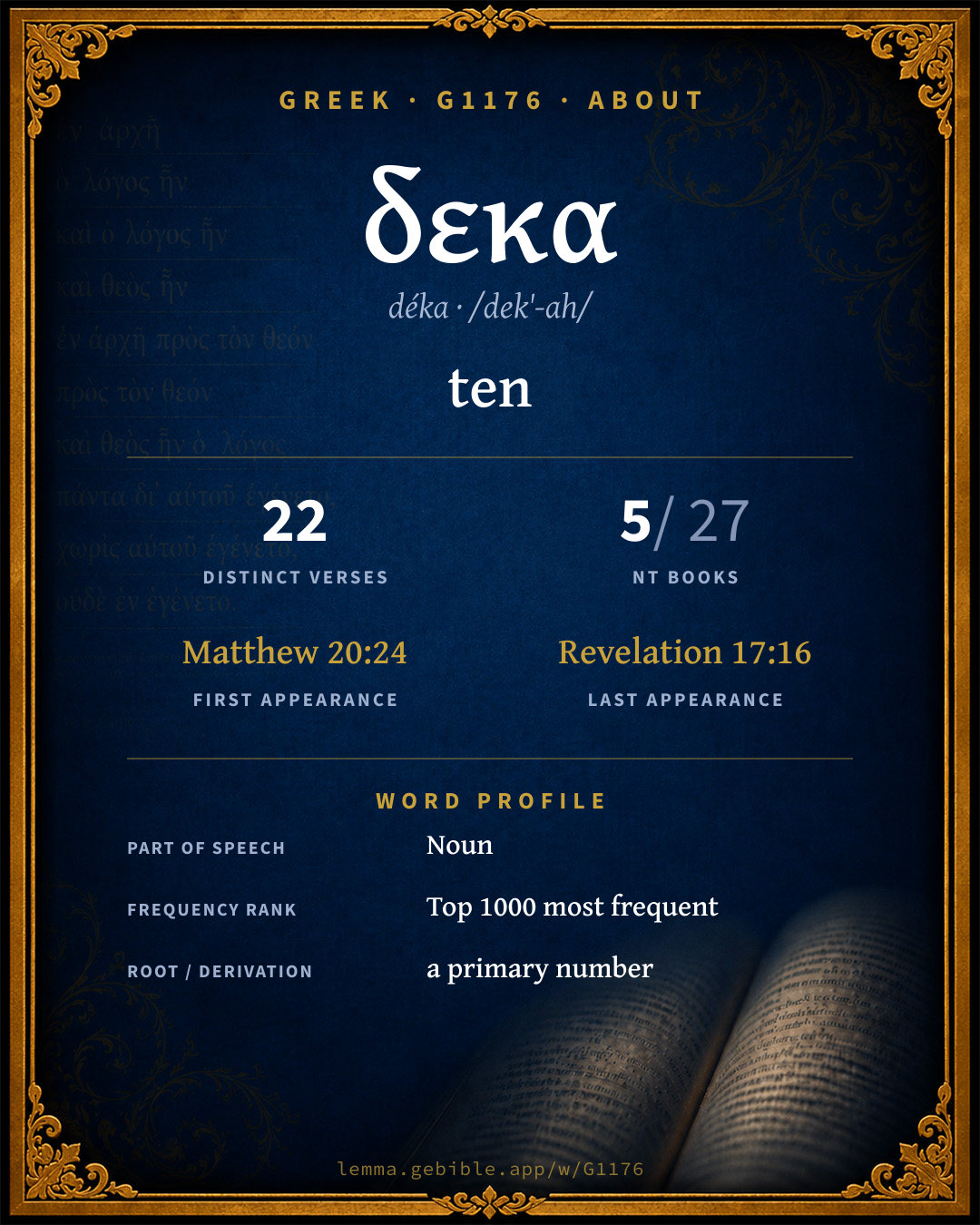
δέκα
ten
Full lexicon entry — Thayer's Greek Lexicon
From Thayer's Greek Lexicon
Where this word appears
Every verse where G1176 appears in the Book of Luke — 10 distinct verses. Click any verse to open its interlinear word-by-word view. Verse text shown in the World English Bible for context — . Each verse’s Greek form is shown with its reference; the English is not keyword-highlighted, since the data carries no word-level English alignment. Use “Compare translations” on any verse to read it across multiple English versions. This concordance covers the Greek New Testament; Septuagint (Greek Old Testament) occurrences of this word are not indexed here.
Luke
- Luke 13:16 δέκα adj num indecl Ought not this woman, being a daughter of Abraham, whom Satan had bound eighteen long years, be freed from this bondage on the Sabbath day?"
- Luke 14:31 δέκα adj num indecl Or what king, as he goes to encounter another king in war, will not sit down first and consider whether he is able with ten thousand to meet him who comes against him with twenty thousand?
- Luke 15:8 δέκα adj num indecl Or what woman, if she had ten drachma coins, if she lost one drachma coin, wouldn't light a lamp, sweep the house, and seek diligently until she found it?
- Luke 17:12 δέκα adj num indecl As he entered into a certain village, ten men who were lepers met him, who stood at a distance.
- Luke 17:17 δέκα adj num indecl Jesus answered, "Weren't the ten cleansed? But where are the nine?
- Luke 19:13 δέκα δέκα adj num indecl adj num indecl He called ten servants of his, and gave them ten mina coins, and told them, 'Conduct business until I come.'
- Luke 19:16 δέκα adj num indecl The first came before him, saying, 'Lord, your mina has made ten more minas.'
- Luke 19:17 δέκα adj num indecl "He said to him, 'Well done, you good servant! Because you were found faithful with very little, you shall have authority over ten cities.'
- Luke 19:24 δέκα adj num indecl He said to those who stood by, 'Take the mina away from him, and give it to him who has the ten minas.'
- Luke 19:25 δέκα adj num indecl "They said to him, 'Lord, he has ten minas!'
About this entry
At a glance — auto-summarized from this page’s data, not written by a person. Every figure links to its source below. This summary describes the numbers; it doesn’t interpret them.
At its core, δεκα (déka) means “ten.” It first appears in Matthew 20:24. Spanning 22 verses in 5 books, it ranks among the uncommon words of the Greek New Testament. Its uses concentrate in Luke (45% of all occurrences). Sharing its root, it stands alongside δακτυλος, δεκαδυο and δεκαπεντε. Each statement above links to its evidence; the full detail follows below.
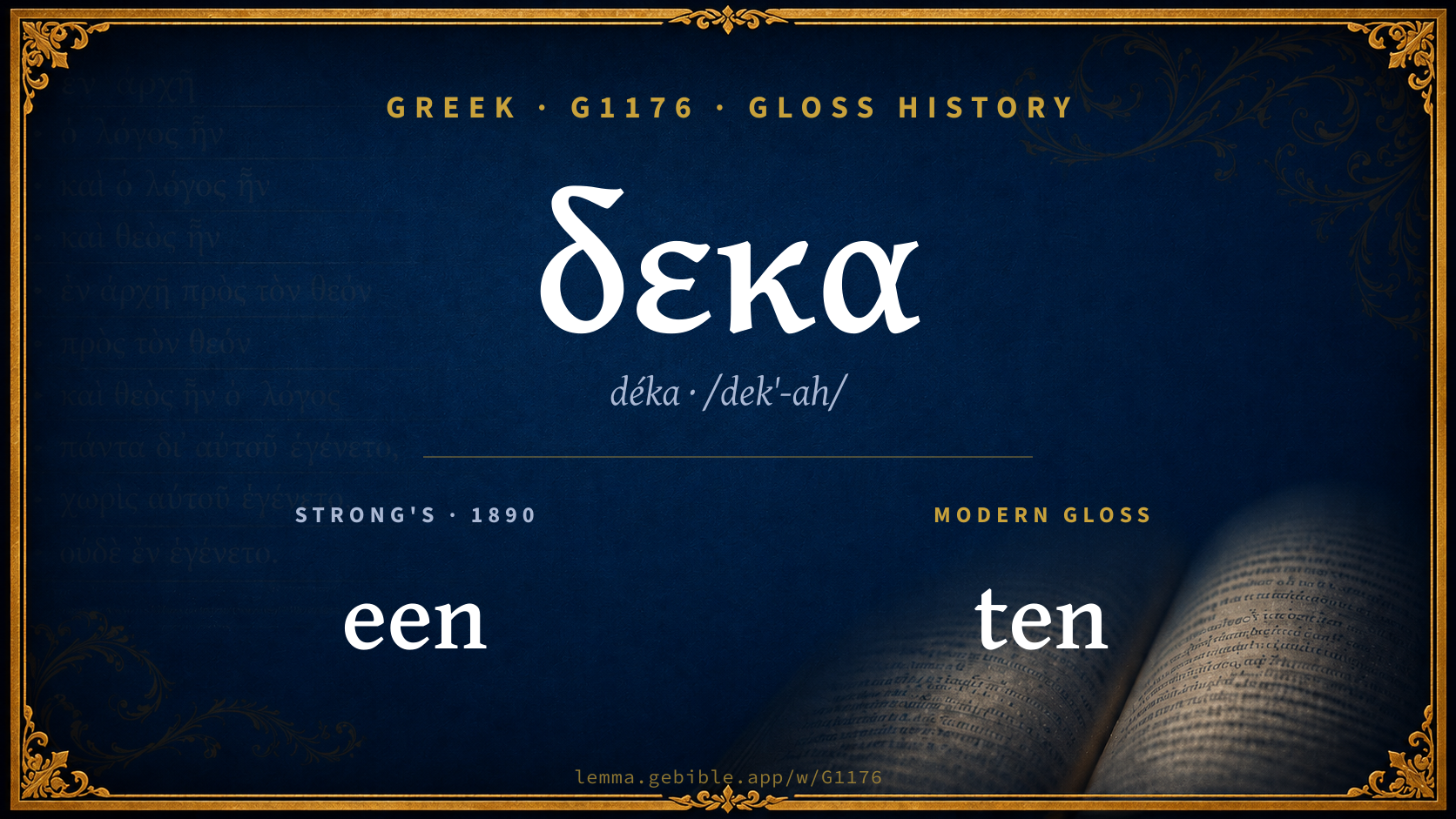
Gloss history
Strong's 1890 vs modern scholarship
About this word
Strong's G1176 catalogs a Greek word from the Greek New Testament.
These counts are not copied from any lexicon or concordance. They are computed here, from the morphology-tagged Greek New Testament. What Lemma adds →
- 22
- distinct verses
- The word appears in 22 distinct verses.
- 5 / 27
- NT books
- The word appears in 5 of 27 New Testament books.
- #530
- by frequency
- Top 1000 most frequent Greek words (rank 530 of 5,347 Greek words by occurrence).
View all 22 occurrences in the concordance →
Most concentrated in
- Luke 10 verses 45%
- Revelation 7 verses 32%
- Matthew 3 verses 14%
By section of the New Testament
By traditional corpus
Conventional, traditional groupings — biblical authorship is debated, so this is a traditional corpus grouping, not an authorship claim. Some books belong to more than one corpus (Luke is in both the Gospels and the Lukan corpus, and so on), so these shares overlap and need not total 100%. Each figure is a share of the word’s 22 distinct verses.
- Gospels 14 verses · 64%
- Lukan (Luke–Acts) 11 verses · 50%
- Johannine 7 verses · 32%
- Revelation 7 verses · 32%
How translations render this word
Counts come from each version’s own published word-to-Strong’s tagging or interlinear alignment — an approximate guide to how each version renders this word, not a word-level alignment the data otherwise carries. Because each total is that version’s own tagged count, the per-version totals vary from one another and need not match the appearance or distinct-verse counts above. These counts may also differ from a printed concordance because Lemma counts each distinctly tagged rendering and does not collapse phrase taggings into a single head-word total. This is a fixed set of word-tagged versions (KJV, ASV, BSB, ULT) and does not change with the reading translation you choose elsewhere. Each version’s license is shown beside its name below (and on Sources).
- King James Version: Ten 24×, Eighteen 3×
- American Standard Version: Ten 22×
- Berean Standard Bible: Ten 24×, Eighteen 3×
- unfoldingWord Literal Text: Ten 23×
King James Version Public Domain
Renders G1176 across 27 tagged occurrences — most commonly:
American Standard Version Public Domain
Renders G1176 across 25 tagged occurrences — most commonly:
Plus 3 renderings that appear only once — usually multi-word phrases or single function words the recovered tagging swept in, not distinct renderings.
Berean Standard Bible Public Domain
Renders G1176 across 27 tagged occurrences — most commonly:
unfoldingWord Literal Text CC BY-SA 4.0
Renders G1176 across 23 tagged occurrences — most commonly:
Not rendered by a distinct English word in 2 further occurrences.
Senses in Thayer's
The 1 sense Thayer's distinguishes for this word, in lexicon order (not ranked by frequency or importance). The full entry — with sub-senses — is in the Lexicon Entry tab.
- ten
Word origin
Origin: a primary number
A primary number; ten : - [eight-] een ten.
— Strong’s Exhaustive Concordance (1890), public domain.
Same root — word family
Other Thayer's entries built from the same root as G1176, grouped by Strong’s listed origin. These share a root / origin per the lexicon — not necessarily a shared meaning. Each links to that word’s own entry.
Derived from this word
- δακτυλος dáktylos G1147 finger
- δεκαδυο dekadýo G1177 twelve
- δεκαπεντε dekapénte G1178 fifteen
- δεκατεσσαρες dekatéssares G1180 fourteen
- δεκατος dékatos G1182 tenth
Proper names from this root
People and places named from this root — a name, not an additional meaning of the word.
Compare all same-root words → Showing 4 of 8 — not the complete family. 2 of the same-root words are proper names (people or places). They share a root, not necessarily a meaning.
Septuagint usage
The same Greek word δεκα appears 268 times in the Greek Old Testament (Septuagint), across 238 verses in 24 books.
- 268
- LXX occurrences
- Tagged occurrences of this Greek word in the Septuagint.
- 238
- verses
- Distinct Septuagint verses containing this word.
- 24 / 39
- OT books
- The word appears in 24 of the 39 Old Testament books.
Sample Septuagint occurrences
- Genesis 5:10 δέκα
- Exodus 26:1 δέκα
- Leviticus 26:26 δέκα
- Numbers 7:14 δέκα
- Deuteronomy 4:13 δέκα
- Joshua 15:36 δέκα
- Judges 1:4 δέκα
- Ruth 1:4 δέκα
- 1 Samuel 1:8 δέκα
- 2 Samuel 15:16 δέκα
- 1 Kings 2:46 δέκα
- 2 Kings 1:18 δέκα
Septuagint occurrences (same lexeme)
Every verse where the same Strong’s number (G1176) appears in the Greek Septuagint — showing the first 50 of 238. Verse text shown in the World English Bible for context; the Greek form is the matched word — the English is not keyword-highlighted.
- Genesis 5:10 δέκα Enosh lived after he became the father of Kenan, eight hundred fifteen years, and became the father of sons and daughters.
- Genesis 5:14 δέκα and all the days of Kenan were nine hundred ten years, then he died.
- Genesis 7:20 δέκα The waters prevailed fifteen cubits upward, and the mountains were covered.
- Genesis 14:14 δέκα When Abram heard that his relative was taken captive, he led forth his trained men, born in his house, three hundred and eighteen, and pursued as far as Dan.
- Genesis 16:3 δέκα Sarai, Abram's wife, took Hagar the Egyptian, her handmaid, after Abram had lived ten years in the land of Canaan, and gave her to Abram her husband to be his wife.
- Genesis 17:25 δέκα Ishmael, his son, was thirteen years old when he was circumcised in the flesh of his foreskin.
- Genesis 18:32 δέκα He said, "Oh don't let the Lord be angry, and I will speak yet but this once. What if ten are found there?" He said, "I will not destroy it for the ten's sake."
- Genesis 24:10 δέκα The servant took ten camels, of his master's camels, and departed, having all goodly things of his master's in his hand. He arose, and went to Mesopotamia, to the city of Nahor.
- Genesis 24:22 δέκα It happened, as the camels had done drinking, that the man took a golden ring of half a shekel weight, and two bracelets for her hands of ten shekels weight of gold,
- Genesis 24:55 δέκα Her brother and her mother said, "Let the young lady stay with us a few days, at least ten. After that she will go."
- Genesis 31:7 δέκα Your father has deceived me, and changed my wages ten times, but God didn't allow him to hurt me.
- Genesis 31:41 δέκα These twenty years have I been in your house. I served you fourteen years for your two daughters, and six years for your flock, and you have changed my wages ten times.
- Genesis 32:16 δέκα He delivered them into the hands of his servants, every herd by itself, and said to his servants, "Pass over before me, and put a space between herd and herd."
- Genesis 37:2 δέκα This is the history of the generations of Jacob. Joseph, being seventeen years old, was feeding the flock with his brothers. He was a boy with the sons of Bilhah and Zilpah, his father's wives. Joseph brought an evil report of them to their father.
- Genesis 42:3 δέκα Joseph's ten brothers went down to buy grain from Egypt.
- Genesis 45:23 δέκα To his father, he sent after this manner: ten donkeys loaded with the good things of Egypt, and ten female donkeys loaded with grain and bread and provision for his father by the way.
- Genesis 46:18 δέκα These are the sons of Zilpah, whom Laban gave to Leah, his daughter, and these she bore to Jacob, even sixteen souls.
- Genesis 46:22 δέκα These are the sons of Rachel, who were born to Jacob: all the souls were fourteen.
- Genesis 47:28 δέκα Jacob lived in the land of Egypt seventeen years. So the days of Jacob, the years of his life, were one hundred forty-seven years.
- Genesis 50:22 δέκα Joseph lived in Egypt, he, and his father's house. Joseph lived one hundred ten years.
- Genesis 50:26 δέκα So Joseph died, being one hundred ten years old, and they embalmed him, and he was put in a coffin in Egypt.
- Exodus 26:1 δέκα "Moreover you shall make the tent with ten curtains; of fine twined linen, and blue, and purple, and scarlet, with cherubim. The work of the skillful workman you shall make them.
- Exodus 26:16 δέκα Ten cubits shall be the length of a board, and one and a half cubits the breadth of each board.
- Exodus 26:25 δέκα There shall be eight boards, and their sockets of silver, sixteen sockets; two sockets under one board, and two sockets under another board.
- Exodus 27:12 δέκα For the breadth of the court on the west side shall be hangings of fifty cubits; their pillars ten, and their sockets ten.
- Exodus 27:13 δέκα The breadth of the court on the east side eastward shall be fifty cubits.
- Exodus 27:15 δέκα For the other side shall be hangings of fifteen cubits; their pillars three, and their sockets three.
- Exodus 28:21 δέκα The stones shall be according to the names of the children of Israel, twelve, according to their names; like the engravings of a signet, everyone according to his name, they shall be for the twelve tribes.
- Exodus 34:28 δέκα He was there with Yahweh forty days and forty nights; he neither ate bread, nor drank water. He wrote on the tablets the words of the covenant, the ten commandments.
- Exodus 37:1 δέκα Bezalel made the ark of acacia wood. Its length was two and a half cubits, and its breadth a cubit and a half, and a cubit and a half its height.
- Exodus 37:10 δέκα He made the table of acacia wood. Its length was two cubits, and its breadth was a cubit, and its height was a cubit and a half.
- Leviticus 26:26 δέκα When I break your staff of bread, ten women shall bake your bread in one oven, and they shall deliver your bread again by weight: and you shall eat, and not be satisfied.
- Leviticus 27:5 δέκα If the person is from five years old even to twenty years old, then your valuation shall be for a male twenty shekels, and for a female ten shekels.
- Leviticus 27:7 δέκα If the person is from sixty years old and upward; if it is a male, then your valuation shall be fifteen shekels, and for a female ten shekels.
- Numbers 7:14 δέκα one golden ladle of ten shekels, full of incense;
- Numbers 7:20 δέκα one golden ladle of ten shekels, full of incense;
- Numbers 7:26 δέκα one golden ladle of ten shekels, full of incense;
- Numbers 7:32 δέκα one golden ladle of ten shekels, full of incense;
- Numbers 7:38 δέκα one golden ladle of ten shekels, full of incense;
- Numbers 7:44 δέκα one golden ladle of ten shekels, full of incense;
- Numbers 7:50 δέκα one golden ladle of ten shekels, full of incense;
- Numbers 7:56 δέκα one golden ladle of ten shekels, full of incense;
- Numbers 7:62 δέκα one golden ladle of ten shekels, full of incense;
- Numbers 7:68 δέκα one golden ladle of ten shekels, full of incense;
- Numbers 7:74 δέκα one golden ladle of ten shekels, full of incense;
- Numbers 7:80 δέκα one golden spoon of ten shekels, full of incense;
- Numbers 11:19 δέκα You shall not eat one day, nor two days, nor five days, neither ten days, nor twenty days,
- Numbers 11:32 δέκα The people rose up all that day, and all the night, and all the next day, and gathered the quails: he who gathered least gathered ten homers: and they spread them all abroad for themselves round about the camp.
- Numbers 17:14 δέκα
- Numbers 29:13 δέκα and you shall offer a burnt offering, an offering made by fire, of a sweet savor to Yahweh; thirteen young bulls, two rams, fourteen he-lambs a year old; they shall be without blemish;
These are occurrences of the same Greek lexeme (G1176) in the Septuagint — not a translation of any one Hebrew word. The store carries no word-level Hebrew↔Greek alignment, so no Hebrew original is asserted here. Counts come from the recovered LXX Strong's tagging — high-frequency vocabulary is well covered, while rare or late forms may be untagged — so they reflect tagged occurrences and may slightly undercount.