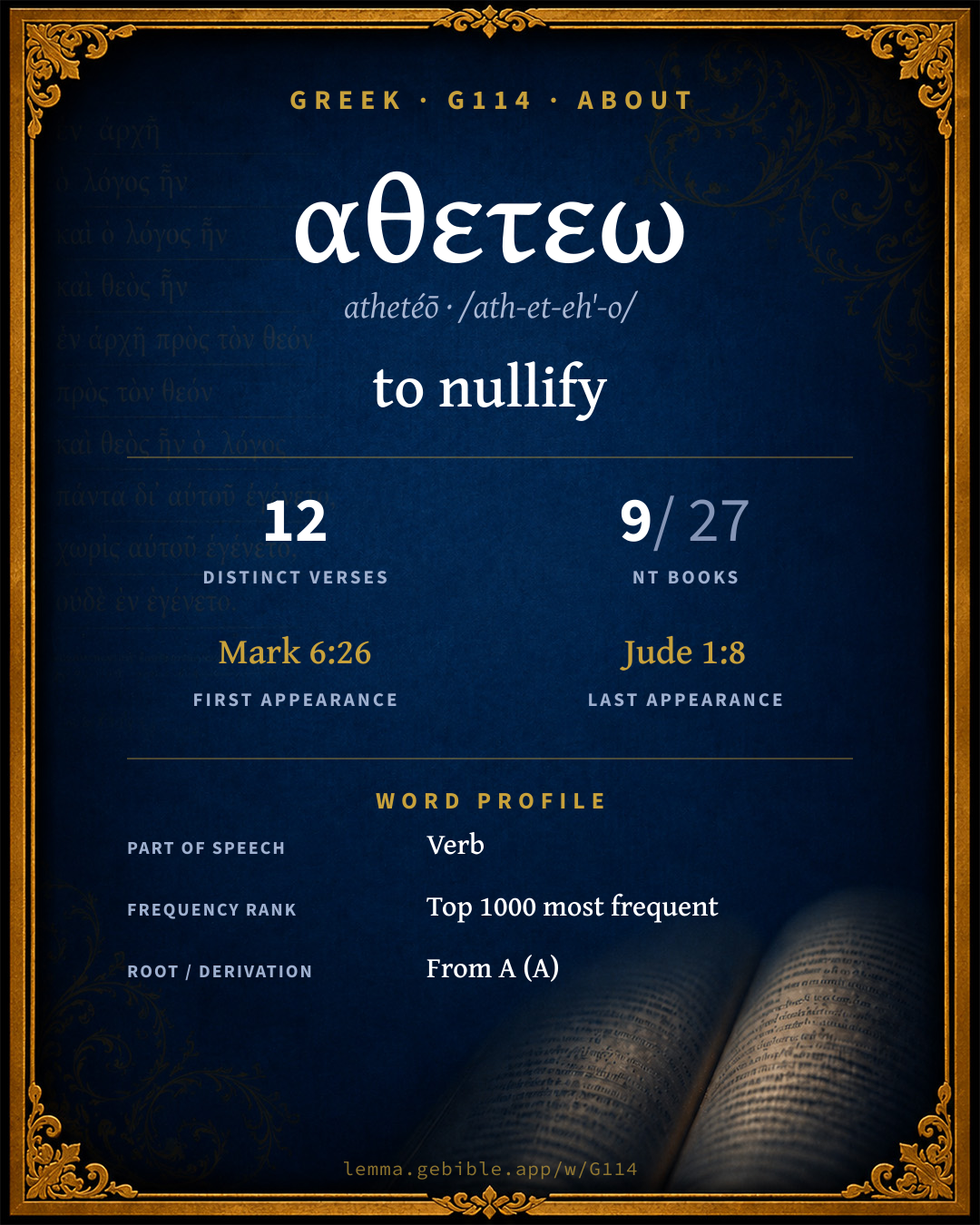
ἀθετέω
to nullify
‘to nullify’ is one of 3 main senses fuller range ↓
Full lexicon entry — Thayer's Greek Lexicon
From Thayer's Greek Lexicon
Where this word appears
Grammar key — what these labels mean
Part of speech
- Verb
- An action or state-of-being word.
Tense
- Present
- Ongoing or general action in present time (imperfective aspect).
- Aorist
- Action viewed as a simple whole, without regard to duration — often past (perfective aspect).
- Future
- Action expected in future time.
Voice
- Active
- The subject performs the action.
Mood
- Indicative
- States a fact or asks a factual question (the mood of reality).
- Participle
- A verbal adjective (“writing,” “having written”).
- Infinitive
- A verbal noun (“to write”), unmarked for person or number.
Case
- Nominative
- The case of the subject (and the predicate nominative).
Person
- 3rd person
- The one spoken about (“he / she / it / they”).
- 1st person
- The speaker (“I / we”).
- 2nd person
- The one addressed (“you”).
Gender
- Masculine
- Grammatically masculine.
Number
- Singular
- One.
- Plural
- More than one.
Every verse where G114 appears in the Book of Jude — 1 distinct verse. Click any verse to open its interlinear word-by-word view. Verse text shown in the World English Bible for context — . Each verse’s Greek form is shown with its reference; the English is not keyword-highlighted, since the data carries no word-level English alignment. Use “Compare translations” on any verse to read it across multiple English versions. This concordance covers the Greek New Testament; Septuagint (Greek Old Testament) occurrences of this word are not indexed here.
Jude
About this entry
At a glance — auto-summarized from this page’s data, not written by a person. Every figure links to its source below. This summary describes the numbers; it doesn’t interpret them.
“to nullify” is the headline sense of the Greek verb αθετεω (athetéō). First canonically at Mark 6:26, it enters the text early. The Greek New Testament uses it across 12 verses — uncommon. Catalogued under 3 senses, its meaning is not single-sense. It shares a root with Α, αβαρης and αβυσσος. See the sense tree, 12-verse concordance, and the renderings breakdown below.
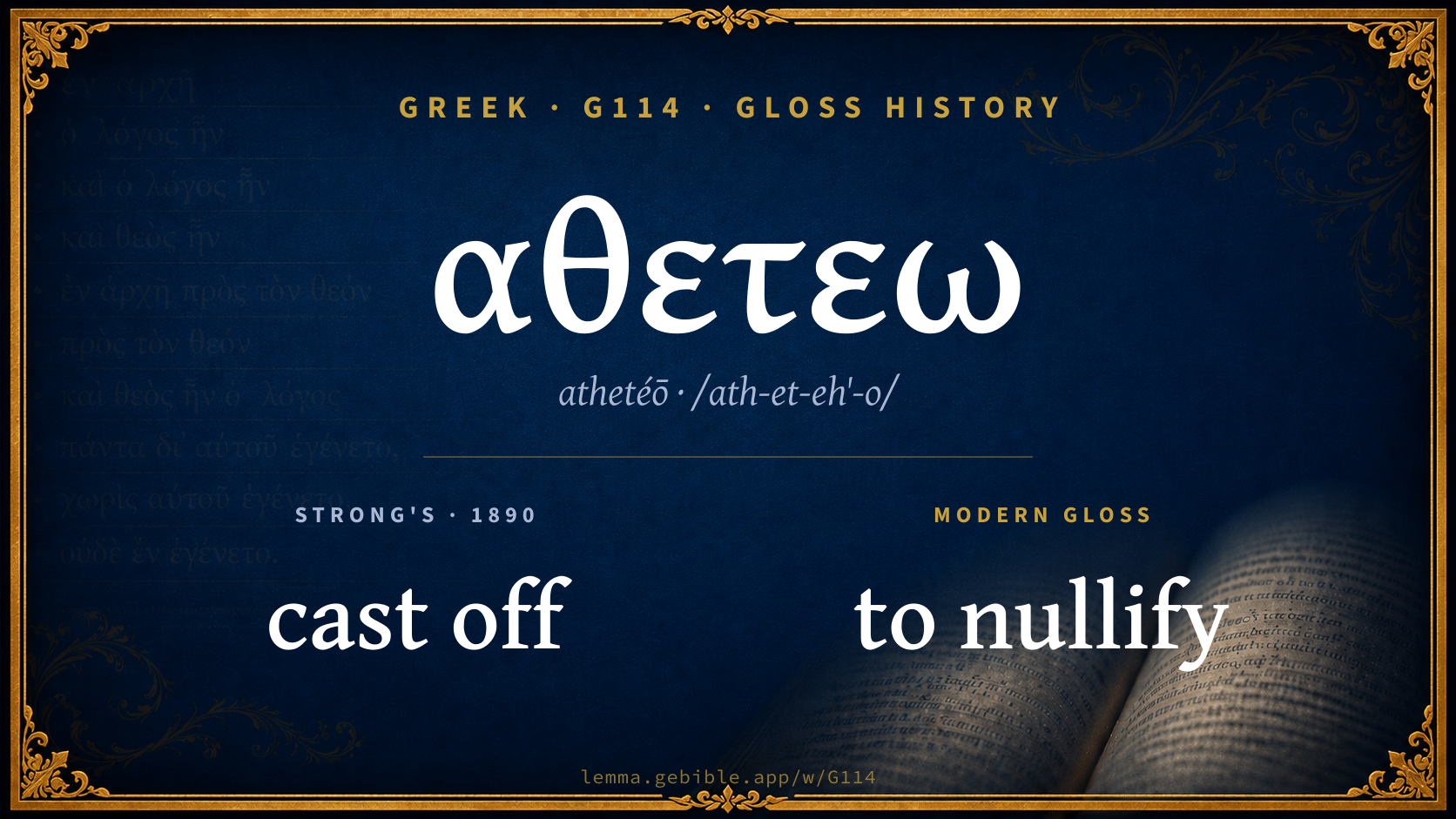
Gloss history
Strong's 1890 vs modern scholarship
About this word
Strong's G114 catalogs a Greek word from the Greek New Testament.
These counts are not copied from any lexicon or concordance. They are computed here, from the morphology-tagged Greek New Testament. What Lemma adds →
- 12
- distinct verses
- The word appears in 12 distinct verses.
- 9 / 27
- NT books
- The word appears in 9 of 27 New Testament books.
- #726
- by frequency
- Top 1000 most frequent Greek words (rank 726 of 5,347 Greek words by occurrence).
View all 12 occurrences in the concordance →
By section of the New Testament
By traditional corpus
Conventional, traditional groupings — biblical authorship is debated, so this is a traditional corpus grouping, not an authorship claim. Some books belong to more than one corpus (Luke is in both the Gospels and the Lukan corpus, and so on), so these shares overlap and need not total 100%. Each figure is a share of the word’s 12 distinct verses.
- Gospels 5 verses · 42%
- Pauline corpus 5 verses · 42%
- Lukan (Luke–Acts) 2 verses · 17%
- Johannine 1 verse · 8%
- Hebrews 1 verse · 8%
- General (Catholic) Epistles 1 verse · 8%
How translations render this word
Counts come from each version’s own published word-to-Strong’s tagging or interlinear alignment — an approximate guide to how each version renders this word, not a word-level alignment the data otherwise carries. Because each total is that version’s own tagged count, the per-version totals vary from one another and need not match the appearance or distinct-verse counts above. These counts may also differ from a printed concordance because Lemma counts each distinctly tagged rendering and does not collapse phrase taggings into a single head-word total. This is a fixed set of word-tagged versions (KJV, ASV, BSB, ULT) and does not change with the reading translation you choose elsewhere. Each version’s license is shown beside its name below (and on Sources).
- King James Version: Despiseth 4×, He that despiseth 2×
- American Standard Version: Rejecteth 4×, He that rejecteth 3×
- Berean Standard Bible: Rejects 6×, Reject 2×, Rejected 2×
- unfoldingWord Literal Text: Rejecting 4×, Rejects 3×
King James Version Public Domain
Renders G114 across 17 tagged occurrences — most commonly:
Plus 11 renderings that appear only once — usually multi-word phrases or single function words the recovered tagging swept in, not distinct renderings.
American Standard Version Public Domain
Renders G114 across 17 tagged occurrences — most commonly:
Plus 10 renderings that appear only once — usually multi-word phrases or single function words the recovered tagging swept in, not distinct renderings.
Berean Standard Bible Public Domain
Renders G114 across 16 tagged occurrences — most commonly:
Plus 6 renderings that appear only once — usually multi-word phrases or single function words the recovered tagging swept in, not distinct renderings.
unfoldingWord Literal Text CC BY-SA 4.0
Renders G114 across 17 tagged occurrences — most commonly:
Plus 10 renderings that appear only once — usually multi-word phrases or single function words the recovered tagging swept in, not distinct renderings.
Senses in Thayer's
The 3 senses Thayer's distinguishes for this word, in lexicon order (not ranked by frequency or importance). The full entry — with sub-senses — is in the Lexicon Entry tab.
- to do away with, to set aside, disregard
- to thwart the efficacy of anything, nullify, make void, frustrate
- to reject, to refuse, to slight
Word origin
Derived from Α (A) (G1) — alpha.
Forms in the corpus
The 9 distinct written forms G114 takes in the Greek New Testament, most frequent first — each parse links to that tense’s occurrences in the concordance.
| Form | Parsing | Example | Uses |
|---|---|---|---|
| ἀθετεῖ atheteî | Verb, Present, Active, Indicative, 3rd person, Singular | Luke 10:16 | 4 |
| ἀθετῶν athetō̂n | Verb, Present, Active, Participle, Nominative, Singular, Masculine | Luke 10:16 | 4 |
| ἠθέτησαν ēthétēsan | Verb, Aorist, Active, Indicative, 3rd person, Plural | Luke 7:30 | 2 |
| ἀθετήσας athetḗsas | Verb, Aorist, Active, Participle, Nominative, Singular, Masculine | Hebrews 10:28 | 1 |
| ἀθετήσω athetḗsō | Verb, Future, Active, Indicative, 1st person, Singular | 1 Corinthians 1:19 | 1 |
| ἀθετεῖτε atheteîte | Verb, Present, Active, Indicative, 2nd person, Plural | Mark 7:9 | 1 |
| ἀθετοῦσιν athetoûsin | Verb, Present, Active, Indicative, 3rd person, Plural | Jude 1:8 | 1 |
| ἀθετῆσαι athetē̂sai | Verb, Aorist, Active, Infinitive | Mark 6:26 | 1 |
| ἀθετῶ athetō̂ | Verb, Present, Active, Indicative, 1st person, Singular | Galatians 2:21 | 1 |
Same root — word family
Other Thayer's entries built from the same root as G114, grouped by Strong’s listed origin. These share a root / origin per the lexicon — not necessarily a shared meaning. Each links to that word’s own entry.
Derives from
Shares the same root
- αβαρης abarḗs G4 light
- αβυσσος ábyssos G12 abyss
- αγαμος ágamos G22 unmarried
- αγενεαλογητος agenealógētos G35 without genealogy
- αγενης agenḗs G36 ignoble
- αγναφος ágnaphos G46 unprocessed
- αγνοεω agnoéō G50 to be ignorant
- αγνωσια agnōsía G56 ignorance
- αγνωστος ágnōstos G57 unknown
- αγραμματος agrámmatos G62 unlearned
- αγρυπνεω agrypnéō G69 to watch
- αδαπανος adápanos G77 free
- αδελφος adelphós G80 brother
- αδηλος ádēlos G82 obscure
- αδης háidēs G86 hell
- αδιακριτος adiákritos G87 clear
- αδιαλειπτος adiáleiptos G88 continual
- αδικος ádikos G94 unjust
- αδοκιμος adókimos G96 unapproved
- αδολος ádolos G97 guileless
- αδυνατος adýnatos G102 weak
- αζυμος ázymos G106 unleavened
- αθανασια athanasía G110 immortal
- αθεμιτος athémitos G111 unlawful
+149 more words share this root (not shown).
Derived from this word
Proper names from this root
People and places named from this root — a name, not an additional meaning of the word.
Compare all same-root words → Showing 4 of 177 — not the complete family. 1 of the same-root words is a proper name (a person or place). They share a root, not necessarily a meaning.
Septuagint usage
The same Greek word αθετεω appears 52 times in the Greek Old Testament (Septuagint), across 43 verses in 15 books.
- 52
- LXX occurrences
- Tagged occurrences of this Greek word in the Septuagint.
- 43
- verses
- Distinct Septuagint verses containing this word.
- 15 / 39
- OT books
- The word appears in 15 of the 39 Old Testament books.
Sample Septuagint occurrences
- Exodus 21:8 ἀθετέω
- Deuteronomy 21:14 ἀθετέω
- Judges 9:23 ἀθετέω
- 1 Samuel 2:17 ἀθετέω
- 1 Kings 8:50 ἀθετέω
- 2 Kings 1:1 ἀθετέω
- 1 Chronicles 2:7 ἀθετέω
- 2 Chronicles 10:19 ἀθετέω
- Esther 2:15 ἀθετέω
- Psalms 14:4 ἀθετέω
- Isaiah 1:2 ἀθετέω
- Jeremiah 3:20 ἀθετέω
Septuagint occurrences (same lexeme)
Every verse where the same Strong’s number (G114) appears in the Greek Septuagint. Verse text shown in the World English Bible for context; the Greek form is the matched word — the English is not keyword-highlighted.
- Exodus 21:8 ἀθετέω If she doesn't please her master, who has married her to himself, then he shall let her be redeemed. He shall have no right to sell her to a foreign people, seeing he has dealt deceitfully with her.
- Deuteronomy 21:14 ἀθετέω It shall be, if you have no delight in her, then you shall let her go where she will; but you shall not sell her at all for money, you shall not deal with her as a slave, because you have humbled her.
- Judges 9:23 ἀθετέω God sent an evil spirit between Abimelech and the men of Shechem; and the men of Shechem dealt treacherously with Abimelech:
- 1 Samuel 2:17 ἀθετέω The sin of the young men was very great before Yahweh; for the men despised the offering of Yahweh.
- 1 Samuel 13:3 ἀθετέω Jonathan struck the garrison of the Philistines that was in Geba: and the Philistines heard of it. Saul blew the trumpet throughout all the land, saying, Let the Hebrews hear.
- 1 Kings 8:50 ἀθετέω and forgive your people who have sinned against you, and all their transgressions in which they have transgressed against you; and give them compassion before those who carried them captive, that they may have compassion on them
- 1 Kings 12:19 ἀθετέω So Israel rebelled against the house of David to this day.
- 2 Kings 1:1 ἀθετέω Moab rebelled against Israel after the death of Ahab.
- 2 Kings 3:5 ἀθετέω But it happened, when Ahab was dead, that the king of Moab rebelled against the king of Israel.
- 2 Kings 3:7 ἀθετέω He went and sent to Jehoshaphat the king of Judah, saying, The king of Moab has rebelled against me: will you go with me against Moab to battle? He said, I will go up: I am as you are, my people as your people, my horses as your horses.
- 2 Kings 8:20 ἀθετέω In his days Edom revolted from under the hand of Judah, and made a king over themselves.
- 2 Kings 8:22 ἀθετέω So Edom revolted from under the hand of Judah to this day. Then did Libnah revolt at the same time.
- 2 Kings 18:7 ἀθετέω Yahweh was with him; wherever he went forth he prospered: and he rebelled against the king of Assyria, and didn't serve him.
- 2 Kings 18:20 ἀθετέω You say (but they are but vain words), [There is] counsel and strength for the war. Now on whom do you trust, that you have rebelled against me?
- 2 Kings 24:1 ἀθετέω In his days Nebuchadnezzar king of Babylon came up, and Jehoiakim became his servant three years: then he turned and rebelled against him.
- 2 Kings 24:20 ἀθετέω For through the anger of Yahweh did it happen in Jerusalem and Judah, until he had cast them out from his presence. Zedekiah rebelled against the king of Babylon.
- 1 Chronicles 2:7 ἀθετέω The sons of Carmi: Achar, the troubler of Israel, who committed a trespass in the devoted thing.
- 1 Chronicles 5:25 ἀθετέω They trespassed against the God of their fathers, and played the prostitute after the gods of the peoples of the land, whom God destroyed before them.
- 2 Chronicles 10:19 ἀθετέω So Israel rebelled against the house of David to this day.
- 2 Chronicles 36:13 ἀθετέω He also rebelled against king Nebuchadnezzar, who had made him swear by God: but he stiffened his neck, and hardened his heart against turning to Yahweh, the God of Israel.
- 2 Chronicles 36:14 ἀθετέω Moreover all the chiefs of the priests, and the people, trespassed very greatly after all the abominations of the nations; and they polluted the house of Yahweh which he had made holy in Jerusalem.
- Esther 2:15 ἀθετέω Now when the turn of Esther, the daughter of Abihail the uncle of Mordecai, who had taken her for his daughter, was come to go in to the king, she required nothing but what Hegai the king's chamberlain, the keeper of the women, appointed. Esther obtained favor in the sight of all those who looked at her.
- Psalms 14:4 ἀθετέω Have all the workers of iniquity no knowledge, Who eat up my people as they eat bread, And don't call on Yahweh?
- Psalms 32:10 ἀθετέω Many sorrows shall be to the wicked, But he who trusts in Yahweh, loving kindness shall surround him.
- Psalms 88:35 ἀθετέω
- Psalms 131:11 ἀθετέω
- Isaiah 1:2 ἀθετέω Hear, heavens, And listen, earth; for Yahweh has spoken: I have nourished and brought up children, And they have rebelled against me.
- Isaiah 21:2 ἀθετέω A grievous vision is declared to me; the treacherous man deals treacherously, and the destroyer destroys. Go up, Elam; besiege, Media; all the sighing of it have I made to cease.
- Isaiah 24:16 ἀθετέω From the uttermost part of the earth have we heard songs: Glory to the righteous. But I said, I pine away, I pine away, woe is me! the treacherous have dealt treacherously; yes, the treacherous have dealt very treacherously.
- Isaiah 31:2 ἀθετέω Yet he also is wise, and will bring evil, and will not call back his words, but will arise against the house of the evil-doers, and against the help of those who work iniquity.
- Isaiah 33:1 ἀθετέω Woe to you who destroy, and you weren't destroyed; and deal treacherously, and they didn't deal treacherously with you! When you have ceased to destroy, you shall be destroyed; and when you have made an end of dealing treacherously, they shall deal treacherously with you.
- Isaiah 48:8 ἀθετέω Yes, you didn't hear; yes, you didn't know; yes, from of old your ear was not opened: for I knew that you did deal very treacherously, and was called a transgressor from the womb.
- Isaiah 63:8 ἀθετέω For he said, Surely, they are my people, children who will not deal falsely: so he was their Savior.
- Jeremiah 3:20 ἀθετέω Surely as a wife treacherously departs from her husband, so have you dealt treacherously with me, house of Israel, says Yahweh.
- Jeremiah 5:11 ἀθετέω For the house of Israel and the house of Judah have dealt very treacherously against me, says Yahweh.
- Jeremiah 9:1 ἀθετέω Oh that my head were waters, and my eyes a spring of tears, that I might weep day and night for the slain of the daughter of my people!
- Jeremiah 12:1 ἀθετέω Righteous are you, Yahweh, when I contend with you; yet would I reason the cause with you: why does the way of the wicked prosper? why are all they at ease who deal very treacherously?
- Jeremiah 12:6 ἀθετέω For even your brothers, and the house of your father, even they have dealt treacherously with you; even they have cried aloud after you: don't believe them, though they speak beautiful words to you.
- Jeremiah 15:16 ἀθετέω Your words were found, and I ate them; and your words were to me a joy and the rejoicing of my heart: for I am called by your name, Yahweh, God of hosts.
- Lamentations 1:2 ἀθετέω She weeps sore in the night, and her tears are on her cheeks; Among all her lovers she has none to comfort her: All her friends have dealt treacherously with her; they are become her enemies.
- Ezekiel 22:26 ἀθετέω Her priests have done violence to my law, and have profaned my holy things: they have made no distinction between the holy and the common, neither have they caused men to discern between the unclean and the clean, and have hid their eyes from my Sabbaths, and I am profaned among them.
- Ezekiel 39:23 ἀθετέω The nations shall know that the house of Israel went into captivity for their iniquity; because they trespassed against me, and I hid my face from them: so I gave them into the hand of their adversaries, and they fell all of them by the sword.
- Daniel 3:95 ἀθετέω
These are occurrences of the same Greek lexeme (G114) in the Septuagint — not a translation of any one Hebrew word. The store carries no word-level Hebrew↔Greek alignment, so no Hebrew original is asserted here. Counts come from the recovered LXX Strong's tagging — high-frequency vocabulary is well covered, while rare or late forms may be untagged — so they reflect tagged occurrences and may slightly undercount.