Ephesians 4:22

Greek (Tischendorf 8th ed.) Ephesians 4:22 appears in the Greek New Testament. The text above is from the Tischendorf 8th edition. Each word links to its Strong’s number and a concise gloss. Click any word for its full Thayer’s Greek Lexicon entry.
Download image
Cite this verse

Ephesians 4:22 (World English Bible). Public Domain. Lemma interlinear Bible study tool, https://lemma.gebible.app/v/ephesians/4/22.

Show BibTeX & RIS
BibTeX
RIS
English Translation
that you put away, as concerning your former way of life, the old man, that grows corrupt after the lusts of deceit;
World English Bible · Public Domain
Download a study sheet

One document with this verse’s original text, its word-by-word gloss line, the meaning frame, cross-references with their text, attributed commentary, and full source and license credits — printable, and it pastes into notes with its structure intact.

This verse Autodidact and up

Study sheet (.html) Plain text (.txt)

A passage Seminary Student

Up to 50 verses in one chapter. A passage sheet keeps up to 6 commentary sources and 12 cross-references per verse, in the order this page ranks them, and says so on the sheet whenever that leaves anything out. Ask for a single verse and you get the Autodidact verse sheet above.

Everything on this page stays free to read, with no account — the sheet is a download of what is already on screen, not access to it.

Want to remove ads? Support Godless Engineer
Compare translations 3

The same verse in 3 English versions, stacked beneath the original-language interlinear above. Click any original word for its lexicon entry.

Each is an independent rendering of the whole verse — the interlinear is not word-aligned to these translations.

Highlighted words mark where these versions differ — a whole-verse word diff, not a word-by-word alignment.

  • World English Bible Public Domain
    that you put away, as concerning your former way of life, the old man, that grows corrupt after the lusts of deceit;
  • King James Version Public Domain
    That ye put off concerning the former conversation the old man, which is corrupt according to the deceitful lusts;
  • unfoldingWord Literal Text CC BY-SA 4.0
    You are to put aside belongs to your former manner of life, the old man being corrupted according to deceitful desires,

unfoldingWord Literal Text — © unfoldingWord, licensed CC BY-SA 4.0. Word-aligned USFM3 via Door43 (git.door43.org/unfoldingWord/en_ult).

Versions to compare (up to 4)

3 of 4 selected

Show all 19 translations

Every available English version of this verse, each an independent rendering of the whole verse.

  • World English Bible Public Domain
    that you put away, as concerning your former way of life, the old man, that grows corrupt after the lusts of deceit;
  • Berean Standard Bible Public Domain
    to put off your former way of life, your old self, which is being corrupted by its deceitful desires;
  • Majority Standard Bible Public Domain
    to put off your former way of life, your old self, which is being corrupted by its deceitful desires;
  • King James Version Public Domain
    That ye put off concerning the former conversation the old man, which is corrupt according to the deceitful lusts;
  • American Standard Version (1901) Public Domain
    that ye put away, as concerning your former manner of life, the old man, that waxeth corrupt after the lusts of deceit;
  • Revised Version (1885) Public Domain
    that ye put away, as concerning your former manner of life, the old man, which waxeth corrupt after the lusts of deceit;
  • Geneva Bible (1599) Public Domain
    That is, that yee cast off, concerning the conuersation in time past, that olde man, which is corrupt through the deceiueable lustes,
  • Douay-Rheims (1899) Public Domain
    To put off, according to former conversation, the old man, who is corrupted according to the desire of error.
  • Young's Literal Translation Public Domain
    ye are to put off concerning the former behaviour the old man, that is corrupt according to the desires of the deceit,
  • Literal Standard Version CC BY-SA 4.0
    concerning the former behavior you are to put off the old man, that is corrupt according to the desires of the deceit,
  • Unlocked Literal Bible CC BY-SA 4.0
    You were taught to put off what belongs to your former manner of life, to put off the old man. It is the old man that is corrupt because of its deceitful desires.
  • unfoldingWord Literal Text CC BY-SA 4.0
    You are to put aside belongs to your former manner of life, the old man being corrupted according to deceitful desires,
  • Darby Bible Public Domain
    [namely] your having put off according to the former conversation the old man which corrupts itself according to the deceitful lusts;
  • World Messianic Bible Public Domain
    that you put away, as concerning your former way of life, the old man that grows corrupt after the lusts of deceit,
  • Webster's Bible Public Domain
    That ye put off concerning the former manner of life the old man, which is corrupt according to the deceitful lusts:
  • Free Bible Version CC BY-SA 4.0
    So get rid of your former lifestyle, that old nature that ruins you through deceptive desires!
  • Bible in Basic English Public Domain
    That you are to put away, in relation to your earlier way of life, the old man, which has become evil by love of deceit;
  • Text-Critical English NT CC BY 4.0
    to put off your old self, which belongs to your former way of life and is being corrupted by its deceitful desires,
  • Tyndale New Testament (1534) Public Domain
    So then as concernynge the coversacion in tyme past laye from you that olde man which is corrupte thorow the deceavable lustes

Literal Standard Version (2020), Covenant Press — licensed CC BY-SA 4.0. Text via the HelloAO Bible API (eBible.org). Unlocked Literal Bible (unfoldingWord) — licensed CC BY-SA 4.0. Text via the HelloAO Bible API (eBible.org). unfoldingWord Literal Text — © unfoldingWord, licensed CC BY-SA 4.0. Word-aligned USFM3 via Door43 (git.door43.org/unfoldingWord/en_ult). Free Bible Version, Dr. Jonathan Gallagher — licensed CC BY-SA 4.0. Text via the HelloAO Bible API (eBible.org).

Word by word

More ways to search: Search by grammar → Find every occurrence → Compare this word →

Practice this passage: Drill this verse → Learn its vocabulary →

ἀπάτης
apátē
G539
“deceit”
Noun, Genitive, Singular, Feminine
Part of Speech
Noun
Case
Genitive
Number
Singular
Gender
Feminine
Full Thayer's Definition

Origin: from G538

TDNT: 07:25,7

1. deceit, deceitfulness
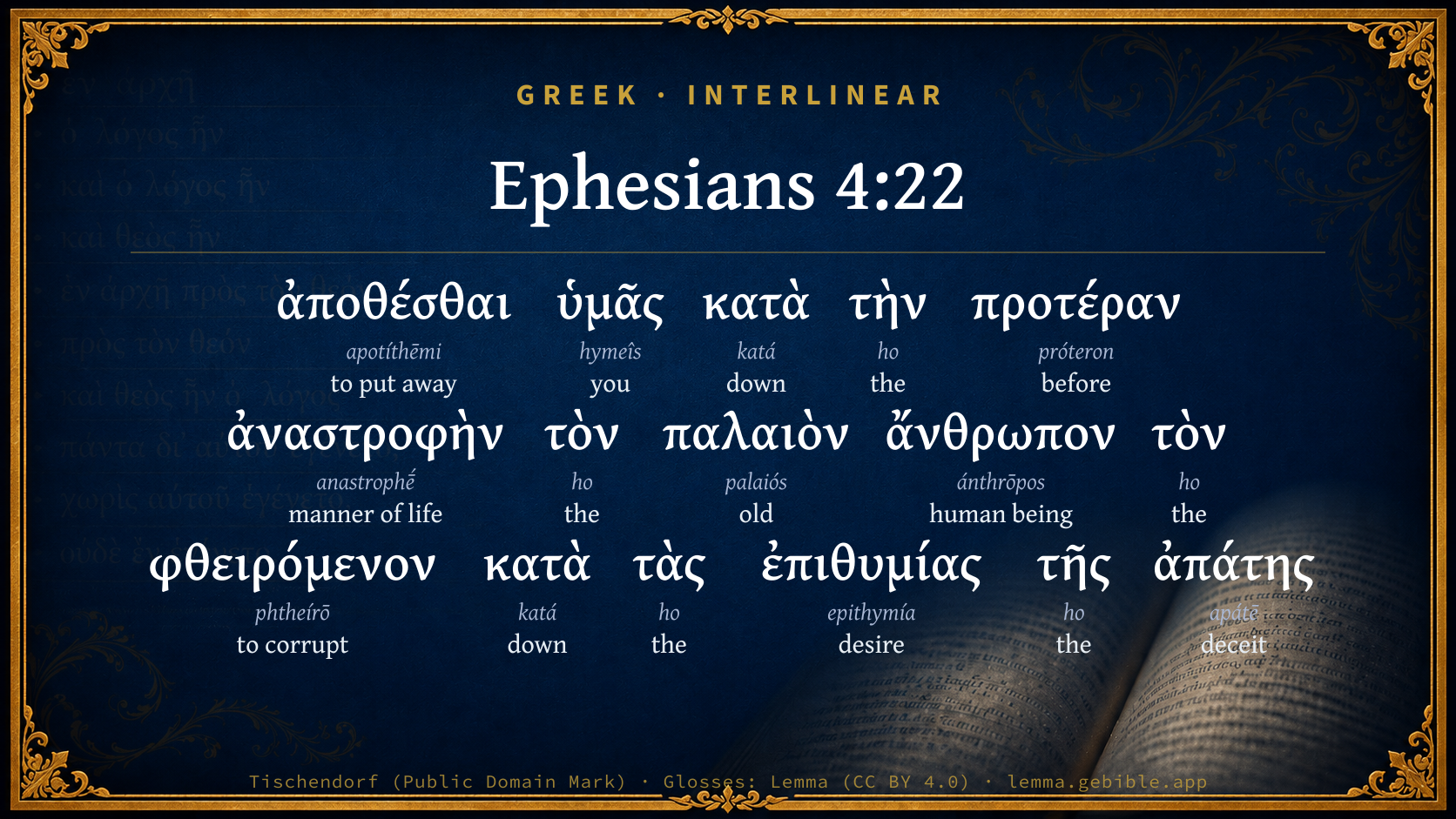
  1. ἀποθέσθαι apotíthēmi G659 “to put away” Verb, Aorist, Middle, Infinitive
  2. ὑμᾶς hymeîs G5210 “you” Personal pronoun, 2nd person, Accusative, Plural
  3. κατὰ katá G2596 “down” Preposition
  4. τὴν ho G3588 “the” Article, Accusative, Singular, Feminine
  5. προτέραν próteron G4386 “before” Adjective, Accusative, Singular, Feminine, Comparative
  6. ἀναστροφὴν anastrophḗ G391 “manner of life” Noun, Accusative, Singular, Feminine
  7. τὸν ho G3588 “the” Article, Accusative, Singular, Masculine
  8. παλαιὸν palaiós G3820 “old” Adjective, Accusative, Singular, Masculine
  9. ἄνθρωπον ánthrōpos G444 “human being” Noun, Accusative, Singular, Masculine
  10. τὸν ho G3588 “the” Article, Accusative, Singular, Masculine
  11. φθειρόμενον phtheírō G5351 “to corrupt” Verb, Present, Passive, Participle, Accusative, Singular, Masculine
  12. κατὰ katá G2596 “down” Preposition
  13. τὰς ho G3588 “the” Article, Accusative, Plural, Feminine
  14. ἐπιθυμίας epithymía G1939 “desire” Noun, Accusative, Plural, Feminine
  15. τῆς ho G3588 “the” Article, Genitive, Singular, Feminine

About this verse

These counts appear in no published source. They are computed here, from the morphology-tagged text and Lemma’s own curated glosses. What Lemma adds →

16
words
11
distinct lemmas
Pauline Epistles
section

Notable vocabulary

The rarest word here is ἀπάτης deceit G539 — appearing just 7 times in the whole Greek New Testament.

Shared distinctive vocabulary

ἀπάτης deceit G539 occurs in 7 verses of the Greek New Testament. Also found in:

Repetition

Words recur within this verse:

Cross-references

19

Topical passages linked to Ephesians 4:22 in the Treasury of Scripture Knowledge — connected by theme and wording, ordered by reader-vote popularity; previews shown in the World English Bible.

  • Romans 6:6 knowing this, that our old man was crucified with him, that the body of sin might be done away with, so that we would no longer be in bondage to sin.
  • Hebrews 12:1 Therefore let us also, seeing we are surrounded by so great a cloud of witnesses, lay aside every weight and the sin which so easily entangles us, and let us run with patience the race that is set before us,
  • James 1:21 Therefore, putting away all filthiness and overflowing of wickedness, receive with humility the implanted word, which is able to save your souls.
  • 1 Peter 2:1–2 Putting away therefore all wickedness, all deceit, hypocrisies, envies, and all evil speaking,
  • Hebrews 3:13 but exhort one another day by day, so long as it is called "today;" lest any one of you be hardened by the deceitfulness of sin.
  • Colossians 3:7–9 You also once walked in those, when you lived in them;
  • Titus 3:3 For we were also once foolish, disobedient, deceived, serving various lusts and pleasures, living in malice and envy, hateful, and hating one another.
  • Ephesians 4:25 Therefore, putting away falsehood, speak truth each one with his neighbor. For we are members one of another.
  • Ephesians 4:17 This I say therefore, and testify in the Lord, that you no longer walk as the rest of the Gentiles also walk, in the futility of their mind,
  • 1 Peter 4:3 For we have spent enough of our past time doing the desire of the Gentiles, and having walked in lewdness, lusts, drunken binges, orgies, carousings, and abominable idolatries.
  • 2 Peter 2:13 receiving the wages of unrighteousness; people who count it pleasure to revel in the day-time, spots and blemishes, reveling in their deceit while they feast with you;
  • 1 Peter 1:18 knowing that you were redeemed, not with corruptible things, with silver or gold, from the useless way of life handed down from your fathers,
  • Ezekiel 18:30–32 Therefore I will judge you, house of Israel, everyone according to his ways, says the Lord Yahweh. Return you, and turn yourselves from all your transgressions; so iniquity shall not be your ruin.
  • Colossians 2:11 in whom you were also circumcised with a circumcision not made with hands, in the putting off of the body of the sins of the flesh, in the circumcision of Christ;
  • Obadiah 1:3 The pride of your heart has deceived you, you who dwell in the clefts of the rock, whose habitation is high, who says in his heart, 'Who will bring me down to the ground?'
  • Ephesians 2:3 among whom we also all once lived in the lust of our flesh, doing the desires of the flesh and of the mind, and were by nature children of wrath, even as the rest.
  • Job 22:23 If you return to the Almighty, you shall be built up, If you put away unrighteousness far from your tents.
  • Proverbs 11:18 Wicked people earn deceitful wages, But one who sows righteousness reaps a sure reward.
  • Jeremiah 49:16 As for your terror, the pride of your heart has deceived you, O you who dwell in the clefts of the rock, who hold the height of the hill: though you should make your nest as high as the eagle, I will bring you down from there, says Yahweh.

Cross-references courtesy of OpenBible.info (CC BY 4.0).

Commentary

Notes on Ephesians 4:22 from classic Christian and Jewish commentators (each source and its license shown beneath its notes). The classic Christian expositions comment on the surrounding passage and are grouped to its opening verse, so a note may address several verses; the Jewish commentaries on the Tanakh (Rashi and others) are per-verse, so they appear only where the commentator wrote on this verse.

Lemma curates 59 commentaries, every one of them public domain or Creative Commons licensed, each selected and text-cleaned for this edition rather than reprinted as found. About our sources →

The Biblical Illustrator

Joseph S. Exell

Eph_4:22

That ye put off concerning the former conversation the old man which is corrupt according to the deceitful lusts.

Morality the basis of piety

A Christian life, here, is regarded as it were from the latent similitude of raiment. As a beggar puts off his rags--his tattered and torn habiliments--and is clothed like an honoured man; so we are to put off the old man and his deeds--clothing, as it were--and put on the new man, created in righteousness and true holiness. Or, as one that has been in an infected port must lay aside the garments that have in them the seed of disease, and be clothed afresh, so that he shall neither carry it for himself, nor contagion for others; so we are to put off the old, and put on the new. But you will observe that there are in this passage which I have read inculcations of certain fundamental morals, as precedent to the full work of God in the soul. Truth, in opposition to lies; honesty, in opposition to craft and stealing; purity, in opposition to all manner of corrupt desires; general integrity and uprightness--these are inculcated as the indispensable prerequisites of Christian life. Taking them in their inverse order, by purity I understand the dominance in the soul of the higher affections and sentiments over the lower appetites and passions. It is the term that antagonizes with a life of lust and of salacious desire. We mean by purity, the predominance of the affections and of the moral sentiments. By fidelity, one means, in a general way, the absolute faithfulness of men to trust reposed in them--that tendency in a man which makes it sure that he will be faithful in his relations to others, and in all his trusts. By honesty, I mean righteous, equitable dealing in all relations between man and man--not what the law requires, but what is, according to mans best light, right between man and man. By truth, is meant the inward love of that which is, and the disposition to use the truth of fact and the truth of relation, just as they are, in all our representations among men. These qualities must exist in controlling strength in every worthy character. As it is in the matter of truth, so it is in the matter of honesty. Is he an honest man? Oh! I do not think he would steal. But is he an honest man? Would he knowingly take advantage? Well, it is not for me to say. Its for you to say. You have said it. Not to be able to say the contrary is to say that. And are there not hundreds of thousands of men who hold their heads up very well as they move in society, who are for the time being prosperous, and of whom those that know them say, They will take every advantage they can; they need watching; they need all that the Church gives them, and all that the customs of society give them, to keep them from dishonesty. A mans reputation always tracks him, and follows him; and if it is in him to be dishonest, it is in ether people to know it. Your reputation is only the shadow that your character throws. Now, on character and reputation a mans prosperity depends in this world, largely. The man who has the goodwill and the good nature of the men among whom he lives, of the society in which he dwells, is like a craft that has the wind astern, and is helped thereby. Truth, honesty, fidelity, and purity win confidence. And there is this capital for a young man. These qualities, too, simplify the working forces of life. A crafty, plotting man always has a tangled skein in his hand. He has to think, What did I say yesterday? and he forgets. He has to think, Let me see; did I, or did I not, cheat on this or that occasion? A dishonest man has to keep a journal, or he will be perpetually running across his own tracks. No mans memory is good enough journal for such a purpose as that. Men are made safe, too, by these simple and sterling virtues. He certainly is safe, who, whether he be at the top or at the bottom, alike is prosperous; but when a mans prosperity turns largely upon his actual manhood, his manhood does not depend upon his relative position in regard to wealth. There is the man of the Island, Garibaldi, just making the ends meet; just gaining his raiment and food; refusing bribes, refusing gifts, refusing all overtures of greatness that are in the lower sphere; a man that lives with a magnificent ambition of patriotism and a perpetual sacrifice of himself. When all the stuff that we can call men in our day--the buyable, the bribable, stuff--is washed away in the sewer, such men as these will stand, and their names shall be held in everlasting remembrance. The memory of the wicked shall rot. The name of the righteous shall shine brighter and brighter until the very perfect day. In application of these views and reasonings I remark--

1. How few can stand an examination on these fundamental points, if they take the law of God as their light and their test!

2. Not, less, perhaps more, is required of women than of men. Their relations to society, their relations as wives and mothers, make it peculiarly desirable that they should be fountains and models of virtue.

3. These simple moralities, in our circumstances in life, and under the temptations which are brought to bear upon us, will necessitate a determined battle. Some men conquer easier than others. I believe in hereditary tendencies. Men like gilded characters and silvered characters; but they do not like gold nor silver in character. And there is a prevalent impression that a man stands in his own way if he is too rigorous. You shall hear it said, What does a man want to be such a fanatical fool for, as to always tell the truth? What is the use of a mans breaking his own back by being so honest as that? Great are the forces that are ready to pull you down; but if you did but know it, greater are they that are for you than are they that are against you. (H. W. Beecher.)

Putting off the old man, and putting on the new

I. The apostles description of holiness. It is putting off the old man, or the corrupt nature so called, which hath spread its influence throughout the whole man, the soul (Eph_4:17-20), and the body (Rom_6:13; Rom_6:19); and which, like a man, consists of various parts. The deeds of the old man are very vigorous and strong, though old: mighty deeds (Gal_5:19-22; Eph_4:25-29); each member acts its part: unbelief, like the heart causing the blood to circulate through the whole body, influences all the other members: pride produces contention, contumely, strife, etc.; self-will leads to murmuring, disobedience, presumption, etc. This must be put off: the metaphor is borrowed from an old worn-out or unclean garment, which we would cast off with abhorrence. We must also be renewed in the spirit of our minds, in the faculties of the soul, by obtaining an enlightened understanding, rectified will, pure and well-regulated affections. We must put on the new man, a new creature: so called because it influences the whole man, soul and body (text, and 1Th_5:23; 1Co_6:20). And it consists of different parts--the soul in which God dwells, and which He animates, influences, directs, actuates, commands (1Co_6:19; 2Co_6:16; Eph_2:22; Rom_8:9-14; the body and its members (Col_3:12-17; Gal_5:22); holiness, righteousness, viz., faith, humility, self-denial, love, meekness, gentleness, patience, etc. The deeds of the new man, are all vigorous, strong, active. It is the image of God, created by Him, renewed in knowledge. This must be put on as a robe of righteousness.

II. The importance of taking this advice of the apostle. If we take it not, our Christianity is but a name or profession, and will only render us more guilty. We cannot glorify God, as being unlike to Him, and at enmity with Him. Nor can we set a good example, and thereby edify others, for the corrupt tree will bring forth corrupt fruit. We cannot be happy ourselves, for this old man is corrupt, like an old, threadbare, ragged, and dirty garment, which cannot cover us, which exposes us to shame, and is offensive, hurtful, encumbering, and entangling. All the evil dispositions of it are productive of misery. Its lusts or desires are foolish, unreasonable, violent, insatiable, deceitful; promising, but not yielding satisfaction. We are not fitted for, and cannot enter heaven without the new man.

III. How to attain this holiness. It is the gift of God: He creates it; but not without our cooperation; He works on us as upon rational creatures, not superseding but directing and assisting us in the use of our faculties, and has appointed certain means to be used by us. We are to hunger and thirst after righteousness; and in order to this, should consider frequently, nay continually, the nature and necessity of it, our want of it, the great worth of it, Gods willingness to give it, and cultivate a spirit of prayer. (J. Benson, D. D.)

That ye put off the old man.--

Putting off

I. Christian life begins with renunciation. Put off concerning the former conversation--the old man--the corrupt self that has been fostered under the influence of worldly, carnal views.

1. This renunciation must be profound. The old man, i.e., our former unconverted self. We must be careful that we do not confound this personal repudiation with any ecclesiastical rite or relationship. The purity demanded of us is inward, spiritual, moral. It is one thing to stand right with the Church, to be blameless concerning its ordinances, to be acknowledged by its authorites, to be fortified by its sacraments; it is another thing to renounce sin and embrace righteousness before Him who is a Spirit, and who judgeth not according to the outward appearance, but according to the heart.

2. This renunciation must be complete. The old man is the personification of our whole sinful condition before regeneration, and the old man is not to be maimed, some fragments of the mutilated personality to be rejected, some to be retained, but he must be crucified, killed, put away once and forever. There must be, as we have seen, the thorough rejection of evil in our heart, even the evil we have loved longest and best. People sometimes say, Well, there is nothing wrong in the thing itself; no harm in the thing itself. Now the thing in itself is a fine theme for metaphysicians, but such a phrase may seriously mislead in practical life. What do we know about things in themselves? The theatre, intoxicating drink, cards, music, fiction, and a hundred other things--we know nothing of these things in themselves; we only know them relatively, the company into which they bring us, the influence they exert upon us, the habit of mind they tend to foster. Do not stay to determine what things are in themselves, inquire only what is their influence upon you, direct and indirect, and if that influence be not altogether pure and helpful, let such things go; be more afraid of sin than of puritanism.

3. This renunciation must be immediate. Daniel said to the king, Break off thy sins by righteousness (Dan_4:27). Our sins are not to be tapered off, or rounded off, but broken off short and sharp. It may be a dangerous thing suddenly to change our physical habits, but there is no danger in suddenly changing our bad habits for good ones; the danger is not to change them suddenly.

II. The success of our Christian life largely depends upon the thoroughness of the renunciation in which it begins. Putting off comes before putting on, and we can only put on the new man in the measure of the depth and determination with which we have put off the old. If there is any defect in our renunciation, it will infallibly betray itself, and greatly hinder us.

1. On the completeness of such renunciation depends our future health and soundness of spirit. If our repentance does not go deep, if the grace of God does not search and purify the very grounds of our life, we shall never enjoy soundness and strength. If any of the vicious element is left, it will work and spoil the sweetness of our soul.

2. On the completeness of this renunciation depends our future freedom and happiness. It is essential to the freedom and peace of our life that we should break utterly with the world.

3. On the completeness of this renunciation depends the full attainment of spiritual beauty of character. Stephen Grellet, the Quaker preacher, said once to an assembly of his brethren, You are starched before you are washed. That is a bad thing indeed, for however much starch may be used, the original dirt will show through and disgrace the well-got-up robe. It is thus with character, as the graphic preacher taught. Some do not in conversation get rid of original weaknesses of character, and these show through raiment that the cleverest fuller has done his best to make dainty.

4. On the completeness of this renunciation largely depends our future safety. We all know people who have contracted vicious habits, who have suffered deeply in social respect, who have become linked in with a set they cannot renounce, and such people often feel, and their friends feel, that if they are ever to recover themselves and lead a new life, they must leave this country altogether and begin again with new scenes and associations; so these unfortunate ones often succeed in putting the ocean between themselves and the scene of their fall and misery, and so doing ofttimes proves their social salvation. So the safety of the new convert depends upon putting a whole ocean between his regenerate self and his old self. Whether we go to America or Australia or not, let us be sure, by Gods grace, that a great gulf is fixed between our present spirit and our past, between our new manner of life and our past, between our new manner of life and our past conversation. It has proved a fatal error to thousands not to have put away the old man as thoroughly as might be. (W. L. Watkinson.)

The new man driving out the old

How often do we see a tree well covered with the early shoots and young leaves, but yet with many of last years dead leaves still hanging on to the branches, intermixed with the latest and best of the summer growth, as if to remind one that even this tree, fresh in the glory of its summer clothing, was but a little while ago unsightly with dead and useless leaves. Nor will the tree rid itself of these till the full tide of sap has filled the branches with full-grown verdure, when the old leaves will drop to the earth, and no longer be cumbersome. The Christian, like the tree, bears fresh leaves of a new heart, and even the good fruit of a godly life, and seems at first to be all but faultless; but how often, on nearer view, do evil ways, bad habits, and wicked passions, come to view, and disfigure the beauty of the Christian man or woman, so that companions are reminded of the late winter of an unrenewed life, of the remainders of evil old leaves not yet all stripped off or blown away by the breath of the Divine chastisement. Nor will the Christian stand in perfect clothing, and without any evil thing, till the Divine influence has permeated every part of the soul, and driven from it the remaining traces of the old Adam. (Austen.)

Religion and human nature

Some years ago, the great country of India was in a ferment of wild rebellion against British rule. During that time of rebellion most sad evils were introduced into the nation; the national spirit and sentiment were debased, and vile passions let loose for rioting. That rebellion was crushed; our Queen was set upon the throne, and peace was proclaimed. But the evils which that rebellion had brought in have not even yet been removed. It has taken the direct labours of a succession of Indias governors, and the indirect efforts of a multitude of Indias friends, to root out some of those evils, and restore to their power some of the old obediences and virtues. It is thus with our nature. The rebellion of the soul brought evils upon it and into it; and when, for any one of us, the king of grace is restored to His throne, there is yet hard work to do to crush out these relics of evil, and free our natures from their degrading influence. And this is the work to which we are called upon the admission of our allegiance to the Lord Jesus Christ. (R. Tuck, B. A.)

The old man

By this figure we understand the depravity of man.

I. His dwelling place. Sin has its seat in the heart. Every disposition to evil comes directly from the heart. The body is but the machine of the man Depravity is in us, dwells in the secret place of the temple.

II. His disposition. Loves darkness, thirsts after the gratification of every evil desire; hates the light, turns with loathing from the light of purity, whether seen in man or God. And he is subtle--deceives those in whom he dwells, so successfully that they disbelieve in his presence.

III. His influence. Pervades every part of the man. Sears the conscience, affects the will, defiles the passions, perverts the mind, hinders the body.

IV. His achievements. At his instigation every vile deed was done that defaces the page of history.

V. His longevity. In the hearts of some he will dwell forever. The lost sin on, although they suffer as they sin. In the case of believers, though put off, still he will seek to gain his old ascendency, or be the cause of bitterness until they reach the grave. In conclusion: Let each ask

(1) Who is this old man? He is your former self--the self that loved sin and hated God.

(2) How can I put him off? Ask God to give you a new nature, and then the new man will struggle with the old, and at last triumph. (R. A. Griffin.)

Deceitful lusts

These lusts are lusts of deceit, inasmuch as they seduce and ensnare under false pretensions. And they are numerous, for present gratification is the absorbing motive of the old man. There is the lust of gain, sinking into avarice; of power, swelling into ruthless and cruel tyranny; of pleasure, falling into beastly sensualism. These lusts have the mastery of the old man, and, whether more gross or more refined, they are not the less the manifestations of moral corruption. Every strong passion that fills the spirit to the exclusion of God is a lust. It may be a lust of proficiency in mental, physical, political, or mechanical science, but if it engross the soul, it is a result and characteristic of the old man. Alas I this deceit is not simply error. It has assumed many guises. It gives a refined name to grossness, calls sensualism gallantry, and it hails drunkenness as good cheer. It promises fame and renown to one class, wealth and power to another, and tempts the third onward by the prospect of brilliant discovery. But genuine satisfaction is never gained, for God is forgotten, and these desires and pursuits leave their victim in disappointment and chagrin. Vanity of vanities, cried Solomon, in vexation, after all his experiments on the summum bonum. I will pull down my barns, and build greater, said another, in the idea that he had much good laid up for many years, and yet, in the very night of his fond imaginings, his soul was required of him. Belshazzar drank wine with his grandees, and perished in his revelry. The prodigal son, who for pleasure and independence had left his fathers house, sank into penury and degradation, and he, a child of Abraham, fed swine to a heathen master. Chalmers felt literary ambition to be in itself a lust of the old man, and a hollow vanity, till it was chastened and sanctified by the grace of God. The pretentious delusions of the old man must be weighed in the balances of the sanctuary. (J. Eadie, D. D.)

Putting off sin

As the beggar puts off his rags, as the master puts off his bad servant, as the porter puts off his burden, as the serpent his slough, or as the captive maid, when she was to be married, put off the garments of her captivity (Deu_21:18). (J. Trapp.)

Sin a deceitful lust

It hath many secret ways of insinuating; it is like a Delilah; it is like Jael to Sisera. Sin is a sweet poison, it tickleth while it stabbeth. The first thing that sin doeth is to bewitch, then to put out the eyes, then to take away the sense and feeling. As Joab came with a kind salute to Abner, and thrust him under the fifth rib, while Abner thought of nothing but kindness, so sin comes smiling, comes pleasing and humouring thee, while it giveth thee a deadly stab. (Anthony Burgess.)

The Biblical Illustrator, edited by Joseph S. Exell (c. 1880s–1900s) — public domain. Text from a community e-Sword module.

MacLaren's Expositions of Holy Scripture

Alexander MacLaren

EPHESIANS

A DARK PICTURE AND A BRIGHT HOPE

Eph 4:22

If a doctor knows that he can cure a disease he can afford to give full weight to its gravest symptoms. If he knows he cannot he is sorely tempted to say it is of slight importance, and, though it cannot be cured, can be endured without much discomfort.

And so the Scripture teachings about man’s real moral condition are characterised by two peculiarities which, at first sight, seem somewhat opposed, but are really harmonious and closely connected. There is no book and no system in the whole world that takes such a dark view of what you and I are; there is none animated with so bright and confident a hope of what you and I may become. And, on the other hand, the common run of thought amongst men minimises the fact of sin, but when you say, ‘Well, be it big or little, can I get rid of it anyhow?’ there is no answer to give that is worth listening to. Christ alone can venture to tell men what they are, because Christ alone can radically change their whole nature and being. There are certain diseases of which a constant symptom is unconsciousness that there is anything the matter. A deep-seated wound does not hurt much. The question is not whether Christian thoughts about a man’s condition are gloomy or not, but whether they are true. As to their being gloomy, it seems to me that the people who complain of our doctrine of human nature, as giving a melancholy view of men, do really take a far more melancholy one. We believe in a fall, and we believe in a possible and actual restoration. The man to whom evil is not an intrusive usurper can have no confidence that it will ever be expelled. Which is the gloomy system-that which paints in undisguised blackness the facts of life, and over against their blackest darkness, the radiant light of a great hope shining bright and glorious, or one that paints humanity in a uniform monotone of indistinguishable grey involving the past, the present, and the future-which, believing in no disease, hopes for no cure? My text, taken in conjunction with the grand words which follow, about ‘The new man, which, after God, is created in righteousness and true holiness,’ brings before us some very solemn views {which the men that want them most realise the least} with regard to what we are, what we ought to be and cannot be, and what, by God’s help, we may become. The old man is ‘corrupt according to the deceitful lusts,’ says Paul. There are a set of characteristics, then, of the universal sinful human self. Then there comes a hopeless commandment-a mockery-if we are to stop with it, ‘put it off.’ And then there dawns on us the blessed hope and possibility of the fulfilment of the injunction, when we learn that ‘the truth in Jesus’ is, that we put off the old man with his deeds. Such is a general outline of the few thoughts I have to suggest to you.

I. I wish to fix, first of all, upon the very significant, though brief, outline sketch of the facts of universal sinful human nature which the Apostle gives here.

These are three, upon which I dilate for a moment or two. ‘The old man’ is a Pauline expression, about which I need only say here that we may take it as meaning that form of character and life which is common to us all, apart from the great change operated through faith in Jesus Christ. It is universal, it is sinful. There is a very remarkable contrast, which you will notice, between the verse upon which I am now commenting and the following one. The old man is set over against the new. One is created, the other is corrupted, as the word might be properly rendered. The one is created after God, the other is rotting to pieces under the influence of its lusts. The one consists of righteousness and holiness, which have their root in truth; the other is under the dominion of passions and desires, which, in themselves evil, are the instruments of and are characterised by deceit.

The first of the characteristics, then, of this sinful self, to which I wish to point for a moment is, that every Christless life, whatsoever the superficial differences in it, is really a life shaped according to and under the influence of passionate desires. You see I venture to alter one word of my text, and that for this simple reason; the word ‘lusts’ has, in modern English, assumed a very much narrower signification than either that of the original has, or than itself had in English when this translation was made. It is a very remarkable testimony, by the by, to the weak point in the bulk of men-to the side of their nature which is most exposed to assaults-that this word, which originally meant strong desire of any kind, should, by the observation of the desires that are strongest in the mass of people, have come to be restricted and confined to the one specific meaning of strong animal, fleshly, sensuous desires. It may point a lesson to some of my congregation, and especially to the younger portion of the men in it. Remember, my brother, that the part of your nature which is closest to the material is likewise closest to the animal, and is least under dominion {without a strong and constant effort} of the power which will save the flesh from corruption, and make the material the vehicle of the spiritual and divine. Many a young man comes into Manchester with the atmosphere of a mother’s prayers and a father’s teaching round about him; with holy thoughts and good resolutions beginning to sway his heart and spirit; and flaunting profligacy and seducing tongues beside him in the counting-house, in the warehouse, and at the shop counter, lead him away into excesses that banish all these, and, after a year or two of riot and sowing to the flesh, he ‘of the flesh reaps corruption,’ and that very literally-in sunken eye, and trembling hand, and hacking cough, and a grave opened for him before his time. Ah, my dear young friends! ‘they promise them liberty.’ It is a fine thing to get out of your father’s house, and away from the restrictions of the society where you are known, and loving eyes-or unloving ones-are watching you. It is a fine thing to get into the freedom and irresponsibility of a big city! ‘They promise them liberty,’ and ‘they themselves become the bond slaves of corruption.’

But, then, that is only the grossest and the lowest form of the truth that is here. Paul’s indictment against us is not anything so exaggerated and extreme as that the animal nature predominates in all who are not Christ’s. That is not true, and is not what my text says. But what it says is just this: that, given the immense varieties of tastes and likings and desires which men have, the point and characteristic feature of every godless life is that, be these what they may, they become the dominant power in that life. Paul does not, of course, deny that the sway and tyranny of such lusts and desires are sometimes broken by remonstrances of conscience; sometimes suppressed by considerations of prudence; sometimes by habit, by business, by circumstances that force people into channels into which they would not naturally let their lives run. He does not deny that often and often in such a life there will be a dim desire for something better-that high above the black and tumbling ocean of that life of corruption and disorder, there lies a calm heaven with great stars of duty shining in it. He does not deny that men are a law to themselves, as well as a bundle of desires which they obey; but what he charges upon us, and what I venture to bring as an indictment against you, and myself too, is this: that apart from Christ it is not conscience that rules our lives; that apart from Christ it is not sense of duty that is strongest; that apart from Christ the real directing impulse to which the inward proclivities, if not the outward activities, do yield in the main and on the whole, is, as this text says, the things that we like, the passionate desires of nature, the sensuous and godless heart.

And you say, ‘Well, if it is so, what harm is it? Did not God make me with these desires, and am not I meant to gratify them?’ Yes, certainly. The harm of it is, first of all, this, that it is an inversion of the true order. The passionate desires about which I am speaking, be they for money, be they for fame, or be they for any other of the gilded baits of worldly joys-these passionate dislikes and likings, as well as the purely animal ones-the longing for food, for drink, for any other physical gratification-these were never meant to be men’s guides. They are meant to be impulses. They have motive power, but no directing power. Do you start engines out of a railway station without drivers or rails to run upon? It would be as reasonable as that course of life which men pursue who say, ‘Thus I wish; thus I command; let my desire stand in the place of other argumentation and reason.’ They take that part of their nature that is meant to be under the guidance of reason and conscience looking up to God, and put it in the supreme place, and so, setting a beggar on horseback, ride where we know such equestrians are said in the end to go! The desires are meant to be impelling powers. It is absurdity and the destruction of true manhood to make them, as we so often do, directing powers, and to put the reins into their hand. They are the wind, not the helm; the steam, not the driver. Let us keep things in their right places. Remember that the constitution of human nature, as God has meant it, is this: down there, under hatches, under control, the strong impulses; above them, the enlightened understanding; above that, the conscience, which has a loftier region than that of thought to move in, the moral region; and above that, the God, whose face, shining down upon the apex of the nature thus constituted, irradiates it with light which filters through all the darkness, down to the very base of the being; and sanctifies the animal, and subdues the impulses, and enlightens the understanding, and calms and quickens the conscience, and makes ductile and pliable the will, and fills the heart with fruition and tranquillity, and orders the life after the image of Him that created it.

I cannot dwell any longer on this first point; but I hope that I have said enough, not to show that the words are true-that is a very poor thing to do, if that were all that I aimed at-but to bring them home to some of our hearts and consciences. I pray God to impress the conviction that, although there be in us all the voice of conscience, which all of us more or less have tried at intervals to follow; yet in the main it abides for ever true-and it is true, my dear brethren, about you-a Christless life is a life under the dominion of tyrannous desires. Ask yourself what I cannot ask for you, Is it I? My hand fumbles about the hinges and handle of the door of the heart. You yourself must open it and let conviction come in!

Still further, the words before us add another touch to this picture. They not only represent the various passionate desires as being the real guides of ‘the old man’ but they give this other characteristic-that these desires are in their very nature the instruments of deceit and lies.

The words of my text are, perhaps, rather enfeebled by the form of rendering which our translators have here, as in many cases, thought proper to adopt. If, instead of reading ‘corrupt according to the deceitful lusts,’ we read ‘corrupt according to the desires of deceit,’ we should have got not only the contrast between the old man and the new man, ‘created in righteousness and holiness of truth’-but we should have had, perhaps, a clearer notion of the characteristic of these lusts, which the Apostle meant to bring into prominence. These desires are, as it were, the tools and instruments by which deceit betrays and mocks men; the weapons used by illusions and lies to corrupt and mar the soul. They are strong, and their nature is to pursue after their objects without regard to any consequences beyond their own gratification; but, strong as they are, they are like the blinded Samson, and will pull the house down on themselves if they be not watched. Their strength is excited on false pretences. They are stirred to grasp what is after all a lie. They are ‘desires of deceit.’

That just points to the truth of all such life being hollow and profitless. If regard be had to the whole scope of our nature and necessities, and to the true aim of life as deduced therefrom, nothing is more certain than that no man will get the satisfaction that his ruling passions promise him, by indulging them. It is very sure that the way never to get what you need and desire is always to do what you like.

And that for very plain reasons. Because, for one thing, the object only satisfies for a time. Yesterday’s food appeased our hunger for the day, but we wake hungry again. And the desires which are not so purely animal have the same characteristic of being stilled for the moment, and of waking more ravenous than ever. ‘He that drinketh of this water shall thirst again.’ Because, further, the desire grows and the object of it does not. The fierce longing increases, and, of course, the power of the thing that we pursue to satisfy it decreases in the same proportion. It is a fixed quantity; the appetite is indefinitely expansible. And so, the longer I go on feeding my desire, the more I long for the food; and the more I long for it, the less taste it has when I get it. It must be more strongly spiced to titillate a jaded palate. And there soon comes to be an end of the possibilities in that direction. A man scarcely tastes his brandy, and has little pleasure in drinking it, but he cannot do without it, and so he gulps it down in bigger and bigger draughts till delirium tremens comes in to finish all. Because, for another thing, after all, these desires are each but a fragment of one’s whole nature, and when one is satisfied another is baying to be fed. The grim brute, like the watchdog of the old mythology, has three heads, and each gaping for honey cakes. And if they were all gorged, there are other longings in men’s nature that will not let them rest, and for which all the leeks and onions of Egypt are not food. So long as these are unmet, you ‘spend your money for that which is not bread, and your labour for that which satisfieth not.’

So we may lay it down as a universal truth, that whoever takes it for his law to do as he likes will not for long like what he does; or, as George Herbert says,

‘Shadows well mounted, dreams in a career,

Embroider’d lies, nothing between two dishes-

These are the pleasures here.’

Do any of you remember the mournful words with which one of our greatest modern writers of fiction closes his saddest, truest book: ‘Ah! vanitas vanitatum! Which of us is happy in this world? which of us has his desire? or, having it, is satisfied?’ No wonder that with such a view of human life as that the next and last sentence should be, ‘Come, children, let us shut up the box and the puppets, for the play is played out.’ Yes! if there be nothing more to follow than the desires which deceive, man’s life, with all its bustle and emotion, is a subject for cynical and yet sad regard, and all the men and women that toil and fret are ‘merely players.’

Then, again, one more point in this portraiture of ‘the old man,’ is that these deceiving desires corrupt. The language of our text conveys a delicate shade of meaning which is somewhat blurred in our version. Properly, it speaks of ‘the old man which is growing corrupt,’ rather than ‘which is corrupt,’ and expresses the steady advance of that inward process of decay and deterioration which is ever the fate of a life subordinated to these desires. And this growing evil, or rather inward eating corruption which disintegrates and destroys a soul, is contrasted in the subsequent verse with the ‘new man which is created in righteousness.’ There is in the one the working of life, in the other the working of death. The one is formed and fashioned by the loving hands and quickening breath of God; the other is gradually and surely rotting away by the eating leprosy of sin. For the former the end is eternal life; for the latter, the second death.

And the truth that underlies that awful representation is the familiar one to which I have already referred in another connection, that, by the very laws of our nature, by the plain necessities of the case, all our moral qualities, be they good or bad, tend to increase by exercise. In whatever direction we move, the rate of progress tends to accelerate itself. And this is preeminently the case when the motion is downwards. Every day that a bad man lives he is a worse man. My friend! you are on a sloping descent. Imperceptibly-because you will not look at the landmarks-but really, and not so very slowly either; convictions are dying out, impulses to good are becoming feeble, habits of neglect of conscience are becoming fixed, special forms of sin-avarice, or pride, or lust-are striking their claws deeper into your soul, and holding their bleeding booty firmer. In all regions of life exercise strengthens capacity. The wrestler, according to the old Greek parable, who began by carrying a calf on his shoulders, got to carry an ox by and by.

It is a solemn thought this of the steady continuous aggravation of sin in the individual character. Surely nothing can be small which goes to make up that rapidly growing total. Beware of the little beginnings which ‘eat as doth a canker.’ Beware of the slightest deflection from the straight line of right. If there be two lines, one straight and the other going off at the sharpest angle, you have only to produce both far enough, and there will be room between them for all the space that separates hell from heaven! Beware of lading your souls with the weight of small single sins. We heap upon ourselves, by slow, steady accretion through a lifetime, the weight that, though it is gathered by grains, crushes the soul. There is nothing heavier than sand. You may lift it by particles. It drifts in atoms, but heaped upon a man it will break his bones, and blown over the land it buries pyramid and sphynx, the temples of gods and the homes of men beneath its barren solid waves. The leprosy gnaws the flesh off a man’s bones, and joints and limbs drop off-he is a living death. So with every soul that is under the dominion of these lying desires-it is slowly rotting away piecemeal, ‘waxing corrupt according to the lusts of deceit.’

II. Note how, this being so, we have here the hopeless command to put off the old man.

That command ‘put it off’ is the plain dictate of conscience and of common sense. But it seems as hopeless as it is imperative. I suppose everybody feels sometimes, more or less distinctly, that they ought to make an effort and get rid of these beggarly usurpers that tyrannise over will, and conscience, and life. Attempts enough are made to shake off the yoke. We have all tried some time or other. Our days are full of foiled resolutions, attempts that have broken down, unsuccessful rebellions, ending like the struggles of some snared wild creature, in wrapping the meshes tighter round us. How many times, since you were a boy or a girl, have you said-’Now I am determined that I will never do that again. I have flung away opportunities. I have played the fool and erred exceedingly-but I now turn over a new leaf!’ Yes, and you have turned it-and, if I might go on with the metaphor, the first gust of passion or temptation has blown the leaf back again, and the old page has been spread before you once more just as it used to be. The history of individual souls and the tragedy of the world’s history recurring in every age, in which the noblest beginnings lead to disastrous ends, and each new star of promise that rises on the horizon leads men into quagmires and sets in blood, sufficiently show how futile the attempt in our own strength to overcome and expel the evils that are rooted in our nature.

Moralists may preach, ‘Unless above himself he can erect himself, how mean a thing is man’; but all the preaching in the world is of no avail. The task is an impossibility. The stream cannot rise above its source, nor be purified in its flow if bitter waters come from the fountain. ‘Who can bring a clean thing out of an unclean?’ There is no power in human nature to cast off this clinging self. As in the awful vision of the poet, the serpent is grown into the man. The will is feeble for good, the conscience sits like a discrowned king issuing empty mandates, while all his realm is up in rebellion and treats his proclamations as so much waste paper. How can a man re-make himself? how cast off his own nature? The means at his disposal themselves need to be cleansed, for themselves are tainted. It is the old story-who will keep the keepers?-who will heal the sick physicians? You will sometimes see a wounded animal licking its wounds with its own tongue. How much more hopeless still is our effort by our own power to stanch and heal the gashes which sin has made! ‘Put off the old man’-yes-and if it but clung to the limbs like the hero’s poisoned vest, it might be possible. But it is not a case of throwing aside clothing, it is stripping oneself of the very skin and flesh-and if there is nothing more to be said than such vain commonplaces of impossible duty, then we must needs abandon hope, and wear the rotting evil till we die.

But that is not all. ‘What the law could not do, in that it was weak through the flesh,’ God sending His own Son did-He condemned sin in the flesh. So we come to

III. The possibility of fulfilling the command.

The context tells us how this is possible. The law, the pattern, and the power for complete victory over the old sinful self, are to be found, ‘as the truth is-in Jesus.’ Union with Christ gives us a real possession of a new principle of life, derived from Him, and like His own. That real, perfect, immortal life, which hath no kindred with evil, and flings off pollution and decay from its pure surface, will wrestle with and finally overcome the living death of obedience to the deceitful lusts. Our weakness will be made rigorous by His inbreathed power. Our gravitation to earth and sin will be overcome by the yearning of that life to its source. An all-constraining motive will be found in love to Him who has given Himself for us. A new hope will spring as to what may be possible for us, when we see Jesus, and in Him recognise the true Man, whose image we may bear. We shall die with Him to sin, when, resting by faith on Him who has died for sin, we are made conformable to His death, that we may walk in newness of life. Faith in Jesus gives us a share in the working of that mighty power by which He makes all things new. The renovation blots out the past, and changes the direction of the future. The fountain in our hearts sends forth bitter waters that cannot be healed. ‘And the Lord showed him a tree,’ even that Cross whereon Christ was crucified for us, ‘which, when he had cast into the waters, the waters were made sweet.’

I remember a rough parable of Luther’s, grafted on an older legend, on this matter, which runs somewhat in this fashion: A man’s heart is like a foul stable. Wheelbarrows and shovels are of little use, except to remove some of the surface filth, and to litter all the passages in the process. What is to be done with it? ‘Turn the Elbe into it,’ says he. The flood will sweep away all the pollution. Not my own efforts, but the influx of that pardoning, cleansing grace which is in Christ will wash away the accumulations of years, and the ingrained evil which has stained every part of my being. We cannot cleanse ourselves, we cannot ‘put off’ this old nature which has struck its roots so deep into our being; but if we turn to Him with faith and say-Forgive me, and cleanse, and strip from me the foul and ragged robe fit only for the swine-troughs in the far-off land of disobedience, He will receive us and answer all our desires, and cast around us the pure garment of His own righteousness. ‘The law of the spirit of life in Christ Jesus shall make us free from the law of sin and death.’

Alexander MacLaren, Expositions of Holy Scripture (1904–1910) — public domain. Text from a community e-Sword module.

Bengel's Gnomon

Johann Albrecht Bengel

Eph 4:22. Ἀποθέσθαι, that ye put off) This word depends on I say, Eph 4:17: and from the same verse the power of the particle no longer [μηκέτι, Engl. Vers. henceforth—not] is taken up, as it were, after a parenthesis without a conjunction in the equivalent verb, out off [= that ye henceforth walk not, Eph 4:17]: for the reverse of those things, which are mentioned Eph 4:18-19, has been already set forth and cleared out of the way in Eph 4:20-21; and yet this verb ἀποθέσθαι, to put off, has some relation to the words immediately preceding Eph 4:21. Putting on, Eph 4:24, is directly opposed to the putting off [Eph 4:22].—κατὰ τὴν προτέραν ἀναστροφὴν, according to the former conversation) according as you have formerly walked. The antithesis is the whole of Eph 4:23: according to shows the force of the verb, which has relation to it, put off, not merely abstain.—τὸν παλαιὸν ἄνθρωπον, the old man) The concrete for the abstract, as presently, at Eph 4:24, “the new man:” comp. Eph 4:13, note. The abstract, for example, is lying, Eph 4:25.—τὸν φθειρόμενον, who was corrupt) The Imperfect, as κλέπτων, who stole, Eph 4:28. The antithesis is, was created [in righteousness, Eph 4:24], and that too in the aorist or imperfect [κτισθέντα, not as Engl. Vers. “which is created”], in respect of the first creation and the original intention [of God in making man at first pure and innocent].—κατὰ τὰς ἐπιθυμίας, according to the lusts) The antithesis is, according to God, in righteousness [Eph 4:24], etc.—τὰς ἐπιθυμίας, the lusts) The antithesis is, righteousness and holiness.—τῆς ἀπάτης) of heathen error. The antithesis is, of truth [τῆς ἀληθείας, lit. “the holiness of truth;” so true holiness, Eph 4:24].

Bengel's Gnomon of the New Testament — English translation (T&T Clark, Edinburgh, 1860) — public domain. Text from a community e-Sword module.

Meyer's Critical & Exegetical Commentary

Heinrich August Wilhelm Meyer

Eph_4:22. Ἀποθέσθαι ὑμᾶς] dependent on καθώς ἐστιν ἀλήθεια ἐν τῷ Ἰησοῦ. See on Eph_4:21. What is truth in Jesus, Paul states, not in general (to lay aside, etc.), but individualizingly in relation to the readers; that ye lay aside.[239] Michaelis and Flatt give the strangely erroneous rendering: to lay aside yourselves! In that case there would be wanting the main matter, the reflexive ἑαυτούς; and how alien to the N.T. such a form of conceiving self-denial! Luther and others are also incorrect in rendering: lay aside. It is not till Eph_4:25 that the direct summons comes in, and that in the usual form of the imperative, instead of which the infinitive (Winer, p. 282 f. [E. T. 397]), and with the accusative ὑμᾶς in addition (Matthiae, p. 1267), would be inappropriate. The figurative expression of laying aside is borrowed from the putting off clothing (comp. ἐνδύσασθαι, Eph_4:24), and in current use, as with Paul (Rom_13:12; Rom_13:14; Col_3:8 ff.; Gal_3:27), so also with Greek writers (see Wetstein in loc.); hence there was the less reason for forcing on the context any more special reference, such as to the custom (at any rate, certainly later) of changing clothes at baptism (so Grotius).

κατὰ τὴν προτέραν ἀναστροφήν] is not to be explained, as if the words stood: τὸν παλ. ἄνθρ. τὸν κατὰ τὴν προτέροαν ἀναστρ. (Jerome, Oecumenius, Vorstius, Grotius, Raphel, Estius, Semler, Koppe, Rosenmüller, and others), but: that ye lay aside in respect of your former life-walk the old man, so that it expresses, in what respect, in reference to what the laying aside of the old man is spoken of. Declarat vim verbi relationem habentis deponere, Bengel. The Pauline παλ. ἄνθρ., ideally conceived of, is not injuriously affected, as de Wette thinks, in its internal truth by this recalling of the pre-Christian walk (as if the author had conceived of it empirically). The προτέρα ἀναστρ., in fact, concerns the whole moral nature of man before his conversion, and the ἀποθέσθαι τὸν παλ. ἄνθρ. affirms that the converted man is to retain nothing of his pre-Christian moral personality, but, as concerns the pre-Christian conduct of life, is utterly to do away with the old ethical individuality and to become the new man. Such a contrast, however, as Cornelius a Lapide (comp. Anselm) found: non quoad naturam et substantiam, would be in itself singular and foreign to the context.

As to ἀναστροφή, see on Gal_1:13.

τὸν παλαιὸν ἄνθρ.] The pre-Christian moral frame[240] is represented as a person. See on Rom_6:6.

τὸν φθειρόμενον κ.τ.λ.] an attribute of the old man serving as a motive for that ἀποθέσθαι κ.τ.λ.: which is being destroyed according to the lusts of deception. φθειρόμενον is not to be explained of putrefaction (Michaelis), seeing that ὁ παλαιὸς ἄνθρ. is not equivalent to τὸ σῶμα, nor yet of inward moral corruption (Koppe, Flatt, Holzhausen, Meier, Harless, and older expositors), or self-corruption (Schenkel), seeing that the moral corruption of the old man is obvious of itself and is already present, not merely coming into existence (present participle, which is not to be taken, with Bengel, as imperfect), but of eternal destruction (Gal_6:8), in which case the present participle: which goes to ruin (comp. on 1Co_1:18), is to be taken either of the certain future realized as present, or of the destruction in the course of development (so Grotius: qui tendit ad exitium). The latter appears more appropriate to the contrast of τὸν κατὰ Θεὸν κτισθέντα, Eph_4:24.

κατὰ τὰς ἐπιθυμίας τῦς ἀπάτης] τῆς ἀπάτης is genitive subjecti, and ἡ ἀπάτη is personified (comp. Hesiod. Theog. 224). Hence: in accordance with the lusts of deception, with which it has had designs on the corruption of the old man. What ἀπάτη is meant, cannot be doubtful according to the context, and according to the doctrine of the apostle as to the principle of sin in man, namely, the power of sin deceiving man (Rom_7:11). Comp. Heb_3:13, also 2Co_11:3. The adjectival resolution into cupiditates seducentes (Grotius), followed by many, is in itself arbitrary and not in keeping with the contrast in Eph_4:24 (τῆς ἀληθείας).

[239] Not: that ye have laid aside, as Hofmann wishes to take it, who explains as if Paul had written: ἀποθεμένους ὑμᾶς … ἀνανεοῦσθαι τῷ πνεύματι … ἐνδυσαμένους κ.τ.λ. Starting from the aorist infinitive thus taken at variance with linguistic usage (comp. on Rom_15:9; 2Co_6:1), Hofmann has incorrectly understood the whole passage. According to his interpretation, the perfect infinitive must have been used. The Vulgate already has correctly not deposuisse, but deponere.

[240] Not original sin (as Calovius and others would have it), which, in fact, cannot be laid aside, but the moral habitus, such as it is in the unregenerate man under the dominion of the sin-principle. Comp. Rom_7:7 ff.; Eph_2:1 ff.

Meyer — Critical and Exegetical Commentary on the New Testament — English translation by Peter Christie, edited by Frederick Crombie (T&T Clark, 1880) — public domain. Text from a community e-Sword module.

Expositor's Greek Testament

ed. W. Robertson Nicoll

Eph 4:22 . ἀποθέσθαι ὑμᾶς κατὰ τὴν προτέραν ἀναστροφὴν τὸν παλαιὸν ἄνθρωπον : that ye put off, as regards your former manner of life, the old man . This is best connected with the ἐδιδάχθητε . It gives the purport or contents of the instruction. The inf., therefore, is the objective inf. ( cf. in μηκέτι περιπατεῖν , Eph 4:17 above, and Donald., Greek Gram. , § 584). It has something of the force of an imperative, but is not to be taken as the same as an imperative, that use of the inf. being very rare in the NT, and found generally indeed only in the case of oracles, laws and the like ( cf. Win.-Moult., p. 397). In such constructions as the present the inf. does not require the pronoun; but ὑμᾶς is introduced here with a view to lucidity, after the reference to Jesus in Eph 4:21 (so Ell., Alf., etc.). The figure in the ἀποθέσθαι is taken from the putting off of garments, and is parallel to the ἐνδύσασθαι of Eph 4:24 . The κατὰ clause defines that in respect of which this putting off is to take effect, the prep. having here the general sense of “in reference to,” not that of “in conformity with”. τὸν παλαιὸν ἄνθρωπον , contrasted with the καινὸς ἄνθρωπος (Eph 4:24 ), the νέος ἄνθρωπος (Col 3:10 ), the καινὴ κτίσις (Gal 6:15 ), is the former unregenerate self in its entirety ( cf. Rom 6:6 ; Col 3:9 ). τὸν φθειρόμενον : which waxeth corrupt . The pres. part. marks the corruption as a process that goes on, a condition that progresses . The point is missed by the “is corrupt” of the AV, but is well put by “waxeth corrupt” (Ell., RV); cf. also Gal 6:8 . The “corruption,” however, is to be understood as “destruction”. The “old man” is in a condition of advancing destruction or ruin, and, therefore, should all the more be “put off”. Some ( e.g. , Meyer) take eternal destruction to be in view, the pres. part. expressing what is to issue in destruction or indicating the certainty of the future. κατὰ τὰς ἐπιθυμίας τῆς ἀπάτης : according to the lusts of deceit . ἀπάτης is the gen. subj. , not = “the deceitful lusts” (AV), but = the lusts which deceit uses or which are its instruments. The ἀπάτη is in contrast with ἀλήθεια , the article giving it the abstract force approaching a personification. κατά here = in accordance with . The process of corruption or ruin goes on in precise conformity with the nature of the lusts which the deceitful power of sin has in its service.

The Expositor's Greek Testament, edited by W. Robertson Nicoll (1897–1910) — public domain. Text from a community e-Sword module.

Hodge's Commentary on Romans, Ephesians & First Corinthians

Charles Hodge

Eph_4:22

Sanctification includes dying to sin, or mortification of the flesh, and living to righteousness; or as it is here expressed, putting off the old man and putting on the new man. The obvious allusion is to a change of clothing. To put off, is to renounce, to remove from us, as garments which are laid aside. To put on, is to adopt, to make our own. We are called upon to put off the works of darkness, Rom_13:12, to put away lying, Eph_4:25; to put off anger, wrath, malice, etc., Col_3:8; to lay aside all filthiness, Jam_1:21. On the other hand, we are called upon to put on the Lord Jesus Christ, Rom_13:14; Gal_3:27; the armor of light, Rom_13:12; bowels of mercy, Col_3:12; and men are said to be clothed with power from on high, Luk_24:49; with immortality or incorruption, etc., 1Co_15:53. As a mans clothes are what strike the eye so these expressions are used in reference to the whole phenomenal life all those acts and attributes by which the interior life of the soul is manifested; and not only that, but also the inherent principle itself whence these acts flow. For here we are said to put off the old man, that is, our corrupt nature, which is old or original as opposed to the new man or principle of spiritual life. Compare Col_3:9, Lie not one to another, seeing you have put off the old man with his deeds. Rom_6:6, Knowing this, that our old man is crucified with him. What is here called the old man Paul elsewhere calls himself, as in Rom_7:14, I am carnal, In me there dwelleth no good thing, Rom_7:18; or, law in the members, Rom_7:23; or the flesh as opposed to the spirit, as in Gal_5:16, Gal_5:17. This evil principle or nature is called old because it precedes what is new, and because it is corrupt. And it is called man, because it is ourselves. We are to be changed and not merely our acts. We are to crucify ourselves. This original principle of evil is not destroyed in regeneration, but is to be daily mortified, in the conflicts of a whole life.

The connection, as intimated above, is with the former clause of Eph_4:21, ἐδιδάχθητε ἀποθέσθαι ὑμᾶς. When the subject of the infinitive in such construction is the same with that of the governing verb, it is usually not expressed. The presence of ὑμᾶς therefore in the text is urged as a fatal objection to this construction. A reference, however, to Luk_20:20; Rom_2:19; Phi_3:13, will show that this rule has its exceptions.

The intervening clause, κατὰ τὴν προτέραν ἀναστροφὴν, concerning the former conversation, belongs to the verb and not to the following noun. The meaning is not, the old man as to the former conversation, (which would require τὸν κατὰ τὴν προτέραν ἀναστροφὴν, κτλ.); but, put away as concerns the former conversation the old man. It is not the old nature as to its former manifestations only that is to be put away, but the old principle entirely. And as that was formerly dominant, the apostle says, as to your former manner of life, put off the old man.

Which is corrupt, φθειρόμενον; which tends to destruction. This latter rendering is to be preferred, because the epithet old includes the idea of corruption. It would be, therefore, tautological to say, the corrupt man which is corrupt. It is the old man or corrupt nature which tends to perdition (qui tendit ad exitium. Grotius), which is to be laid aside, or continually mortified.

It tends to destruction, κατὰ τὰς ἐπιθυμίας τῆς ἀπάτης, according to the deceitful lusts, or ἀπάτης has the article and therefore is not so properly a mere qualifying genitive the lusts which deceit has. The apostle says, Rom_7:11, sin deceived him, and Heb_3:13, speaks of the deceitfulness of sin. It is indwelling sin itself which deceives by means of those desires which tend to destruction.

Charles Hodge — Commentary on Romans (1835), First Corinthians (1857), and Ephesians (1856) — public domain. Text from a community e-Sword module.

Geneva Bible (1599)

Geneva Bible translators

Yourselves.

Geneva Bible (1599) marginal notes — public domain. Text via Bolls.life.

Jamieson, Fausset & Brown

Robert Jamieson, A. R. Fausset & David Brown

That ye--following "Ye have been taught" (Eph 4:21).

concerning the former conversation--"in respect to your former way of life."

the old man--your old unconverted nature (Rom 6:6).

is corrupt according to the deceitful lusts--rather, "which is being corrupted ('perisheth,' compare Gal 6:8, 'corruption,' that is, destruction) according to (that is, as might be expected from) the lusts of deceit." Deceit is personified; lusts are its servants and tools. In contrast to "the holiness of the truth," Eph 4:24, and "truth in Jesus," Eph 4:21; and answering to Gentile "vanity," Eph 4:17. Corruption and destruction are inseparably associated together. The man's old-nature-lusts are his own executioners, fitting him more and more for eternal corruption and death.

Jamieson, Fausset & Brown — Commentary Critical and Explanatory on the Whole Bible (1871) — public domain (CC PDM 1.0). Text via the HelloAO Bible API.

Adam Clarke's Commentary

Verse 22. That ye put off] And this has been one especial part of our teaching, that ye should abandon all these, and live a life totally opposite to what it was before.

The old man] See Clarke on Ro 6:6, and especially the notes on Ro 13:13; Ro 13:14.

Which is corrupt] The whole of your former life was corrupt and abominable; ye lived in the pursuit of pleasure and happiness; ye sought this in the gratification of the lusts of the flesh; and were ever deceived by these lusts, and disappointed in your expectations.

Adam Clarke's Commentary on the Bible (1810–1826) — public domain. Text from a community e-Sword/MySword module.

John Calvin's Commentaries

22. That ye put off. He demands from a Christian man repentance, or a new life, which he makes to consist of self-denial and the regeneration of the Holy Spirit. Beginning with the first, he enjoins us to lay aside, or put off the old man, employing the metaphor of garments, which we have already had occasion to explain. The old man, — as we have repeatedly stated, in expounding the sixth chapter of the Epistle to the Romans, and other passages where it occurs, — means the natural disposition which we bring with us from our mother’s womb. In two persons, Adam and Christ, he describes to us what may be called two natures. As we are first born of Adam, the depravity of nature which we derive from him is called the Old man; and as we are born again in Christ, the amendment of this sinful nature is called the New man. In a word, he who desires to put off the old man must renounce his nature. To suppose that the words Old and New contain an allusion to the Old and New Testaments, is exceedingly unphilosophical.

Concerning the former conversation. To make it more evident that this exhortation to the Ephesians was not unnecessary, he reminds them of their former life. “Before Christ revealed himself to your minds, the old man reigned in you; and therefore, if you desire to lay him aside, you must renounce your former life.” Which is corrupted. He describes the old man from the fruits, that is, from the wicked desires, which allure men to destruction; for the word, corrupt, alludes to old age, which is closely allied to corruption. Let us beware of considering the deceitful lusts, as the Papists do, to mean nothing more than the gross and visible lusts, which are generally acknowledged to be base. The word includes also those dispositions which, instead of being censured, are sometimes applauded, — such as ambition, cunning, and everything that proceeds either from self-love or from want of confidence in God.

John Calvin's Commentaries (1540-1563) — public domain. Text from the Calvin Translation Society English edition (1840s-50s) via the Christian Classics Ethereal Library (ccel.org). Calvin's coverage is partial (roughly two-thirds of the Bible); uncommented books and verses are honest gaps, never fabricated. The 19th-century editor's footnotes and remarks are omitted so the notes are faithfully Calvin's own voice.

Ellicott's Commentary for English Readers

(22) Concerning the former conversation.—So far, that is, as concerns the conversation or mode of life described above (Eph_4:17-19) as the moral condition of heathenism. It is in relation to this, the corruption of the true humanity, and not in relation to the true humanity itself, that the “old man” is put off.

The phrase “the old man” (found also in Rom_6:6; Col_3:9) is here illustrated by the description following: which is being marred in virtue of the lusts of deceit. The word rendered “corrupt” expresses not so much pollution as disintegration and decay, much as in 2Co_4:16; and so carries out the idea implied in the epithet “old.” The unregenerate nature, subject to “the lusts of deceit”—the lusts, that is, of the spirit of delusion, blind themselves, and blinding the soul which yields to them—is gradually sinking into the spiritual decay which must become spiritual death, unless by the effort of faith, entering into the communion with Christ, it be, once for all, “put off.” The various qualities of the nature thus stripped off are variously described: in Rom. 13:22, as the “works of darkness; in Heb_12:1, as simply “encumbrance;” in Jas_1:21, as “filthiness and excess of evil;” in 1Pe_2:1, as “malice, and craft, and hypocrisies, and envies.” All these are the “lusts of deceit.”

(22-24) These verses explain the substance of the teaching of Eph_4:21. The original may be interpreted either of the teaching of a fact, “that ye did put off . . . and are being renewed,” &c., or of a duty, “that ye put off . . . and be renewed.” The latter is, on the whole, the more probable, although the former would yield a simpler sense. It is to be noted that the words “put off” and “put on” in the original denote a distinct and complete act; the word “be renewed,” a continuous and still incomplete process. The complete act is consummated, and the continuous process begun, by the practical “learning” of Christ—that is, by growth in spiritual communion with Him.

A Bible Commentary for English Readers, edited by Charles John Ellicott (1878–1897) — public domain. Text from a community e-Sword module.

The Cambridge Bible for Schools and Colleges

gen. ed. J. J. S. Perowne

22. that ye put off] The Gr. verb is the infinitive aorist. The tense tends to denote singleness of crisis and action. Some would render “that you have” (or “did) put off.” But the better explanation, or paraphrase, is, “with regard to your (definite) putting-off.” The “instruction in Christ” had informed them about such a “putting-off”; its principles, secret, effects, as well as its fact.—But the view of the “putting-off” as a definite crisis remains; and the only question is, does this crisis appear here as a past or future one? The answer will be best given under the words “the old man,” just below. For the present we refer to Col_3:9 as strongly favouring the reference here to a crisis past; so that we may paraphrase, “you were taught in Christ with regard to the fact that your old man was laid aside.”

concerning the former conversation] On “conversation” see on Eph_2:3 above. The word (noun and verb) happens to be almost always used by St Paul in reference to the unregenerate life-course.—The clause means that the “putting-off” concerned, had to do with, a former life-course; it affected it, by being the close of it.—As concerning your former manner of life (R.V.).

the old man] This important phrase occurs elsewhere Rom_6:6; Col_3:9. In Rom. it appears as a thing which “was crucified with Christ”; in Col. as a thing which “was once stripped off” by the saints. (Cp. the remarkable parallel words Col_2:11, as in the best supported reading, “in the stripping off of the body of the flesh.”) On the whole, we may explain the phrase by “the old state.” And under this lie combined the ideas of past personal legal position and moral position; all that I was as an unregenerate son of Adam, liable to eternal doom, and the slave of sin. To “put off the old man” is to quit those positions, which, at the root, are one. It is to step into the position of personal acceptance and of personal spiritual power and victory; and that position is “in Christ.” The believer, lodged there, enters definitely and at once upon both acceptance and spiritual capacity for victory and growth.—“The old man” is thus not identical with “the flesh,” which is an abiding element (Gal_5:16-17) in even the regenerate and spiritual, though it need no longer—even for an hour—be the ruling element; it may be continuously overcome, in a practical and profound manner, in the strength of “the new man.”—The phrases “old Man” and “new Man” have a probable inner reference to the doctrine of the First and Second Adam (Rom_5:12-19; 1Co_15:21-58). The “putting off” and “putting on” may be expressed by saying, “ye broke connexion (in certain great aspects of connexion) with the First Adam, and formed connexion with the Second,” connexion both of acceptance and of life-power[37].

[37] On this aspect of Christian doctrine much excellent matter will be found in an old book, The Gospel Mystery of Sanctification, by Walter Marshall, Fellow of New College, Oxford (about 1670).

corrupt] Lit., corrupting, growing corrupt; morally decaying, on the way to final ruin. Such, from the Divine point of view, is the condition of ideal Man unregenerate, Man as represented by and summed up in Adam fallen. And such accordingly is the actual condition, from the same point of view, of unregenerate men, in whom the ideal is individualized.

according to the deceitful lusts] Lit., the desires of deceit; desires after the forbidden, full of deceitful promises of joy and gain. See Genesis 3 for the great typical case, which perhaps is in view throughout this verse.—“According to”:—by natural result. Moral decay must follow in their path.—Cp. 2Pe_2:19.

The Cambridge Bible for Schools and Colleges (gen. ed. J. J. S. Perowne; Cambridge University Press, 1878–1918) — public domain. Text from a community e-Sword module.

John Gill's Exposition

And be renewed in the spirit of your mind. Or by the Spirit that is in your mind; that is, by the Holy Spirit; who is in the saints, and is the author of renovation in them; and who is the reviver and carrier on, and finisher of that work, and therefore that is called the renewing of the Holy Spirit, Tit 3:5 or rather the mind of man, which is a spirit, of a spiritual nature, immaterial and immortal, and is the seat of that renewing work of the Spirit of God; which shows, that the more noble part of man stands in need of renovation, being corrupted by sin: and this renewing in it, designs not the first work of renovation; for these Ephesians had been renewed, and were made new creatures in Christ; but the gradual progress of it; and takes in, if not principally intends, a renewal, or an increase of spiritual light and knowledge, of life and strength, of joy and comfort, and fresh supplies of grace, and a revival of the exercise of grace; and in short, a renewal of spiritual youth, and a restoration of the saints to that state and condition they were in, in times past: and the exhortation to this can only mean, that it becomes saints to be concerned for such revivings and renewings, and to pray for them, as David did, Psa 51:10 for otherwise, this is as much the work of the Spirit of God, as renovation is at first; and he only who is sent forth, and renews the face of the earth, year by year, can renew us daily in the Spirit of our minds.

for otherwise, this is as much the work of the Spirit of God, as renovation is at first; and he only who is sent forth, and renews the face of the earth, year by year, can renew us daily in the Spirit of our minds.

Ephesians 4:24

eph 4:24

eph 4:24

eph 4:24And that ye put on the new man,.... Which some understand of Jesus Christ, who is truly and really man, and a new or extraordinary one, Jer 31:22 and as such is God's creature, and is made after his image, and which appears in his perfect holiness and righteousness; and the phrase of putting on well agrees with him, Rom 13:14 whose righteousness is a garment, pure and spotless, and which is put on by the hand of faith: though rather by the "new man" is meant, the new nature, the new principle, or work of grace in the soul, elsewhere called a new creature; and it bears this name in opposition to, and distinction from the old man, or corruption of nature, before spoken of; and because it is "de noro", or anew, put into the hearts of men; it is not what was in them naturally; nor is it any old principle renewed, or wrought up in another and better form; but it is something that is infused, that was never there before: and because it is new in all its parts; such who have it, have new hearts and new spirits given unto them; they have new eyes to see with, and new ears to hear with, and new hands to handle and work with, and new feet to walk with; and they live a new life and conversation: so the Jews says of a man that truly repents of sin, and does not return to it, that he is , "a new man" (d): now to put on this new man, is not to make ourselves new creatures; for this is not by the power of man, but by the Spirit of God; this is God's work, and not man's; it is he who made us at first, remakes us, and not we ourselves; besides, these Ephesians the apostle writes to, were already made new men, or new creatures; but to put on the new man, is to walk in our lives and conversations agreeably to the new man, or work of grace upon the soul; as to put off the old man, respects the former conversation, or a not walking as formerly, and agreeably to the dictates of corrupt nature, so to put on the new man, is to walk according to the principles of grace and holiness formed in the soul: and of this new man it is further said,

which after God is created in righteousness and true holiness; the principle of the soul is "created", and therefore is not the effect of man's power, which cannot create; it is peculiar to God only to create; it is a creature, and therefore not to be trusted in, and depended on; for not grace, but the author of grace, is the object of trust: it is created "after God"; by his power, according to his mind and will, and after his image, and in his likeness; which greatly consists "in righteousness and true holiness"; called "true", in opposition to the typical and ceremonial holiness of the Jews, and to the pretended holiness of hypocrites; and denotes the truth and genuineness of the Spirit's work of sanctification upon the heart; unless this should rather be considered as the effect of his grace upon the soul; for so the words may be rendered, "unto righteousness and true holiness"; for the new man is of such a nature, and so formed, as to tend to acts of righteousness and holiness, and to engage men to the performance of them: some copies read, "in righteousness, and holiness, and truth"; and so the Ethiopic version seems to have read.

(d) Tzeror Hammor. fol. 156. 4.

John Gill's Exposition of the Whole Bible (1746–1763) — public domain (CC PDM 1.0). Text via the HelloAO Bible API.

Trapp's Complete Commentary

John Trapp

22 That ye put off concerning the former conversation the old man, which is corrupt according to the deceitful lusts;

Ver. 22. That ye put off, &c.] As the beggar puts off his rags, as the master puts off his bad servant, as the porter puts off his burden, as the husband puts off his lewd wife, as the serpent his slough, or as the captive maid, when she was to be married, put off the garments of her captivity, Deu 21:13.

The old man which is corrupt] Sin is said to be the old man, because it lives in man so as sin seems to be alive and the man dead; and because God will take notice of nothing in the sinner but his sin.

According to the deceitful lusts] Sin, though at first it fawn upon a man, yet in the end (with Cain’s dog lying at the door) it will pluck out the very throat of his soul, if not repented of. Like the serpent, together with the embrace, it stings mortally. Hence the ruler’s meat is called deceivable, Pro 23:3. There being a deceitfulness in sin, Heb 3:13, a lie in vanity, Jon 2:8. Lust hath a deceit in it, as here.

John Trapp, A Commentary or Exposition upon All the Books of the Old and New Testament (1647–1656) — public domain. Text from a community e-Sword module.

Albert Barnes' Notes on the Bible

That ye put off - That you lay aside, or renounce. The manner in which the apostle states those duties, renders it not improbable that there had been some instruction among them of a contrary character, and that it is possible there had been some teachers there who had not enforced, as they should bare done, the duties of practical religion.

Concerning the former conversation - The word “conversation” here means conduct - as it commonly does in the Bible; see the notes, 2Co 1:12. The meaning here is, “with respect to your former conduct or habits of life, lay aside all that pertained to a corrupt and fallen nature.” You are not to lay “everything” aside that formerly pertained to you. Your dress, and manners, and modes of speech and conversation, might have been in many respects correct. But everything that proceeded from sin; every habit, and custom, and mode of speech and of conduct that was the result of depravity, is to be laid aside. The special characteristics of an unconverted man you are to put off, and are to assume those which are the proper fruits of a renewed heart.

The old man - see the notes on Rom 6:6.

Which is corrupt according to the deceitful lusts - The meaning is:

(1) That the unrenewed man is not under the direction of reason and sound sense, but is controlled by his “passions and desires.” The word “lusts,” has a more limited signification with us than the original word. That word we now confine to one class of sensual appetites; but the original word denotes any passion or propensity of the heart. It may include avarice, ambition, the love of pleasure, or of gratification in any way; and the meaning here is, that the heart is by nature under the control of such desires.

(2) Those passions are deceitful. They lead us astray, They plunge us into ruin. All the passions and pleasures of the world are illusive. They promise more than they perform; and they leave their deluded votaries to disappointment and to tears. Nothing is more “deceitful” than the promised pleasures of this world; and all who yield to them find at last that they “flatter but to betray.”

Albert Barnes' Notes on the Bible (1834–1885) — public domain. Text from a community e-Sword/MySword module.

Matthew Poole's English Annotations

That ye put off; a usual metaphor, taken from garments (implying a total abandoning, and casting away, like a garment not to be put on again): it is oppesed to putting on, Eph 4:24, and is the same as mortifying, Col 3:5, crucifying, Gal 6:14.

Concerning the former conversation; the former heathenish life and manners, Eph 2:2. He shows how they should put off their old man, viz. by relinquishing their old manners; the same as putting off

the old man with his deeds, Col 3:9.

The old man; the pravity of nature, or nature as depraved.

Which is corrupt; or, which corrupteth, i.e. tends to destruction, Gal 6:8; or, which daily grows worse and more corrupt by the fulfilling of its lusts.

According to the deceitful lusts; i.e. which draw away and entice men, Jam 1:14; or which put on a show and semblance of some good, or promise pleasure and happiness, but lurch men’s hopes, and make them more miserable.

Matthew Poole's English Annotations on the Holy Bible (1683–1685) — public domain. Text from a community e-Sword/MySword module.

Whedon's Commentary on the Bible

Daniel D. Whedon

22. That—Depending on have been taught, in Eph_4:21. The verb is, indeed, in the infinitive, and the connexion would have been better preserved had the infinitive been retained. Having pictured the depravities of old Gentilism, 11-19, Paul contrastively adds: But not such the lessons you have received from Christ, if ye have indeed learned, as truth is embodied in him, to put off the old man of Gentile depravation, and put on the new man after God’s image.

Concerning… conversation—In regard to your former mode of moral behaviour.

Old man—Inherited from Adam, and manifested pre-eminently in Gentilism. Not merely, as Ellicott, the “personification of our whole sinful condition before regeneration;” but the personification of all our sinward tendencies derived from the fall and progressively put off by our regeneration, sanctification, and final resurrection. The term regeneration, used ordinarily and properly to designate an instantaneous act by which we are made “children of God,” does in its larger sense comprehend the entire process by which we are brought from our deepest ruin in sin to our complete final renewal in glory. This last process passes through a series of stages and progressions. In that sense our regeneration is a gradual work. Notes on 23, 24.

Is corrupt—Is being ever corrupted, sinking from inborn sinwardness to an ever deeper and deeper progression in corruption—a corruption implying ultimate utter perdition. And this becoming more and more corrupt is according to, that is, in compliance and accord with, the impulses of deceit, τας επιθυμιας της απατης, very incorrectly translated deceitful lusts. The word we render impulses designates, in Greek, any appetance or eagerness, either for good or evil, and usually has no special reference to sexual lust. The word translated deceitful is a genitive noun: of deceit. The entire phrase, then, designates the eager promptings of a natural deceitfulness within. It corresponds with gain-greed, in Eph_4:19, and the lying they must put away in Eph_4:25; and is antithetic with truth in Eph_4:21; Eph_4:25.

Daniel D. Whedon (gen. ed.), Commentary on the Old and New Testaments (1874–1909) — public domain. Text from a community e-Sword module.

The Pulpit Commentary

That ye put off, as concerning the former conversation, the old man. The sum of Christ"s practical lessons is given in two particulars putting off and putting on. The change is very decided and verycomplete. It is emphatically personal; not a mere change of opinions or of religious observances, but of life, habit, character; not altering a few things, but first putting off the man as we put off a garment. "It is a change which brings the mind under the government of truth, and gives to the life a new aspect of integrity and devoutness." Which is rotting according to the lusts of deceit. The present participle, fqeiromenon, indicates continuance or progress in corruption. Sin is a disintegrating dissolving thing, causing putridity, and in all cases, when unchecked, tending towards it. Deceit is personified; it is an agent of evil, sending out lusts which seem harmless but are really ruinous their real character is concealed; they come as ministers of pleasure, they end as destructive tyrants. Lust of power, lust of money, lust of pleasure, have all this character; they are the offspring of deceit, and always to be shunned.

The Pulpit Commentary (1880–1919), ed. H.D.M. Spence-Jones & Joseph S. Exell — public domain. Text from a community e-Sword module.

John Wesley's Explanatory Notes

The old man - That is, the whole body of sin. All sinful desires are deceitful; promising the happiness which they cannot give.

John Wesley, Explanatory Notes Upon the Whole Bible (1754–1765) — public domain. Text via the GEBible commentary corpus.

Scofield Reference Notes

C. I. Scofield

old man

(See Scofield "Rom 6:6").

The Scofield Reference Bible (1917 edition), notes by C. I. Scofield — public domain. Text from a community e-Sword module.

Cambridge Greek Testament for Schools and Colleges

22. ἀποθέσθαι. Rom 13:12; Col 3:8; cf. 1Pe 2:1; Jas 1:21; Heb 12:1. ‘Laying aside.’ The context in the Pauline passages suggests the figure of putting off clothes, expressed most forcibly in Col 3:9 ἀπεκδυσάμενοι. Notice the Aor. It implies a resolute effort to take a decisive step.

κατὰ τὴν προτέραν ἀναστροφὴν. Cf. on Eph 2:3: ‘in regard to.’

τὸν παλαιὸν ἄνθρωπον, Col 3:9; Rom 6:6. The phrase is the natural antithesis to ὁ καινὸς ἄνθρωπος Eph 4:24 (ὁ νέος ὁ ἀνακαινούμενος Col 3:10); cf. Eph 2:15. In Eph 2:15 the One New Man is a corporate unit, and mankind is one in Adam (1Co 15:22; cf. Rom 5:12) as in Christ. But here and in the kindred passages (cf. 1Pe 3:4 ὁ κρυπτὸς τῆς καρδίας ἄνθρωπος) the thought is of the ruling principle in the individual character. So in Gal 5:24 (|| Rom 6:6) ἡ σάρξ takes the place of ὁ παλ. ἡμ. ἀνθ.

τὸν φθειρόμενον. In 2Co 4:16 the thought is of physical decay. Here our attention is called to the moral degeneration, of which the physical is the symbol. Notice with Origen the force of the present. The limit of corruption whether in the individual or in Society had not yet been reached, cf. 2Ti 3:13; ct. ἐν ἀφθαρσίᾳ Eph 6:24.

κατὰ τὰς ἐπιθυμίας τῆς ἀπάτης. Cf. Joh 8:44 quoted above and Eph 2:3 ἐν ταῖς ἐπιθυμίαις τῆς σαρκὸς ἡμῶν. ‘Desires that are excited by the spirit of deceit.’ External objects of all kinds attract us with promises of gratification which continually disappoint us when we pursue them without reference to the higher Law. So our Lord speaks of ‘the deceitfulness of riches.’ St Paul here ascribes the origin of the attraction to an active principle of deceit working through these false objects of desire. Such desires, continually failing of satisfaction, are responsible for the progressive deterioration of the old man.

Cambridge Greek Testament for Schools and Colleges (Cambridge University Press, 1896; 21 vols, various authors incl. Carr, Maclear, Plummer, Farrar, Lumby, Moule, M. R. James, Simcox) — public domain. Text from a community e-Sword module.

Alford’s Greek Testament

Henry Alford

22.] namely (the infinitive depends on ἐδιδάχθητε (not on λέγω, ver. 17, as Bengel and Stier), and carries therefore (not in itself, but as thus dependent) an imperative force—see on ver. 17) that ye put off (cf. ἐνδύσασθαι ver. 24: aorist, because the act of putting off is one and decisive, so also of ἐνδύσασθαι below: but ἀνανεοῦσθαι, because the renewal is a gradual process. Beware of rendering, with Eadie and Peile, ‘that ye have put off,’ which is inconsistent with the context (cf. ver. 25), and not justified by ὑμᾶς being expressed. This latter is done merely to resume the subject after the parenthetical ver. 21), as regards your former conversation (explains the reference of ἀποθέσθαι: q. d. (for you were clothed with it in your former conversation): and must not, as by Œc., Jer., Grot., Est., al., be joined with τὸν παλ. ἄνθρ.: on ἀναστρ., see note, Gal 1:13), the old man (your former unconverted selves, see note on Rom 6:6) which is (“almost, ‘as it is, &c.,’ the participle having a slight causal force, and serving to superadd a further motive.” Ellic.) being corrupted (inasmuch as the whole clause is subjectively spoken of the παλ. ἄνθρ., it is better to take φθ. (as usually) of inward ‘waxing corrupt,’ as in reff. (especially Jude), than of destination to perdition, as Mey., which would be introducing an outward objective element) according to (in conformity with; as might be expected under the guidance of) the lusts of deceit (ἡ ἀπάτη is personified—the lusts which are the servants, the instruments of deceit: cf. ἐκ χειλέων ἀπάτης μου, Judith 9:10. Beware of the unsatisfactory hendiadys, ‘deceitful lusts,’ E. V., which destroys the whole force and beauty of the contrast below to ὁσιότητι τῆς ἀληθείας),

Henry Alford, The Greek Testament (1849–1861) — public domain. Text from a community e-Sword module.

International Critical Commentary

22. ἀποθέσθαι, a figure from putting off clothes = ἀπεκδυσάμενοι, Col 3:9, as ἐνδύσασθαι from putting them on. The frequency of the figure in Greek writers puts out of the question any reference to change of dress in baptism (Grotius).

It is rightly rendered in the Vulg. “deponere,” not “deposuisse,” which would require the perfect inf. The aorist expresses the singleness of the act, whereas ἀνανεοῦσθαι expresses a continuing process.1 The infin. is not for the imperative (as in Php 3:16), which is inconsistent with ὑμᾶς.

κατὰ τὴν προτέραν ἀναστροφήν. “As concerns your former manner of life,” defining the particular respect in which the old man was to be put off ἀναστροφή in this sense belongs to later Greek. The word originally meant a turning back, thence dwelling in a place; hence Aeschylus uses it of a “haunt.” We find it in Polybius in the sense of “behaviour.” κατά τε τὴν λοιπὴν ἀναστροφὴν καὶ τὰς πράξεις τεθαυμασμένος ὑπὲρ τὴν ἡλικίαν. (iv. 82. l); so also Epict. i. 9. 5. In the Sept. it occurs only in the Apocrypha, Tobit 4:19; 2 Macc. 5:8; both times in this sense.

τὸν παλαιὸν ἄνθρωπον. The ἐγὼ σαρκικός of Rom 7:14; ἐγὼ σάρξ, ib. 18, opposed to ἄνθρωπος ὁ κατὰ Θεὸν κτισθείς. The adoption of the expression the old and the new ἄνθρωπος, indicates that the change affects, not some particulars only, but the whole personality or ἐγώ.

τὸν φθειρόμενον. “Which waxeth corrupt.” This supplies a motive for the putting off. The present tense indicates a process that is going on. Compare Rom 8:21, “bondage of φθορά.” Meyer thinks the reference is to eternal destruction, the present expressing either the future vividly conceived as perfect, or rather what already exists in tendency, “qui tendit ad exitium,” Grot. His reason is that the moral corruption of the old man is already existing, not “becoming.” But though the corruption exists it is progressive. The tendency to perdition is expressed by St. Paul elsewhere by the term ἀπολλύμενον κατὰ τὰς ἐπιθυμίας τῆς ἀπάτης. Mark the contrast with ἀληθείας, ver. 24; τῆς ἀπάτης, not as in AV. a genitive of quality, but a subjective genitive, ἀπάτη being almost personified, not, indeed, by the article alone, but by the attributing to it of ἐπιθυμίαι. It is the deceitful power of sin. Cf. ἀπάτη τῆς ἀμαρτίας, Heb 3:13, and Rom 7:11, ἡ ἁμαρτία ἐξαπάτησέ με. Hence the ἐπιθυμίαι derive their power ἡ ἀμαρτία … κατειργάσατο πᾶσαν ἐπιθυμίαν, ib. 8. It is quite against N.T. usage to understand ἀπάτη here as “error.” Compare ἀπάτη τοῦ πλούτου, Mat 13:22; ἀπ. ἀδικίας, 2Th 2:10.

κατά, “in accordance with,” i.e. as their nature implies.

International Critical Commentary — older volumes (1896–1929), various authors — public domain. Text from a community e-Sword module.

Vincent's Word Studies in the New Testament

Marvin R. Vincent

That ye put away. Dependent upon ye were taught, and specifying the purport of the teaching.

The old man. See on Rom 6:6. Compare Col 3:9.

Which is corrupt [τον φθειρομενον] . The A. V. misses the force of the participle. The verb is passive, which is being corrupted, 170 and marks the progressive condition of corruption which characterizes "the old man." Rev., correctly, waxeth corrupt.

According to the deceitful lusts [κατα τας επιθυμιας της απατης] . Rev., correctly, lusts of deceit. On the vicious rendering of similar phrases in A. V., see on ch. Eph 1:19. Deceit is personified.

Marvin R. Vincent, Word Studies in the New Testament (1887–1900) — public domain. Text from a community e-Sword/MySword module.

Lesson kit

Teaching starters — assembled from the data on this page, not authored interpretation. Every prompt links to the verse data it draws on. Edit before teaching.

Ephesians, in the Pauline Epistles, opens this verse with 16 words (11 distinct Greek lemmas). Its most distinctive word is apátē (“deceit”). A historical commentator’s framing appears above. Read the whole chapter for the surrounding context.

Discussion questions

  1. What does “deceit” (apátē) contribute to the verse as a whole?
  2. Matthew 13:22 shares the word «deceit» with this verse. How do the two illuminate each other?
  3. “down” occurs 2× in this one verse. What is the effect of the repetition?
  4. These translations render this verse differently. What is at stake in choosing one wording over another?
  5. Reading how The Biblical Illustrator and MacLaren's Expositions of Holy Scripture read this verse, where do the two commentators agree and where do they part?

Things to notice

Reading settings

Reading text

Shown beneath each verse's original-language words.

Old Testament
Old Testament edition

Read the OT as the Masoretic Hebrew (MT) or the Greek Septuagint (LXX).

English shown for the Greek Septuagint (in the Hebrew ↔ Greek comparison).

Comparing translations? Open the Compare panel on any verse page to stack up to four side by side.