
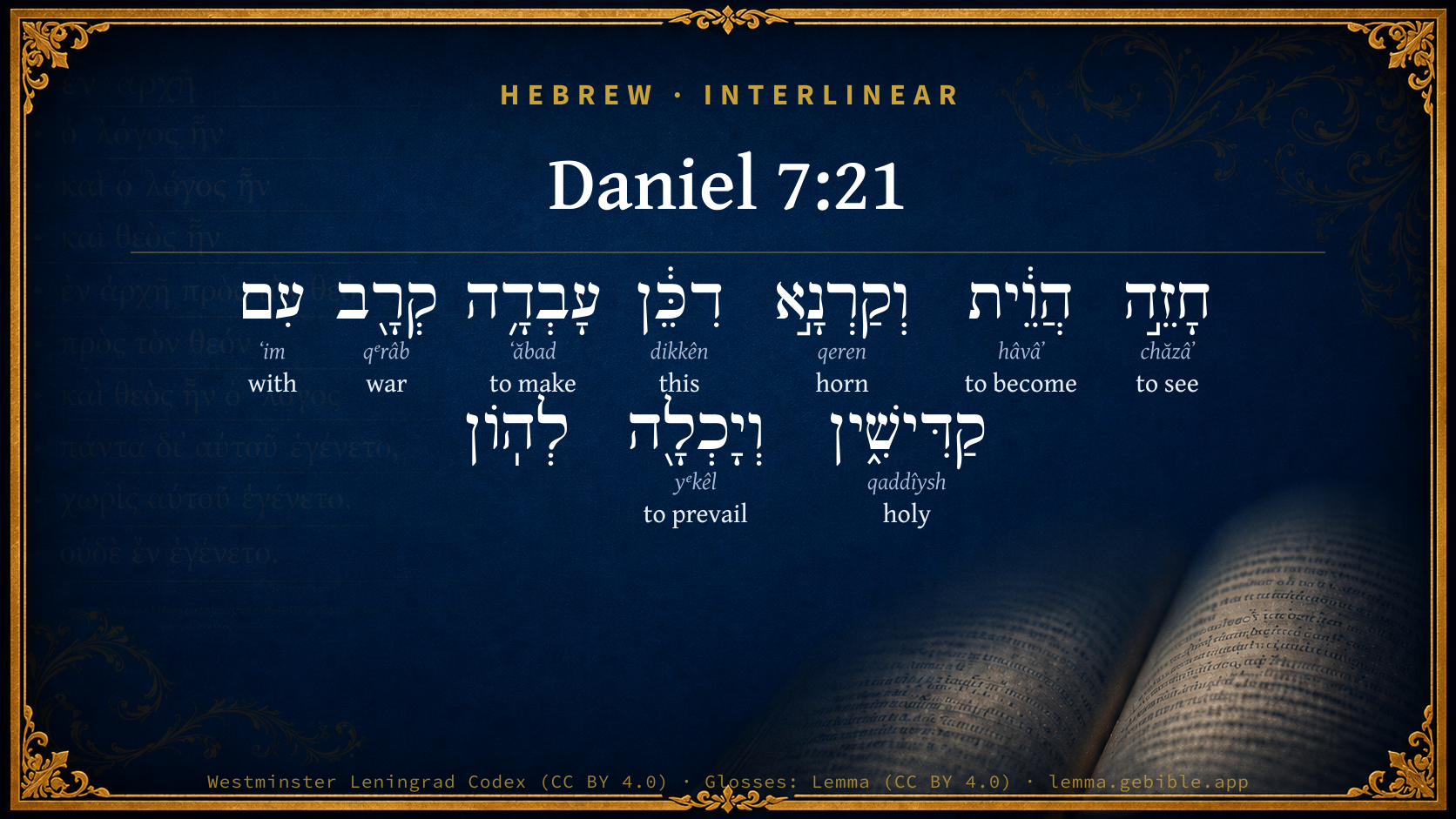
Daniel 7:21

Hebrew (Westminster Leningrad Codex) Daniel 7:21 appears in the Hebrew Old Testament. The text above is from the Westminster Leningrad Codex. Each word links to its Strong’s number, a concise gloss, and parsing drawn from the Open Scriptures Hebrew Bible morphology. Click any word for its full Brown-Driver-Briggs (BDB) entry.
Download image
Cite this verse

Daniel 7:21 (World English Bible). Public Domain. Lemma interlinear Bible study tool, https://lemma.gebible.app/v/daniel/7/21.

Show BibTeX & RIS
BibTeX
RIS
English Translation
I saw, and the same horn made war with the saints, and prevailed against them;
World English Bible · Public Domain
Highlights
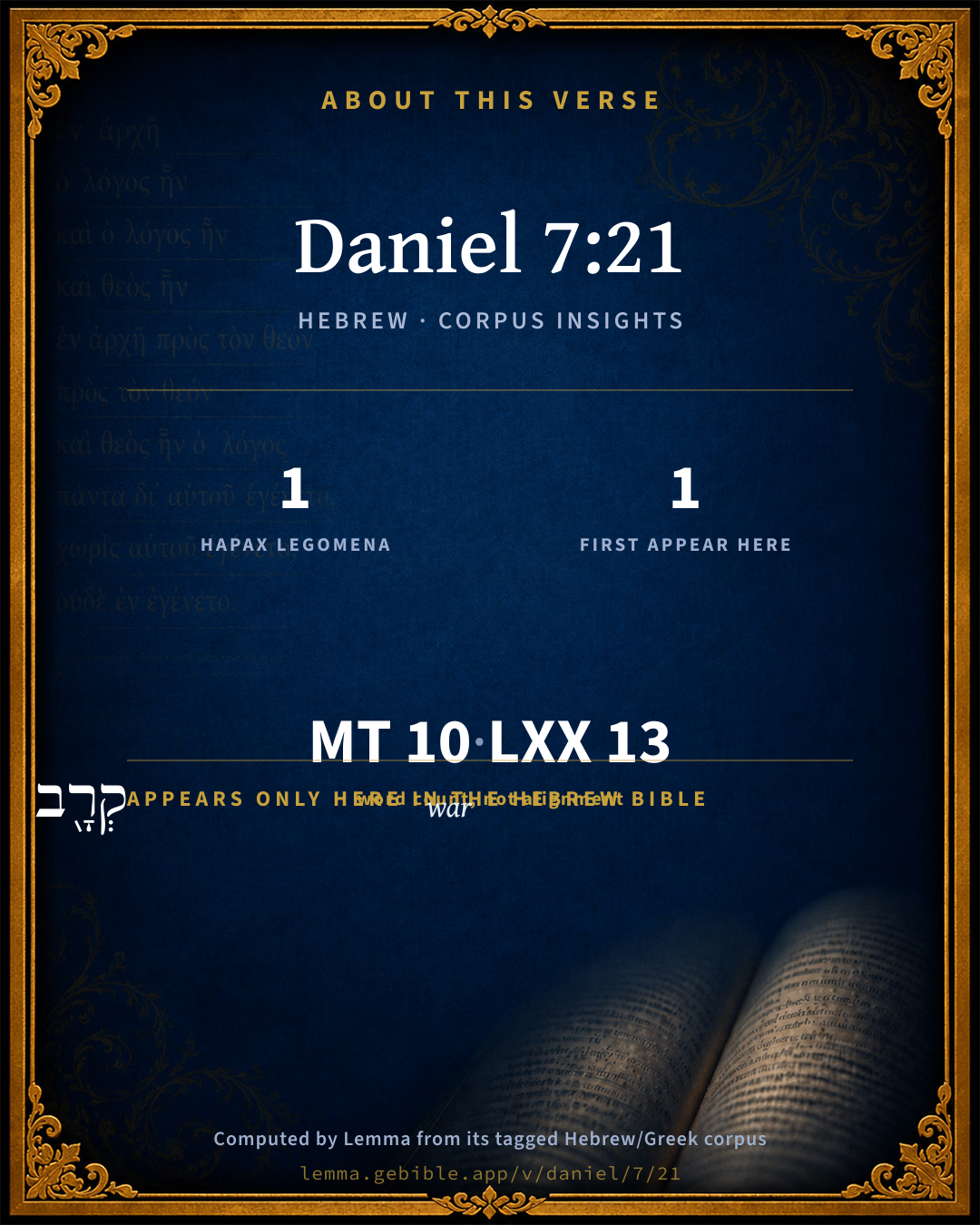
  • 1 hapax legomenon — only here in the Hebrew Bible
  • 1 first appearance in the Hebrew Bible
Full analysis ↓
Download a study sheet

One document with this verse’s original text, its word-by-word gloss line, the meaning frame, cross-references with their text, attributed commentary, and full source and license credits — printable, and it pastes into notes with its structure intact.

This verse Autodidact and up

Study sheet (.html) Plain text (.txt)

A passage Seminary Student

Up to 50 verses in one chapter. A passage sheet keeps up to 6 commentary sources and 12 cross-references per verse, in the order this page ranks them, and says so on the sheet whenever that leaves anything out. Ask for a single verse and you get the Autodidact verse sheet above.

Everything on this page stays free to read, with no account — the sheet is a download of what is already on screen, not access to it.

Want to remove ads? Support Godless Engineer
Compare translations 3

The same verse in 3 English versions, stacked beneath the original-language interlinear above. Click any original word for its lexicon entry.

Each is an independent rendering of the whole verse — the interlinear is not word-aligned to these translations.

Highlighted words mark where these versions differ — a whole-verse word diff, not a word-by-word alignment.

  • World English Bible Public Domain
    I saw, and the same horn made war with the saints, and prevailed against them;
  • King James Version Public Domain
    I beheld, and the same horn made war with the saints, and prevailed against them;
  • unfoldingWord Literal Text CC BY-SA 4.0
    I kept looking, and this horn was waging war with the saints and prevailing against them

unfoldingWord Literal Text — © unfoldingWord, licensed CC BY-SA 4.0. Word-aligned USFM3 via Door43 (git.door43.org/unfoldingWord/en_ult).

Versions to compare (up to 4)

3 of 4 selected

Show all 18 translations

Every available English version of this verse, each an independent rendering of the whole verse.

  • World English Bible Public Domain
    I saw, and the same horn made war with the saints, and prevailed against them;
  • Berean Standard Bible Public Domain
    As I watched, this horn was waging war against the saints and prevailing against them,
  • Majority Standard Bible Public Domain
    As I watched, this horn was waging war against the saints and prevailing against them,
  • King James Version Public Domain
    I beheld, and the same horn made war with the saints, and prevailed against them;
  • American Standard Version (1901) Public Domain
    I beheld, and the same horn made war with the saints, and prevailed against them;
  • Revised Version (1885) Public Domain
    I beheld, and the same horn made war with the saints, and prevailed against them;
  • Geneva Bible (1599) Public Domain
    I beheld, and the same horne made battel against the Saintes, yea, and preuailed against them,
  • Douay-Rheims (1899) Public Domain
    I beheld, and lo, that horn made war against the saints, and prevailed over them,
  • Young's Literal Translation Public Domain
    `I was seeing, and this horn is making war with the saints, and hath prevailed over them,
  • Literal Standard Version CC BY-SA 4.0
    I was seeing, and this horn is making war with the saints, and has prevailed over them,
  • Unlocked Literal Bible CC BY-SA 4.0
    As I looked, this horn waged war against the holy people and was defeating them
  • unfoldingWord Literal Text CC BY-SA 4.0
    I kept looking, and this horn was waging war with the saints and prevailing against them
  • Darby Bible Public Domain
    I beheld, and that horn made war with the saints, and prevailed over them;
  • World Messianic Bible Public Domain
    I saw, and the same horn made war with the holy ones, and prevailed against them,
  • Webster's Bible Public Domain
    I beheld, and the same horn made war with the saints, and prevailed against them;
  • Free Bible Version CC BY-SA 4.0
    I watched as this horn attacked God's dedicated people and was conquering them,
  • Bible in Basic English Public Domain
    And I saw how that horn made war on the saints and overcame them,
  • JPS Tanakh (1917) Public Domain
    I beheld, and the same horn made war with the saints, and prevailed against them;

Literal Standard Version (2020), Covenant Press — licensed CC BY-SA 4.0. Text via the HelloAO Bible API (eBible.org). Unlocked Literal Bible (unfoldingWord) — licensed CC BY-SA 4.0. Text via the HelloAO Bible API (eBible.org). unfoldingWord Literal Text — © unfoldingWord, licensed CC BY-SA 4.0. Word-aligned USFM3 via Door43 (git.door43.org/unfoldingWord/en_ult). Free Bible Version, Dr. Jonathan Gallagher — licensed CC BY-SA 4.0. Text via the HelloAO Bible API (eBible.org).

Word by word

More ways to search: Search by grammar → Find every occurrence → Compare this word →

Practice this passage: Drill this verse → Learn its vocabulary →

About this verse

These counts appear in no published source. They are computed here, from the morphology-tagged text and Lemma’s own curated glosses. What Lemma adds →

10
words
9
distinct lemmas
Prophets
section

Notable vocabulary

1 hapax legomenon — a word that appears only here in the entire Hebrew Bible:

First appearance in Scripture

This word makes its first canonical appearance in the Hebrew Bible here:

Shared distinctive vocabulary

דִכֵּ֔ן this H1797 occurs in 3 verses of the Hebrew Bible. Also found in:

Grammatical profile

  • 1 verb
  • 8 adjectives
  • 1 particle

Verb forms

  • וְיָכְלָ֖ה Qal · Participle Active

Hebrew & Septuagint length

In English translation the verse runs 15 words from the Hebrew and 14 from the Septuagint (LXX English) — closely comparable.

A rough comparison of the two English renderings, which tokenize alike — not a word-level alignment.

Word counts can differ between the Hebrew and the Greek without any difference in meaning — e.g. the Hebrew direct-object marker אֵת has no separate Greek word, and Greek often adds the article ὁ.

In the original languages it is 10 Hebrew tokens and 13 Greek tokens — but the two are counted differently (Hebrew bundles its prefixes and suffixes into one token; the Greek is in lemma form), so that isn’t a like-for-like length.

Cross-references

9

Topical passages linked to Daniel 7:21 in the Treasury of Scripture Knowledge — connected by theme and wording, ordered by reader-vote popularity; previews shown in the World English Bible.

  • Daniel 12:7 I heard the man clothed in linen, who was above the waters of the river, when he held up his right hand and his left hand to heaven, and swore by him who lives forever that it shall be for a time, times, and a half; and when they have made an end of breaking in pieces the power of the holy people, all these things shall be finished.
  • Daniel 8:24 His power shall be mighty, but not by his own power; and he shall destroy wonderfully, and shall prosper and do [his pleasure]; and he shall destroy the mighty ones and the holy people.
  • Revelation 13:5–18 A mouth speaking great things and blasphemy was given to him. Authority to make war for forty-two months was given to him.
  • Revelation 17:14 These will war against the Lamb, and the Lamb will overcome them, for he is Lord of lords, and King of kings. They also will overcome who are with him, called and chosen and faithful."
  • Revelation 12:3–4 Another sign was seen in heaven. Behold, a great red dragon, having seven heads and ten horns, and on his heads seven crowns.
  • Revelation 17:6 I saw the woman drunken with the blood of the saints, and with the blood of the martyrs of Jesus. When I saw her, I wondered with great amazement.
  • Revelation 11:7–9 When they have finished their testimony, the beast that comes up out of the abyss will make war with them, and overcome them, and kill them.
  • Revelation 19:19 I saw the beast, and the kings of the earth, and their armies, gathered together to make war against him who sat on the horse, and against his army.
  • Daniel 8:12 The host was given over [to it] together with the continual [burnt offering] through disobedience; and it cast down truth to the ground, and it did [its pleasure] and prospered.

Cross-references courtesy of OpenBible.info (CC BY 4.0).

Hebrew and Greek witnesses Masoretic Hebrew ↔ Greek Septuagint

The same verse in the two great witnesses to the Old Testament, shown verse-for-verse.

These are two independent witnesses, not word-aligned to each other, and the Septuagint is shown in lemma (dictionary) form.

Hebrew Daniel 7:21 Masoretic · Westminster Leningrad Codex

חָזֵ֣ה הֲוֵ֔ית וְקַרְנָ֣א דִכֵּ֔ן עָבְדָ֥ה קְרָ֖ב עִם קַדִּישִׁ֑ין וְיָכְלָ֖ה לְהֽוֹן

I saw, and the same horn made war with the saints, and prevailed against them;

World English Bible · Public Domain

Greek LXX Daniel 7:21 Septuagint · lemma form

καί κατανοέω ὁ κέρας ἐκεῖνος πόλεμος συνἵστημι πρός ὁ ἅγιος καί τροπόω αὐτός

I saw, and that horn made war with the saints, and prevailed against them;

LXX2012 (modern English Septuagint) · Public Domain

Hebrew: Westminster Leningrad Codex (CC BY 4.0). Greek: Septuagint (public domain); English from LXX2012 (modern English Septuagint) (Public Domain). How the Septuagint differs from the Hebrew →

Commentary

Notes on Daniel 7:21 from classic Christian and Jewish commentators (each source and its license shown beneath its notes). The classic Christian expositions comment on the surrounding passage and are grouped to its opening verse, so a note may address several verses; the Jewish commentaries on the Tanakh (Rashi and others) are per-verse, so they appear only where the commentator wrote on this verse.

Lemma curates 59 commentaries, every one of them public domain or Creative Commons licensed, each selected and text-cleaned for this edition rather than reprinted as found. About our sources →

Trapp's Complete Commentary

John Trapp

Dan 7:21 I beheld, and the same horn made war with the saints, and prevailed against them;

Ver. 21. I beheld, and the same horn made war with the saints.] With the Waldenses, against whom the Pope turned his croisados, those armies of the Cross which had been first appointed against the Saracens. {a} This war began in the year 1160, and yet continueth, and must till the end of the reign of Antichrist. {Dan 7:9-10; Dan 7:26}

And prevailed against them.] As they did against the ancient Waldenses or Leonists, and against their posterity lately in Piedmont. Yea, it is the opinion and fear of some great divines that Antichrist, before his abolition, shall once again overflow the whole face of the West, and suppress the whole Protestant Churches.

{a} Thuan.

John Trapp, A Commentary or Exposition upon All the Books of the Old and New Testament (1647–1656) — public domain. Text from a community e-Sword module.

Tyndale Open Study Notes

Tyndale Open Resources

7:21 The object of the little horn’s hatred and arrogance was God’s holy people. In this, the little horn was like Pharaoh and Haman (see Exod 1:22; Esth 3:8-9; cp. Dan 11:36-40).

Tyndale Open Study Notes — © Tyndale Open Resources, licensed CC BY-SA 4.0. Text via the HelloAO Bible API.

Geneva Bible (1599)

Geneva Bible translators

Meaning the Roman Emperors, who were most cruel against the Church of God both of the Jews and of the Gentiles.

Geneva Bible (1599) marginal notes — public domain. Text via Bolls.life.

Jamieson, Fausset & Brown

Robert Jamieson, A. R. Fausset & David Brown

made war with the saints--persecuted the Church (Rev 11:7; Rev 13:7).

prevailed--but not ultimately. The limit is marked by "until" (Dan 7:22). The little horn continues, without intermission, to persecute up to Christ's second advent (Rev 17:12, Rev 17:14; Rev 19:19-20).

Jamieson, Fausset & Brown — Commentary Critical and Explanatory on the Whole Bible (1871) — public domain (CC PDM 1.0). Text via the HelloAO Bible API.

Adam Clarke's Commentary

Verse 21. The same horn made war with the saints, and prevailed against them.] Those who make Antiochus the little horn, make the saints the Jewish people. Those who understand the popedom by it, see this as referring to the cruel persecutions of the popes of Rome against the Waldenses and Albigenses, and the Protestant Church in general.

Adam Clarke's Commentary on the Bible (1810–1826) — public domain. Text from a community e-Sword/MySword module.

John Calvin's Commentaries

The Prophet now adds what he had omitted. The angel does not yet answer him, but as he had not sufficiently expressed how the little horn waged war with the sons of God, he now supplies the omission. He says, therefore, he saw — this ought to be received by way of correction; I saw, says he, meaning it was shewn me in a vision, how the little horn made war with the saints so as to prevail against them. Clearly enough other tyrants assailed the elect people of God with tier greater injury. Hence many refer this to Antiochus Epiphanes, who was hostile to the Jews beyond all others, and was utterly determined to blot out the name of the God of Israel. And we know how often he raised powerful armaments to extinguish both the people and the worship of God. As, therefore, the cruelty of Antiochus was so severe against the Israelites, many think his image to have been exhibited to the Prophet as the little horn, and what we shall afterwards see about “the time,” and “times’ and “half-a-time,” they explain of the three years and a half during which the Temple was in ruins, and the people thereby prevented from offering sacrifices. As, therefore, their religion was then interrupted, they think that tyranny was denoted, by which the people were prohibited from testifying their piety. But although this opinion is plausible, and at first sight bears upon the face of it the appearance of truth, yet if we weigh all things in order, we may easily judge how unsuitable it is to Antiochus. Why, therefore, does the Prophet say — the little horn waged war with the saint? Antiochus certainly made war against the Church, and so did many others; the Egyptians, we know, often broke in and spoiled the Temple and the Romans too, before the monarchy of the Caesars. I reply, this is spoken comparatively, because no war was ever carried on so continuously and professedly against the Church, as those which occurred after the Caesars arose, and after Christ was made manifest to the world; for the devil was then more enraged, and God also relaxed the reins to prove the patience of his people. Lastly, it was natural for the bitterest conflicts to occur when the redemption of the world was carried out; and the event clearly showed this. We know first of all, by horrid examples, how Judea was laid waste, for never was such cruelty practiced against any other people. Nor was the calamity of short duration; we are well acquainted with their extreme obstinacy, which compelled their enemies to forget clemency altogether. For the Romans desired to spare them as far as possible, but so great was their obstinacy and the madness of their rage, that they provoked their enemies as if devoting themselves to destruction, until that dreadful slaughter happened, of which history has sufficiently informed us. When Titus, under the auspices of his father Vespasian, tools: and destroyed the city, the Jews were stabbed and slaughtered like cattle throughout the whole extent of Asia. Thus far, then, it concerns the Jews.

When God had inserted the body of the Gentiles into his Church, the cruelty of the Caesars embraced all Christians; thus the little horn waged war with the saints in a manner different from that of the former beasts, because the occasion was different, and the wrath of Satan was excited against all God’s children on account of the manifestation of Christ. This, then, is the best explanation of the little horn, waging war against the saints. Thus he says, It must prevail. For the Caesars and all who governed the provinces of the empire raged with such extreme violence against the Church, that it almost disappeared from the face of the earth. And thus it happened, that the little horn prevailed in appearance and in general opinion, as, for a short time, the safety of the Church was almost despaired of.

John Calvin's Commentaries (1540-1563) — public domain. Text from the Calvin Translation Society English edition (1840s-50s) via the Christian Classics Ethereal Library (ccel.org). Calvin's coverage is partial (roughly two-thirds of the Bible); uncommented books and verses are honest gaps, never fabricated. The 19th-century editor's footnotes and remarks are omitted so the notes are faithfully Calvin's own voice.

Ellicott's Commentary for English Readers

(21) Made war.—This corresponds to “the mouth speaking great things” (Dan_7:8; Dan_7:20). These events occur while the saints are expecting their deliverance.

A Bible Commentary for English Readers, edited by Charles John Ellicott (1878–1897) — public domain. Text from a community e-Sword module.

The Cambridge Bible for Schools and Colleges

gen. ed. J. J. S. Perowne

21. made war with the saints] Alluding to the violent efforts made by Antiochus Epiphanes to denationalize the Jews and to suppress their religion: cf. Dan_7:25, Dan_8:10-14; Dan_8:24-25.

and prevailed against them] The war was a desperate one; and the ‘little horn’ would have conquered, had it not been for the intervention of the Most High (Dan_7:22).

21–22. A recapitulation of the substance of Dan_7:9-12, and of Dan_7:13-14,—the latter in the phraseology of Dan_7:18,—with a mention of the fact not noticed before, that a war with the ‘little horn’ had preceded the triumph of the saints.

The Cambridge Bible for Schools and Colleges (gen. ed. J. J. S. Perowne; Cambridge University Press, 1878–1918) — public domain. Text from a community e-Sword module.

John Gill's Exposition

I beheld, and the same horn made war with the saints,.... The same little horn before described; not Antiochus Epiphanes, who made war with the Jews, as many think; or the Roman Caesars, that persecuted the church of Christ, as others; nor Titus Vespasian, who fought against Israel, as Saadiah; but antichrist, or the pope of Rome; and this refers to the wars of the popes with the Waldenses, which began in the year 1160, and continued long, and with the two witnesses at the close of their testimony, Rev 11:7, this Daniel had a view of in vision; not while he was inquiring of the angel, but before, though not mentioned till now; and was a reason he was so very inquisitive about this little horn, because of its war with the saints, and its success, as follows:

and prevailed against them: as the popes and their abettors did against the Waldenses and Albigenses, whom they slew in great numbers, and got the victory over; as the beast also, the same with this little horn, will overcome the witnesses, and slay them, Rev 11:7.

John Gill's Exposition of the Whole Bible (1746–1763) — public domain (CC PDM 1.0). Text via the HelloAO Bible API.

Albert Barnes' Notes on the Bible

I beheld, and the same horn made war with the saints - I continued to look on this until I saw war made by this horn with the people of God. This circumstance, also, is not referred to in the first description, and the order of time in the description would seem to imply that the war with the saints would be at a considerable period after the first appearance of the horn, or would be only when it had grown to its great size and power. This “war” might refer to open hostilities, carried on in the usual manner of war; or to persecution, or to any invasion of the rights and privileges of others. As it is a “war with the saints,” it would be most natural to refer it to persecution.

And prevailed against them - That is, he overcame and subdued them, he was stronger than they were, and they were not able to resist him. The same events are evidently referred to and in almost similar language - borrowed probably from Daniel - in Rev 13:5-7 : “And there was given him a mouth speaking great things and blasphemies, and power was given unto him to continue forty and two months. And he opened his mouth in blasphemy against God, to blaspheme his name, and his tabernacle, and them that dwell in heaven. And it was given him to make war with the saints, and to overcome them; and power was given him over all kindreds, and tongues, and nations.”

Albert Barnes' Notes on the Bible (1834–1885) — public domain. Text from a community e-Sword/MySword module.

Haydock's Catholic Bible Commentary

Saints. The Machabees at last prevailed. Christ will punish the Jews. (Matthew xxiv. 30.)

George Leo Haydock (1774–1849), Haydock's Catholic Family Bible and Commentary, 1859 edition — public domain. Excludes Psalms (Douay-Rheims chapter numbering differs from Protestant) and Deuterocanonical books (Catholic canon only).

unfoldingWord translationNotes

Door43 World Missions Community

this horn

"this fourth horn." This refers to the horn that is described in Daniel 7:20.

until the Ancient of Days came, and justice was given

This can be stated in active form. AT: "until the Ancient of Days came and brought justice" (See: Active or Passive)

Ancient of Days

This is a title for God that emphasizes that he is eternal. See how you translated this title in Daniel 7:9.

the holy people received the kingdom

This can be stated in active form. AT: "God gave his kingdom to his holy people" (See: Active or Passive)

translationWords

just

holy

people of God

kingdom

unfoldingWord translationNotes — © Distant Shores Media and the Door43 World Missions Community, licensed CC BY-SA 4.0. Source: git.door43.org/Door43/en_tn.

Rashi

Rabbi Shlomo Yitzchaki (Rashi)

I looked in my first dream, which I told above.

with the holy ones with Israel.

Rashi on the Tanakh — English translations: “The Judaica Press complete Tanach with Rashi, translated by A. J. Rosenberg” (CC BY 4.0); “Pentateuch with Rashi's commentary by M. Rosenbaum and A.M. Silbermann, 1929-1934” (public domain); “The Metsudah Tanach series, Lakewood, N.J” (CC BY 4.0); and “The Book of Joshua, Metsudah Publications, 1997” (CC BY 4.0). Text via Sefaria.

Lesson kit

Teaching starters — assembled from the data on this page, not authored interpretation. Every prompt links to the verse data it draws on. Edit before teaching.

Daniel, in the Prophets, opens this verse with 10 words (9 distinct Hebrew lemmas). Its most distinctive word is qᵉrâb (“war”). A historical commentator’s framing appears above. Read the whole chapter for the surrounding context.

Discussion questions

  1. How does “war” (qᵉrâb) shape what this verse is saying?
  2. 1 word here appears nowhere else in the Hebrew Bible. Why might the author reach for such rare wording?
  3. This is the first place “war” appears in Scripture (first appears here). What does its debut here establish?
  4. How does Daniel 2:31, which shares the word «this», read alongside this verse?
  5. These translations render this verse differently. What is at stake in choosing one wording over another?
  6. «וְיָכְלָ֖ה» is a Qal Participle Active verb. How does that grammatical form shape the action described?
  7. Compare how Trapp's Complete Commentary and Tyndale Open Study Notes read this verse. Where do they agree or differ?

Things to notice

Reading settings

Reading text

Shown beneath each verse's original-language words.

Old Testament
Old Testament edition

Read the OT as the Masoretic Hebrew (MT) or the Greek Septuagint (LXX).

English shown for the Greek Septuagint (in the Hebrew ↔ Greek comparison).

Comparing translations? Open the Compare panel on any verse page to stack up to four side by side.