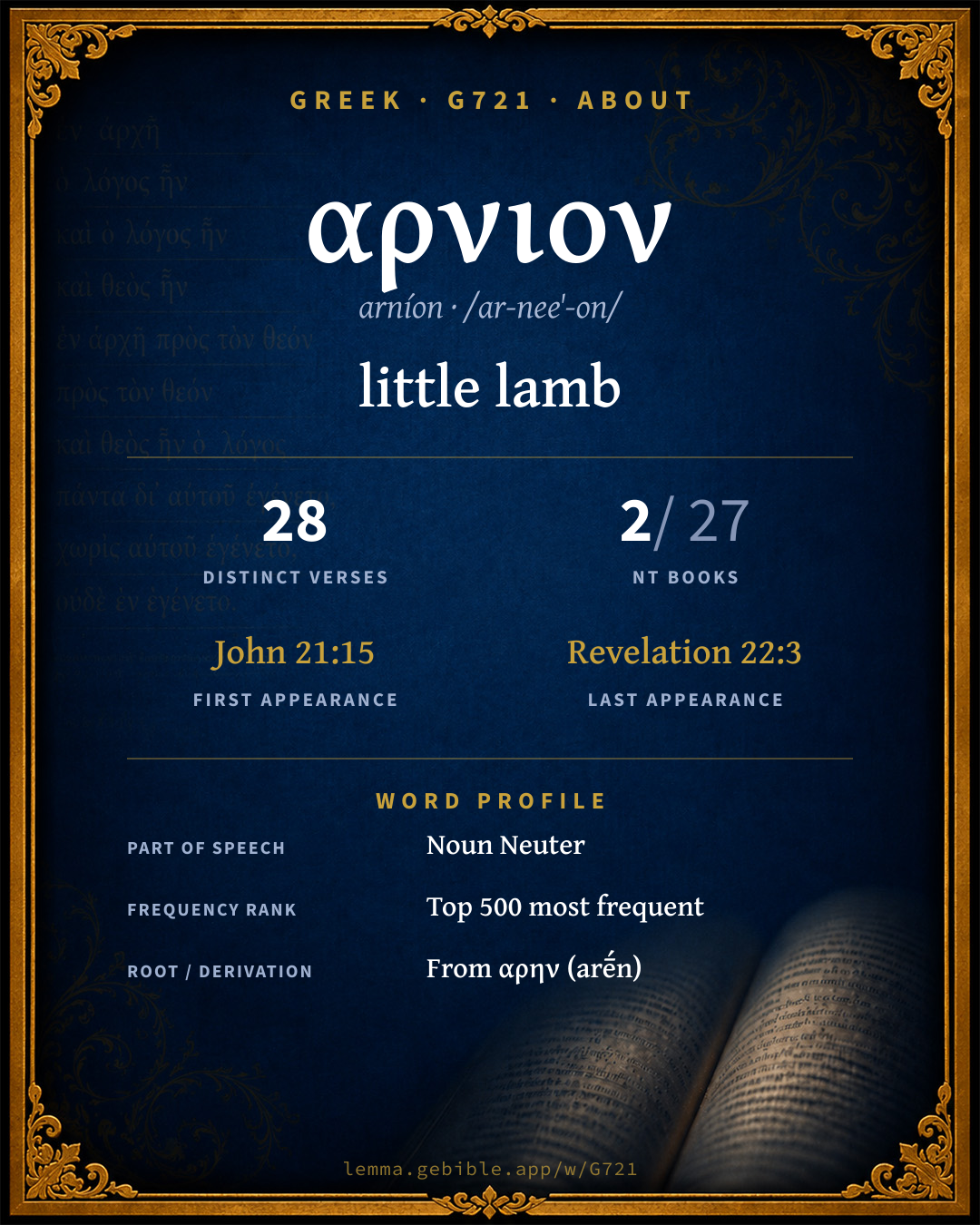
ἀρνίον
little lamb
Full lexicon entry — Thayer's Greek Lexicon
From Thayer's Greek Lexicon
Where this word appears
See every Genitive-case word in the Greek New Testament →
Grammar key — what these labels mean
Part of speech
- Noun
- A naming word — a person, place, thing, or idea.
Case
- Genitive
- The case of source, possession, or “of” — answers “whose / from what.”
- Nominative
- The case of the subject (and the predicate nominative).
- Dative
- The case of the indirect object, means, or location — “to / for / with / in.”
- Accusative
- The case of the direct object and of extent.
Gender
- Neuter
- Grammatically neuter.
Number
- Singular
- One.
- Plural
- More than one.
Grammatical forms
- Noun, Genitive, Singular, Neuter 16 times (53%)
- Noun, Nominative, Singular, Neuter 7 times (23%)
- Noun, Dative, Singular, Neuter 5 times (17%)
- Noun, Accusative, Plural, Neuter 1 time (3%)
- Noun, Accusative, Singular, Neuter 1 time (3%)
Parsed forms decoded from the imported morphology (Robinson–Tischendorf, public domain), counted across 30 parsed occurrences — not distinct verses.
Every verse where G721 appears — 28 distinct verses across 2 books. Click any verse to open its interlinear word-by-word view. Verse text shown in the World English Bible for context — . Each verse’s Greek form is shown with its reference; the English is not keyword-highlighted, since the data carries no word-level English alignment. Use “Compare translations” on any verse to read it across multiple English versions. This concordance covers the Greek New Testament; Septuagint (Greek Old Testament) occurrences of this word are not indexed here.
John 1 verse
Revelation 27 verses
- Revelation 5:6 ἀρνίον n acc sg neut I saw in the midst of the throne and of the four living creatures, and in the midst of the elders, a Lamb standing, as though it had been slain, having seven horns, and seven eyes, which are the seven Spirits of God, sent out into all the earth.
- Revelation 5:8 ἀρνίου n gen sg neut Now when he had taken the book, the four living creatures and the twenty-four elders fell down before the Lamb, each one having a harp, and golden bowls full of incense, which are the prayers of the saints.
- Revelation 5:12 ἀρνίον n nom sg neut saying with a loud voice, "Worthy is the Lamb who has been killed to receive the power, wealth, wisdom, strength, honor, glory, and blessing!"
- Revelation 5:13 ἀρνίῳ n dat sg neut I heard every created thing which is in heaven, on the earth, under the earth, on the sea, and everything in them, saying, "To him who sits on the throne, and to the Lamb be the blessing, the honor, the glory, and the dominion, forever and ever! Amen!"
- Revelation 6:1 ἀρνίον n nom sg neut I saw that the Lamb opened one of the seven seals, and I heard one of the four living creatures saying, as with a voice of thunder, "Come and see!"
- Revelation 6:16 ἀρνίου n gen sg neut They told the mountains and the rocks, "Fall on us, and hide us from the face of him who sits on the throne, and from the wrath of the Lamb,
- Revelation 7:9 ἀρνίου n gen sg neut After these things I looked, and behold, a great multitude, which no man could number, out of every nation and of all tribes, peoples, and languages, standing before the throne and before the Lamb, dressed in white robes, with palm branches in their hands.
- Revelation 7:10 ἀρνίῳ n dat sg neut They cried with a loud voice, saying, "Salvation be to our God, who sits on the throne, and to the Lamb!"
- Revelation 7:14 ἀρνίου n gen sg neut I told him, "My lord, you know." He said to me, "These are those who came out of the great tribulation. They washed their robes, and made them white in the Lamb's blood.
- Revelation 7:17 ἀρνίον n nom sg neut for the Lamb who is in the midst of the throne shepherds them, and leads them to springs of waters of life. And God will wipe away every tear from their eyes."
- Revelation 12:11 ἀρνίου n gen sg neut They overcame him because of the Lamb's blood, and because of the word of their testimony. They didn't love their life, even to death.
- Revelation 13:8 ἀρνίου n gen sg neut All who dwell on the earth will worship him, everyone whose name has not been written from the foundation of the world in the book of life of the Lamb who has been killed.
- Revelation 13:11 ἀρνίῳ n dat sg neut I saw another beast coming up out of the earth. He had two horns like a lamb, and he spoke like a dragon.
- Revelation 14:1 ἀρνίον n nom sg neut I saw, and behold, the Lamb standing on Mount Zion, and with him a number, one hundred forty-four thousand, having his name, and the name of his Father, written on their foreheads.
- Revelation 14:4 ἀρνίῳ ἀρνίῳ n dat sg neut n dat sg neut These are those who were not defiled with women, for they are virgins. These are those who follow the Lamb wherever he goes. These were redeemed by Jesus from among men, the first fruits to God and to the Lamb.
- Revelation 14:10 ἀρνίου n gen sg neut he also will drink of the wine of the wrath of God, which is prepared unmixed in the cup of his anger. He will be tormented with fire and sulfur in the presence of the holy angels, and in the presence of the Lamb.
- Revelation 15:3 ἀρνίου n gen sg neut They sang the song of Moses, the servant of God, and the song of the Lamb, saying, "Great and marvelous are your works, Lord God, the Almighty; Righteous and true are your ways, you King of the nations.
- Revelation 17:14 ἀρνίου ἀρνίον n gen sg neut n nom sg neut These will war against the Lamb, and the Lamb will overcome them, for he is Lord of lords, and King of kings. They also will overcome who are with him, called and chosen and faithful."
- Revelation 19:7 ἀρνίου n gen sg neut Let us rejoice and be exceedingly glad, and let us give the glory to him. For the marriage of the Lamb has come, and his wife has made herself ready."
- Revelation 19:9 ἀρνίου n gen sg neut He said to me, "Write, 'Blessed are those who are invited to the marriage supper of the Lamb.'" He said to me, "These are true words of God."
- Revelation 21:9 ἀρνίου n gen sg neut One of the seven angels who had the seven bowls, who were loaded with the seven last plagues came, and he spoke with me, saying, "Come here. I will show you the wife, the Lamb's bride."
- Revelation 21:14 ἀρνίου n gen sg neut The wall of the city had twelve foundations, and on them twelve names of the twelve Apostles of the Lamb.
- Revelation 21:22 ἀρνίον n nom sg neut I saw no temple in it, for the Lord God, the Almighty, and the Lamb, are its temple.
- Revelation 21:23 ἀρνίον n nom sg neut The city has no need for the sun, neither of the moon, to shine, for the very glory of God illuminated it, and its lamp is the Lamb.
- Revelation 21:27 ἀρνίου n gen sg neut There will in no way enter into it anything profane, or one who causes an abomination or a lie, but only those who are written in the Lamb's book of life.
- Revelation 22:1 ἀρνίου n gen sg neut He showed me a river of water of life, clear as crystal, proceeding out of the throne of God and of the Lamb,
- Revelation 22:3 ἀρνίου n gen sg neut There will be no curse any more. The throne of God and of the Lamb will be in it, and his servants serve him.
About this entry
At a glance — auto-summarized from this page’s data, not written by a person. Every figure links to its source below. This summary describes the numbers; it doesn’t interpret them.
At its core, αρνιον (arníon) means “little lamb.” Its uses cluster heavily in Revelation (96% of all occurrences). With 28 verses in 2 books, it is a moderately common word in the Greek New Testament. Scripture first uses it in John 21:15. Dig into 28-verse concordance and the renderings breakdown below.
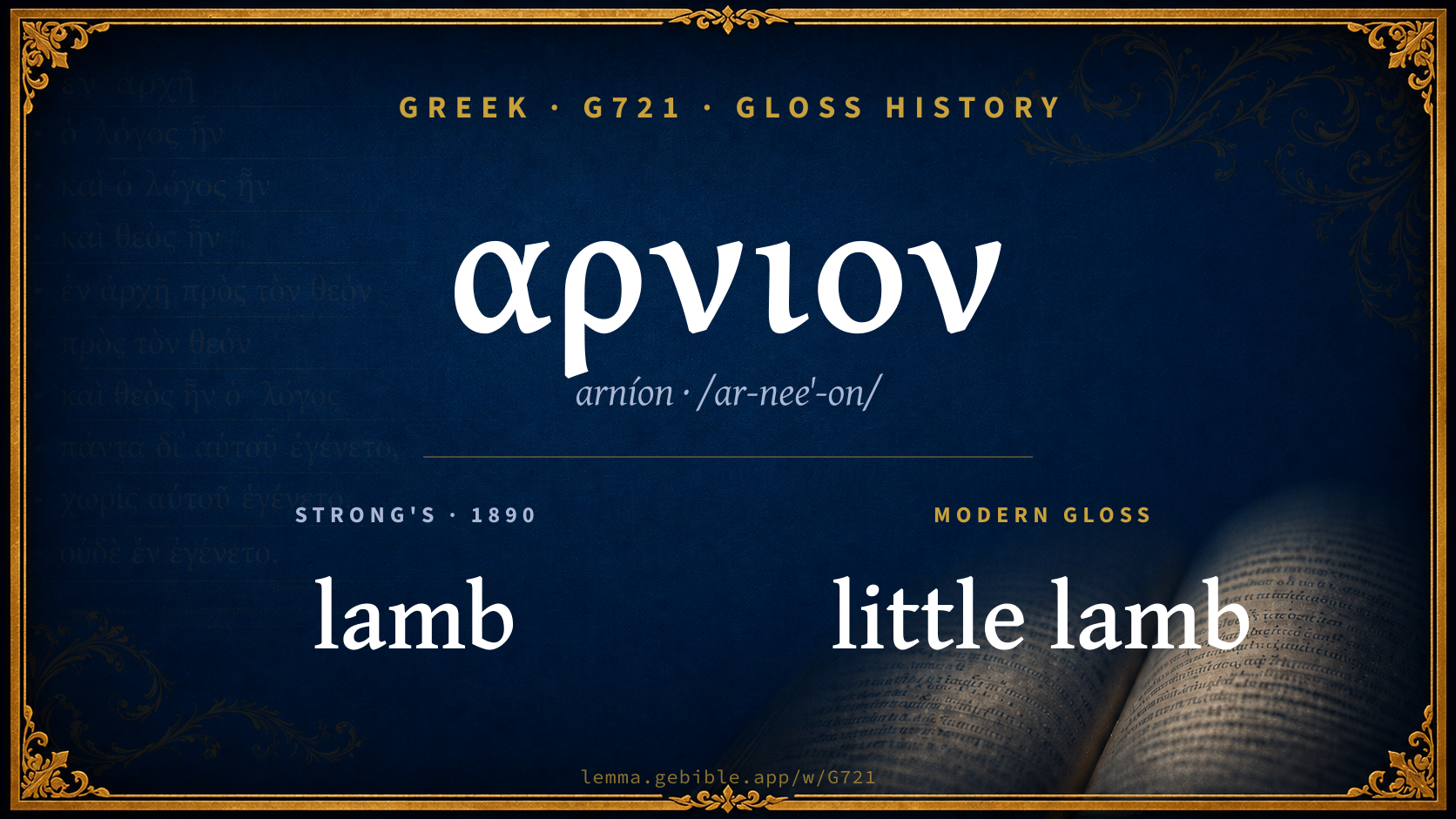
Gloss history
Strong's 1890 vs modern scholarship
About this word
Strong's G721 catalogs a Greek word from the Greek New Testament.
These counts are not copied from any lexicon or concordance. They are computed here, from the morphology-tagged Greek New Testament. What Lemma adds →
- 28
- distinct verses
- The word appears in 28 distinct verses.
- 2 / 27
- NT books
- The word appears in 2 of 27 New Testament books.
- #463
- by frequency
- Top 500 most frequent Greek words (rank 463 of 5,347 Greek words by occurrence).
View all 28 occurrences in the concordance →
Most concentrated in
- Revelation 27 verses 96%
- John 1 verse 4%
By section of the New Testament
By traditional corpus
Conventional, traditional groupings — biblical authorship is debated, so this is a traditional corpus grouping, not an authorship claim. Some books belong to more than one corpus (Luke is in both the Gospels and the Lukan corpus, and so on), so these shares overlap and need not total 100%. Each figure is a share of the word’s 28 distinct verses.
- Johannine 28 verses · 100%
- Revelation 27 verses · 96%
- Gospels 1 verse · 4%
How translations render this word
Counts come from each version’s own published word-to-Strong’s tagging or interlinear alignment — an approximate guide to how each version renders this word, not a word-level alignment the data otherwise carries. Because each total is that version’s own tagged count, the per-version totals vary from one another and need not match the appearance or distinct-verse counts above. These counts may also differ from a printed concordance because Lemma counts each distinctly tagged rendering and does not collapse phrase taggings into a single head-word total. This is a fixed set of word-tagged versions (KJV, ASV, BSB, ULT) and does not change with the reading translation you choose elsewhere. Each version’s license is shown beside its name below (and on Sources).
- King James Version: Lamb 27×, Lamb's 2×
- American Standard Version: Lamb 27×
- Berean Standard Bible: Lamb 28×
- unfoldingWord Literal Text: Lamb 29×
King James Version Public Domain
Renders G721 across 30 tagged occurrences — most commonly:
Plus 1 rendering that appears only once — usually multi-word phrases or single function words the recovered tagging swept in, not distinct renderings.
American Standard Version Public Domain
Renders G721 across 28 tagged occurrences — most commonly:
Plus 1 rendering that appears only once — usually multi-word phrases or single function words the recovered tagging swept in, not distinct renderings.
Berean Standard Bible Public Domain
Renders G721 across 30 tagged occurrences — most commonly:
Plus 2 renderings that appear only once — usually multi-word phrases or single function words the recovered tagging swept in, not distinct renderings.
unfoldingWord Literal Text CC BY-SA 4.0
Renders G721 across 31 tagged occurrences — most commonly:
Plus 2 renderings that appear only once — usually multi-word phrases or single function words the recovered tagging swept in, not distinct renderings.
Senses in Thayer's
The 1 sense Thayer's distinguishes for this word, in lexicon order (not ranked by frequency or importance). The full entry — with sub-senses — is in the Lexicon Entry tab.
- a little lamb, a lamb
Word origin
Derived from αρην (arḗn) (G704) — lamb.
Diminutive from G704 ; a lambkin : - lamb.
— Strong’s Exhaustive Concordance (1890), public domain.
Forms in the corpus
The 4 distinct written forms G721 takes in the Greek New Testament, most frequent first — each parse links to that case’s occurrences in the concordance.
| Form | Parsing | Example | Uses |
|---|---|---|---|
| ἀρνίου arníou | Noun, Genitive, Singular, Neuter | Revelation 5:8 | 16 |
| ἀρνίον arníon | Noun, Nominative, Singular, Neuter | Revelation 5:12 | 8 |
| ἀρνίῳ arníō | Noun, Dative, Singular, Neuter | Revelation 5:13 | 5 |
| ἀρνία arnía | Noun, Accusative, Plural, Neuter | John 21:15 | 1 |
Septuagint usage
The same Greek word αρνιον appears 4 times in the Greek Old Testament (Septuagint), across 4 verses in 2 books.
- 4
- LXX occurrences
- Tagged occurrences of this Greek word in the Septuagint.
- 4
- verses
- Distinct Septuagint verses containing this word.
- 2 / 39
- OT books
- The word appears in 2 of the 39 Old Testament books.
Sample Septuagint occurrences
- Psalms 113:4 ἀρνίον
- Jeremiah 11:19 ἀρνίον
Septuagint occurrences (same lexeme)
Every verse where the same Strong’s number (G721) appears in the Greek Septuagint. Verse text shown in the World English Bible for context; the Greek form is the matched word — the English is not keyword-highlighted.
- Psalms 113:4 ἀρνίον Yahweh is high above all nations, His glory above the heavens.
- Psalms 113:6 ἀρνίον Who stoops down to see in heaven and in the earth?
- Jeremiah 11:19 ἀρνίον But I was like a gentle lamb that is led to the slaughter; and I didn't know that they had devised devices against me, [saying], Let us destroy the tree with the fruit of it, and let us cut him off from the land of the living, that his name may be no more remembered.
- Jeremiah 27:45 ἀρνίον
These are occurrences of the same Greek lexeme (G721) in the Septuagint — not a translation of any one Hebrew word. The store carries no word-level Hebrew↔Greek alignment, so no Hebrew original is asserted here. Counts come from the recovered LXX Strong's tagging — high-frequency vocabulary is well covered, while rare or late forms may be untagged — so they reflect tagged occurrences and may slightly undercount.