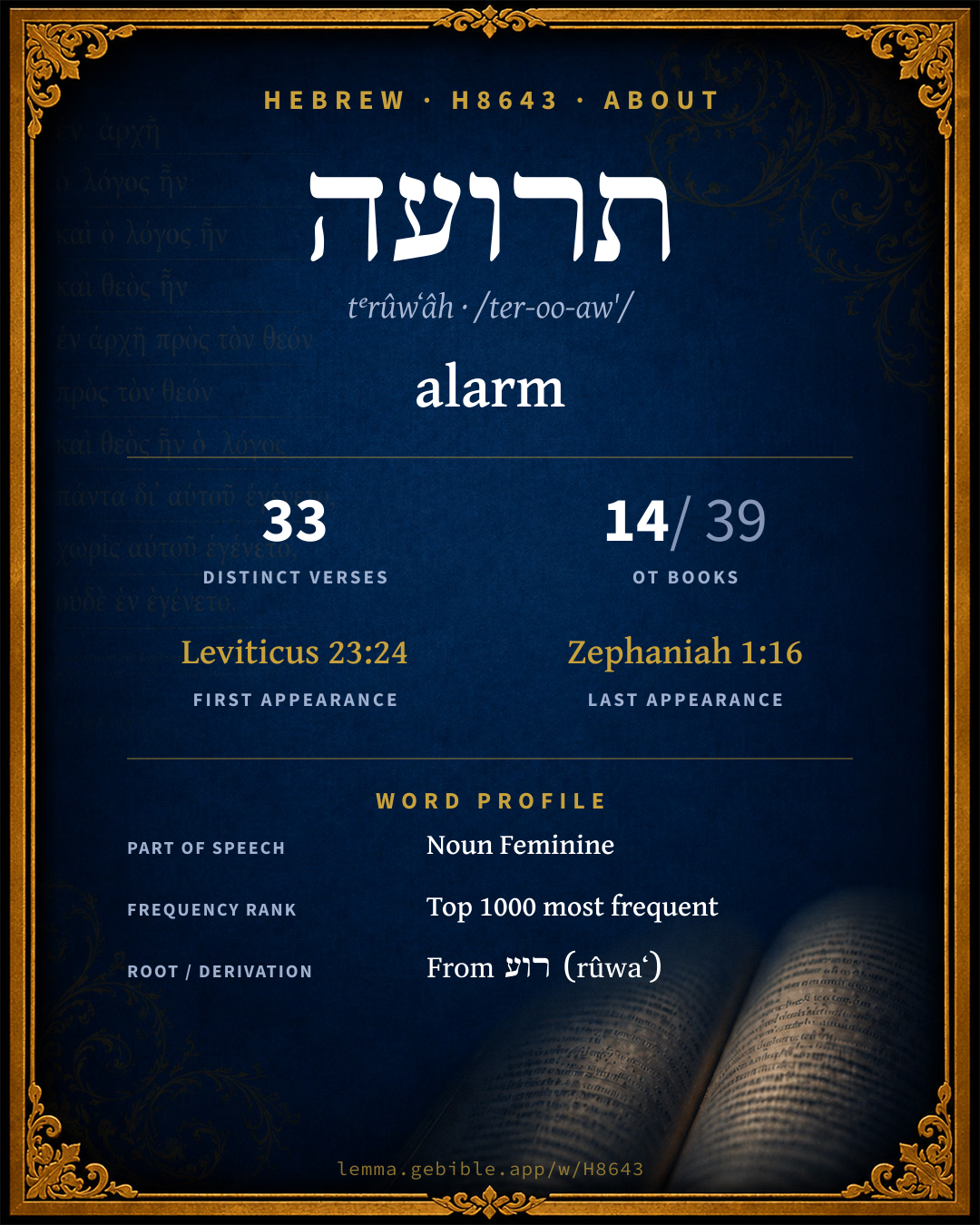
תְּרוּעָה
alarm
also: signal, sound of tempest, shout fuller range ↓
Full lexicon entry — Brown-Driver-Briggs (BDB)
From Brown-Driver-Briggs (BDB)
Where this word appears
See every Absolute-state word in the Hebrew Bible →
Grammar key — what these labels mean
Part of speech
- Noun
- A naming word — a person, place, thing, or idea.
Noun type
- Common
- A common noun — a general class of person, place, or thing (“king,” “city,” “water”), not a specific name.
State
- Absolute
- The independent form of a noun, not bound to a following word.
- Construct
- A noun bound to a following noun in a possessive / “of” relationship (the construct chain).
Gender
- Feminine
- Grammatically feminine.
Number
- Singular
- One.
Grammatical forms
- Noun, Common, Feminine, Singular, Absolute 32 times (89%)
- Noun, Common, Feminine, Singular, Construct 4 times (11%)
Parsed forms decoded from the imported morphology (morphhb / Westminster Leningrad Codex — WLC text public domain, morphhb tagging CC BY 4.0), counted across 36 parsed occurrences — not distinct verses.
Every verse where H8643 appears — 33 distinct verses across 14 books. Click any verse to open its interlinear word-by-word view. Verse text shown in the World English Bible for context — . Each verse’s Hebrew form is shown with its reference; the English is not keyword-highlighted, since the data carries no word-level English alignment. Use “Compare translations” on any verse to read it across multiple English versions. This concordance covers the Hebrew Bible; Septuagint (Greek Old Testament) occurrences are not indexed here.
Leviticus 2 verses
- Leviticus 23:24 תְּרוּעָ֖ה n c fs "Speak to the children of Israel, saying, 'In the seventh month, on the first day of the month, shall be a solemn rest to you, a memorial of blowing of trumpets, a holy convocation.
- Leviticus 25:9 תְּרוּעָה֙ n c fs Then you shall sound the loud trumpet on the tenth day of the seventh month. On the Day of Atonement you shall sound the trumpet throughout all your land.
Numbers 5 verses
- Numbers 10:5 תְּרוּעָ֑ה n c fs When you blow an alarm, the camps that lie on the east side shall take their journey.
- Numbers 10:6 תְּרוּעָה֙ תְּרוּעָ֥ה n c fs n c fs When you blow an alarm the second time, the camps that lie on the south side shall take their journey: they shall blow an alarm for their journeys.
- Numbers 23:21 וּ/תְרוּעַ֥ת conj + n c fs cs He has not saw iniquity in Jacob; Neither has he seen perverseness in Israel: Yahweh his God is with him, The shout of a king is among them.
- Numbers 29:1 תְּרוּעָ֖ה n c fs In the seventh month, on the first day of the month, you shall have a holy convocation; you shall do no servile work: it is a day of blowing of trumpets to you.
- Numbers 31:6 הַ/תְּרוּעָ֖ה ptcl def.art + n c fs Moses sent them, one thousand of every tribe, to the war, them and Phinehas the son of Eleazar the priest, to the war, with the vessels of the sanctuary and the trumpets for the alarm in his hand.
Joshua 2 verses
- Joshua 6:5 תְּרוּעָ֣ה n c fs It shall be that when they make a long blast with the ram's horn, and when you hear the sound of the trumpet, all the people shall shout with a great shout; and the wall of the city shall fall down flat, and the people shall go up every man straight before him.
- Joshua 6:20 תְּרוּעָ֣ה n c fs So the people shouted, and [the priests] blew the trumpets; and it happened, when the people heard the sound of the trumpet, that the people shouted with a great shout, and the wall fell down flat, so that the people went up into the city, every man straight before him, and they took the city.
1 Samuel 2 verses
- 1 Samuel 4:5 תְּרוּעָ֣ה n c fs When the ark of the covenant of Yahweh came into the camp, all Israel shouted with a great shout, so that the earth rang again.
- 1 Samuel 4:6 הַ/תְּרוּעָ֔ה הַ/תְּרוּעָ֧ה ptcl def.art + n c fs ptcl def.art + n c fs When the Philistines heard the noise of the shout, they said, What means the noise of this great shout in the camp of the Hebrews? They understood that the ark of Yahweh was come into the camp.
2 Samuel 1 verse
1 Chronicles 1 verse
2 Chronicles 2 verses
- 2 Chronicles 13:12 הַ/תְּרוּעָ֖ה ptcl def.art + n c fs Behold, God is with us at our head, and his priests with the trumpets of alarm to sound an alarm against you. Children of Israel, don't you fight against Yahweh, the God of your fathers; for you shall not prosper.
- 2 Chronicles 15:14 וּ/בִ/תְרוּעָ֑ה conj + prep + n c fs They swore to Yahweh with a loud voice, and with shouting, and with trumpets, and with cornets.
Ezra 3 verses
- Ezra 3:11 תְרוּעָ֨ה n c fs They sang one to another in praising and giving thanks to Yahweh, [saying], For he is good, for his loving kindness endures forever toward Israel. All the people shouted with a great shout, when they praised Yahweh, because the foundation of the house of Yahweh was laid.
- Ezra 3:12 בִּ/תְרוּעָ֥ה prep + n c fs But many of the priests and Levites and heads of fathers' [houses], the old men who had seen the first house, when the foundation of this house was laid before their eyes, wept with a loud voice; and many shouted aloud for joy:
- Ezra 3:13 תְּרוּעַ֣ת תְּרוּעָ֣ה n c fs cs n c fs so that the people could not discern the noise of the shout of joy from the noise of the weeping of the people; for the people shouted with a loud shout, and the noise was heard afar off.
Job 3 verses
- Job 8:21 תְרוּעָֽה n c fs He will still fill your mouth with laughter, Your lips with shouting.
- Job 33:26 בִּ/תְרוּעָ֑ה prep + n c fs He prays to God, and he is favorable to him, So that he sees his face with joy: He restores to man his righteousness.
- Job 39:25 וּ/תְרוּעָֽה conj + n c fs As often as the trumpet sounds he snorts, 'Aha!' He smells the battle afar off, The thunder of the captains, and the shouting.
Psalms 5 verses
- Psalms 27:6 תְרוּעָ֑ה n c fs Now my head will be lifted up above my enemies around me. I will offer sacrifices of joy in his tent. I will sing, yes, I will sing praises to Yahweh.
- Psalms 33:3 בִּ/תְרוּעָֽה prep + n c fs Sing to him a new song. Play skillfully with a shout of joy!
- Psalms 47:5 בִּ/תְרוּעָ֑ה prep + n c fs God has gone up with a shout, Yahweh with the sound of a trumpet.
- Psalms 89:15 תְרוּעָ֑ה n c fs Blessed are the people who learn to acclaim you. They walk in the light of your presence, Yahweh.
- Psalms 150:5 תְרוּעָֽה n c fs Praise him with loud cymbals! Praise him with resounding cymbals!
Jeremiah 3 verses
- Jeremiah 4:19 תְּרוּעַ֖ת n c fs cs My anguish, my anguish! I am pained at my very heart; my heart is disquieted in me; I can't hold my peace; because you have heard, O my soul, the sound of the trumpet, the alarm of war.
- Jeremiah 20:16 וּ/תְרוּעָ֖ה conj + n c fs Let that man be as the cities which Yahweh overthrew, and didn't repent: and let him hear a cry in the morning, and shouting at noontime;
- Jeremiah 49:2 תְּרוּעַ֣ת n c fs cs Therefore, behold, the days come, says Yahweh, that I will cause an alarm of war to be heard against Rabbah of the children of Ammon; and it shall become a desolate heap, and her daughters shall be burned with fire: then shall Israel possess those who did possess him, says Yahweh.
Ezekiel 1 verse
Amos 2 verses
- Amos 1:14 בִּ/תְרוּעָה֙ prep + n c fs But I will kindle a fire in the wall of Rabbah, And it will devour its palaces, With shouting in the day of battle, With a tempest in the day of the whirlwind;
- Amos 2:2 בִּ/תְרוּעָ֖ה prep + n c fs But I will send a fire on Moab, And it will devour the palaces of Kerioth; And Moab will die with tumult, with shouting, and with the sound of the trumpet;
Zephaniah 1 verse
About this entry
At a glance — auto-summarized from this page’s data, not written by a person. Every figure links to its source below. This summary describes the numbers; it doesn’t interpret them.
At its core, תרועה (tᵉrûwʻâh) means “alarm.” Not a single-sense word: its full sense range also takes in “signal”, “sound of tempest”, and “shout”. It appears 33 verses across 14 books of the Hebrew Bible, among its moderately common vocabulary. First canonically at Leviticus 23:24, it enters the text early. It shares a root with רוע and רע. Each statement above links to its evidence; the full detail follows below.
Gloss history
Strong's 1890 vs modern scholarship
About this word
Strong's H8643 catalogs a Hebrew word from the Hebrew Old Testament.
These counts are not copied from any lexicon or concordance. They are computed here, from the morphology-tagged Hebrew Old Testament. What Lemma adds →
- 33
- distinct verses
- The word appears in 33 distinct verses.
- 14 / 39
- OT books
- The word appears in 14 of 39 Old Testament books.
- #990
- by frequency
- Top 1000 most frequent Hebrew words (rank 990 of 8,640 Hebrew words by occurrence).
View all 33 occurrences in the concordance →
By section of the Old Testament
By traditional corpus
Conventional, traditional groupings — biblical authorship is debated, so this is a traditional corpus grouping, not an authorship claim. Each share is this word’s portion of its verses in that division of the Hebrew canon. Each figure is a share of the word’s 33 distinct verses.
- Writings (Ketuvim) 14 verses · 42%
- Prophets (Nevi'im) 12 verses · 36%
- Torah (Pentateuch) 7 verses · 21%
How translations render this word
Counts come from each version’s own published word-to-Strong’s tagging or interlinear alignment — an approximate guide to how each version renders this word, not a word-level alignment the data otherwise carries. Because each total is that version’s own tagged count, the per-version totals vary from one another and need not match the appearance or distinct-verse counts above. These counts may also differ from a printed concordance because Lemma counts each distinctly tagged rendering and does not collapse phrase taggings into a single head-word total. This is a fixed set of word-tagged versions (KJV, ASV, BSB, ULT) and does not change with the reading translation you choose elsewhere. Each version’s license is shown beside its name below (and on Sources).
- King James Version: Shout 9×, Shouting 7×, Alarm 5×
- American Standard Version: Shout 8×, Shouting 8×, Alarm 6×
- Berean Standard Bible: Shouting 4×, Amid war cries 2×, Battle cry 2×
- unfoldingWord Literal Text: Shout 15×, A 5×, Shouting 4×
King James Version Public Domain
Renders H8643 across 36 tagged occurrences — most commonly:
Plus 11 renderings that appear only once — usually multi-word phrases or single function words the recovered tagging swept in, not distinct renderings.
American Standard Version Public Domain
Renders H8643 across 34 tagged occurrences — most commonly:
Plus 10 renderings that appear only once — usually multi-word phrases or single function words the recovered tagging swept in, not distinct renderings.
Berean Standard Bible Public Domain
Renders H8643 across 31 tagged occurrences — most commonly:
Plus 15 renderings that appear only once — usually multi-word phrases or single function words the recovered tagging swept in, not distinct renderings. Not rendered by a distinct English word in 5 further occurrences.
unfoldingWord Literal Text CC BY-SA 4.0
Renders H8643 across 40 tagged occurrences — most commonly:
Plus 9 renderings that appear only once — usually multi-word phrases or single function words the recovered tagging swept in, not distinct renderings.
Senses in the full BDB
What do BDB’s symbols mean?
BDB uses these scholarly abbreviations:
| Symbol | Meaning |
|---|---|
| 𝔊 | the Septuagint (the ancient Greek translation, LXX) |
| 𝔙 | the Vulgate (the Latin translation) |
| 𝔖 | the Syriac version (the Peshitta) |
| 𝔗 | the Targum (the Aramaic translation) |
| ψ | the Psalms |
| √ | root (the underlying root or stem) |
| ‖ | parallel passage (a synonymous or contrasted parallel) |
| † | the dagger: every passage where the word occurs is cited |
The 4 senses and sub-senses the full Brown-Driver-Briggs lexicon distinguishes for this word, in lexicon order (not ranked by frequency), with BDB’s own verbatim wording and sub-sense lettering. Shown in Hebrew script with BDB’s own scholarly abbreviations. The condensed entry is in the Lexicon Entry tab. See also the Forms in the corpus table below.
- 1. alarm of war, war-cry, Jos 6:5, 20; Je 20:16; Ez 21:27; Am 1:14; 2:2; Zp 1:16; Jb 39:25; ת׳ מִלְחָמָה Je 4:19; 49:2; ת׳ מֶלֶךְ battle-cry of kingNu 23:21 (poem in JE). e.g. Joshua 6:5
- 2. blast for march: תקע ת׳ Nu 10:5, 6(×2) (P; with חֲצֹצְרוֹת; hence) חֲצֹצְרוֹת הַתּ׳ Nu 31:6 (P) 2 Ch 13:12; on day of atonement שׁוֹפַר ת׳ Lv 25:9 (H); 1st of mo. זִכְרוֹן ת׳ 23:24 (P; בַּחֹדֶשׁ הַשְּׁבִיעִי בְּאֶחָד לַחֹדֶשׁ), יוֹם תֹ Nu 29:1 (P); gen. צִלְצְלֵי ת׳ ψ 150:5. e.g. Numbers 10:5
- 3. shout of joy with religious impulse, 1 S 4:5, 6(×2); 2 S 6:15 = 1 Ch 15:28; 2 Ch 15:14; Ezr 3:11, 12, 13; קוֹל ת׳ הַשִּׂמְחָה Ezr 3:13; in public worship gen. Jb 33:26; especially + musical service ψ 33:3; 47:6; זִבְחֵי ת׳ 27:6, יֹדְעֵי ת׳ 89:16. e.g. 1 Samuel 4:5
- 4. shout of joy, in gen. Jb 8:21 (‖שְׂחוֹק). e.g. Job 8:21
Senses from the full Brown-Driver-Briggs lexicon (Brown, Driver, Briggs; Oxford 1906 — public domain), digitized via Sefaria, supplemented by the OpenScriptures HebrewLexicon (CC BY 4.0). Full attribution on Sources.
Word origin
n.f. shout or blast of war, alarm, or joy;—ת׳ Lv 23:24 +; cstr. תְּרוּעַת Je 4:19 +;—
— Brown-Driver-Briggs (Oxford 1906, public domain), digitized via Sefaria, supplemented by the OpenScriptures HebrewLexicon (CC BY 4.0). See Sources.
Derived from רוע (rûwaʻ) (H7321) — to shout.
Jastrow Dictionary
A second Hebrew/Aramaic lexicon for comparison, covering Aramaic and post-biblical (Talmudic, Targumic, Midrashic) usage that the biblical-Hebrew BDB does not. Matched by lemma rather than by Strong’s number, so a lemma may carry more than one Jastrow headword (shown separately below), and the entries cover usage well beyond the Bible.
תְּרוּעָה
- blowing the trumpet, esp. T’ruʿah, a rapid succession of three notes, tremolo. R. Hash. IV, 9 שיעור ת׳, v. יַבָּבָה. Ib. 34ᵃ שיעור תקיעה כת׳ שיעור ת׳ וכ׳ the value of a T’ḳiʿah is equal to a T’ruʿah, and that of a T’ruʿah is equal to three Sh’barim. Ib. ת׳ בפני עצמה ות׳ וכ׳ t’kiʿah (the verb תקע) means one thing, and t’ruʿah (the verb הריע) another thing; תקיעה ותר׳ אחת היא they mean the same; a. fr.—Pl. תְּרוּעוֹת. Ib. IV, 9 כשלש ת׳, v. תְּקִיעָה. Ib. 34ᵃ; a. fr.
A Dictionary of the Targumim, the Talmud Babli and Yerushalmi, and the Midrashic Literature (Marcus Jastrow; London, Luzac, 1903) — Public Domain. Digitized via Sefaria. Digitized via Sefaria. Full attribution on Sources.
Forms in the corpus
The 23 distinct written forms H8643 takes in the Hebrew Bible, most frequent first — each parse links to that state’s occurrences in the concordance. Hebrew forms include their vowel points and cantillation, so a single lemma takes many written forms.
Same root — word family
Other BDB entries built from the same root as H8643, grouped by Strong’s listed origin. These share a root / origin per the lexicon — not necessarily a shared meaning. Each links to that word’s own entry.
Derives from
Shares the same root
Compare all same-root words → They share a root, not necessarily a meaning.
Septuagint verse parallels
This word appears in 33 verses that also exist in the Greek Old Testament (Septuagint), out of the 33 Hebrew verses it occurs in. You can read those verses in Greek by switching the Old Testament edition to the Septuagint.
Read these verses in the Septuagint
- Leviticus 23:24
- Numbers 10:5
- Joshua 6:5
- 1 Samuel 4:5
- 2 Samuel 6:15
- 1 Chronicles 15:28
- 2 Chronicles 13:12
- Ezra 3:11
- Job 8:21
- Psalms 27:6
- Jeremiah 4:19
- Ezekiel 21:22
This is a verse-level parallel only — the same verses exist in both the Hebrew and Greek Old Testaments. No word-level Hebrew↔Greek correspondence is claimed: the data carries no such alignment, so no Greek word is shown as this Hebrew word’s translation. Coverage is not total — the Septuagint omits the deuterocanon and renumbers the Psalms, so some Hebrew verses have no direct Greek parallel.