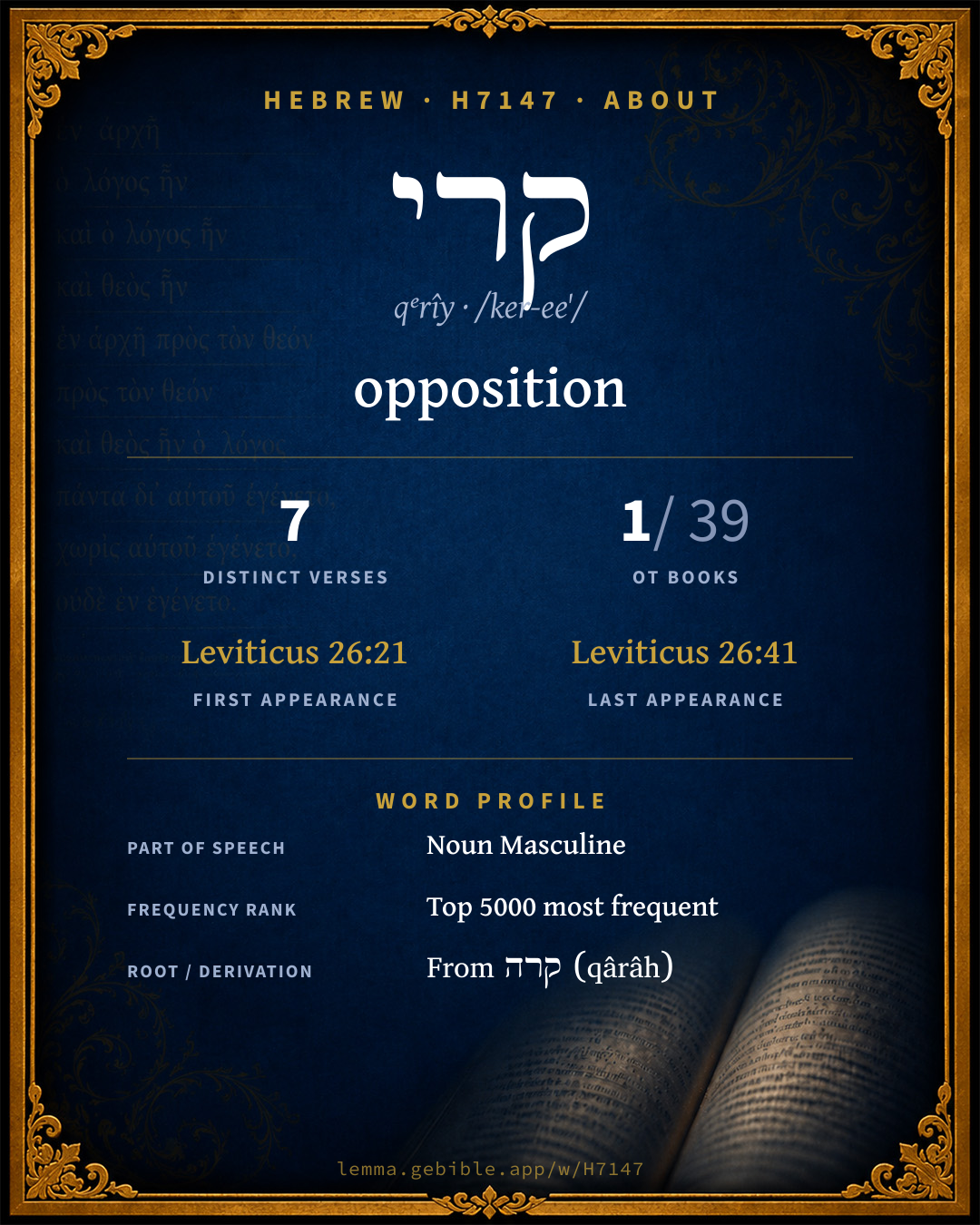
קְרִי
opposition
Full lexicon entry — Brown-Driver-Briggs (BDB)
From Brown-Driver-Briggs (BDB)
Where this word appears
Grammar key — what these labels mean
Part of speech
- Noun
- A naming word — a person, place, thing, or idea.
Noun type
- Common
- A common noun — a general class of person, place, or thing (“king,” “city,” “water”), not a specific name.
State
- Absolute
- The independent form of a noun, not bound to a following word.
Gender
- Masculine
- Grammatically masculine.
Number
- Singular
- One.
Every verse where H7147 appears — 7 distinct verses across 1 book. Click any verse to open its interlinear word-by-word view. Verse text shown in the World English Bible for context — . Each verse’s Hebrew form is shown with its reference; the English is not keyword-highlighted, since the data carries no word-level English alignment. Use “Compare translations” on any verse to read it across multiple English versions. This concordance covers the Hebrew Bible; Septuagint (Greek Old Testament) occurrences are not indexed here.
Leviticus 7 verses
- Leviticus 26:21 קֶ֔רִי n c ms "'If you walk contrary to me, and won't listen to me, then I will bring seven times more plagues on you according to your sins.
- Leviticus 26:23 קֶֽרִי n c ms "'If by these things you won't be reformed to me, but will walk contrary to me;
- Leviticus 26:24 בְּ/קֶ֑רִי prep + n c ms then I will also walk contrary to you; and I will strike you, even I, seven times for your sins.
- Leviticus 26:27 בְּ/קֶֽרִי prep + n c ms "'If you in spite of this won't listen to me, but walk contrary to me;
- Leviticus 26:28 קֶ֑רִי n c ms then I will walk contrary to you in wrath; and I also will chastise you seven times for your sins.
- Leviticus 26:40 בְּ/קֶֽרִי prep + n c ms "'If they confess their iniquity, and the iniquity of their fathers, in their trespass which they trespassed against me, and also that, because they walked contrary to me,
- Leviticus 26:41 בְּ/קֶ֔רִי prep + n c ms I also walked contrary to them, and brought them into the land of their enemies: if then their uncircumcised heart is humbled, and they then accept the punishment of their iniquity;
About this entry
At a glance — auto-summarized from this page’s data, not written by a person. Every figure links to its source below. This summary describes the numbers; it doesn’t interpret them.
The Hebrew noun קרי centers on the idea of “opposition.” The word gravitates to Leviticus (100%). It appears 7 verses across 1 book of the Hebrew Bible, among its uncommon vocabulary. Its earliest occurrence is Leviticus 26:21. Older and newer Bibles part ways — “contrary” in the King James Version, “hostility” (Berean Standard Bible) in modern versions. See the renderings breakdown. For the data behind this summary, explore the sense tree and the renderings breakdown below.
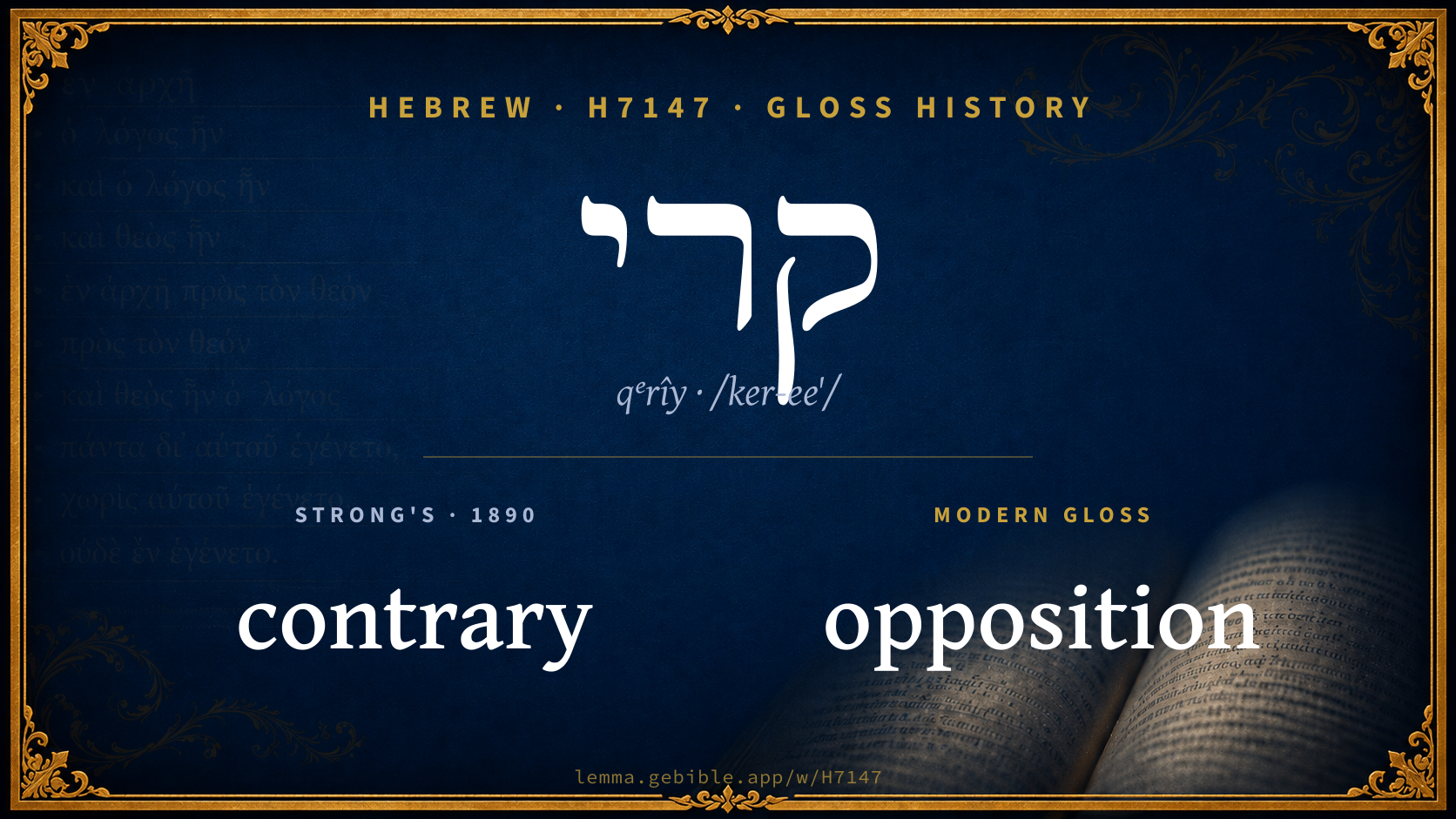
Gloss history
Strong's 1890 vs modern scholarship
About this word
Strong's H7147 catalogs a Hebrew word from the Hebrew Old Testament.
These counts are not copied from any lexicon or concordance. They are computed here, from the morphology-tagged Hebrew Old Testament. What Lemma adds →
- 7
- distinct verses
- The word appears in 7 distinct verses.
- 1 / 39
- OT books
- The word appears in 1 of 39 Old Testament books.
- #2,835
- by frequency
- Top 5000 most frequent Hebrew words (rank 2,835 of 8,640 Hebrew words by occurrence).
View all 7 occurrences in the concordance →
Most concentrated in
- Leviticus 7 verses 100%
By section of the Old Testament
By traditional corpus
Conventional, traditional groupings — biblical authorship is debated, so this is a traditional corpus grouping, not an authorship claim. Each share is this word’s portion of its verses in that division of the Hebrew canon. Each figure is a share of the word’s 7 distinct verses.
- Torah (Pentateuch) 7 verses · 100%
How translations render this word
Counts come from each version’s own published word-to-Strong’s tagging or interlinear alignment — an approximate guide to how each version renders this word, not a word-level alignment the data otherwise carries. Because each total is that version’s own tagged count, the per-version totals vary from one another and need not match the appearance or distinct-verse counts above. These counts may also differ from a printed concordance because Lemma counts each distinctly tagged rendering and does not collapse phrase taggings into a single head-word total. This is a fixed set of word-tagged versions (KJV, ASV, BSB, ULT) and does not change with the reading translation you choose elsewhere. Each version’s license is shown beside its name below (and on Sources).
BDB lists this Strong’s number as 2 distinct words (homographs). Each count above pools all of them and is not split by sense — see the Senses section below. A low-frequency rendering may belong to a different one of those words, not the primary meaning.
- King James Version†: Contrary 7×
- American Standard Version†: Contrary 4×
- Berean Standard Bible†: Hostility 6×
- unfoldingWord Literal Text†: Hostility 7×
King James Version Public Domain
Renders H7147 across 7† tagged occurrences — most commonly:
American Standard Version Public Domain
Renders H7147 across 7† tagged occurrences — most commonly:
Plus 3 renderings that appear only once — usually multi-word phrases or single function words the recovered tagging swept in, not distinct renderings.
Berean Standard Bible Public Domain
Renders H7147 across 7† tagged occurrences — most commonly:
Plus 1 rendering that appears only once — usually multi-word phrases or single function words the recovered tagging swept in, not distinct renderings.
unfoldingWord Literal Text CC BY-SA 4.0
Renders H7147 across 7† tagged occurrences — most commonly:
Senses in BDB
The 1 sense BDB distinguishes for this word, in lexicon order (not ranked by frequency or importance). The full entry — with sub-senses — is in the Lexicon Entry tab.
- opposition, contrariness, encounter, contrary or hostile encounter
Word origin
n.[m.] opposition, contrariness;—only (בְּ)קֶ֑רִי in Lv 26, as adv. modifier of הָלַךְ (in fig. sense), + עִם pers., of Isr.’s relation to י׳: תֵּלְכוּ עִמִּי קֶ֑רִי Lv 26:21 if ye walk with me contrariwise, so v 23, בְּקֶ֑רִי v 27, 40; י׳ subj., וְהָלַכְתִּי עִמָּכֶם בַּקֶּ֑רִי v 24, so v 41 and (בַּחֲמַת ק׳ in wrath of opposition) v 28.
— Brown-Driver-Briggs (Oxford 1906, public domain), digitized via Sefaria, supplemented by the OpenScriptures HebrewLexicon (CC BY 4.0). See Sources.
Derived from קרה (qârâh) (H7136) — to meet.
Jastrow Dictionary
A second Hebrew/Aramaic lexicon for comparison, covering Aramaic and post-biblical (Talmudic, Targumic, Midrashic) usage that the biblical-Hebrew BDB does not. Matched by lemma rather than by Strong’s number, so a lemma may carry more than one Jastrow headword (shown separately below), and the entries cover usage well beyond the Bible.
קרי
- , Pesik. R. s. 22, v. קִירִי.—Yalk. Deut. 946, v. קירִי.
קרי ²
- (b. h.)
- 1. to call, name; to invite. Ber. 7ᵇ מיום שברא … שקְרָאוֹ … וּקְרָאוֹ אדון from the day that the Lord created the world there was no man that called the Holy One, blessed be He, lord, until Abraham came and called him lord (Gen. XV, 2 אדני). Gen. R. s. 56 אברהם קראו יראה Abraham called it (the Temple site) yeraëh (Gen. XXII, 14), שם ק׳ אותו שלם Shem called it Salem (ib. XIV, 18), הריני קוֹרֵא אותו ירושלם I will call it Jerusalem. Snh. 70ᵇ אין … לִקְרוֹא אבא וכ׳ no sooner does a child know to call ‘father’ and ‘mother’, than it tastes grain food. Num. R. s. 15, beg. ק׳ אותו אוהב he invited that friend. Ib. והיה קורא אומניות, v. אוּמָנוּת; a. v. fr.—Part. pass. קָרוּא, קָרוּי; f. קְרוּאָה, קְרוּיָה; Pl. קְרוּאִים, קְרוּאִין, קְרוּיִים, קְרוּיִם, קְרוּיִין, קְרוּיִן; קְרוּאוֹת, קְרוּיוֹת. B. Mets. 114ᵇ, a. e. (ref. to Ez. XXXIV, 31) אתם ק׳ אדם וכ׳ you are called men, but idolaters &c. Sifra Aḥăré, end כל העריות ק׳ טומאה all illicit connections are called uncleanness; a. fr.—Esp. קְרוּאִים, קְרוּיִין those called up to read from the Torah (v. infra). Gen. R. s. 70 (ref. to Gen. XXIX, 2) אלו שלשה ק׳ this is typical of the three persons called up to read from the Torah (priest, Levite, and Israelite). Y. Meg. III, 74ᵇ ולא שבעה ק׳ אינון are not seven persons called up (on the Sabbath)?; a. fr.—V. קְרוּיוֹת.—2) to read, recite (esp. from the Scriptures). Yoma I, 6 אם רגיל לִקְרוֹת … קוֹרִין לפניו if he (the high priest) is accustomed to read (the Scriptures), he reads himself, if not, they read to him; ובמה קורין לפניו and from what books do they read to him? Ib. פעמים הרבה קָרִיתִי וכ׳ many a time I read to him from Daniel. Meg. II, 1 הקורא את המגילה וכ׳, v. מִפְרֵעַ. Ib. 2 קְרָאָהּ סירוגין, v. סֵירוּג. Ib. 3 קורא כמקומו he must read in accordance with the usage of the place he came from. Ib. 4 הכל כשרין לִקְרוֹת וכ׳ all persons are qualified to recite the Book of Esther (before the congregation). Y. Meg. IV, 74ᵈ bot. וקְרָיָיהּ and read from it; a. fr.—Esp. to read from the Torah at public services. Ib. III, 4 קורין בפרשת שקלים they (those who are called up, v. supra) read the section of Sheḳalim (Ex. XXX, 11-16). Ib. 6 אחד קורא את כולן one person must read the entire chapter (of the curses). Ib. IV, 1 בשני … קורין שלשה on Mondays … three persons read. Ib. 4 הקורא בתורה לא יפחות וכ׳ he who is designated to read from the Torah must read no less than three verses; לא יִקְרָא למתורגמן וכ׳ he must read to the interpreter one verse at a time, but from the Prophets, three verses. Bicc. I, 1 יש מביאין … וקורין וכ׳ there are those who are bound to bring the first-fruits and to read (Deut. XXVI, 5-10), and those who must bring but not read &c. Ib. 4; a. v. fr.—Esp. (את שמע) ק׳ to recite the Sh’mʿa in the morning and in the evening prayer. Ber. I, 1 לא קָרִינוּ וכ׳ we omitted to read the Sh’mʿa. Ib. II, 3 ק׳ וטעה if one read the Sh’mʿa and made a mistake. Ib. 4 האומנין קוֹרְאִין וכ׳ (Bab. ed. 16ᵃ קורין) workingmen read the Sh’mʿa on top of a tree, or on the scaffolding; a. v. fr.—אל תִּקְרֵי … אלא (or תִּיקְרִי Chald. form; abbrev. א"ת) read not … but—, i.e. change the traditional (Massoretic) reading (for homiletical purposes). Ib. 64ᵃ (ref. to Is. LIV, 13 א"ת בָּנַיִךְ אלא בּוֹנַיִךְ read not banayikh (thy children) but bonayikh (thy builders, the scholars). M. Kat. 9ᵇ (ref. to Ps. XLIX, 12) א"ת קִרְבָּם אלא קִבְרָם read not ḳirbam (their innermost) but ḳibram (their grave); a. fr. e.g. Genesis 15:2
- same, to call, invite. Part. pass. מְקוֹרָא, pl. מְקוֹרָאִים, מְקוֹרָאִין. Num. R. s. 13 יש חתן … למק׳ וכ׳ does a bridegroom give a banquet for the invited guests and not sit with them?; a. e.
- 1. to be called. Lev. R. s. 1, beg. נִקְרְאוּ הנביאים וכ׳, v. בַּיִת. Ex. R. s. 1 (ref. to Ex. II, 13) מכאן … נ׳ רשע from here we learn that when a man lifts up his hand to strike his neighbor, even if he does not strike, he is called a wicked man; Snh. 58ᵇ. Ab. Zar. 19ᵃ (ref. to Ps. I, 2) בתחלה נִקְרֵאת … נקראת וכ׳ first it (the Law) is called the Lord’s, and then his (the student’s); a. fr.— to be read, recited. Meg. I, 1 מגלה נקראת וכ׳ the Book of Esther may be read at public service on the eleventh &c. Ib. IV, 10 מעשה ראובן נ׳ ולא וכ׳ the story of Reuben (Gen. XXXV, 22) is read at public service but not translated. Ib. לא נִקְרָאִין וכ׳ (Y. ed. נִיקְרִין) must be neither read nor interpreted. Tosef. ib. IV (III), 31 יש נקראין ומתרגמין וכ׳ certain verses are read but not interpreted &c.; Meg. 25ᵃ נִקְרִין; a. v. fr. e.g. Exodus 2:13
- to cause to call, to lead in reading. Sot. 10ᵃ sq. (ref. to Gen. XXI, 33) א"ת וַיִּקְרָא אלא וַיַּקְרִיא read not vayiḳra (and he called) but vayaḳri (and he made call), מלמד שה׳ וכ׳ intimating that Abraham caused the name of the Lord to be called by the mouth of every passer-by. Y. ib. V, 20ᶜ top קטן שהוא מַקְרֵא וכ׳ a child that reads the Hallel at school, and they (the class) respond by repeating each sentence (v. עָנָה I); גדול שהוא מקרא וכ׳ an adult that leads in reciting …, when the congregation responds with the first sentence (as refrain). Succ. III, 10 מי שהיה … מַקְרִין אותו וכ׳ if a slave, a woman, or a child reads to him, he responds with Hallelujah. Gitt. III, 1 שמע קול סופרים מקרין וכ׳ heard the teaching scribes as they made the practicing children read, ‘such and such … divorces &c.’—Esp. to teach the Scriptures (מִקְרָא). Lam. R. to I, 6 הַקְרינִי דף אחד … השניני וכ׳ teach me a page of the Scriptures, teach me a chapter of the Mishnah; a. fr.—[Erub. 104ᵇ שהקרו, v. קָרַר I.] e.g. Genesis 21:33
קְרֵי I
- , to call, name, invite; to read. Targ. Gen. XXIX, 34. Targ. I Sam. III, 6. Targ. Gen. II, 19, sq. Targ. Deut. XVII, 19. Targ. Esth. VI, 1; a. v. fr.—Meg. 18ᵇ דקָרוּ ליה וכ׳ when they call him (in his sleep), and he answers. Gen. R. s. 17; Lev. R. s. 34 קְרוּן בשכונתיה וכ׳ they called (begging for alms) in the neighborhood &c. Ber. 13ᵇ מִקְרָא הוא דלא לִיקְרֵי וכ׳ one is not permitted to read the Sh’mʿa (while lying on one’s back), but &c.; מקרא … נמי אסיר to read is forbidden even when turning sideways. Ib. 11ᵇ כתיב רע וקְרִינָן הכל it is written (Is. XLV, 7) ‘and creates evil’, and we read (in the morning prayers) ‘all’! Pes. 3ᵃ קָרוּ נגהי, v. נָגְהָא. Ib. קַרְיֵיה … לנהורא וכ׳ the Lord called the light and appointed it &c. Gen. R. s. 40 הוה קָרֵי עליהין נותן וכ׳ applied to them the verse (Is. XL, 29), he giveth &c. M. Kat. 5ᵇ top, a. fr. ק׳ עליה וכ׳ applied to him the verse &c. Keth. 17ᵃ sq. למאן דקרי ותני וכ׳ (at the funeral) of one that read the Bible and studied Mishnah, but of one that taught others &c. Sabb. 152ᵇ גלית … נביאי לא קְרֵית thou showest that thou hast not even read the Prophets (v. infra). Y. Meg. III, 74ᵇ bot. אילין … מאי דיִקְרִינָן וכ׳ as to the curses (v. אֲרַר), dare one person read them and recite the benediction before and after them? Ex. R. s. 47 למדו … ודקָרִין בלילה learn the Torah from such teachers as get up early and study while it is yet night, v. אִימְּטִין; a. v. fr.—Y. Meg. IV, 75ᵃ bot., a. e. קְרָאיֵי they recite.—Part. pass. קְרִי, קְרִיא; pl. קְרִיָּין the Massoretic reading, opp. כתיב. Treat. Sof’rim ch. IX, 8. Ned. 37ᵇ, v. כְּתִיב; a. fr. e.g. Isaiah 45:7
- (Pa. קָרֵי) to make read, to teach (the Scriptures). Sabb. l. c. דקָרְיָיךְ קהלת לא אַקְרְיָיךְ משלי (Ms. M. דאַקְרְיָיךְ) he that taught thee Koheleth (Ecclesiastes) failed to teach thee Mishlé (Proverbs); Yalk. Gen. 33; Yalk. Ez. 376 דאקרייך. Yeb. 9ᵃ מדמַקְרֵי ליה וכ׳ as R. J. taught his son the interpretation of &c. Koh. R. to III, 14 מקרתה, read: מקרי ליה, v. קַרְיָיא; a. fr.—V. מַקְרֵי.—[Tanḥ. B’resh. 2 ולקרוייה, read: וליַקּוּרֵיה.] e.g. Genesis 2:19
- , אִיקְּרֵי to be called, named; to be called upon, visited. Targ. Esth. III, 12. Ib. IV, 11. Targ. Gen. XVII, 5; a. fr.—Snh. 26ᵇ היכן … דאִיקְּרוּ שָׁתוֹת where do we find that the righteous are called ‘foundations’? Yalk. Ez. 376 אפי׳ … אִיקְּרוּ לך even Prophets have not been taught thee; Yalk. Gen. 133 לא אַקְרוּ they have not taught thee (v. supra); a. fr.
קרי ³
- (b. h.) to join.—Denom. קוֹרָה III.—לִקְרַאת to meet. Sabb. 31ᵃ ויצא לִקְרָאתוֹ and came out to meet him. Ib. 119ᵃ; B. Kam. 32ᵃ top לקראת כלה to meet the bride (the Sabbath); a. fr.
- to meet, join, esp. נִקְרֵי, נִיקְרֵי (denom. of קֶרִי) to lose semen. Gen. R. s. 52; s. 74, a. e. אין הלשון הזה וַיִּקָּר אלא לשון טומאה this expression vayiḳḳar (Num. XXIII, 4) has the meaning of uncleanness (by analogy from Deut. XXIII, 11).—Meg. 15ᵃ; Taan. 5ᵇ. Yeb. 76ᵃ e.g. Numbers 23:4
- same, to have (nocturnal) pollution; to lose semen. Y. Snh. II, 20ᵇ top; Midr. Sam. ch. XXIII (ref. to I Sam. XXV, 20) ותפגש אותם הוּקְרוּ כולן ‘she struck them’ (with her charms), all of them met with &c. e.g. 1 Samuel 25:20
קְרֵי II
- , to join.
- to do something by accident; to happen. Snh. 33ᵃ א׳ ועבד כחד וכ׳ if he happened to act in accordance with the opinion of one of them, when the common usage agrees with the other. Keth. 26ᵃ אִיקְּרוּ ויהבו ליה accidentally they gave it to him.
קרי ⁴
- , Pi. קֵרָה (b. h.)
- 1. (denom. of קוֹרָה, q. v.) to lay beams; to cover.
- 2. (denom. of קִיר I, q. v.) to wall up, close. Ber. 10ᵇ (ref. to II Kings IV, 10) עלייה … וקֵירוּהָ it was an open upper room (a balcony), and they closed it up. M. Kat. I, 4 מְקָרִין את הפירצה וכ׳ you may close up a breach during the festive week. Ib. 7ᵃ כיצד מקרין וכ׳ in what way is it to be done?… With shrubbery or bay-trees. Succ. I, 8 המְקָרֶה סוכתו וכ׳ he who covers his Succah with spits or boards of a bed-side. Lev. R. s. 1 היה מקרה בקורות וכ׳ he covered the building with joists, and wrote the name of the king on them; a. e.—Part. pass. מְקוֹרֶה; f. מְקוֹרָה. Y. Succ. I, 51ᵈ top סוכה מ׳ פסולה a Succah covered with beams is ritually unfit; מבוי מ׳ כשר a covered alley is fit (for Sabbath movements). Y. Naz. IX, 57ᵈ מערה מ׳ a vaulted cave. Sabb. 5ᵃ; a. fr. e.g. 2 Kings 4:10
קְרֵי III
- = קִרְיָיא, town, place. Targ. O. Gen. XLVII, 21 (some ed. קְרִי). Targ. Is. XIX, 2; a. e.—Pl., v. קִרְיָיא
קְרִי
- , part. pass. of קְרי I, q. v.
קְרִי ²
- 1. accident, mishap. R. Hash. 16ᵃ תבואה שאירע בה ק׳ וכ׳ a crop to which an accident happened (an injury from natural causes) or a misfortune (through human agencies). Ib. אדם … ק׳ וכ׳ a man whom a mishap befell or &c.
- 2. (euphem.) nocturnal pollution. Ab. V, 5. Midd. I, 9. Yoma 88ᵃ בעל ק׳ one to whom pollution happened; a. fr.—Pl. קְרָיִין. Ber. 22ᵇ; B. Kam. 82ᵃ (Ms. H. קְרָאִין); Y. Meg. IV, 75ᵃ top; a. e.
A Dictionary of the Targumim, the Talmud Babli and Yerushalmi, and the Midrashic Literature (Marcus Jastrow; London, Luzac, 1903) — Public Domain. Digitized via Sefaria. Digitized via Sefaria. Full attribution on Sources.
Forms in the corpus
The 6 distinct written forms H7147 takes in the Hebrew Bible, most frequent first — each parse links to that state’s occurrences in the concordance. Hebrew forms include their vowel points and cantillation, so a single lemma takes many written forms.
| Form | Parsing | Example | Uses |
|---|---|---|---|
| בְּ/קֶֽרִי | Noun, Common, Masculine, Singular, Absolute | Leviticus 26:27 | 2 |
| בְּ/קֶ֑רִי | Noun, Common, Masculine, Singular, Absolute | Leviticus 26:24 | 1 |
| בְּ/קֶ֔רִי | Noun, Common, Masculine, Singular, Absolute | Leviticus 26:41 | 1 |
| קֶ֑רִי | Noun, Common, Masculine, Singular, Absolute | Leviticus 26:28 | 1 |
| קֶ֔רִי | Noun, Common, Masculine, Singular, Absolute | Leviticus 26:21 | 1 |
| קֶֽרִי | Noun, Common, Masculine, Singular, Absolute | Leviticus 26:23 | 1 |
Same root — word family
Other BDB entries built from the same root as H7147, grouped by Strong’s listed origin. These share a root / origin per the lexicon — not necessarily a shared meaning. Each links to that word’s own entry.
Derives from
Shares the same root
- מקרה miqreh H4745 chance
- מקרה mᵉqâreh H4746 beam work
- קרה qâreh H7137 chance
- קריה qiryâh H7151 city
- קרת qereth H7176 city
Compare all same-root words → Showing 4 of 7 — not the complete family. They share a root, not necessarily a meaning.
Septuagint verse parallels
This word appears in 7 verses that also exist in the Greek Old Testament (Septuagint), out of the 7 Hebrew verses it occurs in. You can read those verses in Greek by switching the Old Testament edition to the Septuagint.
Read these verses in the Septuagint
This is a verse-level parallel only — the same verses exist in both the Hebrew and Greek Old Testaments. No word-level Hebrew↔Greek correspondence is claimed: the data carries no such alignment, so no Greek word is shown as this Hebrew word’s translation. Coverage is not total — the Septuagint omits the deuterocanon and renumbers the Psalms, so some Hebrew verses have no direct Greek parallel.