
Micah 6:10

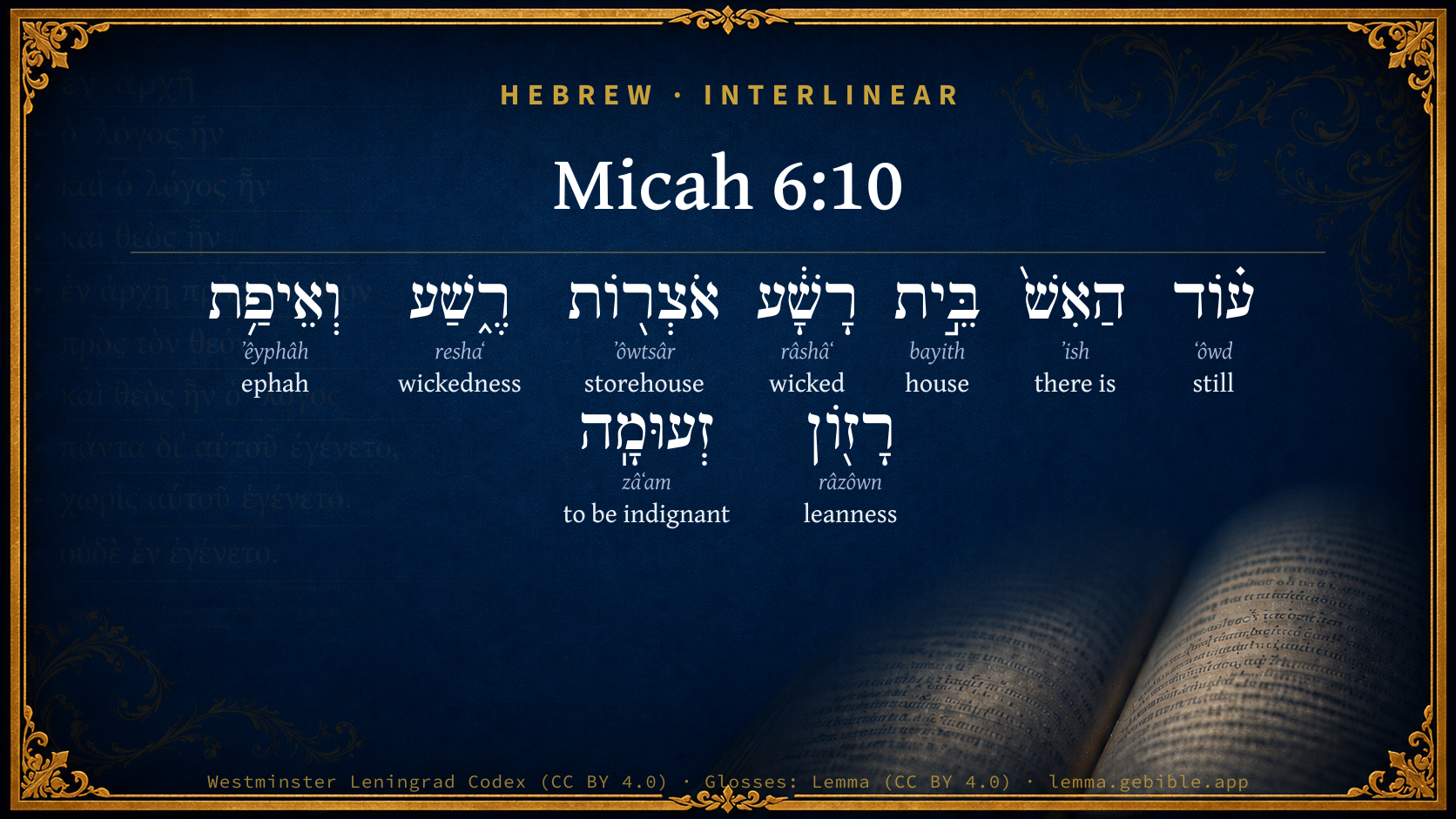
Hebrew (Westminster Leningrad Codex) Micah 6:10 appears in the Hebrew Old Testament. The text above is from the Westminster Leningrad Codex. Each word links to its Strong’s number, a concise gloss, and parsing drawn from the Open Scriptures Hebrew Bible morphology. Click any word for its full Brown-Driver-Briggs (BDB) entry.
Download image
Cite this verse

Micah 6:10 (World English Bible). Public Domain. Lemma interlinear Bible study tool, https://lemma.gebible.app/v/micah/6/10.

Show BibTeX & RIS
BibTeX
RIS
English Translation
Are there yet treasures of wickedness in the house of the wicked, And a short ephah that is accursed?
World English Bible · Public Domain
Download a study sheet

One document with this verse’s original text, its word-by-word gloss line, the meaning frame, cross-references with their text, attributed commentary, and full source and license credits — printable, and it pastes into notes with its structure intact.

This verse Autodidact and up

Study sheet (.html) Plain text (.txt)

A passage Seminary Student

Up to 50 verses in one chapter. A passage sheet keeps up to 6 commentary sources and 12 cross-references per verse, in the order this page ranks them, and says so on the sheet whenever that leaves anything out. Ask for a single verse and you get the Autodidact verse sheet above.

Everything on this page stays free to read, with no account — the sheet is a download of what is already on screen, not access to it.

Want to remove ads? Support Godless Engineer
Compare translations 3

The same verse in 3 English versions, stacked beneath the original-language interlinear above. Click any original word for its lexicon entry.

Each is an independent rendering of the whole verse — the interlinear is not word-aligned to these translations.

Highlighted words mark where these versions differ — a whole-verse word diff, not a word-by-word alignment.

  • World English Bible Public Domain
    Are there yet treasures of wickedness in the house of the wicked, And a short ephah that is accursed?
  • King James Version Public Domain
    Are there yet the treasures of wickedness in the house of the wicked, and the scant measure that is abominable?
  • unfoldingWord Literal Text CC BY-SA 4.0
    Are there still in the house of the wicked treasures of wickedness, and the scant ephah cursed?

unfoldingWord Literal Text — © unfoldingWord, licensed CC BY-SA 4.0. Word-aligned USFM3 via Door43 (git.door43.org/unfoldingWord/en_ult).

Versions to compare (up to 4)

3 of 4 selected

Show all 18 translations

Every available English version of this verse, each an independent rendering of the whole verse.

  • World English Bible Public Domain
    Are there yet treasures of wickedness in the house of the wicked, And a short ephah that is accursed?
  • Berean Standard Bible Public Domain
    Can I forget any longer, O house of the wicked, the treasures of wickedness and the short ephah, which is accursed?
  • Majority Standard Bible Public Domain
    Can I forget any longer, O house of the wicked, the treasures of wickedness and the short ephah, which is accursed?
  • King James Version Public Domain
    Are there yet the treasures of wickedness in the house of the wicked, and the scant measure that is abominable?
  • American Standard Version (1901) Public Domain
    Are there yet treasures of wickedness in the house of the wicked, and a scant measure that is abominable?
  • Revised Version (1885) Public Domain
    Are there yet the treasures of wickedness in the house of the wicked, and the scant measure that is abominable?
  • Geneva Bible (1599) Public Domain
    Are yet the treasures of wickednes in the house of the wicked, and the scant measure, that is abominable?
  • Douay-Rheims (1899) Public Domain
    I will shew thee, O man, what is good, and what the Lord requireth of thee: Verily, to do judgment, and to love mercy, and to walk solicitous with thy God.
  • Young's Literal Translation Public Domain
    Are there yet `in' the house of the wicked Treasures of wickedness, And the abhorred scanty ephah?
  • Literal Standard Version CC BY-SA 4.0
    Are there yet [in] the house of the wicked || Treasures of wickedness, || And the abhorred meager ephah?
  • Unlocked Literal Bible CC BY-SA 4.0
    There is wealth in the houses of the wicked that is dishonest, and false measures that are abominable.
  • unfoldingWord Literal Text CC BY-SA 4.0
    Are there still in the house of the wicked treasures of wickedness, and the scant ephah cursed?
  • Darby Bible Public Domain
    Are there yet treasures of wickedness in the house of the wicked, and the scant measure [which is] abominable?
  • World Messianic Bible Public Domain
    Are there yet treasures of wickedness in the house of the wicked, and a short efah that is accursed?
  • Webster's Bible Public Domain
    Are there yet the treasures of wickedness in the house of the wicked, and the scant measure that is abominable?
  • Free Bible Version CC BY-SA 4.0
    Are there still ill-gotten gains in the houses of the wicked? Are they still using dishonest measures in selling grain?
  • Bible in Basic English Public Domain
    Am I to let the stores of the evil-doer go out of my memory, and the short measure, which is cursed?
  • JPS Tanakh (1917) Public Domain
    Are there yet the treasures of wickedness in the house of the wicked, and the scant measure that is abominable?

Literal Standard Version (2020), Covenant Press — licensed CC BY-SA 4.0. Text via the HelloAO Bible API (eBible.org). Unlocked Literal Bible (unfoldingWord) — licensed CC BY-SA 4.0. Text via the HelloAO Bible API (eBible.org). unfoldingWord Literal Text — © unfoldingWord, licensed CC BY-SA 4.0. Word-aligned USFM3 via Door43 (git.door43.org/unfoldingWord/en_ult). Free Bible Version, Dr. Jonathan Gallagher — licensed CC BY-SA 4.0. Text via the HelloAO Bible API (eBible.org).

Word by word

More ways to search: Search by grammar → Find every occurrence → Compare this word →

Practice this passage: Drill this verse → Learn its vocabulary →

About this verse

These counts appear in no published source. They are computed here, from the morphology-tagged text and Lemma’s own curated glosses. What Lemma adds →

9
words
9
distinct lemmas
Prophets
section

Notable vocabulary

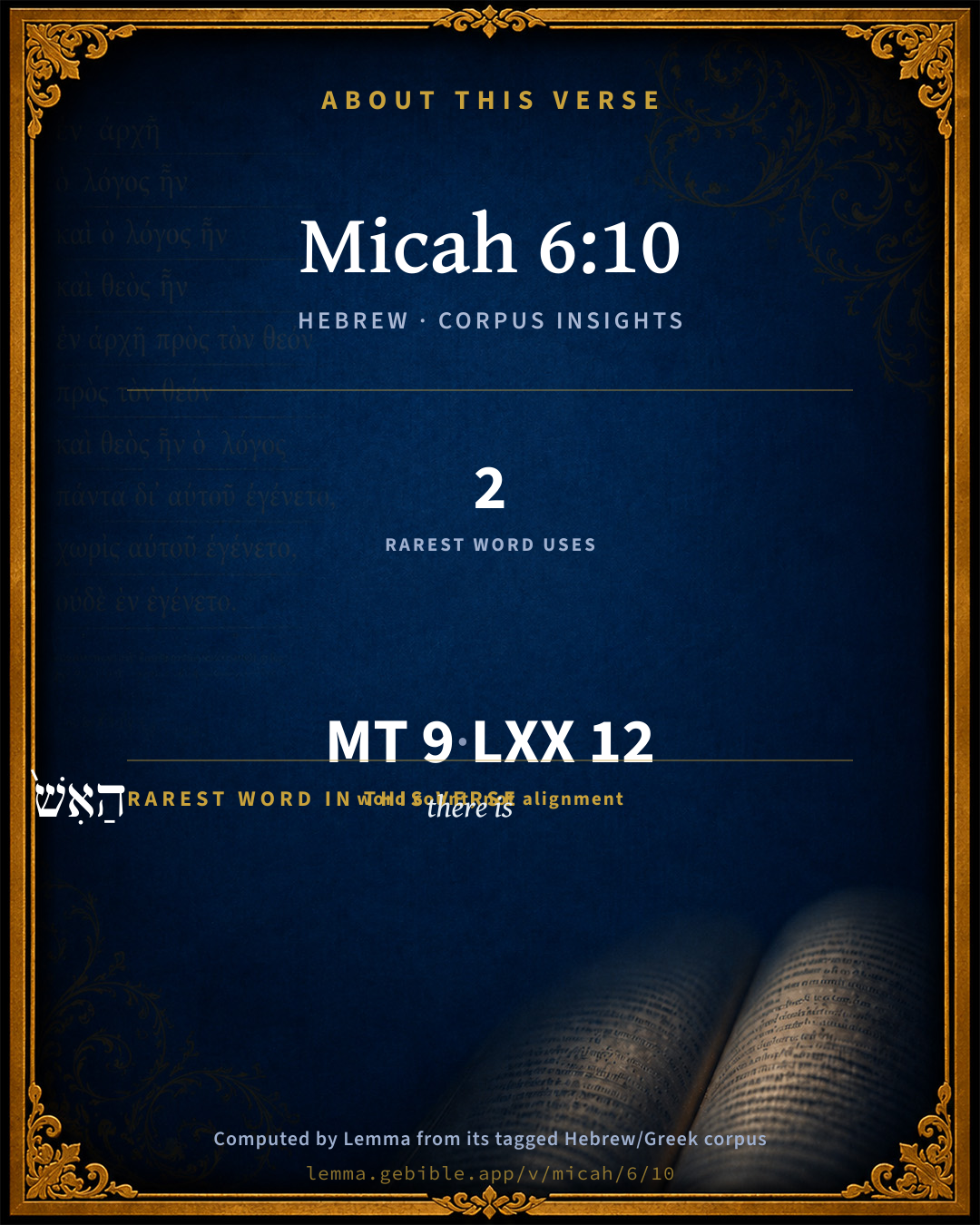
The rarest word here is הַאִשׁ֙ there is H786 — appearing just 2 times in the whole Hebrew Bible.

Shared distinctive vocabulary

הַאִשׁ֙ there is H786 occurs in 2 verses of the Hebrew Bible. Also found in:

Grammatical profile

  • 1 verb
  • 5 nouns
  • 1 adjective
  • 1 adverb
  • 1 particle

Verb forms

  • זְעוּמָֽה Qal · Participle Passive

Hebrew & Septuagint length

In English translation the verse runs 19 words from the Hebrew and 21 from the Septuagint (LXX English) — closely comparable.

A rough comparison of the two English renderings, which tokenize alike — not a word-level alignment.

Word counts can differ between the Hebrew and the Greek without any difference in meaning — e.g. the Hebrew direct-object marker אֵת has no separate Greek word, and Greek often adds the article ὁ.

In the original languages it is 9 Hebrew tokens and 12 Greek tokens — but the two are counted differently (Hebrew bundles its prefixes and suffixes into one token; the Greek is in lemma form), so that isn’t a like-for-like length.

Cross-references

18

Topical passages linked to Micah 6:10 in the Treasury of Scripture Knowledge — connected by theme and wording, ordered by reader-vote popularity; previews shown in the World English Bible.

  • Amos 3:10 "Indeed they don't know to do right," says Yahweh, "Who hoard plunder and loot in their palaces."
  • Proverbs 20:10 Differing weights and differing measures, Both of them alike are an abomination to Yahweh.
  • Proverbs 21:6 Getting treasures by a lying tongue Is a fleeting vapor for those who seek death.
  • Jeremiah 5:26–27 For among my people are found wicked men: they watch, as fowlers lie in wait; they set a trap, they catch men.
  • Amos 8:5–6 Saying, 'When will the new moon be gone, that we may sell grain? And the Sabbath, that we may market wheat, Making the ephah small, and the shekel large, And dealing falsely with balances of deceit;
  • Leviticus 19:35–36 "'You shall do no unrighteousness in judgment, in measures of length, of weight, or of quantity.
  • Deuteronomy 25:13–16 You shall not have in your bag diverse weights, a great and a small.
  • Joshua 7:1 But the children of Israel committed a trespass in the devoted thing; for Achan, the son of Carmi, the son of Zabdi, the son of Zerah, of the tribe of Judah, took of the devoted thing: and the anger of Yahweh was kindled against the children of Israel.
  • 2 Kings 5:23–24 Naaman said, Be pleased to take two talents. He urged him, and bound two talents of silver in two bags, with two changes of clothing, and laid them on two of his servants; and they bore them before him.
  • Proverbs 10:2 Treasures of wickedness profit nothing, But righteousness delivers from death.
  • Proverbs 11:1 A false balance is an abomination to Yahweh, But accurate weights are his delight.
  • Proverbs 20:23 Yahweh detests differing weights, And dishonest scales are not pleasing.
  • Ezekiel 45:9–12 Thus says the Lord Yahweh: Let it suffice you, princes of Israel: remove violence and spoil, and execute justice and righteousness; dispossessing my people, says the Lord Yahweh.
  • Hosea 12:7–8 A merchant has dishonest scales in his hand. He loves to defraud.
  • Habakkuk 2:5–11 Yes, moreover, wine is treacherous. A haughty man who doesn't stay at home, who enlarges his desire as Sheol, and he is like death, and can't be satisfied, but gathers to himself all nations, and heaps to himself all peoples.
  • Zechariah 5:3–4 Then he said to me, "This is the curse that goes out over the surface of the whole land; for everyone who steals shall be cut off according to it on the one side; and everyone who swears falsely shall be cut off according to it on the other side.
  • James 5:1–4 Come now, you rich, weep and howl for your miseries that are coming on you.
  • Zephaniah 1:9 In that day, I will punish all those who leap over the threshold, who fill their master's house with violence and deceit.

Cross-references courtesy of OpenBible.info (CC BY 4.0).

Hebrew and Greek witnesses Masoretic Hebrew ↔ Greek Septuagint

The same verse in the two great witnesses to the Old Testament, shown verse-for-verse.

These are two independent witnesses, not word-aligned to each other, and the Septuagint is shown in lemma (dictionary) form.

Hebrew Micah 6:10 Masoretic · Westminster Leningrad Codex

ע֗וֹד הַאִשׁ֙ בֵּ֣ית רָשָׁ֔ע אֹצְר֖וֹת רֶ֑שַׁע וְאֵיפַ֥ת רָז֖וֹן זְעוּמָֽה

Are there yet treasures of wickedness in the house of the wicked, And a short ephah that is accursed?

World English Bible · Public Domain

Greek LXX Micah 6:10 Septuagint · lemma form

μή πῦρ καί οἶκος ἄνομος θησαυρίζω θησαυρός ἄνομος καί μετά ὕβρις ἀδικία

Is there not fire, and the house of the wicked heaping up wicked treasures, and that with the pride of unrighteousness?

LXX2012 (modern English Septuagint) · Public Domain

On this verse, The Pulpit Commentary discusses the Septuagint’s reading. Read the note in Commentary ↓

Hebrew: Westminster Leningrad Codex (CC BY 4.0). Greek: Septuagint (public domain); English from LXX2012 (modern English Septuagint) (Public Domain). How the Septuagint differs from the Hebrew →

Targum (Aramaic paraphrase)

1

The Targum is the ancient Jewish Aramaic paraphrase of the Hebrew Scriptures — an interpretive translation, not the Hebrew text itself. Onkelos (literal) and Pseudo-Jonathan (expansive) render the Torah, and Jonathan the Prophets. Coverage is partial: where no permissively-licensed English translation exists for a verse, only the Aramaic is shown. This is verse-level text, not a word-by-word alignment to the Hebrew.

  1. Targum Jonathan Prophets (Joshua–Malachi)
    עוֹד הַאִית בֵּית רְשִׁיעָא אוֹצְרִין דִרְשַׁע וּמְכִילַן דִשְׁקַר מַיְתִין לוּט:

    (no public-domain English translation for this verse)

    Targum Jonathan — Aramaic: “Mikraot Gedolot” (public domain). English: “Sefaria Community Translation” (CC0 1.0 (public-domain dedication)); “London "Chaldee Paraphrase," 1871” (public domain). Text via Sefaria.

Commentary

Notes on Micah 6:10 from classic Christian and Jewish commentators (each source and its license shown beneath its notes). The classic Christian expositions comment on the surrounding passage and are grouped to its opening verse, so a note may address several verses; the Jewish commentaries on the Tanakh (Rashi and others) are per-verse, so they appear only where the commentator wrote on this verse.

Lemma curates 59 commentaries, every one of them public domain or Creative Commons licensed, each selected and text-cleaned for this edition rather than reprinted as found. About our sources →

Trapp's Complete Commentary

John Trapp

Mic 6:10 Are there yet the treasures of wickedness in the house of the wicked, and the scant measure [that is] abominable?

Ver. 10. Are there yet the treasures of wickedness] What yet? for all that ever I can say or do to the contrary? Though I cry out unto you by my word (and have set it on with my rod, that it might stick the better), Oh do not this abominable thing! is there yet unto every man a house of the wicked and treasures of wickedness (so some read it)? see Mic 2:2. See Trapp on "Mic 2:2"} The Vulgate reads it (and Gualther disliketh it not), Is there yet fire in the house of the wicked? sc. the fire of God’s wrath? and treasures of wickedness, as fuel cast upon it, to consume all? see Jas 5:1-3. Treasures of wickedness profit not, Pro 10:2, since to heap up sin is to heap up wrath, Rom 2:5, and to rake together ill-gotten goods is to carry home a fardel of plaguey clothes, and death with them. Ephraim said, "Yet I am become rich, I have found me out substance," Hos 12:8. But in so doing, Ephraim fed upon the wind, Mic 6:1, yea, upon pestilential air; he daily increased lies and desolation, that is, such lying vanities as bring desolation and not consolation, desolationem potius quam consolationem (Aug.), as hale hell at the heels of them (as we see in the parable of that wretched rich man, Luk 16:19-31); Animam ipsam incendio gehennae mancipant, the fire that is in them shall feed upon their souls and flesh throughout all eternity. Out of doors, therefore, with these treasures of wickedness, by restoring them to the right owners, as Zaccheus did; and as Justinian the emperor, who would not put the vessels of the temple taken by Titus, and recovered from Gensericus, into the treasury, but restored them.

And the scant measure that is abominable?] Heb. the ephah of leanness, so called, both because it lacks its due proportion ( modius macilentus), and makes men lean, full of wrath; q.d. you scant it to those you trade with, but God fills it up with his fierce wrath and indignation. See Amo 8:5. {See Trapp on "Amo 8:5"}

John Trapp, A Commentary or Exposition upon All the Books of the Old and New Testament (1647–1656) — public domain. Text from a community e-Sword module.

The Biblical Illustrator

Joseph S. Exell

Mic_6:10-11

The scant measure which is abomination

Civic sins

In these verses we have a sample of the crimes which abound in the city, and which would bring on the threatened judgment.

I. Their variety.

1. Here is fraud. Fraud is one of the most prevalent crimes in all cities.

2. Here is violence. The rich men thereof are full of violence. Wealth has a tendency to make men arrogant, haughty, heartless, often inhuman.

3. Here is falsehood. The inhabitants thereof have spoken lies, and their tongue is deceitful in their mouth. There is scarcely a trade or profession carried on without deception. Fortunes are made by lies. Such are samples of the crimes prevalent in Jerusalem.

II. Their retribution. All these crimes are offensive to the Ruler of the universe.

1. Disease. Therefore also will I make thee sick in smiting thee. Crime is inimical to physical health and strength.

2. Desolation. In making thee desolate because of thy sins. A desolate man is one who neither loves nor is loved; and sin produces this state. Few states of mind are more awful or more crushing than the sense of aloneness.

3. Dissatisfaction. Thou shalt eat, but not be satisfied. Sin and satisfaction can never coexist.

4. Disappointment. Thou shalt sow, but thou shalt not reap; thou shalt tread the olives, but thou shalt not anoint thee with oil; and sweet wine, but shalt not drink wine. A sinful soul can never get out of its labour that which it expects.

5. Destruction. Thy casting down shall be in the midst of thee. Conclusion. Mark the law of retribution. Not more certain is it that the rivers follow the ocean, the planets the sun, than that suffering follows sin. (Homilist.)

The Biblical Illustrator, edited by Joseph S. Exell (c. 1880s–1900s) — public domain. Text from a community e-Sword module.

Joseph Benson's Commentary

Mic 6:10-12. Are there yet the treasures of wickedness, &c. — Notwithstanding all the express laws, the exhortations and reproofs given you upon this subject, and so many examples of punishment set before you; still are there many that use unjust and fraudulent means to enrich themselves? who keep scant measures to sell their goods by, which the law of God often declares to be an abomination to him? The reproof is the same with that of Amo 8:5, where see the note. Shall I count them pure with the wicked balances, &c. — Shall I approve or acquit them, as if they were righteous? For the rich men thereof — Namely, of the city, spoken of Mic 6:9; are full of violence — Not only of fraud and injustice, but oppression, tyranny, and cruelty. And the inhabitants have spoken lies — Have gone aside from truth, integrity, and fidelity, and have deceived each other by falsehood.

Joseph Benson's Commentary on the Old and New Testaments (1811–1818) — public domain. Text from a community e-Sword module.

The Preacher's Complete Homiletical Commentary

Joseph S. Exell (gen. ed.)

CRITICAL NOTES.]

Mic_6:10. Yet] notwithstanding warnings, treasures acquired by fraud and oppression. Scant] Lit. lean ephah, the measure forbidden (too small), not the right measure (Deu_25:16; Deu_25:16; Lev_19:36). Abom.] Smitten by God (Pro_22:14); cursed (Num_23:7; Pro_24:24).

Mic_6:11. Pure] Men dream that they can be clean by sacrifices to God, in spite of daily sins. The prophet destroys this hope, reproves the rich for violence and the people for deceit. Bag] In which money and weights were carried (Deu_25:13; Pro_16:11).

COMMERCIAL IMMORALITY.—Mic_6:10-12

Here we have a special accusation of sins which procure the rod. Sins which are common in all ranks and committed after many admonitions. In social intercourse and business transactions covetousness, violence, and deceit prevailed. Riches were sought and acquired by cruel and unlawful means.

I. Fraud in the shops. Trickery has never lacked its representatives in all departments of trade.

1. Dishonest dealings. “Wicked balances, and with the bag of deceitful weights.” Rich sellers gave scant measure and short weight. They cheated and deceived the poor in the necessities of life. The law is violated in the present day. Are grocers, drapers, and corn-merchants always honest in business transactions? Why so many fines for “colouring,” “adulteration,” and fraud? “Ye shall do no unrighteousness in judgment, in mete-yard, in weight, or in measure. Just balances, just weights, a just ephah, and a just hin shall ye have.”

2. Ill-gotten gains. “The treasures of wickedness in the house of the wicked.” Wealth was sought by wickedness. The house was a store-room of vanity, a monument of injustice, and an abomination to God. To heap up wickedness is to treasure up wrath (Rom_2:5). “Treasures of wickedness profit nothing” (Pro_10:2).

II. Oppression in the market-place. “For the rich men thereof are full of violence:” not the poor out of distress, but the rich in covetousness and luxury, lived by violence. Dishonest bargains, hard dealings, and rapacity were daily events. Equity was ignored. Justice, the foundation of the state and the right of the citizen, was openly defied. Commerce was a means of gain, not of mutual help. National injustice was the fundamental sin of commercial life. Rank and power used in violence will crush the possessor. Robbery with authority will bring a curse. “Envy thou not the oppressor (a man of violence, marg.), and choose none of his ways.”

III. Falsehood in the month of the poor. “The inhabitants thereof have spoken lies.”

1. This was a common practice. As often as they speak, in daily intercourse and conversation, “their tongue is deceitful (lit. deceit) in their mouth.” Nothing but deceit, and deceit to ruin others and enrich themselves.

2. This was a universal practice. No exception is made. “A population of liars,” says one. “It cannot be wrong for it is always done,” “It would be impossible to carry on business in any other way,” are pleas to justify the conduct of some in trade. Christianity requires no concealment, no misrepresentation, but strict adherence to truth. No earthly tribunal, no ancient custom, can exempt from eternal justice. An honest man will be guilty of no fraud. “The obligation of an honest man can never die,” said De Foe. “Bread of deceit is sweet to a man; but afterwards his mouth shall be filled with gravel.”

HOMILETIC HINTS AND SUGGESTIONS

Mic_6:10. Treasures of wickedness. I. Illegal in their acquisition. Gained,

1. By dishonest means;

2. In opposition to Divine warning. II. Risky in their position. “In the house of the wicked,” which is exposed to danger and decay. III. Unsatisfactory in their nature. IV. Doomed in their existence. No power or combination of circumstances can keep them from the judgment of God.

Mic_6:11. He also has a false weight who judges not his neighbour with the same measure as himself [Lange]. God requires exact justice in all our dealings, and therefore it is our duty to take care that the weights and the balance be just [Wells]. Impositions; double-dealings; the hard bargain struck with self-complacent shrewdness (Pro_20:14)—this is the false balance forbidden alike by law (Lev_19:35-36), and gospel (Mat_7:12; Php_4:8). Men may “commend its wisdom” (Luk_16:1-8); God not only forbids, but he abominates it (Pro_11:1) [Bridge].

Mic_6:10-12. I. Men are apt to sin even after many admonitions. “Are there yet treasures,” &c. II. Men are apt to dream of God’s approbation in their sinful ways. Hence the challenge, “Shall I count them pure?” III. After they have enriched themselves by sinful ways they grow worse and openly oppress. “Full of violence.” But God is a righteous judge, and will not acquit the guilty (Exo_34:7). As men deal towards their fellow-men, so God deals with them. “Neither will he help the evil-doers” (Job_8:20).

ILLUSTRATIONS TO CHAPTER 6

Mic_6:10-11. Upright simplicity is the deepest wisdom, and perverse craft the merest shallowness [Barrow]. “No man is wise or safe but he that is honest.” An upright posture is easier than a stooping one, because it is more natural, and one part is better supported by another; so it is easier to be an honest man than a knave [Skelton].

Mic_6:12-15. Crafty counsels are joyful in the expectation, difficult in the management, and sad in the event [Tacitus]. “There is no law more just than that the contrivers of destruction should perish by their own acts.” “The deceiver is often ruined by deceit.”

The Preacher's Complete Homiletical Commentary (gen. ed. Joseph S. Exell; Funk & Wagnalls, c. 1892) — public domain (pre-1929). A full-Bible homiletical/sermon-outline anthology covering 65 of 66 books (2 John is absent from the source module). Text from a community e-Sword module.

Keil & Delitzsch

C. F. Keil & F. Delitzsch

The threatening words commence in Mic 6:10; Mic 6:10-12 containing a condemnation of the prevailing sins. Mic 6:10. "Are there yet in the house of the unjust treasures of injustice, and the ephah of consumption, the cursed one? Mic 6:11. Can I be clean with the scale of injustice, and with a purse with stones of deceit? Mic 6:12. That their rich men are full of wickedness, and their inhabitants speak deceit, and their tongue is falseness in their mouth." The reproof is dressed up in the form of a question. In the question in Mic 6:10 the emphasis is laid upon the עוד, which stands for that very reason before the interrogative particle, as in Gen 19:12, the only other place in which this occurs. אשׁ, a softened form for ישׁ, as in Sa2 14:19. Treasures of wickedness are treasures acquired through wickedness or acts of injustice. The meaning of the question is not, Are the unjust treasures not yet removed out of the house, not yet distributed again? but, as Mic 6:10 and Mic 6:11 require, Does the wicked man still bring such treasures into the house? does he still heap up such treasures in his house? The question is affirmative, and the form of a question is chosen to sharpen the conscience, as the unjust men to whom it is addressed cannot deny it. איפת רזון, ephah of consumption or hungriness, analogous to the German expression "a hungry purse," is too small an ephah (cf. Deu 25:14; Amo 8:5); the opposite of א שׁלמה (Deu 25:15) or א צדק (Lev 19:36), which the law prescribed. Hence Micah calls it זעוּמה = זעוּם יהוה in Pro 22:14, that which is smitten by the wrath of God (equivalent to cursed; cf. Num 23:7; Pro 24:24). Whoever has not a full ephah is, according to Deu 25:16, an abomination to the Lord. If these questions show the people that they do not answer to the demands made by the Lord in Mic 6:8, the questions in Mic 6:11 also teach that, with this state of things, they cannot hold themselves guiltless. The speaker inquires, from the standpoint of his own moral consciousness, whether he can be pure, i.e., guiltless, if he uses deceitful scales and weights, - a question to which every one must answer No. It is difficult, however, to decide who the questioner is. As Mic 6:9 announces words of God, and in Mic 6:10 God is speaking, and also in Mic 6:12, Mic 6:13, it appears as though Jehovah must be the questioner here. But אזכּה does not tally with this. Jerome therefore adopts the rendering numquid justificabo stateram impiam; but זכה in the kal has only the meaning to be pure, and even in the piel it is not used in the sense of niqqh, to acquit. This latter fact is sufficient to overthrow the proposal to alter the reading into piel. Moreover, "the context requires the thought that the rich men fancy they can be pure with deceitful weights, and a refutation of this delusive idea" (Caspari). Consequently the prophet only can raise this question, namely as the representative of the moral consciousness; and we must interpret this transition, which is so sudden and abrupt to our ears, by supplying the thought, "Let every one ask himself," Can I, etc. Instead of רשׁע we have the more definite mirmh in the parallel clause. Scales and a bag with stones belong together; 'ăbhanı̄m are the stone weights (cf. Lev 19:36; Deu 25:13) which were carried in a bag (Pro 16:11). In Mic 6:12 the condemnation of injustice is widened still further. Whereas in the first clause the rich men of the capital (the suffix pointing back to עיר in Mic 6:9), who are also to be thought of in Mic 6:10, are expressly mentioned, in the second clause the inhabitants generally are referred to. And whilst the rich are not only charged with injustice or fraud in trade, but with châmâs, violence of every kind, the inhabitants are charged with lying and deceit of the tongue. Leshōnâm (their tongue) is not placed at the head absolutely, in the sense of "As for their tongue, deceit is," etc. Such an emphasis as this is precluded by the fact that the preceding clause, "speaking lies," involves the use of the tongue. Leshōnâm is the simple subject: Their tongue is deceit or falsehood in their mouth; i.e., their tongue is so full of deceit, that it is, so to speak, resolved into it. Both clauses express the thought, that "the inhabitants of Jerusalem are a population of liars and cheats" (Hitzig). The connection in which the verse stands, or the true explanation of אשׁר, has been a matter of dispute. We must reject both the combination of Mic 6:12 and Mic 6:13 ("Because their rich men, etc., therefore I also," etc.), and also the assumption that Mic 6:12 contains the answer to the question in Mic 6:10, and that אשׁר precedes the direct question (Hitzig): the former, because Mic 6:12 obviously forms the conclusion to the reproof, and must be separated from what precedes it; the latter, because the question in Mic 6:11 stands between Mic 6:10 and Mic 6:12, which is closely connected with Mic 6:10, and Mic 6:12 also contains no answer to Mic 6:10, so far as the thought is concerned, even if the latter actually required an answer. We must rather take אשׁר as a relative, as Caspari does, and understand the verse as an exclamation, which the Lord utters in anger over the city: "She, whose rich men are full," etc. "Angry persons generally prefer to speak of those who have excited their wrath, instead of addressing their words to them."

Keil & Delitzsch — Biblical Commentary on the Old Testament (1861–1891) — public domain (CC PDM 1.0). Text via the HelloAO Bible API. (Old Testament only.)

Tyndale Open Study Notes

Tyndale Open Resources

6:10-12 The Lord had specific accusations against his people. They had become a community of deceit that was ripe for rejection and destruction. Falsely acquired wealth, unethical business practices, threats, and violence characterized this supposed people of God (see 2 Kgs 6:25; Hos 12:7-8; Amos 8:5-6). They could not change, because lying was their way of life (cp. Prov 6:16-19). Israel was completely corrupt.

Tyndale Open Study Notes — © Tyndale Open Resources, licensed CC BY-SA 4.0. Text via the HelloAO Bible API.

Jamieson, Fausset & Brown

Robert Jamieson, A. R. Fausset & David Brown

Are there yet--notwithstanding all My warnings. Is there to be no end of acquiring treasures by wickedness? Jehovah is speaking (Mic 6:9).

scant measure . . . abominable-- (Pro 11:1; Amo 8:5).

Jamieson, Fausset & Brown — Commentary Critical and Explanatory on the Whole Bible (1871) — public domain (CC PDM 1.0). Text via the HelloAO Bible API.

Adam Clarke's Commentary

Verse 10. Are there yet the treasures of wickedness] Such as false balances and deceitful weights. See on Ho 12:7. This shows that they were not DOING JUSTLY. They did not give to each his due.

Adam Clarke's Commentary on the Bible (1810–1826) — public domain. Text from a community e-Sword/MySword module.

John Calvin's Commentaries

Interpreters differ as to the word האש, eash: some think that it ought to be read האיש, eaish, with an addition of two letters, and render it, “Is it yet man?” But this would render the passage abrupt. Others translate, “Is there yet fire?” As though it was אש, ash; and they suppose that wealth, wickedly and unjustly got, is so called, because it consumes itself. But as this is against what grammar requires, I am more inclined to take their view, who think that האש, eash, is to be taken here for היש, eish, , aleph being put for jod: and they rightly consider that the sentence is to be read as a question, Are there yet the treasures of wickedness in the house of the ungodly? If this view be approved, then we must consider the Prophet as proposing a question respecting a thing really monstrous, — How can it be that treasures, gathered by plunder and wickedness, still remain with you, since ye have been so often warned, and since God daily urges you to repentance? How great is your hardness, that no fear of God lays hold on your minds? But the meaning would not be unsuitable were we to regard God as a Judge examining them concerning a matter unknown, Are there still the treasures of impiety in the house of the ungodly? that is, “I will see whether the ungodly and wicked hide their treasures:” for God often assumes the character of earthly judges; not that any thing escapes his knowledge, but that we may know that he is not precipitant in deciding a question. This view, then, is by no means inappropriate, that is, that God here assumes the character of an earthly judge, and thus speaks, “I will see whether there are still treasures concealed by the ungodly; I will search their houses; I will know whether they have as yet repented of their crimes.” thus, then, may be understood the words of the Prophet, Are there yet the treasures of wickedness in the house of the ungodly? For God, as I have already said, shows that he would know respecting the plunders and the various kinds of cruelty which they had exercised.

He then adds, Is there the bare measure, that is, a measure less than it ought to be, which is detestable? Then he says,

John Calvin's Commentaries (1540-1563) — public domain. Text from the Calvin Translation Society English edition (1840s-50s) via the Christian Classics Ethereal Library (ccel.org). Calvin's coverage is partial (roughly two-thirds of the Bible); uncommented books and verses are honest gaps, never fabricated. The 19th-century editor's footnotes and remarks are omitted so the notes are faithfully Calvin's own voice.

Ellicott's Commentary for English Readers

(10) The scant measure.—Literally, the hateful ephah of leanness—i.e., less than it should be. The Jews were much addicted to the falsification of weights and measures. They made “the ephah small, and the shekel great, falsifying the balances by deceit” (Amo_8:5).

A Bible Commentary for English Readers, edited by Charles John Ellicott (1878–1897) — public domain. Text from a community e-Sword module.

The Cambridge Bible for Schools and Colleges

gen. ed. J. J. S. Perowne

10. The denunciation is couched in the form of questions, to prick the conscience of the guilty ones.

Are there yet the treasures …] i.e. Does the oppressor go on heaping up unjustly acquired spoil?

the scant measure] A particular measure is referred to, viz. the ephah (about three pecks, dry measure). The sin specified reminds us forcibly of Deuteronomy, where it is forbidden to have in one’s house ‘divers ephahs, a great and a small,’ and ‘a perfect and right ephah’ is prescribed (Deu_24:14-15). Amos, too, Micah’s senior, speaks of those who longed for the expiration of the sabbath, ‘that they might set forth wheat, making the ephah small’ (Amo_8:5).

The Cambridge Bible for Schools and Colleges (gen. ed. J. J. S. Perowne; Cambridge University Press, 1878–1918) — public domain. Text from a community e-Sword module.

John Gill's Exposition

Are there yet the treasures of wickedness the house of the wicked?.... There are; they continue there. This is the voice of the Lord by the prophet, and the language of the rod of correction to be heard, exposing the sins of the people, for which the Lord had a controversy with them; particularly their mammon of unrighteousness, the vast wealth, riches, and treasures, collected together by very wicked and unlawful ways and means; and which, instead of restoring them to the persons they had defrauded of them, they retained them in their houses, notwithstanding the reproofs of the prophets, and the corrections of the Almighty. Some render it, "is there not fire?" &c. (k); that is, in the house of the wicked, because of the treasures of wickedness, that which consumes them; but Gussetius (l) interprets it of fornications and adulteries. Others render it, "is there yet a man?" &c. (m); an honourable man, as Aben Ezra, who continues in his iniquity, after the Lord's voice cries to the city; but Abendana interprets it of the prophet himself, continuing to reprove the wicked for their treasures of wickedness, and their other sins;

and the scant measure that is abominable? or "the ephah of leanness provoking to wrath" (n); that is, a deficient measure, less than it should be; the "ephah" was a dry measure, and it was made small, as in Amo 8:5; and held less than it should; and this brought leanness and poverty upon those to whom they sold by it, as well as ruin upon themselves in the issue; for such practices as they were abominable and detestable to God; they stirred up his wrath, and brought destruction on those that used them. The Targum is,

"false measures that bring a curse.''

(k) , Sept. "adhuc ignis", V. L. So Joseph Kimchi. (l) Ebr. Comment. p. 352. (m) "Adhuc num vir domo", Montanus; "adhuc suntne viro domus improbi", some in Drusius. So R. Sol. Urbin, fol. 37. 2. (n) "et ephah macilentiae indignatio a Deo proventura", Tarnovius; "detestatus Domino", Pagninus; "et ephah maciei abominatione digna", Burkius.

John Gill's Exposition of the Whole Bible (1746–1763) — public domain (CC PDM 1.0). Text via the HelloAO Bible API.

Albert Barnes' Notes on the Bible

Are there yet - Still after all the warnings and long-suffering of God, “the treasures of wickedness in the house of the wicked?” “Treasures of wickedness” are treasures gotten by wickedness; yet it means too that he wicked shall have no treasure, no fruit, but his wickedness. He treasureth up treasures, but of wickedness; as James saith, “Ye have heaped treasure together for the last days” Jam 5:3, that is, of the miseries that shall come upon them James 1. The words stand over against one another; “house of the wicked, treasures of wickedness;” as though the whole house of the wicked was but a “treasure-house of wickedness.” Therein it began; therein and in its rewards it shall end. “Are there yet?” the prophet asks. There shall soon cease to be. The treasure shall be spoiled; the iniquity alone shall remain.

And the scant ephah - (Literally, “ephah of leanness” the English margin) which is abominable? Scant itself, and, by the just judgment of God, producing scantness, emaciated and emaciating (See Mic 6:14); as He says, “He gave them their desire, and sent leanness withal into their soul” Psa 106:15; and James, “it shall eat your flesh as it were fire” Jam 5:3. Even a pagan said, , “Gain gotten by wickedness is loss;” and that, as being “abominable” or “accursed” or, one might say, “bewrathed,” lying under the wrath and curse of God. Rib.: “What they minish from the measure, that they add to the wrath of God and the vengeance which shall come upon them; what is lacking to the measure shall be supplied out of the wrath of God.” The Ephah was a corn-measure Amo 8:5, containing about six bushels; the rich, in whose house it was, were the sellers; they were the necessaries of life then, which the rich retailers of corn were selling dishonestly, at the price of the lives of the poor . Our subtler ways of sin cheat ourselves, not God. In what ways do not competitive employers use the scant measure which is accursed? What else is all our competitive trade, our cheapness, our wealth, but scant measure to the poor, making their wages lean, full and overflowing with the wrath of God?

Albert Barnes' Notes on the Bible (1834–1885) — public domain. Text from a community e-Sword/MySword module.

Matthew Poole's English Annotations

Are there yet? after so many express laws peremptorily forbidding, so many examples of punishments on such, after so many reproofs, menaces, and exhortations by so many prophets, dare you still do so unjustly?

Treasures of wickedness; gotten by injurious, oppressive courses, ill-gotten wealth; the wickedness wherewith they raked their wealth together is laid up with their wealth, as the like is said, Jam 5:3.

In the house of the wicked: none have thought of restoring their ill-gotten goods; the wicked fathers, who heaped them together, laid them up in their houses, and the children retain them; the house, i.e. family, of these do as their fathers, store up violence, and so do directly contrary to the first rule, Mic 6:1, to do justly.

The scant measure, which is less than standard; see Amo 8:5; by which these unrighteous ones did both offend against God, and cozen their chapmen.

That is abominable; God abhors such injustice, Pro 11:1; 20:10,23; Deu 25:13-16. It is most hateful in his sight.

Matthew Poole's English Annotations on the Holy Bible (1683–1685) — public domain. Text from a community e-Sword/MySword module.

The Pulpit Commentary

The reproof is given in the form of questions, in order to rouse the sleeping conscience of the people. Are there yet the treasures of wickedness in the house of the wicked? Do the wicked still continue to bring into their houses treasures obtained by wrong? The old versions compare this ill-gotten wealth to a fire which shall consume the homes of its possessors. Septuagint, Mh pur kai oikov anomou yhsaurizw yhsauroumouv ; "Is there fire and the house of the wicked treasuring up wicked treasures?" Vulgate, Adhuc ignis in domo impii thesauri iniquitatis? So the Syriac; the Chaldee keeps to the Masoretic reading. The scant measure; literally, the ephah of leanness. The ephah was about three pecks. According to Josephus ("Ant.," 15:9. 2), it contained one Attic medimnus, which would be nearly a bushel and a half. Fraudulent weights and measures are often denounced. (Lev_19:35, etc.; Deu_25:14, etc.; Pro_20:10, 23 Amo_8:5) Vulgate, Mensura minor irae plena, where the Hebrew has, that is abominable. Such frauds are hateful to God, and are marked with his wrath.

Vers. 10-12. "Weighed in the balances, and found wanting.

Having expounded the nature of true piety, the prophet, proceeds in these verses to apply the principles thus enunciated to the case of his people, endeavouring by means of searching inquiries to bring home to their hearts a sense of their guilt and depravity.

I WE HAVE HERE AN ILLUSTRATIVE EXAMPLE OF HUMAN CONDUCT WHEN TESTED BY THE DIVINE REQUIREMENTS BEING FOUND WANTING. Notice in this case:

1. Dishonesty in trade as opposed to doing justly. " Rectitude in all the transactions of life was repeatedly insisted upon in the Law of God as given by Moses. (Lev_19:35, 36 Deu_25:14, Deu_25:15) Disregard of this requirement was an indictment constantly brought against the Jewish people by their faithful seers. (Amo_8:4-6 Eze_45:9, 10 Hos_12:7, Hos_12:8) To be engaged in trade has been regarded by some as a badge of social inferiority. No right-minded man could speak or even think thus. All honest trades are honourable. None need be ashamed of their callings because these belong to the shop and the mart. The dishonour lies in fraud, trickery, deceit, and sharp practice; but let all these be eschewed, and the principles of uprightness and honour prevail, and the humblest trade, conducted on these lines, is thereby ennobled. "Royalty in her robes of state is not so majestic as Commerce clothed in spotless integrity and commanding unlimited confidence. Victory, raising her trophies from the spoils of a conquered army, is not so glorious as Commerce, patiently and perseveringly, slowly but surely, gaining its end by scorning and disdaining the arts which promise a speedy but treacherous elevation" (Dr. Robert Halley).

2. Oppression and violence as opposed to "loving mercy" (ver. 12). Men, making haste to be rich, fall into many hurtful snares, (1Ti_6:9) and one of these is that of oppressing those less favoured than themselves. They become hard, and are led to take undue advantage of those who are needy and who can in any way be made tributary to their interests. Provision against this was made in the Law of Moses. (Deu_24:10-22) This provision of that Divine law, which so marvellously met every circumstance and condition of life, the prophet charged his people with disregarding. "The rich men thereof are full of violence". (ver. 12; Isa_1:23 Isa_5:7 Amo_5:11 Mal_3:5) The love of mercy was sacrificed to the love of gain. Man, consumed by lust of wealth, used his fellow men as mere steppingstones, trampling them beneath his feet.

3. Degeneration in speech as altogether incompatible with walking humbly with God?"(Ver. 12.) Very glorious is the power of utterance, the ability to give audible expression, with clearness and perspicuity, to the thoughts which may be filling our minds and stirring our very souls. "And when she spake Sweet words, like dropping honey, she did shed: And "twixt the pearls and rubies softly brake A silver sound that heavenly music seemed to make. (Spenser"s "Faery Queene.")

Speech is a very sure index to character. "Out of thine own mouth will I judge thee". (Luk_19:22) "A bell may have a crack, and you may not see it, but take the cropper and strike it, and you"ll soon perceive that it is flawed." Degradation is stamped, not only upon the physical form of savage tribes, but also upon the very language they employ. When, as the result of a long course of transgression or of prolonged banishment from civilization, noble thoughts and high spiritual conceptions have dropped away from them, there has attended this the loss even of the very words by which these thoughts and conceptions are expressed, so that the language of such people has become woefully impoverished. Clearly, then, would we have our speech right, we must get our hearts right. "The weights and wheels are in the heart, and the clock strikes according to their motion. Truth in the inward parts is the certain cure for all evil in the tongue." The prevailing degeneracy over which this seer so deeply mourned is indicated in his words, "The inhabitants thereof have spoken lies, and their tongue is deceitful in their mouth" (ver. 12). And, this being the case, they were utterly unfitted for complying with the requirement that they should walk humbly "with their God;" for only "the pure in heart" can have fellowship with him. "Weighed" thus "in the balances" of the requirements of God"s pure Law, they were "found wanting.

II ALTHOUGH DIFFERING IN DEGREE, YET IT IS TRUE UNIVERSALLY THAT HUMAN CONDUCT, PROVED THUS, WILL NOT STAND THE TEST. God"s Law is "holy, just, and true," and man is by nature and practice so sinful that, judged by that high standard, "every mouth must be stopped, and the whole world appear guilty before God". (Rom_3:19)

III THE CONSCIOUSNESS OF THIS SHOULD LEAD US TO WELCOME THE CHRIST OF GOD, WHOSE ADVENT THIS PROPHET PREDICTED, AND TO REJOICE IN HIS WORK ON OUR BEHALF. We cannot meet God on the ground of obedience to his pure Law. If we take that stand, then he righteously and imperatively requires that the whole Law be kept; and this is impossible to us, since even if we were capable of perfect obedience in the future, this would not atone for the failures of the past. The true meeting place is not Sinai, but Calvary. (2Ti_1:9 Rom_3:20-26)

Vers. 10-15. Civic sins.

"Are there yet the treasures of wickedness in the house of the wicked, and the scant measure that is abominable? Shall I count them pure with the wicked balances, and with the bag of deceitful weights? For the rich men thereof are full of violence," etc. In these verses we have specified a sample of the crimes which abounded in the city, and which would bring on the threatened judgment. The passage leads us to make two remarks concerning civic sins, or the sins of a city.

I THEIR VARIETY.

1. Here is fraud. "Are there yet the treasures of wickedness in the house of the wicked, and the scant measure that is abominable?" "Are there still in the house of the wicked treasures of wickedness and the scanty ephah?" (Henderson). This sin is described in Amo_8:5, "When will the new moon be gone, that we may sell corn? and the sabbath, that we may set forth wheat, making the ephah small, and the shekel great, and falsifying the balances by deceit?" Fraud is one of the most prevalent crimes in all cities. Perhaps in no city was it ever more prevalent than it is in London today. Our commercial immorality is that at which thoughtful men stand aghast.

2. Here is violence. "The rich men thereof are full of violence." Strong in every age has been the tendency of rich men to oppress the lower classes by unrighteous exactions of service, by oppressive enactments. Wealth has a tendency to make men arrogant, haughty, heartless, often inhuman. The tyrant in man, as a rule, grows with the increase of his wealth.

3. Here is falsehood. "The inhabitants thereof have spoken lies, and their tongue is deceitful in their mouth." Unveracity is a crime, and a crime most prevalent in all cities. There is scarcely a trade or profession carded on without deception. Fortunes are made by lies. Men are everywhere deceiving each other. Such are samples of the crimes prevalent in Jerusalem.

II THEIR RETRIBUTION. All these crimes are offensive to the Ruler of the universe, and by the law of retribution bring dire results upon the population. God says," Shall I count them pure with the wicked balances?" It is said in Psa_18:26 that with the "pure God will show himself pure; but with the froward he will show himself froward," And what are the results? Several are here specified.

1. Disease. "Therefore also will I make thee sick in smiting thee." Crime is inimical to physical health and strength. The diseases that prevail in cities are, in most cases, traceable to their crimes. In every sin there is a germ of physical disease, a something which tends to disturb the nerves, taint the blood, and sap the constitution.

2. Desolation. "In making thee desolate because of thy sins." What is desolation? It is not the mere loss of property, friends, or the external means of physical enjoyment. A man may have all these and yet be desolate. It is the awful sense of lonesomeness desertion. A desolate man is one who neither loves nor is loved; and sin produces this state. Few states of mind are more awful or more crushing than the sense of aloneness.

3. Dissatisfaction. "Thou shalt eat, but not be satisfied." Of whatever a sinful man partakes, however delicious the viands, however choice and costly the provisions, he has no satisfaction of soul. He has in connection with, and in spite of, all a hunger deep, gnawing, unappeasable. Sin and satisfaction can never coexist.

4. Disappointment. "Thou shalt sow, but thou shalt not reap; thou shalt tread the olives, but thou shalt not anoint thee with oil; and sweet wine, but shalt not drink wine." A sinful soul can never get out of its labour that which it expects. He toils hard for enjoyment, but all the tolls are fruitless; enjoyment is not won. The autumn comes, and the fruits are gathered in the wheat, the olives, the sweet wine; but they do not bring him what he has struggled for true enjoyment. He has laboured for that which satisfieth not.

5. Destruction. "Thy casting down shall be in the midst of thee; and thou shalt take hold, but shalt not deliver; and that which thou deliverest will I give up to the sword." Henderson"s translation of this seems to me good: "Thou shalt be inwardly depressed; thou mayest remove, but thou shalt not rescue, or what thou rescuest I will give to the sword.

CONCLUSION. Mark the law of retribution. "Be not deceived; God is not mocked: for whatsoever a man soweth, that shall he also reap;" "Be sure your sin will find you out." Not more certain is it that the rivers flow to the ocean, the planets follow the sun, than that suffering follows sin. Sins brings with it disease, desolation, dissatisfaction, disappointment, destruction. D.T.

The Pulpit Commentary (1880–1919), ed. H.D.M. Spence-Jones & Joseph S. Exell — public domain. Text from a community e-Sword module.

John Wesley's Explanatory Notes

Yet - After so many express laws, and so many examples of punishment. Treasures - Gotten by injurious courses.

John Wesley, Explanatory Notes Upon the Whole Bible (1754–1765) — public domain. Text via the GEBible commentary corpus.

Rashi

Rabbi Shlomo Yitzchaki (Rashi)

Does the house of the wicked last long, [or do] the treasures of wickedness?—The “hey” of הַאִשׁ is vowelized with a “pattach” [not a kamatz] because it denotes a question. And this is its meaning: עוֹד is an expression of longevity. הַאִשׁ is like הֲיֵשׁ, is there. In I Chronicles (2:13) we find: “Ishai the father of David,” instead of “Yishai.” Here, too, is אִשׁ instead of יֵשׁ. And so in II Samuel (14:19): “If anyone can (אִשׁ) turn to the right or to the left.” [This is identical to] “If anyone can (יֵשׁ) turn to the right or to the left.” So did Jonathan render it: Is there. Will it enter your mind that the house of the wicked will last long, and the treasures of wickedness?

And an ephah of leanness is condemned—A small measure with which your wealthy deceive the poor and bring them to leanness - that is condemned by the wrath of the Holy One, blessed be He.

Rashi on the Tanakh — English translations: “The Judaica Press complete Tanach with Rashi, translated by A. J. Rosenberg” (CC BY 4.0); “Pentateuch with Rashi's commentary by M. Rosenbaum and A.M. Silbermann, 1929-1934” (public domain); “The Metsudah Tanach series, Lakewood, N.J” (CC BY 4.0); and “The Book of Joshua, Metsudah Publications, 1997” (CC BY 4.0). Text via Sefaria.

Lesson kit

Teaching starters — assembled from the data on this page, not authored interpretation. Every prompt links to the verse data it draws on. Edit before teaching.

Micah, in the Prophets, opens this verse with 9 words (9 distinct Hebrew lemmas). Its most distinctive word is ʼish (“there is”). A historical commentator’s framing appears above. Read the whole chapter for the surrounding context.

Discussion questions

  1. How does “there is” (ʼish) shape what this verse is saying?
  2. How does 2 Samuel 14:19, which shares the word «there is», read alongside this verse?
  3. These translations render this verse differently; the difference is in the English rendering, not the original. What questions does that raise?
  4. «זְעוּמָֽה» is a Qal Participle Passive verb. How does that grammatical form shape the action described?
  5. Compare how Trapp's Complete Commentary and The Biblical Illustrator read this verse. Where do they agree or differ?

Things to notice

Reading settings

Reading text

Shown beneath each verse's original-language words.

Old Testament
Old Testament edition

Read the OT as the Masoretic Hebrew (MT) or the Greek Septuagint (LXX).

English shown for the Greek Septuagint (in the Hebrew ↔ Greek comparison).

Comparing translations? Open the Compare panel on any verse page to stack up to four side by side.