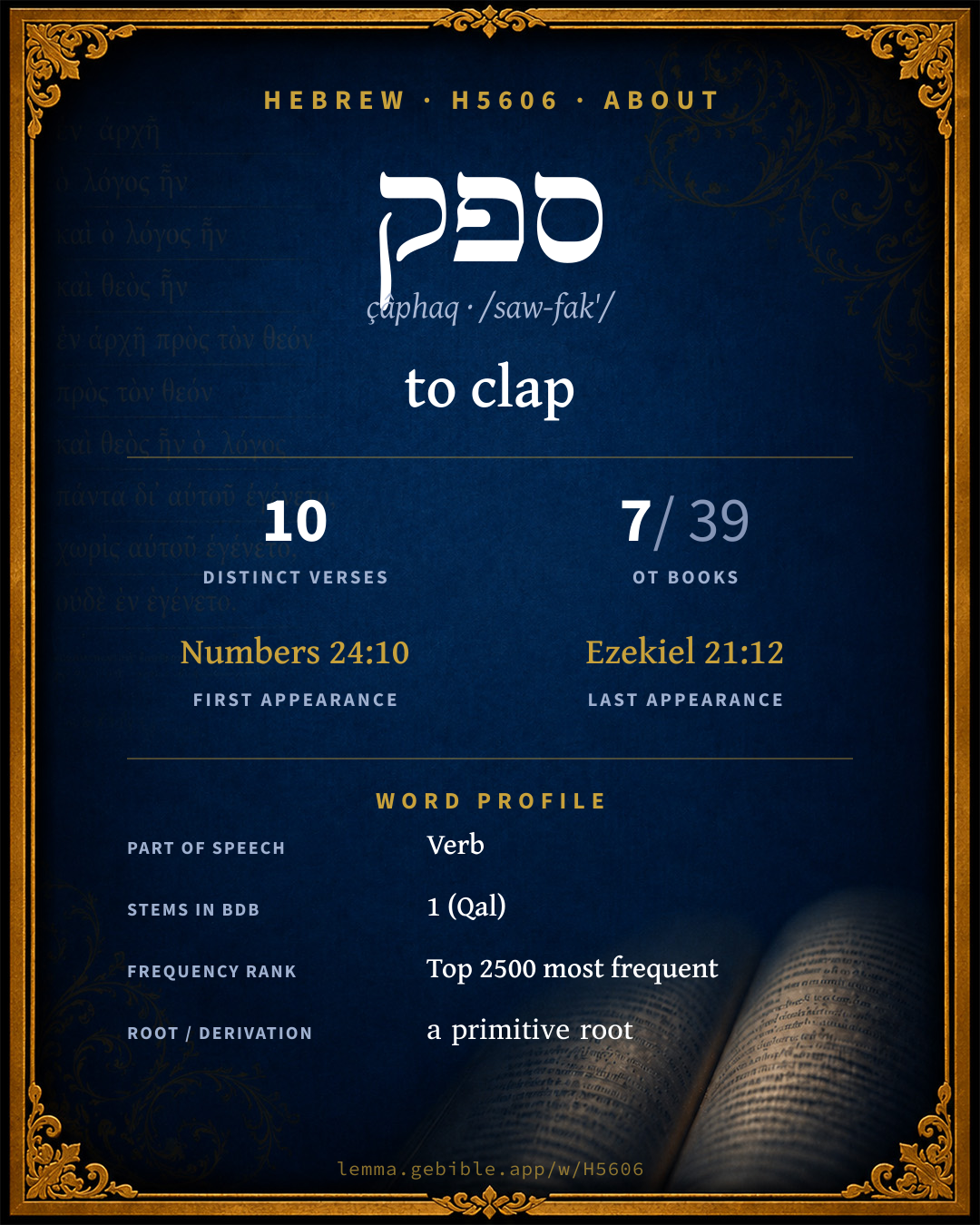
סָפַק
to clap
Full lexicon entry — Brown-Driver-Briggs (BDB)
From Brown-Driver-Briggs (BDB)
Where this word appears
See every Qal verb in the Hebrew Bible →
Grammar key — what these labels mean
Part of speech
- Verb
- An action or state-of-being word.
Stem
- Qal
- The basic, simple active stem — the plain form of the verb (“he wrote”).
- Hiphil
- The causative active stem (“he caused / brought about”).
Form
- Imperfect
- An incomplete, ongoing, or future action (“he will / would write”).
- Sequential Perfect
- A perfect with prefixed waw continuing a preceding imperfect or command (waw-consecutive perfect).
- Sequential Imperfect
- An imperfect with prefixed waw — the standard past-narrative form (waw-consecutive imperfect).
- Perfect
- A completed action or state — Hebrew marks aspect (completeness) more than strict tense (“he wrote”).
- Imperative
- A direct command (“write!”).
Person
- 3rd Person
- The one spoken about (“he / she / it / they”).
- 1st Person
- The speaker (“I / we”).
- 2nd Person
- The one addressed (“you”).
Gender
- Masculine
- Grammatically masculine.
- Common
- Either gender — not distinguished for this form.
Number
- Singular
- One.
- Plural
- More than one (in Hebrew, generally three or more).
Grammatical forms
- Verb, Qal, Imperfect, 3rd Person, Masculine, Singular 3 times (30%)
- Verb, Qal, Sequential Perfect, 3rd Person, Masculine, Singular 1 time (10%)
- Verb, Qal, Sequential Imperfect, 3rd Person, Masculine, Singular 1 time (10%)
- Verb, Hiphil, Imperfect, 3rd Person, Masculine, Plural 1 time (10%)
- Verb, Qal, Perfect, 1st Person, Common, Singular 1 time (10%)
- Verb, Qal, Perfect, 3rd Person, Common, Plural 1 time (10%)
- Verb, Qal, Perfect, 3rd Person, Masculine, Singular 1 time (10%)
- Verb, Qal, Imperative, 2nd Person, Masculine, Singular 1 time (10%)
Parsed forms decoded from the imported morphology (morphhb / Westminster Leningrad Codex — WLC text public domain, morphhb tagging CC BY 4.0), counted across 10 parsed occurrences — not distinct verses.
Every verse where H5606 appears — 10 distinct verses across 7 books. Click any verse to open its interlinear word-by-word view. Verse text shown in the World English Bible for context — . Each verse’s Hebrew form is shown with its reference; the English is not keyword-highlighted, since the data carries no word-level English alignment. Use “Compare translations” on any verse to read it across multiple English versions. This concordance covers the Hebrew Bible; Septuagint (Greek Old Testament) occurrences are not indexed here.
Numbers 1 verse
1 Kings 1 verse
Job 3 verses
- Job 27:23 יִשְׂפֹּ֣ק Qal impf 3ms Men shall clap their hands at him, And shall hiss him out of his place.
- Job 34:26 סְפָקָ֗/ם Qal pf 3ms + sfx pers 3mp He strikes them as wicked men In the open sight of others;
- Job 34:37 יִסְפּ֑וֹק Qal impf 3ms For he adds rebellion to his sin. He claps his hands among us, And multiplies his words against God."
Isaiah 1 verse
Jeremiah 2 verses
- Jeremiah 31:19 סָפַ֖קְתִּי Qal pf 1cs Surely after that I was turned, I repented; and after that I was instructed, I struck on my thigh: I was ashamed, yes, even confounded, because I did bear the reproach of my youth.
- Jeremiah 48:26 וְ/סָפַ֤ק conj + Qal wpf 3ms Make you him drunken; for he magnified himself against Yahweh: and Moab shall wallow in his vomit, and he also shall be in derision.
Lamentations 1 verse
Ezekiel 1 verse
About this entry
At a glance — auto-summarized from this page’s data, not written by a person. Every figure links to its source below. This summary describes the numbers; it doesn’t interpret them.
At its core, ספק (çâphaq) means “to clap.” First canonically at Numbers 24:10, it enters the text early. With 10 verses in 7 books, it is an uncommon word in the Hebrew Bible. Its uses concentrate in Job (30% of all occurrences). From the same root come ספק. Each statement above links to its evidence; the full detail follows below.
Gloss history
Strong's 1890 vs modern scholarship
About this word
Strong's H5606 catalogs a Hebrew word from the Hebrew Old Testament.
These counts are not copied from any lexicon or concordance. They are computed here, from the morphology-tagged Hebrew Old Testament. What Lemma adds →
- 10
- distinct verses
- The word appears in 10 distinct verses.
- 7 / 39
- OT books
- The word appears in 7 of 39 Old Testament books.
- #2,342
- by frequency
- Top 2500 most frequent Hebrew words (rank 2,342 of 8,640 Hebrew words by occurrence).
View all 10 occurrences in the concordance →
By section of the Old Testament
By traditional corpus
Conventional, traditional groupings — biblical authorship is debated, so this is a traditional corpus grouping, not an authorship claim. Each share is this word’s portion of its verses in that division of the Hebrew canon. Each figure is a share of the word’s 10 distinct verses.
- Prophets (Nevi'im) 5 verses · 50%
- Writings (Ketuvim) 4 verses · 40%
- Torah (Pentateuch) 1 verse · 10%
How translations render this word
Counts come from each version’s own published word-to-Strong’s tagging or interlinear alignment — an approximate guide to how each version renders this word, not a word-level alignment the data otherwise carries. Because each total is that version’s own tagged count, the per-version totals vary from one another and need not match the appearance or distinct-verse counts above. These counts may also differ from a printed concordance because Lemma counts each distinctly tagged rendering and does not collapse phrase taggings into a single head-word total. This is a fixed set of word-tagged versions (KJV, ASV, BSB, ULT) and does not change with the reading translation you choose elsewhere. Each version’s license is shown beside its name below (and on Sources).
BDB lists this Strong’s number as 2 distinct words (homographs). Each count above pools all of them and is not split by sense — see the Senses section below. A low-frequency rendering may belong to a different one of those words, not the primary meaning.
- King James Version†: Clap 1×, He clappeth 1×, He smote 1×
- American Standard Version†: Clap 1×, He clappeth 1×, He smote 1×
- Berean Standard Bible†: Clap 1×, Claps 1×, He claps 1×
- unfoldingWord Literal Text†: Clap 1×, Claps 1×, He claps 1×
King James Version Public Domain
Renders H5606 across 11† tagged occurrences — most commonly:
American Standard Version Public Domain
Renders H5606 across 11† tagged occurrences — most commonly:
Berean Standard Bible Public Domain
Renders H5606 across 10† tagged occurrences — most commonly:
unfoldingWord Literal Text CC BY-SA 4.0
Renders H5606 across 8† tagged occurrences — most commonly:
Senses in the full BDB
What do BDB’s symbols mean?
BDB uses these scholarly abbreviations:
| Symbol | Meaning |
|---|---|
| 𝔊 | the Septuagint (the ancient Greek translation, LXX) |
| 𝔙 | the Vulgate (the Latin translation) |
| 𝔖 | the Syriac version (the Peshitta) |
| 𝔗 | the Targum (the Aramaic translation) |
| ψ | the Psalms |
| √ | root (the underlying root or stem) |
| ‖ | parallel passage (a synonymous or contrasted parallel) |
| † | the dagger: every passage where the word occurs is cited |
The 4 senses and sub-senses the full Brown-Driver-Briggs lexicon distinguishes for this word, in lexicon order (not ranked by frequency), with BDB’s own verbatim wording and sub-sense lettering. Shown in Hebrew script with BDB’s own scholarly abbreviations. The condensed entry is in the Lexicon Entry tab. See also the Forms in the corpus table below.
ספק I [I. שָׂפַקִ] vb. slap, clap (NH Pi. id.
- 1. slap, sq. עַל־יָרֵךְ on the thigh, in remorse and sorrow Je 31:19 Ez 21:17; c. כַּפַּיִם clap one’s hands Nu 24:10 (in anger), c. עַל at, La 2:15; Jb 27:23 (in mockery); כ׳ om. Jb 34:37 (in presumptuousness, against God). e.g. Jeremiah 31:19
- 2. slap, chastise, c. acc. pers. Jb 34:26 (subj. God). e.g. Job 34:26
- 3. splash וְס׳ מוֹאָב בְּקִיאוֹ Je 48:26 and Moab shall splash (fall with a splash) into his vomit, > Thes BuhlLex 13 empty himself(?), throw up (cf. Syriac ܣܦܩ Pa.). Hiph. Impf. 3 mpl. וּבְיַלְדֵי נָכְרִים יַשְׂפִּ֫יקוּ Is 2:6 (read perhaps וּבִידֵי Hi Du Che, and into the hands of foreigners they clap, lit. cause to clap, sc. their hands; > 𝔊 𝔖 from ii. שׂפק q.v., they abound in, have a sufficienty of). e.g. Jeremiah 48:26
ספק II suffice (NH סָפַק suffice, abound, so Ecclus 15
Qal
- Impf. 3 ms. יִשְׂפֹּק 1 K 20:10, subj. dust, c. לְ rei. e.g. 1 Kings 20:10
Senses from the full Brown-Driver-Briggs lexicon (Brown, Driver, Briggs; Oxford 1906 — public domain), digitized via Sefaria, supplemented by the OpenScriptures HebrewLexicon (CC BY 4.0). Full attribution on Sources.
Word origin
I. [I. שָׂפַקִ] vb. slap, clap (NH Pi. id.; Arabic سَفَقَ slap (face), strike (hands) Lane 1373);—Qal Pf. 3 ms. וְסָפַק consec. Je 48:26, sf. סְפָקָם Jb 34:26; 1 s. סָפַ֫קְתִּי Je 31:19; 3 pl. סָֽפְקוּ La 2:15; Impf. 3 ms. יִשְׂפֹּק (שׂ subst. for ס) Jb 27:23, יִסְפּוֹק 34:37, הִסְפֹּק Nu 24:10; Imv. ms. סְפֹק Ez 21:17;—
I. vb. suffice (NH סָפַק suffice, abound, so Ecclus 15:18 +; 𝔗 סְפֵיק, סְפַק, Syriac ܣܦܰܩ; Arabic شَفِقَ is be niggardly, scanty, Lane1573);—
— Brown-Driver-Briggs (Oxford 1906, public domain), digitized via Sefaria, supplemented by the OpenScriptures HebrewLexicon (CC BY 4.0). See Sources.
Origin: a primitive root
Jastrow Dictionary
A second Hebrew/Aramaic lexicon for comparison, covering Aramaic and post-biblical (Talmudic, Targumic, Midrashic) usage that the biblical-Hebrew BDB does not. Matched by lemma rather than by Strong’s number, so a lemma may carry more than one Jastrow headword (shown separately below), and the entries cover usage well beyond the Bible.
סָפַק I
- , Pi. סִיפֵּק
- 1. to strike, clap, esp. to clap the hands against the hips to a certain tune in mourning or in rejoicing; cmp. טָפַח I. Bets. V, 2 (36ᵇ) ולא מְסַפְּקִין וכ׳ you must not clap or dance (on the Sabbath or Holy Day). Tosef. Sabb. VI (VII), 2 המְסַפֵּק וכ׳ he who strikes the hip, claps hands or dances by a flame (a superstitious practice); a. e.—V. סִיפּוּק I.
- 2. (cmp. נָקַף, נָקַשׁ) to join closely; to attach; to engraft Y. Sabb. V, beg. 7ᵇ במְסַפֵּק חבל על חבל when he ties a rope to a rope (of the halter). Kil. VI, 9 סִפְּקָהּ בחבל וכ׳ if, in training the vine, he attached to it a rope or a reed (with which he fastened it to a plant). Par. XII, 1 האזוב … מְסַפְּקוֹ וכ׳ if the hyssop is too short, he ties it to a thread &c. Y. Orl. I, 61ᵃ bot. ילדה שסִיפְּקָהּ a young plant (subject to ‘Orlah) which one engrafted on an old tree; a. fr.—V. סִיפּוּק I.
סְפַק
- , to strike, knock. Targ. Job XXXIV, 26 סְפֵיקִינוּן ed. Lag. (ed. Wil. סַפְּקִי׳ Pa.).—Esp. to clap hands. Targ. Lam. II, 15 (ed. Lag. a. oth. שָׂ׳); a. e.—[Targ. Koh. IV, 16 לאסתפקא, read with ed. Lag. לאִסְתַּקָּפָא, v. סְקַף I.]
סָפַק II
- to divide, distribute; to supply;to suffice. Mekh. B’shall., Vayass‘a, s. 1 ולא סָפְקוּ אלא וכ׳ and they supplied water for only seventy date trees; כיון … וספקו להם ושנו וכ׳ when the Israelites came and six hundred thousand men encamped around them, they supplied them (with drinking water), and this a second and a third time.
- to supply, furnish. Ib. s. 6 אם מְסַפֵּק לנו צרכנו וכ׳ (ed. Weiss מַסְפִּיק, Hif.) if he supplies our wants, we shall serve him &c. B. Mets. IX, 1 (103ᵇ) שניהם מְסַפְּקִין את הקנים the two together have to furnish the needed poles. Sot. 11ᵇ היו מְסַפְּקוֹת להם מים ומזון they supplied them with water and food; a. fr.—[Midr. Till. to Ps. XCII לספק לו, v. סְפִיקוּלָא I.]—V. סִיפּוּק II.
- 1. to distribute, supply. Lev. R. s. 4 (ref. to יספוק, Job XXXIV, 37) אתה מַסְפִּיק בנינו וכ׳ thou distributest thy sins among us, i.e. we have to suffer for thy sins; Yalk. Job 920 משתיק (corr. acc.; Var. משְׂפִּיק). Mekh. l. c., v. supra; a. e. e.g. Job 34:37
- 2. (with ביד) to give sufficient time or power; to allow an opportunity. Ab. V, 18 אין מַסְפִּיקִין בידו וכ׳ no time (or opportunity) will be given him to do repentance; Yoma 87ᵃ; Tosef. ib. V (IV), 11. Ib. 10 אין מספיקין בידו וכ׳ he will be given no opportunity (temptation) to sin; a. fr.
- 3. to have sufficient time, power &c.; to succeed, finish. Taan. 21ᵃ לא הִסְפַּקְתִּי לפרוק וכ׳ I had not yet finished unloading when &c. Y. Ber. IX, 14ᵇ bot. לא ה׳ לומר עד וכ׳ he had not yet finished saying Sh’m‘a, when he expired; a. fr.—[Ib. 14ᵃ מספיק למדינה, v. סָפַח.]
- Nithpa. נִסְתַּפֵּק
- 1. to be supplied, to supply one’s self. Pes. 8ᵃ במִסְתַּפֵּק when it is a store-room from which supplies are taken for the table; ib. 8ᵇ. Y. Ab. Zar. V, 44ᵈ bot. אבותיכם היו מִסְתַּפְּקִין משלנו וכ׳ (not בשלנו) your fathers used to buy supplies (of wine) of our fathers, why do you not buy of us? Y. Dem. III, 23ᶜ, a. e. מִסְתַּפֶּקֶת, v. סִידְקִי. Erub. 88ᵃ אדם עשוי להִסְתַּפֵּק סאתים וכ׳ a person usually consumes two S’ah of water a day (from the supply in the cistern &c.); a. fr.—Der. Er. ch. VII ונִסְתַּפְּקוּ they ate and were amply supplied (enjoyed their meal).
- 2. (cmp. סָפֵק) to be doubtful Y. Yeb. XI, end, 12ᵇ נ׳ לו he was in doubt.
סְפַק ²
- 1. to supply, furnish; to give an opportunity. Targ. Y. II, Num. XXIV, 6. Targ. Y. II, Deut. XXVIII, 32.
- 2. to be sufficient; to have enough; to have done. Targ. I Kings XX, 10. Targ. I Chr. XXVII, 24. Targ. O. Gen. XXIV, 19 דִּיסָפְקוּן ed. Berl. (oth. דיסַפְּקוּן, Pa.; Y. די ספְקוּן); a. fr.—[Targ. Lam. II, 11 ספקו בדמען וכ׳ my eyes have done shedding tears; prob. to be read: פסקו; h. text כלו.]
- 1. to distribute, supply. Targ. O. Deut. II, 7 סַפֶּק (ed. Berl. סוֹפֵיק Poël; Y. ed. Vien. סוּפֵיק, read: סוֹ׳). Targ. Hos. II, 7; a. fr.
- 2. to be sufficient. Targ. Jud. XXI, 14. Targ. Num. XI, 22; a. e.—Esp. (with ידא; interch. with Pe.) to be able, afford, Targ. Y. Lev. XIV, 21, sq.; 30, sq.—V. מְסַפְּקָא.
- 3. to divide.—Part. pass. מְסַפַּק, מְסַפְּקָא divided in opinion, doubtful, questionable. Targ. Lam. V, 3 מס׳ להון they are in doubt.—Bets. 4ᵇ ר׳ אסי סַפּוּקֵי מס׳ ליה R. A. was undecided in his opinion. Pes. 117ᵃ אלמא מס׳ ליה which proves that he was undecided; a. fr.—Hence:
- 4. to create a doubt, make doubtful, treat as doubtful. Kidd. 39ᵃ (ref. to doubtful ‘Orlah fruit outside of Palestine) סַפֵּק לי וכ׳ make them doubtful for me (pluck them in my absence), and I shall eat them. Ib. מְסַפְּקוּ סַפּוּקֵי להדדי they made (the fruit) doubtful to one another (by exchanging fruit cut by the one in the absence of the other). Bekh. 49ᵃ מְסַפְּקִינָן ליה we treat it as doubtful.
- to supply. Targ. Hos. XIII, 5. Targ. Deut. II, 7, v. supra.
- 1. same, same, to supply; to be sufficient. Targ. Y. II, Gen. XLIX, 20. Targ. Josh. XVII, 16; a. e.
- 2. to divide, distribute. Targ. Job XXXIV, 37 (v. Lev. R. s. 4, quot. in preced.).
סֵפֶק
- (preced.) sufficiency, v. סְפֵיקָה I, a. סִיפּוּק II.—[Midr. Till. to Ps. LXXXI, 4 ס׳ ידים, v. סַלְפִּינְגָּס.]
סָפֵק
- (preced. wds.)
- 1. division, doubt, opp. וַדַּאי. Ker. IV, 1 ס׳ אכל ס׳ לא אכל if there is a doubt whether or not he has eaten forbidden fat; ס׳ יש בו וכ׳ if there is a doubt whether it was the legally required quantity. B. Bath. 10ᵃ ס׳ מקבלין … ס׳ אין וכ׳ it is uncertain whether it will be accepted from him or not. Ab. Zar. 41ᵃ הוי ס׳ וכ׳, v. וַדַּאי. Y. Bets. I, 60ᵇ bot. סְפֵיקוֹ, סְפֵיקָהּ where there is a doubt about it, v. וַדַּאי. Ib. מאי ס׳ וש שם what is the doubt there? i. fr. what difference does it make in practice?—Yeb. 37ᵇ, a. fr. ממון המוטל בס׳, v. מָמוֹן. Ker. VI, 3 (25ᵃ) המתן עד שתכנס לס׳ (Var. in Talm. ed. לבית הס׳) wait until you arrive at a condition of doubt, i.e. until you are in doubt as to having committed a sin requiring a sacrifice. Ib. 2 כִּפְּרָה סְפֵיקָהּ וכ׳ the heifer has atoned for the doubt for which it has been put to death, and is gone (i.e. at the time of its being thrown down the murderer was unknown); ib. 25ᵃ עדיין לא כיפרה סְפֵיקָתָהּ it had not yet atoned for the doubt for which it was to be put to death; a. v. fr.—Pl. סְפֵיקוֹת, סְפֵק׳ (fem.). Kidd. IV, 3 ואלו הן הס׳ and these are the cases of uncertain parentage. B. Mets. 83ᵇ ס׳ שלכם cases in which you act on doubts (mere suspicion), v. וַדָּאָה. Y. Keth. I, beg. 24ᵈ שתי ס׳ a double doubt, v. next w.; a. e.
- 2. dilemma, difficulty. Cant. R. to VII, 8 למה באו ישראל בס׳ וכ׳ why did the Israelites get into trouble in the days of Haman?
A Dictionary of the Targumim, the Talmud Babli and Yerushalmi, and the Midrashic Literature (Marcus Jastrow; London, Luzac, 1903) — Public Domain. Digitized via Sefaria. Digitized via Sefaria. Full attribution on Sources.
Forms in the corpus
The 10 distinct written forms H5606 takes in the Hebrew Bible, most frequent first — each parse links to that stem’s occurrences in the concordance. Hebrew forms include their vowel points and cantillation, so a single lemma takes many written forms.
| Form | Parsing | Example | Uses |
|---|---|---|---|
| וְ/סָפַ֤ק | Verb, Qal, Sequential Perfect, 3rd Person, Masculine, Singular | Jeremiah 48:26 | 1 |
| וַ/יִּסְפֹּ֖ק | Verb, Qal, Sequential Imperfect, 3rd Person, Masculine, Singular | Numbers 24:10 | 1 |
| יִסְפּ֑וֹק | Verb, Qal, Imperfect, 3rd Person, Masculine, Singular | Job 34:37 | 1 |
| יִשְׂפֹּ֣ק | Verb, Qal, Imperfect, 3rd Person, Masculine, Singular | Job 27:23 | 1 |
| יִשְׂפֹּק֙ | Verb, Qal, Imperfect, 3rd Person, Masculine, Singular | 1 Kings 20:10 | 1 |
| יַשְׂפִּֽיקוּ | Verb, Hiphil, Imperfect, 3rd Person, Masculine, Plural | Isaiah 2:6 | 1 |
| סְפָקָ֗/ם | Verb, Qal, Perfect, 3rd Person, Masculine, Singular | Job 34:26 | 1 |
| סְפֹ֥ק | Verb, Qal, Imperative, 2nd Person, Masculine, Singular | Ezekiel 21:12 | 1 |
| סָֽפְק֨וּ | Verb, Qal, Perfect, 3rd Person, Common, Plural | Lamentations 2:15 | 1 |
| סָפַ֖קְתִּי | Verb, Qal, Perfect, 1st Person, Common, Singular | Jeremiah 31:19 | 1 |
Same root — word family
Other BDB entries built from the same root as H5606, grouped by Strong’s listed origin. These share a root / origin per the lexicon — not necessarily a shared meaning. Each links to that word’s own entry.
Derived from this word
Compare all same-root words → They share a root, not necessarily a meaning.
Septuagint verse parallels
This word appears in 9 verses that also exist in the Greek Old Testament (Septuagint), out of the 10 Hebrew verses it occurs in. You can read those verses in Greek by switching the Old Testament edition to the Septuagint.
Read these verses in the Septuagint
This is a verse-level parallel only — the same verses exist in both the Hebrew and Greek Old Testaments. No word-level Hebrew↔Greek correspondence is claimed: the data carries no such alignment, so no Greek word is shown as this Hebrew word’s translation. Coverage is not total — the Septuagint omits the deuterocanon and renumbers the Psalms, so some Hebrew verses have no direct Greek parallel.